
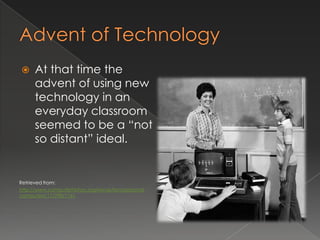

     At that time the
      advent of using new
      technology in an
      everyday classroom
      seemed to be a “not
      so distant” ideal.


Retrieved from:
http://www.computerhistory.org/revolution/personal-
computers/17/298/1161
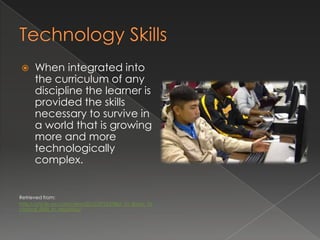
     When integrated into
      the curriculum of any
      discipline the learner is
      provided the skills
      necessary to survive in
      a world that is growing
      more and more
      technologically
      complex.


Retrieved from:
http://article.wn.com/view/2012/07/25/IBM_To_Boost_Te
chnical_Skills_In_Mauritius/
    The integration of
     technology into the
     class room is
     essential to the
     complete education
     of today’s learner.


Retrieved from:
http://manenews.com/
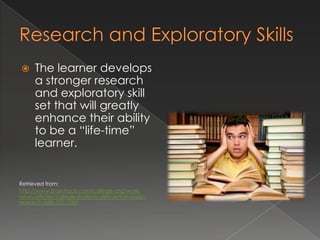
     The learner develops
      a stronger research
      and exploratory skill
      set that will greatly
      enhance their ability
      to be a “life-time”
      learner.


Retrieved from:
http://www.braintrack.com/college-and-work-
news/articles/college-students-deficient-in-basic-
research-skills-10111001
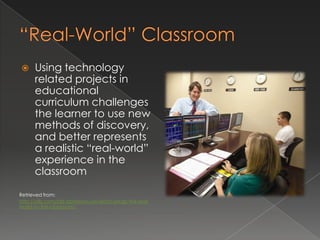
     Using technology
      related projects in
      educational
      curriculum challenges
      the learner to use new
      methods of discovery,
      and better represents
      a realistic “real-world”
      experience in the
      classroom

Retrieved from:
http://yilb.com/old-dominion-university-brings-the-real-
world-to-the-classroom/
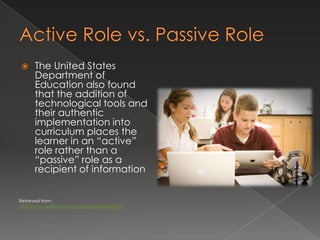
     The United States
      Department of
      Education also found
      that the addition of
      technological tools and
      their authentic
      implementation into
      curriculum places the
      learner in an “active”
      role rather than a
      “passive” role as a
      recipient of information


Retrieved from:
http://www.walsingham.org/page.aspx?pid=751
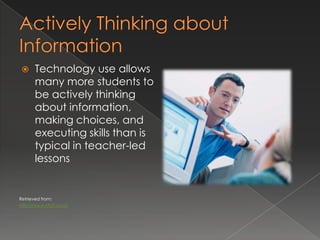
     Technology use allows
      many more students to
      be actively thinking
      about information,
      making choices, and
      executing skills than is
      typical in teacher-led
      lessons


Retrieved from:
http://www.nfcit.com/
     Assessments should
      then be configured
      around the ability of
      the learner to “find”
      correct answers,
      rather than
      “memorize” correct
      answers.


Retrieved from:
http://www.instructables.com/id/How-to-memorize-any-
sheet-music/
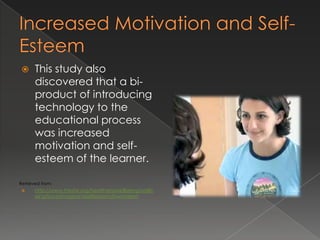
     This study also
       discovered that a bi-
       product of introducing
       technology to the
       educational process
       was increased
       motivation and self-
       esteem of the learner.

Retrieved from:
      http://www.thesite.org/healthandwellbeing/wellb
       eing/bodyimageandselfesteem/lowesteem
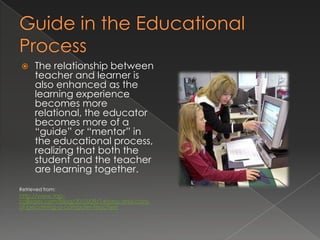
     The relationship between
      teacher and learner is
      also enhanced as the
      learning experience
      becomes more
      relational, the educator
      becomes more of a
      “guide” or “mentor” in
      the educational process,
      realizing that both the
      student and the teacher
      are learning together.
Retrieved from:
http://www.top-
colleges.com/blog/2010/09/14/pros-and-cons-
of-becoming-a-computer-teacher/

Technology in the Classroom

  • 2.
    At that time the advent of using new technology in an everyday classroom seemed to be a “not so distant” ideal. Retrieved from: http://www.computerhistory.org/revolution/personal- computers/17/298/1161
  • 3.
    When integrated into the curriculum of any discipline the learner is provided the skills necessary to survive in a world that is growing more and more technologically complex. Retrieved from: http://article.wn.com/view/2012/07/25/IBM_To_Boost_Te chnical_Skills_In_Mauritius/
  • 4.
    The integration of technology into the class room is essential to the complete education of today’s learner. Retrieved from: http://manenews.com/
  • 5.
    The learner develops a stronger research and exploratory skill set that will greatly enhance their ability to be a “life-time” learner. Retrieved from: http://www.braintrack.com/college-and-work- news/articles/college-students-deficient-in-basic- research-skills-10111001
  • 6.
    Using technology related projects in educational curriculum challenges the learner to use new methods of discovery, and better represents a realistic “real-world” experience in the classroom Retrieved from: http://yilb.com/old-dominion-university-brings-the-real- world-to-the-classroom/
  • 7.
    The United States Department of Education also found that the addition of technological tools and their authentic implementation into curriculum places the learner in an “active” role rather than a “passive” role as a recipient of information Retrieved from: http://www.walsingham.org/page.aspx?pid=751
  • 8.
    Technology use allows many more students to be actively thinking about information, making choices, and executing skills than is typical in teacher-led lessons Retrieved from: http://www.nfcit.com/
  • 9.
    Assessments should then be configured around the ability of the learner to “find” correct answers, rather than “memorize” correct answers. Retrieved from: http://www.instructables.com/id/How-to-memorize-any- sheet-music/
  • 10.
    This study also discovered that a bi- product of introducing technology to the educational process was increased motivation and self- esteem of the learner. Retrieved from:  http://www.thesite.org/healthandwellbeing/wellb eing/bodyimageandselfesteem/lowesteem
  • 11.
    The relationship between teacher and learner is also enhanced as the learning experience becomes more relational, the educator becomes more of a “guide” or “mentor” in the educational process, realizing that both the student and the teacher are learning together. Retrieved from: http://www.top- colleges.com/blog/2010/09/14/pros-and-cons- of-becoming-a-computer-teacher/