QUESTION 4 - TECHOLOGY
How did you use new media technologies
in the construction and research, planning
and evaluation stages?
Kate Bradford
RESEARCH
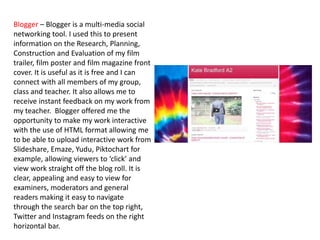
Blogger – Blogger is a multi-media social
networking tool. I used this to present
information on the Research, Planning,
Construction and Evaluation of my film
trailer, film poster and film magazine front
cover. It is useful as it is free and I can
connect with all members of my group,
class and teacher. It also allows me to
receive instant feedback on my work from
my teacher. Blogger offered me the
opportunity to make my work interactive
with the use of HTML format allowing me
to be able to upload interactive work from
Slideshare, Emaze, Yudu, Piktochart for
example, allowing viewers to ‘click’ and
view work straight off the blog roll. It is
clear, appealing and easy to view for
examiners, moderators and general
readers making it easy to navigate
through the search bar on the top right,
Twitter and Instagram feeds on the right
horizontal bar.
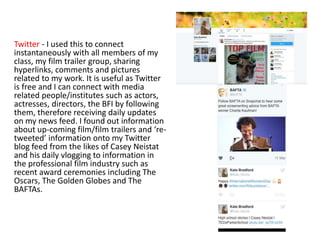
Twitter - I used this to connect
instantaneously with all members of my
class, my film trailer group, sharing
hyperlinks, comments and pictures
related to my work. It is useful as Twitter
is free and I can connect with media
related people/institutes such as actors,
actresses, directors, the BFI by following
them, therefore receiving daily updates
on my news feed. I found out information
about up-coming film/film trailers and ‘re-
tweeted’ information onto my Twitter
blog feed from the likes of Casey Neistat
and his daily vlogging to information in
the professional film industry such as
recent award ceremonies including The
Oscars, The Golden Globes and The
BAFTAs.
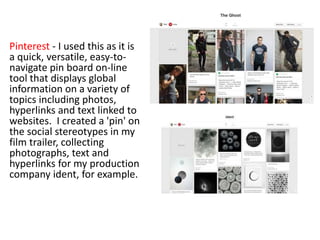
Pinterest - I used this as it is
a quick, versatile, easy-to-
navigate pin board on-line
tool that displays global
information on a variety of
topics including photos,
hyperlinks and text linked to
websites. I created a 'pin' on
the social stereotypes in my
film trailer, collecting
photographs, text and
hyperlinks for my production
company ident, for example.
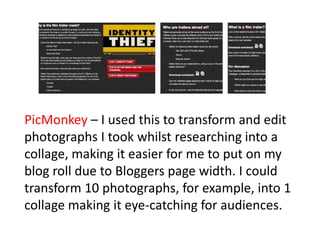
PicMonkey – I used this to transform and edit
photographs I took whilst researching into a
collage, making it easier for me to put on my
blog roll due to Bloggers page width. I could
transform 10 photographs, for example, into 1
collage making it eye-catching for audiences.
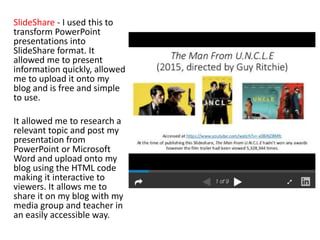
SlideShare - I used this to
transform PowerPoint
presentations into
SlideShare format. It
allowed me to present
information quickly, allowed
me to upload it onto my
blog and is free and simple
to use.
It allowed me to research a
relevant topic and post my
presentation from
PowerPoint or Microsoft
Word and upload onto my
blog using the HTML code
making it interactive to
viewers. It allows me to
share it on my blog with my
media group and teacher in
an easily accessible way.
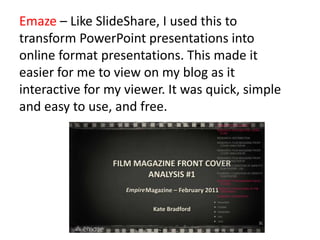
Emaze – Like SlideShare, I used this to
transform PowerPoint presentations into
online format presentations. This made it
easier for me to view on my blog as it
interactive for my viewer. It was quick, simple
and easy to use, and free.
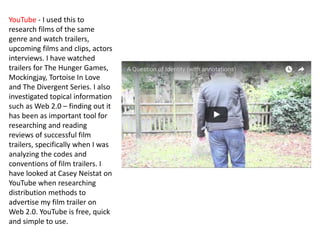
YouTube - I used this to
research films of the same
genre and watch trailers,
upcoming films and clips, actors
interviews. I have watched
trailers for The Hunger Games,
Mockingjay, Tortoise In Love
and The Divergent Series. I also
investigated topical information
such as Web 2.0 – finding out it
has been as important tool for
researching and reading
reviews of successful film
trailers, specifically when I was
analyzing the codes and
conventions of film trailers. I
have looked at Casey Neistat on
YouTube when researching
distribution methods to
advertise my film trailer on
Web 2.0. YouTube is free, quick
and simple to use.
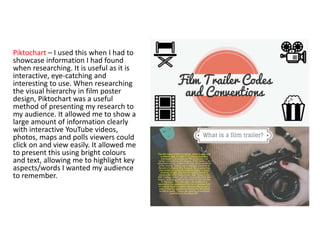
Piktochart – I used this when I had to
showcase information I had found
when researching. It is useful as it is
interactive, eye-catching and
interesting to use. When researching
the visual hierarchy in film poster
design, Piktochart was a useful
method of presenting my research to
my audience. It allowed me to show a
large amount of information clearly
with interactive YouTube videos,
photos, maps and polls viewers could
click on and view easily. It allowed me
to present this using bright colours
and text, allowing me to highlight key
aspects/words I wanted my audience
to remember.
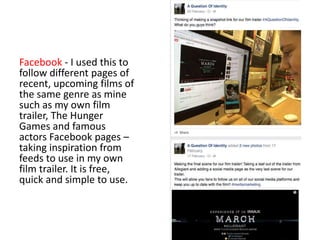
Facebook - I used this to
follow different pages of
recent, upcoming films of
the same genre as mine
such as my own film
trailer, The Hunger
Games and famous
actors Facebook pages –
taking inspiration from
feeds to use in my own
film trailer. It is free,
quick and simple to use.
Online Magazines - I use
MediaMagazine to
learn about the film
industry, such as
distribution ‘Lionsgate:
Can Katniss Everdeen
Save It’. It is useful as it
is specifically targeted
at people in the media
industry, media
students and covers the
media syllabus.
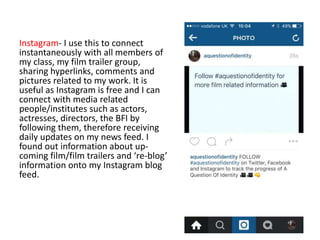
Instagram- I use this to connect
instantaneously with all members of
my class, my film trailer group,
sharing hyperlinks, comments and
pictures related to my work. It is
useful as Instagram is free and I can
connect with media related
people/institutes such as actors,
actresses, directors, the BFI by
following them, therefore receiving
daily updates on my news feed. I
found out information about up-
coming film/film trailers and ‘re-blog’
information onto my Instagram blog
feed.
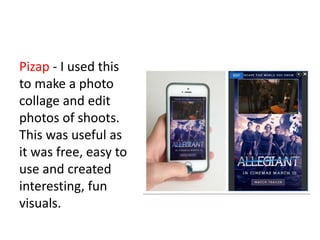
Pizap - I used this
to make a photo
collage and edit
photos of shoots.
This was useful as
it was free, easy to
use and created
interesting, fun
visuals.
PLANNING
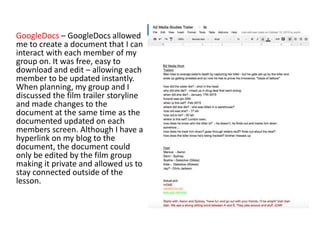
GoogleDocs – GoogleDocs allowed
me to create a document that I can
interact with each member of my
group on. It was free, easy to
download and edit – allowing each
member to be updated instantly.
When planning, my group and I
discussed the film trailer storyline
and made changes to the
document at the same time as the
documented updated on each
members screen. Although I have a
hyperlink on my blog to the
document, the document could
only be edited by the film group
making it private and allowed us to
stay connected outside of the
lesson.
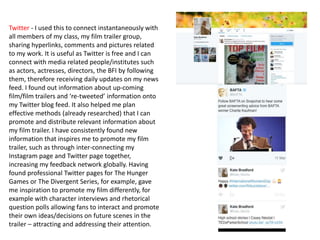
Twitter - I used this to connect instantaneously with
all members of my class, my film trailer group,
sharing hyperlinks, comments and pictures related
to my work. It is useful as Twitter is free and I can
connect with media related people/institutes such
as actors, actresses, directors, the BFI by following
them, therefore receiving daily updates on my news
feed. I found out information about up-coming
film/film trailers and ‘re-tweeted’ information onto
my Twitter blog feed. It also helped me plan
effective methods (already researched) that I can
promote and distribute relevant information about
my film trailer. I have consistently found new
information that inspires me to promote my film
trailer, such as through inter-connecting my
Instagram page and Twitter page together,
increasing my feedback network globally. Having
found professional Twitter pages for The Hunger
Games or The Divergent Series, for example, gave
me inspiration to promote my film differently, for
example with character interviews and rhetorical
question polls allowing fans to interact and promote
their own ideas/decisions on future scenes in the
trailer – attracting and addressing their attention.
Facetime - I use this to
connect instantaneously
with all members of my
film trailer group. It was
useful as it allowed me to
have a face to face
conversation with each
member at the same time.
It is quick and simple to
use.
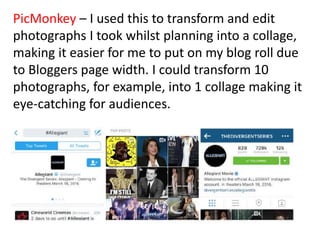
PicMonkey – I used this to transform and edit
photographs I took whilst planning into a collage,
making it easier for me to put on my blog roll due
to Bloggers page width. I could transform 10
photographs, for example, into 1 collage making it
eye-catching for audiences.
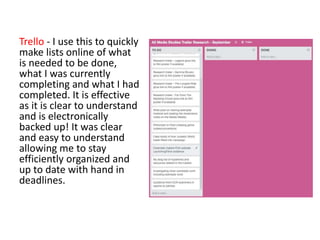
Trello - I use this to quickly
make lists online of what
is needed to be done,
what I was currently
completing and what I had
completed. It is effective
as it is clear to understand
and is electronically
backed up! It was clear
and easy to understand
allowing me to stay
efficiently organized and
up to date with hand in
deadlines.
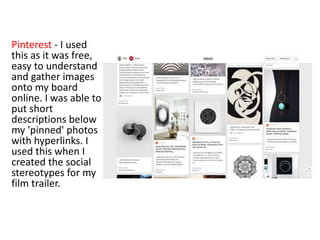
Pinterest - I used
this as it was free,
easy to understand
and gather images
onto my board
online. I was able to
put short
descriptions below
my 'pinned' photos
with hyperlinks. I
used this when I
created the social
stereotypes for my
film trailer.
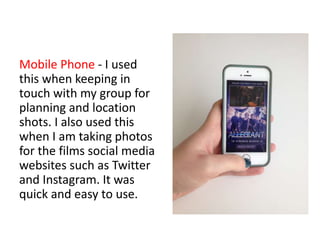
Mobile Phone - I used
this when keeping in
touch with my group for
planning and location
shots. I also used this
when I am taking photos
for the films social media
websites such as Twitter
and Instagram. It was
quick and easy to use.
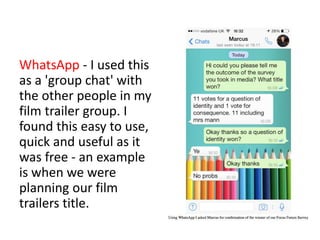
WhatsApp - I used this
as a 'group chat' with
the other people in my
film trailer group. I
found this easy to use,
quick and useful as it
was free - an example
is when we were
planning our film
trailers title.
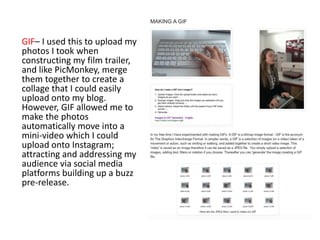
GIF– I used this to upload my
photos I took when
constructing my film trailer,
and like PicMonkey, merge
them together to create a
collage that I could easily
upload onto my blog.
However, GIF allowed me to
make the photos
automatically move into a
mini-video which I could
upload onto Instagram;
attracting and addressing my
audience via social media
platforms building up a buzz
pre-release.
CONSTRUCTION
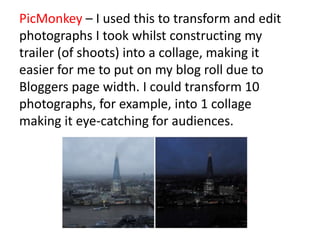
PicMonkey – I used this to transform and edit
photographs I took whilst constructing my
trailer (of shoots) into a collage, making it
easier for me to put on my blog roll due to
Bloggers page width. I could transform 10
photographs, for example, into 1 collage
making it eye-catching for audiences.
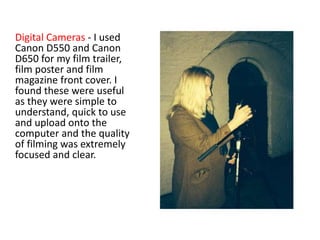
Digital Cameras - I used
Canon D550 and Canon
D650 for my film trailer,
film poster and film
magazine front cover. I
found these were useful
as they were simple to
understand, quick to use
and upload onto the
computer and the quality
of filming was extremely
focused and clear.
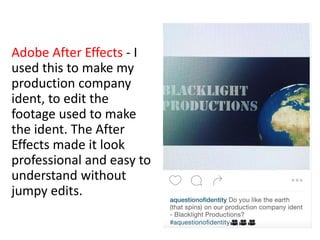
Adobe After Effects - I
used this to make my
production company
ident, to edit the
footage used to make
the ident. The After
Effects made it look
professional and easy to
understand without
jumpy edits.
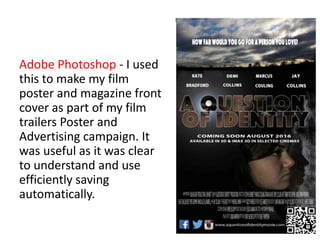
Adobe Photoshop - I used
this to make my film
poster and magazine front
cover as part of my film
trailers Poster and
Advertising campaign. It
was useful as it was clear
to understand and use
efficiently saving
automatically.
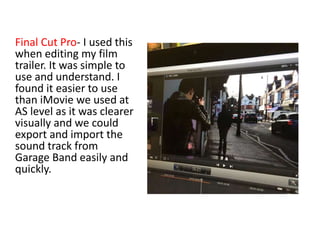
Final Cut Pro- I used this
when editing my film
trailer. It was simple to
use and understand. I
found it easier to use
than iMovie we used at
AS level as it was clearer
visually and we could
export and import the
sound track from
Garage Band easily and
quickly.
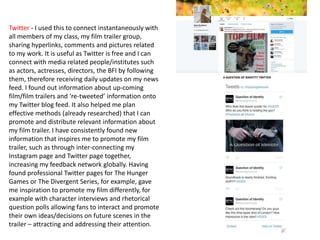
Twitter - I used this to connect instantaneously with
all members of my class, my film trailer group,
sharing hyperlinks, comments and pictures related
to my work. It is useful as Twitter is free and I can
connect with media related people/institutes such
as actors, actresses, directors, the BFI by following
them, therefore receiving daily updates on my news
feed. I found out information about up-coming
film/film trailers and ‘re-tweeted’ information onto
my Twitter blog feed. It also helped me plan
effective methods (already researched) that I can
promote and distribute relevant information about
my film trailer. I have consistently found new
information that inspires me to promote my film
trailer, such as through inter-connecting my
Instagram page and Twitter page together,
increasing my feedback network globally. Having
found professional Twitter pages for The Hunger
Games or The Divergent Series, for example, gave
me inspiration to promote my film differently, for
example with character interviews and rhetorical
question polls allowing fans to interact and promote
their own ideas/decisions on future scenes in the
trailer – attracting and addressing their attention.
Flipagram – I used this to
upload my photos I took when
constructing my film trailer,
and like PicMonkey, merge
them together to create a
collage that I could easily
upload onto my blog.
However, Flipagram allowed
me to make the photos
automatically move into a
mini-video which I could
upload onto Instagram;
attracting and addressing my
audience via social media
platforms building up a buzz
pre-release.
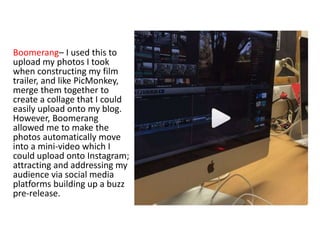
Boomerang– I used this to
upload my photos I took
when constructing my film
trailer, and like PicMonkey,
merge them together to
create a collage that I could
easily upload onto my blog.
However, Boomerang
allowed me to make the
photos automatically move
into a mini-video which I
could upload onto Instagram;
attracting and addressing my
audience via social media
platforms building up a buzz
pre-release.
Garage Band – I used this to
construct my film trailer
soundtrack, merging and
mixing music into our own
style to match the genre of
my film trailer. It was useful
as it allowed my group and I
to quickly edit music and
upload it onto our film
efficiently.
EVALUATION
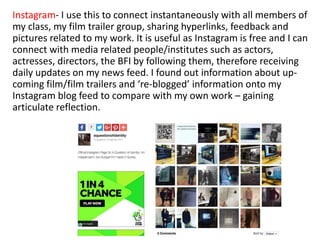
Instagram- I use this to connect instantaneously with all members of
my class, my film trailer group, sharing hyperlinks, feedback and
pictures related to my work. It is useful as Instagram is free and I can
connect with media related people/institutes such as actors,
actresses, directors, the BFI by following them, therefore receiving
daily updates on my news feed. I found out information about up-
coming film/film trailers and ‘re-blogged’ information onto my
Instagram blog feed to compare with my own work – gaining
articulate reflection.
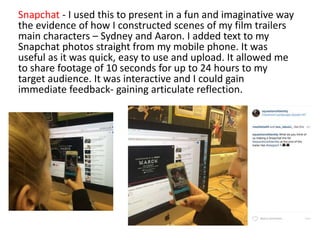
Snapchat - I used this to present in a fun and imaginative way
the evidence of how I constructed scenes of my film trailers
main characters – Sydney and Aaron. I added text to my
Snapchat photos straight from my mobile phone. It was
useful as it was quick, easy to use and upload. It allowed me
to share footage of 10 seconds for up to 24 hours to my
target audience. It was interactive and I could gain
immediate feedback- gaining articulate reflection.
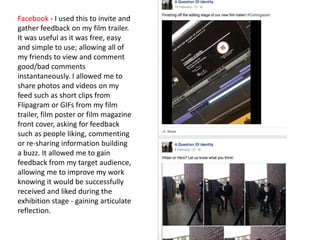
Facebook - I used this to invite and
gather feedback on my film trailer.
It was useful as it was free, easy
and simple to use; allowing all of
my friends to view and comment
good/bad comments
instantaneously. I allowed me to
share photos and videos on my
feed such as short clips from
Flipagram or GIFs from my film
trailer, film poster or film magazine
front cover, asking for feedback
such as people liking, commenting
or re-sharing information building
a buzz. It allowed me to gain
feedback from my target audience,
allowing me to improve my work
knowing it would be successfully
received and liked during the
exhibition stage - gaining articulate
reflection.
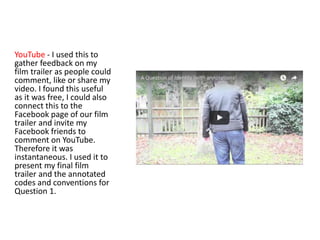
YouTube - I used this to
gather feedback on my
film trailer as people could
comment, like or share my
video. I found this useful
as it was free, I could also
connect this to the
Facebook page of our film
trailer and invite my
Facebook friends to
comment on YouTube.
Therefore it was
instantaneous. I used it to
present my final film
trailer and the annotated
codes and conventions for
Question 1.
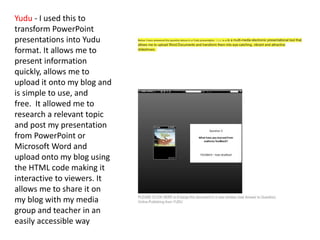
Yudu - I used this to
transform PowerPoint
presentations into Yudu
format. It allows me to
present information
quickly, allows me to
upload it onto my blog and
is simple to use, and
free. It allowed me to
research a relevant topic
and post my presentation
from PowerPoint or
Microsoft Word and
upload onto my blog using
the HTML code making it
interactive to viewers. It
allows me to share it on
my blog with my media
group and teacher in an
easily accessible way

Technology

  • 1.
    QUESTION 4 -TECHOLOGY How did you use new media technologies in the construction and research, planning and evaluation stages? Kate Bradford
  • 2.
  • 3.
    Blogger – Bloggeris a multi-media social networking tool. I used this to present information on the Research, Planning, Construction and Evaluation of my film trailer, film poster and film magazine front cover. It is useful as it is free and I can connect with all members of my group, class and teacher. It also allows me to receive instant feedback on my work from my teacher. Blogger offered me the opportunity to make my work interactive with the use of HTML format allowing me to be able to upload interactive work from Slideshare, Emaze, Yudu, Piktochart for example, allowing viewers to ‘click’ and view work straight off the blog roll. It is clear, appealing and easy to view for examiners, moderators and general readers making it easy to navigate through the search bar on the top right, Twitter and Instagram feeds on the right horizontal bar.
  • 4.
    Twitter - Iused this to connect instantaneously with all members of my class, my film trailer group, sharing hyperlinks, comments and pictures related to my work. It is useful as Twitter is free and I can connect with media related people/institutes such as actors, actresses, directors, the BFI by following them, therefore receiving daily updates on my news feed. I found out information about up-coming film/film trailers and ‘re- tweeted’ information onto my Twitter blog feed from the likes of Casey Neistat and his daily vlogging to information in the professional film industry such as recent award ceremonies including The Oscars, The Golden Globes and The BAFTAs.
  • 5.
    Pinterest - Iused this as it is a quick, versatile, easy-to- navigate pin board on-line tool that displays global information on a variety of topics including photos, hyperlinks and text linked to websites. I created a 'pin' on the social stereotypes in my film trailer, collecting photographs, text and hyperlinks for my production company ident, for example.
  • 6.
    PicMonkey – Iused this to transform and edit photographs I took whilst researching into a collage, making it easier for me to put on my blog roll due to Bloggers page width. I could transform 10 photographs, for example, into 1 collage making it eye-catching for audiences.
  • 7.
    SlideShare - Iused this to transform PowerPoint presentations into SlideShare format. It allowed me to present information quickly, allowed me to upload it onto my blog and is free and simple to use. It allowed me to research a relevant topic and post my presentation from PowerPoint or Microsoft Word and upload onto my blog using the HTML code making it interactive to viewers. It allows me to share it on my blog with my media group and teacher in an easily accessible way.
  • 8.
    Emaze – LikeSlideShare, I used this to transform PowerPoint presentations into online format presentations. This made it easier for me to view on my blog as it interactive for my viewer. It was quick, simple and easy to use, and free.
  • 9.
    YouTube - Iused this to research films of the same genre and watch trailers, upcoming films and clips, actors interviews. I have watched trailers for The Hunger Games, Mockingjay, Tortoise In Love and The Divergent Series. I also investigated topical information such as Web 2.0 – finding out it has been as important tool for researching and reading reviews of successful film trailers, specifically when I was analyzing the codes and conventions of film trailers. I have looked at Casey Neistat on YouTube when researching distribution methods to advertise my film trailer on Web 2.0. YouTube is free, quick and simple to use.
  • 10.
    Piktochart – Iused this when I had to showcase information I had found when researching. It is useful as it is interactive, eye-catching and interesting to use. When researching the visual hierarchy in film poster design, Piktochart was a useful method of presenting my research to my audience. It allowed me to show a large amount of information clearly with interactive YouTube videos, photos, maps and polls viewers could click on and view easily. It allowed me to present this using bright colours and text, allowing me to highlight key aspects/words I wanted my audience to remember.
  • 11.
    Facebook - Iused this to follow different pages of recent, upcoming films of the same genre as mine such as my own film trailer, The Hunger Games and famous actors Facebook pages – taking inspiration from feeds to use in my own film trailer. It is free, quick and simple to use.
  • 12.
    Online Magazines -I use MediaMagazine to learn about the film industry, such as distribution ‘Lionsgate: Can Katniss Everdeen Save It’. It is useful as it is specifically targeted at people in the media industry, media students and covers the media syllabus.
  • 13.
    Instagram- I usethis to connect instantaneously with all members of my class, my film trailer group, sharing hyperlinks, comments and pictures related to my work. It is useful as Instagram is free and I can connect with media related people/institutes such as actors, actresses, directors, the BFI by following them, therefore receiving daily updates on my news feed. I found out information about up- coming film/film trailers and ‘re-blog’ information onto my Instagram blog feed.
  • 14.
    Pizap - Iused this to make a photo collage and edit photos of shoots. This was useful as it was free, easy to use and created interesting, fun visuals.
  • 15.
  • 16.
    GoogleDocs – GoogleDocsallowed me to create a document that I can interact with each member of my group on. It was free, easy to download and edit – allowing each member to be updated instantly. When planning, my group and I discussed the film trailer storyline and made changes to the document at the same time as the documented updated on each members screen. Although I have a hyperlink on my blog to the document, the document could only be edited by the film group making it private and allowed us to stay connected outside of the lesson.
  • 17.
    Twitter - Iused this to connect instantaneously with all members of my class, my film trailer group, sharing hyperlinks, comments and pictures related to my work. It is useful as Twitter is free and I can connect with media related people/institutes such as actors, actresses, directors, the BFI by following them, therefore receiving daily updates on my news feed. I found out information about up-coming film/film trailers and ‘re-tweeted’ information onto my Twitter blog feed. It also helped me plan effective methods (already researched) that I can promote and distribute relevant information about my film trailer. I have consistently found new information that inspires me to promote my film trailer, such as through inter-connecting my Instagram page and Twitter page together, increasing my feedback network globally. Having found professional Twitter pages for The Hunger Games or The Divergent Series, for example, gave me inspiration to promote my film differently, for example with character interviews and rhetorical question polls allowing fans to interact and promote their own ideas/decisions on future scenes in the trailer – attracting and addressing their attention.
  • 18.
    Facetime - Iuse this to connect instantaneously with all members of my film trailer group. It was useful as it allowed me to have a face to face conversation with each member at the same time. It is quick and simple to use.
  • 19.
    PicMonkey – Iused this to transform and edit photographs I took whilst planning into a collage, making it easier for me to put on my blog roll due to Bloggers page width. I could transform 10 photographs, for example, into 1 collage making it eye-catching for audiences.
  • 20.
    Trello - Iuse this to quickly make lists online of what is needed to be done, what I was currently completing and what I had completed. It is effective as it is clear to understand and is electronically backed up! It was clear and easy to understand allowing me to stay efficiently organized and up to date with hand in deadlines.
  • 21.
    Pinterest - Iused this as it was free, easy to understand and gather images onto my board online. I was able to put short descriptions below my 'pinned' photos with hyperlinks. I used this when I created the social stereotypes for my film trailer.
  • 22.
    Mobile Phone -I used this when keeping in touch with my group for planning and location shots. I also used this when I am taking photos for the films social media websites such as Twitter and Instagram. It was quick and easy to use.
  • 23.
    WhatsApp - Iused this as a 'group chat' with the other people in my film trailer group. I found this easy to use, quick and useful as it was free - an example is when we were planning our film trailers title.
  • 24.
    GIF– I usedthis to upload my photos I took when constructing my film trailer, and like PicMonkey, merge them together to create a collage that I could easily upload onto my blog. However, GIF allowed me to make the photos automatically move into a mini-video which I could upload onto Instagram; attracting and addressing my audience via social media platforms building up a buzz pre-release.
  • 25.
  • 26.
    PicMonkey – Iused this to transform and edit photographs I took whilst constructing my trailer (of shoots) into a collage, making it easier for me to put on my blog roll due to Bloggers page width. I could transform 10 photographs, for example, into 1 collage making it eye-catching for audiences.
  • 27.
    Digital Cameras -I used Canon D550 and Canon D650 for my film trailer, film poster and film magazine front cover. I found these were useful as they were simple to understand, quick to use and upload onto the computer and the quality of filming was extremely focused and clear.
  • 28.
    Adobe After Effects- I used this to make my production company ident, to edit the footage used to make the ident. The After Effects made it look professional and easy to understand without jumpy edits.
  • 29.
    Adobe Photoshop -I used this to make my film poster and magazine front cover as part of my film trailers Poster and Advertising campaign. It was useful as it was clear to understand and use efficiently saving automatically.
  • 30.
    Final Cut Pro-I used this when editing my film trailer. It was simple to use and understand. I found it easier to use than iMovie we used at AS level as it was clearer visually and we could export and import the sound track from Garage Band easily and quickly.
  • 31.
    Twitter - Iused this to connect instantaneously with all members of my class, my film trailer group, sharing hyperlinks, comments and pictures related to my work. It is useful as Twitter is free and I can connect with media related people/institutes such as actors, actresses, directors, the BFI by following them, therefore receiving daily updates on my news feed. I found out information about up-coming film/film trailers and ‘re-tweeted’ information onto my Twitter blog feed. It also helped me plan effective methods (already researched) that I can promote and distribute relevant information about my film trailer. I have consistently found new information that inspires me to promote my film trailer, such as through inter-connecting my Instagram page and Twitter page together, increasing my feedback network globally. Having found professional Twitter pages for The Hunger Games or The Divergent Series, for example, gave me inspiration to promote my film differently, for example with character interviews and rhetorical question polls allowing fans to interact and promote their own ideas/decisions on future scenes in the trailer – attracting and addressing their attention.
  • 32.
    Flipagram – Iused this to upload my photos I took when constructing my film trailer, and like PicMonkey, merge them together to create a collage that I could easily upload onto my blog. However, Flipagram allowed me to make the photos automatically move into a mini-video which I could upload onto Instagram; attracting and addressing my audience via social media platforms building up a buzz pre-release.
  • 33.
    Boomerang– I usedthis to upload my photos I took when constructing my film trailer, and like PicMonkey, merge them together to create a collage that I could easily upload onto my blog. However, Boomerang allowed me to make the photos automatically move into a mini-video which I could upload onto Instagram; attracting and addressing my audience via social media platforms building up a buzz pre-release.
  • 34.
    Garage Band –I used this to construct my film trailer soundtrack, merging and mixing music into our own style to match the genre of my film trailer. It was useful as it allowed my group and I to quickly edit music and upload it onto our film efficiently.
  • 35.
  • 36.
    Instagram- I usethis to connect instantaneously with all members of my class, my film trailer group, sharing hyperlinks, feedback and pictures related to my work. It is useful as Instagram is free and I can connect with media related people/institutes such as actors, actresses, directors, the BFI by following them, therefore receiving daily updates on my news feed. I found out information about up- coming film/film trailers and ‘re-blogged’ information onto my Instagram blog feed to compare with my own work – gaining articulate reflection.
  • 37.
    Snapchat - Iused this to present in a fun and imaginative way the evidence of how I constructed scenes of my film trailers main characters – Sydney and Aaron. I added text to my Snapchat photos straight from my mobile phone. It was useful as it was quick, easy to use and upload. It allowed me to share footage of 10 seconds for up to 24 hours to my target audience. It was interactive and I could gain immediate feedback- gaining articulate reflection.
  • 38.
    Facebook - Iused this to invite and gather feedback on my film trailer. It was useful as it was free, easy and simple to use; allowing all of my friends to view and comment good/bad comments instantaneously. I allowed me to share photos and videos on my feed such as short clips from Flipagram or GIFs from my film trailer, film poster or film magazine front cover, asking for feedback such as people liking, commenting or re-sharing information building a buzz. It allowed me to gain feedback from my target audience, allowing me to improve my work knowing it would be successfully received and liked during the exhibition stage - gaining articulate reflection.
  • 39.
    YouTube - Iused this to gather feedback on my film trailer as people could comment, like or share my video. I found this useful as it was free, I could also connect this to the Facebook page of our film trailer and invite my Facebook friends to comment on YouTube. Therefore it was instantaneous. I used it to present my final film trailer and the annotated codes and conventions for Question 1.
  • 40.
    Yudu - Iused this to transform PowerPoint presentations into Yudu format. It allows me to present information quickly, allows me to upload it onto my blog and is simple to use, and free. It allowed me to research a relevant topic and post my presentation from PowerPoint or Microsoft Word and upload onto my blog using the HTML code making it interactive to viewers. It allows me to share it on my blog with my media group and teacher in an easily accessible way