OFFICE
MEETINGS
CHAPTER 8:
OBJECTIVES
• Explain the purpose and objectives of meeting;
• Differentiate various types of meetings;
• Discuss how to prepare for a meeting;
• Draw up an agenda for a meeting;
• Explain the duties of a chairperson;
• Explain the duties of the secretary before, during,
and after meeting;
• Understand the basic meeting terminology;
• Explain the correct procedure to follow at
meetings;
• Identify and discuss the basic parts of the minutes
of the meeting.
2
INTRODUCTION
Meetings in today’s organizations
are a fact of organizational life. Holding
effective meetings is one of the
essential managerial skills. Meetings
are at the heart of management. At
least 60 percent of manager’s time is
spent in meetings (Barker, 1997:9).
“When the outcome of a meeting is to
have another meeting, it has been a
lousy meeting” (Stewart et al 1996:49).
3
WHAT ARE MEETINGS?
Erasmus-Kritzinger, Swart and
Mona (2000:263) define a meeting
as follows: “A meeting is a gathering
of two or more people to discuss
matters of mutual concerns, and to
take and implement any necessary
decisions relating to these matters”.
In an organization, a meeting
is used for various purposes, such as
the following, as outlined by
Penrose, Rasberry and Myers
(1993:268) and Moseley,
Megginson and Pietri (2005:296).
4
MEETING PURPOSES:
1. To accept reports from participants
2. To reach a group judgement of
decision
3. To analyze or solve a problem
4. To gain acceptability for an idea,
programme or decision
5. To achieve a training objectives
6. To reconcile conflicting views
7. To communicate essential
information to a group
8. To relieve tension or insecurity by
providing information and
management’s viewpoints
9. To ensure that everyone has the
same understanding of information
10. To obtain quick reactions
11. To reactivate a stalled project
12. To demonstrate a product or
system, and
13. To generate new ideas or concept
5
ESSENTIALS OF COMPANY MEETINGS
6
1. Two or More Person: To constitute a valid meeting, there must be two or more
persons. However, the articles of association may provide for a larger number of
persona to constitute a valid quorum.
2. Lawful Assembly: The gathering must be for conducting a lawful business. An
unlawful shall not be a meeting in the eye of law.
3. Previous Notice: It is a condition precedent for a valid meeting. A meeting, which is
purely accidental and not summoned after a due notice, is not at all a valid meeting in
the of law.
4. To Transact a Business: The purpose of the meeting is to transact a business. If the
meeting has no definite object or summoned without predetermined object, it is not
a valid meeting. Some business should be transacted in the meeting but no decision
needed be arrived in such meeting.
1. Meeting of the Shareholders
2. Meeting of the Board of
Directors and their
Committees
3. Meetings of the Debenture
Holders
4. Meeting of the Creditors
7
TYPES OF MEETING
1. MEETING OFTHE
SHAREHOLDERS
• Statutory Meeting
• Annual General
Meeting
• Extraordinary General
Meeting
• Class Meeting
8
2. MEETING OF THE
DIRECTORS
3. MEETING OF
DEBENTURE
HOLDERS
4. MEETINGS OF THE
CREDITORS
9
WHATTO CONSIDERWHEN
ARRANGING A MEETING
10
 Purpose of the Meeting
 Meeting Logistics
 Meeting Agenda
 Minute Taking
11
On arrival:
1. When arriving early at a formal meeting, wait to be told where to sit.
2. At a formal meeting, the chairperson usually sits in a prominent
position. For example, at the head of the table
3. Make sure you are aware of the rules and conventions your
organization uses to govern formal meetings.
4. If you arrive late at a meeting, apologize to the chairperson and
quietly take your seat.
5. Don’t greet all your colleagues and interrupt the meeting.
FORMAL MEETINGS
12
During the meeting:
1. Don’t fidget, tap your fingers or look bored while someone is
speaking.
2. Do not ‘click’ your pen.
3. Make certain that your cell phone is switched off, not on silent.
Settings such as silent and vibrate, may affect the sound system and
disturb attendees.
4. Do not use your laptop during meeting to respond to e-mails or do
anything else not related to the meeting.
5. Avoid interrupting another speaker.
FORMAL MEETINGS
13
During the meeting:
6. At a formal meeting, speak ‘through’ the chairperson. That means
indicating to the chairperson that you want to speak, and then
speaking when a chairperson invites you to do so. When addressing
the chairperson, use the correct title i.e Madam / Sir Chair.
7. Do not hold private discussions with attendees during a meeting.
8. Do not leave a meeting unnecessarily and if you have to first asking
the chairperson to excuse you.
9. Do not eat snacks and food during a meeting, wait for the scheduled
break.
FORMAL MEETINGS
14
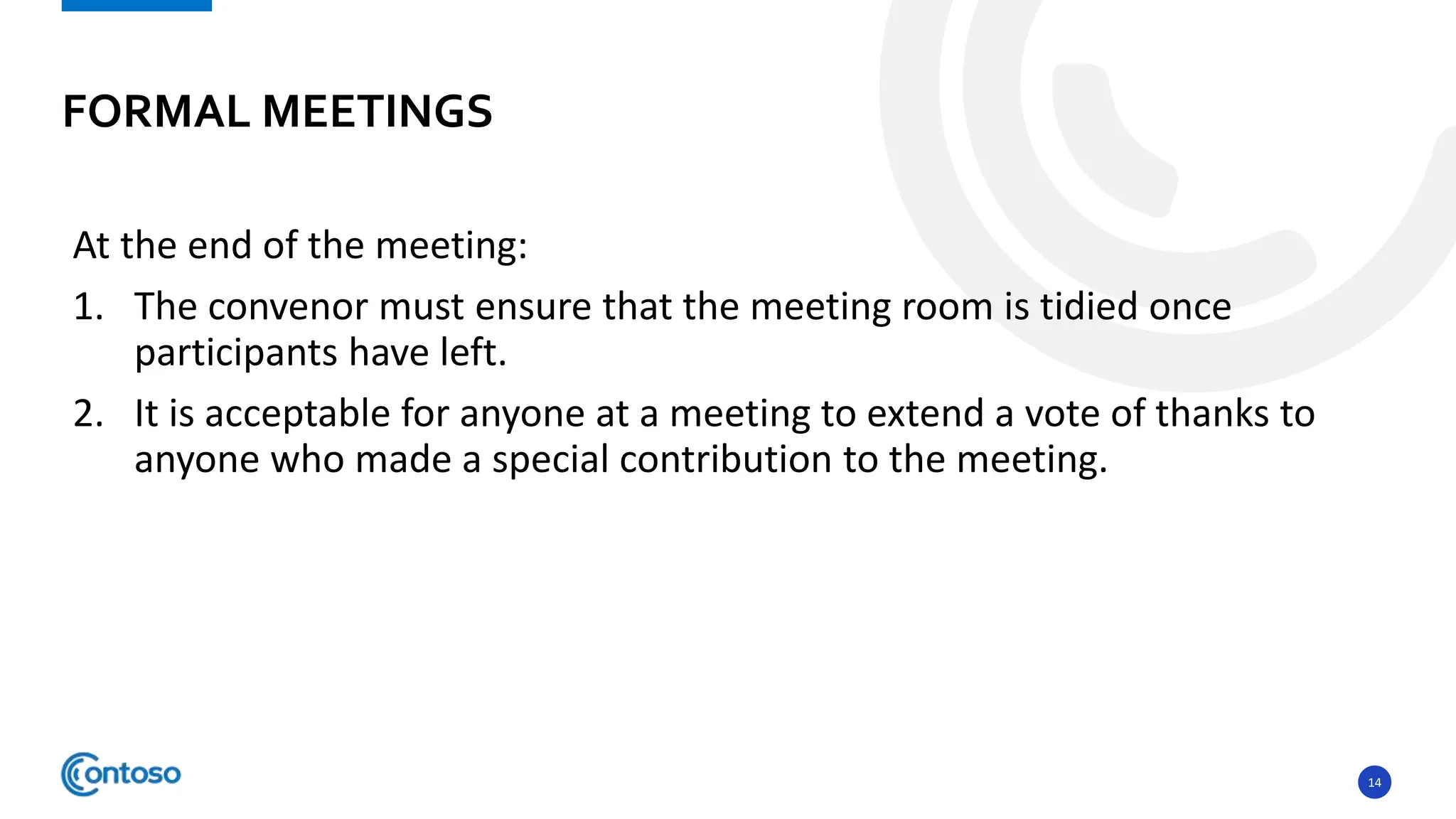
At the end of the meeting:
1. The convenor must ensure that the meeting room is tidied once
participants have left.
2. It is acceptable for anyone at a meeting to extend a vote of thanks to
anyone who made a special contribution to the meeting.
FORMAL MEETINGS
15
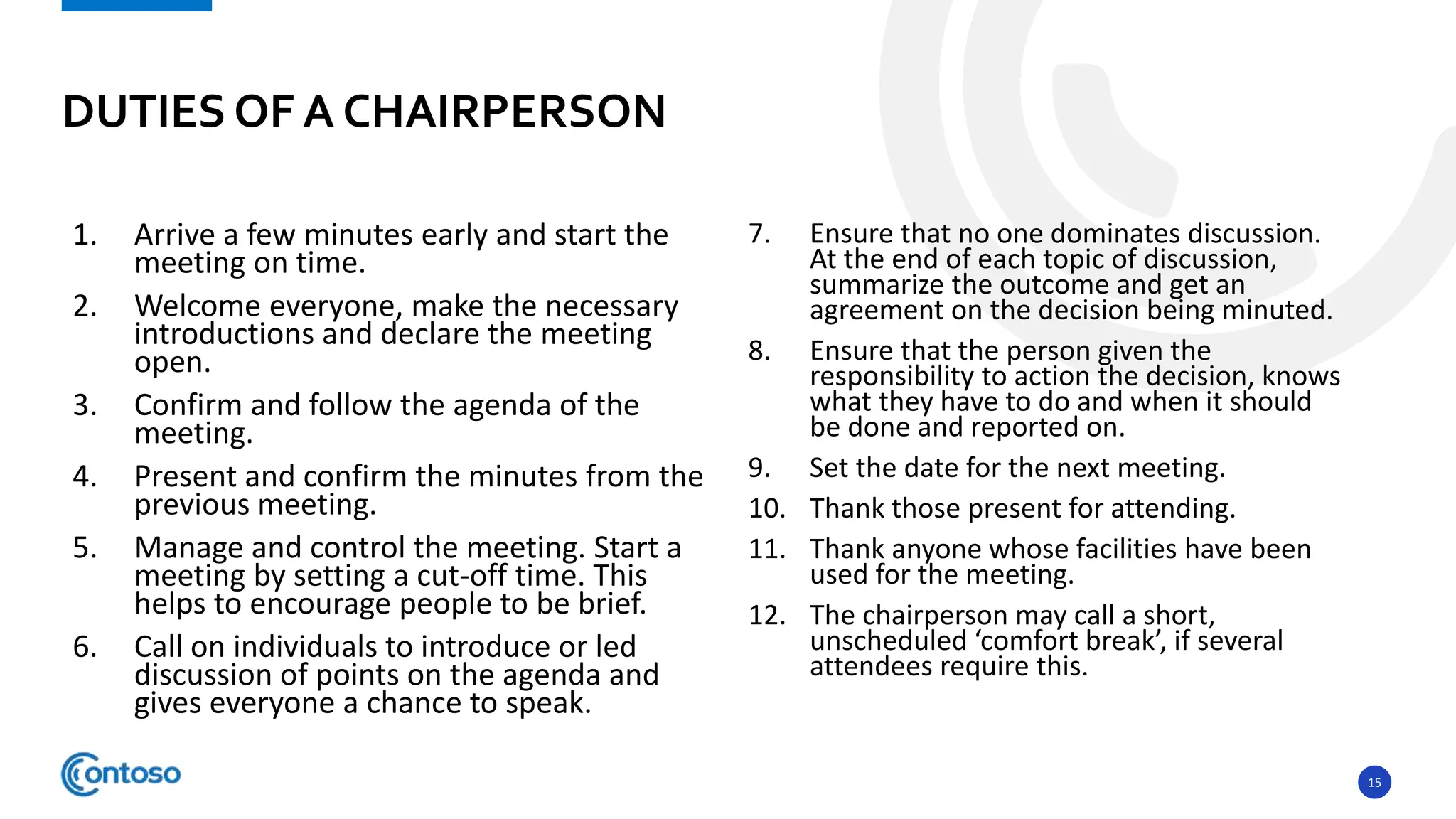
1. Arrive a few minutes early and start the
meeting on time.
2. Welcome everyone, make the necessary
introductions and declare the meeting
open.
3. Confirm and follow the agenda of the
meeting.
4. Present and confirm the minutes from the
previous meeting.
5. Manage and control the meeting. Start a
meeting by setting a cut-off time. This
helps to encourage people to be brief.
6. Call on individuals to introduce or led
discussion of points on the agenda and
gives everyone a chance to speak.
7. Ensure that no one dominates discussion.
At the end of each topic of discussion,
summarize the outcome and get an
agreement on the decision being minuted.
8. Ensure that the person given the
responsibility to action the decision, knows
what they have to do and when it should
be done and reported on.
9. Set the date for the next meeting.
10. Thank those present for attending.
11. Thank anyone whose facilities have been
used for the meeting.
12. The chairperson may call a short,
unscheduled ‘comfort break’, if several
attendees require this.
DUTIES OF A CHAIRPERSON
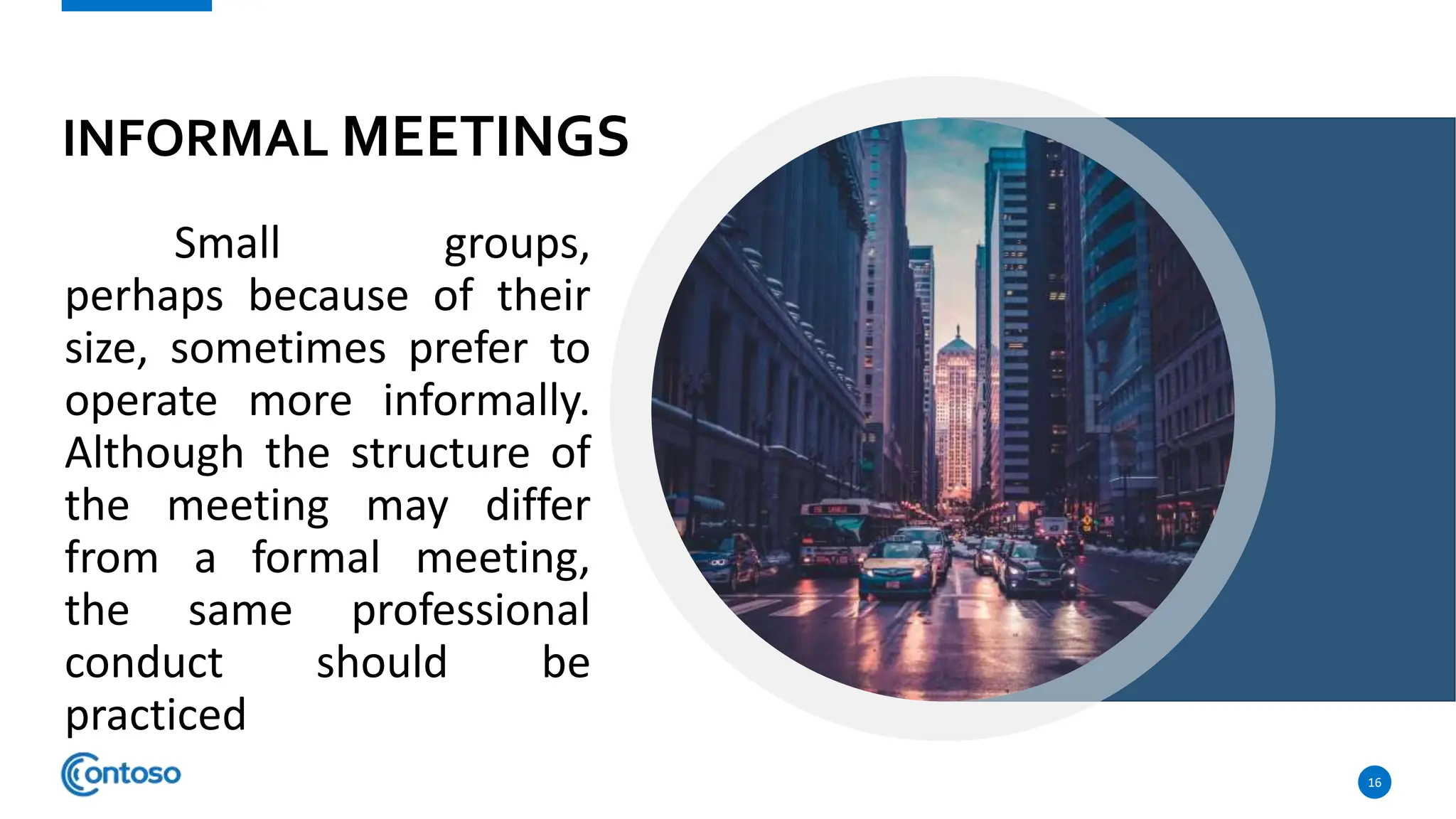
INFORMAL MEETINGS
Small groups,
perhaps because of their
size, sometimes prefer to
operate more informally.
Although the structure of
the meeting may differ
from a formal meeting,
the same professional
conduct should be
practiced
16
BASIC MEETINGTERMINOLOGY
17
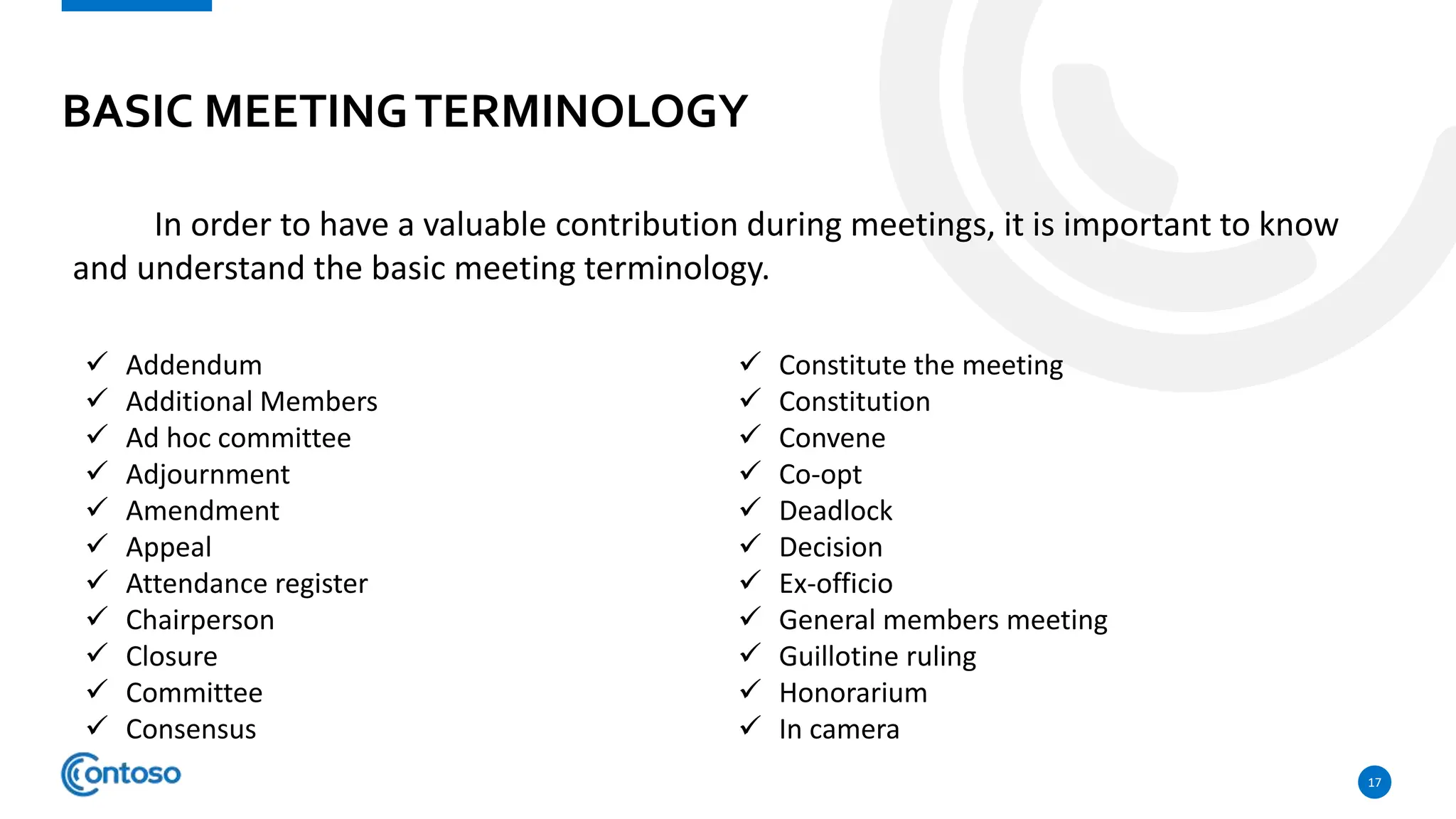
In order to have a valuable contribution during meetings, it is important to know
and understand the basic meeting terminology.
 Addendum
 Additional Members
 Ad hoc committee
 Adjournment
 Amendment
 Appeal
 Attendance register
 Chairperson
 Closure
 Committee
 Consensus
 Constitute the meeting
 Constitution
 Convene
 Co-opt
 Deadlock
 Decision
 Ex-officio
 General members meeting
 Guillotine ruling
 Honorarium
 In camera
Agenda is a document that
outlines the contents of a
forthcoming meeting. It is usually
sent along with the notice of the
meeting.
18
AGENDA
1. Minutes of the last meeting.
2. Matters arising from the minutes.
3. Financial irregularities.
4. Re-organization of work.
5. Any other business.
6. Date of next meeting.
Minutes serves as official records
of meetings or proceedings. In
deliberative assembles organizations,
the need for preparing and
documenting the proceedings of the
meeting is highly imperative.
19
MINUTES OFTHE
MEETING
1. Name of the organization
2. The type of meeting
3. The time and place of the meeting
4. The venue of the meting
5. The number of the meeting
IMPORTANCE OF KEEPING MINUTES
20
1. Minutes contain a record of the business transacted and decisions taken
at a meeting. They serve as a personal record for future reference.
2. Minutes serve as a reminder for the actins to be taken to implement the
decisions arrived at a meeting.
3. Minutes can be produced as evidence of the proceedings in a Court of
Law.
4. Minutes help in the efficient conduct of business. If proper minutes are
not kept, the decisions arrived at meeting may be questioned by any
member or Author and therefore, they cannot be proved in Court of Law.
GENERAL GUIDELINES FORWRITING MINUTES
21
1. Minutes of each meeting should have heading containing the type of meeting.
2. The date, time and place at which the meeting was held should be mentioned.
3. In the case of general meetings and board meetings, it is usual to state the number of
the meeting.
4. The minutes should contain the names of all those who were present and the capacity
in which they were present.
5. Each item in the minutes is numbered and given a brief heading.
6. Each item should be written in the minutes in the same order in which the business
was transacted.
7. Minutes should be brief but no important detail should be omitted.
8. Defamatory language, irrelevant points should not be recorded.
GENERAL GUIDELINES FORWRITING MINUTES
22
9. While writing minutes, no reference should be made to the feelings of the persons
present.
10. Dates and figures should be clearly and precisely stated in the minutes. If a reference
is made in certain letters or reports, their numbers and dates should also be
mentioned.
11. In case of a special resolution passed at the meeting, the number of those in favour
and against should be recorded.
12. The secretary should go on taking notes during the meeting.
13. It is advisable for the secretary to show the rough draft of the minutes to the
Chairman and get his approval.
14. The language of the minutes should be simple and precise. Simple past tense and
passive voice are preferable.
GENERAL GUIDELINES FORWRITING MINUTES
23
15. Ensure that each item discussed in the meeting has been recorded.
16. Use a separate paragraph for each item.
17. Record full text of motions.
TEAM
GLENFORD ABAD LIANNA JOYCE CINCO APRIL ECLEO SYRA MAE PAMEN
24
THANKYOU!
GLENABAD6@GMAIL.COM
FB: GLENFORD VELASQUEZ ABAD

Chapter 8 in administrative office procedure and management

  • 1.
  • 2.
    OBJECTIVES • Explain thepurpose and objectives of meeting; • Differentiate various types of meetings; • Discuss how to prepare for a meeting; • Draw up an agenda for a meeting; • Explain the duties of a chairperson; • Explain the duties of the secretary before, during, and after meeting; • Understand the basic meeting terminology; • Explain the correct procedure to follow at meetings; • Identify and discuss the basic parts of the minutes of the meeting. 2
  • 3.
    INTRODUCTION Meetings in today’sorganizations are a fact of organizational life. Holding effective meetings is one of the essential managerial skills. Meetings are at the heart of management. At least 60 percent of manager’s time is spent in meetings (Barker, 1997:9). “When the outcome of a meeting is to have another meeting, it has been a lousy meeting” (Stewart et al 1996:49). 3
  • 4.
    WHAT ARE MEETINGS? Erasmus-Kritzinger,Swart and Mona (2000:263) define a meeting as follows: “A meeting is a gathering of two or more people to discuss matters of mutual concerns, and to take and implement any necessary decisions relating to these matters”. In an organization, a meeting is used for various purposes, such as the following, as outlined by Penrose, Rasberry and Myers (1993:268) and Moseley, Megginson and Pietri (2005:296). 4
  • 5.
    MEETING PURPOSES: 1. Toaccept reports from participants 2. To reach a group judgement of decision 3. To analyze or solve a problem 4. To gain acceptability for an idea, programme or decision 5. To achieve a training objectives 6. To reconcile conflicting views 7. To communicate essential information to a group 8. To relieve tension or insecurity by providing information and management’s viewpoints 9. To ensure that everyone has the same understanding of information 10. To obtain quick reactions 11. To reactivate a stalled project 12. To demonstrate a product or system, and 13. To generate new ideas or concept 5
  • 6.
    ESSENTIALS OF COMPANYMEETINGS 6 1. Two or More Person: To constitute a valid meeting, there must be two or more persons. However, the articles of association may provide for a larger number of persona to constitute a valid quorum. 2. Lawful Assembly: The gathering must be for conducting a lawful business. An unlawful shall not be a meeting in the eye of law. 3. Previous Notice: It is a condition precedent for a valid meeting. A meeting, which is purely accidental and not summoned after a due notice, is not at all a valid meeting in the of law. 4. To Transact a Business: The purpose of the meeting is to transact a business. If the meeting has no definite object or summoned without predetermined object, it is not a valid meeting. Some business should be transacted in the meeting but no decision needed be arrived in such meeting.
  • 7.
    1. Meeting ofthe Shareholders 2. Meeting of the Board of Directors and their Committees 3. Meetings of the Debenture Holders 4. Meeting of the Creditors 7 TYPES OF MEETING
  • 8.
    1. MEETING OFTHE SHAREHOLDERS •Statutory Meeting • Annual General Meeting • Extraordinary General Meeting • Class Meeting 8
  • 9.
    2. MEETING OFTHE DIRECTORS 3. MEETING OF DEBENTURE HOLDERS 4. MEETINGS OF THE CREDITORS 9
  • 10.
    WHATTO CONSIDERWHEN ARRANGING AMEETING 10  Purpose of the Meeting  Meeting Logistics  Meeting Agenda  Minute Taking
  • 11.
    11 On arrival: 1. Whenarriving early at a formal meeting, wait to be told where to sit. 2. At a formal meeting, the chairperson usually sits in a prominent position. For example, at the head of the table 3. Make sure you are aware of the rules and conventions your organization uses to govern formal meetings. 4. If you arrive late at a meeting, apologize to the chairperson and quietly take your seat. 5. Don’t greet all your colleagues and interrupt the meeting. FORMAL MEETINGS
  • 12.
    12 During the meeting: 1.Don’t fidget, tap your fingers or look bored while someone is speaking. 2. Do not ‘click’ your pen. 3. Make certain that your cell phone is switched off, not on silent. Settings such as silent and vibrate, may affect the sound system and disturb attendees. 4. Do not use your laptop during meeting to respond to e-mails or do anything else not related to the meeting. 5. Avoid interrupting another speaker. FORMAL MEETINGS
  • 13.
    13 During the meeting: 6.At a formal meeting, speak ‘through’ the chairperson. That means indicating to the chairperson that you want to speak, and then speaking when a chairperson invites you to do so. When addressing the chairperson, use the correct title i.e Madam / Sir Chair. 7. Do not hold private discussions with attendees during a meeting. 8. Do not leave a meeting unnecessarily and if you have to first asking the chairperson to excuse you. 9. Do not eat snacks and food during a meeting, wait for the scheduled break. FORMAL MEETINGS
  • 14.
    14 At the endof the meeting: 1. The convenor must ensure that the meeting room is tidied once participants have left. 2. It is acceptable for anyone at a meeting to extend a vote of thanks to anyone who made a special contribution to the meeting. FORMAL MEETINGS
  • 15.
    15 1. Arrive afew minutes early and start the meeting on time. 2. Welcome everyone, make the necessary introductions and declare the meeting open. 3. Confirm and follow the agenda of the meeting. 4. Present and confirm the minutes from the previous meeting. 5. Manage and control the meeting. Start a meeting by setting a cut-off time. This helps to encourage people to be brief. 6. Call on individuals to introduce or led discussion of points on the agenda and gives everyone a chance to speak. 7. Ensure that no one dominates discussion. At the end of each topic of discussion, summarize the outcome and get an agreement on the decision being minuted. 8. Ensure that the person given the responsibility to action the decision, knows what they have to do and when it should be done and reported on. 9. Set the date for the next meeting. 10. Thank those present for attending. 11. Thank anyone whose facilities have been used for the meeting. 12. The chairperson may call a short, unscheduled ‘comfort break’, if several attendees require this. DUTIES OF A CHAIRPERSON
  • 16.
    INFORMAL MEETINGS Small groups, perhapsbecause of their size, sometimes prefer to operate more informally. Although the structure of the meeting may differ from a formal meeting, the same professional conduct should be practiced 16
  • 17.
    BASIC MEETINGTERMINOLOGY 17 In orderto have a valuable contribution during meetings, it is important to know and understand the basic meeting terminology.  Addendum  Additional Members  Ad hoc committee  Adjournment  Amendment  Appeal  Attendance register  Chairperson  Closure  Committee  Consensus  Constitute the meeting  Constitution  Convene  Co-opt  Deadlock  Decision  Ex-officio  General members meeting  Guillotine ruling  Honorarium  In camera
  • 18.
    Agenda is adocument that outlines the contents of a forthcoming meeting. It is usually sent along with the notice of the meeting. 18 AGENDA 1. Minutes of the last meeting. 2. Matters arising from the minutes. 3. Financial irregularities. 4. Re-organization of work. 5. Any other business. 6. Date of next meeting.
  • 19.
    Minutes serves asofficial records of meetings or proceedings. In deliberative assembles organizations, the need for preparing and documenting the proceedings of the meeting is highly imperative. 19 MINUTES OFTHE MEETING 1. Name of the organization 2. The type of meeting 3. The time and place of the meeting 4. The venue of the meting 5. The number of the meeting
  • 20.
    IMPORTANCE OF KEEPINGMINUTES 20 1. Minutes contain a record of the business transacted and decisions taken at a meeting. They serve as a personal record for future reference. 2. Minutes serve as a reminder for the actins to be taken to implement the decisions arrived at a meeting. 3. Minutes can be produced as evidence of the proceedings in a Court of Law. 4. Minutes help in the efficient conduct of business. If proper minutes are not kept, the decisions arrived at meeting may be questioned by any member or Author and therefore, they cannot be proved in Court of Law.
  • 21.
    GENERAL GUIDELINES FORWRITINGMINUTES 21 1. Minutes of each meeting should have heading containing the type of meeting. 2. The date, time and place at which the meeting was held should be mentioned. 3. In the case of general meetings and board meetings, it is usual to state the number of the meeting. 4. The minutes should contain the names of all those who were present and the capacity in which they were present. 5. Each item in the minutes is numbered and given a brief heading. 6. Each item should be written in the minutes in the same order in which the business was transacted. 7. Minutes should be brief but no important detail should be omitted. 8. Defamatory language, irrelevant points should not be recorded.
  • 22.
    GENERAL GUIDELINES FORWRITINGMINUTES 22 9. While writing minutes, no reference should be made to the feelings of the persons present. 10. Dates and figures should be clearly and precisely stated in the minutes. If a reference is made in certain letters or reports, their numbers and dates should also be mentioned. 11. In case of a special resolution passed at the meeting, the number of those in favour and against should be recorded. 12. The secretary should go on taking notes during the meeting. 13. It is advisable for the secretary to show the rough draft of the minutes to the Chairman and get his approval. 14. The language of the minutes should be simple and precise. Simple past tense and passive voice are preferable.
  • 23.
    GENERAL GUIDELINES FORWRITINGMINUTES 23 15. Ensure that each item discussed in the meeting has been recorded. 16. Use a separate paragraph for each item. 17. Record full text of motions.
  • 24.
    TEAM GLENFORD ABAD LIANNAJOYCE CINCO APRIL ECLEO SYRA MAE PAMEN 24
  • 25.