








Are we designing for algorithms – or humans?
Technical SEO vs UI/UX
Bastian Grimm, Peak Ace AG | @basgr
I have a confession to make…
I am really, really old!
pa.ag@peakaceag5
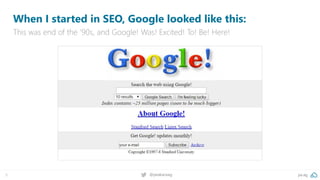
When I started in SEO, Google looked like this:
This was end of the ‘90s, and Google! Was! Excited! To! Be! Here!
pa.ag@peakaceag6
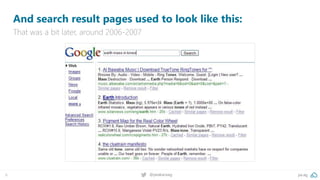
And search result pages used to look like this:
That was a bit later, around 2006-2007
pa.ag@peakaceag7
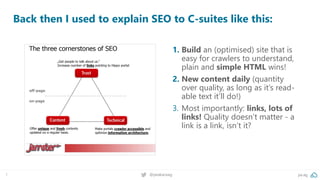
Back then I used to explain SEO to C-suites like this:
1. Build an (optimised) site that is
easy for crawlers to understand,
plain and simple HTML wins!
2. New content daily (quantity
over quality, as long as it’s read-
able text it’ll do!)
3. Most importantly: links, lots of
links! Quality doesn’t matter - a
link is a link, isn’t it?
At the time, I honestly couldn’t have cared less about a
site delivering a decent experience…!
UX? Never heard of her.
It had to be good, when it was
ranking highly – right!?
Well…
things change.
pa.ag@peakaceag11
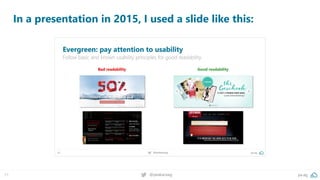
In a presentation in 2015, I used a slide like this:
pa.ag@peakaceag12
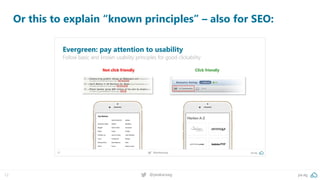
Or this to explain “known principles” – also for SEO:
Some UX trends really made
me mad though!
pa.ag@peakaceag14
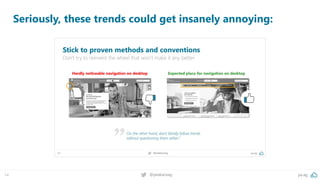
Seriously, these trends could get insanely annoying:
Google started pushing various
topics in parallel…
pa.ag@peakaceag16
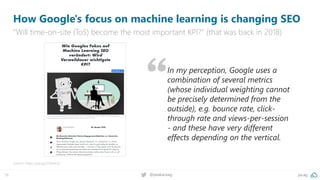
How Google's focus on machine learning is changing SEO
“Will time-on-site (ToS) become the most important KPI?” (that was back in 2018)
Source: https://pa.ag/2Zeem5t
In my perception, Google uses a
combination of several metrics
(whose individual weighting cannot
be precisely determined from the
outside), e.g. bounce rate, click-
through rate and views-per-session
- and these have very different
effects depending on the vertical.
But there is more…
For me, there is nothing worse than having to wait
for anything to load!
I'm really impatient
GDPR is actually pretty cool!
pa.ag@peakaceag20
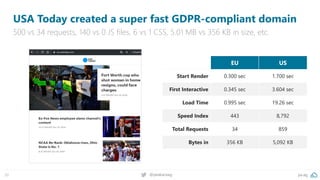
USA Today created a super fast GDPR-compliant domain
500 vs 34 requests, 140 vs 0 JS files, 6 vs 1 CSS, 5.01 MB vs 356 KB in size, etc.
EU US
Start Render 0.300 sec 1.700 sec
First Interactive 0.345 sec 3.604 sec
Load Time 0.995 sec 19.26 sec
Speed Index 443 8,792
Total Requests 34 859
Bytes in 356 KB 5,092 KB
pa.ag@peakaceag21
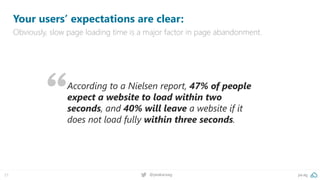
Your users’ expectations are clear:
Obviously, slow page loading time is a major factor in page abandonment.
According to a Nielsen report, 47% of people
expect a website to load within two
seconds, and 40% will leave a website if it
does not load fully within three seconds.
Fast loading time plays an important role
in overall user experience!
“Performance = user experience”
pa.ag@peakaceag23
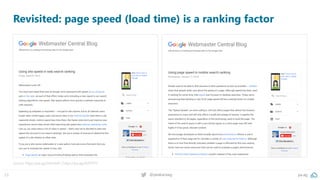
Revisited: page speed (load time) is a ranking factor
Source: https://pa.ag/2iAmA4Y | https://pa.ag/2ERTPYY
pa.ag@peakaceag24
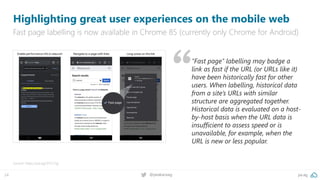
Highlighting great user experiences on the mobile web
Fast page labelling is now available in Chrome 85 (currently only Chrome for Android)
Source: https://pa.ag/31CChgi
"Fast page" labelling may badge a
link as fast if the URL (or URLs like it)
have been historically fast for other
users. When labelling, historical data
from a site’s URLs with similar
structure are aggregated together.
Historical data is evaluated on a host-
by-host basis when the URL data is
insufficient to assess speed or is
unavailable, for example, when the
URL is new or less popular.
pa.ag@peakaceag25
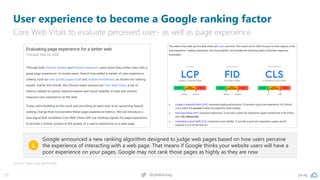
User experience to become a Google ranking factor
Core Web Vitals to evaluate perceived user- as well as page experience
Source: https://pa.ag/3irantb
Google announced a new ranking algorithm designed to judge web pages based on how users perceive
the experience of interacting with a web page. That means if Google thinks your website users will have a
poor experience on your pages, Google may not rank those pages as highly as they are now
i
pa.ag@peakaceag26
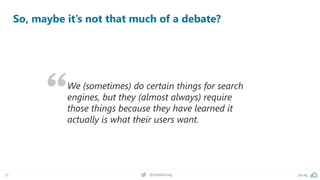
So, maybe it’s not that much of a debate?
We (sometimes) do certain things for search
engines, but they (almost always) require
those things because they have learned it
actually is what their users want.
What do you think? Is it still one or the other - or not so
much anymore?
Let‘s discuss!

Technical SEO vs. User Experience - Bastian Grimm, Peak Ace AG

  • 1.
    Are we designingfor algorithms – or humans? Technical SEO vs UI/UX Bastian Grimm, Peak Ace AG | @basgr
  • 2.
    I have aconfession to make…
  • 3.
    I am really,really old!
  • 4.
    pa.ag@peakaceag5 When I startedin SEO, Google looked like this: This was end of the ‘90s, and Google! Was! Excited! To! Be! Here!
  • 5.
    pa.ag@peakaceag6 And search resultpages used to look like this: That was a bit later, around 2006-2007
  • 6.
    pa.ag@peakaceag7 Back then Iused to explain SEO to C-suites like this: 1. Build an (optimised) site that is easy for crawlers to understand, plain and simple HTML wins! 2. New content daily (quantity over quality, as long as it’s read- able text it’ll do!) 3. Most importantly: links, lots of links! Quality doesn’t matter - a link is a link, isn’t it?
  • 7.
    At the time,I honestly couldn’t have cared less about a site delivering a decent experience…! UX? Never heard of her.
  • 8.
    It had tobe good, when it was ranking highly – right!?
  • 9.
  • 10.
    pa.ag@peakaceag11 In a presentationin 2015, I used a slide like this:
  • 11.
    pa.ag@peakaceag12 Or this toexplain “known principles” – also for SEO:
  • 12.
    Some UX trendsreally made me mad though!
  • 13.
    pa.ag@peakaceag14 Seriously, these trendscould get insanely annoying:
  • 14.
    Google started pushingvarious topics in parallel…
  • 15.
    pa.ag@peakaceag16 How Google's focuson machine learning is changing SEO “Will time-on-site (ToS) become the most important KPI?” (that was back in 2018) Source: https://pa.ag/2Zeem5t In my perception, Google uses a combination of several metrics (whose individual weighting cannot be precisely determined from the outside), e.g. bounce rate, click- through rate and views-per-session - and these have very different effects depending on the vertical.
  • 16.
    But there ismore…
  • 17.
    For me, thereis nothing worse than having to wait for anything to load! I'm really impatient
  • 18.
    GDPR is actuallypretty cool!
  • 19.
    pa.ag@peakaceag20 USA Today createda super fast GDPR-compliant domain 500 vs 34 requests, 140 vs 0 JS files, 6 vs 1 CSS, 5.01 MB vs 356 KB in size, etc. EU US Start Render 0.300 sec 1.700 sec First Interactive 0.345 sec 3.604 sec Load Time 0.995 sec 19.26 sec Speed Index 443 8,792 Total Requests 34 859 Bytes in 356 KB 5,092 KB
  • 20.
    pa.ag@peakaceag21 Your users’ expectationsare clear: Obviously, slow page loading time is a major factor in page abandonment. According to a Nielsen report, 47% of people expect a website to load within two seconds, and 40% will leave a website if it does not load fully within three seconds.
  • 21.
    Fast loading timeplays an important role in overall user experience! “Performance = user experience”
  • 22.
    pa.ag@peakaceag23 Revisited: page speed(load time) is a ranking factor Source: https://pa.ag/2iAmA4Y | https://pa.ag/2ERTPYY
  • 23.
    pa.ag@peakaceag24 Highlighting great userexperiences on the mobile web Fast page labelling is now available in Chrome 85 (currently only Chrome for Android) Source: https://pa.ag/31CChgi "Fast page" labelling may badge a link as fast if the URL (or URLs like it) have been historically fast for other users. When labelling, historical data from a site’s URLs with similar structure are aggregated together. Historical data is evaluated on a host- by-host basis when the URL data is insufficient to assess speed or is unavailable, for example, when the URL is new or less popular.
  • 24.
    pa.ag@peakaceag25 User experience tobecome a Google ranking factor Core Web Vitals to evaluate perceived user- as well as page experience Source: https://pa.ag/3irantb Google announced a new ranking algorithm designed to judge web pages based on how users perceive the experience of interacting with a web page. That means if Google thinks your website users will have a poor experience on your pages, Google may not rank those pages as highly as they are now i
  • 25.
    pa.ag@peakaceag26 So, maybe it’snot that much of a debate? We (sometimes) do certain things for search engines, but they (almost always) require those things because they have learned it actually is what their users want.
  • 26.
    What do youthink? Is it still one or the other - or not so much anymore? Let‘s discuss!