Module #1
Setting Up The Recruitment Process
Track #1
Steps in Setting Up The Recruitment Process
Update yourself with the basics
of tech you are hiring for
Qualify Your Resume Search
Assess the culture of the
organisation
Create ideal candidate
personas / profiles
Identify and setup assessment tests
based on the skill sets needed
Update yourself with
the basics of tech you
are hiring for
Keeping yourself abreast of tech concepts & terminologies and
latest industry developments are imperative. It is equally
essential to find oneself self-sufficient while answering
questions like…
“What is the difference between a full-stack framework
and a micro-framework?
OR
“What is the difference between Ruby and
Ruby-on-Rails?”
This will help you...
● Deeply understand the role you are sourcing for.
● Establish your own credibility with the candidates.
● Help you communicate effectively better during the
interviews.
● Improve your relationship with hiring managers.
● Helps with career progression
Source Code:
● Every computer program is written in a
programming language, which includes text
in the form of variable declarations,
instructions, functions, etc., called as Source
Code.
UI Designer:
● A UI Designer is someone who focuses on
designing interface in software or computerized
devices with a strong focus on looks and style,
helping to create an easy to use user experience.
System Administrator:
● Responsible for smooth operations and proper maintenance of the computer systems of the
organization.
Front-End Developer:
● A programmer who focuses on developing
user interfaces of websites and applications
using web technologies.
Framework:
● A standard way to build and deploy
applications, a set of predefined solutions to
build softwares and products.
Mean-Stack Developer:
● A developer who has to be adept at
Javascript (one of the computer languages)
and works with both front-end and
back-end technologies.
Back-End Developer:
● He focuses on the source code to help
applications and website run smoothly.
Database:
● An easily managed, well organised way to store everything data of a web application, website or
mobile application.
UX Designer:
● A UX Designer uses aspects of branding,
design, usability and function to deliver a
meaningful and relevant user experience for
different applications and softwares.
Full-Stack Developer:
● A developer who delivers a finished product by
working with both back-end and front-end
technologies.
DevOps:
● A combination of two words (development &
operations), is a process to enhance speedy
delivery of the final product, increasingly
being adopted by the technical community.
SaaS:
● Software as a Service, is a model in which
customers can enjoy the software without
having to worry about development,
deployment, license fees, maintenance,
support, etc.
API:
● A set of definitions, protocols and practices
for developers to interact with the
applications.
Site Reliability Engineer:
● A person who develops, maintains and
operates the software. He has to look out for
any emerging complex systems.
Different developers use different
computer languages to design a
program. Here’s a list of all the
common languages that you
should be aware of as a technical
recruiter.
Understand Your Company’s Tech stack, the
combination of all the programming languages,
frameworks, servers, tools, softwares etc. used
by the developers in your organisation to build
the finished product.
Understanding tech stack helps you...
● Know your company’s product inside out.
● Ask relevant and to-the-point questions
when sourcing your hires.
● Answer the confidently and reliably the
questions candidates might ask you
during the interview processes.
Assess the Culture of
the Organisation
Organizational Culture is...
● Morals, values, beliefs and the mission that govern
people’s behaviour.
It Helps..
● Give an identity to the organisation.
● Brings all the employees on a common platform.
● Ensures everyone is working towards achieving the
same vision.
Find the best culture fit, based on candidate’s...
Personality Interests
Strengths Working Styles
Benefits of Hiring for Culture Fit:
● Better work environment: With the positive energy that flows
in an organisation, if the employees feel aligned to the overall
work culture, there exists a conducive working environment too.
● Reduced employee turnover: A pleasant work environment is
most likely to translate into reduced employee turnover and
better retention rates.
● Better customer service: Every department is committed
towards performing to their fullest, leading to a good customer
experience.
And, Further Leads To...
● Higher job satisfaction: The overall feel-good factor leads to
higher job satisfaction levels.
● Lowered stress levels: A good work culture which employees
identify with is equal to reaching goals on time and less stress.
● Loyal & Dedicated employees: You know you have a loyal and
dedicated team if the deadlines are being met, quality is
adhered to and all the stakeholders are happy.
A company’s culture is reflected in the way
people interact with one another, the
values upon which the organisation is built
and the different belief systems that have
become the way of everyday life of the
people that work there. To understand your
own company culture, you need to dust off
a few facts and figures, which will help you
see the bigger picture.
To Best Determine Company Culture to Empower
Hiring, You Need to Understand...
● The programming practices
○ How developers are assigned tasks, what is the reporting
structure, what is the maximum duration for a given project that
can be allotted, etc.
● How different engineering teams are structured?
○ How many such teams are there?
○ What is the composition of such teams with respect to
demography, work hours etc.
● Age of your organisation:
○ When was the organisation founded?
● Who is the end customer of the product?
○ Who are the final customers? Are they satisfied with the
product? How can the different teams work together to
enhance the product?
● Founder’s personality:
○ Do they interact with the employees?
○ Are they invested and aligned with the company’s vision?
○ Does it reflect in their personality and are employees able to
take positive cues from them?
● Hiring manager’s personality:
○ Are they making correct hiring decisions?
○ Do they have a standard procedure in place when it comes
to hiring?
● Working hours:
○ Are working hours in line with the labour laws?
○ Do employees enjoy working in the company?
● Decorum and code of conduct to be followed:
○ Are the rules and regulations laid down being adhered to?
○ Are there slight deviations or many?
● Dress Code / Attire:
○ Is there a strict policy for dress code or is it lenient?
● Company’s Growth Timeline:
○ Has the company shown good track record as far as growth
numbers are concerned?
○ Are things on track as per the projections?
● Company Product:
○ Do you understand the final product of the company, which
can be an application, a software, a website etc?
● Company’s Mission & Vision:
○ Do employees clearly understand company’s mission and
vision statement and then make day-to-day decisions or
interact with clients?
Create Ideal
Candidate Character
One of the critical factors in getting job applications is posting
job descriptions. However, you must ensure that the
description is targeted to the right candidate?
The best way to achieve this is to first build a “Candidate
Character”.
What is ‘Candidate Character’?
● A semi-fictional representation of your ideal
candidate.
● A composite sketch of a key segment of your
candidate pool.
● Defines the characteristics, skills and traits of your
perfect hire.
Candidate character helps you...
● Devise your sourcing strategy to focus on the right candidates
● Get a deeper understanding of requirement from various
stakeholders
● Prepare targeted job description, introductory materials, emails,
etc. to get more applicants
● Identify the best recruiting channels for your target candidates
3 Steps to Creating Candidate Character...
Research Identifying Trends Character Stories
Candidate characters should be based on
thorough industry research and not just
gut feel.
Whom to include in your research for a
well-crafted candidate character...
Employees Major Stakeholders Candidates
When including Employees...
Interview existing team members to understand the following:
● What motivates them?
○ Why did they apply to your company and what keeps them going?
● What are their work-related goals?
○ Where do they see themselves after a few years in the organisation?
○ What are their personal goals like marriage, mortgage, children’s education etc.
● What are their interests?
○ What and why they like to read anything particular?
○ Where do they spend their time online?
● The Company Culture & their Skills..
○ Do they like the company culture? If yes, what about it?
○ What skills help them succeed in the job?
When including Stakeholders...
Involve the hiring managers, recruiters, sourcers and interviewers by asking about...
● Job Title:
○ Growth hacker, growth ninja, customer acquisition manager are all different names for the
same job title. Zero down on a job title which is also SEO friendly.
● Where do they work:
○ Consult hiring team for a list of companies they may be eyeing to source the next hires.
● Experience:
○ What level of experience is required? Is sector experience necessary? Does a lack of
experience disqualify someone or is it just a guideline?
● Demographics:
○ Do candidates need to belong to a certain location? Are you looking for candidates from a
certain background... programmer, developer, etc? Are there any specific universities that need
to be targeted?
● Current interactions with the candidates:
○ Where is the team finding these candidates right now? LinkedIn, Twitter, other online forums,
etc.? Is the strategy working?
When including Candidates...
Right from unsuccessful applicants, to prospects, to candidates currently in your hiring
process, asking questions related to candidate persona help because:
● They are the people interested in your employer brand
● They are a great source of insight
● Previously collected data can be biased, as it is entirely from company’s perspective
Ask them, the same questions that you asked your employees for drawing up a quick
comparison, and improving your candidate persona.
Identifying the industry trends helps to spot the commonalities in
requirements for different roles.
● For example, trend for a sales and marketing professional
would be – incredibly driven and belonging to Ivy League
background.
Such identification helps shortlist the key qualities required in a
candidate and helps build a complete character.
Creating Character Stories will help put all the
research in one place to create a handy 360-degree
view of the ideal candidate you are looking for and
help the team target candidates effectively.
Candidate Character Story Example
UX Designer Neha
Background:
● BSc in Design from a top tier school
Cultural Characteristics:
● Solution oriented and always on the lookout to
improve experience
● Updated with latest trends
Roles & Experience:
● 3 years experience
● Preferably worked at one of our competitors
/ leading IT services company
Watering Holes:
● Industry related websites
Goals:
● Fast career growth
● Learning opportunities
Skills:
● Project management and research
● HTML/CSS
Objections:
● Prefers less interaction
● Likes to get back to work after short breaks.
Interests:
● Arts
● Sports
Qualify Your Resume
Search
Narrow down your search by reviewing resumes
based on the following:
● Does this person possess necessary skills for the open position?
○ Helps the new hire learn & adapt to the work quickly!
● Do they have the required and relevant work-experience?
○ If hired, it can lead to speeding up the processes.
● Are they problem solvers?
○ Helps to quickly unclog any bottlenecks in the workflow!
● How senior are they?
○ Will they assimilate into the team, understand the team
demographics and match with the role you are hiring for.
● Can you afford them?
○ Helps match their current salary and expectations with your
current budget and resources.
● Is the Candidate a Keeper?
○ Look into the fact if the candidate stuck around in his previous
jobs for at least 2-3 years to get an idea if he will stay with your
organization for a considerable time or not. Helps you plan
better for team-building & future recruitments!
Identify & Set-up
Assessment Tests Based
on the Skill Sets Needed
Did you know…
60% of the recruiters find it challenging to hire
developers with sufficient technical skills.
Resumes while important, do not help in getting to
know the true skills and expertise of the candidate
applying for the role.
What to look for when setting up an Assessment Test
Based on the skillsets?
● What tests will be required for a particular job role?
● How can a recruiter check a candidate’s technical
know-how on a real-time basis?
● Analyze a candidate’s attitude and aptitude and
based on certain psychometric tests?
Some Examples:
How to set-up skill-based Assessment Test for
the position of a Developer?
Check his / her programming portfolio to
understand...
● Coding skills through personal projects
● Ability to explain and present things
● Candidate’s development level, career goals, skills
they aspire to acquire
● The kind of questions to ask questions during
interviews
Check candidate’s reputation on Stack
Overflow, a Q&A site on all things
computer programming, because...
● It’s perfect for measuring a candidate’s level of
knowledge & involvement in the development
community
● High reputation on stack overflow indicates:
○ Regularly active on the site
○ Asks relevant questions
○ Provide helpful answers often
Giving Live Coding assignments to assess
candidate’s technical knowledge...
● Allows recruiter to observe candidate’s logic,
ability to explain, their thinking process and ability
to code under pressure
● Gauge the performance of a candidate using just
their programming knowledge
● Check communicative and collaborative skills
within a team (group interviews)
Testing them for Programming skills on
real, practical problems that are
encountered in your company helps...
● Optimise the hiring process
● Provide an improved candidate experience
● Show the tech-friendly attitude of recruiters
● Demonstrate candidate’s skills in a better way
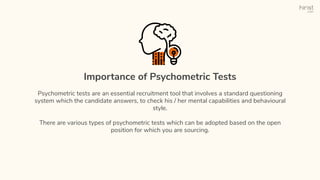
Importance of Psychometric Tests
Psychometric tests are an essential recruitment tool that involves a standard questioning
system which the candidate answers, to check his / her mental capabilities and behavioural
style.
There are various types of psychometric tests which can be adopted based on the open
position for which you are sourcing.
Examples of Psychometric Tests
Aptitude Tests
● These are used to assess a specific or general set of skills such as numerical
reasoning tests, logical reasoning tests, etc.
Skill Tests
● These will help you assess if the candidate is a quick learner or not, how
quickly he adopts the skills that are crucial for the job.
Personality Tests
● They help in figuring out a candidate’s personality inside out as well as their
approach towards work in general.
Psychometric tests help you understand...
● Whether the candidates possess the capabilities to handle the work and
pressure?
● Do they possess the necessary aptitude for the job?
● Are they a good culture fit for your organization?
● What’s their personality traits like - is he/she a loner or prefers working in a
team?
● Does he stick to timelines?
○ For example, in the tech industries, where typically the dates of a product
launch or feature updates are pre-announced, sticking to deadlines could
be one critical factor to assess the candidate on, right at the recruitment
stage.
Recruitment is a complex process, but
can be simplified with a planned,
step-by-step approach.
We hope this module was able to assist
you in planning your recruitment
processes better and source the perfect
candidate!
End of Module #1

Technical recruiter

  • 1.
    Module #1 Setting UpThe Recruitment Process Track #1
  • 2.
    Steps in SettingUp The Recruitment Process Update yourself with the basics of tech you are hiring for Qualify Your Resume Search Assess the culture of the organisation Create ideal candidate personas / profiles Identify and setup assessment tests based on the skill sets needed
  • 3.
    Update yourself with thebasics of tech you are hiring for
  • 4.
    Keeping yourself abreastof tech concepts & terminologies and latest industry developments are imperative. It is equally essential to find oneself self-sufficient while answering questions like… “What is the difference between a full-stack framework and a micro-framework? OR “What is the difference between Ruby and Ruby-on-Rails?”
  • 5.
    This will helpyou... ● Deeply understand the role you are sourcing for. ● Establish your own credibility with the candidates. ● Help you communicate effectively better during the interviews. ● Improve your relationship with hiring managers. ● Helps with career progression
  • 6.
    Source Code: ● Everycomputer program is written in a programming language, which includes text in the form of variable declarations, instructions, functions, etc., called as Source Code. UI Designer: ● A UI Designer is someone who focuses on designing interface in software or computerized devices with a strong focus on looks and style, helping to create an easy to use user experience. System Administrator: ● Responsible for smooth operations and proper maintenance of the computer systems of the organization. Front-End Developer: ● A programmer who focuses on developing user interfaces of websites and applications using web technologies. Framework: ● A standard way to build and deploy applications, a set of predefined solutions to build softwares and products.
  • 7.
    Mean-Stack Developer: ● Adeveloper who has to be adept at Javascript (one of the computer languages) and works with both front-end and back-end technologies. Back-End Developer: ● He focuses on the source code to help applications and website run smoothly. Database: ● An easily managed, well organised way to store everything data of a web application, website or mobile application. UX Designer: ● A UX Designer uses aspects of branding, design, usability and function to deliver a meaningful and relevant user experience for different applications and softwares. Full-Stack Developer: ● A developer who delivers a finished product by working with both back-end and front-end technologies.
  • 8.
    DevOps: ● A combinationof two words (development & operations), is a process to enhance speedy delivery of the final product, increasingly being adopted by the technical community. SaaS: ● Software as a Service, is a model in which customers can enjoy the software without having to worry about development, deployment, license fees, maintenance, support, etc. API: ● A set of definitions, protocols and practices for developers to interact with the applications. Site Reliability Engineer: ● A person who develops, maintains and operates the software. He has to look out for any emerging complex systems.
  • 9.
    Different developers usedifferent computer languages to design a program. Here’s a list of all the common languages that you should be aware of as a technical recruiter.
  • 11.
    Understand Your Company’sTech stack, the combination of all the programming languages, frameworks, servers, tools, softwares etc. used by the developers in your organisation to build the finished product.
  • 12.
    Understanding tech stackhelps you... ● Know your company’s product inside out. ● Ask relevant and to-the-point questions when sourcing your hires. ● Answer the confidently and reliably the questions candidates might ask you during the interview processes.
  • 13.
    Assess the Cultureof the Organisation
  • 14.
    Organizational Culture is... ●Morals, values, beliefs and the mission that govern people’s behaviour. It Helps.. ● Give an identity to the organisation. ● Brings all the employees on a common platform. ● Ensures everyone is working towards achieving the same vision.
  • 15.
    Find the bestculture fit, based on candidate’s... Personality Interests Strengths Working Styles
  • 16.
    Benefits of Hiringfor Culture Fit: ● Better work environment: With the positive energy that flows in an organisation, if the employees feel aligned to the overall work culture, there exists a conducive working environment too. ● Reduced employee turnover: A pleasant work environment is most likely to translate into reduced employee turnover and better retention rates. ● Better customer service: Every department is committed towards performing to their fullest, leading to a good customer experience.
  • 17.
    And, Further LeadsTo... ● Higher job satisfaction: The overall feel-good factor leads to higher job satisfaction levels. ● Lowered stress levels: A good work culture which employees identify with is equal to reaching goals on time and less stress. ● Loyal & Dedicated employees: You know you have a loyal and dedicated team if the deadlines are being met, quality is adhered to and all the stakeholders are happy.
  • 18.
    A company’s cultureis reflected in the way people interact with one another, the values upon which the organisation is built and the different belief systems that have become the way of everyday life of the people that work there. To understand your own company culture, you need to dust off a few facts and figures, which will help you see the bigger picture.
  • 19.
    To Best DetermineCompany Culture to Empower Hiring, You Need to Understand... ● The programming practices ○ How developers are assigned tasks, what is the reporting structure, what is the maximum duration for a given project that can be allotted, etc. ● How different engineering teams are structured? ○ How many such teams are there? ○ What is the composition of such teams with respect to demography, work hours etc.
  • 20.
    ● Age ofyour organisation: ○ When was the organisation founded? ● Who is the end customer of the product? ○ Who are the final customers? Are they satisfied with the product? How can the different teams work together to enhance the product? ● Founder’s personality: ○ Do they interact with the employees? ○ Are they invested and aligned with the company’s vision? ○ Does it reflect in their personality and are employees able to take positive cues from them?
  • 21.
    ● Hiring manager’spersonality: ○ Are they making correct hiring decisions? ○ Do they have a standard procedure in place when it comes to hiring? ● Working hours: ○ Are working hours in line with the labour laws? ○ Do employees enjoy working in the company? ● Decorum and code of conduct to be followed: ○ Are the rules and regulations laid down being adhered to? ○ Are there slight deviations or many?
  • 22.
    ● Dress Code/ Attire: ○ Is there a strict policy for dress code or is it lenient? ● Company’s Growth Timeline: ○ Has the company shown good track record as far as growth numbers are concerned? ○ Are things on track as per the projections? ● Company Product: ○ Do you understand the final product of the company, which can be an application, a software, a website etc? ● Company’s Mission & Vision: ○ Do employees clearly understand company’s mission and vision statement and then make day-to-day decisions or interact with clients?
  • 23.
  • 24.
    One of thecritical factors in getting job applications is posting job descriptions. However, you must ensure that the description is targeted to the right candidate? The best way to achieve this is to first build a “Candidate Character”.
  • 25.
    What is ‘CandidateCharacter’? ● A semi-fictional representation of your ideal candidate. ● A composite sketch of a key segment of your candidate pool. ● Defines the characteristics, skills and traits of your perfect hire.
  • 26.
    Candidate character helpsyou... ● Devise your sourcing strategy to focus on the right candidates ● Get a deeper understanding of requirement from various stakeholders ● Prepare targeted job description, introductory materials, emails, etc. to get more applicants ● Identify the best recruiting channels for your target candidates
  • 27.
    3 Steps toCreating Candidate Character... Research Identifying Trends Character Stories
  • 28.
    Candidate characters shouldbe based on thorough industry research and not just gut feel.
  • 29.
    Whom to includein your research for a well-crafted candidate character... Employees Major Stakeholders Candidates
  • 30.
    When including Employees... Interviewexisting team members to understand the following: ● What motivates them? ○ Why did they apply to your company and what keeps them going? ● What are their work-related goals? ○ Where do they see themselves after a few years in the organisation? ○ What are their personal goals like marriage, mortgage, children’s education etc. ● What are their interests? ○ What and why they like to read anything particular? ○ Where do they spend their time online? ● The Company Culture & their Skills.. ○ Do they like the company culture? If yes, what about it? ○ What skills help them succeed in the job?
  • 31.
    When including Stakeholders... Involvethe hiring managers, recruiters, sourcers and interviewers by asking about... ● Job Title: ○ Growth hacker, growth ninja, customer acquisition manager are all different names for the same job title. Zero down on a job title which is also SEO friendly. ● Where do they work: ○ Consult hiring team for a list of companies they may be eyeing to source the next hires. ● Experience: ○ What level of experience is required? Is sector experience necessary? Does a lack of experience disqualify someone or is it just a guideline? ● Demographics: ○ Do candidates need to belong to a certain location? Are you looking for candidates from a certain background... programmer, developer, etc? Are there any specific universities that need to be targeted? ● Current interactions with the candidates: ○ Where is the team finding these candidates right now? LinkedIn, Twitter, other online forums, etc.? Is the strategy working?
  • 32.
    When including Candidates... Rightfrom unsuccessful applicants, to prospects, to candidates currently in your hiring process, asking questions related to candidate persona help because: ● They are the people interested in your employer brand ● They are a great source of insight ● Previously collected data can be biased, as it is entirely from company’s perspective Ask them, the same questions that you asked your employees for drawing up a quick comparison, and improving your candidate persona.
  • 33.
    Identifying the industrytrends helps to spot the commonalities in requirements for different roles. ● For example, trend for a sales and marketing professional would be – incredibly driven and belonging to Ivy League background. Such identification helps shortlist the key qualities required in a candidate and helps build a complete character.
  • 34.
    Creating Character Storieswill help put all the research in one place to create a handy 360-degree view of the ideal candidate you are looking for and help the team target candidates effectively.
  • 35.
    Candidate Character StoryExample UX Designer Neha
  • 36.
    Background: ● BSc inDesign from a top tier school Cultural Characteristics: ● Solution oriented and always on the lookout to improve experience ● Updated with latest trends Roles & Experience: ● 3 years experience ● Preferably worked at one of our competitors / leading IT services company Watering Holes: ● Industry related websites Goals: ● Fast career growth ● Learning opportunities Skills: ● Project management and research ● HTML/CSS Objections: ● Prefers less interaction ● Likes to get back to work after short breaks. Interests: ● Arts ● Sports
  • 37.
  • 38.
    Narrow down yoursearch by reviewing resumes based on the following: ● Does this person possess necessary skills for the open position? ○ Helps the new hire learn & adapt to the work quickly! ● Do they have the required and relevant work-experience? ○ If hired, it can lead to speeding up the processes. ● Are they problem solvers? ○ Helps to quickly unclog any bottlenecks in the workflow!
  • 39.
    ● How seniorare they? ○ Will they assimilate into the team, understand the team demographics and match with the role you are hiring for. ● Can you afford them? ○ Helps match their current salary and expectations with your current budget and resources. ● Is the Candidate a Keeper? ○ Look into the fact if the candidate stuck around in his previous jobs for at least 2-3 years to get an idea if he will stay with your organization for a considerable time or not. Helps you plan better for team-building & future recruitments!
  • 40.
    Identify & Set-up AssessmentTests Based on the Skill Sets Needed
  • 41.
    Did you know… 60%of the recruiters find it challenging to hire developers with sufficient technical skills. Resumes while important, do not help in getting to know the true skills and expertise of the candidate applying for the role.
  • 42.
    What to lookfor when setting up an Assessment Test Based on the skillsets? ● What tests will be required for a particular job role? ● How can a recruiter check a candidate’s technical know-how on a real-time basis? ● Analyze a candidate’s attitude and aptitude and based on certain psychometric tests?
  • 43.
    Some Examples: How toset-up skill-based Assessment Test for the position of a Developer?
  • 44.
    Check his /her programming portfolio to understand... ● Coding skills through personal projects ● Ability to explain and present things ● Candidate’s development level, career goals, skills they aspire to acquire ● The kind of questions to ask questions during interviews
  • 45.
    Check candidate’s reputationon Stack Overflow, a Q&A site on all things computer programming, because... ● It’s perfect for measuring a candidate’s level of knowledge & involvement in the development community ● High reputation on stack overflow indicates: ○ Regularly active on the site ○ Asks relevant questions ○ Provide helpful answers often
  • 46.
    Giving Live Codingassignments to assess candidate’s technical knowledge... ● Allows recruiter to observe candidate’s logic, ability to explain, their thinking process and ability to code under pressure ● Gauge the performance of a candidate using just their programming knowledge ● Check communicative and collaborative skills within a team (group interviews)
  • 47.
    Testing them forProgramming skills on real, practical problems that are encountered in your company helps... ● Optimise the hiring process ● Provide an improved candidate experience ● Show the tech-friendly attitude of recruiters ● Demonstrate candidate’s skills in a better way
  • 48.
    Importance of PsychometricTests Psychometric tests are an essential recruitment tool that involves a standard questioning system which the candidate answers, to check his / her mental capabilities and behavioural style. There are various types of psychometric tests which can be adopted based on the open position for which you are sourcing.
  • 49.
    Examples of PsychometricTests Aptitude Tests ● These are used to assess a specific or general set of skills such as numerical reasoning tests, logical reasoning tests, etc. Skill Tests ● These will help you assess if the candidate is a quick learner or not, how quickly he adopts the skills that are crucial for the job. Personality Tests ● They help in figuring out a candidate’s personality inside out as well as their approach towards work in general.
  • 50.
    Psychometric tests helpyou understand... ● Whether the candidates possess the capabilities to handle the work and pressure? ● Do they possess the necessary aptitude for the job? ● Are they a good culture fit for your organization? ● What’s their personality traits like - is he/she a loner or prefers working in a team? ● Does he stick to timelines? ○ For example, in the tech industries, where typically the dates of a product launch or feature updates are pre-announced, sticking to deadlines could be one critical factor to assess the candidate on, right at the recruitment stage.
  • 51.
    Recruitment is acomplex process, but can be simplified with a planned, step-by-step approach. We hope this module was able to assist you in planning your recruitment processes better and source the perfect candidate!
  • 52.