Topics To Cover
 Recruitment Hierarchy
 US Map
 Full Life Cycle
 Daily Work
 Visa
 Tax Terms
 Portals
 Technologies
 Paper Work
Recruitment hierarchy
 Recruiters
 Bench Sales
 Business Development Manager
What is US-IT Recruitment?
Recruitment is the process of finding, attracting and
hiring the right talent at the right time for the right
job profile.
In USA it is called as talent acquisition means filling
the right consultant on a vacant job at the right time
in US for US Companies.
US MAP WITH TIMEZONES
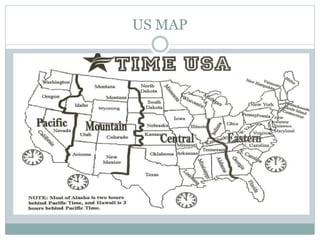
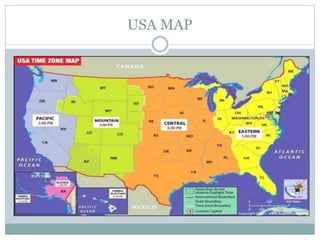
 There are 50 states and 4 different Time-zones in
US.
 Forty eight states are divide into these four Time-
zones and two other states are:
1. Alaska (AK)
2. Hawaii (HI).
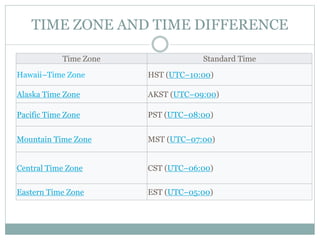
TIME ZONE AND TIME DIFFERENCE
Time Zone Standard Time
Hawaii–Time Zone HST (UTC−10:00)
Alaska Time Zone AKST (UTC−09:00)
Pacific Time Zone PST (UTC−08:00)
Mountain Time Zone MST (UTC−07:00)
Central Time Zone CST (UTC−06:00)
Eastern Time Zone EST (UTC−05:00)
US MAP
USA MAP
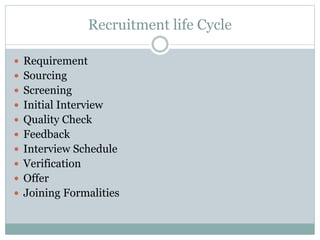
Recruitment life Cycle
 Requirement
 Sourcing
 Screening
 Initial Interview
 Quality Check
 Feedback
 Interview Schedule
 Verification
 Offer
 Joining Formalities
Daily Work
 Requirement
 Sourcing
 Screening
 Interviewing
 Submission
Daily Work
 Requirement: Recruiter’s start his day with the
requirement, provided by his senior leads after
understanding the JD he will make a Boolean
keeping in mind the R&R.
 Sourcing: In this step he will start sourcing CVs
with the help of Boolean from the Job portals like
Monster, CB, Dice, LinkedIn, Indeed, etc.
Daily Work
 Screening: In this step, he will compare the CV with the
given JD and try to find a relevant CV that nearly fulfills
all the aspects of the JD.
 Interviewing: After screening, he will try to contact
with the ultimate consultant by Calling, E-Mail, or Voice-
Mail and discuss the JD with him and also rate
confirmation and negotiation at the end.
 Submission: This is the last activity of the day he will
submit the CV after taking the required details from the
Consultant to his Senior.
Why Recruiters need to know about Visa
 To understand who is eligible and who is not.
 To understand which category Visa.
 To understand options for tax terms.
 To understand Experience level.
Immigrant Visa
 Green Card: An official document issued by US
Government to consultants allowing them to work
permanently in US. Its validity is for 10 years.
 US Citizens.
Non-immigrant Visa
 This visa is given to those immigrants whose
permanent residence is outside US, however they
wish to stay in US on a temporary basis for a certain
purpose like tourism, medical treatment, work or
study.
Types of Non-Immigrant Visa
 H1B Visa: This is the only temporary work visa that
is available for US Companies to hire foreign talent.
Individuals can not apply for H1B Visa.
The initial duration of this visa is 3 years and can be
extended up to 3 more years.
 H4 Visa: This visa is given to immediate family
members (Spouse and children under 21 years of
age) of the H1B holders.
Non Immigrant Visa
 L1 Visa: The L1 visa is an intra company transfer visa for any
company who is also operating in US and can transfer its employee
to US.
There are two categories in L1 visa:
1. L1A Visa (Managers/Executives): This visa issued initially
for a three year period extendible in two year increments to a
maximum of seven years.
2. L1B Visa (Specialized knowledge Staff): This visa issued
initially for three year period and extendible to a maximum of five
years.
 L2 Visa: This visa is given to immediate family members (Spouse
and children under 21 years of age) of the L1 Visa holders.
Non Immigrant Visa
 J1 Visa: Basically provided for someone from home country to US
for training or research which should be useful for home country.
 F1 Visa: (Student Visa) This visa is for the people who came to US
from around the world to study and improve their skills.
There are two cases of F1 visa:
CPT (Curricular Practical Training):- This visa allows the
students to work for full time or part time while they are studying in
US, and it is valid for 12 months.
OPT (Optical Practical Training):- This visa allows the students
to work right after completion of their studies. The maximum
validity for this visa is 12 months.
Non Immigrant Visa
 EAD (Employment Authorization Document): Work permit
that authorizes an immigrant to work in US for a period of time.
 E-3 Visa: This visa allows Australian citizens to work in US initially
for a two year period extendible in two year increments to a
maximum of 10 years period.
 TN Visa: (Trade National) visa allows Canadian and Mexican
Citizens to work in US as NAFTA professionals for a maximum
period of three years. It may be renewed indefinitely.
 H1B1 Visa: H-1B1 Visa is very similar to the H-1B visa, it allows
qualified professionals from Chili and Singapore to temporarily live
and work in the US and this visa is valid for three years and can be
extended for three more years.
US TAXATION
The US is a federal republic with separate states and
local governments. Taxes are imposed in the US at
each of these levels.
These includes taxes on Income, Payroll, Property,
Sales, Capital gains, Dividends, Imports, Exports,
Gifts as well as Fees.
Tax Terms
 W2: In W2 the employer automatically withholds a part of pay from its
employees and pay all the necessary taxes on its own as per the required norms
of US Federal Government.
W2 is further classified in two sections:
1. W2 Salaried: In this the consultant will be paid on a daily rate basis, means
he will be billed on 800 hours instead of 880 hours on a monthly basis, he
will be eligible for paid benefits like medical insurance, paid time off,
National holidays and 401k contribution. The consultant is not eligible for
overtime in this type of payroll.
2. W2 Hourly: In this the consultant will be paid on a hourly basis, means he
will be billed for 880 hours (8 hours a day*5 days a week*22 days a month).
He will not eligible for paid benefits but eligible for overtime in this type of
payroll.
Tax Terms
 1099: In this tax term the consultant himself pay his
parole taxes. US citizens and GCs are eligible.
 C2C: It is the Payroll run between two incorporations
means the Vendor’s candidate work with client on a
contract basis for a certain period of time and later he will
be hired as a permanent employee of the client.
 Per Diem: Per diem is basically an allowance given to
candidate in case he is relocating from his location to the
client state to work for an assignment.
US-IT Recruitment Portals
 Social Media:
1. LinkedIn
2. Face book
3. Twitter
4. YouTube
 Search Engine:
1. Google
2. Yahoo
3. Bing
US-IT Recruitment Portals
 Free Portals:
1. Indeed
2. Glassdoor.
 Paid Portals:
1. Monster
2. Career Builder
3. Dice.
 Groups:
1. Google group
2. Yahoo group.

Us it recruitment

  • 2.
    Topics To Cover Recruitment Hierarchy  US Map  Full Life Cycle  Daily Work  Visa  Tax Terms  Portals  Technologies  Paper Work
  • 3.
    Recruitment hierarchy  Recruiters Bench Sales  Business Development Manager
  • 4.
    What is US-ITRecruitment? Recruitment is the process of finding, attracting and hiring the right talent at the right time for the right job profile. In USA it is called as talent acquisition means filling the right consultant on a vacant job at the right time in US for US Companies.
  • 5.
    US MAP WITHTIMEZONES  There are 50 states and 4 different Time-zones in US.  Forty eight states are divide into these four Time- zones and two other states are: 1. Alaska (AK) 2. Hawaii (HI).
  • 6.
    TIME ZONE ANDTIME DIFFERENCE Time Zone Standard Time Hawaii–Time Zone HST (UTC−10:00) Alaska Time Zone AKST (UTC−09:00) Pacific Time Zone PST (UTC−08:00) Mountain Time Zone MST (UTC−07:00) Central Time Zone CST (UTC−06:00) Eastern Time Zone EST (UTC−05:00)
  • 7.
  • 8.
  • 9.
    Recruitment life Cycle Requirement  Sourcing  Screening  Initial Interview  Quality Check  Feedback  Interview Schedule  Verification  Offer  Joining Formalities
  • 10.
    Daily Work  Requirement Sourcing  Screening  Interviewing  Submission
  • 11.
    Daily Work  Requirement:Recruiter’s start his day with the requirement, provided by his senior leads after understanding the JD he will make a Boolean keeping in mind the R&R.  Sourcing: In this step he will start sourcing CVs with the help of Boolean from the Job portals like Monster, CB, Dice, LinkedIn, Indeed, etc.
  • 12.
    Daily Work  Screening:In this step, he will compare the CV with the given JD and try to find a relevant CV that nearly fulfills all the aspects of the JD.  Interviewing: After screening, he will try to contact with the ultimate consultant by Calling, E-Mail, or Voice- Mail and discuss the JD with him and also rate confirmation and negotiation at the end.  Submission: This is the last activity of the day he will submit the CV after taking the required details from the Consultant to his Senior.
  • 13.
    Why Recruiters needto know about Visa  To understand who is eligible and who is not.  To understand which category Visa.  To understand options for tax terms.  To understand Experience level.
  • 14.
    Immigrant Visa  GreenCard: An official document issued by US Government to consultants allowing them to work permanently in US. Its validity is for 10 years.  US Citizens.
  • 15.
    Non-immigrant Visa  Thisvisa is given to those immigrants whose permanent residence is outside US, however they wish to stay in US on a temporary basis for a certain purpose like tourism, medical treatment, work or study.
  • 16.
    Types of Non-ImmigrantVisa  H1B Visa: This is the only temporary work visa that is available for US Companies to hire foreign talent. Individuals can not apply for H1B Visa. The initial duration of this visa is 3 years and can be extended up to 3 more years.  H4 Visa: This visa is given to immediate family members (Spouse and children under 21 years of age) of the H1B holders.
  • 17.
    Non Immigrant Visa L1 Visa: The L1 visa is an intra company transfer visa for any company who is also operating in US and can transfer its employee to US. There are two categories in L1 visa: 1. L1A Visa (Managers/Executives): This visa issued initially for a three year period extendible in two year increments to a maximum of seven years. 2. L1B Visa (Specialized knowledge Staff): This visa issued initially for three year period and extendible to a maximum of five years.  L2 Visa: This visa is given to immediate family members (Spouse and children under 21 years of age) of the L1 Visa holders.
  • 18.
    Non Immigrant Visa J1 Visa: Basically provided for someone from home country to US for training or research which should be useful for home country.  F1 Visa: (Student Visa) This visa is for the people who came to US from around the world to study and improve their skills. There are two cases of F1 visa: CPT (Curricular Practical Training):- This visa allows the students to work for full time or part time while they are studying in US, and it is valid for 12 months. OPT (Optical Practical Training):- This visa allows the students to work right after completion of their studies. The maximum validity for this visa is 12 months.
  • 19.
    Non Immigrant Visa EAD (Employment Authorization Document): Work permit that authorizes an immigrant to work in US for a period of time.  E-3 Visa: This visa allows Australian citizens to work in US initially for a two year period extendible in two year increments to a maximum of 10 years period.  TN Visa: (Trade National) visa allows Canadian and Mexican Citizens to work in US as NAFTA professionals for a maximum period of three years. It may be renewed indefinitely.  H1B1 Visa: H-1B1 Visa is very similar to the H-1B visa, it allows qualified professionals from Chili and Singapore to temporarily live and work in the US and this visa is valid for three years and can be extended for three more years.
  • 20.
    US TAXATION The USis a federal republic with separate states and local governments. Taxes are imposed in the US at each of these levels. These includes taxes on Income, Payroll, Property, Sales, Capital gains, Dividends, Imports, Exports, Gifts as well as Fees.
  • 21.
    Tax Terms  W2:In W2 the employer automatically withholds a part of pay from its employees and pay all the necessary taxes on its own as per the required norms of US Federal Government. W2 is further classified in two sections: 1. W2 Salaried: In this the consultant will be paid on a daily rate basis, means he will be billed on 800 hours instead of 880 hours on a monthly basis, he will be eligible for paid benefits like medical insurance, paid time off, National holidays and 401k contribution. The consultant is not eligible for overtime in this type of payroll. 2. W2 Hourly: In this the consultant will be paid on a hourly basis, means he will be billed for 880 hours (8 hours a day*5 days a week*22 days a month). He will not eligible for paid benefits but eligible for overtime in this type of payroll.
  • 22.
    Tax Terms  1099:In this tax term the consultant himself pay his parole taxes. US citizens and GCs are eligible.  C2C: It is the Payroll run between two incorporations means the Vendor’s candidate work with client on a contract basis for a certain period of time and later he will be hired as a permanent employee of the client.  Per Diem: Per diem is basically an allowance given to candidate in case he is relocating from his location to the client state to work for an assignment.
  • 23.
    US-IT Recruitment Portals Social Media: 1. LinkedIn 2. Face book 3. Twitter 4. YouTube  Search Engine: 1. Google 2. Yahoo 3. Bing
  • 24.
    US-IT Recruitment Portals Free Portals: 1. Indeed 2. Glassdoor.  Paid Portals: 1. Monster 2. Career Builder 3. Dice.  Groups: 1. Google group 2. Yahoo group.