2015
ECONOMIC
SURVEY
REPORT
HIGHLIGHTS
Presented by
Ms. Anne, Waiguru, OGW
CABINET SECRETARY
MINISTRY OF DEVOLUTION AND
PLANNING
29TH APRIL 2015
ECONOMIC SURVEY 2015
Outline
• International scene
• Highlights of the country’s economic
performance in 2014
• Highlights of key Social and Governance
statistics in 2014
• Economic outlook for 2015
3
International Scene
• The world economy is estimated to have grown by 3.3
per cent in 2014.
• This growth rate is similar to the revised growth of 3.3
per cent in 2013.
• This low growth was due to
– persistent weak import demand from advanced economies,
– slower expansion of global supply chains and
– shifts in demand towards less import intensive products.
4
International Scene cont’d
GDP Growth Rates and Projections for Selected Countries
Country 2013 2014 2015*
USA 2.2 2.2 3.1
UK 1.7 3.0 2.7
Japan 1.5 0.4 0.8
Euro Area -0.4 0.8 1.1
China 7.7 7.4 7.1
Uganda 5.8 5.9 6.3
Tanzania 7.0 7.2 7.0
Rwanda 4.7 6.0 6.7
Burundi 4.5 4.7 4.8
South Africa 2.0 1.4 2.3
• Source: OECD and World Economic Outlook [IMF]
*Projections
5
DOMESTIC ECONOMY -
Sectoral Performance
6
Agriculture
• Agricultural sector in 2014 recorded a growth of 3.5 per
cent compared to a growth of 5.2 per cent in 2013
• The Agricultural sector recorded mixed performance
mainly attributable to erratic rains with some regions
experiencing depressed rainfall.
• The value of marketed agricultural production at current
prices declined marginally from KSh 334.8 billion in 2013
to 333.2 billion in 2014.
7
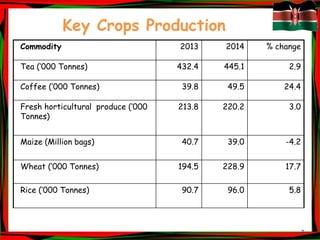
Key Crops Production
Commodity 2013 2014 % change
Tea (‘000 Tonnes) 432.4 445.1 2.9
Coffee (‘000 Tonnes) 39.8 49.5 24.4
Fresh horticultural produce (‘000
Tonnes)
213.8 220.2 3.0
Maize (Million bags) 40.7 39.0 -4.2
Wheat (‘000 Tonnes) 194.5 228.9 17.7
Rice (‘000 Tonnes) 90.7 96.0 5.8
8
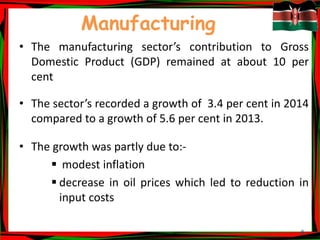
Manufacturing
• The manufacturing sector’s contribution to Gross
Domestic Product (GDP) remained at about 10 per
cent
• The sector’s recorded a growth of 3.4 per cent in 2014
compared to a growth of 5.6 per cent in 2013.
• The growth was partly due to:-
 modest inflation
 decrease in oil prices which led to reduction in
input costs
9
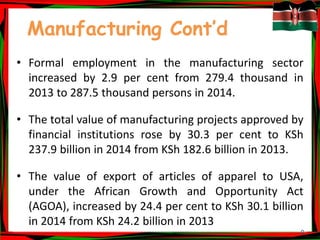
Manufacturing Cont’d
• Formal employment in the manufacturing sector
increased by 2.9 per cent from 279.4 thousand in
2013 to 287.5 thousand persons in 2014.
• The total value of manufacturing projects approved by
financial institutions rose by 30.3 per cent to KSh
237.9 billion in 2014 from KSh 182.6 billion in 2013.
• The value of export of articles of apparel to USA,
under the African Growth and Opportunity Act
(AGOA), increased by 24.4 per cent to KSh 30.1 billion
in 2014 from KSh 24.2 billion in 2013
10
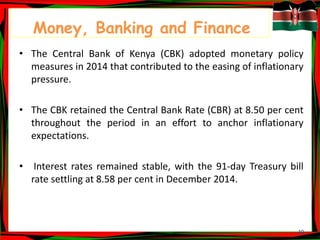
Money, Banking and Finance
• The Central Bank of Kenya (CBK) adopted monetary policy
measures in 2014 that contributed to the easing of inflationary
pressure.
• The CBK retained the Central Bank Rate (CBR) at 8.50 per cent
throughout the period in an effort to anchor inflationary
expectations.
• Interest rates remained stable, with the 91-day Treasury bill
rate settling at 8.58 per cent in December 2014.
11
Money, Banking and Finance Cont’d
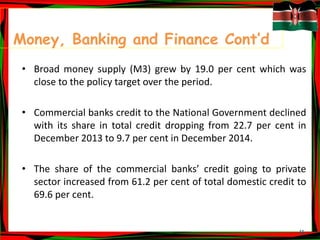
• Broad money supply (M3) grew by 19.0 per cent which was
close to the policy target over the period.
• Commercial banks credit to the National Government declined
with its share in total credit dropping from 22.7 per cent in
December 2013 to 9.7 per cent in December 2014.
• The share of the commercial banks’ credit going to private
sector increased from 61.2 per cent of total domestic credit to
69.6 per cent.
12
Stock Market
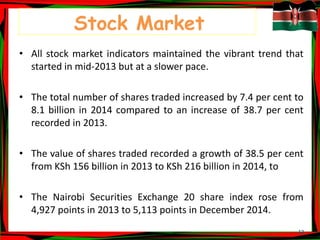
• All stock market indicators maintained the vibrant trend that
started in mid-2013 but at a slower pace.
• The total number of shares traded increased by 7.4 per cent to
8.1 billion in 2014 compared to an increase of 38.7 per cent
recorded in 2013.
• The value of shares traded recorded a growth of 38.5 per cent
from KSh 156 billion in 2013 to KSh 216 billion in 2014, to
• The Nairobi Securities Exchange 20 share index rose from
4,927 points in 2013 to 5,113 points in December 2014.
13
Inflation
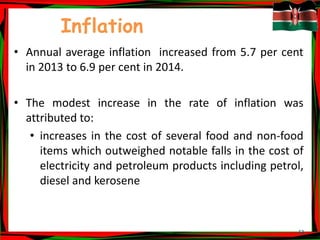
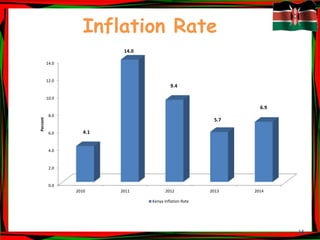
• Annual average inflation increased from 5.7 per cent
in 2013 to 6.9 per cent in 2014.
• The modest increase in the rate of inflation was
attributed to:
• increases in the cost of several food and non-food
items which outweighed notable falls in the cost of
electricity and petroleum products including petrol,
diesel and kerosene
14
Inflation Rate
0.0
2.0
4.0
6.0
8.0
10.0
12.0
14.0
2010 2011 2012 2013 2014
4.1
14.0
9.4
5.7
6.9
Percent
Kenya Inflation Rate
15
Tourism
• The number of international visitor arrivals contracted
by 11.1 per cent from 1.52 million in 2013 to 1.35 million
in 2014.
• Tourism earnings declined by 7.3 per cent from KSh 94.0
billion to KSh 87.1 billion over the same period.
• Factors that impacted negatively on the tourism sector
include:
– security concerns , negative travel advisories and fear of
spread of Ebola.
16
Tourism Cont’d
• The number of bed-nights occupied declined from 6.6
million in 2013 to 6.3 million in 2014.
• The number of international conferences decreased
by 19.4 per cent to 241 in 2014 from 299 in 2013
• However, the number of local conferences held
increased by 8.0 per cent from 2,849 in 2013 to 3,077
in 2014.
17
Building and Construction
• The Building and Construction sector registered an
accelerated growth of 13.1 per cent in 2014 compared
to a revised growth of 5.8 per cent in 2013.
• This growth is attributed to an increase in funds
allocated to construction of roads and railways
coupled with rehabilitation of existing road network.
18
Building and Construction
Cont’d
• Cement consumption, a key indicator in the
construction industry, grew by 21.8 per cent in 2014
to 5.2 million tonnes.
• Commercial bank credit extended to the sector
grew by 13.6 per cent from KSh 70.8 billion in 2013
to KSh 80.4 billion in 2014
19
Energy
• International crude oil prices plummeted by more
than 40 per cent to 60.65 US Dollars per barrel in
December 2014.
• This translated to reduced domestic petroleum pump
prices. As at December, diesel prices declined from an
average of KSh 105.44 per litre in 2013 to KSh 91.79
per litre in 2014
• Total quantity of petroleum products imported
increased by 12.5 per cent to 4.5 million tonnes in
2014 from 4.0 million tonnes in 2013
20
Energy Cont’d
• Import bill of the petroleum products expanded by
5.6 per cent to KSh 333.1 billion.
• Total domestic demand for petroleum products
increased by 5.3 per cent to 3.9 million tonnes in
2014.
• Total capacity installed expanded by 4.7 per cent from
1,717.8 MW in 2013 to 1,798.3 MW in 2014 mainly
due to increased geothermal capacity.
21
Energy Cont’d
• Total electricity generation expanded by 8.2 per cent
to 9,138.7 GWh in 2014.
• Domestic demand for electricity registered a growth
of 3.8 per cent to 7,768.6 GWh in 2014 from 6,928.1
GWh in 2013.
• The number of customers connected under the Rural
Electrification Programme expanded by 16.5 per cent
to 528,552 as at July 2014.
22
Transport and Storage
• The Transport and Storage sector registered a growth
of 5.0 per cent in 2014 compared to a growth of 1.22
per cent in 2013.
• Output value for the road transport sub-sector rose by
15.2 per cent to KSh 600.2 billion in 2014.
• Total freight traffic via rail expanded by 24.3 per cent
from 1.2million tonnes in 2013 to 1.5 million tonnes in
2014.
23
Transport and Storage Cont’d
• The Port of Mombasa recorded a growth of 11.7 per cent
in total cargo throughput handled from 22.3 million
tonnes in 2013 to 24.9 million tonnes in 2014.
• Container traffic handled by the port stood at 1,012.0
thousand Twenty-foot Equivalent Units (TEUs) in 2014
compared to 894.0 thousand TEUs in 2013.
24
Transport and Storage Cont’d
• The volume of white petroleum products transported
via pipeline expanded by 7.7 per cent to 5.6 million
cubic metres over the review period.
• Total air passenger and cargo traffic handled at the
airports rose by 7.9 and 6.8 per cent, respectively, in
2014.
• The total number of newly registered motor vehicles
recorded a 9.1 per cent increase from 94,017 units in
2013 to 102,606 units in 2014
25
Information Communication and
Technology
• ICT sector expanded by 13.4 per cent in 2014 from 12.3 per cent
growth recorded in 2013.
• Internet penetration stood at 38.3 per cent in the year under
review.
• Total domestic Short Messaging Services (SMS) sent increased by
38.5 per cent to 27.5 billion SMS in 2014.
• In 2014, the mobile money subscriptions reached at 26.0 million,
representing a penetration rate of 60.6 per cent to the total
population.
26
Information Communication and
Technology Cont’d
• The cash deposits made via the mobile money agents
reached KSh 1,269 billion in 2014 up from KSh 1,033
billion in 2013 while the total transfers increased by
24.7 per cent to KSh 2,372 billion up from KSh1,902
billion in 2013.
• The broadcasting sub section, implemented the digital
migration in the country, which added 36 digital
Kenyan TV stations to the existing 14 analogue
stations.
27
International Trade
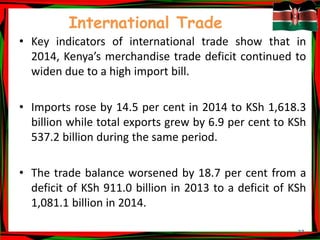
• Key indicators of international trade show that in
2014, Kenya’s merchandise trade deficit continued to
widen due to a high import bill.
• Imports rose by 14.5 per cent in 2014 to KSh 1,618.3
billion while total exports grew by 6.9 per cent to KSh
537.2 billion during the same period.
• The trade balance worsened by 18.7 per cent from a
deficit of KSh 911.0 billion in 2013 to a deficit of KSh
1,081.1 billion in 2014.
28
International Trade Cont’d
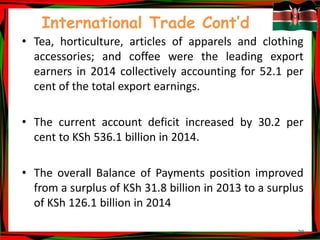
• Tea, horticulture, articles of apparels and clothing
accessories; and coffee were the leading export
earners in 2014 collectively accounting for 52.1 per
cent of the total export earnings.
• The current account deficit increased by 30.2 per
cent to KSh 536.1 billion in 2014.
• The overall Balance of Payments position improved
from a surplus of KSh 31.8 billion in 2013 to a surplus
of KSh 126.1 billion in 2014
29
Social sector
30
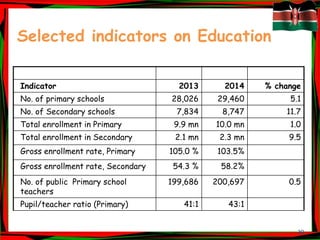
Selected indicators on Education
Indicator 2013 2014 % change
No. of primary schools 28,026 29,460 5.1
No. of Secondary schools 7,834 8,747 11.7
Total enrollment in Primary 9.9 mn 10.0 mn 1.0
Total enrollment in Secondary 2.1 mn 2.3 mn 9.5
Gross enrollment rate, Primary 105.0 % 103.5%
Gross enrollment rate, Secondary 54.3 % 58.2%
No. of public Primary school
teachers
199,686 200,697 0.5
Pupil/teacher ratio (Primary) 41:1 43:1
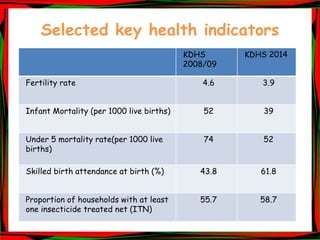
Selected key health indicators
KDHS
2008/09
KDHS 2014
Fertility rate 4.6 3.9
Infant Mortality (per 1000 live births) 52 39
Under 5 mortality rate(per 1000 live
births)
74 52
Skilled birth attendance at birth (%) 43.8 61.8
Proportion of households with at least
one insecticide treated net (ITN)
55.7 58.7
32
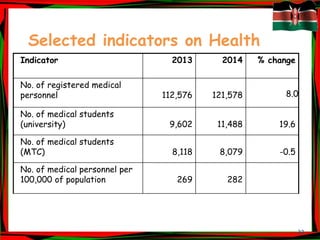
Selected indicators on Health
Indicator 2013 2014 % change
No. of registered medical
personnel 112,576 121,578 8.0
No. of medical students
(university) 9,602 11,488 19.6
No. of medical students
(MTC) 8,118 8,079 -0.5
No. of medical personnel per
100,000 of population 269 282
33
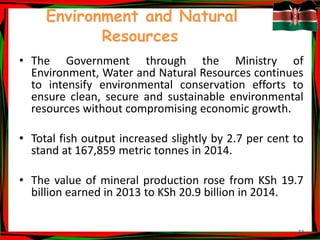
Environment and Natural
Resources
• The Government through the Ministry of
Environment, Water and Natural Resources continues
to intensify environmental conservation efforts to
ensure clean, secure and sustainable environmental
resources without compromising economic growth.
• Total fish output increased slightly by 2.7 per cent to
stand at 167,859 metric tonnes in 2014.
• The value of mineral production rose from KSh 19.7
billion earned in 2013 to KSh 20.9 billion in 2014.
34
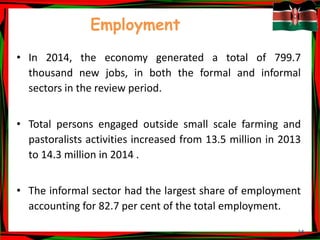
Employment
• In 2014, the economy generated a total of 799.7
thousand new jobs, in both the formal and informal
sectors in the review period.
• Total persons engaged outside small scale farming and
pastoralists activities increased from 13.5 million in 2013
to 14.3 million in 2014 .
• The informal sector had the largest share of employment
accounting for 82.7 per cent of the total employment.
35
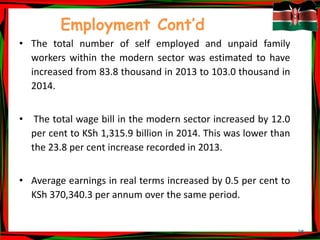
Employment Cont’d
• The total number of self employed and unpaid family
workers within the modern sector was estimated to have
increased from 83.8 thousand in 2013 to 103.0 thousand in
2014.
• The total wage bill in the modern sector increased by 12.0
per cent to KSh 1,315.9 billion in 2014. This was lower than
the 23.8 per cent increase recorded in 2013.
• Average earnings in real terms increased by 0.5 per cent to
KSh 370,340.3 per annum over the same period.
36
Governance
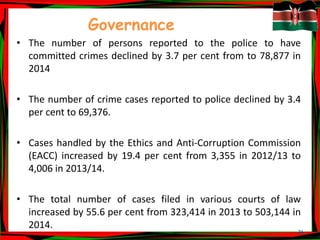
• The number of persons reported to the police to have
committed crimes declined by 3.7 per cent from to 78,877 in
2014
• The number of crime cases reported to police declined by 3.4
per cent to 69,376.
• Cases handled by the Ethics and Anti-Corruption Commission
(EACC) increased by 19.4 per cent from 3,355 in 2012/13 to
4,006 in 2013/14.
• The total number of cases filed in various courts of law
increased by 55.6 per cent from 323,414 in 2013 to 503,144 in
2014.
37
Governance Cont’d
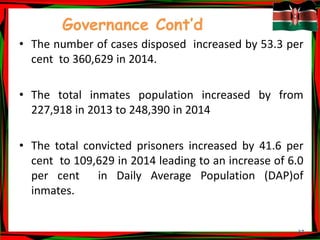
• The number of cases disposed increased by 53.3 per
cent to 360,629 in 2014.
• The total inmates population increased by from
227,918 in 2013 to 248,390 in 2014
• The total convicted prisoners increased by 41.6 per
cent to 109,629 in 2014 leading to an increase of 6.0
per cent in Daily Average Population (DAP)of
inmates.
38
Governance
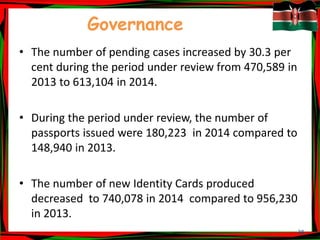
• The number of pending cases increased by 30.3 per
cent during the period under review from 470,589 in
2013 to 613,104 in 2014.
• During the period under review, the number of
passports issued were 180,223 in 2014 compared to
148,940 in 2013.
• The number of new Identity Cards produced
decreased to 740,078 in 2014 compared to 956,230
in 2013.
39
Domestic Economy
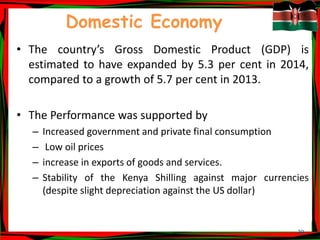
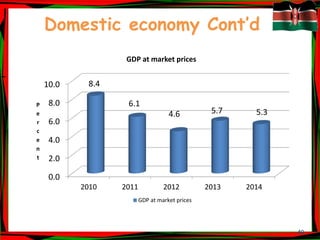
• The country’s Gross Domestic Product (GDP) is
estimated to have expanded by 5.3 per cent in 2014,
compared to a growth of 5.7 per cent in 2013.
• The Performance was supported by
– Increased government and private final consumption
– Low oil prices
– increase in exports of goods and services.
– Stability of the Kenya Shilling against major currencies
(despite slight depreciation against the US dollar)
40
Domestic economy Cont’d
-
0.0
2.0
4.0
6.0
8.0
10.0
2010 2011 2012 2013 2014
8.4
6.1
4.6 5.7 5.3
P
e
r
c
e
n
t
GDP at market prices
41
Contribution to Growth
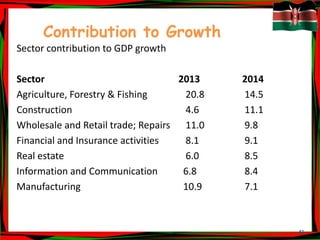
Sector contribution to GDP growth
Sector 2013 2014
Agriculture, Forestry & Fishing 20.8 14.5
Construction 4.6 11.1
Wholesale and Retail trade; Repairs 11.0 9.8
Financial and Insurance activities 8.1 9.1
Real estate 6.0 8.5
Information and Communication 6.8 8.4
Manufacturing 10.9 7.1
42
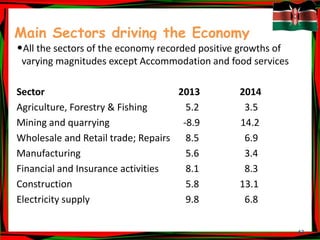
Main Sectors driving the Economy
•All the sectors of the economy recorded positive growths of
varying magnitudes except Accommodation and food services
Sector 2013 2014
Agriculture, Forestry & Fishing 5.2 3.5
Mining and quarrying -8.9 14.2
Wholesale and Retail trade; Repairs 8.5 6.9
Manufacturing 5.6 3.4
Financial and Insurance activities 8.1 8.3
Construction 5.8 13.1
Electricity supply 9.8 6.8
43
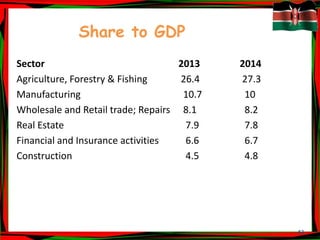
Share to GDP
Sector 2013 2014
Agriculture, Forestry & Fishing 26.4 27.3
Manufacturing 10.7 10
Wholesale and Retail trade; Repairs 8.1 8.2
Real Estate 7.9 7.8
Financial and Insurance activities 6.6 6.7
Construction 4.5 4.8
44
Economic outlook 2015
45
Economic Outlook for 2015
Global Economy
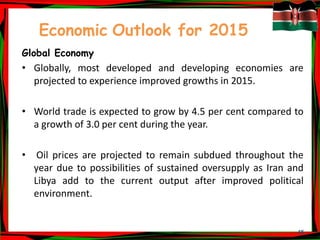
• Globally, most developed and developing economies are
projected to experience improved growths in 2015.
• World trade is expected to grow by 4.5 per cent compared to
a growth of 3.0 per cent during the year.
• Oil prices are projected to remain subdued throughout the
year due to possibilities of sustained oversupply as Iran and
Libya add to the current output after improved political
environment.
46
Economic Outlook for 2015
Global Economy
• Based on these projections, the global economic prospects for
2015 is therefore bright with world real GDP projected to grow
at 3.5 per cent in 2015 subject to continued recovery from the
global financial crisis.
• This is expected to impact positively on Kenya’s economic
growth.
47
Economic Outlook for 2015
Domestic Economy
• The country experienced depressed rainfall during first quarter
of 2015 while weather forecast points to a possibility of
insufficient long rains in parts of the country.
• Performance of the agriculture sector is therefore likely to
remain close to the 2014 level due to its over-reliance on rain
fed water.
• On average, electricity prices might fall slightly in 2015 due to
increased share of geothermal electricity generation.
48
Economic Outlook for 2015
Domestic Economy
• Inflation is projected to ease in 2015 supported by lower
prices of oil and electricity.
• Improved external environment and a sustained strong
internal demand are likely to favour growths in many sectors
of the economy this year.
• The ratio of current account to GDP is expected to remain
close to the level of 2014.
49
Economic Outlook for 2015
Domestic Economy
• The Government fiscal policies in the 2015/16 national budget
will focus on re-orientation of expenditure from recurrent to
development while private sector investment is anticipated to
remain vibrant.
• Other macroeconomic indicators are projected to remain
stable and supportive of growth in 2015.
• Investments in the construction industry is likely to remain
robust against a background of stable interest rates coupled
with the ongoing government infrastructural projects and the
private sector's resilient participation especially in the real
estate development.
Policy interventions
Agriculture
To spur growth in the sector, the Government will endeavor to:-
• Step up efforts aimed at increasing the adoption of
commercial agriculture
• Reduce the cost of farm inputs to ensure affordability
• Increase the level of mechanization in farming practices
• Fast track the construction of fertilizer factory to reduce the
price of fertilizer and therefore encourage its use.
• Promote good agricultural husbandry especially with regard to
agricultural exports
• Reduce rain dependency by expanding land under irrigation
Policy intervention Cont’d
Manufacturing
• Fast track the ongoing efforts aimed at reducing the cost of
production
• Diversification of manufactured products
• Fast track the enactment of Special Economic Zones (SEZ) bill
and facilitate the establishment of SEZ’s and industrial parks
Policy intervention Cont’d
Tourism
To address challenges in the sector, the following measures need
to be undertaken:-
• To find a long lasting solution to address insecurity
• Diversify and intensify efforts to attract visitors particularly
from emerging economies such as China, India, Middle East
and Brazil amongst others
• To aggressively conduct marketing of the country as preferred
destination for tourists
Policy intervention Cont’d
Trade
To promote exports and improve balance of trade the
Government should;
• Facilitate establishment of SEZ and provide tax and other
incentives to exporters
• Put in place measures to facilitate export growth such as
establishment of Special Economic Zones (SEZ).
• Facilitate bilateral arrangements with regional trading
economic blocks to enhance trade
• Improve the competitiveness of Kenyan products
54
Closing Remarks
 I take this opportunity to thank all of you for attending the
Launch of this year’s Economic Survey
 My sincere appreciation once again goes to all the data
producers, both large and small establishments, for their
valuable input into this report
 I once again appeal to all data producers, who are still
hesitant to provide data to do so, as this information is
crucial in the planning and development of our country
55
Closing Remarks
• My special thanks goes to the KNBS Board of Directors,
Director General and entire staff of KNBS who have worked
tirelessly to make the production of this document a success
• Finally, it is my pleasure to now declare the Economic Survey
2015 Report officially launched
56
Thank You

Technical presentation on es2015 24042015 1 final 2

  • 1.
    2015 ECONOMIC SURVEY REPORT HIGHLIGHTS Presented by Ms. Anne,Waiguru, OGW CABINET SECRETARY MINISTRY OF DEVOLUTION AND PLANNING 29TH APRIL 2015
  • 2.
    ECONOMIC SURVEY 2015 Outline •International scene • Highlights of the country’s economic performance in 2014 • Highlights of key Social and Governance statistics in 2014 • Economic outlook for 2015
  • 3.
    3 International Scene • Theworld economy is estimated to have grown by 3.3 per cent in 2014. • This growth rate is similar to the revised growth of 3.3 per cent in 2013. • This low growth was due to – persistent weak import demand from advanced economies, – slower expansion of global supply chains and – shifts in demand towards less import intensive products.
  • 4.
    4 International Scene cont’d GDPGrowth Rates and Projections for Selected Countries Country 2013 2014 2015* USA 2.2 2.2 3.1 UK 1.7 3.0 2.7 Japan 1.5 0.4 0.8 Euro Area -0.4 0.8 1.1 China 7.7 7.4 7.1 Uganda 5.8 5.9 6.3 Tanzania 7.0 7.2 7.0 Rwanda 4.7 6.0 6.7 Burundi 4.5 4.7 4.8 South Africa 2.0 1.4 2.3 • Source: OECD and World Economic Outlook [IMF] *Projections
  • 5.
  • 6.
    6 Agriculture • Agricultural sectorin 2014 recorded a growth of 3.5 per cent compared to a growth of 5.2 per cent in 2013 • The Agricultural sector recorded mixed performance mainly attributable to erratic rains with some regions experiencing depressed rainfall. • The value of marketed agricultural production at current prices declined marginally from KSh 334.8 billion in 2013 to 333.2 billion in 2014.
  • 7.
    7 Key Crops Production Commodity2013 2014 % change Tea (‘000 Tonnes) 432.4 445.1 2.9 Coffee (‘000 Tonnes) 39.8 49.5 24.4 Fresh horticultural produce (‘000 Tonnes) 213.8 220.2 3.0 Maize (Million bags) 40.7 39.0 -4.2 Wheat (‘000 Tonnes) 194.5 228.9 17.7 Rice (‘000 Tonnes) 90.7 96.0 5.8
  • 8.
    8 Manufacturing • The manufacturingsector’s contribution to Gross Domestic Product (GDP) remained at about 10 per cent • The sector’s recorded a growth of 3.4 per cent in 2014 compared to a growth of 5.6 per cent in 2013. • The growth was partly due to:-  modest inflation  decrease in oil prices which led to reduction in input costs
  • 9.
    9 Manufacturing Cont’d • Formalemployment in the manufacturing sector increased by 2.9 per cent from 279.4 thousand in 2013 to 287.5 thousand persons in 2014. • The total value of manufacturing projects approved by financial institutions rose by 30.3 per cent to KSh 237.9 billion in 2014 from KSh 182.6 billion in 2013. • The value of export of articles of apparel to USA, under the African Growth and Opportunity Act (AGOA), increased by 24.4 per cent to KSh 30.1 billion in 2014 from KSh 24.2 billion in 2013
  • 10.
    10 Money, Banking andFinance • The Central Bank of Kenya (CBK) adopted monetary policy measures in 2014 that contributed to the easing of inflationary pressure. • The CBK retained the Central Bank Rate (CBR) at 8.50 per cent throughout the period in an effort to anchor inflationary expectations. • Interest rates remained stable, with the 91-day Treasury bill rate settling at 8.58 per cent in December 2014.
  • 11.
    11 Money, Banking andFinance Cont’d • Broad money supply (M3) grew by 19.0 per cent which was close to the policy target over the period. • Commercial banks credit to the National Government declined with its share in total credit dropping from 22.7 per cent in December 2013 to 9.7 per cent in December 2014. • The share of the commercial banks’ credit going to private sector increased from 61.2 per cent of total domestic credit to 69.6 per cent.
  • 12.
    12 Stock Market • Allstock market indicators maintained the vibrant trend that started in mid-2013 but at a slower pace. • The total number of shares traded increased by 7.4 per cent to 8.1 billion in 2014 compared to an increase of 38.7 per cent recorded in 2013. • The value of shares traded recorded a growth of 38.5 per cent from KSh 156 billion in 2013 to KSh 216 billion in 2014, to • The Nairobi Securities Exchange 20 share index rose from 4,927 points in 2013 to 5,113 points in December 2014.
  • 13.
    13 Inflation • Annual averageinflation increased from 5.7 per cent in 2013 to 6.9 per cent in 2014. • The modest increase in the rate of inflation was attributed to: • increases in the cost of several food and non-food items which outweighed notable falls in the cost of electricity and petroleum products including petrol, diesel and kerosene
  • 14.
    14 Inflation Rate 0.0 2.0 4.0 6.0 8.0 10.0 12.0 14.0 2010 20112012 2013 2014 4.1 14.0 9.4 5.7 6.9 Percent Kenya Inflation Rate
  • 15.
    15 Tourism • The numberof international visitor arrivals contracted by 11.1 per cent from 1.52 million in 2013 to 1.35 million in 2014. • Tourism earnings declined by 7.3 per cent from KSh 94.0 billion to KSh 87.1 billion over the same period. • Factors that impacted negatively on the tourism sector include: – security concerns , negative travel advisories and fear of spread of Ebola.
  • 16.
    16 Tourism Cont’d • Thenumber of bed-nights occupied declined from 6.6 million in 2013 to 6.3 million in 2014. • The number of international conferences decreased by 19.4 per cent to 241 in 2014 from 299 in 2013 • However, the number of local conferences held increased by 8.0 per cent from 2,849 in 2013 to 3,077 in 2014.
  • 17.
    17 Building and Construction •The Building and Construction sector registered an accelerated growth of 13.1 per cent in 2014 compared to a revised growth of 5.8 per cent in 2013. • This growth is attributed to an increase in funds allocated to construction of roads and railways coupled with rehabilitation of existing road network.
  • 18.
    18 Building and Construction Cont’d •Cement consumption, a key indicator in the construction industry, grew by 21.8 per cent in 2014 to 5.2 million tonnes. • Commercial bank credit extended to the sector grew by 13.6 per cent from KSh 70.8 billion in 2013 to KSh 80.4 billion in 2014
  • 19.
    19 Energy • International crudeoil prices plummeted by more than 40 per cent to 60.65 US Dollars per barrel in December 2014. • This translated to reduced domestic petroleum pump prices. As at December, diesel prices declined from an average of KSh 105.44 per litre in 2013 to KSh 91.79 per litre in 2014 • Total quantity of petroleum products imported increased by 12.5 per cent to 4.5 million tonnes in 2014 from 4.0 million tonnes in 2013
  • 20.
    20 Energy Cont’d • Importbill of the petroleum products expanded by 5.6 per cent to KSh 333.1 billion. • Total domestic demand for petroleum products increased by 5.3 per cent to 3.9 million tonnes in 2014. • Total capacity installed expanded by 4.7 per cent from 1,717.8 MW in 2013 to 1,798.3 MW in 2014 mainly due to increased geothermal capacity.
  • 21.
    21 Energy Cont’d • Totalelectricity generation expanded by 8.2 per cent to 9,138.7 GWh in 2014. • Domestic demand for electricity registered a growth of 3.8 per cent to 7,768.6 GWh in 2014 from 6,928.1 GWh in 2013. • The number of customers connected under the Rural Electrification Programme expanded by 16.5 per cent to 528,552 as at July 2014.
  • 22.
    22 Transport and Storage •The Transport and Storage sector registered a growth of 5.0 per cent in 2014 compared to a growth of 1.22 per cent in 2013. • Output value for the road transport sub-sector rose by 15.2 per cent to KSh 600.2 billion in 2014. • Total freight traffic via rail expanded by 24.3 per cent from 1.2million tonnes in 2013 to 1.5 million tonnes in 2014.
  • 23.
    23 Transport and StorageCont’d • The Port of Mombasa recorded a growth of 11.7 per cent in total cargo throughput handled from 22.3 million tonnes in 2013 to 24.9 million tonnes in 2014. • Container traffic handled by the port stood at 1,012.0 thousand Twenty-foot Equivalent Units (TEUs) in 2014 compared to 894.0 thousand TEUs in 2013.
  • 24.
    24 Transport and StorageCont’d • The volume of white petroleum products transported via pipeline expanded by 7.7 per cent to 5.6 million cubic metres over the review period. • Total air passenger and cargo traffic handled at the airports rose by 7.9 and 6.8 per cent, respectively, in 2014. • The total number of newly registered motor vehicles recorded a 9.1 per cent increase from 94,017 units in 2013 to 102,606 units in 2014
  • 25.
    25 Information Communication and Technology •ICT sector expanded by 13.4 per cent in 2014 from 12.3 per cent growth recorded in 2013. • Internet penetration stood at 38.3 per cent in the year under review. • Total domestic Short Messaging Services (SMS) sent increased by 38.5 per cent to 27.5 billion SMS in 2014. • In 2014, the mobile money subscriptions reached at 26.0 million, representing a penetration rate of 60.6 per cent to the total population.
  • 26.
    26 Information Communication and TechnologyCont’d • The cash deposits made via the mobile money agents reached KSh 1,269 billion in 2014 up from KSh 1,033 billion in 2013 while the total transfers increased by 24.7 per cent to KSh 2,372 billion up from KSh1,902 billion in 2013. • The broadcasting sub section, implemented the digital migration in the country, which added 36 digital Kenyan TV stations to the existing 14 analogue stations.
  • 27.
    27 International Trade • Keyindicators of international trade show that in 2014, Kenya’s merchandise trade deficit continued to widen due to a high import bill. • Imports rose by 14.5 per cent in 2014 to KSh 1,618.3 billion while total exports grew by 6.9 per cent to KSh 537.2 billion during the same period. • The trade balance worsened by 18.7 per cent from a deficit of KSh 911.0 billion in 2013 to a deficit of KSh 1,081.1 billion in 2014.
  • 28.
    28 International Trade Cont’d •Tea, horticulture, articles of apparels and clothing accessories; and coffee were the leading export earners in 2014 collectively accounting for 52.1 per cent of the total export earnings. • The current account deficit increased by 30.2 per cent to KSh 536.1 billion in 2014. • The overall Balance of Payments position improved from a surplus of KSh 31.8 billion in 2013 to a surplus of KSh 126.1 billion in 2014
  • 29.
  • 30.
    30 Selected indicators onEducation Indicator 2013 2014 % change No. of primary schools 28,026 29,460 5.1 No. of Secondary schools 7,834 8,747 11.7 Total enrollment in Primary 9.9 mn 10.0 mn 1.0 Total enrollment in Secondary 2.1 mn 2.3 mn 9.5 Gross enrollment rate, Primary 105.0 % 103.5% Gross enrollment rate, Secondary 54.3 % 58.2% No. of public Primary school teachers 199,686 200,697 0.5 Pupil/teacher ratio (Primary) 41:1 43:1
  • 31.
    Selected key healthindicators KDHS 2008/09 KDHS 2014 Fertility rate 4.6 3.9 Infant Mortality (per 1000 live births) 52 39 Under 5 mortality rate(per 1000 live births) 74 52 Skilled birth attendance at birth (%) 43.8 61.8 Proportion of households with at least one insecticide treated net (ITN) 55.7 58.7
  • 32.
    32 Selected indicators onHealth Indicator 2013 2014 % change No. of registered medical personnel 112,576 121,578 8.0 No. of medical students (university) 9,602 11,488 19.6 No. of medical students (MTC) 8,118 8,079 -0.5 No. of medical personnel per 100,000 of population 269 282
  • 33.
    33 Environment and Natural Resources •The Government through the Ministry of Environment, Water and Natural Resources continues to intensify environmental conservation efforts to ensure clean, secure and sustainable environmental resources without compromising economic growth. • Total fish output increased slightly by 2.7 per cent to stand at 167,859 metric tonnes in 2014. • The value of mineral production rose from KSh 19.7 billion earned in 2013 to KSh 20.9 billion in 2014.
  • 34.
    34 Employment • In 2014,the economy generated a total of 799.7 thousand new jobs, in both the formal and informal sectors in the review period. • Total persons engaged outside small scale farming and pastoralists activities increased from 13.5 million in 2013 to 14.3 million in 2014 . • The informal sector had the largest share of employment accounting for 82.7 per cent of the total employment.
  • 35.
    35 Employment Cont’d • Thetotal number of self employed and unpaid family workers within the modern sector was estimated to have increased from 83.8 thousand in 2013 to 103.0 thousand in 2014. • The total wage bill in the modern sector increased by 12.0 per cent to KSh 1,315.9 billion in 2014. This was lower than the 23.8 per cent increase recorded in 2013. • Average earnings in real terms increased by 0.5 per cent to KSh 370,340.3 per annum over the same period.
  • 36.
    36 Governance • The numberof persons reported to the police to have committed crimes declined by 3.7 per cent from to 78,877 in 2014 • The number of crime cases reported to police declined by 3.4 per cent to 69,376. • Cases handled by the Ethics and Anti-Corruption Commission (EACC) increased by 19.4 per cent from 3,355 in 2012/13 to 4,006 in 2013/14. • The total number of cases filed in various courts of law increased by 55.6 per cent from 323,414 in 2013 to 503,144 in 2014.
  • 37.
    37 Governance Cont’d • Thenumber of cases disposed increased by 53.3 per cent to 360,629 in 2014. • The total inmates population increased by from 227,918 in 2013 to 248,390 in 2014 • The total convicted prisoners increased by 41.6 per cent to 109,629 in 2014 leading to an increase of 6.0 per cent in Daily Average Population (DAP)of inmates.
  • 38.
    38 Governance • The numberof pending cases increased by 30.3 per cent during the period under review from 470,589 in 2013 to 613,104 in 2014. • During the period under review, the number of passports issued were 180,223 in 2014 compared to 148,940 in 2013. • The number of new Identity Cards produced decreased to 740,078 in 2014 compared to 956,230 in 2013.
  • 39.
    39 Domestic Economy • Thecountry’s Gross Domestic Product (GDP) is estimated to have expanded by 5.3 per cent in 2014, compared to a growth of 5.7 per cent in 2013. • The Performance was supported by – Increased government and private final consumption – Low oil prices – increase in exports of goods and services. – Stability of the Kenya Shilling against major currencies (despite slight depreciation against the US dollar)
  • 40.
    40 Domestic economy Cont’d - 0.0 2.0 4.0 6.0 8.0 10.0 20102011 2012 2013 2014 8.4 6.1 4.6 5.7 5.3 P e r c e n t GDP at market prices GDP at market prices
  • 41.
    41 Contribution to Growth Sectorcontribution to GDP growth Sector 2013 2014 Agriculture, Forestry & Fishing 20.8 14.5 Construction 4.6 11.1 Wholesale and Retail trade; Repairs 11.0 9.8 Financial and Insurance activities 8.1 9.1 Real estate 6.0 8.5 Information and Communication 6.8 8.4 Manufacturing 10.9 7.1
  • 42.
    42 Main Sectors drivingthe Economy •All the sectors of the economy recorded positive growths of varying magnitudes except Accommodation and food services Sector 2013 2014 Agriculture, Forestry & Fishing 5.2 3.5 Mining and quarrying -8.9 14.2 Wholesale and Retail trade; Repairs 8.5 6.9 Manufacturing 5.6 3.4 Financial and Insurance activities 8.1 8.3 Construction 5.8 13.1 Electricity supply 9.8 6.8
  • 43.
    43 Share to GDP Sector2013 2014 Agriculture, Forestry & Fishing 26.4 27.3 Manufacturing 10.7 10 Wholesale and Retail trade; Repairs 8.1 8.2 Real Estate 7.9 7.8 Financial and Insurance activities 6.6 6.7 Construction 4.5 4.8
  • 44.
  • 45.
    45 Economic Outlook for2015 Global Economy • Globally, most developed and developing economies are projected to experience improved growths in 2015. • World trade is expected to grow by 4.5 per cent compared to a growth of 3.0 per cent during the year. • Oil prices are projected to remain subdued throughout the year due to possibilities of sustained oversupply as Iran and Libya add to the current output after improved political environment.
  • 46.
    46 Economic Outlook for2015 Global Economy • Based on these projections, the global economic prospects for 2015 is therefore bright with world real GDP projected to grow at 3.5 per cent in 2015 subject to continued recovery from the global financial crisis. • This is expected to impact positively on Kenya’s economic growth.
  • 47.
    47 Economic Outlook for2015 Domestic Economy • The country experienced depressed rainfall during first quarter of 2015 while weather forecast points to a possibility of insufficient long rains in parts of the country. • Performance of the agriculture sector is therefore likely to remain close to the 2014 level due to its over-reliance on rain fed water. • On average, electricity prices might fall slightly in 2015 due to increased share of geothermal electricity generation.
  • 48.
    48 Economic Outlook for2015 Domestic Economy • Inflation is projected to ease in 2015 supported by lower prices of oil and electricity. • Improved external environment and a sustained strong internal demand are likely to favour growths in many sectors of the economy this year. • The ratio of current account to GDP is expected to remain close to the level of 2014.
  • 49.
    49 Economic Outlook for2015 Domestic Economy • The Government fiscal policies in the 2015/16 national budget will focus on re-orientation of expenditure from recurrent to development while private sector investment is anticipated to remain vibrant. • Other macroeconomic indicators are projected to remain stable and supportive of growth in 2015. • Investments in the construction industry is likely to remain robust against a background of stable interest rates coupled with the ongoing government infrastructural projects and the private sector's resilient participation especially in the real estate development.
  • 50.
    Policy interventions Agriculture To spurgrowth in the sector, the Government will endeavor to:- • Step up efforts aimed at increasing the adoption of commercial agriculture • Reduce the cost of farm inputs to ensure affordability • Increase the level of mechanization in farming practices • Fast track the construction of fertilizer factory to reduce the price of fertilizer and therefore encourage its use. • Promote good agricultural husbandry especially with regard to agricultural exports • Reduce rain dependency by expanding land under irrigation
  • 51.
    Policy intervention Cont’d Manufacturing •Fast track the ongoing efforts aimed at reducing the cost of production • Diversification of manufactured products • Fast track the enactment of Special Economic Zones (SEZ) bill and facilitate the establishment of SEZ’s and industrial parks
  • 52.
    Policy intervention Cont’d Tourism Toaddress challenges in the sector, the following measures need to be undertaken:- • To find a long lasting solution to address insecurity • Diversify and intensify efforts to attract visitors particularly from emerging economies such as China, India, Middle East and Brazil amongst others • To aggressively conduct marketing of the country as preferred destination for tourists
  • 53.
    Policy intervention Cont’d Trade Topromote exports and improve balance of trade the Government should; • Facilitate establishment of SEZ and provide tax and other incentives to exporters • Put in place measures to facilitate export growth such as establishment of Special Economic Zones (SEZ). • Facilitate bilateral arrangements with regional trading economic blocks to enhance trade • Improve the competitiveness of Kenyan products
  • 54.
    54 Closing Remarks  Itake this opportunity to thank all of you for attending the Launch of this year’s Economic Survey  My sincere appreciation once again goes to all the data producers, both large and small establishments, for their valuable input into this report  I once again appeal to all data producers, who are still hesitant to provide data to do so, as this information is crucial in the planning and development of our country
  • 55.
    55 Closing Remarks • Myspecial thanks goes to the KNBS Board of Directors, Director General and entire staff of KNBS who have worked tirelessly to make the production of this document a success • Finally, it is my pleasure to now declare the Economic Survey 2015 Report officially launched
  • 56.