Technology Planning for Small Non-profits # 11NTCsmallplan Kristin Anderson Tony Brunswick Dan Shenk-Evans
Session Evaluation Each entry via text or web is a chance to win great NTEN prizes throughout the day!  Session Evaluations  Powered By: TEXT Text  #NTCsmallplan to  69866. ONLINE Use  #NTCsmallplan at http://nten.org/ntc/eval
Take-aways Assigning IT responsibilities in a small org How to prioritize IT decision-making Basic Elements of IT Budget
Agenda Introductions Overview Responsibility for IT Prioritizing IT Basic elements of IT Budget Executing the Budget Closing
Speakers Kristin Anderson Director of Operations, Congressional Hunger Center Tony Brunswick COO, LIFT Dan Shenk Evans IT Director, Capital Area Food Bank Johan Hammerstrom VP Client Services, Community IT Innovators
small IT
responsibility
Affirmation Technology  is  important, your organization needs to be focused on it Focusing on technology brings  tremendous value to your organization responsibility
Ownership Someone has to own IT They need to have authority Executive leadership needs to support them Having a point person has an impact What will fit with your culture? responsibility
Getting buy-in… Educate leadership in an inclusive way Be patient, be persistent Walk leadership through different scenarios Tell some good stories Set realistic expectations responsibility
Value of IT Return on investment Achieving the mission What your peers are doing Know what matters to leadership Impact on job satisfaction and retention responsibility
Dividing IT responsibilities Network Infrastructure Databases and data assets Financial Fundraising : CRM Programs Online communication Web site & Social Media responsibility
prioritizing
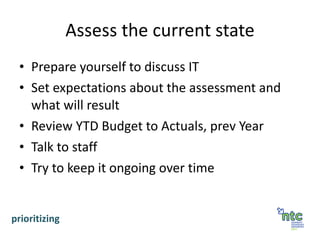
Assess the current state Prepare yourself to discuss IT Set expectations about the assessment and what will result Review YTD Budget to Actuals, prev Year Talk to staff Try to keep it ongoing over time prioritizing
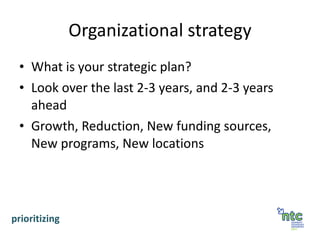
Organizational strategy What is your strategic plan? Look over the last 2-3 years, and 2-3 years ahead Growth, Reduction, New funding sources, New programs, New locations prioritizing
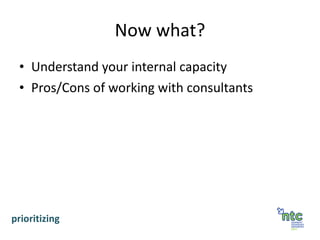
Now what? Understand your internal capacity Pros/Cons of working with consultants prioritizing
Consultant Pros Consultants have a wider range of skills Can be more candid Bring experience from many other organizations prioritizing
Consultant Cons Expendable – can be let go more easily, thus avoiding commitment to IT Variable – can be brought in at insufficient levels Potential trust issues More expensive Have to learn the business prioritizing
budgeting
Hardware Network Switches Firewall Servers Cloud Virtualization & consolidation budgeting
Hardware Workstations Replace every 3-5 years Align with your funding Cascade down to interns, volunteers Laptops Replace every 3 years Support contract and warranty Budget for eCycling! budgeting
Software Hosting Host locally? Migrate to the cloud? Routine upgrades Upgrade server OS Upgrade Office version budgeting
Security Backup  Local devices Hosted service Anti-virus Local software Email & Web filtering Passwords budgeting
Ongoing Contracts Internet Services Internet Connection Web-hosting Domain name Annual Support Contracts Hardware Software budgeting
People IT Support: In-house Volunteer Support firm Training to use software IT Acceptable Use Policy budgeting
execution
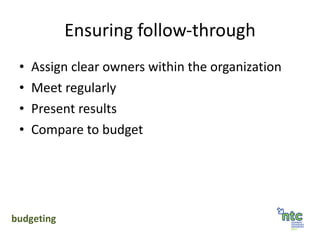
Ensuring follow-through Assign clear owners within the organization Meet regularly Present results Compare to budget budgeting
www.citidc.com/ntc this presentation budget spreadsheet template  additional resources contact info
Session Evaluation Each entry via text or web is a chance to win great NTEN prizes throughout the day!  Session Evaluations  Powered By: TEXT Text  #NTCsmallplan to  69866. ONLINE Use  #NTCsmallplan at http://nten.org/ntc/eval

Tech Plan 4 Small NPOs - Hammerstrom

  • 1.
    Technology Planning forSmall Non-profits # 11NTCsmallplan Kristin Anderson Tony Brunswick Dan Shenk-Evans
  • 2.
    Session Evaluation Eachentry via text or web is a chance to win great NTEN prizes throughout the day! Session Evaluations Powered By: TEXT Text #NTCsmallplan to 69866. ONLINE Use #NTCsmallplan at http://nten.org/ntc/eval
  • 3.
    Take-aways Assigning ITresponsibilities in a small org How to prioritize IT decision-making Basic Elements of IT Budget
  • 4.
    Agenda Introductions OverviewResponsibility for IT Prioritizing IT Basic elements of IT Budget Executing the Budget Closing
  • 5.
    Speakers Kristin AndersonDirector of Operations, Congressional Hunger Center Tony Brunswick COO, LIFT Dan Shenk Evans IT Director, Capital Area Food Bank Johan Hammerstrom VP Client Services, Community IT Innovators
  • 6.
  • 7.
  • 8.
    Affirmation Technology is important, your organization needs to be focused on it Focusing on technology brings tremendous value to your organization responsibility
  • 9.
    Ownership Someone hasto own IT They need to have authority Executive leadership needs to support them Having a point person has an impact What will fit with your culture? responsibility
  • 10.
    Getting buy-in… Educateleadership in an inclusive way Be patient, be persistent Walk leadership through different scenarios Tell some good stories Set realistic expectations responsibility
  • 11.
    Value of ITReturn on investment Achieving the mission What your peers are doing Know what matters to leadership Impact on job satisfaction and retention responsibility
  • 12.
    Dividing IT responsibilitiesNetwork Infrastructure Databases and data assets Financial Fundraising : CRM Programs Online communication Web site & Social Media responsibility
  • 13.
  • 14.
    Assess the currentstate Prepare yourself to discuss IT Set expectations about the assessment and what will result Review YTD Budget to Actuals, prev Year Talk to staff Try to keep it ongoing over time prioritizing
  • 15.
    Organizational strategy Whatis your strategic plan? Look over the last 2-3 years, and 2-3 years ahead Growth, Reduction, New funding sources, New programs, New locations prioritizing
  • 16.
    Now what? Understandyour internal capacity Pros/Cons of working with consultants prioritizing
  • 17.
    Consultant Pros Consultantshave a wider range of skills Can be more candid Bring experience from many other organizations prioritizing
  • 18.
    Consultant Cons Expendable– can be let go more easily, thus avoiding commitment to IT Variable – can be brought in at insufficient levels Potential trust issues More expensive Have to learn the business prioritizing
  • 19.
  • 20.
    Hardware Network SwitchesFirewall Servers Cloud Virtualization & consolidation budgeting
  • 21.
    Hardware Workstations Replaceevery 3-5 years Align with your funding Cascade down to interns, volunteers Laptops Replace every 3 years Support contract and warranty Budget for eCycling! budgeting
  • 22.
    Software Hosting Hostlocally? Migrate to the cloud? Routine upgrades Upgrade server OS Upgrade Office version budgeting
  • 23.
    Security Backup Local devices Hosted service Anti-virus Local software Email & Web filtering Passwords budgeting
  • 24.
    Ongoing Contracts InternetServices Internet Connection Web-hosting Domain name Annual Support Contracts Hardware Software budgeting
  • 25.
    People IT Support:In-house Volunteer Support firm Training to use software IT Acceptable Use Policy budgeting
  • 26.
  • 27.
    Ensuring follow-through Assignclear owners within the organization Meet regularly Present results Compare to budget budgeting
  • 28.
    www.citidc.com/ntc this presentationbudget spreadsheet template additional resources contact info
  • 29.
    Session Evaluation Eachentry via text or web is a chance to win great NTEN prizes throughout the day! Session Evaluations Powered By: TEXT Text #NTCsmallplan to 69866. ONLINE Use #NTCsmallplan at http://nten.org/ntc/eval

Editor's Notes

  • #2 slide owner: Johan
  • #3 slide owner: Johan
  • #4 slide owner: Johan
  • #5 slide owner: Johan
  • #6 slide owner: Johan Each panelists introduces themselves with a brief discussion of… What you do now Size of your organization Interest in the topic Background in IT
  • #7 slide owner: Johan What do we mean by small? Small in terms of capacity to manage IT. It generally means there isn’t a clearly-defined person whose primary job is to manage IT. In small orgs, most staff are focused on the program/mission, so no one is clearly responsible for IT, and, as a result, it languishes.
  • #8 slide owner: Johan Please hold your questions until the end of the section. Identifying who owns IT is the critical first step in managing it well.
  • #9 slide owner: Tony > Kristin > Dan
  • #10 slide owner: Kristin Someone has to step up and take ownership. Generally Ops or Admin staff…occasionally it’s Program staff, by necessity. Organizational culture needs to fit…collaborative approach may not work if there isn’t a clear budgetary authority You can assign someone to take on tasks related to IT, but they need to have access to the budget of IT
  • #11 slide owner: Kristin Need to convince key stakeholders that they should understand, realistically, the value that holistic technology planning brings to your business. Set a culture within the organization around the value of technology. You don’t have to be the strategist or the person who executes. Don’t be scared off by costs…there can be long-term benefits. Managing expectations is a key part of your approach. Set clear and realistic expectations. Encourage people to be creative in their abilities to sway leadership…don’t under-estimate what you can do with your leadership.
  • #12 slide owner: Tony
  • #13 slide owner: Dan IT is often one line item in an organization’s budget. These are the general buckets that IT usually falls into. Dividing IT responsibilities can make it easier to connect IT to strategy It can allows you to bring in more people as well.
  • #14 slide owner: Johan Let’s take questions for the first section If you are overwhelmed and don’t know where to start…prioritizing can help. You can’t focus on this enough…it’s very important.
  • #15 slide owner: Tony Share some ideas with them
  • #16 slide owner: Dan Connecting to strategy is how IT gets funding. Tony…some possible questions to ask What is it that we do? What is it that we want to do? What tools do we need to succeed? (These are the building blocks to strategy)
  • #17 slide owner: Kristin
  • #18 slide owner: Kristin
  • #19 slide owner: Kristin Tony: bring in consultants when you have a need, but no clearly defined role/position in the organization; hire in-house when you have the need and a clearly defined role/position
  • #20 slide owner: Johan Let’s take questions for the previous section Kristin: say something about learning how your organization does budgeting (ie. things like depreciation, capital vs. operating expenses, etc.)
  • #21 slide owner: Johan owns remaining slides
  • #24 Pause to allow panelists to speak to the importance of backups
  • #27 slide owner: Johan Let’s take questions for the previous section
  • #28 slide owner: Johan Allow panelists to say a few words. Final Q&A