TEARS:
    TIERED EMOTIONAL
          ACCESS AND
RESPONSIBILITY SYSTEM
          AN ACTION PLANNING METHOD


            CHANZO GREENIDGE, Ph.D.
   Emotional Connection and Assignment of
    Responsibility for Specific Actions are key
    elements to producing tangible benefits from any
    strategic planning process.

   The challenge for leaders and project managers
    is converting research and consultation into clear
    options for action and collaboration.

   This presentation presents an original method for
    doing so.

   Take a look and send me your feedback at
    chanzo7@bravocom.net


INTRODUCTION
   To execute TEARS, you need:

    ◦ 1) A facilitator
    ◦ 2) A tabulator (can be the same person)
    ◦ 3) Color-coded place-holders (where you sit
      impacts the group you’re in)
    ◦ 4) Scorecards and option sheets for everyone
    ◦ 5) Two separate rooms (no sound bleeding)
    ◦ 6) A good mix of stakeholders
    ◦ 7) Up to 10 well-researched options/concepts
    ◦ 8) Four-five hours with at least three breaks
    ◦ 9) Refreshments


WHAT YOU NEED
   The TEARS strategic planning method
    consists of four steps between research &
    consultations and results.

1)   Introductions (Intros & Option Sheets)
2)   Primary Ratings/Rankings
3)   Breakaway Groups/Option Development
4)   Secondary Rankings and Horse-trading


BREAKDOWN
   Introductions are 2-3 minute snapshots of
    each concept. The Facilitator should present
    these snapshots, up to 10 options.

   Introductions should be accompanied by one-
    page synopses of the concept or action item.

   At no time should the facilitator betray a
    preference, but it is important to be open to
    questions that allow the group to understand
    the context of each concept.


1) Intros
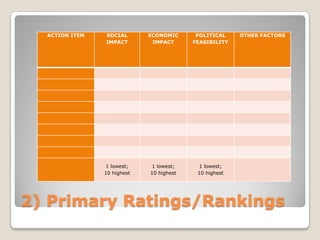
   A scorecard (see next slide) should
    accompany the options sheet outlining the
    main criteria (political feasibility, social
    impact, economic benefit etc).

   Participants are given 10-15 minutes to
    rate options on a scale from 1-10 (higher
    if discussing more than 10 options).


2) Primary Ratings/Rankings
ACTION ITEM   SOCIAL       ECONOMIC      POLITICAL    OTHER FACTORS
                IMPACT        IMPACT      FEASIBILITY


                 1 lowest;    1 lowest;     1 lowest;
                10 highest   10 highest    10 highest


2) Primary Ratings/Rankings
   The first key to TEARS is this approach to
    ranking.

   No rating can be the same for any two
    items, so this also becomes a ranking of
    these options.

   This forces participants to make early
    CHOICES about which options they think
    are better and reflect on why they would
    choose one option over another.

2) Primary Ratings/Ranking
   Breakaway Groups should be assigned
    before the management event begins or
    by participants selection of seats/folders
    etc. No leader should be assigned.

   Once the first tabulation of ratings is done
    in plenary, teams now go into separate
    rooms and are responsible for elaborating
    an equal number of action items (if
    possible).


3) Breakaway Groups
   Breakaway Groups decide in less than 1
    hour on implementation steps, data
    needs, and preliminary funding, training
    and human resource needs for each
    action item.

   The objective is that groups will develop
    an ‘affinity’ to their items independent of
    their original ratings and rankings as
    individuals.


3) Breakaway Groups
   The stage is now set. The groups present to
    each other on their elaboration work in 15
    minutes or less.

   The facilitator should not have been part of a
    group, though available to feed information
    to each of them. She now becomes the
    auctioneer.

   In this auction session, participants are free
    to change their individual ratings once more.


4) Horse-trading
   These secondary rankings are now tallied, and
    the results revealed in front of the plenary.

   Just this process will generated surprises and
    excite discussion as people see options they are
    emotionally and intellectually attached to now in
    danger.

   The facilitator informs the room that only one-
    four of the options can be taken up. Leave the
    door open for combining options and let the
    room talk.

   If a budget is available, decisions on financial
    priorities should be made as well.
4) Horse-trading
   The TEARS method is a results-oriented,
    participative way to achieve consensus
    through hard choices, team-building and
    negotiation.

   By the end of a TEARS session, participants
    have seen each option from a number of
    angles, have built coalitions, and are feeling
    responsible and motivated to make ‘their’
    option a success.

   The end result is a number of well-developed
    action items with established champions for
    integration into a strategic plan.

Closing the Deal

TEARS: An Emotionally Intelligent Action Planning Method

  • 1.
    TEARS: TIERED EMOTIONAL ACCESS AND RESPONSIBILITY SYSTEM AN ACTION PLANNING METHOD CHANZO GREENIDGE, Ph.D.
  • 2.
    Emotional Connection and Assignment of Responsibility for Specific Actions are key elements to producing tangible benefits from any strategic planning process.  The challenge for leaders and project managers is converting research and consultation into clear options for action and collaboration.  This presentation presents an original method for doing so.  Take a look and send me your feedback at chanzo7@bravocom.net INTRODUCTION
  • 3.
    To execute TEARS, you need: ◦ 1) A facilitator ◦ 2) A tabulator (can be the same person) ◦ 3) Color-coded place-holders (where you sit impacts the group you’re in) ◦ 4) Scorecards and option sheets for everyone ◦ 5) Two separate rooms (no sound bleeding) ◦ 6) A good mix of stakeholders ◦ 7) Up to 10 well-researched options/concepts ◦ 8) Four-five hours with at least three breaks ◦ 9) Refreshments WHAT YOU NEED
  • 4.
    The TEARS strategic planning method consists of four steps between research & consultations and results. 1) Introductions (Intros & Option Sheets) 2) Primary Ratings/Rankings 3) Breakaway Groups/Option Development 4) Secondary Rankings and Horse-trading BREAKDOWN
  • 5.
    Introductions are 2-3 minute snapshots of each concept. The Facilitator should present these snapshots, up to 10 options.  Introductions should be accompanied by one- page synopses of the concept or action item.  At no time should the facilitator betray a preference, but it is important to be open to questions that allow the group to understand the context of each concept. 1) Intros
  • 6.
    A scorecard (see next slide) should accompany the options sheet outlining the main criteria (political feasibility, social impact, economic benefit etc).  Participants are given 10-15 minutes to rate options on a scale from 1-10 (higher if discussing more than 10 options). 2) Primary Ratings/Rankings
  • 7.
    ACTION ITEM SOCIAL ECONOMIC POLITICAL OTHER FACTORS IMPACT IMPACT FEASIBILITY 1 lowest; 1 lowest; 1 lowest; 10 highest 10 highest 10 highest 2) Primary Ratings/Rankings
  • 8.
    The first key to TEARS is this approach to ranking.  No rating can be the same for any two items, so this also becomes a ranking of these options.  This forces participants to make early CHOICES about which options they think are better and reflect on why they would choose one option over another. 2) Primary Ratings/Ranking
  • 9.
    Breakaway Groups should be assigned before the management event begins or by participants selection of seats/folders etc. No leader should be assigned.  Once the first tabulation of ratings is done in plenary, teams now go into separate rooms and are responsible for elaborating an equal number of action items (if possible). 3) Breakaway Groups
  • 10.
    Breakaway Groups decide in less than 1 hour on implementation steps, data needs, and preliminary funding, training and human resource needs for each action item.  The objective is that groups will develop an ‘affinity’ to their items independent of their original ratings and rankings as individuals. 3) Breakaway Groups
  • 11.
    The stage is now set. The groups present to each other on their elaboration work in 15 minutes or less.  The facilitator should not have been part of a group, though available to feed information to each of them. She now becomes the auctioneer.  In this auction session, participants are free to change their individual ratings once more. 4) Horse-trading
  • 12.
    These secondary rankings are now tallied, and the results revealed in front of the plenary.  Just this process will generated surprises and excite discussion as people see options they are emotionally and intellectually attached to now in danger.  The facilitator informs the room that only one- four of the options can be taken up. Leave the door open for combining options and let the room talk.  If a budget is available, decisions on financial priorities should be made as well. 4) Horse-trading
  • 13.
    The TEARS method is a results-oriented, participative way to achieve consensus through hard choices, team-building and negotiation.  By the end of a TEARS session, participants have seen each option from a number of angles, have built coalitions, and are feeling responsible and motivated to make ‘their’ option a success.  The end result is a number of well-developed action items with established champions for integration into a strategic plan. Closing the Deal