R
                                     E
Case Study Competition               S
                                     I
Sustainability Network IIT Madras    D
                                     E
                                     N
                                     T
                                     I

   Urban Sustainability Strategies   A
                                     L
                                                       Indian Institute of
     for the City of Uttpravan       C
                                     O
                                             E
                                                      Technology Madras
                                     M   W       W
                                     M       N
                                     E   A       A
                                     R       E
                                         S       T
                                     C       R
                                     I   T       E
                                     A       G             Siddharth Pillai
                                         E       R
                                     L       Y       Engineering Physics, IIT Madras


                      Uttpravan      I                      Abinash Pati
                                     N               Engineering Physics, IIT Madras
                                     D
                                     U
                                     S
                                     T
                                     R
                                     I
                                     A
                                     L
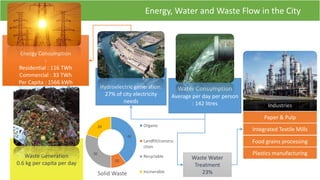
Energy, Water and Waste Flow in the City


 Energy Consumption
           :
Residential : 116 TWh
Commercial : 33 TWh
Per Capita : 1566 kWh
                                  Hydroelectric generation:            Water Consumption
                                   27% of city electricity         Average per day per person
                                           needs                           : 142 litres               Industries

                                                                                                     Paper & Pulp
                                 20                 Organic
                                                                                                Integrated Textile Mills
                                               40
                                                    Landfill/constru                            Food grains processing
                                                    ction

   Waste Generation         30
                                                    Recyclable
                                                                                                Plastics manufacturing
                                       10
                                                                           Waste Water
0.6 kg per capita per day                                                   Treatment
                                 Solid Waste        Incinerable                23%
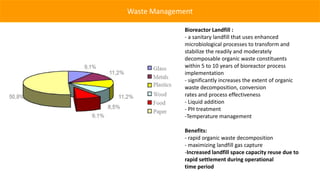
Waste Management

              Bioreactor Landfill :
              - a sanitary landfill that uses enhanced
              microbiological processes to transform and
              stabilize the readily and moderately
              decomposable organic waste constituents
              within 5 to 10 years of bioreactor process
              implementation
              - significantly increases the extent of organic
              waste decomposition, conversion
              rates and process effectiveness
              - Liquid addition
              - PH treatment
              -Temperature management

              Benefits:
              - rapid organic waste decomposition
              - maximizing landfill gas capture
              -Increased landfill space capacity reuse due to
              rapid settlement during operational
              time period
Waste Management – Paper and Pulp

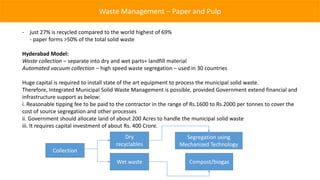
- just 27% is recycled compared to the world highest of 69%
  - paper forms >50% of the total solid waste

Hyderabad Model:
Waste collection – separate into dry and wet parts+ landfill material
Automated vacuum collection – high speed waste segregation – used in 30 countries

Huge capital is required to install state of the art equipment to process the municipal solid waste.
Therefore, Integrated Municipal Solid Waste Management is possible, provided Government extend financial and
infrastructure support as below:
i. Reasonable tipping fee to be paid to the contractor in the range of Rs.1600 to Rs.2000 per tonnes to cover the
cost of source segregation and other processes
ii. Government should allocate land of about 200 Acres to handle the municipal solid waste
iii. It requires capital investment of about Rs. 400 Crore.
                                          Dry                     Segregation using
                                      recyclables               Mechanized Technology
            Collection
                                      Wet waste                     Compost/biogas
Waste Management – Plastic

Primary recycling involves processing of a waste/scrap into a product with characteristics similar to those of
original product.

Secondary recycling involves processing of waste/scrap plastics into materials that have characteristics different
from those of original plastics product.

Tertiary recycling involves the production of basic chemicals and fuels from plastics waste/scrap as part of the
municipal waste stream or as a segregated waste.

Quaternary recycling retrieves the energy content of waste/scrap plastics by burning / incineration. This process
is not in use in India.

Polymer Coated Bitumen Road
• Good skid resistance and texture values.
• The unevenness index values of these roads are nearly 3000 mm/km, which indicate a good surface evenness.
• The plastic tar roads have not developed any potholes, rutting, raveling or edge flaw, even though these roads
   are more than four years of age.
• Higher percentage of polymer coating improves the binding strength of the mix.
Waste Management – Textile

Selection and Substitution of Chemicals used
• Substitution of conventional surfactants with high toxicity (e.g. Polyaromatic hydrocarbons APEO, NPE) by
   biodegradable or bioeliminable surfactants.
• Substitution of complexing agents by biodegradable or bioeliminable compounds that do not contain
   Nitrogen or Phosphor in their molecules


Install automated dosing and dispensing systems which measure the exact amount of chemicals and auxiliaries
required.
Combine desizing, scouring and bleaching in one single step for cotton woven fabrics and its blends with
synthetic fibres. New auxiliaries, formulations, automatic dosing and steamers allow the "Flash
Steam", procedure with telescopes desizing, alkaline cracking and pad-steam peroxide bleaching into a single
step.

ALSO : Minimise transport, at source management- so create a self sufficient society
Waste Management – Food grains

Bulking agent- high C:N ratio- like saw dust
From
DAIRY- Whey (4-5 lactose), 9 kg per 1 kg of cheese
fermentation- beverages and ethyl alcohol
concentration- protein foods
pasteurization- whey cream
MEAT- Animal feeding, Tallow for Cosmetics, slaughter house blood is rich in protein.
SUGAR Canning- bagasse,the fibrous residue can be used as fuel – minimise dependence on oil crops.
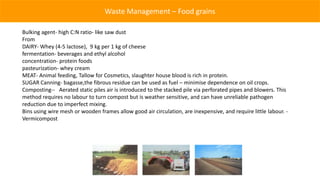
Composting-- Aerated static piles air is introduced to the stacked pile via perforated pipes and blowers. This
method requires no labour to turn compost but is weather sensitive, and can have unreliable pathogen
reduction due to imperfect mixing.
Bins using wire mesh or wooden frames allow good air circulation, are inexpensive, and require little labour. -
Vermicompost
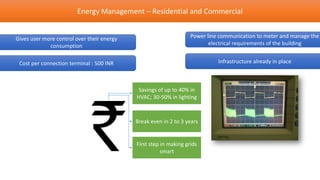
Energy Management – Residential and Commercial


Gives user more control over their energy                          Power line communication to meter and manage the
             consumption                                                  electrical requirements of the building


 Cost per connection terminal : 500 INR                                      Infrastructure already in place


                                             Savings of up to 40% in
                                            HVAC; 30-50% in lighting


                                            Break even in 2 to 3 years


                                            First step in making grids
                                                       smart
Energy Management - Industrial

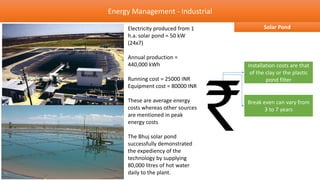
     Electricity produced from 1          Solar Pond
     h.a. solar pond = 50 kW
     (24x7)

     Annual production =
     440,000 kWh                   Installation costs are that
                                    of the clay or the plastic
     Running cost = 25000 INR              pond filter
     Equipment cost = 80000 INR

     These are average energy      Break even can vary from
     costs whereas other sources          3 to 7 years
     are mentioned in peak
     energy costs

     The Bhuj solar pond
     successfully demonstrated
     the expediency of the
     technology by supplying
     80,000 litres of hot water
     daily to the plant.
Energy Management - Industrial
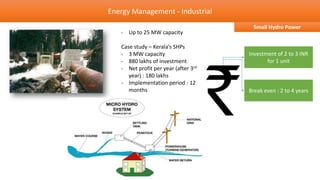
                                       Small Hydro Power
   - Up to 25 MW capacity

   Case study – Kerala’s SHPs
   - 3 MW capacity                    Investment of 2 to 3 INR
   - 880 lakhs of investment                 for 1 unit
   - Net profit per year (after 3rd
      year) : 180 lakhs
   - Implementation period : 12
      months                          Break even : 2 to 4 years
Water Management - Paper

We assume the average fresh specific water consumption of about 150 m3/ton (average figure
for India) of paper product, which is far above the global best specific water consumption of
28.66 m3/ton (for large scale wood based pulp and paper mill) .This large gap is primarily
attributed to the use of obsolete technology /equipments and poor water management
practices.

Zero discharge Concept-
the main objective in a zero discharge treatment system is to see that
i) does not generate any additional pollutants;
ii) production of waste is minimized by suitable selection of unit processes and adjusting
operating parameters;
iii)pollutants in the wastewater are transfered to solid phase (sludge);
iv) sludge is stored in a secured landfill;
v) recovery of reusable materials, especially water, is achieved and remnants directed to waste
recovery
Water Management – Food grains

reduce water consumption from 4,25,000 gallons/month to 3,00,000 gallons/month in a span of
1.5 years.

1) direct in-plant reuse (e.g., recovery of sugars from fruit canning),
2) sale to external markets (e.g. recovery of pasta starch for animal feed or for compost), or
3) use in energy recovery (e.g., through biological or thermo chemical gasification).

Source reduction
- Changing production procedures to minimize product or byproduct wastage, such as installing
spill collection trays to collect solids at appropriate places in the production line.
Modernizing water sprays to include jets or nozzles, using high-pressure low-volume washing
systems, and auto shut-off valves.

Emerging technology :
- Pneumatic transport- coffee bean plantations (vactrain)
-Process Modeling is a technique to use computers to optimize process conditions. Process
modeling will help fine-tune such input parameters as material or water flow
velocity, temperature, and chemical concentration.
Uses ANN and fuzzy based logic
Water Management – Food grains

Treatment:
Centrifugation, Evaporation, gravity separation and Filtration.

Biotreatment involves the use of a biological reactor that contains a high specific concentration of
either suspended or attached growth microorganisms As wastewater is passed through the
reactor, the microorganisms metabolize organic compounds into carbon dioxide.
Water Management – Textile

In the processes which are highly water-intensive, water is used to remove natural impurities and
wash out chemicals, and to keep concentrations low thereby allowing diffusion to proceed.

So any reduction in water usage gives liquors that are proportionally stronger, and a limit is reached
where further changes may be detrimental to the quality of the textile product.

Hydrogen peroxide can be used instead of calcium hypochlorite during actual bleaching operations
Segregation of streams based on TSS(total suspended solids)

different operations have different TSS. Rinsing, stone washing

Team greenbow

  • 1.
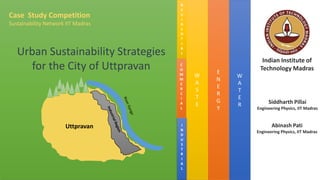
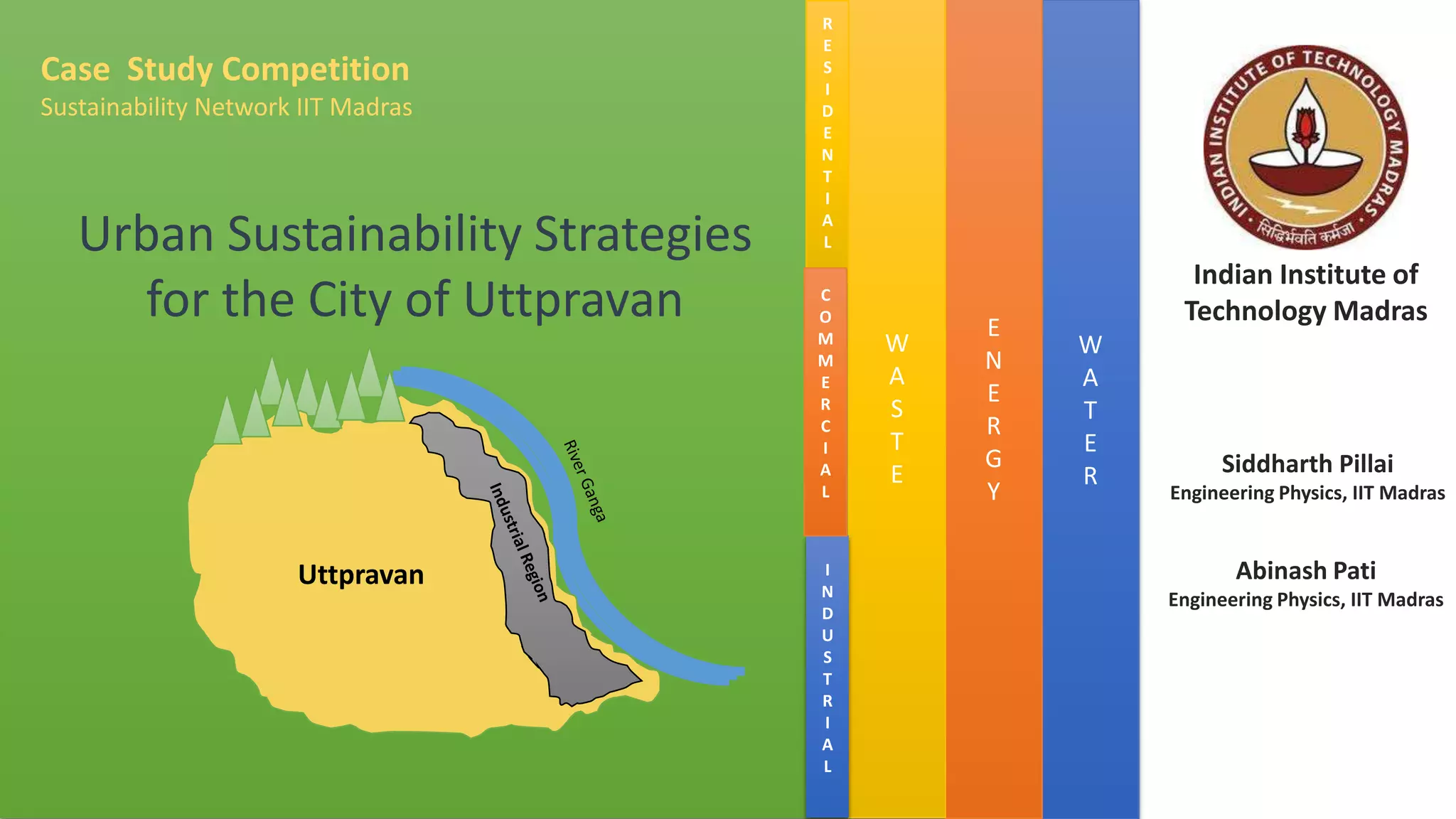
    R E Case Study Competition S I Sustainability Network IIT Madras D E N T I Urban Sustainability Strategies A L Indian Institute of for the City of Uttpravan C O E Technology Madras M W W M N E A A R E S T C R I T E A G Siddharth Pillai E R L Y Engineering Physics, IIT Madras Uttpravan I Abinash Pati N Engineering Physics, IIT Madras D U S T R I A L
  • 2.
    Energy, Water andWaste Flow in the City Energy Consumption : Residential : 116 TWh Commercial : 33 TWh Per Capita : 1566 kWh Hydroelectric generation: Water Consumption 27% of city electricity Average per day per person needs : 142 litres Industries Paper & Pulp 20 Organic Integrated Textile Mills 40 Landfill/constru Food grains processing ction Waste Generation 30 Recyclable Plastics manufacturing 10 Waste Water 0.6 kg per capita per day Treatment Solid Waste Incinerable 23%
  • 3.
    Waste Management Bioreactor Landfill : - a sanitary landfill that uses enhanced microbiological processes to transform and stabilize the readily and moderately decomposable organic waste constituents within 5 to 10 years of bioreactor process implementation - significantly increases the extent of organic waste decomposition, conversion rates and process effectiveness - Liquid addition - PH treatment -Temperature management Benefits: - rapid organic waste decomposition - maximizing landfill gas capture -Increased landfill space capacity reuse due to rapid settlement during operational time period
  • 4.
    Waste Management –Paper and Pulp - just 27% is recycled compared to the world highest of 69% - paper forms >50% of the total solid waste Hyderabad Model: Waste collection – separate into dry and wet parts+ landfill material Automated vacuum collection – high speed waste segregation – used in 30 countries Huge capital is required to install state of the art equipment to process the municipal solid waste. Therefore, Integrated Municipal Solid Waste Management is possible, provided Government extend financial and infrastructure support as below: i. Reasonable tipping fee to be paid to the contractor in the range of Rs.1600 to Rs.2000 per tonnes to cover the cost of source segregation and other processes ii. Government should allocate land of about 200 Acres to handle the municipal solid waste iii. It requires capital investment of about Rs. 400 Crore. Dry Segregation using recyclables Mechanized Technology Collection Wet waste Compost/biogas
  • 5.
    Waste Management –Plastic Primary recycling involves processing of a waste/scrap into a product with characteristics similar to those of original product. Secondary recycling involves processing of waste/scrap plastics into materials that have characteristics different from those of original plastics product. Tertiary recycling involves the production of basic chemicals and fuels from plastics waste/scrap as part of the municipal waste stream or as a segregated waste. Quaternary recycling retrieves the energy content of waste/scrap plastics by burning / incineration. This process is not in use in India. Polymer Coated Bitumen Road • Good skid resistance and texture values. • The unevenness index values of these roads are nearly 3000 mm/km, which indicate a good surface evenness. • The plastic tar roads have not developed any potholes, rutting, raveling or edge flaw, even though these roads are more than four years of age. • Higher percentage of polymer coating improves the binding strength of the mix.
  • 6.
    Waste Management –Textile Selection and Substitution of Chemicals used • Substitution of conventional surfactants with high toxicity (e.g. Polyaromatic hydrocarbons APEO, NPE) by biodegradable or bioeliminable surfactants. • Substitution of complexing agents by biodegradable or bioeliminable compounds that do not contain Nitrogen or Phosphor in their molecules Install automated dosing and dispensing systems which measure the exact amount of chemicals and auxiliaries required. Combine desizing, scouring and bleaching in one single step for cotton woven fabrics and its blends with synthetic fibres. New auxiliaries, formulations, automatic dosing and steamers allow the "Flash Steam", procedure with telescopes desizing, alkaline cracking and pad-steam peroxide bleaching into a single step. ALSO : Minimise transport, at source management- so create a self sufficient society
  • 7.
    Waste Management –Food grains Bulking agent- high C:N ratio- like saw dust From DAIRY- Whey (4-5 lactose), 9 kg per 1 kg of cheese fermentation- beverages and ethyl alcohol concentration- protein foods pasteurization- whey cream MEAT- Animal feeding, Tallow for Cosmetics, slaughter house blood is rich in protein. SUGAR Canning- bagasse,the fibrous residue can be used as fuel – minimise dependence on oil crops. Composting-- Aerated static piles air is introduced to the stacked pile via perforated pipes and blowers. This method requires no labour to turn compost but is weather sensitive, and can have unreliable pathogen reduction due to imperfect mixing. Bins using wire mesh or wooden frames allow good air circulation, are inexpensive, and require little labour. - Vermicompost
  • 8.
    Energy Management –Residential and Commercial Gives user more control over their energy Power line communication to meter and manage the consumption electrical requirements of the building Cost per connection terminal : 500 INR Infrastructure already in place Savings of up to 40% in HVAC; 30-50% in lighting Break even in 2 to 3 years First step in making grids smart
  • 9.
    Energy Management -Industrial Electricity produced from 1 Solar Pond h.a. solar pond = 50 kW (24x7) Annual production = 440,000 kWh Installation costs are that of the clay or the plastic Running cost = 25000 INR pond filter Equipment cost = 80000 INR These are average energy Break even can vary from costs whereas other sources 3 to 7 years are mentioned in peak energy costs The Bhuj solar pond successfully demonstrated the expediency of the technology by supplying 80,000 litres of hot water daily to the plant.
  • 10.
    Energy Management -Industrial Small Hydro Power - Up to 25 MW capacity Case study – Kerala’s SHPs - 3 MW capacity Investment of 2 to 3 INR - 880 lakhs of investment for 1 unit - Net profit per year (after 3rd year) : 180 lakhs - Implementation period : 12 months Break even : 2 to 4 years
  • 11.
    Water Management -Paper We assume the average fresh specific water consumption of about 150 m3/ton (average figure for India) of paper product, which is far above the global best specific water consumption of 28.66 m3/ton (for large scale wood based pulp and paper mill) .This large gap is primarily attributed to the use of obsolete technology /equipments and poor water management practices. Zero discharge Concept- the main objective in a zero discharge treatment system is to see that i) does not generate any additional pollutants; ii) production of waste is minimized by suitable selection of unit processes and adjusting operating parameters; iii)pollutants in the wastewater are transfered to solid phase (sludge); iv) sludge is stored in a secured landfill; v) recovery of reusable materials, especially water, is achieved and remnants directed to waste recovery
  • 12.
    Water Management –Food grains reduce water consumption from 4,25,000 gallons/month to 3,00,000 gallons/month in a span of 1.5 years. 1) direct in-plant reuse (e.g., recovery of sugars from fruit canning), 2) sale to external markets (e.g. recovery of pasta starch for animal feed or for compost), or 3) use in energy recovery (e.g., through biological or thermo chemical gasification). Source reduction - Changing production procedures to minimize product or byproduct wastage, such as installing spill collection trays to collect solids at appropriate places in the production line. Modernizing water sprays to include jets or nozzles, using high-pressure low-volume washing systems, and auto shut-off valves. Emerging technology : - Pneumatic transport- coffee bean plantations (vactrain) -Process Modeling is a technique to use computers to optimize process conditions. Process modeling will help fine-tune such input parameters as material or water flow velocity, temperature, and chemical concentration. Uses ANN and fuzzy based logic
  • 13.
    Water Management –Food grains Treatment: Centrifugation, Evaporation, gravity separation and Filtration. Biotreatment involves the use of a biological reactor that contains a high specific concentration of either suspended or attached growth microorganisms As wastewater is passed through the reactor, the microorganisms metabolize organic compounds into carbon dioxide.
  • 14.
    Water Management –Textile In the processes which are highly water-intensive, water is used to remove natural impurities and wash out chemicals, and to keep concentrations low thereby allowing diffusion to proceed. So any reduction in water usage gives liquors that are proportionally stronger, and a limit is reached where further changes may be detrimental to the quality of the textile product. Hydrogen peroxide can be used instead of calcium hypochlorite during actual bleaching operations Segregation of streams based on TSS(total suspended solids) different operations have different TSS. Rinsing, stone washing