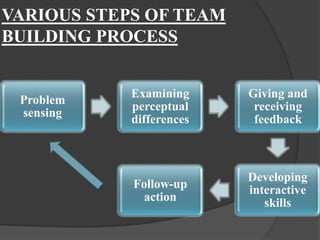
VARIOUS STEPS OF TEAM
BUILDING PROCESS
Problem
sensing
Examining
perceptual
differences
Giving and
receiving
feedback
Developing
interactive
skills
Follow-up
action
1. PROBLEM SENSING
 What is hindering group effectiveness.
 Members come forward with their arguments as to
what the real problems are.
 In problem identification, the emphasis should be on
consensus.
 Much of the problems may be solved through effective
communication and training sessions.
2. EXAMINING DIFFERENCES
 Perception of people on an issue differs.
 The perception may be brought to conformity through
the process of exercise on perception.
 The role of communication is important in this context
because it will help in clarifying the actual problem to
members.
3. Giving and receiving feedback
 Perceiving things and listening to each other may be
relayed back to the members.
 The discussion should continue until all the members
of the team have commented.
 The feedback should be given to the members about
their feelings, about the issue, the staying with topic or
going off on tangents
 Such feedback generally provide members to evaluate
the values but at the same time, also provide
opportunity to understand themselves.
4. DEVELOPING
INTERACTIVE SKILLS
CONSTRUCTIVE BEHAVIOUR:
1.Buliding: developing and expanding ideas of others.
2.Bringing in: harmonizing, encouraging others to participate.
3.Clarifying: resting, ensuring, understanding, seeking
relevant information.
4.Innovating: bringing in new relevant ideas, information,
feelings etc.
 NEGATIVE BEHAVIOUR
1. Over talk
2. Attacking and criticizing person.
3. Negative : undermining morale.
5. FOLLOW-UPACTION
 The total team is convened to review what has
been learned and to identify what the next step
should be.
 Helps in overcoming the drawback involved at the
initial stages of team building.
 Decision to take care of each area of team’s
responsibilities.
 Clarifying and settling differences in perception
concerning responsibility and authority among
members.

Team building process

  • 2.
    VARIOUS STEPS OFTEAM BUILDING PROCESS Problem sensing Examining perceptual differences Giving and receiving feedback Developing interactive skills Follow-up action
  • 3.
    1. PROBLEM SENSING What is hindering group effectiveness.  Members come forward with their arguments as to what the real problems are.  In problem identification, the emphasis should be on consensus.  Much of the problems may be solved through effective communication and training sessions.
  • 4.
    2. EXAMINING DIFFERENCES Perception of people on an issue differs.  The perception may be brought to conformity through the process of exercise on perception.  The role of communication is important in this context because it will help in clarifying the actual problem to members.
  • 5.
    3. Giving andreceiving feedback  Perceiving things and listening to each other may be relayed back to the members.  The discussion should continue until all the members of the team have commented.  The feedback should be given to the members about their feelings, about the issue, the staying with topic or going off on tangents  Such feedback generally provide members to evaluate the values but at the same time, also provide opportunity to understand themselves.
  • 6.
    4. DEVELOPING INTERACTIVE SKILLS CONSTRUCTIVEBEHAVIOUR: 1.Buliding: developing and expanding ideas of others. 2.Bringing in: harmonizing, encouraging others to participate. 3.Clarifying: resting, ensuring, understanding, seeking relevant information. 4.Innovating: bringing in new relevant ideas, information, feelings etc.
  • 7.
     NEGATIVE BEHAVIOUR 1.Over talk 2. Attacking and criticizing person. 3. Negative : undermining morale.
  • 8.
    5. FOLLOW-UPACTION  Thetotal team is convened to review what has been learned and to identify what the next step should be.  Helps in overcoming the drawback involved at the initial stages of team building.  Decision to take care of each area of team’s responsibilities.  Clarifying and settling differences in perception concerning responsibility and authority among members.