Teaching the Media: Literacy and Ethiopian Journalists
0
Teaching the Media: Literacy and Ethiopian journalists
Table of Contents
Abstract
1. Introduction
2. Literacy, media and journalism: an overview
I. Literacy and a journalist
II. Ethics and professionalism
III. Role of media institutions in ensuring professionalism
IV. Accreditation/licencing of practitioners
3. Journalism education and training in Ethiopia
I. Ideological muddle: Liberal vs Development Journalism
II. Cooperation between journalism schools and media institutions
III. NGOs involvement in media capacity building
4. Challenges of the journalist in Ethiopia
I. Becoming a journalist: Job vs passion
II. Respect to ethical values
III. Self-censorship and Political interference
IV. An activist, PR, spokesperson or a journalist
V. Experience, socio-economic and political cognizance
VI. System, creativity and leadership
5. Conclusion and recommendation
6. Appendices
Acronyms
AAU – Addis Ababa University
PMC – Population Media Centre
ERTA – Ethiopia Radio and Television Agency
ETV – Ethiopian Television
DJ – Development Journalism
PMC – Population Media Centre
SNNPR – South Nations, Nationalities and People Region
Teaching the Media: Literacy and Ethiopian Journalists
1
Abstract
This papers asses the educational background and training opportunities of journalists in
Ethiopia as well as their perception and evaluations of the practice in light of capacity
building activities. Through questioners for 30 journalists and in-depth interview with 15
editors, journalists, NGO representatives and trainers, the study unveils the professional and
technical capacity building needs of the media today. Journalists acknowledge that there is a
capacity gap in their practice. Most journalists never attended journalism schools or take
journalism courses. Instead, their understanding of the profession comes from on job training
by their institution or other stakeholders. Still, the study finds out that journalists are fairly,
familiar with the ethical values and codes of conduct of the profession. However, everyone
participated in this study felt the defilement for the ethical values of the practice in the
present media landscape. Some argue that this could change with a continued training on
ethics, professionalism and technical skills and better curriculum in journalism schools.
Others suggested, professionals in the present media, should show a better loyalty to the
profession since they should earn the respect and integrity their profession deserves. Hence,
lack of capacity is considered as a secondary cause for poor standard of Ethiopian media. The
study suggests that, both lack of capacity, absence of passion and commitment for the
profession caused the contemporary situations, and they have a cause and effect relationship.
1. Introduction
The importance of personal capacity of individual journalist, his/her education, experience,
and training opportunities as well as passion and commitment to the profession determines
the level of each media. Credibility, which is the most important asset of any media, comes
from quality in both technique and content. The quality of the work force (the technical team,
the management and the journalist) determines the standard of a given media.
Ethiopian media in general entertains a loud criticism for lack of basic journalistic and
technical skills, poor ethics as well as failed strategy in leadership. The limited researches in
the area indicates that one of the fundamental challenges of the Ethiopian media is lack of
creative, competent, experienced, and cultured journalists and media managers who can pass
a sound judgment as well as fight for the ethical values of the profession. Journalists
themselves share this view and note that capacity-building activities have little or no attention
in their institutions. Training in technical skills, ethics and professionalism is a timely issue
for the media.
This study probes the current training opportunities, their impact, and the practical challenges
of journalists. It assesses how journalists view their practice, and identify capacity-building
gaps from their point of view. Through serious of questions, it identifies areas for support and
training for improvement. The study involves trainers and senior journalists who evaluate the
impact of the current education system as well as the trainings by media institutions and
NGOs.
Teaching the Media: Literacy and Ethiopian Journalists
2
2. Literacy, Ethics and Practicing Journalism: An Overview
I. Literacy and the Journalist
Scholars trace back journalism as early as human beings understood the importance of
sharing information in a wider context. Enlightenment thinkers in Europe were particularly
attentive to how literacy, then alphabetical literacy and finally the printing press occasioned
deep structural changes in social, cultural, and political life (Wahl-Jorgensen &Hanitzsch,
2009). Throughout its history, scholars view journalism as a social norm of knowledge
production.
However, given its complexity and ingenuousness for interpretation, journalism as
knowledge has been a point for an endless debate. Austrian intellectual Karl Kraus, in the
beginning of the 20th century, revealed his deep concern about the potential of journalism in
degrading knowledge in general. He famously said the following:
‘To imagine that a journalist can write about a new opera as well as he writes about
a new regulation of the parliament is something of an embarrassing thought’ (White,
2008)
Kraus is not the only one in challenging journalism in general and journalists in particular on
their capacity to shape how society views the world. Several scholars, for centuries argued
whether journalism is a form of knowledge or just a means of communication. However,
regardless of these ongoing debates, in fact, the relevance of journalism has flourished
through the past century and the world has increasingly become dominated by the views of
journalists (Rudin & Lbbston, 2007).
Nowadays, many like to accentuate on the importance of individual ability of journalists’
instead of the relevance of media in general. The agreement is unanimous on the fact that
media is as good as its system, and the work force it involves. As a result, the emphasis is on
the educational background and training opportunities of journalists, experience, talent,
passion, and commitment for the ethical values of the profession. In addition, style of
presentation of each journalist (uniqueness), appearance, communication skills, use of
technology and even a sense of humor and other personal abilities count as points that
enriches and strengthens any media land escape. Therefore, education, whether formal or
informal is a foundation of journalism. Journalism depends on literacy, which is writing
reading and understanding critical issues well enough to explain and inform others.
II. Ethics and Professionalism
Journalism is a domain of moral choices, occasionally involving a melodramatic interplay
between good and evil. As a practice, journalism has a potential to provide journalists with a
robust group identity that can distinguish them from others in the media marketplace and
reinvigorate the occupation with a new sense of purpose. A healthy and ethical practice
would constitute a viable moral community capable of inspiring real solidarity among
journalists (Borden, 2007).
Teaching the Media: Literacy and Ethiopian Journalists
3
Bill Kovach and Tom Rosenstile, leading figures in the American movement for more
traditional standard journalism, have set characteristics they believe the news media must
adopt if they are to have the most important asset of a media, which is credibility
(Hargreaves, 2005)
 Journalism’s first obligation is to the truth (reporting truth is almost not liable, which
makes accuracy the most important rule of journalism)
 It’s first loyalty is to citizens
 Its essence is a discipline of verification
 Its practitioner must maintain independence from those they cover
 It must bring a forum for public criticism and compromise
 It must strive to make the significant interesting and relevant
 Its practitioner must be allowed to exercise their conscience
However, often media professionals, face criticisms for failing to observe the ethical values
of journalism. Putting the word a ‘journalist’ and ‘ethics’ in the same sentence has now
become increasingly difficult (Hargreaves, 2005). Journalists often found themselves under a
public microscope their motives and their morals questioned (Hill, 2005). In England for
example, a nation taken as a model of free press, surveys of public opinion place journalists
at the bottom of 15 groups in terms of public credibility – even below politicians (Keebl,
2001) According to the Global Corruption Barometer report by Transparency International,
in 2013, 23% of Ethiopians felt that the media is corrupted/extremely corrupted.
The new journalism, which has now become a struggle for attention and uniqueness in a very
competitive media landscape, is considered responsible for many of the violations. Modern
journalists argue that this codes needs to be flexible. Some practitioners’ claim that rules are
there simply to be broken and sometimes violations amount to bravery (Keeble, 2001 p13).
However, the predominant view to this day is that ethics is inseparable from journalism. If
the proper role of journalism is providing information, then the ethical question focuses on
one issue, which is maintaining the quality of information (Besely & Chadwick, 1992). That
makes the practice of journalism centered on a set of essential ethical concepts.
III. The Role of Media Institutions in ensuring Professionalism
From journalists who participated in this study, 70% of them received two and more trainings
mostly from their own organization. The trainings are meant to familiarize journalists with
timely political or social takeover like elections, to a certain issue, and not directly on the
canon and technique of journalism.
ERTA Training centre is busy, all year around, training its own and regional mass media
journalists. Ato Daniel Bekele, the centre’s head says that the training is nonstop. The centre
uses its own trainers as well as, in some cases, experts from different areas.
Teaching the Media: Literacy and Ethiopian Journalists
4
‘We give our journalists an opportunity to reflect in their own work. Their job is
routine, hectic and crowded with deadlines. Our trainings are means to give them a
break and reflect in their work. We believe if they reflect and carefully evaluate their
work, they can learn from their mistakes’
However, the training does not focus on basic journalism, assuming journalists have the
required understanding. Instead, it focuses on advance journalism, and tries to upgrade the
technical skills of the journalist. On the contrary, organizations claim that there are serious
consequences for journalists who fail to observe the basic ethical standards. Public media
institutions have a department for Ethics and Antic Corruption. The mission of these
departments is to train journalists on basic ethical values, and to investigate and punish when
there is a violation.
However, journalists claim that Ethics and Anti Corruption Departments in their respective
institutions do more damage to the profession. That is because they do not trust their
decision; instead believe that they are means of punishing journalists with different opinions.
The private press also claims that there are ways of dealing with malpractice. However, it is
more informal, and subjective. It is mostly the editor, who would judge a certain act and
make a decision.
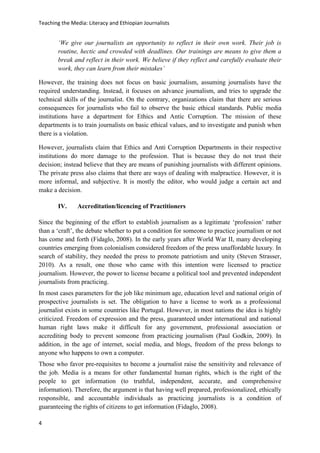
IV. Accreditation/licencing of Practitioners
Since the beginning of the effort to establish journalism as a legitimate ‘profession’ rather
than a ‘craft’, the debate whether to put a condition for someone to practice journalism or not
has come and forth (Fidaglo, 2008). In the early years after World War II, many developing
countries emerging from colonialism considered freedom of the press unaffordable luxury. In
search of stability, they needed the press to promote patriotism and unity (Steven Strasser,
2010). As a result, one those who came with this intention were licensed to practice
journalism. However, the power to license became a political tool and prevented independent
journalists from practicing.
In most cases parameters for the job like minimum age, education level and national origin of
prospective journalists is set. The obligation to have a license to work as a professional
journalist exists in some countries like Portugal. However, in most nations the idea is highly
criticized. Freedom of expression and the press, guaranteed under international and national
human right laws make it difficult for any government, professional association or
accrediting body to prevent someone from practicing journalism (Paul Godkin, 2009). In
addition, in the age of internet, social media, and blogs, freedom of the press belongs to
anyone who happens to own a computer.
Those who favor pre-requisites to become a journalist raise the sensitivity and relevance of
the job. Media is a means for other fundamental human rights, which is the right of the
people to get information (to truthful, independent, accurate, and comprehensive
information). Therefore, the argument is that having well prepared, professionalized, ethically
responsible, and accountable individuals as practicing journalists is a condition of
guaranteeing the rights of citizens to get information (Fidaglo, 2008).
Teaching the Media: Literacy and Ethiopian Journalists
5
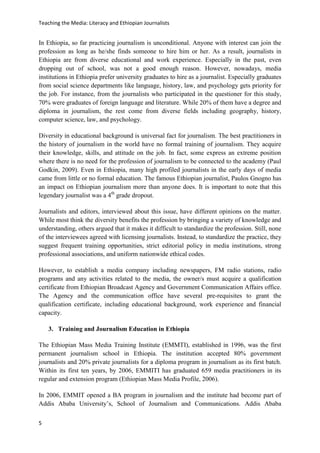
In Ethiopia, so far practicing journalism is unconditional. Anyone with interest can join the
profession as long as he/she finds someone to hire him or her. As a result, journalists in
Ethiopia are from diverse educational and work experience. Especially in the past, even
dropping out of school, was not a good enough reason. However, nowadays, media
institutions in Ethiopia prefer university graduates to hire as a journalist. Especially graduates
from social science departments like language, history, law, and psychology gets priority for
the job. For instance, from the journalists who participated in the questioner for this study,
70% were graduates of foreign language and literature. While 20% of them have a degree and
diploma in journalism, the rest come from diverse fields including geography, history,
computer science, law, and psychology.
Diversity in educational background is universal fact for journalism. The best practitioners in
the history of journalism in the world have no formal training of journalism. They acquire
their knowledge, skills, and attitude on the job. In fact, some express an extreme position
where there is no need for the profession of journalism to be connected to the academy (Paul
Godkin, 2009). Even in Ethiopia, many high profiled journalists in the early days of media
came from little or no formal education. The famous Ethiopian journalist, Paulos Gnogno has
an impact on Ethiopian journalism more than anyone does. It is important to note that this
legendary journalist was a 4th
grade dropout.
Journalists and editors, interviewed about this issue, have different opinions on the matter.
While most think the diversity benefits the profession by bringing a variety of knowledge and
understanding, others argued that it makes it difficult to standardize the profession. Still, none
of the interviewees agreed with licensing journalists. Instead, to standardize the practice, they
suggest frequent training opportunities, strict editorial policy in media institutions, strong
professional associations, and uniform nationwide ethical codes.
However, to establish a media company including newspapers, FM radio stations, radio
programs and any activities related to the media, the owner/s must acquire a qualification
certificate from Ethiopian Broadcast Agency and Government Communication Affairs office.
The Agency and the communication office have several pre-requisites to grant the
qualification certificate, including educational background, work experience and financial
capacity.
3. Training and Journalism Education in Ethiopia
The Ethiopian Mass Media Training Institute (EMMTI), established in 1996, was the first
permanent journalism school in Ethiopia. The institution accepted 80% government
journalists and 20% private journalists for a diploma program in journalism as its first batch.
Within its first ten years, by 2006, EMMITI has graduated 659 media practitioners in its
regular and extension program (Ethiopian Mass Media Profile, 2006).
In 2006, EMMIT opened a BA program in journalism and the institute had become part of
Addis Ababa University’s, School of Journalism and Communications. Addis Ababa
Teaching the Media: Literacy and Ethiopian Journalists
6
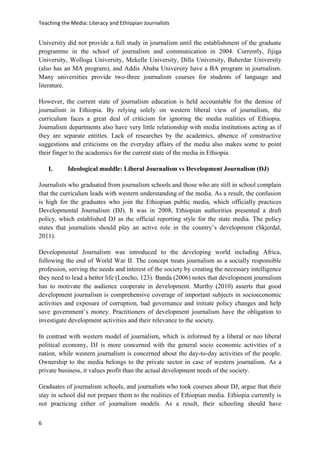
University did not provide a full study in journalism until the establishment of the graduate
programme in the school of journalism and communication in 2004. Currently, Jijiga
University, Wolloga University, Mekelle University, Dilla University, Baherdar University
(also has an MA program), and Addis Ababa University have a BA program in journalism.
Many universities provide two-three journalism courses for students of language and
literature.
However, the current state of journalism education is held accountable for the demise of
journalism in Ethiopia. By relying solely on western liberal view of journalism, the
curriculum faces a great deal of criticism for ignoring the media realities of Ethiopia.
Journalism departments also have very little relationship with media institutions acting as if
they are separate entities. Lack of researches by the academics, absence of constructive
suggestions and criticisms on the everyday affairs of the media also makes some to point
their finger to the academics for the current state of the media in Ethiopia.
I. Ideological muddle: Liberal Journalism vs Development Journalism (DJ)
Journalists who graduated from journalism schools and those who are still in school complain
that the curriculum leads with western understanding of the media. As a result, the confusion
is high for the graduates who join the Ethiopian public media, which officially practices
Developmental Journalism (DJ). It was in 2008, Ethiopian authorities presented a draft
policy, which established DJ as the official reporting style for the state media. The policy
states that journalists should play an active role in the country’s development (Skjerdal,
2011).
Developmental Journalism was introduced to the developing world including Africa,
following the end of World War II. The concept treats journalism as a socially responsible
profession, serving the needs and interest of the society by creating the necessary intelligence
they need to lead a better life (Lencho, 123). Banda (2006) notes that development journalism
has to motivate the audience cooperate in development. Murthy (2010) asserts that good
development journalism is comprehensive coverage of important subjects in socioeconomic
activities and exposure of corruption, bad governance and initiate policy changes and help
save government’s money. Practitioners of development journalism have the obligation to
investigate development activities and their relevance to the society.
In contrast with western model of journalism, which is informed by a liberal or neo liberal
political economy, DJ is more concerned with the general socio economic activities of a
nation, while western journalism is concerned about the day-to-day activities of the people.
Ownership to the media belongs to the private sector in case of western journalism. As a
private business, it values profit than the actual development needs of the society.
Graduates of journalism schools, and journalists who took courses about DJ, argue that their
stay in school did not prepare them to the realities of Ethiopian media. Ethiopia currently is
not practicing either of journalism models. As a result, their schooling should have
Teaching the Media: Literacy and Ethiopian Journalists
7
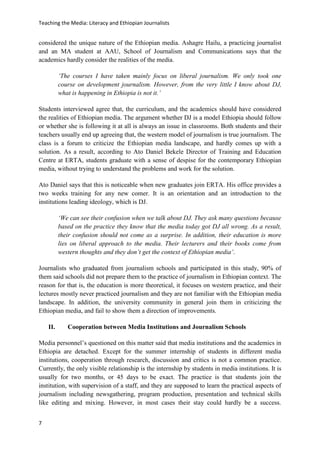
considered the unique nature of the Ethiopian media. Ashagre Hailu, a practicing journalist
and an MA student at AAU, School of Journalism and Communications says that the
academics hardly consider the realities of the media.
‘The courses I have taken mainly focus on liberal journalism. We only took one
course on development journalism. However, from the very little I know about DJ,
what is happening in Ethiopia is not it.’
Students interviewed agree that, the curriculum, and the academics should have considered
the realities of Ethiopian media. The argument whether DJ is a model Ethiopia should follow
or whether she is following it at all is always an issue in classrooms. Both students and their
teachers usually end up agreeing that, the western model of journalism is true journalism. The
class is a forum to criticize the Ethiopian media landscape, and hardly comes up with a
solution. As a result, according to Ato Daniel Bekele Director of Training and Education
Centre at ERTA, students graduate with a sense of despise for the contemporary Ethiopian
media, without trying to understand the problems and work for the solution.
Ato Daniel says that this is noticeable when new graduates join ERTA. His office provides a
two weeks training for any new comer. It is an orientation and an introduction to the
institutions leading ideology, which is DJ.
‘We can see their confusion when we talk about DJ. They ask many questions because
based on the practice they know that the media today got DJ all wrong. As a result,
their confusion should not come as a surprise. In addition, their education is more
lies on liberal approach to the media. Their lecturers and their books come from
western thoughts and they don’t get the context of Ethiopian media’.
Journalists who graduated from journalism schools and participated in this study, 90% of
them said schools did not prepare them to the practice of journalism in Ethiopian context. The
reason for that is, the education is more theoretical, it focuses on western practice, and their
lectures mostly never practiced journalism and they are not familiar with the Ethiopian media
landscape. In addition, the university community in general join them in criticizing the
Ethiopian media, and fail to show them a direction of improvements.
II. Cooperation between Media Institutions and Journalism Schools
Media personnel’s questioned on this matter said that media institutions and the academics in
Ethiopia are detached. Except for the summer internship of students in different media
institutions, cooperation through research, discussion and critics is not a common practice.
Currently, the only visible relationship is the internship by students in media institutions. It is
usually for two months, or 45 days to be exact. The practice is that students join the
institution, with supervision of a staff, and they are supposed to learn the practical aspects of
journalism including newsgathering, program production, presentation and technical skills
like editing and mixing. However, in most cases their stay could hardly be a success.
Teaching the Media: Literacy and Ethiopian Journalists
8
According to Ato Ashagere Teshome, Media Quality Coordinator at SNNPR Mass Media
Agency the reason for this is attendance is not taken seriously, and the students are usually
unhappy with especially how that public media runs its routine activities and lack interest to
be part of it.
‘The students come and we assign them with reporters so that they can mentor them.
To be honest no body follows them seriously since their mentors are busy. The
teachers come occasionally for supervision but do not stay around.’
Ato Daniel says that the academics should involve more on the practice. The current
relationship, if there is any, is just not good enough for the media to improve itself, for the
journalists to understand the Ethiopian media land scape and the context better and for the
lecturers to engage in research to identify loopholes and ways forward.
‘In journalism context is everything. We have a different culture, different political
and social structure and we have to learn what works for us. Journalism schools are
supposed to do that. They should do a research and come up with a theory that will
work for the country and encourage their students to do the same. ’
Both Ato Ashagere and Ato Daniel agree that the internship period for the students is not
enough. Recruitment is a serious problem for many media institutions. It is a common
complain, among media institutions that it is hard to find talent in the journalists market.
Therefore, if students do at least a semester internship, with a strict follow-up, they will learn
the Ethiopian media and at the same time, the institutions get the opportunity to recruit new
staff.
III. NGOs Involvement in Capacity Building of the Media
State media journalists; often participate in trainings by NGOs and INGOs. The trainings are
meant to create awareness on specific projects. To get better media coverage and deepen the
understanding of journalists, or to implement a media campaign on a certain issue, NGOs
prepare training sessions that usually take from 3-15 days. From the journalists who took part
in this study 95% at some point received training on issues like HIV Aids, Gender and HTPs
by different NGOs.
Journalists say that they enjoy this training sessions. The sessions, usually takes place in the
premises of the NGOs or hotels, invite trainer’s professionals on the project issues.
Journalists learn, about the interventions planned by certain NGOs and the technical or
medical concepts of the issues. Still, many journalists appreciate the opportunity. Ato
Ahagere Teshome Media Quality Coordinator, SNNPR Mass Media Agency says that
considering the training opportunities are small, his organization is always happy to send
journalists for the sessions organized by the NGOs. However, he is aware that, journalists
often do not take the sessions seriously.
Teaching the Media: Literacy and Ethiopian Journalists
9
NGOs admit that their involvement is limited to their own activities. Tigist Moges, Training
Coordinator of Population Media Centre (PMC) says that her organization trains journalists
on issues relevant to its own project. In the past, they have had media campaigns on many
social problems including HTPs, Health and Nutrition. They have trained journalists, to make
them understand these issues better and get them interested to cover the issue.
‘We are primarily interested to get our message out there. Media is the best way for
us to do this. However, it does not mean that we train only on the subject matter. We
believe that we also have to give something for journalists to help them improve their
skills. Therefore, we give trainings on communication and technical skills like
presentation, angles, and issue selection. We believe we are also contributing
something to the improvement of the media in general’
Journalists who participated in this study said that trainings by NGOs are mostly promotional.
Therefore, it is freebees and brown envelops (Butches) in another form. The priority of the
NGOs is to get coverage on their respective projects from the media.
Private media houses are not the primary targets of NGOs when it comes to capacity building
activities. Journalists who work for a private media said that they have received no training
by an NGO while working for a private media.
4. Challenges of the Journalist in Ethiopia
I. Becoming a Journalist: Passion vs Job
There is an ongoing debate whether journalism is a craft or a profession. To constitute a
profession, the members of an occupation have to be able to control their own work and to
have autonomy in their everyday practice. Sociologists have distinguished a number of means
for this autonomy including a knowledge monopoly, a clear division of labour, direct and
strong educational and research background (Witschge, 2008). Unlike established
professions such as law, medicine or accounting, standard of journalistic competence must
centre on practice rather than theory (Paul Godkin, 2009).
Yet, it is obvious that journalism has the better of the two worlds. As a profession, it has
ethical values as well as specific skills one must acquire to be a practitioner. As a craft, it
requires a faculty to be creative. In journalism, routine and repetition does not make one a
good journalist.
Journalists usually perceive their practice more than just a means of making a living. These
seem to build a distinct identity for the practitioners; assuming that journalism is not
something, anyone can become by mere training. Instead, it is a calling and a passion, which
only the chosen granted. A vast number of best practitioners of journalism around the world
have no formal training in Journalism (Paul Godkin, 2009). The case is similar in Ethiopia.
For example, from those who take part in this study, for a question whether they wanted to
become a journalist or not, 95% said they intentionally chose to become a journalist. Though
most came from different educational background and work experience, they pushed their
Teaching the Media: Literacy and Ethiopian Journalists
10
way in to journalism because it has always been ‘their passion’. The rest 5% also expressed
love to the profession, though it was not their prior choice as a career path.
However, in interview, journalists express frustration for the practice. The reason for that is
because; they do not have the resource, space and the freedom to practice journalism. In
addition to the tight legal environment and frequent political interference and intimidation,
they struggle with low salary that hardly covers their expenses. Form journalists who
participated in this study the maximum salary is 7000 birr monthly (368$) and the minimum
is 1300 birr (68$). Most admitted that they live from paycheck to pay check or swamped in
debt. Therefore, they say, it should not come as a surprise if journalists fail to observe the
ethical values of the profession.
II. Respect to Ethical Values
Ethiopian journalists, agree their practice, fails to observe ethical values of journalism. This
leads many to argue that journalism, as a profession does not exist in Ethiopia. Notably, the
media today is at two extreme ends of rivalries, one committed in prising the government and
the other condemning. In addition, journalists widely face criticism for bribery.
These problems are not, however, new to the Ethiopian media. From early days, the
Ethiopian media, one way or another has served as a tool of propaganda, and
journalists face criticisms for looking after their own personal interest. Workaferahu
Kebede a journalist for 25 years says that compromising professionalism has been a
challenge for a long time.
‘Payment under the table has happened in the early days too. Especially invitation to
embassy cocktail parties or to the palace on special occasions was eagerly sought
after for the free food and drinks. Of course, the media also lacked impartiality in my
time. We were busy praising the Dergu regime’
Journalists and editors affirm violations but disagree on the cause. Some argued that, it has
something to do with lack of assertiveness among journalists. In addition, they are easy
targets for corruption since they are at the bottom of the salary scale and their financial
insecurity triumphs their commitment to the profession. Training and capacity building
activities have little role to change this.
In fact, there is no literature that says that journalists ignore ethics because they do not know
right from wrong. Regardless of their educational status and level of experience, to become a
journalist a person needs a certain level of common sense. Ethical codes of journalism are in
direct conformity with rational judgement and common sense. A former owner and managing
Editor of Addis Press newspaper Ato Mohammed Ali Mohammed agrees with this assertion.
‘I doubt there is a journalist who actually works for a media and does not know these
ethical values. However, journalists intentionally ignore the ethics sometimes because
Teaching the Media: Literacy and Ethiopian Journalists
11
they are careless, or they have an agenda but most the times because their mere
instinct is survival. They do not want to compromise their personal safety or mess
with their source of income.’
Ato Ashagere Teshome, Media Quality Coordinator of SNNPR Mass Media Agency said that
training has small role to create journalists who observe the ethical values and act
professionally all the time.
‘We believe that familiarity with the code of conduct has little to do with what we
witness today. Disregard comes from character. Journalists mostly know, when they
breach the ethical standard, they are wronging their profession. That is why they
work so hard to hide it’
Observation also shows that journalists mostly know the ethical values by heart. They also
know when their act constitutes a violation. In fact, among journalists, the grey areas of
commitment to the profession and violation of ethical standard is often a subject of
conversation. When asked, journalists also prefer training on technical aspects of journalism
instead of ethics and professionalism since they feel like they are familiar with the values.
However, lack of exemplary system, training opportunities and leadership is visible in the
blaming. Observation shows that young journalists do not understand their actions constitute
a breach of the code of conduct. Junior journalists are exposed to the malpractice by the
senior staffs, which make them think, in the Ethiopian context, that is journalism. Frequent
capacity building on ethics, especially for the editors and the senior members of the media,
could change the perception of the young on professionalism.
III. Self-censorship and Political Interference
Self-censorship, which many call the worst form of censorship, is one of the major challenges
of Ethiopian media.
However, this challenge is not limited to Ethiopia or the developing world with limited
democratic culture. Throughout the world, journalists cut speeches, edit actions and rewrite
events in a way they think will please whoever is intimidating them. The intimidation comes
from politics, the private sector or the leadership of the media itself. For example, American
Journalists are famous for self-censorship resulting from pressure from financial sponsors or
advertisers. This pressure to make advertisers look good is hurting the outcome of the
American media and the standard of journalism (Hargreaves, 2005, P 118).
In Ethiopia Journalists widely admit that they self-censor. Journalists questioned puts
intimidation from the politics as the primary cause of self-censorship. As several studies
suggest, there is a relationship between self-censorship and the overall political climate in the
country (Amin, 2000). Financial gains are also a major factor. Lack of capacity from the
journalist and the editor is noted as a cause of self-censorship. Other factors like cultural
expectations and underestimating the audience are the cause for self-censorship.
Teaching the Media: Literacy and Ethiopian Journalists
12
- Intimidation
Intimidation and severe media regulation is a characteristics of defensive states willing to
employ a range of means to control their citizens. The outcome is high degree of fear for
authorities (Skjerdal, 2007). Journalists who participated in this study commented that,
imprisonment, abuse and intimidation of journalists makes them cautious of what they should
and should not say.
One public media journalist, who chose to be unanimous, said that he always makes sure
what he produced does not offend his editors:
‘It is not that we do not understand what we do hurts our professional integrity.
However, most of our editors are political appointees. Questioning their orders will
cost us our job. Those who challenge do not get promotions and other benefits.
Therefore, we work to please them.’
Especially private media journalists feel the pain of self-censorship because of intimidation.
They think no amount of training will change this reality, unless there is a political will from
the government. Ato Ferew Abebe, Editor-in-Chief, Sendek Newspaper, says that private
media journalists are aware of the consequences of their actions beforehand.
‘We know what will make officials call us; intimidate us, what will make the police
stand in our door, and what will set the opposition off, label us the government
mouthpiece. We are a victim anyways. If the government is not threatening us the
opposition will open a campaign on us claiming we are working for the government.
Our journalists are in the middle of this and they have their own safety to protect. So
of course, we are intimidated and that causes a great deal of self-censorship. This is
not something we can change with training. It is a question for the politicians. If they
show respect to freedom of expression and the press, then the journalist will feel
confident enough to make a decision based on logic and rationality instead of fear
and insecurity’
- Pleasing the payer
Brown envelops (Butche) and freebees are the main ethical violations of Ethiopian
journalism. Journalists notably favour those who pay per dime, serve free meal and drinks.
The term ‘buffet journalists’ is used to describe journalists who frequently appear at
receptions, conference centres, and luxury hotels to enjoy free alcohol and drinks although
they often fail to produce any story from the event (Ladamo & Skjerdal). Even when they
produce report, from the emphasis given to the report, the time and the tone of the reporting,
it is possible identify whether bribery was involved.
Journalists have mentioned this as one of the reasons for omitting some information from a
report, remaking occasions and rewriting facts just to please those who paid for it. However,
the main cause of self-censorship, for many journalists goes deeper than a simple payment
Teaching the Media: Literacy and Ethiopian Journalists
13
and free dinner. State media journalists especially argue that, since they only report positive
stories and self-censor anyways, they do not see the harm of accepting money or treatments.
A state media journalist, who chose to be unanimous, gave the following statement on the
matter:
‘We are not allowed to make a balanced and fair reporting, criticize or investigate
and expose scandals. What we do is routine and obvious. We make the government
look good and its enemies look bad. Therefore, I do not think Butche is the primary
reason for self-censorship. The main reason is that the system denied us the freedom
to be loyal for our profession. The Butche is just a conciliation prize.’
Ato Nebuy Hailu, an Editor-in-Chief, Finote Netsnet newspaper, said that Butche is not a
problem for the public media only. It leads the private media journalists to self-censor and
exaggerate or ignore/omit facts.
‘Compare to public media journalists I like to believe that those who work for the
private media enjoy a better freedom. However, some times, reporters present to me
news or feature articles that purely sound like a promotion. I also get news that are
only one sided with unverified facts and biased opinions. I cannot prove if the
journalist has received financial benefit to write the story. However, I know that they
are not ethical so I don’t allow such stories to get published’
Self-censorship, to please the advertisers the owners of media houses and those who slip cash
and a luxury treatment under the table has always been a challenge for journalism at the
international level. Some journalists claim that this, to a larger level, might threat Ethiopian
media in the future. Currently, the degree might not be as significant, since the private sector
shows less interest in the media. As this interest grows however, to save the media from an
moral destruction, it is important to strengthen institutional supervision on ethical conducts.
In addition, compensating journalists with better salary and freedom to practice journalism so
that they get job satisfaction can be preventive measures. Journalism schools and training
centres should also take Ethics seriously, underlining that there is not necessarily a direct
relation between poor economy and poor ethical behaviour.
- Lack of capacity and specialization
Journalists raised lack of capacity as one of the reasons for self-censorship. Journalists in
Ethiopia are expected to report about everything. Journalists who produce an entertainment
show at one point become a commenter for parliamentary meetings or regional and
international summits. This makes journalists stick to the usual formats, omit information’s or
any element of a story that might open a door for criticism.
Selamawit Tesfahugne, an Editor with Walta Information Centre says that training and better
management could cure this problem. By assigning journalists on similar issues, helping
them to get trainings and exposures on that specific matter, it is possible to build the capacity
Teaching the Media: Literacy and Ethiopian Journalists
14
of the journalist to be confident on specific subject matters. According to her journalists must
choose a genre and stick to it. Media organizations should have a system that encourages
journalists to specialize on specific matters.
In media reporting, the devils are always in the details. If a journalist avoids going to the
details because he/she is uncertain, then the public misses the important bits of that
information. Currently, it is easily observable that Ethiopian journalist, whether it’s news,
program making, or reporting for a newspaper, mostly avoid the details and assert the general
features of their story. As a result, most reporting does not have a unique angle for them, and
sounds similar every time they appear. For example, while reporting on the economic growth,
the focus is on the general issues, which are the growth rate, and the opinions of the officials
on the numbers. To inspect details like what does the growth rate mean to ordinary people,
and how that affect everyday life does are overlooked, since they require a special insight.
This is a point where journalism could take advantage of its diversity in educational
background. Media encompasses almost all kinds of professionals under one umbrella.
Assigning journalists based on their background and experience avoids starting from zero in
every assignment.
Currently, journalists move from one issue to another. With an exception of sport journalists,
journalists are expected to fill any gap available at that particular time. For example in ERTA
people who work for education programs join newsroom or current affairs. An editor at
ERTA who chose to be unanimous says this is the main reason why ERTA reporting usually
sounds similar and there are so many errors in the reporting.
‘The worst form of self-censorship is trying to censor things one does not understand.
Even to self-censor, a journalist should understand the content and must have a
technical skills to make it look natural. Otherwise, the report completely comes out
senseless. We have had that problem a lot before. We are still struggling with it’
Tigist Moges, Training Coordinator at PMC says that journalists involve in things they do not
understand. That makes the output sound shallow and misinformed. She gives an example of
the youth program at ERTA. Journalists who passed their youth and fail to relate with the
current issues of the new generation produce the program.
‘Today’s youth have their own language and words to understand situations. Not
anyone who is not part of them might be able to address it in the right way.
Journalists produce programs based on assumption and usually fail to connect the
target audience. This leads to self-censorship because the journalist avoids things
they do not completely understand. ’
Journalists who commented on this issue agrees that, sometimes the omit information’s or
limit themselves from going to the distance to explain them because they do not understand
the issue completely. Yonas Kiflu, a journalist for a private newspaper shared his experience:
Teaching the Media: Literacy and Ethiopian Journalists
15
‘I use to work for a newspaper and my boss send me to cover some event organized by
DSTV. Pay TV was very much new and there was some technical staff explaining how
it will work. To this day, I do not think I understood the content. My editor wanted the
news anyways and he wanted it fast. I wrote it with so many technical words without
knowing their meanings, avoiding going to the details. The next day, some of my
colleagues asked me to explain then news but I did not have an answer. When you
don’t understand something you censor a lot because you don’t want to sound
ignorant’
Private press also practices ‘Yellow Journalism’, which means presenting little or no
legitimate well-researched news. Instead, they use catchy headlines by exaggerating events,
scandals and sensationalism. The purpose is just to sell more newspaper or to get attention for
a certain agenda. In addition to resource constraints, lack of research and investigation skills
as well as negligence is held responsible for yellow journalism in Ethiopia. Observation also
shows that journalists lack basic skills like identifying story, choosing the right angle,
understand what is relevant and what to avoid. These makes the reporting miss the main story
and shout at the wrong door, by ignoring the relevant aspects. Therefore, trainings on these
issues could support to improve the practice.
- Cultural expectations and underestimating the audience
Journalists interviewed for the purpose of this study suggested that there is a self-censorship
because the audience is not mature enough or is not ready to understand certain subject
matters. This is based on an assumption that some information’s could be culturally
inappropriate and offend the audience. As a result, they omit facts and choose to oversee
happenings.
One public media journalist, who chose to be unanimous, said that at ERTA journalists self-
censor, solely thinking that the audience might not be able to understand the message of their
content. The presumption is be that the journalist is always mature than the audience. This
superiority sentiment leads journalists to believe that their audience did not reach the same
understanding level as them. Therefore, they take their self-censorship as a measure
necessary to protect their audience.
This came from the fact that journalists do not have a proper means of getting feedback, and
recognize how their audience perceives them. According to journalists, the only means for
them to learn about their audience and impact of their program through frequent phone calls
and letters. Journalists say that this is deceiving. Desalgne Assefa a senior journalist and
trainer, suggests that this way of learning about audience is dangerous.
‘We call them serial callers. There are people who always call every station to tell them
they are doing a great job. There is no culture for audience research and journalists have
learnt about the impact of their program and conscious level of their audience from the
wrong sources. Often, when I train public media journalists they tell me that the present
Teaching the Media: Literacy and Ethiopian Journalists
16
approach, which only entertains positive stories about the country, is proper because the
audience is not ready for journalism that is more critical. That leads them to censor many
of their facts and issues’
In fact, better audience research mechanism to identify show the impact of
programs/reporting’s, will help journalists to be cautious and match their output with the
needs of their audience.
IV. An Activist/advocate, a Spokesperson, a PR or a Journalist
Confusion in job description for an activist/advocate, a Public Relation (PR), spokesperson
and a journalist is a point that has challenged journalism as a profession for long. Though
each of these roles has their own distinct objectives, practically speaking they often overlap.
Whether this junction affects the integrity of journalism or not remain a point of debate
among professionals.
Ato Nebuy Hailu, Editor-in-Chief of Finote Netsanet Newspaper argues that the crossover is
inevitable. He says that journalism today, is not just presenting facts and leaves the judgment
to the audience. Whether recognized or not, there is an implied position of the media or
whoever behind it.
‘In modern journalism the audience wants to know the opinion of a journalist.
Journalists without opinions are not serving the public’s interest. What we should
expect is that the journalist forms his/her opinion based on facts and logic.’
With the fast-paced information flow through mobile phones, electronic media and the
internet, survival is a primary concern of any media. Modern journalism took a path to
survive by trying to analyse a story from different angles. That is because; the basic facts
reach the audience, maybe before the journalist. What happens is not really news anymore.
Instead, people want to know why it happened, what does it mean to their lives and where
will it go from there. All these, requires the journalist to take position, predict, support or
condemn the views of others. The thin line that separates advocacy, PR works or journalism
is the source of inspiration for the journalist to take the stands. A journalist loyal to the
profession is neutral, objective, fair and accurate, and his/her judgment is grounded only
based on logic and rationality.
However, this modern view of journalism faces frequent criticisms from those who favour a
more traditional approach to journalism. Ferew Hailu, Editor-in-Chief of Sendek Newspaper
argues that we should stick to traditional journalism. He thinks that relaxing the rules will
give discretion to the journalist and opens more doors for the abuse of the profession.
‘I tell my journalists that, whatever your political position might be, or whether you
like or hate a certain individual or institution, the monument you reflect that on your
coverage you are not a journalist anymore. I think we need to emphasize on this point
whenever there is an opportunity to train journalists. As an editor, I try to set an
Teaching the Media: Literacy and Ethiopian Journalists
17
example and always stick to the facts. The main difference I see is, in activism, the
means justifies the end. Journalism is never about the end. The focus is always
whether the means satisfies the values of journalism’
While the private media struggles in journalism vs activism debate, the public media also
fight its own war over the PR/Spokesperson vs journalist role. Public media journalists admit
that they do more of a public relations work than journalism. From the public journalists who
questioned on this matter, most suggested that they feel like their job is to make the
government look good. Journalists say that they are not the one who needs training, but it is
their editors and those who play the leadership role.
Ato Daniel, Head of Training Centre for ERTA says that to separate journalism from
PR/Spokesperson role the assignment of editors in any media should be based on merits.
Moreover, capacity-building activities must target editors more often. The current practice is
the appointment is not clear and journalists claim it comes from loyalty to the ruling party. As
a result, Ato Daniel says that journalists feel daunted to come up with ‘positive stories’ which
is now mistaken to DJ.
‘Considering that our journalists are mostly young and inexperienced, they don’t have
the confidence and strength to stand by their position and disagree with their editors.
They also think, in Ethiopian context, it is better to stick to the already existing practice.’
V. Experience, Socio-economic and Political Cognize
Journalism seems a profession for the young in Ethiopia. From the journalists who
participated in this study, 85% were in their twenties. Most practiced journalism for less than
five years. Only 5% from those who participated said that they practiced journalism for more
than five years. One journalist has a 25 years’ experience.
Only 25% are married with children. Most said they live with their families and relatives
while a few live in rental houses. Questioned about their reading culture, 90% said that they
love books. However, only 30% said they have read a book in the last two months. Reading
fictional books is famous among journalists, and astonishingly most expressed dislike for
historical and political books. Therefore, young age, low reading culture and lack of proper
exposure to the socio-economic situations of the country seems to define the current state of
journalism as a career in Ethiopia.
Almost all the journalists said that they follow BBC, CNN and Aljazeera as their main source
of news for international affairs. Some even suggested that they rarely watch/listen/read their
own media. Only journalists from private press said they read everything written in their
newspaper. One journalist from Sheger FM said he listen to his own station predominantly.
Lack of experience, according to a senior journalist at ERTA who chose to be unanimous
‘make journalists insensitive’ of their surroundings and overlook the challenges of citizens. In
addition, the system at most media institutions does not create a situation where journalists
Teaching the Media: Literacy and Ethiopian Journalists
18
develop experience, by exposing them for similar subject matters. Especially in the public
media, Editors assign reporters in whatever issue at hand. As a result, journalists usually
claim that, they feel scattered, and do their news and reports just following the usually
formats.
Ato Daniel Bekele Head of the Training and Education Centre at ERTA thinks that for this,
the main blame should go to the journalists themselves. That is because low reading culture
and negligence in the profession causes the greenness on socio-economic and political
matters of the country.
‘Journalists, have the opportunity to learn the country’s situation, the global trend and
put their knowledge in perspective. For example, at ERTA, we have the best broadband
internet connection. Journalists can take advantage and learn about the world as well as
their country. I also believe that they have access to books, different professionals and
experts if they have the drive to dig further and understand a certain issue all the way
through. However, what we witness today is that journalists spend more time on
Facebook and useless YouTube videos than searching materials that might improve their
skills’
Almost all journalists who participated in this study agree that there is an opportunity to learn
and update themselves in socio-economic and political issues. In addition to the internet,
books and the international media, they are relatively closer to what is going on in the
country, which gives them a better insight. However, at the same time, they claim that
knowing is irrelevant for their routine day-to-day reporting. That is because, as a trend, they
follow a fixed format, use similar scripting and reach at the same conclusion all the time,
regardless of the subject matter. Sometimes, they even claim to hide their knowledge since
their organization are not interested in their opinions and just expects them to follow orders.
A public media journalist who chose to be unanimous said the following:
‘People think we don’t see what we do is not journalism and it’s not even a good
propaganda. However, I can assure you that there are brilliant and insightful journalists,
if given the opportunity and the freedom would have done a wonder for Ethiopian
journalism. However, we work in a very tight environment. Training and better education
have little impact on this. What we need is a system that values our opinion and trusts our
judgment. We need better editors who understands journalism and whose loyalty is to the
profession’
Ato Daniel agrees that, ERTA now and then gets talented journalists who are insightful and
creative. However, they do not last or make a significant change, according to Ato Daniel,
‘because they get swamped by the system. Therefore, the turnover at ERTA is big, because
usually journalists resign as soon as another opportunity is on sight. If they choose to stay,
that means they have fallen to the routine of the practice.
Teaching the Media: Literacy and Ethiopian Journalists
19
Speaking journalists in informal and casual encounters could reveal that, the current outputs
of the media, especially state owned media do not reflect their best works. Mostly journalists
appear concerned about the public, criticize or appreciate the economic and political system
based on logic and give insightful opinions on the social structure of the country. For
someone unfamiliar with the Ethiopian media, it almost makes one wonder why they do not
use these insights in their reporting. In fact, journalists know where they go wrong and how
they could improve their works. They usually criticize their outputs in sensible manners;
however blame the system and their editors for what goes wrong.
VI. System, creativity and leadership
Media institutions evolve over time; at each step of their evolution, past events and
institutional patterns influence their directions (Hallin and Mancini, 2004, p 12). Culture is a
powerful force with in organizations. It shapes decisions, determines priority, influences
behaviours, and impacts outcomes (Mierzejewska, 2011, P18). Culture can be a source of
strength or weakness in media institutions.
The current output evidently reflects the culture and history of Ethiopian media. Ethiopian
media could be characterized as a tool of propaganda. Workaferahu Kebede, a senior
journalist agrees that, the media today is swamp by its past demise.
‘Except for the first few years after the EPDRF came to power the Ethiopian press
has always been under tight control of the government. During the reign of Emperor
Haile Selassie or during the rule of the Dergue, journalists did not dare to criticize
the government. There was relatively better freedom especially for the private press
when EPRDF came to power. Still, given its history, the media did not know how to
manage, and both state media and the private press abused the freedom, which led to
the 2005 election crises. After the 2005 elections things go back where they started.’
As a result, the media clearly perceive itself as a propaganda machine. This perception
influences most of the decisions, and determines content and structure. Journalists argue that,
political will from the government could release the media from its monotonous trap. Until
then, the same patterns will continue to lead the organizations.
None of the editors who took part in the study received training on management and
leadership. While the requirements to become an editor is subjective in the public media and
journalist continue their claim that only political loyalty matters to get the post, in the private
media editors are subjectively assigned by the owners. Top leadership in the public media is
also, notably political assignment. Mostly, those with no media background and
understanding, becomes members of top leadership.
As a result, there is little room to break the patterns and create a new culture in the media.
The change, as many journalists agree, would probably depend on the change of heart by the
government on the issue of freedom of expression and the press. Meanwhile, there are
Teaching the Media: Literacy and Ethiopian Journalists
20
measures journalists, individually could take to improve the situation. Upgrading oneself
using any opportunity available, commitment and passion to the quality of production, at
least in non-political issues like entertainment and sports, could lead to the improvement of
professionalism in the country.
5. Concluding remarks and recommendation
Concluding remarks
Journalists who participated in this study agree that there are noticeable gaps in professional
journalism in Ethiopia. Non-observance of ethical values, self-censorship, bribery (brown
envelops (Butche) and free bees) are mentioned as the main challenge of journalism in
Ethiopia.
Though none of the journalists questioned the importance of trainings and better education,
whether it could be an ultimate solution was a point of debate. Some argue that the problem
today comes from system deficiencies like lack of political will, media culture, and financial
insecurity of journalists. A better media system that treats journalists fairly and value their
input and opinion, as well as political exertion to respect freedom of expression could be the
major attributes of the solution.
On the other hand, others argued that it is up to each journalist to decide to be loyal for
his/her profession. According to this line of argument, professionals should be held
responsible for compromising the integrity of their work and lose the required passion to
struggle for it. The study finds out that, journalists are familiar with the ethical standards of
journalism. Journalists also admitted that they have an opportunity to improve their technical
and professional skills using their access to the internet, books and experts. If journalists
work for excellence and prioritize the integrity of the profession, they will leave the
government with little or no discretion over them.
Still, better education and frequent training opportunities are seen as turning points to the
media today. Journalists complain that there are little training opportunities to improve
especially their technical skills. In journalism schools, the education is mostly theoretical and
on the job, training opportunities always have some agenda instead of capacitating them in
basic skills of the profession. As an example training by NGOs, which always aim at
promoting a cause is mentioned.
Public Media institutions assessed in this study, ERTA and SNNPR Mass Media Agency,
have capacity building departments. The departments train their journalists based on needs.
However, the trainings are not on basic journalism. Journalists say that these trainings are
mostly motivated by the politics. They are a means to aware journalists on a certain
upcoming political activity.
Teaching the Media: Literacy and Ethiopian Journalists
21
The private media is in the worst condition compare to the public media. The private press do
not have a capacity to train their journalists. All private media journalists say that they never
had an opportunity to take part in capacity building activities.
Journalists in schools also say that there is an ideological confusion. While they dominantly
take courses on western practice of journalism, the Ethiopian public media chose to stick to
DJ. As a result, joining the public media, which has the most significant hiring capacity
compare to the private media, leads to confusion of the practice. Most graduates of
journalism school said that their education did not prepare them to the reality of Ethiopian
media. Media institutions agree on this point, maintaining a position that universities must
put the current media practice in their agenda.
Recommendations
The study recommends the following actions points to improve the present media in Ethiopia
 Journalists need more training on technical issues, ethical standards: Most
journalists showed a desire for training opportunities on basic journalism. They need
technical training including using updated technologies. In addition, they, wish to
have a sessions to discuss the implications of journalism ethical values in the
Ethiopian context.
 Training to help journalists specialize: Journalists claim that they are expected to be
experts on everything, which left them with r understanding of nothing. They propose
that, for them to be better, media institutions should have a system to assign
journalists in their area of interest. In addition opportunities for training, experience
sharing and exposure to other media journalists who work on the same matters will
improve the quality of their content.
 Promotion based on merit: journalists wish to have leaders who are professionals
with media background and understanding to the system. Editors also need more
training on the basics of journalism, media leadership and management regardless of
the criteria for their assignment. .
 Training on the legal framework, responsible journalism and freedom of
expression: Journalism as a profession places a huge amount of responsibility on the
journalist. Training on the legal framework of the country, the thin line between
freedom of expression and national security as well as the responsibilities of a
journalist will help to clarify the confusions in the area.
 Respect for freedom of expression: government must show a political will for
freedom of expression and the press in the country. Journalists claim to be terrified
and choose to self-censor and remain invisible in the media landscape. This could be
improved by training the lawmakers (Members of the House of Parliament) and
government officials, on the importance of free press and the role of the media as a
partner for development and a means to create a democratic nation.
 There is a desperate need for audience research: who is the audience for a certain
publication or program, what is their status, education, economy, sex, age etc. helps to
shape the programs better. Journalists generalize their audience, assuming that the
Teaching the Media: Literacy and Ethiopian Journalists
22
majority are not ‘mature’ enough to handle sophisticated information. This is one of
the reasons mentioned for self-censorship.
 Recruitment/talent search: Journalism requires a specific talent and a passion to the
profession. Journalists need to present a unique quality and style in order to have an
impact on the profession. As a result, there needs to be a better means of recruiting
new journalists by the media institutions. One of the means suggested by media
institutions is working closely with universities. If students are able to spend at least
one semester as interns, that will give a better opportunity for the media institutions to
recruit those with talent and passion. Institutions also need a better human resource
department that is aware of the special nature of work force the media requires and set
better recruitment mechanisms for hiring. The human resource department needs
additional training, special to the nature of media institutions.
 Clarifying Developmental Journalism: Journalists in the public media confused
‘positive stories’ to development Journalism. Additional trainings on the concept of
development, and the ways media could serve, as a support tool needs further
discussion among journalists.
 Awards and recognitions: Award of excellence possibly by independent
professional associations or private bodies composed of professional panels could
motivate journalists to do better in their professions. Currently, ERTA and other
regional state owned media institutions have recognition and award ceremony, for
their staff, which they do not publicize. Journalists say that the awards have subjective
criteria and are never clear.
 Contextualized education in journalism schools: Journalism students focus on the
western practice of journalism, and continuously condemn the practice in Ethiopia.
Their teachers also agree with them. However, comparing the western media with the
Ethiopian practice might not be a constructive approach for the way forward. Instead,
understating the anthropological, political and social structure of the nation and
suggesting ways of improvement could make students more active, concerned and
parts of the solution.
 Universities/the academics involvement in media research and critics: Media
work is mostly hectic and routine, and research departments in public media
institutions are understaffed, they showed a desperate interest to get more researches
that will contextualize the practice from the academics.
 NGOs should focus on capacity building and basic journalism: the current
involvement of training journalists by NGOs is limited to awareness creation for their
specific projects. NGOs could use this opportunity further, by giving training not only
on ‘what’ to cover but also ‘how’ and ‘why’. This could be an opportunity to give
journalists to learn new technical skills, ways of thinking and understanding their
profession.
 There should be a strong focus on private media journalists for capacity building
activities: As it stands today, the private media struggles with lack of capacity, and
resource to improve its content as well as technical qualities. NGOs should start
considering including private media, for their media campaign and awareness
Teaching the Media: Literacy and Ethiopian Journalists
23
creations activities. Short-term trainings and crash courses by the universities, inviting
the private press could help to improve their capacity.
 Commitment to self-development: Journalists also need to show initiation to build
their own capacity using their access to internet, books, international media and
experts. Evaluation and recognitions based on performance by media institutions
could motivate journalists to compete amongst each other and struggle to improve
their practice by acquiring new skills.
6. Appendices
Appendix 1: Interviewees
Ashagere Teshome, Media Quality Coordinator, SNNPR Mass Media Agency
Ashagere Hailu, a practicing journalist and a Master’s student at AAU School of Journalism
Admasu Haile, Journalist
Daniel Bekele Director of Training and Education Centre at ERTA
Desalgne Assefa, Former journalist, Trainer and owner of Tena Yestelgne Media and
Communication
Admasu Haile, Journalist
Ferew Abebe, Editor-in-Chief, Sendek Newspaper
Hawi, A master’s student at AAU, School of Journalism
Ato Mohammed Ali Mohammed, managing Editor, Addis Press News Paper, a journalist and
a lawyer
Nebuy Hailu, Editor-in-Chief, Finote Netsnet
Selamwit Tesfahugne, Editor, Walta Information Centre
Tigist Moges, Training Coordinator, Population Media Centre
Workaferahui Kebede, A senior journalist, Ethiopian Radio and VOA
Yonas Kefulu, Freelance Journalist
Appendix II: References
Belsely, A and Chadwick, (1992), Ethical Issues in Journalism and the Media, Routledge
Teaching the Media: Literacy and Ethiopian Journalists
24
Fidaglo, J (2008) Journalists: To Licence or not to Licence, Communication and Society
Centre, University of Minho
Folkerts, J, Hamilton, and Leman, (2013) Education Journalists: a New Plea for the
University Tradition, Colombia Journalism School
Dr. Gebremedhin Simon Geberetsadek, (2006) Ethiopia, research Findings and conclusions,
African Media Development Initiative, Bill and Melinda Gates Foundation
Gomez, J (2007), What do we Know About Creativity?, University of Alabama at
Tuscaloosa, Alabama, the Journal of Effective Teaching, Vol. 7, No. 1
Habtamu Alebachew, (2014) The Developmental State and Developmental journalism:
Spotlighting Ethiopia
Hallin, D and Manchini, (2004), Comparing Media System, Three Models of Media and
Politics, Cambridge University Press
Hargreaves, I (2005) JOURNALISM, a Very Short Introduction, Oxford University Press
Lencho, N, Communicating for Development and Democratization in Ethiopia: journalists
Practice and challenges, Addis Ababa University, retrieved from
http://www.starjournal.org/uploads/starjournalnew/18.pdf
Smith, R, (1999), Grouping for Ethics in Journalism, Iowa State University Press
Spencer, R (2007), The Yellow Journalism, North-western University Press
Sanders, K, (2003) Ethics and Journalism, SAGE Publications
Skjerdal, T, Justifying Self-Censorship: A perspective from Ethiopia, Gimlekollen School of
Journalism and Communication, Kristiansand, Norway
Strasser, S, (2010) Registering reporters, How Licencing of Journalists Threatens
Independent News Media, International Media Assistance
Velasquez, M (1996), Why Ethics Matters: A Defence of Ethics in Business Organizations,
Business Ethics Quarterly, Vol. 6, Issue 2
Witschge, T, (2009), Journalism: a Profession under Pressure? Journal of Media Business
Studies, University of London
White, A, (2008). To Tell You the Truth, The Ethical Journalism Initiative, International
Press Centre

Teaching The Media

  • 1.
    Teaching the Media:Literacy and Ethiopian Journalists 0 Teaching the Media: Literacy and Ethiopian journalists Table of Contents Abstract 1. Introduction 2. Literacy, media and journalism: an overview I. Literacy and a journalist II. Ethics and professionalism III. Role of media institutions in ensuring professionalism IV. Accreditation/licencing of practitioners 3. Journalism education and training in Ethiopia I. Ideological muddle: Liberal vs Development Journalism II. Cooperation between journalism schools and media institutions III. NGOs involvement in media capacity building 4. Challenges of the journalist in Ethiopia I. Becoming a journalist: Job vs passion II. Respect to ethical values III. Self-censorship and Political interference IV. An activist, PR, spokesperson or a journalist V. Experience, socio-economic and political cognizance VI. System, creativity and leadership 5. Conclusion and recommendation 6. Appendices Acronyms AAU – Addis Ababa University PMC – Population Media Centre ERTA – Ethiopia Radio and Television Agency ETV – Ethiopian Television DJ – Development Journalism PMC – Population Media Centre SNNPR – South Nations, Nationalities and People Region
  • 2.
    Teaching the Media:Literacy and Ethiopian Journalists 1 Abstract This papers asses the educational background and training opportunities of journalists in Ethiopia as well as their perception and evaluations of the practice in light of capacity building activities. Through questioners for 30 journalists and in-depth interview with 15 editors, journalists, NGO representatives and trainers, the study unveils the professional and technical capacity building needs of the media today. Journalists acknowledge that there is a capacity gap in their practice. Most journalists never attended journalism schools or take journalism courses. Instead, their understanding of the profession comes from on job training by their institution or other stakeholders. Still, the study finds out that journalists are fairly, familiar with the ethical values and codes of conduct of the profession. However, everyone participated in this study felt the defilement for the ethical values of the practice in the present media landscape. Some argue that this could change with a continued training on ethics, professionalism and technical skills and better curriculum in journalism schools. Others suggested, professionals in the present media, should show a better loyalty to the profession since they should earn the respect and integrity their profession deserves. Hence, lack of capacity is considered as a secondary cause for poor standard of Ethiopian media. The study suggests that, both lack of capacity, absence of passion and commitment for the profession caused the contemporary situations, and they have a cause and effect relationship. 1. Introduction The importance of personal capacity of individual journalist, his/her education, experience, and training opportunities as well as passion and commitment to the profession determines the level of each media. Credibility, which is the most important asset of any media, comes from quality in both technique and content. The quality of the work force (the technical team, the management and the journalist) determines the standard of a given media. Ethiopian media in general entertains a loud criticism for lack of basic journalistic and technical skills, poor ethics as well as failed strategy in leadership. The limited researches in the area indicates that one of the fundamental challenges of the Ethiopian media is lack of creative, competent, experienced, and cultured journalists and media managers who can pass a sound judgment as well as fight for the ethical values of the profession. Journalists themselves share this view and note that capacity-building activities have little or no attention in their institutions. Training in technical skills, ethics and professionalism is a timely issue for the media. This study probes the current training opportunities, their impact, and the practical challenges of journalists. It assesses how journalists view their practice, and identify capacity-building gaps from their point of view. Through serious of questions, it identifies areas for support and training for improvement. The study involves trainers and senior journalists who evaluate the impact of the current education system as well as the trainings by media institutions and NGOs.
  • 3.
    Teaching the Media:Literacy and Ethiopian Journalists 2 2. Literacy, Ethics and Practicing Journalism: An Overview I. Literacy and the Journalist Scholars trace back journalism as early as human beings understood the importance of sharing information in a wider context. Enlightenment thinkers in Europe were particularly attentive to how literacy, then alphabetical literacy and finally the printing press occasioned deep structural changes in social, cultural, and political life (Wahl-Jorgensen &Hanitzsch, 2009). Throughout its history, scholars view journalism as a social norm of knowledge production. However, given its complexity and ingenuousness for interpretation, journalism as knowledge has been a point for an endless debate. Austrian intellectual Karl Kraus, in the beginning of the 20th century, revealed his deep concern about the potential of journalism in degrading knowledge in general. He famously said the following: ‘To imagine that a journalist can write about a new opera as well as he writes about a new regulation of the parliament is something of an embarrassing thought’ (White, 2008) Kraus is not the only one in challenging journalism in general and journalists in particular on their capacity to shape how society views the world. Several scholars, for centuries argued whether journalism is a form of knowledge or just a means of communication. However, regardless of these ongoing debates, in fact, the relevance of journalism has flourished through the past century and the world has increasingly become dominated by the views of journalists (Rudin & Lbbston, 2007). Nowadays, many like to accentuate on the importance of individual ability of journalists’ instead of the relevance of media in general. The agreement is unanimous on the fact that media is as good as its system, and the work force it involves. As a result, the emphasis is on the educational background and training opportunities of journalists, experience, talent, passion, and commitment for the ethical values of the profession. In addition, style of presentation of each journalist (uniqueness), appearance, communication skills, use of technology and even a sense of humor and other personal abilities count as points that enriches and strengthens any media land escape. Therefore, education, whether formal or informal is a foundation of journalism. Journalism depends on literacy, which is writing reading and understanding critical issues well enough to explain and inform others. II. Ethics and Professionalism Journalism is a domain of moral choices, occasionally involving a melodramatic interplay between good and evil. As a practice, journalism has a potential to provide journalists with a robust group identity that can distinguish them from others in the media marketplace and reinvigorate the occupation with a new sense of purpose. A healthy and ethical practice would constitute a viable moral community capable of inspiring real solidarity among journalists (Borden, 2007).
  • 4.
    Teaching the Media:Literacy and Ethiopian Journalists 3 Bill Kovach and Tom Rosenstile, leading figures in the American movement for more traditional standard journalism, have set characteristics they believe the news media must adopt if they are to have the most important asset of a media, which is credibility (Hargreaves, 2005)  Journalism’s first obligation is to the truth (reporting truth is almost not liable, which makes accuracy the most important rule of journalism)  It’s first loyalty is to citizens  Its essence is a discipline of verification  Its practitioner must maintain independence from those they cover  It must bring a forum for public criticism and compromise  It must strive to make the significant interesting and relevant  Its practitioner must be allowed to exercise their conscience However, often media professionals, face criticisms for failing to observe the ethical values of journalism. Putting the word a ‘journalist’ and ‘ethics’ in the same sentence has now become increasingly difficult (Hargreaves, 2005). Journalists often found themselves under a public microscope their motives and their morals questioned (Hill, 2005). In England for example, a nation taken as a model of free press, surveys of public opinion place journalists at the bottom of 15 groups in terms of public credibility – even below politicians (Keebl, 2001) According to the Global Corruption Barometer report by Transparency International, in 2013, 23% of Ethiopians felt that the media is corrupted/extremely corrupted. The new journalism, which has now become a struggle for attention and uniqueness in a very competitive media landscape, is considered responsible for many of the violations. Modern journalists argue that this codes needs to be flexible. Some practitioners’ claim that rules are there simply to be broken and sometimes violations amount to bravery (Keeble, 2001 p13). However, the predominant view to this day is that ethics is inseparable from journalism. If the proper role of journalism is providing information, then the ethical question focuses on one issue, which is maintaining the quality of information (Besely & Chadwick, 1992). That makes the practice of journalism centered on a set of essential ethical concepts. III. The Role of Media Institutions in ensuring Professionalism From journalists who participated in this study, 70% of them received two and more trainings mostly from their own organization. The trainings are meant to familiarize journalists with timely political or social takeover like elections, to a certain issue, and not directly on the canon and technique of journalism. ERTA Training centre is busy, all year around, training its own and regional mass media journalists. Ato Daniel Bekele, the centre’s head says that the training is nonstop. The centre uses its own trainers as well as, in some cases, experts from different areas.
  • 5.
    Teaching the Media:Literacy and Ethiopian Journalists 4 ‘We give our journalists an opportunity to reflect in their own work. Their job is routine, hectic and crowded with deadlines. Our trainings are means to give them a break and reflect in their work. We believe if they reflect and carefully evaluate their work, they can learn from their mistakes’ However, the training does not focus on basic journalism, assuming journalists have the required understanding. Instead, it focuses on advance journalism, and tries to upgrade the technical skills of the journalist. On the contrary, organizations claim that there are serious consequences for journalists who fail to observe the basic ethical standards. Public media institutions have a department for Ethics and Antic Corruption. The mission of these departments is to train journalists on basic ethical values, and to investigate and punish when there is a violation. However, journalists claim that Ethics and Anti Corruption Departments in their respective institutions do more damage to the profession. That is because they do not trust their decision; instead believe that they are means of punishing journalists with different opinions. The private press also claims that there are ways of dealing with malpractice. However, it is more informal, and subjective. It is mostly the editor, who would judge a certain act and make a decision. IV. Accreditation/licencing of Practitioners Since the beginning of the effort to establish journalism as a legitimate ‘profession’ rather than a ‘craft’, the debate whether to put a condition for someone to practice journalism or not has come and forth (Fidaglo, 2008). In the early years after World War II, many developing countries emerging from colonialism considered freedom of the press unaffordable luxury. In search of stability, they needed the press to promote patriotism and unity (Steven Strasser, 2010). As a result, one those who came with this intention were licensed to practice journalism. However, the power to license became a political tool and prevented independent journalists from practicing. In most cases parameters for the job like minimum age, education level and national origin of prospective journalists is set. The obligation to have a license to work as a professional journalist exists in some countries like Portugal. However, in most nations the idea is highly criticized. Freedom of expression and the press, guaranteed under international and national human right laws make it difficult for any government, professional association or accrediting body to prevent someone from practicing journalism (Paul Godkin, 2009). In addition, in the age of internet, social media, and blogs, freedom of the press belongs to anyone who happens to own a computer. Those who favor pre-requisites to become a journalist raise the sensitivity and relevance of the job. Media is a means for other fundamental human rights, which is the right of the people to get information (to truthful, independent, accurate, and comprehensive information). Therefore, the argument is that having well prepared, professionalized, ethically responsible, and accountable individuals as practicing journalists is a condition of guaranteeing the rights of citizens to get information (Fidaglo, 2008).
  • 6.
    Teaching the Media:Literacy and Ethiopian Journalists 5 In Ethiopia, so far practicing journalism is unconditional. Anyone with interest can join the profession as long as he/she finds someone to hire him or her. As a result, journalists in Ethiopia are from diverse educational and work experience. Especially in the past, even dropping out of school, was not a good enough reason. However, nowadays, media institutions in Ethiopia prefer university graduates to hire as a journalist. Especially graduates from social science departments like language, history, law, and psychology gets priority for the job. For instance, from the journalists who participated in the questioner for this study, 70% were graduates of foreign language and literature. While 20% of them have a degree and diploma in journalism, the rest come from diverse fields including geography, history, computer science, law, and psychology. Diversity in educational background is universal fact for journalism. The best practitioners in the history of journalism in the world have no formal training of journalism. They acquire their knowledge, skills, and attitude on the job. In fact, some express an extreme position where there is no need for the profession of journalism to be connected to the academy (Paul Godkin, 2009). Even in Ethiopia, many high profiled journalists in the early days of media came from little or no formal education. The famous Ethiopian journalist, Paulos Gnogno has an impact on Ethiopian journalism more than anyone does. It is important to note that this legendary journalist was a 4th grade dropout. Journalists and editors, interviewed about this issue, have different opinions on the matter. While most think the diversity benefits the profession by bringing a variety of knowledge and understanding, others argued that it makes it difficult to standardize the profession. Still, none of the interviewees agreed with licensing journalists. Instead, to standardize the practice, they suggest frequent training opportunities, strict editorial policy in media institutions, strong professional associations, and uniform nationwide ethical codes. However, to establish a media company including newspapers, FM radio stations, radio programs and any activities related to the media, the owner/s must acquire a qualification certificate from Ethiopian Broadcast Agency and Government Communication Affairs office. The Agency and the communication office have several pre-requisites to grant the qualification certificate, including educational background, work experience and financial capacity. 3. Training and Journalism Education in Ethiopia The Ethiopian Mass Media Training Institute (EMMTI), established in 1996, was the first permanent journalism school in Ethiopia. The institution accepted 80% government journalists and 20% private journalists for a diploma program in journalism as its first batch. Within its first ten years, by 2006, EMMITI has graduated 659 media practitioners in its regular and extension program (Ethiopian Mass Media Profile, 2006). In 2006, EMMIT opened a BA program in journalism and the institute had become part of Addis Ababa University’s, School of Journalism and Communications. Addis Ababa
  • 7.
    Teaching the Media:Literacy and Ethiopian Journalists 6 University did not provide a full study in journalism until the establishment of the graduate programme in the school of journalism and communication in 2004. Currently, Jijiga University, Wolloga University, Mekelle University, Dilla University, Baherdar University (also has an MA program), and Addis Ababa University have a BA program in journalism. Many universities provide two-three journalism courses for students of language and literature. However, the current state of journalism education is held accountable for the demise of journalism in Ethiopia. By relying solely on western liberal view of journalism, the curriculum faces a great deal of criticism for ignoring the media realities of Ethiopia. Journalism departments also have very little relationship with media institutions acting as if they are separate entities. Lack of researches by the academics, absence of constructive suggestions and criticisms on the everyday affairs of the media also makes some to point their finger to the academics for the current state of the media in Ethiopia. I. Ideological muddle: Liberal Journalism vs Development Journalism (DJ) Journalists who graduated from journalism schools and those who are still in school complain that the curriculum leads with western understanding of the media. As a result, the confusion is high for the graduates who join the Ethiopian public media, which officially practices Developmental Journalism (DJ). It was in 2008, Ethiopian authorities presented a draft policy, which established DJ as the official reporting style for the state media. The policy states that journalists should play an active role in the country’s development (Skjerdal, 2011). Developmental Journalism was introduced to the developing world including Africa, following the end of World War II. The concept treats journalism as a socially responsible profession, serving the needs and interest of the society by creating the necessary intelligence they need to lead a better life (Lencho, 123). Banda (2006) notes that development journalism has to motivate the audience cooperate in development. Murthy (2010) asserts that good development journalism is comprehensive coverage of important subjects in socioeconomic activities and exposure of corruption, bad governance and initiate policy changes and help save government’s money. Practitioners of development journalism have the obligation to investigate development activities and their relevance to the society. In contrast with western model of journalism, which is informed by a liberal or neo liberal political economy, DJ is more concerned with the general socio economic activities of a nation, while western journalism is concerned about the day-to-day activities of the people. Ownership to the media belongs to the private sector in case of western journalism. As a private business, it values profit than the actual development needs of the society. Graduates of journalism schools, and journalists who took courses about DJ, argue that their stay in school did not prepare them to the realities of Ethiopian media. Ethiopia currently is not practicing either of journalism models. As a result, their schooling should have
  • 8.
    Teaching the Media:Literacy and Ethiopian Journalists 7 considered the unique nature of the Ethiopian media. Ashagre Hailu, a practicing journalist and an MA student at AAU, School of Journalism and Communications says that the academics hardly consider the realities of the media. ‘The courses I have taken mainly focus on liberal journalism. We only took one course on development journalism. However, from the very little I know about DJ, what is happening in Ethiopia is not it.’ Students interviewed agree that, the curriculum, and the academics should have considered the realities of Ethiopian media. The argument whether DJ is a model Ethiopia should follow or whether she is following it at all is always an issue in classrooms. Both students and their teachers usually end up agreeing that, the western model of journalism is true journalism. The class is a forum to criticize the Ethiopian media landscape, and hardly comes up with a solution. As a result, according to Ato Daniel Bekele Director of Training and Education Centre at ERTA, students graduate with a sense of despise for the contemporary Ethiopian media, without trying to understand the problems and work for the solution. Ato Daniel says that this is noticeable when new graduates join ERTA. His office provides a two weeks training for any new comer. It is an orientation and an introduction to the institutions leading ideology, which is DJ. ‘We can see their confusion when we talk about DJ. They ask many questions because based on the practice they know that the media today got DJ all wrong. As a result, their confusion should not come as a surprise. In addition, their education is more lies on liberal approach to the media. Their lecturers and their books come from western thoughts and they don’t get the context of Ethiopian media’. Journalists who graduated from journalism schools and participated in this study, 90% of them said schools did not prepare them to the practice of journalism in Ethiopian context. The reason for that is, the education is more theoretical, it focuses on western practice, and their lectures mostly never practiced journalism and they are not familiar with the Ethiopian media landscape. In addition, the university community in general join them in criticizing the Ethiopian media, and fail to show them a direction of improvements. II. Cooperation between Media Institutions and Journalism Schools Media personnel’s questioned on this matter said that media institutions and the academics in Ethiopia are detached. Except for the summer internship of students in different media institutions, cooperation through research, discussion and critics is not a common practice. Currently, the only visible relationship is the internship by students in media institutions. It is usually for two months, or 45 days to be exact. The practice is that students join the institution, with supervision of a staff, and they are supposed to learn the practical aspects of journalism including newsgathering, program production, presentation and technical skills like editing and mixing. However, in most cases their stay could hardly be a success.
  • 9.
    Teaching the Media:Literacy and Ethiopian Journalists 8 According to Ato Ashagere Teshome, Media Quality Coordinator at SNNPR Mass Media Agency the reason for this is attendance is not taken seriously, and the students are usually unhappy with especially how that public media runs its routine activities and lack interest to be part of it. ‘The students come and we assign them with reporters so that they can mentor them. To be honest no body follows them seriously since their mentors are busy. The teachers come occasionally for supervision but do not stay around.’ Ato Daniel says that the academics should involve more on the practice. The current relationship, if there is any, is just not good enough for the media to improve itself, for the journalists to understand the Ethiopian media land scape and the context better and for the lecturers to engage in research to identify loopholes and ways forward. ‘In journalism context is everything. We have a different culture, different political and social structure and we have to learn what works for us. Journalism schools are supposed to do that. They should do a research and come up with a theory that will work for the country and encourage their students to do the same. ’ Both Ato Ashagere and Ato Daniel agree that the internship period for the students is not enough. Recruitment is a serious problem for many media institutions. It is a common complain, among media institutions that it is hard to find talent in the journalists market. Therefore, if students do at least a semester internship, with a strict follow-up, they will learn the Ethiopian media and at the same time, the institutions get the opportunity to recruit new staff. III. NGOs Involvement in Capacity Building of the Media State media journalists; often participate in trainings by NGOs and INGOs. The trainings are meant to create awareness on specific projects. To get better media coverage and deepen the understanding of journalists, or to implement a media campaign on a certain issue, NGOs prepare training sessions that usually take from 3-15 days. From the journalists who took part in this study 95% at some point received training on issues like HIV Aids, Gender and HTPs by different NGOs. Journalists say that they enjoy this training sessions. The sessions, usually takes place in the premises of the NGOs or hotels, invite trainer’s professionals on the project issues. Journalists learn, about the interventions planned by certain NGOs and the technical or medical concepts of the issues. Still, many journalists appreciate the opportunity. Ato Ahagere Teshome Media Quality Coordinator, SNNPR Mass Media Agency says that considering the training opportunities are small, his organization is always happy to send journalists for the sessions organized by the NGOs. However, he is aware that, journalists often do not take the sessions seriously.
  • 10.
    Teaching the Media:Literacy and Ethiopian Journalists 9 NGOs admit that their involvement is limited to their own activities. Tigist Moges, Training Coordinator of Population Media Centre (PMC) says that her organization trains journalists on issues relevant to its own project. In the past, they have had media campaigns on many social problems including HTPs, Health and Nutrition. They have trained journalists, to make them understand these issues better and get them interested to cover the issue. ‘We are primarily interested to get our message out there. Media is the best way for us to do this. However, it does not mean that we train only on the subject matter. We believe that we also have to give something for journalists to help them improve their skills. Therefore, we give trainings on communication and technical skills like presentation, angles, and issue selection. We believe we are also contributing something to the improvement of the media in general’ Journalists who participated in this study said that trainings by NGOs are mostly promotional. Therefore, it is freebees and brown envelops (Butches) in another form. The priority of the NGOs is to get coverage on their respective projects from the media. Private media houses are not the primary targets of NGOs when it comes to capacity building activities. Journalists who work for a private media said that they have received no training by an NGO while working for a private media. 4. Challenges of the Journalist in Ethiopia I. Becoming a Journalist: Passion vs Job There is an ongoing debate whether journalism is a craft or a profession. To constitute a profession, the members of an occupation have to be able to control their own work and to have autonomy in their everyday practice. Sociologists have distinguished a number of means for this autonomy including a knowledge monopoly, a clear division of labour, direct and strong educational and research background (Witschge, 2008). Unlike established professions such as law, medicine or accounting, standard of journalistic competence must centre on practice rather than theory (Paul Godkin, 2009). Yet, it is obvious that journalism has the better of the two worlds. As a profession, it has ethical values as well as specific skills one must acquire to be a practitioner. As a craft, it requires a faculty to be creative. In journalism, routine and repetition does not make one a good journalist. Journalists usually perceive their practice more than just a means of making a living. These seem to build a distinct identity for the practitioners; assuming that journalism is not something, anyone can become by mere training. Instead, it is a calling and a passion, which only the chosen granted. A vast number of best practitioners of journalism around the world have no formal training in Journalism (Paul Godkin, 2009). The case is similar in Ethiopia. For example, from those who take part in this study, for a question whether they wanted to become a journalist or not, 95% said they intentionally chose to become a journalist. Though most came from different educational background and work experience, they pushed their
  • 11.
    Teaching the Media:Literacy and Ethiopian Journalists 10 way in to journalism because it has always been ‘their passion’. The rest 5% also expressed love to the profession, though it was not their prior choice as a career path. However, in interview, journalists express frustration for the practice. The reason for that is because; they do not have the resource, space and the freedom to practice journalism. In addition to the tight legal environment and frequent political interference and intimidation, they struggle with low salary that hardly covers their expenses. Form journalists who participated in this study the maximum salary is 7000 birr monthly (368$) and the minimum is 1300 birr (68$). Most admitted that they live from paycheck to pay check or swamped in debt. Therefore, they say, it should not come as a surprise if journalists fail to observe the ethical values of the profession. II. Respect to Ethical Values Ethiopian journalists, agree their practice, fails to observe ethical values of journalism. This leads many to argue that journalism, as a profession does not exist in Ethiopia. Notably, the media today is at two extreme ends of rivalries, one committed in prising the government and the other condemning. In addition, journalists widely face criticism for bribery. These problems are not, however, new to the Ethiopian media. From early days, the Ethiopian media, one way or another has served as a tool of propaganda, and journalists face criticisms for looking after their own personal interest. Workaferahu Kebede a journalist for 25 years says that compromising professionalism has been a challenge for a long time. ‘Payment under the table has happened in the early days too. Especially invitation to embassy cocktail parties or to the palace on special occasions was eagerly sought after for the free food and drinks. Of course, the media also lacked impartiality in my time. We were busy praising the Dergu regime’ Journalists and editors affirm violations but disagree on the cause. Some argued that, it has something to do with lack of assertiveness among journalists. In addition, they are easy targets for corruption since they are at the bottom of the salary scale and their financial insecurity triumphs their commitment to the profession. Training and capacity building activities have little role to change this. In fact, there is no literature that says that journalists ignore ethics because they do not know right from wrong. Regardless of their educational status and level of experience, to become a journalist a person needs a certain level of common sense. Ethical codes of journalism are in direct conformity with rational judgement and common sense. A former owner and managing Editor of Addis Press newspaper Ato Mohammed Ali Mohammed agrees with this assertion. ‘I doubt there is a journalist who actually works for a media and does not know these ethical values. However, journalists intentionally ignore the ethics sometimes because
  • 12.
    Teaching the Media:Literacy and Ethiopian Journalists 11 they are careless, or they have an agenda but most the times because their mere instinct is survival. They do not want to compromise their personal safety or mess with their source of income.’ Ato Ashagere Teshome, Media Quality Coordinator of SNNPR Mass Media Agency said that training has small role to create journalists who observe the ethical values and act professionally all the time. ‘We believe that familiarity with the code of conduct has little to do with what we witness today. Disregard comes from character. Journalists mostly know, when they breach the ethical standard, they are wronging their profession. That is why they work so hard to hide it’ Observation also shows that journalists mostly know the ethical values by heart. They also know when their act constitutes a violation. In fact, among journalists, the grey areas of commitment to the profession and violation of ethical standard is often a subject of conversation. When asked, journalists also prefer training on technical aspects of journalism instead of ethics and professionalism since they feel like they are familiar with the values. However, lack of exemplary system, training opportunities and leadership is visible in the blaming. Observation shows that young journalists do not understand their actions constitute a breach of the code of conduct. Junior journalists are exposed to the malpractice by the senior staffs, which make them think, in the Ethiopian context, that is journalism. Frequent capacity building on ethics, especially for the editors and the senior members of the media, could change the perception of the young on professionalism. III. Self-censorship and Political Interference Self-censorship, which many call the worst form of censorship, is one of the major challenges of Ethiopian media. However, this challenge is not limited to Ethiopia or the developing world with limited democratic culture. Throughout the world, journalists cut speeches, edit actions and rewrite events in a way they think will please whoever is intimidating them. The intimidation comes from politics, the private sector or the leadership of the media itself. For example, American Journalists are famous for self-censorship resulting from pressure from financial sponsors or advertisers. This pressure to make advertisers look good is hurting the outcome of the American media and the standard of journalism (Hargreaves, 2005, P 118). In Ethiopia Journalists widely admit that they self-censor. Journalists questioned puts intimidation from the politics as the primary cause of self-censorship. As several studies suggest, there is a relationship between self-censorship and the overall political climate in the country (Amin, 2000). Financial gains are also a major factor. Lack of capacity from the journalist and the editor is noted as a cause of self-censorship. Other factors like cultural expectations and underestimating the audience are the cause for self-censorship.
  • 13.
    Teaching the Media:Literacy and Ethiopian Journalists 12 - Intimidation Intimidation and severe media regulation is a characteristics of defensive states willing to employ a range of means to control their citizens. The outcome is high degree of fear for authorities (Skjerdal, 2007). Journalists who participated in this study commented that, imprisonment, abuse and intimidation of journalists makes them cautious of what they should and should not say. One public media journalist, who chose to be unanimous, said that he always makes sure what he produced does not offend his editors: ‘It is not that we do not understand what we do hurts our professional integrity. However, most of our editors are political appointees. Questioning their orders will cost us our job. Those who challenge do not get promotions and other benefits. Therefore, we work to please them.’ Especially private media journalists feel the pain of self-censorship because of intimidation. They think no amount of training will change this reality, unless there is a political will from the government. Ato Ferew Abebe, Editor-in-Chief, Sendek Newspaper, says that private media journalists are aware of the consequences of their actions beforehand. ‘We know what will make officials call us; intimidate us, what will make the police stand in our door, and what will set the opposition off, label us the government mouthpiece. We are a victim anyways. If the government is not threatening us the opposition will open a campaign on us claiming we are working for the government. Our journalists are in the middle of this and they have their own safety to protect. So of course, we are intimidated and that causes a great deal of self-censorship. This is not something we can change with training. It is a question for the politicians. If they show respect to freedom of expression and the press, then the journalist will feel confident enough to make a decision based on logic and rationality instead of fear and insecurity’ - Pleasing the payer Brown envelops (Butche) and freebees are the main ethical violations of Ethiopian journalism. Journalists notably favour those who pay per dime, serve free meal and drinks. The term ‘buffet journalists’ is used to describe journalists who frequently appear at receptions, conference centres, and luxury hotels to enjoy free alcohol and drinks although they often fail to produce any story from the event (Ladamo & Skjerdal). Even when they produce report, from the emphasis given to the report, the time and the tone of the reporting, it is possible identify whether bribery was involved. Journalists have mentioned this as one of the reasons for omitting some information from a report, remaking occasions and rewriting facts just to please those who paid for it. However, the main cause of self-censorship, for many journalists goes deeper than a simple payment
  • 14.
    Teaching the Media:Literacy and Ethiopian Journalists 13 and free dinner. State media journalists especially argue that, since they only report positive stories and self-censor anyways, they do not see the harm of accepting money or treatments. A state media journalist, who chose to be unanimous, gave the following statement on the matter: ‘We are not allowed to make a balanced and fair reporting, criticize or investigate and expose scandals. What we do is routine and obvious. We make the government look good and its enemies look bad. Therefore, I do not think Butche is the primary reason for self-censorship. The main reason is that the system denied us the freedom to be loyal for our profession. The Butche is just a conciliation prize.’ Ato Nebuy Hailu, an Editor-in-Chief, Finote Netsnet newspaper, said that Butche is not a problem for the public media only. It leads the private media journalists to self-censor and exaggerate or ignore/omit facts. ‘Compare to public media journalists I like to believe that those who work for the private media enjoy a better freedom. However, some times, reporters present to me news or feature articles that purely sound like a promotion. I also get news that are only one sided with unverified facts and biased opinions. I cannot prove if the journalist has received financial benefit to write the story. However, I know that they are not ethical so I don’t allow such stories to get published’ Self-censorship, to please the advertisers the owners of media houses and those who slip cash and a luxury treatment under the table has always been a challenge for journalism at the international level. Some journalists claim that this, to a larger level, might threat Ethiopian media in the future. Currently, the degree might not be as significant, since the private sector shows less interest in the media. As this interest grows however, to save the media from an moral destruction, it is important to strengthen institutional supervision on ethical conducts. In addition, compensating journalists with better salary and freedom to practice journalism so that they get job satisfaction can be preventive measures. Journalism schools and training centres should also take Ethics seriously, underlining that there is not necessarily a direct relation between poor economy and poor ethical behaviour. - Lack of capacity and specialization Journalists raised lack of capacity as one of the reasons for self-censorship. Journalists in Ethiopia are expected to report about everything. Journalists who produce an entertainment show at one point become a commenter for parliamentary meetings or regional and international summits. This makes journalists stick to the usual formats, omit information’s or any element of a story that might open a door for criticism. Selamawit Tesfahugne, an Editor with Walta Information Centre says that training and better management could cure this problem. By assigning journalists on similar issues, helping them to get trainings and exposures on that specific matter, it is possible to build the capacity
  • 15.
    Teaching the Media:Literacy and Ethiopian Journalists 14 of the journalist to be confident on specific subject matters. According to her journalists must choose a genre and stick to it. Media organizations should have a system that encourages journalists to specialize on specific matters. In media reporting, the devils are always in the details. If a journalist avoids going to the details because he/she is uncertain, then the public misses the important bits of that information. Currently, it is easily observable that Ethiopian journalist, whether it’s news, program making, or reporting for a newspaper, mostly avoid the details and assert the general features of their story. As a result, most reporting does not have a unique angle for them, and sounds similar every time they appear. For example, while reporting on the economic growth, the focus is on the general issues, which are the growth rate, and the opinions of the officials on the numbers. To inspect details like what does the growth rate mean to ordinary people, and how that affect everyday life does are overlooked, since they require a special insight. This is a point where journalism could take advantage of its diversity in educational background. Media encompasses almost all kinds of professionals under one umbrella. Assigning journalists based on their background and experience avoids starting from zero in every assignment. Currently, journalists move from one issue to another. With an exception of sport journalists, journalists are expected to fill any gap available at that particular time. For example in ERTA people who work for education programs join newsroom or current affairs. An editor at ERTA who chose to be unanimous says this is the main reason why ERTA reporting usually sounds similar and there are so many errors in the reporting. ‘The worst form of self-censorship is trying to censor things one does not understand. Even to self-censor, a journalist should understand the content and must have a technical skills to make it look natural. Otherwise, the report completely comes out senseless. We have had that problem a lot before. We are still struggling with it’ Tigist Moges, Training Coordinator at PMC says that journalists involve in things they do not understand. That makes the output sound shallow and misinformed. She gives an example of the youth program at ERTA. Journalists who passed their youth and fail to relate with the current issues of the new generation produce the program. ‘Today’s youth have their own language and words to understand situations. Not anyone who is not part of them might be able to address it in the right way. Journalists produce programs based on assumption and usually fail to connect the target audience. This leads to self-censorship because the journalist avoids things they do not completely understand. ’ Journalists who commented on this issue agrees that, sometimes the omit information’s or limit themselves from going to the distance to explain them because they do not understand the issue completely. Yonas Kiflu, a journalist for a private newspaper shared his experience:
  • 16.
    Teaching the Media:Literacy and Ethiopian Journalists 15 ‘I use to work for a newspaper and my boss send me to cover some event organized by DSTV. Pay TV was very much new and there was some technical staff explaining how it will work. To this day, I do not think I understood the content. My editor wanted the news anyways and he wanted it fast. I wrote it with so many technical words without knowing their meanings, avoiding going to the details. The next day, some of my colleagues asked me to explain then news but I did not have an answer. When you don’t understand something you censor a lot because you don’t want to sound ignorant’ Private press also practices ‘Yellow Journalism’, which means presenting little or no legitimate well-researched news. Instead, they use catchy headlines by exaggerating events, scandals and sensationalism. The purpose is just to sell more newspaper or to get attention for a certain agenda. In addition to resource constraints, lack of research and investigation skills as well as negligence is held responsible for yellow journalism in Ethiopia. Observation also shows that journalists lack basic skills like identifying story, choosing the right angle, understand what is relevant and what to avoid. These makes the reporting miss the main story and shout at the wrong door, by ignoring the relevant aspects. Therefore, trainings on these issues could support to improve the practice. - Cultural expectations and underestimating the audience Journalists interviewed for the purpose of this study suggested that there is a self-censorship because the audience is not mature enough or is not ready to understand certain subject matters. This is based on an assumption that some information’s could be culturally inappropriate and offend the audience. As a result, they omit facts and choose to oversee happenings. One public media journalist, who chose to be unanimous, said that at ERTA journalists self- censor, solely thinking that the audience might not be able to understand the message of their content. The presumption is be that the journalist is always mature than the audience. This superiority sentiment leads journalists to believe that their audience did not reach the same understanding level as them. Therefore, they take their self-censorship as a measure necessary to protect their audience. This came from the fact that journalists do not have a proper means of getting feedback, and recognize how their audience perceives them. According to journalists, the only means for them to learn about their audience and impact of their program through frequent phone calls and letters. Journalists say that this is deceiving. Desalgne Assefa a senior journalist and trainer, suggests that this way of learning about audience is dangerous. ‘We call them serial callers. There are people who always call every station to tell them they are doing a great job. There is no culture for audience research and journalists have learnt about the impact of their program and conscious level of their audience from the wrong sources. Often, when I train public media journalists they tell me that the present
  • 17.
    Teaching the Media:Literacy and Ethiopian Journalists 16 approach, which only entertains positive stories about the country, is proper because the audience is not ready for journalism that is more critical. That leads them to censor many of their facts and issues’ In fact, better audience research mechanism to identify show the impact of programs/reporting’s, will help journalists to be cautious and match their output with the needs of their audience. IV. An Activist/advocate, a Spokesperson, a PR or a Journalist Confusion in job description for an activist/advocate, a Public Relation (PR), spokesperson and a journalist is a point that has challenged journalism as a profession for long. Though each of these roles has their own distinct objectives, practically speaking they often overlap. Whether this junction affects the integrity of journalism or not remain a point of debate among professionals. Ato Nebuy Hailu, Editor-in-Chief of Finote Netsanet Newspaper argues that the crossover is inevitable. He says that journalism today, is not just presenting facts and leaves the judgment to the audience. Whether recognized or not, there is an implied position of the media or whoever behind it. ‘In modern journalism the audience wants to know the opinion of a journalist. Journalists without opinions are not serving the public’s interest. What we should expect is that the journalist forms his/her opinion based on facts and logic.’ With the fast-paced information flow through mobile phones, electronic media and the internet, survival is a primary concern of any media. Modern journalism took a path to survive by trying to analyse a story from different angles. That is because; the basic facts reach the audience, maybe before the journalist. What happens is not really news anymore. Instead, people want to know why it happened, what does it mean to their lives and where will it go from there. All these, requires the journalist to take position, predict, support or condemn the views of others. The thin line that separates advocacy, PR works or journalism is the source of inspiration for the journalist to take the stands. A journalist loyal to the profession is neutral, objective, fair and accurate, and his/her judgment is grounded only based on logic and rationality. However, this modern view of journalism faces frequent criticisms from those who favour a more traditional approach to journalism. Ferew Hailu, Editor-in-Chief of Sendek Newspaper argues that we should stick to traditional journalism. He thinks that relaxing the rules will give discretion to the journalist and opens more doors for the abuse of the profession. ‘I tell my journalists that, whatever your political position might be, or whether you like or hate a certain individual or institution, the monument you reflect that on your coverage you are not a journalist anymore. I think we need to emphasize on this point whenever there is an opportunity to train journalists. As an editor, I try to set an
  • 18.
    Teaching the Media:Literacy and Ethiopian Journalists 17 example and always stick to the facts. The main difference I see is, in activism, the means justifies the end. Journalism is never about the end. The focus is always whether the means satisfies the values of journalism’ While the private media struggles in journalism vs activism debate, the public media also fight its own war over the PR/Spokesperson vs journalist role. Public media journalists admit that they do more of a public relations work than journalism. From the public journalists who questioned on this matter, most suggested that they feel like their job is to make the government look good. Journalists say that they are not the one who needs training, but it is their editors and those who play the leadership role. Ato Daniel, Head of Training Centre for ERTA says that to separate journalism from PR/Spokesperson role the assignment of editors in any media should be based on merits. Moreover, capacity-building activities must target editors more often. The current practice is the appointment is not clear and journalists claim it comes from loyalty to the ruling party. As a result, Ato Daniel says that journalists feel daunted to come up with ‘positive stories’ which is now mistaken to DJ. ‘Considering that our journalists are mostly young and inexperienced, they don’t have the confidence and strength to stand by their position and disagree with their editors. They also think, in Ethiopian context, it is better to stick to the already existing practice.’ V. Experience, Socio-economic and Political Cognize Journalism seems a profession for the young in Ethiopia. From the journalists who participated in this study, 85% were in their twenties. Most practiced journalism for less than five years. Only 5% from those who participated said that they practiced journalism for more than five years. One journalist has a 25 years’ experience. Only 25% are married with children. Most said they live with their families and relatives while a few live in rental houses. Questioned about their reading culture, 90% said that they love books. However, only 30% said they have read a book in the last two months. Reading fictional books is famous among journalists, and astonishingly most expressed dislike for historical and political books. Therefore, young age, low reading culture and lack of proper exposure to the socio-economic situations of the country seems to define the current state of journalism as a career in Ethiopia. Almost all the journalists said that they follow BBC, CNN and Aljazeera as their main source of news for international affairs. Some even suggested that they rarely watch/listen/read their own media. Only journalists from private press said they read everything written in their newspaper. One journalist from Sheger FM said he listen to his own station predominantly. Lack of experience, according to a senior journalist at ERTA who chose to be unanimous ‘make journalists insensitive’ of their surroundings and overlook the challenges of citizens. In addition, the system at most media institutions does not create a situation where journalists
  • 19.
    Teaching the Media:Literacy and Ethiopian Journalists 18 develop experience, by exposing them for similar subject matters. Especially in the public media, Editors assign reporters in whatever issue at hand. As a result, journalists usually claim that, they feel scattered, and do their news and reports just following the usually formats. Ato Daniel Bekele Head of the Training and Education Centre at ERTA thinks that for this, the main blame should go to the journalists themselves. That is because low reading culture and negligence in the profession causes the greenness on socio-economic and political matters of the country. ‘Journalists, have the opportunity to learn the country’s situation, the global trend and put their knowledge in perspective. For example, at ERTA, we have the best broadband internet connection. Journalists can take advantage and learn about the world as well as their country. I also believe that they have access to books, different professionals and experts if they have the drive to dig further and understand a certain issue all the way through. However, what we witness today is that journalists spend more time on Facebook and useless YouTube videos than searching materials that might improve their skills’ Almost all journalists who participated in this study agree that there is an opportunity to learn and update themselves in socio-economic and political issues. In addition to the internet, books and the international media, they are relatively closer to what is going on in the country, which gives them a better insight. However, at the same time, they claim that knowing is irrelevant for their routine day-to-day reporting. That is because, as a trend, they follow a fixed format, use similar scripting and reach at the same conclusion all the time, regardless of the subject matter. Sometimes, they even claim to hide their knowledge since their organization are not interested in their opinions and just expects them to follow orders. A public media journalist who chose to be unanimous said the following: ‘People think we don’t see what we do is not journalism and it’s not even a good propaganda. However, I can assure you that there are brilliant and insightful journalists, if given the opportunity and the freedom would have done a wonder for Ethiopian journalism. However, we work in a very tight environment. Training and better education have little impact on this. What we need is a system that values our opinion and trusts our judgment. We need better editors who understands journalism and whose loyalty is to the profession’ Ato Daniel agrees that, ERTA now and then gets talented journalists who are insightful and creative. However, they do not last or make a significant change, according to Ato Daniel, ‘because they get swamped by the system. Therefore, the turnover at ERTA is big, because usually journalists resign as soon as another opportunity is on sight. If they choose to stay, that means they have fallen to the routine of the practice.
  • 20.
    Teaching the Media:Literacy and Ethiopian Journalists 19 Speaking journalists in informal and casual encounters could reveal that, the current outputs of the media, especially state owned media do not reflect their best works. Mostly journalists appear concerned about the public, criticize or appreciate the economic and political system based on logic and give insightful opinions on the social structure of the country. For someone unfamiliar with the Ethiopian media, it almost makes one wonder why they do not use these insights in their reporting. In fact, journalists know where they go wrong and how they could improve their works. They usually criticize their outputs in sensible manners; however blame the system and their editors for what goes wrong. VI. System, creativity and leadership Media institutions evolve over time; at each step of their evolution, past events and institutional patterns influence their directions (Hallin and Mancini, 2004, p 12). Culture is a powerful force with in organizations. It shapes decisions, determines priority, influences behaviours, and impacts outcomes (Mierzejewska, 2011, P18). Culture can be a source of strength or weakness in media institutions. The current output evidently reflects the culture and history of Ethiopian media. Ethiopian media could be characterized as a tool of propaganda. Workaferahu Kebede, a senior journalist agrees that, the media today is swamp by its past demise. ‘Except for the first few years after the EPDRF came to power the Ethiopian press has always been under tight control of the government. During the reign of Emperor Haile Selassie or during the rule of the Dergue, journalists did not dare to criticize the government. There was relatively better freedom especially for the private press when EPRDF came to power. Still, given its history, the media did not know how to manage, and both state media and the private press abused the freedom, which led to the 2005 election crises. After the 2005 elections things go back where they started.’ As a result, the media clearly perceive itself as a propaganda machine. This perception influences most of the decisions, and determines content and structure. Journalists argue that, political will from the government could release the media from its monotonous trap. Until then, the same patterns will continue to lead the organizations. None of the editors who took part in the study received training on management and leadership. While the requirements to become an editor is subjective in the public media and journalist continue their claim that only political loyalty matters to get the post, in the private media editors are subjectively assigned by the owners. Top leadership in the public media is also, notably political assignment. Mostly, those with no media background and understanding, becomes members of top leadership. As a result, there is little room to break the patterns and create a new culture in the media. The change, as many journalists agree, would probably depend on the change of heart by the government on the issue of freedom of expression and the press. Meanwhile, there are
  • 21.
    Teaching the Media:Literacy and Ethiopian Journalists 20 measures journalists, individually could take to improve the situation. Upgrading oneself using any opportunity available, commitment and passion to the quality of production, at least in non-political issues like entertainment and sports, could lead to the improvement of professionalism in the country. 5. Concluding remarks and recommendation Concluding remarks Journalists who participated in this study agree that there are noticeable gaps in professional journalism in Ethiopia. Non-observance of ethical values, self-censorship, bribery (brown envelops (Butche) and free bees) are mentioned as the main challenge of journalism in Ethiopia. Though none of the journalists questioned the importance of trainings and better education, whether it could be an ultimate solution was a point of debate. Some argue that the problem today comes from system deficiencies like lack of political will, media culture, and financial insecurity of journalists. A better media system that treats journalists fairly and value their input and opinion, as well as political exertion to respect freedom of expression could be the major attributes of the solution. On the other hand, others argued that it is up to each journalist to decide to be loyal for his/her profession. According to this line of argument, professionals should be held responsible for compromising the integrity of their work and lose the required passion to struggle for it. The study finds out that, journalists are familiar with the ethical standards of journalism. Journalists also admitted that they have an opportunity to improve their technical and professional skills using their access to the internet, books and experts. If journalists work for excellence and prioritize the integrity of the profession, they will leave the government with little or no discretion over them. Still, better education and frequent training opportunities are seen as turning points to the media today. Journalists complain that there are little training opportunities to improve especially their technical skills. In journalism schools, the education is mostly theoretical and on the job, training opportunities always have some agenda instead of capacitating them in basic skills of the profession. As an example training by NGOs, which always aim at promoting a cause is mentioned. Public Media institutions assessed in this study, ERTA and SNNPR Mass Media Agency, have capacity building departments. The departments train their journalists based on needs. However, the trainings are not on basic journalism. Journalists say that these trainings are mostly motivated by the politics. They are a means to aware journalists on a certain upcoming political activity.
  • 22.
    Teaching the Media:Literacy and Ethiopian Journalists 21 The private media is in the worst condition compare to the public media. The private press do not have a capacity to train their journalists. All private media journalists say that they never had an opportunity to take part in capacity building activities. Journalists in schools also say that there is an ideological confusion. While they dominantly take courses on western practice of journalism, the Ethiopian public media chose to stick to DJ. As a result, joining the public media, which has the most significant hiring capacity compare to the private media, leads to confusion of the practice. Most graduates of journalism school said that their education did not prepare them to the reality of Ethiopian media. Media institutions agree on this point, maintaining a position that universities must put the current media practice in their agenda. Recommendations The study recommends the following actions points to improve the present media in Ethiopia  Journalists need more training on technical issues, ethical standards: Most journalists showed a desire for training opportunities on basic journalism. They need technical training including using updated technologies. In addition, they, wish to have a sessions to discuss the implications of journalism ethical values in the Ethiopian context.  Training to help journalists specialize: Journalists claim that they are expected to be experts on everything, which left them with r understanding of nothing. They propose that, for them to be better, media institutions should have a system to assign journalists in their area of interest. In addition opportunities for training, experience sharing and exposure to other media journalists who work on the same matters will improve the quality of their content.  Promotion based on merit: journalists wish to have leaders who are professionals with media background and understanding to the system. Editors also need more training on the basics of journalism, media leadership and management regardless of the criteria for their assignment. .  Training on the legal framework, responsible journalism and freedom of expression: Journalism as a profession places a huge amount of responsibility on the journalist. Training on the legal framework of the country, the thin line between freedom of expression and national security as well as the responsibilities of a journalist will help to clarify the confusions in the area.  Respect for freedom of expression: government must show a political will for freedom of expression and the press in the country. Journalists claim to be terrified and choose to self-censor and remain invisible in the media landscape. This could be improved by training the lawmakers (Members of the House of Parliament) and government officials, on the importance of free press and the role of the media as a partner for development and a means to create a democratic nation.  There is a desperate need for audience research: who is the audience for a certain publication or program, what is their status, education, economy, sex, age etc. helps to shape the programs better. Journalists generalize their audience, assuming that the
  • 23.
    Teaching the Media:Literacy and Ethiopian Journalists 22 majority are not ‘mature’ enough to handle sophisticated information. This is one of the reasons mentioned for self-censorship.  Recruitment/talent search: Journalism requires a specific talent and a passion to the profession. Journalists need to present a unique quality and style in order to have an impact on the profession. As a result, there needs to be a better means of recruiting new journalists by the media institutions. One of the means suggested by media institutions is working closely with universities. If students are able to spend at least one semester as interns, that will give a better opportunity for the media institutions to recruit those with talent and passion. Institutions also need a better human resource department that is aware of the special nature of work force the media requires and set better recruitment mechanisms for hiring. The human resource department needs additional training, special to the nature of media institutions.  Clarifying Developmental Journalism: Journalists in the public media confused ‘positive stories’ to development Journalism. Additional trainings on the concept of development, and the ways media could serve, as a support tool needs further discussion among journalists.  Awards and recognitions: Award of excellence possibly by independent professional associations or private bodies composed of professional panels could motivate journalists to do better in their professions. Currently, ERTA and other regional state owned media institutions have recognition and award ceremony, for their staff, which they do not publicize. Journalists say that the awards have subjective criteria and are never clear.  Contextualized education in journalism schools: Journalism students focus on the western practice of journalism, and continuously condemn the practice in Ethiopia. Their teachers also agree with them. However, comparing the western media with the Ethiopian practice might not be a constructive approach for the way forward. Instead, understating the anthropological, political and social structure of the nation and suggesting ways of improvement could make students more active, concerned and parts of the solution.  Universities/the academics involvement in media research and critics: Media work is mostly hectic and routine, and research departments in public media institutions are understaffed, they showed a desperate interest to get more researches that will contextualize the practice from the academics.  NGOs should focus on capacity building and basic journalism: the current involvement of training journalists by NGOs is limited to awareness creation for their specific projects. NGOs could use this opportunity further, by giving training not only on ‘what’ to cover but also ‘how’ and ‘why’. This could be an opportunity to give journalists to learn new technical skills, ways of thinking and understanding their profession.  There should be a strong focus on private media journalists for capacity building activities: As it stands today, the private media struggles with lack of capacity, and resource to improve its content as well as technical qualities. NGOs should start considering including private media, for their media campaign and awareness
  • 24.
    Teaching the Media:Literacy and Ethiopian Journalists 23 creations activities. Short-term trainings and crash courses by the universities, inviting the private press could help to improve their capacity.  Commitment to self-development: Journalists also need to show initiation to build their own capacity using their access to internet, books, international media and experts. Evaluation and recognitions based on performance by media institutions could motivate journalists to compete amongst each other and struggle to improve their practice by acquiring new skills. 6. Appendices Appendix 1: Interviewees Ashagere Teshome, Media Quality Coordinator, SNNPR Mass Media Agency Ashagere Hailu, a practicing journalist and a Master’s student at AAU School of Journalism Admasu Haile, Journalist Daniel Bekele Director of Training and Education Centre at ERTA Desalgne Assefa, Former journalist, Trainer and owner of Tena Yestelgne Media and Communication Admasu Haile, Journalist Ferew Abebe, Editor-in-Chief, Sendek Newspaper Hawi, A master’s student at AAU, School of Journalism Ato Mohammed Ali Mohammed, managing Editor, Addis Press News Paper, a journalist and a lawyer Nebuy Hailu, Editor-in-Chief, Finote Netsnet Selamwit Tesfahugne, Editor, Walta Information Centre Tigist Moges, Training Coordinator, Population Media Centre Workaferahui Kebede, A senior journalist, Ethiopian Radio and VOA Yonas Kefulu, Freelance Journalist Appendix II: References Belsely, A and Chadwick, (1992), Ethical Issues in Journalism and the Media, Routledge
  • 25.
    Teaching the Media:Literacy and Ethiopian Journalists 24 Fidaglo, J (2008) Journalists: To Licence or not to Licence, Communication and Society Centre, University of Minho Folkerts, J, Hamilton, and Leman, (2013) Education Journalists: a New Plea for the University Tradition, Colombia Journalism School Dr. Gebremedhin Simon Geberetsadek, (2006) Ethiopia, research Findings and conclusions, African Media Development Initiative, Bill and Melinda Gates Foundation Gomez, J (2007), What do we Know About Creativity?, University of Alabama at Tuscaloosa, Alabama, the Journal of Effective Teaching, Vol. 7, No. 1 Habtamu Alebachew, (2014) The Developmental State and Developmental journalism: Spotlighting Ethiopia Hallin, D and Manchini, (2004), Comparing Media System, Three Models of Media and Politics, Cambridge University Press Hargreaves, I (2005) JOURNALISM, a Very Short Introduction, Oxford University Press Lencho, N, Communicating for Development and Democratization in Ethiopia: journalists Practice and challenges, Addis Ababa University, retrieved from http://www.starjournal.org/uploads/starjournalnew/18.pdf Smith, R, (1999), Grouping for Ethics in Journalism, Iowa State University Press Spencer, R (2007), The Yellow Journalism, North-western University Press Sanders, K, (2003) Ethics and Journalism, SAGE Publications Skjerdal, T, Justifying Self-Censorship: A perspective from Ethiopia, Gimlekollen School of Journalism and Communication, Kristiansand, Norway Strasser, S, (2010) Registering reporters, How Licencing of Journalists Threatens Independent News Media, International Media Assistance Velasquez, M (1996), Why Ethics Matters: A Defence of Ethics in Business Organizations, Business Ethics Quarterly, Vol. 6, Issue 2 Witschge, T, (2009), Journalism: a Profession under Pressure? Journal of Media Business Studies, University of London White, A, (2008). To Tell You the Truth, The Ethical Journalism Initiative, International Press Centre