Facilitating
Learning
is a dynamicand interactive process in
which an individual, often referred to as
a facilitator or educator, helps others
acquire knowledge, skills, attitudes, and
understanding.
It involves creating an environment that
fosters active engagement, critical
thinking, and the application of
knowledge.
goes beyond traditional teaching
methods and emphasizes the learner's
active participation in the learning
process.
1. Creating aPositive
Learning Environment
Establishing a safe and inclusive space
where learners feel comfortable
expressing their thoughts and ideas.
Promoting mutual respect and
open communication among
participants.
4.
2. Understanding
Learners' Needs
Recognizingthe diverse
backgrounds, learning styles, and
prior knowledge of participants.
Tailoring instructional methods and
content to meet the specific needs
of the learners.
5.
3. Setting Clear
LearningObjectives
Clearly defining the goals and outcomes
of the learning experience.
Communicating expectations and helping
learners understand what they are
expected to achieve.
6.
4. Designing Engaging
LearningActivities
Incorporating a variety of interactive and
participatory activities that cater to
different learning styles.
Using real-world examples and practical
applications to enhance understanding.
7.
5. Encouraging
Critical Thinking
Stimulating intellectual curiosity and
encouraging learners to question,
analyze, and evaluate information.
Fostering a mindset that promotes
problem-solving and independent
thinking.
8.
6. Providing
Constructive Feedback
Offeringtimely and constructive
feedback to guide learners in their
progress.
Emphasizing positive
reinforcement and highlighting
areas for improvement.
9.
7. Promoting Collaboration
andInteraction
Encouraging group discussions,
teamwork, and collaborative
projects.
Facilitating peer-to-peer learning and
creating opportunities for knowledge
exchange.
10.
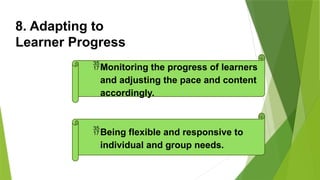
8. Adapting to
LearnerProgress
Monitoring the progress of learners
and adjusting the pace and content
accordingly.
Being flexible and responsive to
individual and group needs.
11.
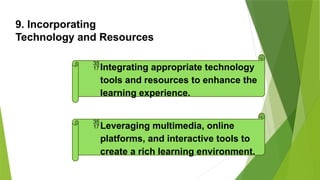
9. Incorporating
Technology andResources
Integrating appropriate technology
tools and resources to enhance the
learning experience.
Leveraging multimedia, online
platforms, and interactive tools to
create a rich learning environment.
12.
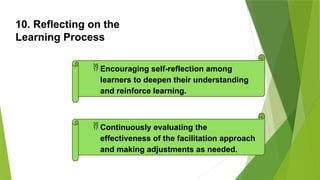
10. Reflecting onthe
Learning Process
Encouraging self-reflection among
learners to deepen their understanding
and reinforce learning.
Continuously evaluating the
effectiveness of the facilitation approach
and making adjustments as needed.
13.
Facilitating learning isa
learner-centered approach that
empowers individuals to take an
active role in their education,
fostering not only the acquisition of
knowledge but also the
development of critical thinking
skills and a lifelong love for
learning
14.
Facilitation of learninginvolves
guiding and supporting individuals or
groups in the process of acquiring
knowledge, skills, and attitudes.
Traditional and non-traditional facilitation
methods refer to different approaches
used in educational settings.
Students studyfrom
textbooks and other written
materials, with the
instructor providing
explanations and
clarifications.
Textbook
Learning
18.
Interactive sessions where
studentsengage in conversation,
ask questions, and share their
thoughts with the facilitator and
peers.
Classroom
Discussions
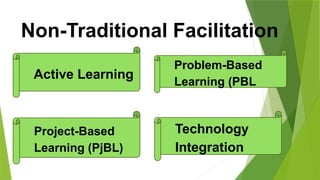
Learning is centeredaround
completing a project, fostering
creativity and practical
application of knowledge.
Project-Based
Learning (PjBL)
25.
Using digital tools,online
resources, and interactive
platforms to enhance learning
experiences.
Technology
Integration
26.
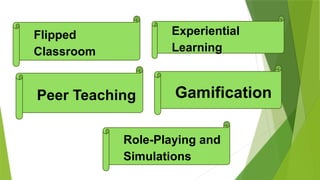
Students review instructionalcontent
independently outside of class, and
class time is used for discussions,
activities, and application of knowledge.
Flipped
Classroom
Students take onthe role of
instructors, teaching and
explaining concepts to their
peers.
Peer Teaching
29.
Applying game elementsand
principles to learning to make it
more engaging and enjoyable.
Gamification
30.
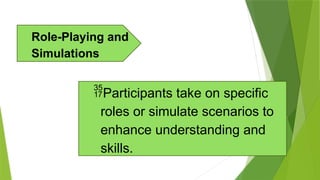
Participants take onspecific
roles or simulate scenarios to
enhance understanding and
skills.
Role-Playing and
Simulations
31.
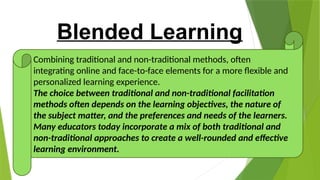
Blended Learning
Combining traditionaland non-traditional methods, often
integrating online and face-to-face elements for a more flexible and
personalized learning experience.
The choice between traditional and non-traditional facilitation
methods often depends on the learning objectives, the nature of
the subject matter, and the preferences and needs of the learners.
Many educators today incorporate a mix of both traditional and
non-traditional approaches to create a well-rounded and effective
learning environment.
A facilitator oflearning plays a crucial
role in creating a positive and effective
learning environment. Their
responsibilities extend beyond
traditional teaching, as they focus on
guiding and supporting learners rather
than delivering content.
34.
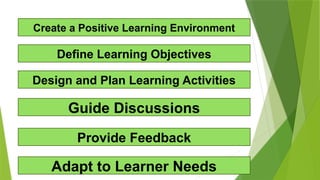
Define Learning Objectives
Createa Positive Learning Environment
Design and Plan Learning Activities
Guide Discussions
Provide Feedback
Adapt to Learner Needs
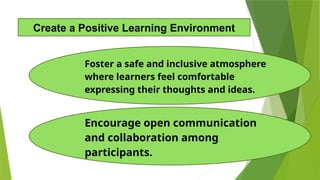
Create a PositiveLearning Environment
Encourage open communication
and collaboration among
participants.
Foster a safe and inclusive atmosphere
where learners feel comfortable
expressing their thoughts and ideas.
37.
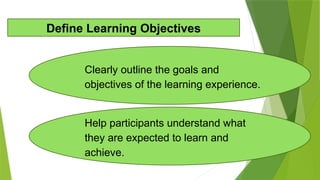
Help participants understandwhat
they are expected to learn and
achieve.
Clearly outline the goals and
objectives of the learning experience.
Define Learning Objectives
38.
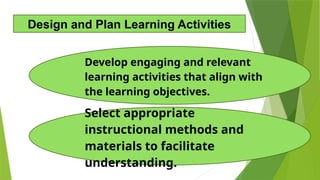
Select appropriate
instructional methodsand
materials to facilitate
understanding.
Develop engaging and relevant
learning activities that align with
the learning objectives.
Design and Plan Learning Activities
39.
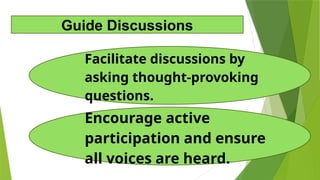
Encourage active
participation andensure
all voices are heard.
Facilitate discussions by
asking thought-provoking
questions.
Guide Discussions
40.
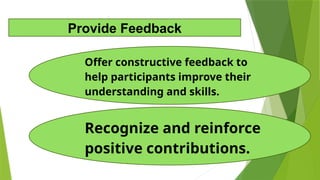
Recognize and reinforce
positivecontributions.
Offer constructive feedback to
help participants improve their
understanding and skills.
Provide Feedback
41.
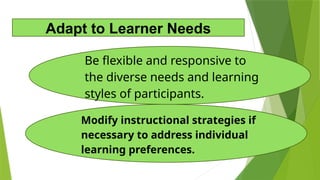
Modify instructional strategiesif
necessary to address individual
learning preferences.
Be flexible and responsive to
the diverse needs and learning
styles of participants.
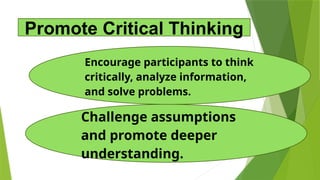
Adapt to Learner Needs
42.
Challenge assumptions
and promotedeeper
understanding.
Encourage participants to think
critically, analyze information,
and solve problems.
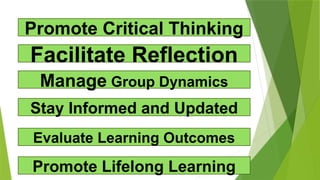
Promote Critical Thinking
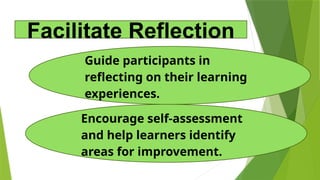
43.
Encourage self-assessment
and helplearners identify
areas for improvement.
Guide participants in
reflecting on their learning
experiences.
Facilitate Reflection
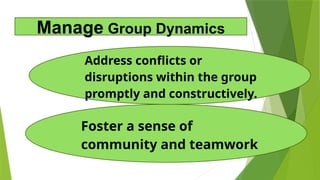
44.
Foster a senseof
community and teamwork
Address conflicts or
disruptions within the group
promptly and constructively.
Manage Group Dynamics
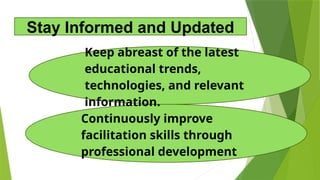
45.
Continuously improve
facilitation skillsthrough
professional development
Keep abreast of the latest
educational trends,
technologies, and relevant
information.
Stay Informed and Updated
46.
Use feedback and
assessmentsto refine future
learning experiences.
Assess whether participants
have achieved the learning
objectives.
Evaluate Learning Outcomes
47.
Instill a passionfor
continuous learning and
encourage participants to
take responsibility for their
own learning beyond the
facilitated sessions.
Promote Lifelong Learning
48.
In summary, afacilitator of learning serves
as a guide and mentor, creating an
environment that fosters learning, critical
thinking, and collaboration. They facilitate
the learning process rather than dictating
it, empowering participants to take an
active role in their educational journey.
49.
essential for thelongevity
of education and the
continued influence of
teachers in the classroom
Teacher-
Centered
Philosophies
the teacher’s roleis to impart a
respect for authority, determination,
a strong work ethic, compassion for
others, and sensibility
Teacher-
Centered
Philosophies
52.
Teachers and schoolssucceed when
students prove, typically through
taking tests, that they have mastered
the objectives they learned
Teacher-
Centered
Philosophies
53.
Essentialism
is theeducational philosophy of
teaching basic skills. This
philosophy advocates training the
mind
54.
Essentialism
Essentialist educatorsfocus on
transmitting a series of progressively
difficult topics and promotion of
students to the next level or grade
55.
Essentialism
Subjects arefocused on the historical
context of the material world and
culture, and move sequentially to give a
solid understanding of the present day
56.
Essentialism
This philosophystresses core knowledge
in reading, writing, math, science,
history, foreign language, and
technology
Essentialism
William C.Bagley (1874–1946) was one of the
most influential advocates of essentialism.
Bagley believed that education was not
supposed to change society but to preserve it
59.
Perennialism
is theeducational philosophy that the
importance of certain works transcends time.
Perennial works are those considered as
important and applicable today as they were
when they were written, and are often
referred to as great books
60.
Perennialism
sometimes referredto as “culturally
conservative,” because it does not challenge
gender stereotypes, incorporate
multiculturalism, or expose and advocate
technology, as would be expected of
contemporary literature.
61.
Perennialism
The goalof a perennialist education is to
teach students to think rationally and develop
minds that can think critically
62.
Perennialism
A perennialistclassroom aims to be a closely
organized and well-disciplined environment,
which develops in students a lifelong quest for
the truth
63.
Perennialism
Perennialists believethat education should epitomize
a prepared effort to make these ideas available to
students and to guide their thought processes toward
the understanding and appreciation of the great
works, works of literature written by history’s finest
thinkers that transcend time and never become
outdated.
64.
Perennialism
Perennialists areprimarily concerned with
the importance of mastery of the content
and development of reasoning skills
65.
Perennialism
Perennialists areprimarily concerned with
the importance of mastery of the content
and development of reasoning skills
66.
These philosophies placemore
emphasis on the individuality of
students and helping them to realize
their potential
Student-
centered
philosophies
67.
A student-centeredclassroom may be less
rigid or structured, less concerned about past
teaching practices and drilling academics, and
more focused on training students for success
in an ever-changing world
Student-
centered
philosophies
68.
Students andteachers typically decide
together what should be learned, as well as
how this can best be achieved.
Student-
centered
philosophies
69.
Progressivis
m
is basedon the positive changes and
problem-solving approach that individuals
with various educational credentials can
provide their students
70.
Progressivis
m
Progressivist educatorsare outcome focused and
don’t simply impart learned facts. Teachers are
less concerned with passing on the existing
culture and strive to allow students to develop
an individual approach to tasks provided to
them.
71.
Progressivis
m
John JacquesRousseau (1712–1778) and
John Dewey (1859–1952) are the guiding
minds of progressivism.
72.
Progressivis
m
Rousseau maintainedthat people are basically good
and that society is responsible for corrupting them. He
supported education in nature, away from the city and
the influences of civilization, where the child’s
interests (as opposed to a written set of guidelines)
would guide the curriculum.
73.
Progressivis
m
John Deweyproposed that people learn best
by social interaction and problem solving.
Dewey developed the scientific method of
problem solving and experimentalism
74.
Progressivis
m
The progressivistclassroom is about exploration and
experience. Teachers act as facilitators in a classroom where
students explore physical, mental, moral, and social growth.
Common sights in a progressivist classroom might include:
small groups debating, custom-made activities, and learning
stations. Teachers typically walk freely among the groups,
guiding them using suggestions and thought-provoking
questions.
Social
Reconstructionism
Reconstructionists notonly aim to educate a
generation of problem solvers, but also try to
identify and correct many noteworthy social
problems that face our nation, with diverse
targets including racism, pollution,
homelessness, poverty, and violence
Social
Reconstructionism
The reconstructionistclassroom contains a teacher
who involves the students in discussions of moral
dilemmas to understand the implications of one’s
actions. Students individually select their objectives
and social priorities and then, with guidance from the
teacher, create a plan of action to make the change
happen.
Constructivism
is atheory rooted in developmental psychology
and asserts that learning primarily occurs
through constructing meaning from experiences.
This philosophy emphasizes understanding as an
active process generated by individual
perspectives and interpretations
82.
Constructivism
Learner’s involvement:Students play a
central role in their own learning
process by actively participating in
activities such as problem-solving and
group discussions.
Constructivism
Recognition ofprior knowledge:
Teachers build upon learners’ prior
knowledge and experiences to facilitate
new learning opportunities.
Humanism
is aneducational philosophy that
emphasizes the development of the
whole person—intrinsically motivated,
self-directed, and possessing a strong
sense of personal identity
87.
Humanism
Focusing onan individual’s unique
characteristics such as values, beliefs,
emotions, and creativity.
Progressive
Education
seeks toengage students actively in relevant
situations tied to the world beyond the
classroom. This philosophy emphasizes
democracy, diversity, and social justice, aiming
to prepare students for active participation in a
democratic society