Understanding
Learner-Centered
Teaching
FACILITATING LEARNER –
CENTERED TEACHING
LESSON 1:
Understanding Learner-Centered Teaching
FACILITATING LEARNER –
CENTERED TEACHING
 Demonstrate knowledge and understanding of
learner-centered teaching.
Objective:
 Relate learner-centered principles to actual life
experiences
FACILITATING LEARNER –
CENTERED TEACHING
What do you know about learner-centered
teaching?
TASK 1
FACILITATING LEARNER –
CENTERED TEACHING
What is Learner-Centered Teaching?
Teaching is an interactive process. The teacher acts
as the learning facilitator while the learners are active
participants in the teaching-learning process. As a
learning facilitator, the teacher provides the learners
with varied opportunities to enhance their knowledge,
skills, and attitudes while emphasizing the 21st
century
skills of collaboration, communication, critical thinking
and problem solving, and creative thinking and
innovation.
FACILITATING LEARNER –
CENTERED TEACHING
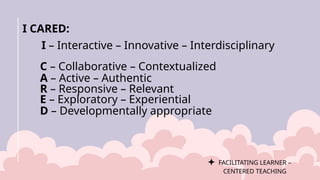
I CARED:
I – Interactive – Innovative – Interdisciplinary
C – Collaborative – Contextualized
A – Active – Authentic
R – Responsive – Relevant
E – Exploratory – Experiential
D – Developmentally appropriate
FACILITATING LEARNER –
CENTERED TEACHING
As learning facilitators, teachers must creatively plan
varied interactive learning activities in the classroom.
These activities should be in the context of learners’
developmental stages, needs, skills, abilities, interests,
feelings, cultures, lives, and experiences.
METACOGNITION
FACILITATING LEARNER –
CENTERED TEACHING
LESSON 2:
FACILITATING LEARNER –
CENTERED TEACHING
What you just did while answering the
questionnaire and analyzing your scores is an exercise
in metacognition. You stopped for a moment and
thought about how you study and learn. You were
reminded of your strengths and weaknesses, then you
wrote what it is that you can do to improve your study
habits. Hopefully, this will help you start to learn more
effectively.
The most important goal of education is to teach
students how to learn on their own.
“If you teach a person what to learn, you are preparing
that person for the past. If you teach a person how to
learn, you are preparing that person for the future”.
- Cyril Houle
FACILITATING LEARNER –
CENTERED TEACHING
It is vital that students acquire the skills of how to
learn; and these skills enable them to learn not just
while they are in school but for a lifetime. This entails a
deeper awareness of how one processes information,
the ability to evaluate his own thinking and to think of
ways to make his own learning process more effective.
All these involve metacognition.
FACILITATING LEARNER –
CENTERED TEACHING
What is METACOGNITION?
This appears to be such a high-sounding word that
some people are confused about even before they
actually spend time to find out what it really means. It
is not at all that complicated. In fact, we do
metacognitive activities so often in our daily lives.
When you sense that you are experiencing some
difficulty with a topic you are studying, and you try out
different strategies to learn better, you are practicing
metacognition. The word maybe long, seems to be so
intangible but it is worth focusing on because it can
help you to be more successful learner. When you
become a teacher, it can also help your students to
FACILITATING LEARNER –
CENTERED TEACHING
The term “metacognition” was coined by John
Flavell. According to Flavell (1979, 1987), metacognition
consists of both metacognitive knowledge and
metacognitive experiences or regulation.
METACOGNITION, simply put, is “thinking about
thinking” or “learning how to learn” . It refers to higher
order thinking which involves active awareness and
control over the cognitive processes engaged in
learning. Metacognitive knowledge refers to acquired
knowledge about cognitive processes, knowledge that
can be used to control cognitive processes. Flavell
further divides metacognitive knowledge into three
categories: knowledge of person variables, task variables,
and strategy variables.
FACILITATING LEARNER –
CENTERED TEACHING
PERSON VARIABLES. This includes how one views
himself as a learner and thinker. Knowledge of person
variables refers to knowledge about how human
beings learn and process information, as well as
individual knowledge of one’s own learning processes.
For example, you may be aware that you study
more effectively if you study very early in the morning
than late in the evening, and that you work better in a
quiet library rather than at home where there are a lot
of things that make it hard for you to focus and
concentrate.
FACILITATING LEARNER –
CENTERED TEACHING
TASK VARIABLES. Knowledge of task variables
includes knowledge about the nature of the task as
well as the type of processing demands that it will
place upon the individual. It is about knowing what
exactly needs to be accomplished, gauging its difficulty
and knowing the kind of effort it will demand from you.
For example, you may be aware that it takes more
time for you to read and comprehend a book in
educational philosophy than it is for you to read and
comprehend a novel.
FACILITATING LEARNER –
CENTERED TEACHING
STRATEGY VARIABLES. Knowledge of strategy
variables involves awareness of the strategy you are
using to learn a topic and evaluating whether this
strategy is effective. If you think your strategy is not
working, then you may think of various strategies and
try out one to see if it will help you learn better. Terms
like meta-attention and meta-memory are related to
strategy variables.
FACILITATING LEARNER –
CENTERED TEACHING
META-ATTENTION
Is the awareness of specific strategies so that you
can keep your attention focused on the topic or task at
hand.
META-MEMORY
Is your awareness of memory strategies that work
best for you.
FACILITATING LEARNER –
CENTERED TEACHING
Knowledge is said to be metacognitive if it is keenly
used in a purposeful manner to ensure that a goal is
met.
For example, a student may use knowledge in planning
how to do homework: “I know that I have more
difficulty with my science assignments than English
and find Araling Panlipunan easier, so I will do my
homework in science first, then Language Arts, then
Araling Panlipunan.
FACILITATING LEARNER –
CENTERED TEACHING
METACOGNITIVE STRATEGIES TO FACILITATE LEARNING
Researches such as that of Fang and Cox showed
that metacognitive awareness was evident in
preschoolers and in students as young as eight years
old. Children already have the capacity to be more
aware and reflective of their own learning. However,
not many have been taught and encouraged to apply
metacognition.
The challenge then to future teachers like you is to
integrate more activities that would build the your
students’ capacity to reflect on their own
characteristics as learners (self-knowledge), the tasks
they are to do (task knowledge) and the strategies that
FACILITATING LEARNER –
CENTERED TEACHING
Remember, metacognition is like any other thing you
will teach. Metacognition involves knowledge and skills
which you and your students can learn and master.
Here are some examples of teaching strategies to
develop metacognition:
1. Have students monitor their own learning and
thinking. (Example: have a student monitor a peer’s
learning/thinking/behaving in dyad)
2. Teach students study or learning strategies.
FACILITATING LEARNER –
CENTERED TEACHING
TQLR – This can be taught to younger students (primary
grades). It is a metacognitive strategy before listening
to a story or presentation.
T is for TUNE IN. It is important for the learner himself
to be aware that he is paying attention, and that he is
ready to learn.
Q is for QUESTION. The learner is given questions or
he thinks of questions about what he will soon learn.
L is for LISTEN. The learner then intentionally exerts
effort to listen. He becomes aware if he is momentarily
detracted and goes back to listen again.
FACILITATING LEARNER –
CENTERED TEACHING
TQLR – This can be taught to younger students (primary
grades). It is a metacognitive strategy before listening
to a story or presentation.
R is for REMEMBER. The learner uses ways or strategies
to remember what was learned.
FACILITATING LEARNER –
CENTERED TEACHING
PQ4R – This is usually for older students in the
intermediate levels ang onwards. This strategy is used
to study a unit or chapter.
P - PREVIEW. Scan the whole chapter before delving on
each paragraph. Check out the objectives. Look for
outlines or advance organizers that will give you an
idea about the important topics and ideas in the
chapter. Ready the summary of the chapter first. (But
please don’t stop at the summary alone. This is not a
good idea at all. Read the whole chapter.)
FACILITATING LEARNER –
CENTERED TEACHING
PQ4R – This is usually for older students in the
intermediate levels ang onwards. This strategy is used
to study a unit or chapter.
Q – QUESTION. Read the guide questions provided, or
think of your own questions about the topic.
R – READ. Check out sub headings as you read. Pay
attention on words that are printed in bold or italicized.
Find out the meaning of words that are not clear to
you. Use a marker or colored pencil to highlight
important words or phrases. (Do not highlight the
whole paragraph.)
FACILITATING LEARNER –
CENTERED TEACHING
PQ4R – This is usually for older students in the
intermediate levels ang onwards. This strategy is used
to study a unit or chapter.
R – RECITE. Work on answering the questions you had
earlier.
R – REVIEW. Pinpoint topics you may need to go back to
and read in order to understand better.
R – REFLECT. Think about what you read. Is everything
clear to you? What are the main points you learned?
How is this relevant or useful to you?
FACILITATING LEARNER –
CENTERED TEACHING
3. Have students make predictions about information
to be presented next based on what they have read.
4. Have students relate ideas to existing knowledge
structures. (It is important to have relevant knowledge
structures well learned.)
5. Have students develop questions; ask questions of
themselves, about what’s going on around them (Have
you asked a good question today?)
FACILITATING LEARNER –
CENTERED TEACHING
6. Help students to know when to ask for help. (He/she
must be able to self-monitor; require students to show
how they have attempted to deal with the problems of
their own.)
7. Show students how to transfer knowledge, attitudes,
values, skills to other situations or tasks.

Understanding Learner-Centered Teachings

  • 1.
  • 2.
    Understanding Learner-Centered Teaching FACILITATINGLEARNER – CENTERED TEACHING  Demonstrate knowledge and understanding of learner-centered teaching. Objective:  Relate learner-centered principles to actual life experiences
  • 3.
    FACILITATING LEARNER – CENTEREDTEACHING What do you know about learner-centered teaching? TASK 1
  • 4.
    FACILITATING LEARNER – CENTEREDTEACHING What is Learner-Centered Teaching? Teaching is an interactive process. The teacher acts as the learning facilitator while the learners are active participants in the teaching-learning process. As a learning facilitator, the teacher provides the learners with varied opportunities to enhance their knowledge, skills, and attitudes while emphasizing the 21st century skills of collaboration, communication, critical thinking and problem solving, and creative thinking and innovation.
  • 5.
    FACILITATING LEARNER – CENTEREDTEACHING I CARED: I – Interactive – Innovative – Interdisciplinary C – Collaborative – Contextualized A – Active – Authentic R – Responsive – Relevant E – Exploratory – Experiential D – Developmentally appropriate
  • 6.
    FACILITATING LEARNER – CENTEREDTEACHING As learning facilitators, teachers must creatively plan varied interactive learning activities in the classroom. These activities should be in the context of learners’ developmental stages, needs, skills, abilities, interests, feelings, cultures, lives, and experiences.
  • 7.
  • 8.
    FACILITATING LEARNER – CENTEREDTEACHING What you just did while answering the questionnaire and analyzing your scores is an exercise in metacognition. You stopped for a moment and thought about how you study and learn. You were reminded of your strengths and weaknesses, then you wrote what it is that you can do to improve your study habits. Hopefully, this will help you start to learn more effectively. The most important goal of education is to teach students how to learn on their own. “If you teach a person what to learn, you are preparing that person for the past. If you teach a person how to learn, you are preparing that person for the future”. - Cyril Houle
  • 9.
    FACILITATING LEARNER – CENTEREDTEACHING It is vital that students acquire the skills of how to learn; and these skills enable them to learn not just while they are in school but for a lifetime. This entails a deeper awareness of how one processes information, the ability to evaluate his own thinking and to think of ways to make his own learning process more effective. All these involve metacognition.
  • 10.
    FACILITATING LEARNER – CENTEREDTEACHING What is METACOGNITION? This appears to be such a high-sounding word that some people are confused about even before they actually spend time to find out what it really means. It is not at all that complicated. In fact, we do metacognitive activities so often in our daily lives. When you sense that you are experiencing some difficulty with a topic you are studying, and you try out different strategies to learn better, you are practicing metacognition. The word maybe long, seems to be so intangible but it is worth focusing on because it can help you to be more successful learner. When you become a teacher, it can also help your students to
  • 11.
    FACILITATING LEARNER – CENTEREDTEACHING The term “metacognition” was coined by John Flavell. According to Flavell (1979, 1987), metacognition consists of both metacognitive knowledge and metacognitive experiences or regulation. METACOGNITION, simply put, is “thinking about thinking” or “learning how to learn” . It refers to higher order thinking which involves active awareness and control over the cognitive processes engaged in learning. Metacognitive knowledge refers to acquired knowledge about cognitive processes, knowledge that can be used to control cognitive processes. Flavell further divides metacognitive knowledge into three categories: knowledge of person variables, task variables, and strategy variables.
  • 12.
    FACILITATING LEARNER – CENTEREDTEACHING PERSON VARIABLES. This includes how one views himself as a learner and thinker. Knowledge of person variables refers to knowledge about how human beings learn and process information, as well as individual knowledge of one’s own learning processes. For example, you may be aware that you study more effectively if you study very early in the morning than late in the evening, and that you work better in a quiet library rather than at home where there are a lot of things that make it hard for you to focus and concentrate.
  • 13.
    FACILITATING LEARNER – CENTEREDTEACHING TASK VARIABLES. Knowledge of task variables includes knowledge about the nature of the task as well as the type of processing demands that it will place upon the individual. It is about knowing what exactly needs to be accomplished, gauging its difficulty and knowing the kind of effort it will demand from you. For example, you may be aware that it takes more time for you to read and comprehend a book in educational philosophy than it is for you to read and comprehend a novel.
  • 14.
    FACILITATING LEARNER – CENTEREDTEACHING STRATEGY VARIABLES. Knowledge of strategy variables involves awareness of the strategy you are using to learn a topic and evaluating whether this strategy is effective. If you think your strategy is not working, then you may think of various strategies and try out one to see if it will help you learn better. Terms like meta-attention and meta-memory are related to strategy variables.
  • 15.
    FACILITATING LEARNER – CENTEREDTEACHING META-ATTENTION Is the awareness of specific strategies so that you can keep your attention focused on the topic or task at hand. META-MEMORY Is your awareness of memory strategies that work best for you.
  • 16.
    FACILITATING LEARNER – CENTEREDTEACHING Knowledge is said to be metacognitive if it is keenly used in a purposeful manner to ensure that a goal is met. For example, a student may use knowledge in planning how to do homework: “I know that I have more difficulty with my science assignments than English and find Araling Panlipunan easier, so I will do my homework in science first, then Language Arts, then Araling Panlipunan.
  • 17.
    FACILITATING LEARNER – CENTEREDTEACHING METACOGNITIVE STRATEGIES TO FACILITATE LEARNING Researches such as that of Fang and Cox showed that metacognitive awareness was evident in preschoolers and in students as young as eight years old. Children already have the capacity to be more aware and reflective of their own learning. However, not many have been taught and encouraged to apply metacognition. The challenge then to future teachers like you is to integrate more activities that would build the your students’ capacity to reflect on their own characteristics as learners (self-knowledge), the tasks they are to do (task knowledge) and the strategies that
  • 18.
    FACILITATING LEARNER – CENTEREDTEACHING Remember, metacognition is like any other thing you will teach. Metacognition involves knowledge and skills which you and your students can learn and master. Here are some examples of teaching strategies to develop metacognition: 1. Have students monitor their own learning and thinking. (Example: have a student monitor a peer’s learning/thinking/behaving in dyad) 2. Teach students study or learning strategies.
  • 19.
    FACILITATING LEARNER – CENTEREDTEACHING TQLR – This can be taught to younger students (primary grades). It is a metacognitive strategy before listening to a story or presentation. T is for TUNE IN. It is important for the learner himself to be aware that he is paying attention, and that he is ready to learn. Q is for QUESTION. The learner is given questions or he thinks of questions about what he will soon learn. L is for LISTEN. The learner then intentionally exerts effort to listen. He becomes aware if he is momentarily detracted and goes back to listen again.
  • 20.
    FACILITATING LEARNER – CENTEREDTEACHING TQLR – This can be taught to younger students (primary grades). It is a metacognitive strategy before listening to a story or presentation. R is for REMEMBER. The learner uses ways or strategies to remember what was learned.
  • 21.
    FACILITATING LEARNER – CENTEREDTEACHING PQ4R – This is usually for older students in the intermediate levels ang onwards. This strategy is used to study a unit or chapter. P - PREVIEW. Scan the whole chapter before delving on each paragraph. Check out the objectives. Look for outlines or advance organizers that will give you an idea about the important topics and ideas in the chapter. Ready the summary of the chapter first. (But please don’t stop at the summary alone. This is not a good idea at all. Read the whole chapter.)
  • 22.
    FACILITATING LEARNER – CENTEREDTEACHING PQ4R – This is usually for older students in the intermediate levels ang onwards. This strategy is used to study a unit or chapter. Q – QUESTION. Read the guide questions provided, or think of your own questions about the topic. R – READ. Check out sub headings as you read. Pay attention on words that are printed in bold or italicized. Find out the meaning of words that are not clear to you. Use a marker or colored pencil to highlight important words or phrases. (Do not highlight the whole paragraph.)
  • 23.
    FACILITATING LEARNER – CENTEREDTEACHING PQ4R – This is usually for older students in the intermediate levels ang onwards. This strategy is used to study a unit or chapter. R – RECITE. Work on answering the questions you had earlier. R – REVIEW. Pinpoint topics you may need to go back to and read in order to understand better. R – REFLECT. Think about what you read. Is everything clear to you? What are the main points you learned? How is this relevant or useful to you?
  • 24.
    FACILITATING LEARNER – CENTEREDTEACHING 3. Have students make predictions about information to be presented next based on what they have read. 4. Have students relate ideas to existing knowledge structures. (It is important to have relevant knowledge structures well learned.) 5. Have students develop questions; ask questions of themselves, about what’s going on around them (Have you asked a good question today?)
  • 25.
    FACILITATING LEARNER – CENTEREDTEACHING 6. Help students to know when to ask for help. (He/she must be able to self-monitor; require students to show how they have attempted to deal with the problems of their own.) 7. Show students how to transfer knowledge, attitudes, values, skills to other situations or tasks.

Editor's Notes

  • #2 This lesson is an introductory lesson on learner-centered teaching and its underlying principles. This will walk you through understanding what is learner-centered teaching. In this lesson, you are expected to:
  • #3 TASK 1:You have to come up with your own creative or unique concept tree. Just draw your own concept tree. Be creative. There are no hard and fast rules on how you should design your tree. Make it unique. On the trunk, write “Learner-centered Teaching.” On the leaves and branches, write words to describe your own idea about learner-centered teaching. (3mins)
  • #4 When we say interactive process this means a dynamic exchange where the teacher and learners actively communicate and respond to each other, influencing and adapting to one another’s contributions. When we say Learning Facilitator, what comes into your mind? YES! Learning facilitator means the teacher only guides and supports learners’ learning by creating an engaging and effective educational environment. Teachers do not have to spoon feed the learners or provide directly the answers. But they will only GUIDE the learners during activities.
  • #5 In a nutshell, the concepts of learner-centered teaching can be summed up in the acronym I CARED. I for Interactive means there is an exchange of communication and feedback., Innovative means introducing new ideas or methods., Interdisciplinary means combining or integrating different subjects/disciplines in relation to your discussion. A good example is if you are teaching kindergarten and your topic is about plants. Some of the subjects that can be integrated are science (when talking about the parts of the plants), numeracy (counting how many plants are shown), and literacy (by letting them read the words aloud). Collaborative means? working together to achieve a common goal. How about Contextualize? Means to place something within its relevant context or background to better understand its meaning or significance. Example: if you are assigned in a remote area, let us say in Kepiyanan Elementary School South District Dipolog City and you are teaching mathematics in a grade 2. you can use materials that are common in the area such as leaves, coconut, twigs. Then use it in discussing addition or subtraction. That is another way of contextualizing your lesson by using available material. Contextualization also means using familiar stories related to your present topic such as noting details. You do not have to use foreign materials or stories they are not familiar with. Next is A for Active-Authentic. Active engagement by involving students in hands-on, problem-solving activities that reflect real-world scenarios. This approach ensures that learning is not only interactive but also authentic, making it more relevant and meaningful to students' lives and future applications. R for Responsive – Relevant. Learner-centered teaching needs to be responsive and relevant to address the diverse needs and backgrounds of students, ensuring that each learner can engage with the material in a way that suits their individual context. By aligning instruction with students' interests and real-world applications, it enhances motivation and facilitates deeper, more meaningful learning. E for Exploratory – Experiential. Learner-centered teaching needs to be exploratory and experiential to encourage students to actively discover and apply knowledge through hands-on experiences, fostering deeper understanding and retention. This approach allows learners to engage with content in a dynamic way, promoting critical thinking and problem-solving skills that are essential for real-world application. D – Developmentally appropriate. Learner-centered teaching needs to be developmentally appropriate to ensure that the content and instructional methods align with students' cognitive, emotional, and social growth stages. This alignment supports effective learning by presenting challenges that are neither too easy nor too difficult, thereby optimizing students' engagement and understanding. IN other words, teachers should give grade level appropriate discussion and material to learners. Do not give stories to grade 1 learners that are taken from grade 3. what do you think will happen to grade 1 learners if you let them read grade 3 English stories? YES. Exactly.
  • #6 As a result, learners will become active participants in the classroom who can apply what they have learned to solve real problems. Now, the question is. WHAT IF YOU ARE ASSIGNED IN AN INCLUSIVE CLASSROOM? When we say inclusive classroom, you will be teaching “regular class” with one or two identified learners with special needs. Recently, majority of DepEd schools are now in an inclusive classroom setting. I know, because I have been into these type of classrooms where the teacher is teaching the majority learners along with learners with special needs (these learners are learners with physical disability, visually impaired with hearing disability, speech disability, and learners with autism) though we did not tag learners with autisms unless diagnosed by professionals. However, we can initially say that the learner is different from the majority based on their mental capability, behavior, and the likes. What will you do to make that learner participate along with others?