Teaching AI about
human knowledge
Ines Montani
Explosion AI
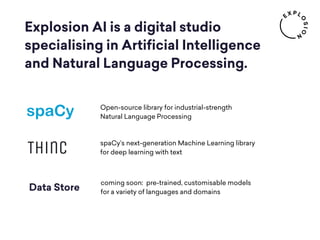
Explosion AI is a digital studio
specialising in Artificial Intelligence
and Natural Language Processing.
Open-source library for industrial-strength
Natural Language Processing
spaCy’s next-generation Machine Learning library
for deep learning with text
Data Store
coming soon: pre-trained, customisable models

for a variety of languages and domains
Machine learning is
programming by
example.
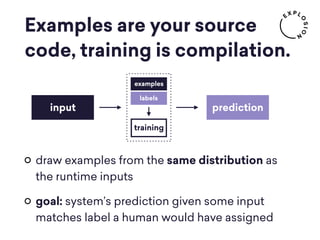
Examples are your source
code, training is compilation.
draw examples from the same distribution as
the runtime inputs
goal: system’s prediction given some input
matches label a human would have assigned
examples
training
predictioninput
labels
How machines “learn”
def train_tagger(examples):
W = defaultdict(lambda: zeros(n_tags))
for (word, prev, next), human_tag in examples:
scores = W[word] + W[prev] + W[next]
guess = scores.argmax()
if guess != human_tag:
for feat in (word, prev, next):
W[feat][guess] -= 1
W[feat][human_tag] += 1
the weights we'll train
if the guess was wrong, adjust weights
get the best-scoring tag
score each tag given weights & context
examples = words, tags, contexts
decrease score for bad tag in this context
increase score for good tag in this context
Example: training a simple part-of-speech tagger with the perceptron algorithm

(teach the model to recognise verbs, nouns, etc.)
The bottleneck in AI
is data, not algorithms.
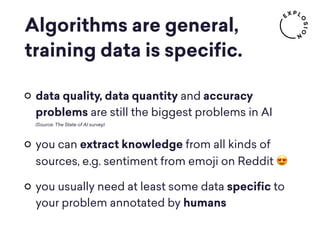
Algorithms are general,
training data is specific.
data quality, data quantity and accuracy
problems are still the biggest problems in AI 

(Source: The State of AI survey)
you can extract knowledge from all kinds of
sources, e.g. sentiment from emoji on Reddit 😍
you usually need at least some data specific to
your problem annotated by humans
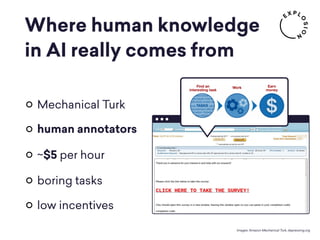
Where human knowledge
in AI really comes from
Images: Amazon Mechanical Turk, depressing.org
Mechanical Turk
human annotators
~$5 per hour
boring tasks
low incentives
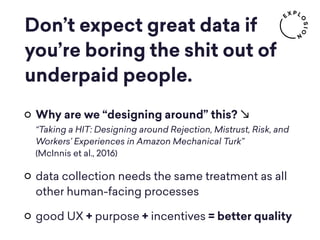
Don’t expect great data if
you’re boring the shit out of
underpaid people.
Why are we “designing around” this?

“Taking a HIT: Designing around Rejection, Mistrust, Risk, and
Workers’ Experiences in Amazon Mechanical Turk” 

(McInnis et al., 2016)
data collection needs the same treatment as all
other human-facing processes
good UX + purpose + incentives = better quality
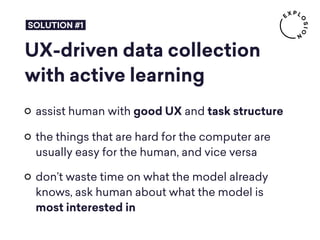
UX-driven data collection
with active learning
assist human with good UX and task structure
the things that are hard for the computer are
usually easy for the human, and vice versa
don’t waste time on what the model already
knows, ask human about what the model is 

most interested in
SOLUTION #1
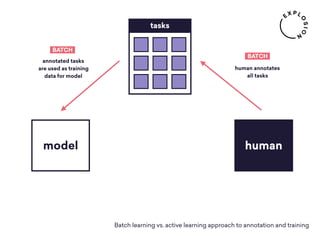
model human
tasks
human annotates
all tasks
annotated tasks
are used as training
data for model
Batch learning vs. active learning approach to annotation and training
BATCH
BATCH
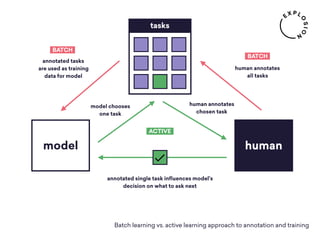
model human
tasks
human annotates
all tasks
annotated tasks
are used as training
data for model
model chooses
one task
human annotates
chosen task
annotated single task influences model’s
decision on what to ask next
Batch learning vs. active learning approach to annotation and training
BATCH
BATCH
ACTIVE
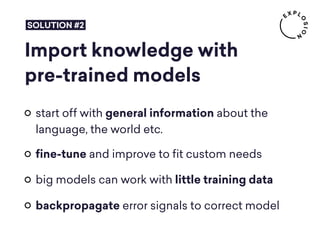
Import knowledge with
pre-trained models
start off with general information about the
language, the world etc.
fine-tune and improve to fit custom needs
big models can work with little training data
backpropagate error signals to correct model
SOLUTION #2
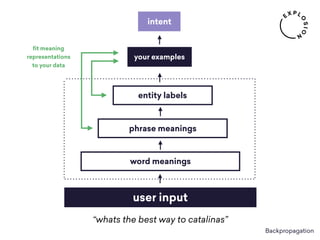
user input
word meanings
entity labels
phrase meanings
intent
your examples
“whats the best way to catalinas”
fit meaning
representations
to your data
Backpropagation
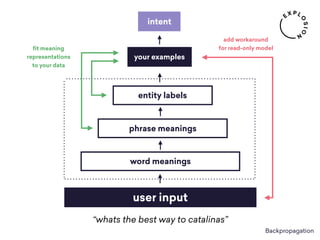
user input
word meanings
entity labels
phrase meanings
intent
your examples
“whats the best way to catalinas”
fit meaning
representations
to your data
add workaround
for read-only model
Backpropagation
If you don’t own the
weights of your model,
you’re missing the
point of deep learning.
Deep learning is about
reading and writing.
deep learning = learning internal
representations to help solve your task.
backpropagate errors on the task you care
about to adjust the internal representations
SaaS is great for read-only software – but deep
learning needs read and write access
1. AI systems today are no magically smart
black boxes. They’re made of annotations and
statistics.
2. AI has an HR problem. To improve the
technology, we need to fix the way we collect
data from humans.
3. AI needs write access. This challenges the
current trends towards thin clients and
centralised cloud computing.
Thanks!
💥 Explosion AI

explosion.ai
📲 Follow us on Twitter

@explosion_ai

@_inesmontani

@honnibal

Teaching AI about human knowledge

  • 1.
    Teaching AI about humanknowledge Ines Montani Explosion AI
  • 2.
    Explosion AI isa digital studio specialising in Artificial Intelligence and Natural Language Processing. Open-source library for industrial-strength Natural Language Processing spaCy’s next-generation Machine Learning library for deep learning with text Data Store coming soon: pre-trained, customisable models
 for a variety of languages and domains
  • 3.
  • 4.
    Examples are yoursource code, training is compilation. draw examples from the same distribution as the runtime inputs goal: system’s prediction given some input matches label a human would have assigned examples training predictioninput labels
  • 5.
    How machines “learn” deftrain_tagger(examples): W = defaultdict(lambda: zeros(n_tags)) for (word, prev, next), human_tag in examples: scores = W[word] + W[prev] + W[next] guess = scores.argmax() if guess != human_tag: for feat in (word, prev, next): W[feat][guess] -= 1 W[feat][human_tag] += 1 the weights we'll train if the guess was wrong, adjust weights get the best-scoring tag score each tag given weights & context examples = words, tags, contexts decrease score for bad tag in this context increase score for good tag in this context Example: training a simple part-of-speech tagger with the perceptron algorithm
 (teach the model to recognise verbs, nouns, etc.)
  • 6.
    The bottleneck inAI is data, not algorithms.
  • 7.
    Algorithms are general, trainingdata is specific. data quality, data quantity and accuracy problems are still the biggest problems in AI 
 (Source: The State of AI survey) you can extract knowledge from all kinds of sources, e.g. sentiment from emoji on Reddit 😍 you usually need at least some data specific to your problem annotated by humans
  • 8.
    Where human knowledge inAI really comes from Images: Amazon Mechanical Turk, depressing.org Mechanical Turk human annotators ~$5 per hour boring tasks low incentives
  • 9.
    Don’t expect greatdata if you’re boring the shit out of underpaid people. Why are we “designing around” this?
 “Taking a HIT: Designing around Rejection, Mistrust, Risk, and Workers’ Experiences in Amazon Mechanical Turk” 
 (McInnis et al., 2016) data collection needs the same treatment as all other human-facing processes good UX + purpose + incentives = better quality
  • 10.
    UX-driven data collection withactive learning assist human with good UX and task structure the things that are hard for the computer are usually easy for the human, and vice versa don’t waste time on what the model already knows, ask human about what the model is 
 most interested in SOLUTION #1
  • 11.
    model human tasks human annotates alltasks annotated tasks are used as training data for model Batch learning vs. active learning approach to annotation and training BATCH BATCH
  • 12.
    model human tasks human annotates alltasks annotated tasks are used as training data for model model chooses one task human annotates chosen task annotated single task influences model’s decision on what to ask next Batch learning vs. active learning approach to annotation and training BATCH BATCH ACTIVE
  • 13.
    Import knowledge with pre-trainedmodels start off with general information about the language, the world etc. fine-tune and improve to fit custom needs big models can work with little training data backpropagate error signals to correct model SOLUTION #2
  • 14.
    user input word meanings entitylabels phrase meanings intent your examples “whats the best way to catalinas” fit meaning representations to your data Backpropagation
  • 15.
    user input word meanings entitylabels phrase meanings intent your examples “whats the best way to catalinas” fit meaning representations to your data add workaround for read-only model Backpropagation
  • 16.
    If you don’town the weights of your model, you’re missing the point of deep learning.
  • 17.
    Deep learning isabout reading and writing. deep learning = learning internal representations to help solve your task. backpropagate errors on the task you care about to adjust the internal representations SaaS is great for read-only software – but deep learning needs read and write access
  • 18.
    1. AI systemstoday are no magically smart black boxes. They’re made of annotations and statistics. 2. AI has an HR problem. To improve the technology, we need to fix the way we collect data from humans. 3. AI needs write access. This challenges the current trends towards thin clients and centralised cloud computing.
  • 19.
    Thanks! 💥 Explosion AI
 explosion.ai 📲Follow us on Twitter
 @explosion_ai
 @_inesmontani
 @honnibal