Rebecca Lee Williams
Teacher's Guide Richmond
200 GM TG2 U0 intro.indd 1 12/6/12 9:04 AM
58 St. Aldates
Oxford, OX1 1ST
United Kingdom
Gumdrops
Teacher’s Guide Level 2
Publisher: Justine Piekarowicz
Managing Editors: Jacaranda Ruiz, Alejandra Zapiain
Editorial Team: Miroslava Guerra
Art Director: Marisela Pérez
Design, Art Coordination and Layout: Isabel Arnaud, Celia Alejos
Cover Design: Isabel Arnaud
Technical Direction: Salvador Pereira
Technical Coordination: Susana Alcántara, Julián Sánchez, Daniel Santillán
Illustrations: A Corazón Abierto pp. 32, 33, 34, 40, 48, 49, 64, 65, 70, 90, 91, 92, 93, 94, 95, 96, 97, 98, 99, 102, 103, 104; Mónica
Cáhue pp. 8, 53, 54, 55, 56, 81, 82, 83, 100, 101; Herenia González pp. 3, 4, 5, 6, 7, 9, 10, 11, 12, 13, 14, 15, 18, 20, 21, 22, 23, 26,
27, 28, 29, 30, 31, 35, 36, 37, 38, 39, 42, 43, 44, 45, 46, 47, 50, 51, 52, 57, 58, 59, 63, 66, 69, 71, 72, 73, 74, 75, 76, 77, 78, 79, 80;
Claudia Navarro pp. 19, 24, 25, 87, 88, 89; Natalia Vázquez pp. 16, 17, 84, 85, 86
Photographs: © Ana Paula Hernández pp. T5a, T7a, T13a, T23a, T29a, T31a, T39a, T41a, T45a, T68a, T69, T70, 71, 72; © PHOTOS.
COM: Alexei Zaycev p. 35; Anna-Yarullina p. 51; Andy Dean p. 29; Arthur Kwiatkowski p. 12; Christian J. Stewart p. 35; Comstock
pp. 12, 35; Cstar55 p. 51; De Santis Paolo p. 35; DessieDavidova p. 27; Dmitry Kalinovsky p. 51; Elvis Santana p. 11; Galina
Barskaya p. 35; Goce Risteski p. 35; Hans Slegers p. 35; Hero30 p. 35; Hkeita p. 35; Jupiterimages p. 35; John Foxx p. 35; Juicybits
p. 51; Maksym Bondarchuk p. 51; Natalia Lukiyanova p. 35; Natalia Siverina p. 51; PaulMaguire p. 35; Peter Zurek p. 35; Petro
Feketa p. 29; Photos.com p. 35; Pixel107 p. 35; Polka Dot Images p. 12; SangHyunPaek p. 51; Sibel Yilmaz p. 35; Stefan Petru
Andronache p. 51; Stockbyte p. 51; Tim Walton p. 12; Viacheslav Krisanov p. 35; Xiaoke ma p.35; © RICHMOND ARCHIVE: pp. 7,
8, T5a, T7a, T9a, T13a, T15a, T17a, T21a, T23a, T25a, T29a, T31a, T33a, T37a, T39a, T41a, T45a, T47a, T49a, T53a, T55a, T57a, T61a,
T63a, T65a, T67a, T68, T69, T70, T71, T72 ; Herenia González p. 11, 36, 51
Richmond publications may contain links to third party websites. We have no control over the content of these websites, which
may change frequently, and we are not responsible for the content or the way it may be used with our materials. Teachers and
students are advised to exercise discretion when accessing the links.
All rights reserved. No part of this book may be reproduced, stored in a retrieval system or transmitted in any form or by any
means, electronic, mechanical, photocopying, recording, or otherwise, without prior permission in writing from the Publisher.
The Publisher has made every effort to trace the owner of copyright material; however, the Publisher will correct any
involuntary omission at the earliest opportunity.
Printed in Mexico
ISBN: 978-607-06-0754-7
First Edition: 2013
D.R. © Richmond Publishing, S. A. de C. V., 2013
Av. Río Mixcoac No. 274, Col. Acacias,
Del. Benito Juárez, C.P. 03240, México, D.F.
This book was printed in
00 GM TG2 U0 intro.indd 2 12/6/12 9:05 AM
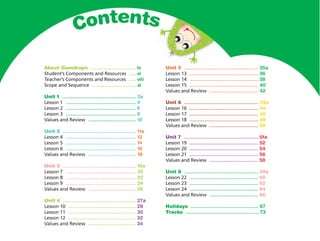
Contents
About Gumdrops ............................... iv
Student’s Components and Resources ..... vi
Teacher’s Components and Resources ..... viii
Scope and Sequence ............................... xi
Unit 1 .................................................. 3a
Lesson 1 ................................................ 4
Lesson 2 ................................................ 6
Lesson 3 ................................................ 8
Values and Review ................................. 10
Unit 2 .................................................. 11a
Lesson 4 ................................................ 12
Lesson 5 ................................................ 14
Lesson 6 ................................................ 16
Values and Review ................................. 18
Unit 3 .................................................. 19a
Lesson 7 ................................................. 20
Lesson 8 ................................................. 22
Lesson 9 ................................................. 24
Values and Review .................................. 26
Unit 4 .................................................. 27a
Lesson 10 ............................................... 28
Lesson 11 ............................................... 30
Lesson 12 ............................................... 32
Values and Review ................................. 34
Unit 5 ................................................... 35a
Lesson 13 ............................................... 36
Lesson 14 ............................................... 38
Lesson 15 ............................................... 40
Values and Review .................................. 42
Unit 6 ................................................... 43a
Lesson 16 ............................................... 44
Lesson 17 ............................................... 46
Lesson 18 ............................................... 48
Values and Review .................................. 50
Unit 7 ................................................... 51a
Lesson 19 ............................................... 52
Lesson 20 ............................................... 54
Lesson 21 ............................................... 56
Values and Review .................................. 58
Unit 8 ................................................... 59a
Lesson 22 ............................................... 60
Lesson 23 ............................................... 62
Lesson 24 ................................................ 64
Values and Review .................................. 66
Holidays .............................................. 67
Tracks .................................................. 73
00 GM TG2 U0 intro.indd 3 12/6/12 9:05 AM
Unit 1
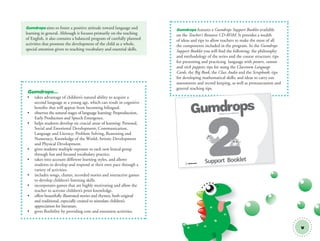
About Gumdrops
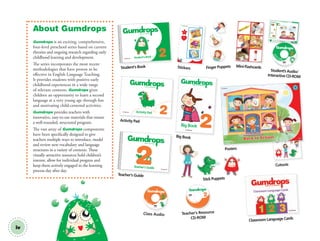
Gumdrops is an exciting, comprehensive,
four-level preschool series based on current
theories and ongoing research regarding early
childhood learning and development.
The series incorporates the most recent
methodologies that have proven to be
effective in English Language Teaching.
It provides students with positive early
childhood experiences in a wide range
of relevant contexts. Gumdrops gives
children an opportunity to learn a second
language at a very young age through fun
and motivating child-centered activities.
Gumdrops provides teachers with
innovative, easy-to-use materials that ensure
a well-rounded, structured program.
The vast array of Gumdrops components
have been specifically designed to give
teachers multiple ways to introduce, model
and review new vocabulary and language
structures in a variety of contexts. These
visually attractive resources hold children’s
interest, allow for individual progress and
keep them actively engaged in the learning
process day after day.
Student's Book
Teacher's Guide
Posters
Big Book Back to School
Richmond
Un
it
1
2 10/23/12 9:42 AM
Big Bo k
Rebecca Lee Williams
Big Book 2Richmond
Richmond
U
nit
1
01 GM2 STK indd 1
Richmond
Listen, drag and drop.
Drag and drop
Un
it
Un
it
8
Activity Pad
Finger PuppetsStickers Mini-flashcards
Activity Pad
2
Rebecca Lee Williams
RebeccaLeeWilliams
ActivityPad
Activity Pad 2Richmond
Student’s Audio/
Interactive CD-ROM
Fing
Mi i fl
Unit 1
Unit 1
Unit 1
Unit 1
Unit 1
Unit 1
2
2
2
2
2
2
Classroom Language Cards
Stick Puppets
Cutouts
iv
Class AudioCl
D.R.©
R
ichmond Publishing, S.A. de C.V., 2013
Clas
s Audio
2
Richmond
Teacher's Resource
CD-ROM
D.R.
©
Richmond Publishing, S.A. de C.V., 2013
Teacher'sR
esource CD-ROM
2Richmond
D.R.
©
Richmond Publishing, S.A. de C.V., 2013
Stude
nt'sAudio
2
3
Richmond
Interac
tive CD-ROM
d t' Book
Rebecca Lee Williams
Student's BookRichmond
2
Teacher's Guide
Rebecca Lee Williams
2Teacher's Guide Richmond
00 GM TG2 U0 intro.indd 4 12/6/12 9:05 AM
v
Gumdrops features a Gumdrops Support Booklet available
on the Teacher’s Resource CD-ROM. It provides a wealth
of ideas and tips to allow teachers to make the most of all
the components included in the program. In the Gumdrops
Support Booklet you will find the following: the philosophy
and methodology of the series and the course structure; tips
for presenting and practicing language with posters, cutouts
and stick puppets; tips for using the Classroom Language
Cards, the Big Book, the Class Audio and the Scrapbook; tips
for developing mathematical skills; and ideas to carry out
assessments and record keeping, as well as pronunciation and
general teaching tips.
Gumdrops...
• takes advantage of children’s natural ability to acquire a
second language at a young age, which can result in cognitive
benefits that will appear from becoming bilingual.
• observes the natural stages of language learning: Preproduction,
Early Production and Speech Emergence.
• helps students develop six crucial areas of learning: Personal,
Social and Emotional Development; Communication,
Language and Literacy; Problem Solving, Reasoning and
Numeracy; Knowledge of the World; Artistic Development
and Physical Development.
• gives students multiple exposure to each new lexical group
through fun and focused vocabulary practice.
• takes into account different learning styles, and allows
students to develop and respond at their own pace through a
variety of activities.
• includes songs, chants, recorded stories and interactive games
to develop children’s listening skills.
• incorporates games that are highly motivating and allow the
teacher to activate children’s prior knowledge.
• offers beautifully illustrated stories and rhymes, both original
and traditional, especially created to stimulate children’s
appreciation for literature.
• gives flexibility by providing core and extension activities.
Rebecca Lee Williams
Richmond Support Booklet
Gumdrops aims to foster a positive attitude toward language and
learning in general. Although it focuses primarily on the teaching
of English, it also contains a balanced program of carefully planned
activities that promote the development of the child as a whole,
special attention given to teaching vocabulary and essential skills.
00 GM TG2 U0 intro.indd 5 12/6/12 9:06 AM
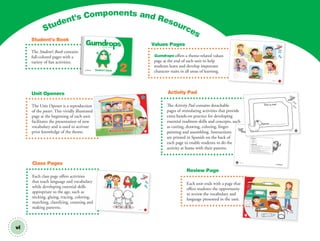
Student's Book
vi
The Student’s Book contains
full-colored pages with a
variety of fun activities.
Gumdrops offers a theme-related values
page at the end of each unit to help
students learn and develop important
character traits in all areas of learning.
67
and
Listen
color.
Values Unit 1
02 GM SB2 VALUES.indd 67
The Unit Opener is a reproduction
of the poster. This vividly illustrated
page at the beginning of each unit
facilitates the presentation of new
vocabulary and is used to activate
prior knowledge of the theme. 3
Un
it
1
Back to School
10/17/12 10:43 AM
Unit Openers
Each class page offers activities
that teach language and vocabulary
while developing essential skills
appropriate to the age, such as
sticking, gluing, tracing, coloring,
matching, classifying, counting and
making patterns. 5
and
color.
Draw
Unit 1 Lesson 1Unit 1
01 GM SB2 U1.indd 5
Class Pages
Values Pages
Student's Components and Resources
The Activity Pad contains detachable
pages of stimulating activities that provide
extra hands-on practice for developing
essential readiness skills and concepts, such
as cutting, drawing, coloring, finger-
painting and assembling. Instructions
are printed in Spanish on the back of
each page to enable students to do the
activity at home with their parents.
Activity Pad
Each unit ends with a page that
offers students the opportunity
to review the vocabulary and
language presented in the unit.
Review Page
10
and
color.
Listen
Review
01 GM SB2 U1.indd 10
2
and
Unit 1 Lesson 1
color.
Draw
Materiales:
• crayolas
• marcador amarillo
• pegamento
• brillantina
• lentejuelas de colores
Instrucciones:
1. Desprenda la página 1 del Activity Pad.2. Pida al niño o a la niña que se dibuje a sí mismo dentro del marco.3. Dígale que coloree su dibujo.
4. Escriba el nombre del alumno sobre la línea con marcador amarilloy pídale que lo trace con crayola.
5. Diga al niño o a la niña que unte un poco de pegamento sobreel dinosaurio y espolvoree brillantina encima.6. Anímelo a pegar lentejuelas sobre el marco para decorarlo.7. Pida al alumno que pegue su dibujo en su álbum de manualidades.
GM AP2 U1.indd 2
lor.
w
Materiales:
Name: ___________
This is me!
1
and
Unit 1 Lesson 1
color.
Draw
10/15/12 10:14 AM
Rebecca Lee Williams
Student's BookRichmond
2
00 GM TG2 U0 intro.indd 6 12/6/12 9:23 AM
vii
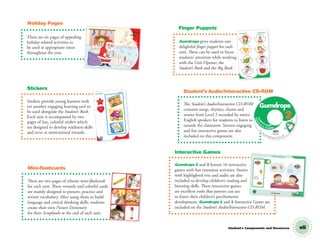
There are six pages of appealing
holiday-related activities to
be used at appropriate times
throughout the year.
Stickers provide young learners with
yet another engaging learning tool to
be used alongside the Student’s Book.
Each unit is accompanied by two
pages of fun, colorful stickers which
are designed to develop readiness skills
and serve as motivational rewards.
Stickers
Holiday Pages
There are two pages of vibrant mini-flashcards
for each unit. These versatile and colorful cards
are mainly designed to present, practice and
review vocabulary. After using them to build
language and critical thinking skills, students
create their own Picture Dictionary
for their Scrapbooks at the end of each unit.
Mini-flashcards
Gumdrops gives students one
delightful finger puppet for each
unit. These can be used to focus
students’ attention while working
with the Unit Opener, the
Student’s Book and the Big Book.
Finger Puppets
The Student’s Audio/Interactive CD-ROM
contains songs, rhymes, chants and
stories from Level 2 recorded by native
English speakers for students to listen to
outside the classroom. Sixteen engaging
and fun interactive games are also
included on this component.
Student’s Audio/Interactive CD-ROM
Gumdrops 2 and 3 feature 16 interactive
games with fun extension activities. Stories
with highlighted text and audio are also
included to develop children’s reading and
listening skills. These interactive games
are excellent tools that parents can use
to foster their children’s psychomotor
development. Gumdrops 2 and 3 Interactive Games are
included on the Student’s Audio/Interactive CD-ROM.
Interactive Games
Holidays Christmas 75
and
Connect
color.
03 GM SB2 HOLIDAYS.indd 75
Richmond
Listen, drag and drop.
Drag and drop
Un
it
Un
it
8
Richmond
Finger Puppets
Unit1
Unit2
Unit3
Unit4
Unit5
Unit6
Unit7
Unit8
Unit 1
Unit 1
Unit 1
Unit 1
Unit 1
Unit 1
2
2
2
2
2
2
Student's Components and Resources
Richmond
Uni
t
1
/17/12 3:26 PM
M
D.R
. ©
Richmond Publishing, S.A. de C.V., 2013
Stud
ent's Audio
2
3
Richmond
Intera
ctive CD-ROM
00 GM TG2 U0 intro.indd 7 1/4/13 10:27 AM
viii
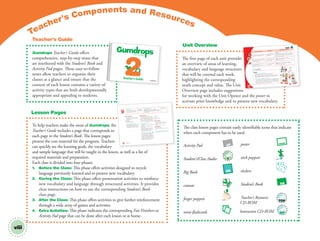
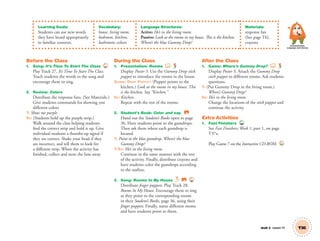
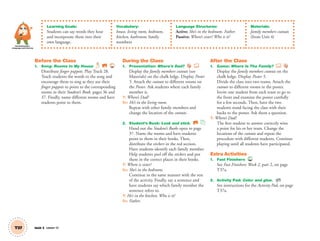
Gumdrops Teacher’s Guide offers
comprehensive, step-by-step notes that
are interleaved with the Student’s Book and
Activity Pad pages. These easy-to-follow
notes allow teachers to organize their
classes at a glance and ensure that the
content of each lesson contains a variety of
activity types that are both developmentally
appropriate and appealing to students.
The class lesson pages contain easily identifiable icons that indicate
when each component has to be used.
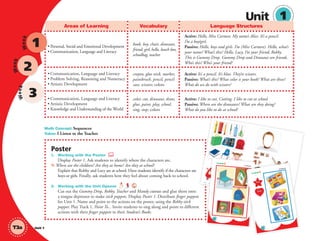
The first page of each unit provides
an overview of areas of learning,
vocabulary and language structures
that will be covered each week,
highlighting the corresponding
math concept and value. The Unit
Overview page includes suggestions
for working with the Unit Opener and the poster to
activate prior knowledge and to present new vocabulary.
To help teachers make the most of Gumdrops, the
Teacher’s Guide includes a page that corresponds to
each page in the Student’s Book. The lesson pages
present the core material for the program. Teachers
can quickly see the learning goals, the vocabulary
and sample language that will be taught in the lesson, as well as a list of
required materials and preparation.
Each class is divided into four phases:
1. Before the Class: This phase offers activities designed to recycle
language previously learned and to present new vocabulary.
2. During the Class: This phase offers presentation activities to reinforce
new vocabulary and language through structured activities. It provides
clear instructions on how to use the corresponding Student’s Book
class page.
3. After the Class: This phase offers activities to give further reinforcement
through a wide array of games and activities.
4. Extra Activities: This phase indicates the corresponding Fast Finishers or
Activity Pad page that can be done after each lesson or at home.
Teacher’s Guide
Unit Overview
Lesson Pages
Unit 1
Unit 1
T3a
Areas of Learning Vocabulary
Language Structures
• Personal, Social and Emotional Development
• Communication, Language and Literacy
book, boy, chair, dinosaur,
friend, girl, hello, lunch box,
schoolbag, teacher
Active: Hello, Miss Carmen. My name’s Alice. It’s a pencil.
I’m a boy/girl.
Passive: Hello, boys and girls. I’m (Miss Carmen). Hello, what’s
your name? What’s this? Hello, Lucy, I’m your friend, Robby.
This is Gummy Drop. Gummy Drop and Dinosaur are friends.
Who’s this? Who’s your friend?
• Communication, Language and Literacy
• Problem Solving, Reasoning and Numeracy
• Artistic Development
crayon, glue stick, marker,
paintbrush, pencil, pencil
case, scissors; colors
Active: It’s a pencil. It’s blue. They’re scissors.
Passive: What’s this? What color is your book? What are these?
What do we do with scissors?
• Communication, Language and Literacy
• Artistic Development
• Knowledge and Understanding of the World
color, cut, dinosaur, draw,
glue, paint, play, school,
sing, stop; colors
Active: I like to cut. Cutting. I like to cut at school.
Passive: Where are the dinosaurs? What are they doing?
What do you like to do at school?
•
•
Week
1
Week
2
Week
3
Poster
1. Working with the Poster
Display Poster 1. Ask students to identify where the characters are.
T: Where are the children? Are they at home? Are they at school?
Explain that Robby and Lucy are at school. Have students identify if the characters are
boys or girls. Finally, ask students how they feel about coming back to school.
2. Working with the Unit Opener
1
Cut out the Gummy Drop, Robby, Teacher and Mandy cutouts and glue them onto
a tongue depressor to make stick puppets. Display Poster 1. Distribute finger puppets
for Unit 1. Name and point to the actions on the poster, using the Robby stick
puppet. Play Track 1, Point To... Invite students to sing along and point to different
actions with their finger puppets in their Student’s Books.
Math Concept: Sequences
Value: I Listen to the Teacher
s
Richmond
Unit 2
GM2 TCH-CO.indd
1
Un
it
1
Richmond
Richmond
Unit
1
10/24/12
8:45 AM
T5 Unit 1 Lesson 1
Learning Goals:
Students can explore new activities.
Students can develop relationships.
Students show interest in peers.
Vocabulary:
boy, dinosaur,
friend, girl, hello
Language Structures:
Active: Hello, Miss Carmen. I’m a boy/girl.
Passive: Hello, Lucy. I’m your friend, Robby. This is Gummy
Drop. Gummy Drop and Dinosaur are friends.Who’s this?
Who’s your friend?
Materials:
crayons, beanbag
Before the Class
1. Greeting Students
Have students line up outside the classroom.
Encourage them to greet you as they come
in the classroom.
T: Hello, Sylvia.
SS: Hello, Miss Carmen.
T: Come in and sit down, please.
2. Song: Hello, My Friend 4
Divide students into pairs. Have them face
each other. Play Track 4, Hello, My Friend.
Teach students the words to the song and
encourage them to sing and act out the song.
Personal, Social
and Emotional Development
During the Class
1. Presentation: Friends
Sit in a circle with the class. Show students
how the stick puppets introduce themselves.
ROBBY PUPPET: Hello, Lucy. I’m your friend, Robby.
Then have the Lucy stick puppet talk in the
same manner to the next student in the circle.
Continue until all students have participated.
2. Presentation: Gummy Drop and
Dinosaur
Present the Gummy Drop and the Dinosaur
stick puppets.
T: This is Gummy Drop. Everybody say, “Hello,
Gummy Drop.”
Repeat with Dinosaur. Tell students that
Gummy Drop and Dinosaur are friends.
T: Gummy Drop and Dinosaur are friends. (Have
the puppets give each other a hug.)
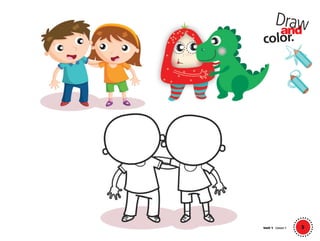
3. Student’s Book: Draw and color. SB
Hand out the Student’s Books open to page 5.
Have students point to the characters.
Say that all the characters are friends. Then
focus students’ attention on the blank faces.
Distribute crayons. Ask students to draw
themselves in one of the faces and a friend in
the other. Have students color in the pictures.
Finally, ask them about their pictures.
T: Who’s this?
S: Me.
T: Who’s your friend?
S: Patty.
After the Class
1. Game: Boy Or Girl?
Toss the beanbag to a student. Have the
student say if he or she is a boy or a girl.
S: I’m a boy.
Repeat the procedure several times.
Extra Activities
1. Fast Finishers TCH
See Fast Finishers: Week 1, part 2, on page
T5a.
2. Activity Pad: Draw and color. AP
See instructions for the Activity Pad, on page
T5a.
Teacher's Components and Resources
Activity Pad AP
Student's/Class Audio 1
Big Book BB
cutouts
finger puppets
mini-flashcards
poster
stick puppets
stickers
Student’s Book SB
Teacher’s Resource
TCH
CD-ROM
Interactive CD-ROM INT
Rebecca Lee Williams
2Teacher's Guide Richmond
00 GM TG2 U0 intro.indd 8 12/6/12 9:25 AM
ix
The last page of every unit contains the teacher’s notes for
appropriate activities that highlight key values. Activities for
general review are also provided to activate key vocabulary
and language structures covered in the lessons. Suggestions
are given to assess both individual and class progress and
detect any weak areas that need extra attention.
The final page of each unit contains step-by-
step instructions for using the Review Page
in the Student’s Book and the Assessments
included on the Teacher’s Resource CD-ROM.
Instructions for students to create their own
Picture Dictionaries with their mini-flashcards
are also found in this section.
This section is found after Unit 8 and includes
instructions on how to use the Holiday
pages in the Student’s Book and Activity Pad,
providing fun holiday-related songs, crafts and
activities. Use these pages at the appropriate
times during the school year.
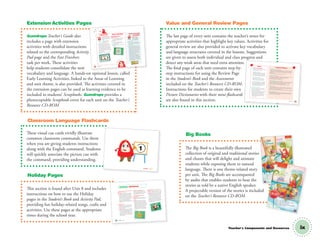
Gumdrops Teacher’s Guide also
includes a page with extension
activities with detailed instructions
related to the corresponding Activity
Pad page and the Fast Finishers
task per week. These activities
help students consolidate the new
vocabulary and language. A hands-on optional lesson, called
Early Learning Activities, linked to the Areas of Learning
and unit theme, is also provided. The activities covered in
the extension pages can be used as learning evidence to be
included in students’ Scrapbooks. Gumdrops provides a
photocopiable Scrapbook cover for each unit on the Teacher’s
Resource CD-ROM.
Extension Activities Pages Value and General Review Pages
Holiday Pages
l l ll d
Unit 1 Lesson 1
T5a
Activity Pad
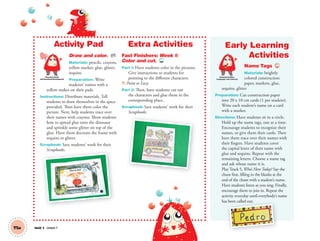
Draw and color. AP
Materials: pencils, crayons,
yellow marker, glue, glitter,
sequins
Preparation: Write
students’ names with a
yellow maker on their pads.
Instructions: Distribute materials. Tell
students to draw themselves in the space
provided. Then have them color the
picture. Next, help students trace over
their names with crayons. Show students
how to spread glue onto the dinosaur
and sprinkle some glitter on top of the
glue. Have them decorate the frame with
sequins or glitter.
Scrapbook: Save students’ work for their
Scrapbooks.
Extra Activities
Fast Finishers: Week 1:
Color and cut. TCH
Part 1: Have students color in the pictures.
Give instructions to students for
pointing to the different characters.
T: Point to Lucy.
Part 2: Then, have students cut out
the characters and glue them in the
corresponding place.
Scrapbook: Save students’ work for their
Scrapbooks.
Early Learning
Activities
Name Tags 5
Materials: brightly
colored construction
paper, markers, glue,
sequins, glitter
Preparation: Cut construction paper
into 20 x 10 cm cards (1 per student).
Write each student’s name on a card
with a marker.
Directions: Have students sit in a circle.
Hold up the name tags, one at a time.
Encourage students to recognize their
names, or give them their cards. Then
have them trace over their names with
their fingers. Have students cover
the capital letter of their name with
glue and sequins. Repeat with the
remaining letters. Choose a name tag
and ask whose name it is.
Play Track 5,Who’s Here Today? Say the
chant first, filling in the blanks at the
end of the chant with a student’s name.
Have students listen as you sing. Finally,
encourage them to join in. Repeat the
activity everyday until everybody’s name
has been called out.
Personal, Social
and Emotional Development
Scrapbooks.
s been called out.
Communication,
Language and Literacy
T67
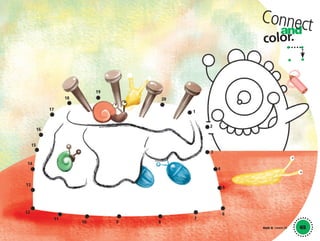
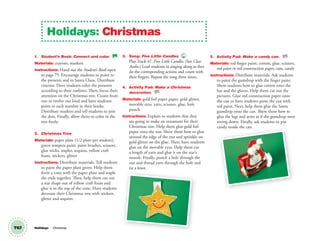
1. Student’s Book: Connect and color. SB
Materials: crayons, markers
Instructions: Hand out the Student’s Book open
to page 75. Encourage students to point to
the presents and to Santa Claus. Distribute
crayons. Have students color the presents
according to their outlines. Then, focus their
attention on the Christmas tree. Count from
one to twelve out loud and have students
point to each number in their books.
Distribute markers and tell students to join
the dots. Finally, allow them to color in the
tree freely.
2. Christmas Tree
Materials: paper plate (1/2 plate per student),
green tempera paint, paint brushes, scissors,
glue sticks, stapler, sequins, yellow craft
foam, stickers, glitter
Instructions: Distribute materials. Tell students
to paint the paper plate green. Help them
form a cone with the paper plate and staple
the ends together. Then, help them cut out
a star shape out of yellow craft foam and
glue it to the top of the cone. Have students
decorate their Christmas tree with stickers,
glitter and sequins.
3. Song: Five Little Candles 49
Play Track 49, Five Little Candles. Lead
students in singing along as they do the
corresponding actions and count with their
fingers. Repeat the song three times.
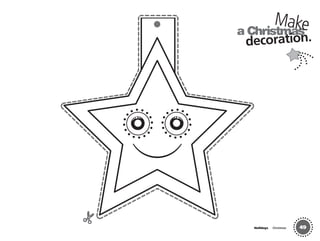
4. Activity Pad: Make a Christmas
decoration. AP
Materials: gold foil paper paper, gold glitter,
movable eyes, yarn, scissors, glue, hole
punch
Instructions: Explain to students that they
are going to make an ornament for their
Christmas tree. Help them glue gold foil
paper onto the star. Show them how to glue
around the edge of the star and sprinkle on
gold glitter on the glue. Then, ha e students
glue on the movable eyes. Help them cut
a length of yarn and glue it on the star’s
mouth. Finally, punch a hole through the
star and thread yarn through the hole and
tie a knot.
Holidays: Christmas
Holidays Christmas
5. Activity Pad: Make a candy can. AP
Materials: red finger paint, cotton, glue, scissors,
red paint or red construction paper, cans, candy
Instructions: Distribute materials. Ask students
to paint the gumdrop with the finger paint.
Show students how to glue cotton onto the
hat and the gloves. Help them cut out the
pictures. Glue red construction paper onto
the can or have students paint the can with
red paint. Next, help them glue the Santa
gumdrop onto the can. Show them how to
glue the legs and arms as if the gumdrop were
sitting down. Finally, ask students to put
candy inside the can.candy inside the can.
.
TC
Unit 1 Review
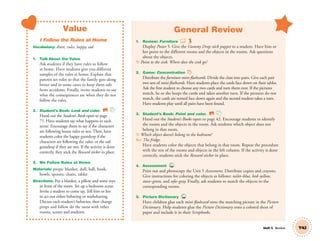
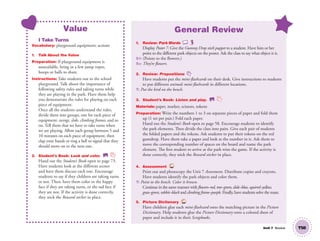
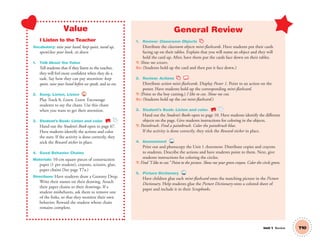
Value
I Listen to the Teacher
Vocabulary: raise your hand, keep quiet, stand up,open/close your book, sit down
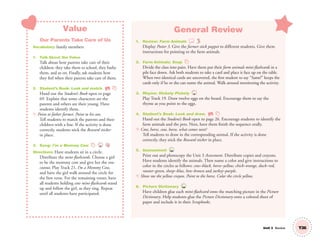
1. Talk About the Value
Tell students that if they listen to the teacher,they will feel more confident when they do atask. Say how they can pay attention: keepquiet, raise your hand before we speak, and so on.
2. Song: Listen, Listen 8
Play Track 8, Listen, Listen. Encourage
students to say the chant. Use this chantwhen you want to get their attention.
3. Student’s Book: Listen and color. SB
Hand out the Student’s Book open to page 67.Have students identify the actions and colorthe stars. If the activity is done correctly, theystick the Reward sticker in place.
4. Good Behavior Chains
Materials: 10-cm square pieces of construction
paper (1 per student), crayons, scissors, glue,paper chains (See page T7a.)
Directions: Have students draw a Gummy Drop.Write their names on their drawing. Attachtheir paper chains to their drawings. If astudent misbehaves, ask them to remove oneof the links, so that they monitor their ownbehavior. Reward the student whose chainremains complete.
General Review
1. Review: Classroom Objects
Distribute the classroom objects mini-flashcards. Have students put their cardsfacing up on their tables. Explain that you will name an object and they willhold the card up. After, have them put the cards face down on their tables.T: Show me scissors.
SS: (Students hold up the card and then put it face down.)
2. Review: Actions
Distribute action mini-flashcards. Display Poster 1. Point to an action on theposter. Have students hold up the corresponding mini-flashcard.T: (Point to the boy cutting.) I like to cut. Show me cut.SS: (Students hold up the cut mini-flashcard.)
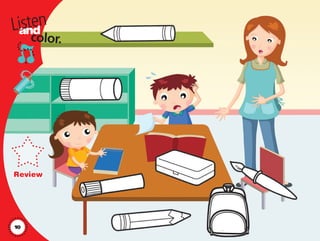
3. Student’s Book: Listen and color. SB
Hand out the Student’s Books open to page 10. Have students identify the differentobjects on the page. Give students instructions for coloring in the objects.T: Paintbrush. Find a paintbrush. Color the paintbrush blue.If the activity is done correctly, they stick the Reward sticker in place.
4. Assessment TCH
Print out and photocopy the Unit 1 Assessment. Distribute copies and crayonsto students. Describe the actions and have students point to them. Next, givestudents instructions for coloring the circles.T: Find “I like to cut.” Point to the picture. Show me your green crayon. Color the circle green.
5. Picture Dictionary TCH
Have children glue each mini-flashcard onto the matching picture in the PictureDictionary. Help students glue the Picture Dictionary onto a colored sheet ofpaper and include it in their Scrapbooks.
T10
The Big Book is a beautifully illustrated
collection of original and traditional stories
and chants that will delight and animate
students while exposing them to natural
language. There is one theme-related story
per unit. The Big Books are accompanied
by audio that enables students to hear the
stories as told by a native English speaker.
A projectable version of the stories is included
on the Teacher’s Resource CD-ROM.
These visual cue cards vividly illustrate
common classroom commands. Use them
when you are giving students instructions
along with the English command. Students
will quickly associate the picture cue with
the command, providing understanding.
Big Books
Classroom Language Flashcards
1 2 3
GM1 CLASS-LANG Flashcards.indd 3
Teacher's Components and Resources
4
I like to say hello in the morning,
I like to say hello today.
I like to say hello, but now I STOP!
It’s time to start our day.
School
I Like
I likeI like to sato sayo sayto say h ll ih lhello ihello iello in the mn the mn then the mhe m ng,g,gorninorningningingng,
I liikikeke toto sayay heelelllloo in ththee moorrniinggg,
I likeI likee ttoto say hello today.day.day.oday.I liikikeke toto sayay heelelllloo totodadayay.y.
I likekekeI likeII to say hello, but nowbut nowt nowbut nowI liikikeke toto sayay heelelllloo, butut nowow STOPP!P!STOSTOI STOI STSTOTOP!
s titiItIt’t’s’s time to smme tm tart ouououour dayr day.r day.day.ItIt’t’s tiimee toto statararrt ourr dadayay.y.
5
I like to sing, sing, sing in the morning,
I like to sing, sing, sing all day.
I like to sing, sing, sing, but now I STOP!
It’s time to draw today.
GM BB2 U1.indd
5
00 GM TG2 U0 intro.indd 9 12/6/12 9:28 AM
x
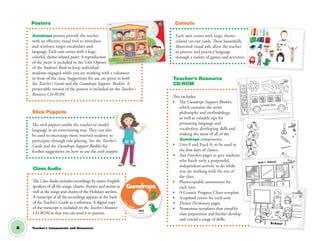
Gumdrops posters provide the teacher
with an effective visual tool to introduce
and reinforce target vocabulary and
language. Each unit comes with a large,
colorful, theme-related poster. A reproduction
of the poster is included in the Unit Opener
of the Student’s Book to keep individual
students engaged while you are working with a volunteer
in front of the class. Suggestions for use are given in both
the Teacher’s Guide and the Gumdrops Support Booklet. A
projectable version of the posters is included on the Teacher’s
Resource CD-ROM.
Each unit comes with large, theme-
related cut-out cards. These beautifully
illustrated visual aids allow the teacher
to present and practice language
through a variety of games and activities.
This includes:
• The Gumdrops Support Booklet,
which contains the series
philosophy and methodology,
as well as valuable tips for
presenting language and
vocabulary, developing skills and
making the most of all of the
Gumdrops components.
• Unit 0 and Track 0, to be used in
the first days of classes.
• Fast Finishers pages to give students
who finish early a purposeful,
independent activity to do while
you are working with the rest of
the class.
• Photocopiable assessments for
each unit.
• A Generic Progress Chart template.
• Scrapbook covers for each unit.
• Picture Dictionary pages.
• Numerous templates that simplify
class preparation and further develop
and extend a range of skills.
Posters
r
Back to School
Richmond
Un
it
1
2 10/23/12 9:42 AM
SCHOOL BUS
and
cut.
Color
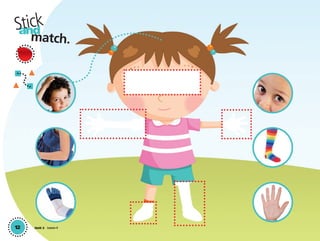
Unit 1 Fast Finishers Week 1
t 1 Fast Finishers Week 1
Lookand
match.
Unit 1 Fast Finishers Week 3
Cutouts
The Class Audio includes recordings by native English
speakers of all the songs, chants, rhymes and stories as
well as the songs and chants of the Holidays section.
A transcript of all the recordings appears at the back
of the Teacher’s Guide as a reference. A digital copy
of the transcript is included on the Teacher’s Resource
CD-ROM so that you can send it to parents.
Class Audio
The stick puppets enable the teacher to model
language in an entertaining way. They can also
be used to encourage more reserved students to
participate through role-playing. See the Teacher’s
Guide and the Gumdrops Support Booklet for
further suggestions on how to use the stick puppets.
Stick Puppets
Teacher's Resource
CD-ROM
Teacher's Components and Resources
Unit 1 Fast Finishers Week 3
PicturedictionaryUnit 1 School
draw glue glue stick
crayon cut
color
draw glue glue stick
MyscrapbookUn
it
1
School
D.R.©
Richmond Publishing, S.A. de C.V., 2013
Cla
ss Audio
2
Richmond
Richmond
Unit 2
Unit 1
GM2 TCH-CO.indd 1
00 GM TG2 U0 intro.indd 10 1/4/13 12:18 PM
xi
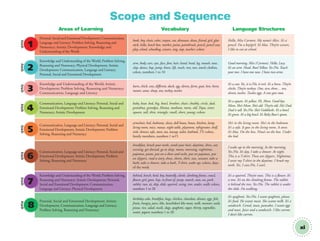
Areas of Learning Vocabulary Language Structures
Personal, Social and Emotional Development; Communication,
Language and Literacy; Problem Solving, Reasoning and
Numeracy; Artistic Development; Knowledge and
Understanding of the World
book, boy, chair, color, crayon, cut, dinosaur, draw, friend, girl, glue
stick, hello, lunch box, marker, paint, paintbrush, pencil, pencil case,
play, school, schoolbag, scissors, sing, stop, teacher; colors
Hello, Miss Carmen. My name’s Alice. It’s a
pencil. I’m a boy/girl. It’s blue. They’re scissors.
I like to cut at school.
Knowledge and Understanding of the World; Problem Solving,
Reasoning and Numeracy; Physical Development; Artistic
Development; Communication, Language and Literacy;
Personal, Social and Emotional Development
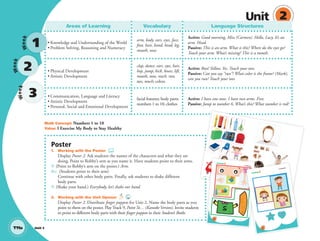
arm, body, ears, eyes, face, foot, hair, hand, head, leg, mouth, nose,
clap, dance, hop, jump, knees, lift, reach, run, toes, touch; clothes,
colors, numbers 1 to 10
Good morning, Miss (Carmen). Hello, Lucy.
It’s an arm. Head. Run! Yellow. Yes./No. Touch
your toes. I have one nose. I have two arms.
Knowledge and Understanding of the World; Artistic
Development; Problem Solving, Reasoning and Numeracy;
Communication, Language and Literacy
barn, chick, cow, different, duck, egg, eleven, farm, goat, hen, horse,
rooster, same, sheep, ten, turkey, twelve
It’s a cow. Yes, it is./No, it isn’t. It’s a horse. They’re
chicks. They’re turkeys. One, two, three… ten,
eleven, twelve. Twelve eggs. A cow goes moo.
Communication, Language and Literacy; Personal, Social and
Emotional Development; Problem Solving, Reasoning and
Numeracy; Artistic Development
baby, bear, bed, big, bowl, brother, chair, chubby, circle, dad,
grandma, grandpa, Mama, medium, mom, old, Papa, sister,
square, tall, thin, triangle, small, short, young; colors
It’s a square. It’s yellow. Hi, Mom. Good-bye,
Mom. She’s Mom. She’s old. They’re old. He’s Dad.
Dad is tall. Yes./No. She’s Goldilocks. It’s a bowl.
It’s green. It’s a big bowl. It’s Baby Bear’s spoon.
Communication, Language and Literacy; Personal, Social and
Emotional Development; Artistic Development; Problem
Solving, Reasoning and Numeracy
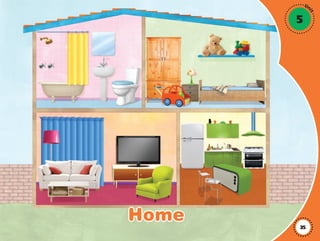
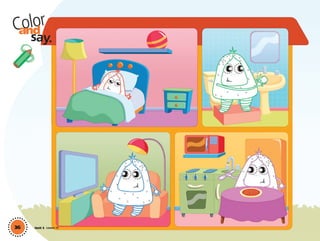
armchair, bed, bedroom, closet, doll house, house, kitchen, lamp,
living room, mice, mouse, night table, playroom, refrigerator, shelf,
sink, shower, sofa, stove, tea, teacup, toilet, bathtub, TV; colors,
family members, numbers 1 to15
He’s in the living room. She’s in the bedroom.
It’s a sofa. It goes in the living room. A stove.
It’s blue. On the box. Nina’s on the box. Under
the bed.
Communication, Language and Literacy; Personal, Social and
Emotional Development; Artistic Development; Problem
Solving, Reasoning and Numeracy
breakfast, brush your teeth, comb your hair, daytime, dress, eat,
evening, get dressed, go to sleep, moon, morning, nighttime,
pajamas, pants, put on a dress and socks, put on pajamas, put
on slippers, read a story, shoes, shorts, skirt, sun, sweater, take a
bath; take a shower, take a bath, T-shirt, wake up; colors, days
of the week
I wake up in the morning. In the morning.
Yes./No. It’s day. I take a shower. At night.
This is a T-shirt. These are slippers. Nighttime.
I wear my T-shirt in the daytime. I brush my
teeth. Yes, I can./No, I can’t.
Knowledge and Understanding of the World; Problem Solving,
Reasoning and Numeracy; Artistic Development; Personal,
Social and Emotional Development; Communication,
Language and Literacy; Physical Development
behind, bench, bird, boy, butterfly, climb, climbing frame, crawl,
flower, girl, grass, hop, in front of, jump, march, nuts, on, park,
rabbit, run, sit, skip, slide, squirrel, swing, tree, under, walk; colors,
numbers 1 to 20
It’s a squirrel. They’re nuts. This is a flower. It’s
a tree. It’s on the climbing frame. The rabbit
is behind the tree. Yes./No. The rabbit is under
the slide. I’m walking.
Personal, Social and Emotional Development; Artistic
Development; Communication, Language and Literacy;
Problem Solving, Reasoning and Numeracy
birthday cake, breakfast, bugs, chicken, chocolate, dinner, eggs, fish,
fruits, hungry, juice, like, lunch/don’t like meat, milk, monster, nails,
pizza, rice, salad, snails, slugs, spaghetti, sugar, thirsty, vegetables,
water, yogurt; numbers 1 to 20
It’s spaghetti. Yes./No. I want spaghetti, please.
It’s food. He wants meat. She wants milk. It’s a
sandwich. Cereal, toast, pancakes. I want eggs
and toast. Juice and a sandwich. I like carrots.
I don’t like carrots.
P
L
N
U
Unit
1
C
E
S
Unit
5
K
D
C
Unit
3
K
R
S
L
Unit
7
K
R
D
P
Unit
2
C
E
S
Unit
6
C
E
N
Unit
4
P
D
P
Unit
8
Scope and Sequence
00 GM TG2 U0 intro.indd 11 12/6/12 9:29 AM
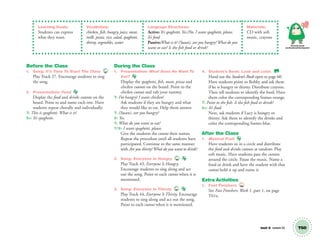
Unit 1
Unit 1T3a
Areas of Learning Vocabulary Language Structures
• Personal, Social and Emotional Development
• Communication, Language and Literacy
book, boy, chair, dinosaur,
friend, girl, hello, lunch box,
schoolbag, teacher
Active: Hello, Miss Carmen. My name’s Alice. It’s a pencil.
I’m a boy/girl.
Passive: Hello, boys and girls. I’m (Miss Carmen). Hello, what’s
your name? What’s this? Hello, Lucy, I’m your friend, Robby.
This is Gummy Drop. Gummy Drop and Dinosaur are friends.
Who’s this? Who’s your friend?
• Communication, Language and Literacy
• Problem Solving, Reasoning and Numeracy
• Artistic Development
crayon, glue stick, marker,
paintbrush, pencil, pencil
case, scissors; colors
Active: It’s a pencil. It’s blue. They’re scissors.
Passive: What’s this? What color is your book? What are these?
What do we do with scissors?
• Communication, Language and Literacy
• Artistic Development
• Knowledge and Understanding of the World
color, cut, dinosaur, draw,
glue, paint, play, school,
sing, stop; colors
Active: I like to cut. Cutting. I like to cut at school.
Passive: Where are the dinosaurs? What are they doing?
What do you like to do at school?
•
•
Week
1
Week
2
Week
3
Poster
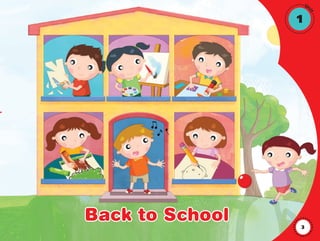
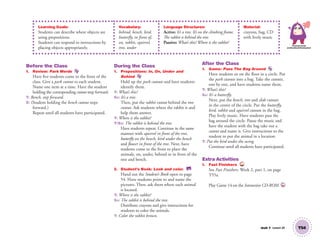
1. Working with the Poster
Display Poster 1. Ask students to identify where the characters are.
T: Where are the children? Are they at home? Are they at school?
Explain that Robby and Lucy are at school. Have students identify if the characters are
boys or girls. Finally, ask students how they feel about coming back to school.
2. Working with the Unit Opener 1
Cut out the Gummy Drop, Robby, Teacher and Mandy cutouts and glue them onto
a tongue depressor to make stick puppets. Display Poster 1. Distribute finger puppets
for Unit 1. Name and point to the actions on the poster, using the Robby stick
puppet. Play Track 1, Point To... Invite students to sing along and point to different
actions with their finger puppets in their Student’s Books.
Math Concept: Sequences
Value: I Listen to the Teacher
s Richmond
Unit 2
Unit 1
GM2 TCH-CO.ind
d 1
Unit 1
Richmond
U
nit
1
01 GM2 STK.indd 1
Richmond
Richmond
Richmond
Uni
t
1
10/24/12 8:45 AM
01 GM TG2 U1.indd 12 12/6/12 9:31 AM
3
Un
it
1
Back to School
01 GM TG2 U1.indd 13 12/6/12 9:31 AM
Lookand
4
stick.
Unit 1 Lesson 1
01 GM TG2 U1.indd 14 12/6/12 9:32 AM
Communication,
Language and Literacy
Unit 1 Lesson 1 T4
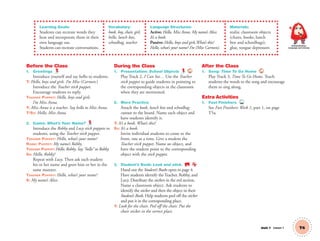
Learning Goals:
Students can recreate words they
hear and incorporate them in their
own language use.
Students can recreate conversations.
Vocabulary:
book, boy, chair, girl,
hello, lunch box,
schoolbag, teacher
Language Structures:
Active: Hello, Miss Anna. My name’s Alice.
It’s a book.
Passive: Hello, boys and girls.What’s this?
Hello, what’s your name? I’m (Miss Carmen).
Materials:
realia: classroom objects
(chairs, books, lunch
box and schoolbags);
glue, tongue depressors
Before the Class
1. Greetings
Introduce yourself and say hello to students.
T: Hello, boys and girls. I’m Miss (Carmen.)
Introduce the Teacher stick puppet.
Encourage students to reply.
TEACHER PUPPET: Hello, boys and girls.
I’m Miss Anna.
T: Miss Anna is a teacher. Say hello to Miss Anna.
T/SS: Hello, Miss Anna.
2. Game: What’s Your Name?
Introduce the Robby and Lucy stick puppets to
students, using the Teacher stick puppet.
TEACHER PUPPET: Hello, what’s your name?
ROBBY PUPPET: My name’s Robby.
TEACHER PUPPET: Hello, Robby. Say “hello” to Robby.
SS: Hello, Robby!
Repeat with Lucy. Then ask each student
his or her name and greet him or her in the
same manner.
TEACHER PUPPET: Hello, what’s your name?
S: My name’s Alice.
During the Class
1. Presentation: School Objects 2
Play Track 2, I Can See… Use the Teacher
stick puppet to guide students in pointing to
the corresponding objects in the classroom
when they are mentioned.
2. More Practice
Attach the book, lunch box and schoolbag
cutouts to the board. Name each object and
have students identify it.
T: It’s a book. What’s this?
SS: It’s a book.
Invite individual students to come to the
front, one at a time. Give a student the
Teacher stick puppet. Name an object, and
have the student point to the corresponding
object with the stick puppet.
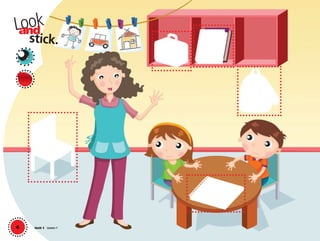
3. Student’s Book: Look and stick. SB
Hand out the Student’s Books open to page 4.
Have students identify the Teacher, Robby, and
Lucy. Distribute the stickers in the red section.
Name a classroom object. Ask students to
identify the sticker and then the object in their
Student’s Book. Help students peel off the sticker
and put it in the corresponding place.
T: Look for the chair. Peel off the chair. Put the
chair sticker in the correct place.
After the Class
1. Song: Time To Go Home 3
Play Track 3, Time To Go Home. Teach
students the words to the song and encourage
them to sing along.
Extra Activities
1. Fast Finishers TCH
See Fast Finishers: Week 1, part 1, on page
T5a.
01 GM TG2 U1.indd 15 12/6/12 9:32 AM
T5 Unit 1 Lesson 1
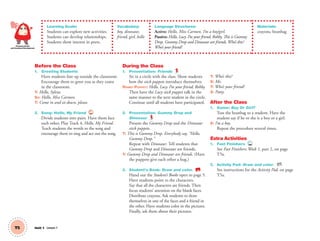
Learning Goals:
Students can explore new activities.
Students can develop relationships.
Students show interest in peers.
Vocabulary:
boy, dinosaur,
friend, girl, hello
Language Structures:
Active: Hello, Miss Carmen. I’m a boy/girl.
Passive: Hello, Lucy. I’m your friend, Robby. This is Gummy
Drop. Gummy Drop and Dinosaur are friends.Who’s this?
Who’s your friend?
Materials:
crayons, beanbag
Before the Class
1. Greeting Students
Have students line up outside the classroom.
Encourage them to greet you as they come
in the classroom.
T: Hello, Sylvia.
SS: Hello, Miss Carmen.
T: Come in and sit down, please.
2. Song: Hello, My Friend 4
Divide students into pairs. Have them face
each other. Play Track 4, Hello, My Friend.
Teach students the words to the song and
encourage them to sing and act out the song.
Personal, Social
and Emotional Development
During the Class
1. Presentation: Friends
Sit in a circle with the class. Show students
how the stick puppets introduce themselves.
ROBBY PUPPET: Hello, Lucy. I’m your friend, Robby.
Then have the Lucy stick puppet talk in the
same manner to the next student in the circle.
Continue until all students have participated.
2. Presentation: Gummy Drop and
Dinosaur
Present the Gummy Drop and the Dinosaur
stick puppets.
T: This is Gummy Drop. Everybody say, “Hello,
Gummy Drop.”
Repeat with Dinosaur. Tell students that
Gummy Drop and Dinosaur are friends.
T: Gummy Drop and Dinosaur are friends. (Have
the puppets give each other a hug.)
3. Student’s Book: Draw and color. SB
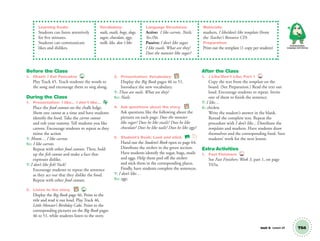
Hand out the Student’s Books open to page 5.
Have students point to the characters.
Say that all the characters are friends. Then
focus students’ attention on the blank faces.
Distribute crayons. Ask students to draw
themselves in one of the faces and a friend in
the other. Have students color in the pictures.
Finally, ask them about their pictures.
T: Who’s this?
S: Me.
T: Who’s your friend?
S: Patty.
After the Class
1. Game: Boy Or Girl?
Toss the beanbag to a student. Have the
student say if he or she is a boy or a girl.
S: I’m a boy.
Repeat the procedure several times.
Extra Activities
1. Fast Finishers TCH
See Fast Finishers: Week 1, part 2, on page
T5a.
2. Activity Pad: Draw and color. AP
See instructions for the Activity Pad, on page
T5a.
01 GM TG2 U1.indd 16 12/6/12 9:32 AM
5
and
color.
Draw
Unit 1 Lesson 1Unit 1
01 GM TG2 U1.indd 17 12/6/12 9:32 AM
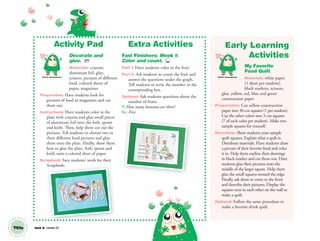
Unit 1 Lesson 1T5a
Activity Pad
Draw and color. AP
Materials: pencils, crayons,
yellow marker, glue, glitter,
sequins
Preparation: Write
students’ names with a
yellow maker on their pads.
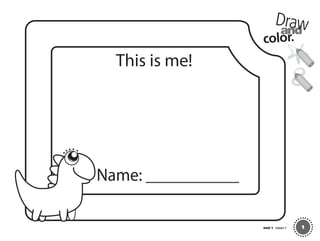
Instructions: Distribute materials. Tell
students to draw themselves in the space
provided. Then have them color the
picture. Next, help students trace over
their names with crayons. Show students
how to spread glue onto the dinosaur
and sprinkle some glitter on top of the
glue. Have them decorate the frame with
sequins or glitter.
Scrapbook: Save students’ work for their
Scrapbooks.
Extra Activities
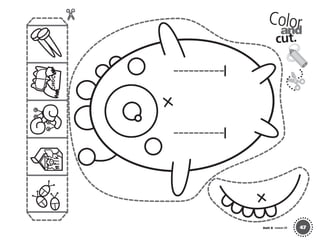
Fast Finishers: Week 1:
Color and cut. TCH
Part 1: Have students color in the pictures.
Give instructions to students for
pointing to the different characters.
T: Point to Lucy.
Part 2: Then, have students cut out
the characters and glue them in the
corresponding place.
Scrapbook: Save students’ work for their
Scrapbooks.
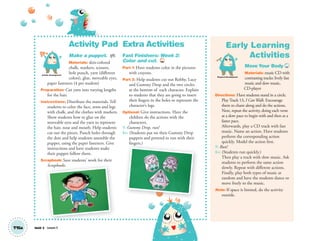
Early Learning
Activities
Name Tags 5
Materials: brightly
colored construction
paper, markers, glue,
sequins, glitter
Preparation: Cut construction paper
into 20 x 10 cm cards (1 per student).
Write each student’s name on a card
with a marker.
Directions: Have students sit in a circle.
Hold up the name tags, one at a time.
Encourage students to recognize their
names, or give them their cards. Then
have them trace over their names with
their fingers. Have students cover
the capital letter of their name with
glue and sequins. Repeat with the
remaining letters. Choose a name tag
and ask whose name it is.
Play Track 5,Who’s Here Today? Say the
chant first, filling in the blanks at the
end of the chant with a student’s name.
Have students listen as you sing. Finally,
encourage them to join in. Repeat the
activity everyday until everybody’s name
has been called out.
Personal, Social
and Emotional Development
Scrapbooks.
s been called out.
Communication,
Language and Literacy
01 GM TG2 U1.indd 18 12/6/12 9:32 AM
Name: ___________
This is me!
1
and
Unit 1 Lesson 1
color.
Draw
01 GM TG2 U1.indd 19 12/6/12 9:33 AM
6
and
color.
Trace
Unit 1 Lesson 2
01 GM TG2 U1.indd 20 12/6/12 9:33 AM
Learning Goals:
Students can
appropriately use
new words they
have heard in
familiar contexts.
Vocabulary:
crayon, glue stick,
marker, paintbrush,
pencil, pencil case,
scissors; colors
Language Structures:
Active: It’s a pencil.
Passive: What’s this?
Materials:
pencils, crayons, red, blue, yellow, orange, pink, purple,
brown, black, white and green construction paper, scissors,
paper fastener, hole punch
Preparation:
Cut a strip of each color of construction paper (3 x 8 cm).
Punch a hole at the bottom. Fasten the strips together with
a paper fastener to make a fan (1 per student).
Unit 1 Lesson 2 T6
Before the Class
1. Song: Hello, My Friend 4
Divide students into pairs. Have them face
each other. Play Track 4. Encourage students
to sing and act out the song. Have students
change partners and repeat the activity.
2. Review: Red, Yellow, Blue, Green
Distribute fans. (See Preparation.) Tell
students to work silently with their fans.
Then, give them commands for showing you
the red, blue, yellow or green strips.
T: Show me yellow.
SS: (Students hold up the yellow strip.)
Walk around the class helping individual
students find the correct strip and hold it
up. Give individual students a thumbs-up
signal if they are correct. Shake your head if
they are incorrect, and tell them to look for
a different strip.
When the activity has finished, show
students how to close the fans, then collect
and store them away.
Communication,
Language and Literacy
During the Class
1. Presentation: Classroom Objects
Display the classroom objects cutouts, one at a
time, and present them. Then have students
identify them.
T: What’s this? (Show the pencil cutout.)
T/SS: It’s a pencil.
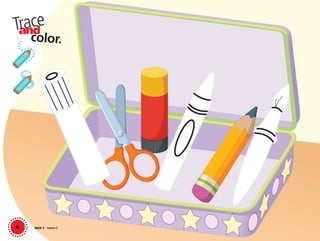
2. Student’s Book: Trace and color. SB
Hand out the Student’s Books open to page 6.
Hold up the marker cutout. Ask students to
look for the marker and point to it in their
books.
T: Marker. Point to the marker.
Continue in the same manner with scissors,
glue stick, crayon, pencil, pencil case and
paintbrush.
Next, distribute pencils and ask students to
trace over the outline of the marker, crayon
and paintbrush.
T: Marker. Trace over the marker.
Distribute crayons. Tell students to color in
the objects.
After the Class
1. Game: Guessing The Classroom
Objects
Put the school objects cutouts face down on a
table. Choose a cutout without showing it to
the class and have individual students guess
what is on the cutout. Then have the whole
class identify it.
T: What’s this?
S1: Pencil?
T: No.
S2: Marker?
T: Yes, this is a marker. What’s this?
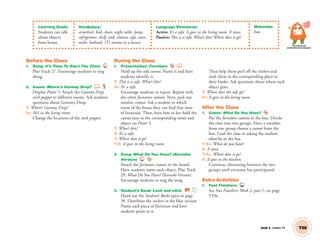
SS: It’s a marker.
Have the student who guesses correctly
choose the next cutout.
2. Song: English Class Is Over 6
Play Track 6, English Class Is Over. Encourage
students to sing and act out the song.
Extra Activities
1. Fast Finishers TCH
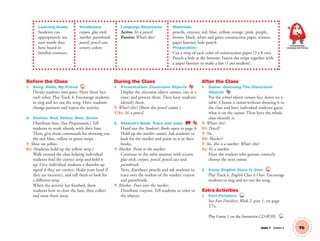
See Fast Finishers: Week 2, part 1, on page
T7a.
Play Game 1 on the Interactive CD-ROM. INT
01 GM TG2 U1.indd 21 12/11/12 5:55 PM
T7 Unit 1 Lesson 2
Communication,
Language and Literacy
Learning Goals:
Students can appropriately use new words
they have heard in familiar contexts.
Students are aware of the functions of a
range of school objects.
Vocabulary:
crayon, glue stick,
marker, paintbrush,
pencil, scissors; colors
Language Structures:
Active: It’s blue.They’re scissors.
Passive: What color is your book? What are
these? What do we do with the scissors?
Materials:
fans (see page T6),
crayons
Before the Class
1. Song: Hello, My Friend 4
Divide students into pairs. Have them face
each other. Play Track 4. Encourage students
to sing and act out the song. Have students
change partners and repeat the activity.
2. Game: Give Me
Distribute the following cutouts to five
students: crayon, glue stick, marker, paintbrush
and pencil. Then ask the students to go to the
front of the class. Display the Gummy Drop
stick puppet. Give students commands.
T: Rick, give Gummy Drop the crayon.
S: (Student gives the Gummy Drop stick puppet
the crayon cutout.)
Continue in the same manner until all
students have participated.
During the Class
1. Review: Colors
Distribute fans. (See Materials.) Remind
students they must work silently. Ask them
to show you the red, blue, yellow, orange or
green strips.
T: Show me orange.
Walk around the class helping individual
students. When the activity has finished
collect and store the fans away.
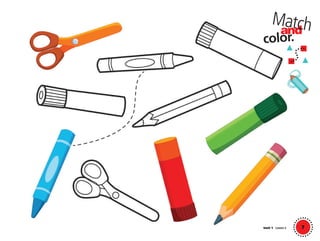
4. Student’s Book: Match and color. SB
Hand out the Student’s Book open to page 7.
Distribute crayons. Ask students to point to
the crayon in their books. Ask students what
color the crayon is. Have students find the
other crayon and trace over the dotted line
to match them. Then have them color the
crayon blue.
T: Show me your blue crayon. Match the crayon
with the crayon. Color the crayon blue.
Repeat the procedure with the rest of the
classroom objects. Finally, name an object.
Encourage students to say what we use the
object for, by miming the actions.
T: What are these?
SS: They’re scissors.
T: What do we do with the scissors?
SS: (Students mime cutting paper.)
After the Class
1. Game: Go For The Colors
Divide the class into five groups and
assign red, yellow, blue, green or orange to
each one. Tell students that when you say
“Go!” they must find as many items in the
classroom with their assigned color as they
can. When you say, “Stop!” students need
to go back and sit in a large circle with their
items. Have members of each group place
their items in the middle of the circle. Ask
the whole class what color the items are.
T: What color is your book?
SS: It’s blue.
2. Song: English Class Is Over 6
Play Track 6. Encourage students to sing and
act out the song
Extra Activities
1. Fast Finishers TCH
See Fast Finishers: Week 2, part 2, on page
T7a.
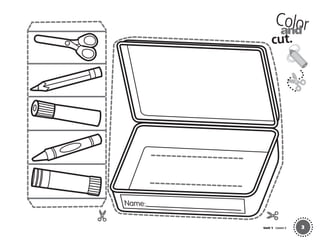
2. Activity Pad: Color and cut. AP
See instructions for the Activity Pad, on page
T7a.
Play Game 2 on the Interactive CD-ROM. INT
01 GM TG2 U1.indd 22 12/6/12 9:33 AM
7
and
color.
Match
Unit 1 Lesson 2Unit 1 Lesson 2
01 GM TG2 U1.indd 23 12/6/12 9:34 AM
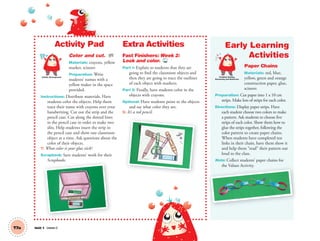
Activity Pad
Color and cut. AP
Materials: crayons, yellow
marker, scissors
Preparation: Write
students’ names with a
yellow maker in the space
provided.
Instructions: Distribute materials. Have
students color the objects. Help them
trace their name with crayons over your
handwriting. Cut out the strip and the
pencil case. Cut along the dotted lines
in the pencil case in order to make two
slits. Help students insert the strip in
the pencil case and show one classroom
object at a time. Ask questions about the
color of their objects.
T: What color it your glue stick?
Scrapbook: Save students’ work for their
Scrapbooks.
Extra Activities
Fast Finishers: Week 2:
Look and color. TCH
Part 1: Explain to students that they are
going to find the classroom objects and
then they are going to trace the outlines
of each object with markers.
Part 2: Finally, have students color in the
objects with crayons.
Optional: Have students point to the objects
and say what color they are.
S: It’s a red pencil.
Unit 1 Lesson 2
Early Learning
Activities
Paper Chains
Materials: red, blue,
yellow, green and orange
construction paper, glue,
scissors
Preparation: Cut paper into 1 x 10 cm
strips. Make lots of strips for each color.
Directions: Display paper strips. Have
each student choose two colors to make
a pattern. Ask students to choose five
strips of each color. Show them how to
glue the strips together, following the
color pattern to create paper chains.
When students have completed ten
links in their chain, have them show it
and help them “read” their pattern out
loud to the class.
Note: Collect students’ paper chains for
the Values Activity.
T7a
the Values Activity.
Artistic Development
Scrapbooks.
Problem Solving,
Reasoning and Numeracy
01 GM TG2 U1.indd 24 12/6/12 9:34 AM
Name:
3Unit 1 Lesson 2
cut.
Colorand
01 GM TG2 U1.indd 25 12/6/12 9:34 AM
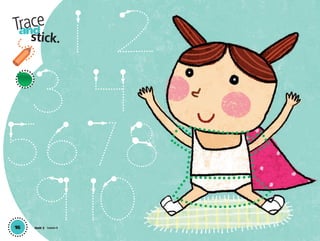
8
andStick
trace.
Unit 1 Lesson 3
01 GM TG2 U1.indd 26 12/6/12 9:34 AM
Unit 1 Lesson 3 T8
Learning Goals:
Students can use new
words or phrases they have
heard in familiar contexts.
Vocabulary:
color, cut, dinosaur,
draw, house, glue,
paint, play, say hello,
school, sing, stop
Language Structures:
Active: I like to cut. Cutting.
Passive: Where are the dinosaurs?
What are they doing?What do
you like to do at school?
Materials:
crayons, markers, I like school template (from
the Teacher’s Resource CD)
Preparation:
Print out the I like school template or write the
text on a piece of paper. (1 per student)
Communication,
Language and Literacy
Before the Class
1. Song: Hello, My Friend 4
Divide students into pairs. Have them face
each other. Play Track 4. Encourage students
to sing and act out the song.
During the Class
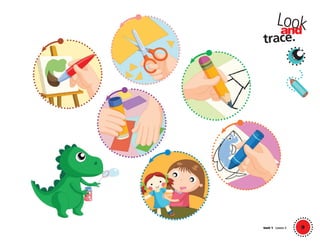
1. Presentation: Actions
Display Poster 1. Point to a picture and say a
sentence about the action.
T: I like to cut. (Mime cutting paper.)
Encourage students to repeat the sentence
and mime the action. Repeat the procedure
with paint, glue, color, sing, draw and play.
2. Make Predictions: I Like School BB
Display the Big Book page 4. Ask students to
make predictions about the story.
T: Where are the dinosaurs? What are they doing?
SS: Cutting.
Display the Big Book pages 4 to 9, one at
a time. Have students look at each picture
and ask them to name and describe as many
things as they can.
T: What’s he doing?
3. Listen to the story. BB SB 7
Hand out the Student’s Books open to page 81.
Play Track 7, I Like School. Point to the
corresponding pictures on the Big Book pages
4 to 9 while students listen to the story and
follow along in their books. Invite individual
students to come up and use their finger
puppets to point to different items on the
page. The other students should look for
the same items and use their finger puppets to
point to them in their books.
T: Point to the boy dinosaur.
Repeat with girl dinosaur, teacher dinosaur,
table, chair and crayon.
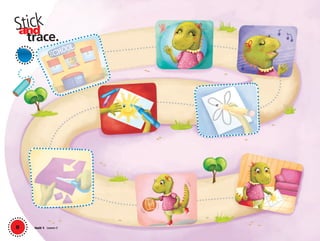
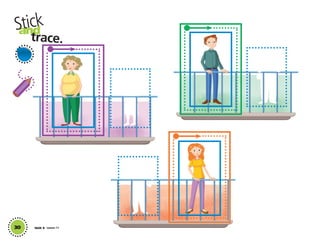
4. Student’s Book: Stick and trace. SB
Hand out the Student’s Books open to page
8. Explain to students that the pictures show
what the dinosaurs do from the moment they
get to school until they go home. Distribute
crayons and the stickers in the blue sections.
Have students identify the actions in their
Student’s Books and the stickers. Help them peel
the stickers off and put them in the correct
places in their Students Books. Next, have
students trace over the dotted lines to connect
the pictures. Finally, encourage students to say
what the dinosaurs like to do at school.
SS: The dinosaurs like to cut.
After the Class
1. I Like School, Part 1 TCH
Copy the text from the I like school template
on the board. (See Preparation.) Read the
text out loud. Encourage students to repeat.
Ask students what they like to do.
T: Mariana, what do you like to do at school?
S: I like to cut.
Write the action on students’ templates.
Reread the texts out loud. Distribute
markers and templates. Have students draw
a picture of what they like to do at school in
the middle of the page. Save students’ work
for the next lesson.
Extra Activities
1. Fast Finishers TCH
See Fast Finishers: Week 3, part 1, on page
T9a.
01 GM TG2 U1.indd 27 12/6/12 9:35 AM
T9 Unit 1 Lesson 3
Communication,
Language and Literacy
Learning Goals:
Students can listen attentively for five minutes.
Students can recognize parts of the story that are
missing and complete the story.
Vocabulary:
color, cut, dinosaur,
draw, glue, paint,
play; colors
Language Structures:
Active: I like to cut at school.
Passive: What do you like to
do at school?
Materials:
colored pencils, markers,
I like school templates
from previous lesson
Before the Class
1. Song: Hello, My Friend 4
Divide students into pairs. Have them face
each other. Play Track 4. Encourage students
to sing and act out the song.
During the Class
1. What is the story about? BB
Display Big Book page 4. Invite students to
say where the dinosaurs are and what they
are doing.
2. Listen to the story. BB 7
Play Track 7. Point to the corresponding
pictures on the Big Book pages as students
listen to the story. Encourage them to mime
the actions.
3. Complete the story. BB
Display the Big Book pages 4 to 9, one at
a time. Read the story out loud. Pause at
the end of each sentence and have students
complete the sentences with the key words.
T: I like to say hello in the…
SS: morning.
T: I like to say hello today.
I like to say hello, but now I…
SS: stop!
T: It’s time to start our day.
Follow the same procedure for the remaining
pages.
4. Review: Actions
Distribute the actions mini-flashcards.
Say different actions. Have students hold up
the corresponding mini-flashcard.
T: Cut. I like to cut. Show me cut.
SS: (Students hold up the corresponding card.)
5. Student Book: Look and trace. SB
Give instructions to students for drawing
circles in the air. Make sure students draw
the circles counterclockwise.
Hand out the Student’s Books open to page 9.
Distribute colored pencils. Name a color
and an action. Have students identify the
action and circle it counterclockwise several
times with the corresponding color.
T: Show me your blue pencil. Point to play.
Circle play.
Continue in the same manner with the rest
of the actions and colors.
After the Class
1. I Like School, Part 2 TCH
Distribute markers and the I like school
templates. (See Materials.) Have students
finish coloring in their pictures. Walk around
the class and ask each student to describe
what he or she likes to do at school.
Have a student come up with his or her
picture. Write the text on the board. Read
the line with the class. Encourage the
student to show everyone his or her picture.
Help the student “read” the text on his or
her page. Have the student point to each
word as you read.
T/S: I like to cut at school.
Repeat the procedure with other students.
Save students’ work for their Scrapbooks.
Extra Activities
1. Fast Finishers TCH
See Fast Finishers: Week 3, part 2, on page
T9a.
2. Activity Pad: Finger-paint and glue. AP
See instructions for the Activity Pad, on page
T9a.
01 GM TG2 U1.indd 28 12/6/12 9:35 AM
9
Lookand
trace.
Unit 1 Lesson 3
01 GM TG2 U1.indd 29 12/6/12 9:35 AM
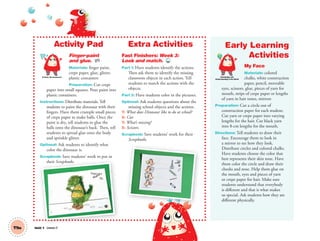
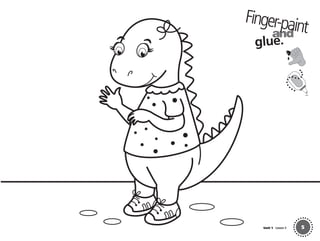
Activity Pad
Finger-paint
and glue. AP
Materials: finger paint,
crepe paper, glue, glitter,
plastic containers
Preparation: Cut crepe
paper into small squares. Pour paint into
plastic containers.
Instructions: Distribute materials. Tell
students to paint the dinosaur with their
fingers. Have them crumple small pieces
of crepe paper to make balls. Once the
paint is dry, tell students to glue the
balls onto the dinosaur’s back. Then, tell
students to spread glue onto the body
and sprinkle glitter.
Optional: Ask students to identify what
color the dinosaur is.
Scrapbook: Save students’ work to put in
their Scrapbooks.
Extra Activities
Fast Finishers: Week 3:
Look and match. TCH
Part 1: Have students identify the actions.
Then ask them to identify the missing
classroom objects in each action. Tell
students to match the actions with the
objects.
Part 2: Have students color in the pictures.
Optional: Ask students questions about the
missing school objects and the actions.
T: What does Dinosaur like to do at school?
S: Cut.
T: What’s missing?
S: Scissors.
Scrapbook: Save students’ work for their
Scrapbooks.
Artistic Development
T9a Unit 1 Lesson 3
Early Learning
Activities
My Face
Materials: colored
chalks, white construction
paper, pencil, moveable
eyes, scissors, glue, pieces of yarn for
mouth, strips of crepe paper or lengths
of yarn in hair tones, mirrors
Preparation: Cut a circle out of
construction paper for each student.
Cut yarn or crepe paper into varying
lengths for the hair. Cut black yarn
into 8-cm lengths for the mouth.
Directions: Tell students to draw their
face. Encourage them to look in
a mirror to see how they look.
Distribute circles and colored chalks.
Have students choose the color that
best represents their skin tone. Have
them color the circle and draw their
cheeks and nose. Help them glue on
the mouth, eyes and pieces of yarn
or crepe paper for hair. Make sure
students understand that everybody
is different and that is what makes
us special. Ask students how they are
different physically.
p
their Scrapbooks.
Knowledge and
Understanding of the World
01 GM TG2 U1.indd 30 12/6/12 9:35 AM
5Unit 1 Lesson 3
and
glue.
Finger-paint
01 GM TG2 U1.indd 31 12/6/12 9:35 AM
10
and
color.
Listen
Review
01 GM TG2 U1.indd 32 12/6/12 9:36 AM
Unit 1 Review
Value
I Listen to the Teacher
Vocabulary: raise your hand, keep quiet, stand up,
open/close your book, sit down
1. Talk About the Value
Tell students that if they listen to the teacher,
they will feel more confident when they do a
task. Say how they can pay attention: keep
quiet, raise your hand before we speak, and so on.
2. Song: Listen, Listen 8
Play Track 8, Listen, Listen. Encourage
students to say the chant. Use this chant
when you want to get their attention.
3. Student’s Book: Listen and color. SB
Hand out the Student’s Book open to page 67.
Have students identify the actions and color
the stars. If the activity is done correctly, they
stick the Reward sticker in place.
4. Good Behavior Chains
Materials: 10-cm square pieces of construction
paper (1 per student), crayons, scissors, glue,
paper chains (See page T7a.)
Directions: Have students draw a Gummy Drop.
Write their names on their drawing. Attach
their paper chains to their drawings. If a
student misbehaves, ask them to remove one
of the links, so that they monitor their own
behavior. Reward the student whose chain
remains complete.
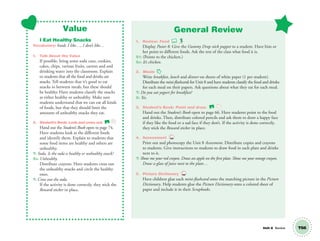
General Review
1. Review: Classroom Objects
Distribute the classroom objects mini-flashcards. Have students put their cards
facing up on their tables. Explain that you will name an object and they will
hold the card up. After, have them put the cards face down on their tables.
T: Show me scissors.
SS: (Students hold up the card and then put it face down.)
2. Review: Actions
Distribute action mini-flashcards. Display Poster 1. Point to an action on the
poster. Have students hold up the corresponding mini-flashcard.
T: (Point to the boy cutting.) I like to cut. Show me cut.
SS: (Students hold up the cut mini-flashcard.)
3. Student’s Book: Listen and color. SB
Hand out the Student’s Books open to page 10. Have students identify the different
objects on the page. Give students instructions for coloring in the objects.
T: Paintbrush. Find a paintbrush. Color the paintbrush blue.
If the activity is done correctly, they stick the Reward sticker in place.
4. Assessment TCH
Print out and photocopy the Unit 1 Assessment. Distribute copies and crayons
to students. Describe the actions and have students point to them. Next, give
students instructions for coloring the circles.
T: Find “I like to cut.” Point to the picture. Show me your green crayon. Color the circle green.
5. Picture Dictionary TCH
Have children glue each mini-flashcard onto the matching picture in the Picture
Dictionary. Help students glue the Picture Dictionary onto a colored sheet of
paper and include it in their Scrapbooks.
T10
01 GM TG2 U1.indd 33 12/6/12 9:37 AM
Unit 2
Unit 2
Areas of Learning Vocabulary Language Structures
• Knowledge and Understanding of the World
• Problem Solving, Reasoning and Numeracy
arm, body, ears, eyes, face,
foot, hair, hand, head, leg,
mouth, nose
Active: Good morning, Miss (Carmen). Hello, Lucy. It’s an
arm. Head.
Passive: This is an arm. What is this? Where do the eyes go?
Touch your arm. What’s missing? This is a mouth.
• Physical Development
• Artistic Development
clap, dance, ears, eyes, hair,
hop, jump, kick, knees, lift,
mouth, nose, reach, run,
toes, touch; colors
Active: Run! Yellow. Yes. Touch your toes.
Passive: Can you say “run”? What color is the frame? (Mark),
can you run? Touch your toes.
• Communication, Language and Literacy
• Artistic Development
• Personal, Social and Emotional Development
facial features; body parts;
numbers 1 to 10; clothes
Active: I have one nose. I have two arms. Five.
Passive: Jump to number 6. What’s this? What number is red?
•
•
Week
1
Week
2
Week
3
Poster
1. Working with the Poster
Display Poster 2. Ask students the names of the characters and what they are
doing. Point to Robby’s arm as you name it. Have students point to their arms.
T: (Point to Robby’s arm on the poster.) Arm.
SS: (Students point to their arm)
Continue with other body parts. Finally, ask students to shake different
body parts.
T: (Shake your hand.) Everybody, let’s shake our hand.
2. Working with the Unit Opener 9
Display Poster 2. Distribute finger puppets for Unit 2. Name the body parts as you
point to them on the poster. Play Track 9, Point To… (Karaoke Version). Invite students
to point to different body parts with their finger puppets in their Student’s Books.
Math Concept: Numbers 1 to 10
Value: I Exercise My Body to Stay Healthy
T11a
Richmond
Unit 2
Unit 1
GM2 TCH-CO.ind
d 1
Unit 1
Richmond
2
U
nit
01 GM2 STK.indd 3
Richmond
Richmond
Richmond
2
Uni
t
dd 4
10/17/12 3:26 PM
01 GM TG2 U2.indd 34 12/6/12 9:44 AM
My Body 11
Un
it
2
01 GM TG2 U2.indd 35 12/6/12 9:44 AM
12
and
match.
Stick
Unit 2 Lesson 4
01 GM TG2 U2.indd 36 12/6/12 9:45 AM
Knowledge and
Understanding of the World
Unit 2 Lesson 4 T12
Learning Goals:
Students can recognize body parts.
Students can name body parts.
Vocabulary:
arm, body, eyes,
foot, hand, head,
leg
Language Structures:
Active: Good morning, Miss (Carmen). Hello, Lucy. It’s an arm.
Passive: This is an arm.What is this?Where do the eyes go?
Touch your arm.
Materials:
none
Before the Class
1. Greetings
Greet students and encourage them to reply.
T: Good morning, boys and girls.
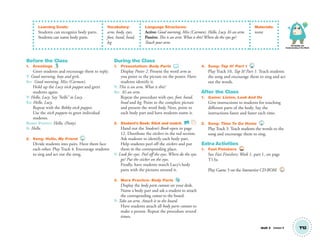
SS: Good morning, Miss (Carmen).
Hold up the Lucy stick puppet and greet
students again.
T: Hello, Lucy. Say “hello” to Lucy.
SS: Hello, Lucy.
Repeat with the Robby stick puppet.
Use the stick puppets to greet individual
students.
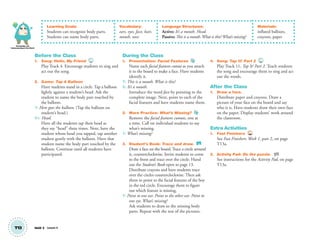
ROBBY PUPPET: Hello, (Patty).
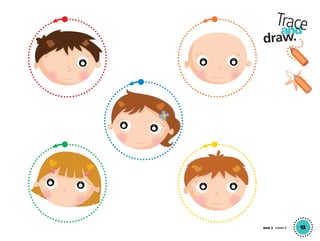
S: Hello.
2. Song: Hello, My Friend 4
Divide students into pairs. Have them face
each other. Play Track 4. Encourage students
to sing and act out the song.
During the Class
1. Presentation: Body Parts
Display Poster 2. Present the word arm as
you point to the picture on the poster. Have
students identify it.
T: This is an arm. What is this?
SS: It’s an arm.
Repeat the procedure with eyes, foot, hand,
head and leg. Point to the complete picture
and present the word body. Next, point to
each body part and have students name it.
2. Student’s Book: Stick and match. SB
Hand out the Student’s Book open to page
12. Distribute the stickers in the red section.
Ask students to identify each body part.
Help students peel off the stickers and put
them in the corresponding place.
T: Look for eyes. Peel off the eyes. Where do the eyes
go? Put the sticker on the eyes.
Finally, have students match Lucy’s body
parts with the pictures around it.
3. More Practice: Body Parts
Display the body parts cutouts on your desk.
Name a body part and ask a student to attach
the corresponding cutout to the board.
T: Take an arm. Attach it to the board.
Have students attach all body parts cutouts to
make a person. Repeat the procedure several
times.
4. Song: Tap It! Part 1 10
Play Track 10, Tap It! Part 1. Teach students
the song and encourage them to sing and act
out the words.
After the Class
1. Game: Listen, Look And Do
Give instructions to students for touching
different parts of the body. Say the
instructions faster and faster each time.
2. Song: Time To Go Home 3
Play Track 3. Teach students the words to the
song and encourage them to sing.
Extra Activities
1. Fast Finishers TCH
See Fast Finishers: Week 1, part 1, on page
T13a.
Play Game 3 on the Interactive CD-ROM. INT
01 GM TG2 U2.indd 37 12/6/12 9:45 AM
Knowledge and
Understanding of the World
T13 Unit 2 Lesson 4
Learning Goals:
Students can recognize body parts.
Students can name body parts.
Vocabulary:
ears, eyes, face, hair,
mouth, nose
Language Structures:
Active: It’s a mouth. Head.
Passive: This is a mouth.What is this?What’s missing?
Materials:
inflated balloon,
crayons, paper
Before the Class
1. Song: Hello, My Friend 4
Play Track 4. Encourage students to sing and
act out the song.
2. Game: Tap A Balloon
Have students stand in a circle. Tap a balloon
lightly against a student’s head. Ask the
student to name the body part touched by
the balloon.
T: Here goes the balloon. (Tap the balloon on
student’s head.)
S1: Head.
Have all the students tap their head as
they say “head” three times. Next, have the
student whose head you tapped, tap another
student gently with the balloon. Have that
student name the body part touched by the
balloon. Continue until all students have
participated.
During the Class
1. Presentation: Facial Features
Name each facial features cutout as you attach
it to the board to make a face. Have students
identify it.
T: This is a mouth. What is this?
S: It’s a mouth.
Introduce the word face by pointing to the
complete image. Next, point to each of the
facial features and have students name them.
2. More Practice: What’s Missing?
Remove the facial features cutouts, one at
a time. Call on individual students to say
what’s missing.
T: What’s missing?
3. Student’s Book: Trace and draw. SB
Draw a face on the board. Trace a circle around
it, counterclockwise. Invite students to come
to the front and trace over the circle. Hand
out the Student’s Book open to page 13.
Distribute crayons and have students trace
over the circles counterclockwise. Then ask
them to point to the facial features of the boy
in the red circle. Encourage them to figure
out which feature is missing.
T: Point to one ear. Point to the other ear. Point to
one eye. What’s missing?
Ask students to draw in the missing body
parts. Repeat with the rest of the pictures.
4. Song: Tap It! Part 2 11
Play Track 11, Tap It! Part 2. Teach students
the song and encourage them to sing and act
out the words.
After the Class
1. Draw a face.
Distribute paper and crayons. Draw a
picture of your face on the board and say
who it is. Have students draw their own face
on the paper. Display students’ work around
the classroom.
Extra Activities
1. Fast Finishers TCH
See Fast Finishers: Week 1, part 2, on page
T13a.
2. Activity Pad: Do the puzzle. AP
See instructions for the Activity Pad, on page
T13a.
01 GM TG2 U2.indd 38 12/6/12 9:45 AM
13
and
draw.
Trace
13Unit 2 Lesson 4
01 GM TG2 U2.indd 39 12/6/12 9:45 AM
Unit 2 Lesson 4T13a
Activity Pad
Do the puzzle. AP
Materials: crayons, scissors,
glue sticks, sheets of paper
(1 per student)
Instructions: Distribute
materials. Have students
color in the pictures. Then,
help them cut out the puzzle pieces.
Have students assemble their puzzles.
Finally, ask them to glue their finished
puzzles onto the sheets of paper.
Optional: Name different body parts or
facial features. Have students point to
them.
Scrapbook: Save students’ work for their
Scrapbooks.
Extra Activities
Fast Finishers: Week 1:
Draw and color. TCH
Part 1: Have students draw themselves in
the blank face.
Part 2: Then, have students color in the
picture.
Optional: Invite students to count their
fingers first and then the fingers in their
pictures.
T: How many fingers do you have? Let’s count.
T/SS: One, two, three, four… ten!
T: Now, let’s count the fingers in the picture.
Scrapbook: Save students’ work for their
Scrapbooks.
Early Learning
Activities
Drawing Shapes
Materials: piece of
white construction paper
(1 per student), crayons,
fine black markers
Directions: Elicit names of shapes: circle,
triangle, square, and rectangle. Next,
have a volunteer come up to the board
and draw one of the shapes. Have the
rest of the class guess which shape he or
she is drawing. The student who guesses
correctly draws the next shape. Finally,
draw a large triangle on the board. Have
different volunteers draw the eyes, ears,
nose, mouth, arms, legs, hands and feet.
Distribute white paper and crayons.
Have students choose a shape and draw
in its body parts. Have students trace
over their drawings with a fine black
marker and then color them in. Display
their pictures in the classroom.
p
Problem Solving,
Reasoning and Numeracy
Problem Solving,
Reasoning and Numeracy
01 GM TG2 U2.indd 40 12/6/12 9:45 AM
7Unit 2 Lesson 4
the
puzzle.
Do
01 GM TG2 U2.indd 41 12/6/12 9:46 AM
14
and
sing.
Trace
Unit 2 Lesson 5
01 GM TG2 U2.indd 42 12/6/12 9:46 AM
Physical Development
Unit 2 Lesson 5 T14
Learning Goals:
Students can control body movements.
Students can make movements in their
places and around the perimeter.
Vocabulary:
clap, dance, hop, jump,
kick, run; colors
Language Structures:
Active: Run! Yellow.
Passive: Can you say “run”? What color is
the frame?
Materials:
fans (See Unit 1,
page T6), markers
Before the Class
1. Song: Tap It! Part 1 10
Play Track 10. Encourage students to sing
and act out the song.
2. Review: Colors
Distribute fans. (See Materials.) Ask
students to show you the red, blue, yellow,
green and orange strips.
T: Show me orange.
SS: (Students hold up the orange strip.)
Give individual students a thumbs-up signal
if they are correct. Shake your head if they
are incorrect, and tell them to look for a
different strip. Collect fans and store
them away.
During the Class
1. Presentation: Actions
Have students stand in a circle. Name an
action as you perform it. Encourage students
to do it along.
T: Run! (Run in your place.)
SS: (Students run in their places.)
Repeat with clap, dance, hop, kick and jump.
2. Presentation: Let’s Run!
Name an action as you do it. Invite students
to stand up and say what they can do.
T: Let’s run! Can you say, “run”? (Run in your place.)
SS: Run!
Repeat the activity with clap, dance, hop, kick
and jump.
3. Student’s Book: Trace and sing. SB
Hand out the Student’s Book open to page
14. Name the actions and have students
point to them. Ask students about the color
of the frames.
T: What color is the frame?
SS: Yellow.
Distribute markers. Have students trace over
the dotted lines with the corresponding marker.
4. Song: Use Your Feet 12
Play Track 12, Use Your Feet. Encourage
students to sing along as they act out the
words.
After the Class
1. Game: Follow The Leader
Take students to the playground. Have
them form a line behind you. Say, “I can
jump” as you jump around the playground.
Have students follow your lead. Repeat with
different actions.
Extra Activities
1. Fast Finishers TCH
See Fast Finishers: Week 2, part 1, on page
T15a.
01 GM TG2 U2.indd 43 12/6/12 9:46 AM
Physical Development
T15 Unit 2 Lesson 5
Learning Goals:
Students can incorporate their imagination
into their movements.
Students can move in their places and around
the perimeter.
Vocabulary:
arm, ears, eyes, foot, head,
hair, knees, lift, leg, mouth,
nose, reach, toes, touch
Language Structures:
Active: Yes. Touch your toes.
Passive: (Mark), can you run?
Touch your toes.
Materials:
crayons, beanbag
Before the Class
1. Song: Use Your Feet 12
Play Track 12. Encourage students to sing
and act out the song.
2. Game: Show Me
Have students sit in a circle. Ask individual
students to show you they can do different
actions.
T: (Mark), can you run?
S: Yes.
T: Show me.
SS: (Student runs around the circle.)
Continue until all the students have
participated.
During the Class
1. Presentation: Following Instructions
Have students stand up. Give an instruction.
Mime the action and have students repeat
the instruction as they perform the action.
T: Touch your toes. (Touch your toes.)
SS: Touch your toes. (Students touch their toes.)
Repeat with reach up high, touch your nose
and lift your knees.
2. More Practice: Instructions
Have five students come up to the front.
Give them instructions. The student who
does not follow an instruction correctly,
must go back to his or her seat. The last
student who remains standing wins. Have
the rest of the class monitor the actions.
Repeat until all students have participated.
3. Student’s Book: Trace and stick. SB
Hand out the Student’s Book open to page
15. Distribute the stickers in the blue section.
Have students identify the actions. Help
students peel off the stickers and put them in
the correct places. Next, distribute crayons.
Have students trace over the dotted lines
several times to match the pictures that show
similar actions.
After the Class
1. Game: The Beanbag Game
Have students sit in a circle. Put the facial
features and body parts cutouts in the middle
of the circle. Toss a beanbag. Ask students
to touch the facial feature or body part
depicted in the cutout that the beanbag
landed on. Invite individual students to
throw the beanbag and give instructions.
2. Song: English Class Is Over 6
Play Track 6. Encourage students to sing and
act out.
Extra Activities
1. Fast Finishers TCH
See Fast Finishers: Week 2, part 2, on page
T15a.
2. Activity Pad: Make a puppet. AP
See instructions for the Activity Pad, on page
T15a.
01 GM TG2 U2.indd 44 12/6/12 9:46 AM
15
and
stick.
Trace
Unit 2 Lesson 5
01 GM TG2 U2.indd 45 12/6/12 9:46 AM
Activity Pad
Make a puppet. AP
Materials: skin-colored
chalk, markers, scissors,
hole punch, yarn (different
colors), glue, moveable eyes,
paper fasteners (4 per student)
Preparation: Cut yarn into varying lengths
for the hair.
Instructions: Distribute the materials. Tell
students to color the face, arms and legs
with chalk, and the clothes with markers.
Show students how to glue on the
moveable eyes and the yarn to represent
the hair, nose and mouth. Help students
cut out the pieces. Punch holes through
the dots and help students assemble the
puppet, using the paper fasteners. Give
instructions and have students make
their puppet follow them.
Scrapbook: Save students’ work for their
Scrapbooks.
Extra Activities
Fast Finishers: Week 2:
Color and cut. TCH
Part 1: Have students color in the pictures
with crayons.
Part 2: Help students cut out Robby, Lucy
and Gummy Drop and the two circles
at the bottom of each character. Explain
to students that they are going to insert
their fingers in the holes to represent the
character’s legs.
Optional: Give instructions. Have the
children do the actions with the
characters.
T: Gummy Drop, run!
SS: (Students put on their Gummy Drop
puppets and pretend to run with their
fingers.)
Unit 2 Lesson 5
Early Learning
Activities
Move Your Body 13
Materials: music CD with
contrasting tracks: lively fast
music and slow music,
CD-player
Directions: Have students stand in a circle.
Play Track 13, I CanWalk. Encourage
them to chant along and do the actions.
Next, repeat the activity, doing each verse
at a slow pace to begin with and then at a
faster pace.
Afterwards, play a CD track with fast
music. Name an action. Have students
perform the corresponding action
quickly. Model the action first.
T: Run!
SS: (Students run quickly.)
Then play a track with slow music. Ask
students to perform the same action
slowly. Repeat with different actions.
Finally, play both types of music at
random and have the students dance or
move freely to the music.
Note: If space is limited, do the activity
outside.
T15a
Artistic Development
Scrapbooks.
Physical Development
fingers.)
01 GM TG2 U2.indd 46 12/6/12 9:47 AM
9Unit 2 Lesson 5
a
puppet.
Make
01 GM TG2 U2.indd 47 12/6/12 9:47 AM
16
and
stick.
Trace
Unit 2 Lesson 6
01 GM TG2 U2.indd 48 12/6/12 9:47 AM
Learning Goals:
Students enjoy hearing
new stories.
Students can listen
attentively for five
minutes.
Vocabulary
facial features; body parts;
numbers 1 to 10; clothes
Language Structures:
Active: I have one nose.
Passive: Jump to number 6.
What’s this?
Materials:
construction paper, sheets of paper, crayons,
markers, Numbers templates, I’m a Superhero!
template (from the Teacher’s Resource CD)
Preparation:
Print out and laminate the Numbers templates.
Print out the I’m a Superhero! template or write
the text on a piece of paper (1 per student).
Unit 2 Lesson 6 T16
Communication,
Language and Literacy
Before the Class
1. Chant: One, Two
Teach students the words to the following
chant and ask them to show the
corresponding number of fingers.
One, Two
One, two,
Three, four,
Five, six,
Seven, eight,
Nine and ten.
Go ahead,
And count again!
During the Class
1. Review: Numbers 1 to 10 TCH
Display the Numbers templates 1 to 10
on different walls in the classroom. (See
Preparation.) Point to the numbers in order
and invite students to name them. Repeat
the procedure, but this time point to the
numbers randomly.
Finally, give commands to students to go to
the numbers performing different actions,
like hopping, running or jumping.
T: Jump to number 6.
2. Make Predictions: I’m a Superhero! BB
Display the Big Book page 10. Ask students
to make predictions about the story.
T: What is the girl doing? Where is she?
Display pages 10 to 15, one at a time. Have
students identify as many things as they can.
T: What’s this? Point to the girl’s eyes.
3. Listen to the story. BB 14
Play Track 14, I’m a Superhero! Point to the
corresponding pictures on the Big Book
pages 10 to 15, while students listen. Invite
individual students to come up and use their
Teacher stick puppet to point to body parts,
facial features and clothes.
4. Student’s Book: Trace and stick. SB
Hand out the Student’s Book open to page
16. Encourage students to count out loud
from 1 to 10 as they point to each number.
Then, distribute crayons and ask students
to trace over the numbers. Next, distribute
the stickers in the green section and have
students identify the skirt and the blouse.
Finally, help students peel off the stickers and
put them in the corresponding places.
After the Class
1. I’m a Superhero! Part 1
Copy the text from the I’m a Superhero!
template on the board. (See Preparation.)
Read the text out loud. Encourage students
to repeat. Invite a student to name a part of
the body to complete the sentence.
T: I have... (Point to your nose.)
S: one nose.
Write one nose in the blank to complete the
sentence on the board. Reread the complete
text. Repeat the procedure with other
students and different parts of the body:
ten fingers, two arms, and so on. Distribute
the templates. Have each student draw a
picture of himself or herself dressed up as a
superhero. Save students’ work for the next
lesson.
Extra Activities
1. Fast Finishers TCH
See Fast Finishers: Week 3, part 1, on page
T17a.
01 GM TG2 U2.indd 49 12/6/12 9:48 AM
Learning Goals:
Students can use new words or phrases they
have heard in familiar contexts.
Students can recognize parts of the story
that are missing and complete the story.
Vocabulary:
facial features;
body parts;
numbers 1 to 10
Language Structures:
Active: I have two arms. Five.
Passive: What number is color red?
Materials:
colored pencils, I’m a Superhero!
templates from the previous
class, fans (See page T6)
T17 Unit 2 Lesson 6
Communication,
Language and Literacy
Before the Class
1. Song: One, Two
Teach students the words to the chant and
encourage them to show the corresponding
number of fingers. (See Page T16.)
2. Review: Body Parts and Actions
Distribute the mini-flashcards for Unit 2.
Name a body part or an action. Have students
hold up the corresponding mini-flashcard.
During the Class
1. What is the story about? BB
Display the Big Book pages 10 to 15. Invite
students to say what the story is about.
2. Listen to the story. BB 14
Play Track 14. Point to the corresponding
pictures on the Big Book pages as students
listen to the story.
3. Complete the story. BB
Display the Big Book pages 10 to 15, one at
a time. Read the story, leaving out key words
and having students fill them in orally.
T: I have ten strong…
SS: fingers
T: and ten strong…
SS: toes.
4. Review: Colors
Distribute fans. (See Materials.) Ask students
to show you the red, blue, yellow, green and
pink strips. Collect fans and store them away.
5. Student’s Book: Look and color. SB
Hand out the Student’s Book open to page 17.
Distribute colored pencils. Name a color
and ask students to tell you the number for
that color.
T: Point to red. What number is the color red?
SS: Five.
Continue in the same manner with the
remaining colors and numbers. Finally, have
students color in the picture using the color
code.
After the Class
1. I’m a Superhero!, Part 2
Distribute crayons and students’ templates.
Have students color in their pictures. Have
each student identify a body part. Ask how
many of those body parts he or she has.
T: How many arms do you have?
S: Two.
Encourage the students to say, “I have two
arms,” as you write his or her response on
the template. Help the student “read” the
text. Repeat the procedure with the rest of
the students. Finally, write examples of the
students’ texts on the board. Read them out
loud with the whole class.
Scrapbook: Save students’ work for their
Scrapbooks.
Extra Activities
1. Fast Finishers TCH
See Fast Finishers: Week 3, part 2, on page
T17a.
2. Activity Pad: Color and play. AP
See instructions for Activity Pad, on page
T17a.
Play Game 4 on the Interactive CD-ROM. INT
01 GM TG2 U2.indd 50 12/6/12 9:49 AM
17
Lookand
color.
Unit 2 Lesson 6
01 GM TG2 U2.indd 51 12/6/12 9:49 AM
Activity Pad
Color and play. AP
Materials: crayons, glitter,
glue, scissors, plastic or
paper cups (1 per student)
Instructions: Tell students
to color in Gummy Drop
and the gumdrops. Then, have students
spread glue onto the pictures and sprinkle
glitter on them. Help students cut out
the pictures. Fold the Gummy Drop and
glue it onto the plastic or paper cup, as if
it were sitting down. Say a number and
have students put the corresponding
number of gumdrops into the cup.
T: Three.
SS: (Students put three gumdrops inside
the cup.)
Extra Activities
Fast Finishers: Week 3:
Make a crown. TCH
Preparation: Cut out a strip of colored
construction paper long enough to go
around students’ heads
Part 1: Have students color in the stars.
Then, have then spread glue on the stars
and sprinkle glitter on them.
Part 2: Help students cut out the stars
and glue them in order onto a strip of
construction paper. Finally, staple both
ends of the strips together to make
acrown.
Artistic Development
T17a Unit 2 Lesson 6
Early Learning
Activities
Superhero
Costume TCH
Materials: crepe paper,
letter-sized piece of
construction paper (1 per
student), hole punch, markers, glue,
glitter, ribbon, elastic, stapler, scissors,
Star and mask template
Preparation: Make a copy of the template
for each student. Cut crepe paper into
sections (approximately 1 meter per
student).
Directions: Distribute the templates and
materials. Help students cut out the
pictures, glue them onto construction
paper and cut them out again. Write
the first letter of students’ names on
the star. Have them color and decorate
the pictures with glitter. Punch a hole
through the top of the star and thread
a piece of ribbon through it to make a
necklace. Staple a piece of elastic to both
sides of the mask. Make a cape with
crepe paper. Staple a piece of ribbon or
elastic to the two top corners to tie the
ends together. Have students wear their
costumes and retell the story.
Personal, Social
and Emotional Development
01 GM TG2 U2.indd 52 12/6/12 9:50 AM
fold
11
and
Unit 2 Lesson 6
play.
Color
01 GM TG2 U2.indd 53 12/6/12 9:50 AM
18
and
color.
Trace
ReviewReview
01 GM TG2 U2.indd 54 12/6/12 9:51 AM
Unit 2 Review
Value
I Exercise My Body to Stay
Healthy
Vocabulary: raise your hands, touch your toes,
walk, run, crawl, jump
1. Game: Teacher Says
Give students commands like raise your
hands up high, touch your toes, walk, run,
crawl and jump. Have students follow only
those commands preceded by “Teacher says.”
2. Student’s Book: Point and color. SB
Hand out the Student’s Book open to page
68. Have students identify the actions.
T: Point to Dad. Dad can raise his hands up high.
Continue with Mommy can walk, Robby can
play, Baby can crawl and Sister can jump rope.
Next, have students color in the pictures. If
the activity is done correctly, students stick
the Reward sticker in place.
3. Talk About the Value
Talk to students about the importance of
exercising. Explain that when they run, jump
and play, they are exercising. Remind them
of the activities the family was doing. Ask
them what kinds of activities they do with
their families to stay active.
4. Song: Exercise 15
Play Track 15, Exercise. Encourage students
to sing and do the corresponding actions.
General Review
1. Review: Facial Features
Display Poster 2. Give the Teacher stick puppet to a student. Have him or her
point to the characters’ facial features.
T: Point to Lucy. Point to her eyes.
Repeat the procedure with different students.
2. Review: Body Parts
Attach the body parts cutouts to the board. Ask individual students to come
to the board and assemble the body parts to make a complete body. Develop
students’ awareness that their bodies are symmetrical, or that they are the same
on both sides.
T: How many heads does she have?
SS: One.
Continue in the same manner with the rest of the body parts cutouts. Finally, give
students the Teacher stick puppet to point to and name each body part.
3. Student’s Book: Trace and color. SB
Hand out the Student’s Book open to page 18. Have students trace over the dotted
lines. Then ask them to identify and color the facial features and body parts.
T: Point to the eyes. Show me your blue pencil. Color the eyes blue.
If the activity is done correctly, students stick the Reward sticker in place.
4. Assessment TCH
Print out and photocopy the Unit 2 Assessment. Distribute copies and crayons.
Have students color the body parts in the girl’s picture.
T: Color the eyes green. Color the head yellow, etc.
Then have students count the body parts and circle the correct number next to
the corresponding body part in the squares.
5. Picture Dictionary TCH
Have children glue each mini-flashcard onto the matching picture in the Picture
Dictionary. Help students glue the Picture Dictionary onto a colored sheet of
paper and include it in their Scrapbooks.
T18
01 GM TG2 U2.indd 55 1/4/13 10:40 AM
Unit 3
Areas of Learning Vocabulary Language Structures
• Knowledge and Understanding of
the World
• Artistic Development
barn, chick, cow, duck, farm,
goat, hen, horse, rooster, sheep,
turkey, same, different
Active: It’s a cow. Yes, it is./No, it isn’t. It’s a horse. They’re chicks.
Passive: What’s this? Is this a cow? What are these? Which animal
is different? A chick lives on the farm.
• Problem Solving, Reasoning and
Numeracy
• Artistic Development
egg, eleven, ten, twelve; farm
animals
Active: Eleven. Twelve. They’re turkeys. One, two, three… ten,
eleven, twelve. Twelve eggs.
Passive: What number is this? What are these? How many eggs
are there?
• Communication, Language and
Literacy
• Artistic Development
• Knowledge and Understanding of
the World
farm, farmer; farm animals;
numbers 1 to 2
Active: It’s a cow. A cow goes moo. It’s brown.
Passive: What animal is this? What sound does the cow make?
Unit 3
•
•
Week
1
Week
2
Week
3
Poster
1. Working with the Poster
Display Poster 3. Have students identify the scene.
T: This is a farm. What’s this?
SS: It’s a farm.
Introduce the words barn, fence and farmer by pointing to the pictures. Have
students identify them.
T: Look. This is the farmer. The farmer lives on the farm. Who’s he?
SS: The farmer.
2. Working with the Unit Opener
Cut out and glue the farmer cutout onto a tongue depressor. Display Poster 3.
Distribute finger puppets for Unit 3. Name the farm animals as you point to them
on the poster with the farmer stick puppet. Have students point to them with their
finger puppets in their Student’s Books.
Math Concept: Numbers 1 to 12
Value: Our Parents Take Care of Us
T19a
Richmond
Unit 4
Unit 3
GM2 TCH-CO.ind
d 3
Unit 3
Richmond
U
nit
3
01 GM2 STK.indd 5
Richmond
Richmond
Richmond
Uni
t
3
dd 6
10/17/12 3:26 PM
01 GM TG2 U3.indd 56 12/6/12 9:53 AM
On the Farm 19
Un
it
3
Un
it
3
01 GM TG2 U3.indd 57 12/6/12 9:53 AM
20
Lookand
stick.
Unit 3 Lesson 7
01 GM TG2 U3.indd 58 12/6/12 9:57 AM
Learning Goals:
Students can identify
and name farm animals.
Vocabulary:
barn, chick, cow,
duck, farm, goat,
hen, horse, rooster,
sheep, turkey
Language Structures:
Active: It’s a cow.
Yes, it is./No, it isn’t.
Passive: What’s this?
Is this a cow?
Materials:
crayons, paper (1 sheet per student), scissors, red
construction paper, tape
Preparation:
Draw and cut out a large barn from construction paper.
Knowledge and
Understanding of the World
Unit 3 Lesson 7 T20
Before the Class
1. Song: Hello, My Friend 4
Divide students into pairs. Have them face
each other. Play Track 4. Encourage them to
sing and act out the song.
During the Class
1. Presentation: Come To
The Farm. 16 17
Hold up a piece of construction paper, and
place the cow cutout behind it. Play Track 16,
Come To The Farm. Slowly start to reveal
the cutout. Have students shout the answer
to the question at the end of the song.
Play Track 17, Come To The Farm (Karaoke
Version). Repeat with the rest of the farm
animals cutouts.
2. Questions
Display the farm animals cutouts, one at a
time, and have students identify them.
T: What’s this?
SS: It’s a cow.
Next, ask questions about the animals.
T: (Point to the chick.) Is this a cow?
SS: No, it isn’t.
3. Student’s Book: Look and stick. SB
Hand out the Student’s Books open to page 20.
Have students identify the animals and mimic
the sounds they make. Distribute the stickers
in the red section. Point to the heads and
encourage students to identify the animals they
belong to. Help students peel off the stickers.
Hold up each one and have students identify
the animals again, before they place the stickers
in the corresponding places.
4. More Practice: Farm Animals
Distribute the farm animals mini-flashcards.
Name three farm animals and have students
put the corresponding mini-flashcards on
their desks in the same order. Repeat the
procedure several times.
After the Class
1. Farm Animals Collage
Display the barn. (See Preparation.) Help
the class identify it.
T: What’s this?
T/SS: It’s a barn.
Distribute crayons and sheets of paper.
Have students draw a picture of their favorite
farm animal. Then invite them to tape their
pictures to the barn. Point to the animals and
have the students name them.
Extra Activities
1. Fast Finishers TCH
See Fast Finishers: Week 1, part 1, on page
T21a.
01 GM TG2 U3.indd 59 12/6/12 9:59 AM
Knowledge and
Understanding of the World
T21 Unit 3 Lesson 7
Learning Goals:
Students can identify
and name farm animals.
Vocabulary:
chick, cow, duck, goat,
horse, rooster, sheep,
turkey
Language Structures:
Active: It’s a horse. They’re chicks. The horse.
Passive: What’s this? What are these?What animal is different?
A chick lives on the farm.
Materials:
inflated balloon,
crayons
Before the Class
1. Song: When Cows Get Up In The
Morning 18
Play Track 18, When Cows Get Up In The
Morning. Show students the corresponding
cutouts when the animals are mentioned.
Encourage students to sing along.
2. Game: Tap The Balloon
Have students stand in a circle. Tap the
balloon to a student and name an animal
that lives on a farm.
T: A chick lives on the farm.
Have the student tap the balloon to another
student and name another animal that lives
on a farm.
S1: (Taps the balloon to a partner.)
S2: Cow.
Repeat the procedure until all students have
named at least one animal.
During the Class
1. Presentation: Animal Groups
Hold up the animal groups cutouts, one at a
time, and ask students to identify them.
T: What are these?
SS: They’re chicks.
2. Name the animals.
Display the farm animals and animal groups
cutouts on the chalk ledge. Have the farmer
stick puppet point to them and have students
name them.
FARMER PUPPET: What’s this?
S: It’s a horse.
FARMER PUPPET: What are they?
S: They’re cows.
3. Student’s Book: Cross out and color. SB
Hand out the Student’s Books open to page
21. Have students identify the animals.
Distribute crayons. Ask students which
animal does not belong in each section and
have them cross it out.
T: Point to the chicks. Point to the horse. Which
animal is different?
SS: The horse.
T: Cross out the horse.
Have students color the chicks. Do the same
with the rest of the animal groups.
After the Class
1. Game: Hide The Cow
Ask a volunteer to leave the room. Hide
the cow cutout in the classroom, leaving
part of it visible. Have the volunteer come
back into the room and look for the hidden
cow. The rest of the class begins to say,
“Moo, moo...” If the student is close to the
hidden cow, the class “moos” loudly. If the
student moves further away, the class “moos”
more softly. Repeat the game with other
volunteers and other farm animals.
Extra Activities
1. Fast Finishers TCH
See Fast Finishers: Week 2, part 2, on page
T21a.
2. Activity Pad: Make masks. AP
See instructions for the Activity Pad, on page
T21a.
Play Game 5 on the Interactive CD-ROM. INT
01 GM TG2 U3.indd 60 12/6/12 9:59 AM
21
and
Crossout
color.
Unit 3 Lesson 7
01 GM TG2 U3.indd 61 12/6/12 10:00 AM
Unit 3 Lesson 7T21a
Activity Pad
Make masks. AP
Materials: watercolors,
paintbrushes, plastic
containers, black and white
crepe paper, glue, scissors,
hole punch, elastic band
Preparation: Cut black and white crepe
paper into small squares. Cut elastic
bands into lengths long enough to tie
around students’ heads.
Instructions: Distribute materials. Have
students paint the masks with watercolors.
Once they are dry, show students how to
crumple small balls of crepe paper and glue
them onto the cow’s spots and onto the
top of the sheep’s head. Help students cut
out the masks. Punch holes on either side
of the masks. Tie the elastic bands through
the holes. Encourage students to put on
their masks and walk around the classroom
mimicking the animals.
Extra Activities
Fast Finishers: Week 1:
Look and color. TCH
Part 1: Have students find the farm animals
and color them in with colored pencils.
Part 2: Tell students to finish coloring the
picture.
Optional: Name a farm animal and have
students point to it.
T: Point to the chick.
Ask students what color their animals are.
T: What color is your chick?
S: Yellow.
Scrapbook: Save students’ work for their
Scrapbooks.
Early Learning
Activities
Farm Animals
Materials: cardboard
boxes, plastic bottles,
milk cartons, toilet paper
rolls, feathers, yarn, moveable eyes,
pom-poms, cotton, scraps of paper,
glue, paint, masking tape, paintbrush
Preparation: Rinse out cartons and
bottles. Make samples of farm animals.
Directions: Show students your samples.
Ask them to choose a farm animal.
Have them select the items they need
to make that animal. Distribute paint
and paint brushes. Have students paint
the boxes, bottles or cartons. Finally,
help them add collage materials for
body parts. Have them show their
work and name the animals they made.
Artistic Development Artistic Development
01 GM TG2 U3.indd 62 12/6/12 10:00 AM
HERENIA
13Unit 3 Lesson 7
Make
masks.
01 GM TG2 U3.indd 63 12/6/12 10:00 AM
22
and
color.
Trace
Unit 3 Lesson 8
01 GM TG2 U3.indd 64 12/6/12 10:00 AM
Learning Goals:
Students can recognize numbers
from 1 to12.
Students can match numerals
to groups of objects.
Vocabulary:
eleven, twelve;
farm animals
Language Structures:
Active: Eleven. Twelve.
They’re turkeys.
Passive: What number is
this? What are these?
Materials:
CD with lively music, paper (1 sheet per student),
crayons, Numbers 1 to 12 templates, Turkeys and
chicks template (from the Teacher’s Resource CD)
Preparation:
Print out and laminate the Numbers templates.
Print out the Turkeys and chicks template. Make
six copies. Color and cut out the animals.
Unit 3 Lesson 8 T22
Before the Class
1. Song: When Cows Get Up In The
Morning 18
Play Track 18. Show students the farm
animals cutouts as the animals are mentioned
in the song. Encourage students to sing.
2. Game: Musical Chairs
Line up students’ chairs back to back in two
rows. Place the farm animals and animal
groups cutouts at random on different
chairs. Play lively music. Lead students in
walking around the chairs. Pause the music
and have students sit on the nearest chair.
Ask students with cutouts to identify and
count the animals. Collect the cutouts and
redistribute them. Play the music again.
Repeat the procedure several times until all
students have described an animal.
During the Class
1. Chant: One, Two
Encourage students to say the chant One,
Two. (See page T16.) Show the corresponding
number of fingers.
2. Presentation: Numbers 1 to 12 TCH
Divide the board into two sections: numbers
and animals. Attach eleven pictures of
turkeys to the animals side of the board.
Then, attach the Number 11 template on the
numbers side. (See Preparation.) Encourage
students to count the turkeys out loud as
you point to them.
T: Look, turkeys. Let’s count them.
T/SS: One, two, three… el even.
Then point to the Number 11 template.
Encourage students to say eleven. Trace
the number 11 with your finger over the
template. Invite students to trace it in the
air. Finally, have different students count the
turkeys out loud and trace the number 11
on the board. Repeat the procedure with the
chicks and the number 12.
3. Student’s Book: Trace and color. SB
Hand out the Student’s Books open to page
22. Have students identify the numbers and
the animals on the page.
T: What number is this?
SS: Ten.
T: What are they?
SS: They’re turkeys.
Distribute crayons. Have students trace over
the numbers and color the corresponding
number of pictures.
After the Class
1. Draw a picture.
Distribute paper and crayons. Write a large
number 12 on the board. Have students
copy it at the top of their sheets. Next, ask
them to choose their favorite farm animal
and draw twelve of them on their sheet.
Finally, have them share their work with
the class.
Extra Activities
1. Fast Finishers TCH
See Fast Finishers: Week 2, part 1, on page
T23a.
Problem Solving,
Reasoning and Numeracy
01 GM TG2 U3.indd 65 1/4/13 11:12 AM
Problem Solving,
Reasoning and Numeracy
T23 Unit 3 Lesson 8
Learning Goals:
Students can recognize the numbers 1 to 12.
Students can match numerals to groups of objects.
Vocabulary:
egg, eleven, ten,
twelve, eleven, hen
Language Structures:
Active: One, two, three… ten,
eleven, twelve. Twelve eggs.
Passive: How many eggs are there?
Materials:
finger paint,
plastic containers,
Numbers templates
Before the Class
1. Song: When Cows Get Up In The
Morning 18
Play Track 18. Show students the farm
animals cutouts as the animals are mentioned
in the song. Encourage students to sing.
2. Review: Numbers 1 to 12 TCH
Hold up the Number templates from 1 to 12,
first in order and then randomly. Have students
identify them. Distribute the templates to twelve
students. Ask them to go to the front. Help
them put themselves in order from 1 to 12.
Ask the rest of the class questions.
Have them raise their hands to respond
individually.
T: Who has number 3?
If the student responds correctly, he or she
should take the place of the student holding
the Numbers template. Continue until
everyone has participated.
During the Class
1. More Practice: Numbers 1 to 12
Draw ten eggs in a nest on the board. Hold
up the Robby and Lucy stick puppets and
the hen cutout. Have Robby introduce the
character and count the eggs.
ROBBY PUPPET: This is Hickety Pickety. She’s a hen.
She lays eggs. How many eggs did she lay? Let’s
count them.One, two… nine, ten.
She laid ten eggs!
LUCY PUPPET: How many eggs are there?
SS: Ten.
Write the number 10 on the board. Draw
another egg in the nest.
ROBBY PUPPET: Look, she laid another egg. How
many eggs are there now?
Help students count the eggs. Write the
number 11 on the board. Name the number
and have students repeat. Repeat the
procedure with the number 12.
2. Student’s Book: Count and stick. SB
Hand out the Student’s Book open to page
23. Have students look at the nests. Explain
what nests are for.
T: Hens lay their eggs in nests.
Distribute the stickers in the blue section.
Point to the top nest. Ask students to count
the eggs out loud.
T: How many eggs are there in the nest?
T/SS: Let’s count. One, two, three…n ine, ten.
Have students identify the number 10 in
the stickers. Help them peel off the sticker
and stick it in the correct place. Finally,
distribute finger paint in plastic containers
and have students paint the eggs.
After the Class
1. Rhyme: Hickety Pickety 19
Ask students if they remember the story
about Hickety Pickety, the black hen. Tell
them they are going to learn a rhyme about
her. Play Track 19, Hickety Pickety. Draw
twelve eggs on the board. Teach students the
words to the rhyme. Encourage them to say
the rhyme as you point to the eggs on the
board. Continue saying the rhyme until you
reach the number 12.
Extra Activities
1. Fast Finishers TCH
See Fast Finishers: Week 2, part 2, on page
T23a.
2. Activity Pad: Paint and glue. AP
See instructions for the Activity Pad, on page
T23a.
01 GM TG2 U3.indd 66 12/6/12 10:01 AM
23
and
stick.
Count
Unit 3 Lesson 8
01 GM TG2 U3.indd 67 12/6/12 10:01 AM
Activity Pad
Paint and glue. AP
Materials: yellow paint,
plastic containers, yellow
yarn, glue, crayons, scissors
Preparation: Cut yarn into
varying lengths.
Instructions: Distribute materials. Have
students paint the nest with the yellow
paint. Once the paint is dry, show
students how to glue the yarn onto the
nest. Tell students to color in the eggs
with crayons. Help students cut out the
pictures. Give instructions for putting
the eggs in the nest.
T: Four. Put four eggs in the nest.
SS: (Students put four eggs in the nest.)
Scrapbook: Save students’ work for their
Scrapbooks.
Extra Activities
Fast Finishers: Week 2:
Count and cut. TCH
Part 1: Tell students to count the animals
and color in the pictures and the numbers
with crayons.
Part 2: Distribute scissors and help students
cut out the puzzle pieces. Ask students
to do the puzzles again. After students
have played with their puzzles, give them
a sheet of white paper and glue sticks.
Have them glue their puzzles on the paper.
Optional: Give instructions for counting the
animals out loud.
T: (Mary), how many sheep are there? Let’s count.
S: One, two… ten .
Unit 3 Lesson 8
Early Learning
Activities
Spotty Cows TCH
Materials: white paper,
Spotty cow template, index
cards, black beans, paper
cups (1 per group).
Preparation: Make a photocopy of the
Spotty cow template (1 per student).
Write the numbers 9, 10, 11 and 12
on the index cards (1 set per group).
Directions: Divide the class into groups
of four and distribute the cards. (See
Preparation). Give each group a cup
with beans in it. Students in each
group take turns choosing a number
card and placing the corresponding
number of beans on their cow. Show
students how to count together to
verify each other’s work.
Optional: Use tissue paper balls instead of
beans.
T23a
Artistic Development
Problem Solving,
Reasoning and Numeracy
01 GM TG2 U3.indd 68 12/6/12 10:18 AM
15Unit 3 Lesson 8
Paintand
glue.
01 GM TG2 U3.indd 69 12/6/12 10:18 AM
24
and
color.
Draw
Unit 3 Lesson 9
01 GM TG2 U3.indd 70 12/6/12 10:20 AM
Learning Goals:
Students enjoy hearing
new stories.
Students can listen
attentively for five minutes.
Vocabulary:
farm, farmer;
farm animals
Language Structures:
Active: It’s a cow. A cow goes moo.
Passive: What animal is this?
What sound does the cow make?
Materials:
CD with lively music, paper, crayons, markers, Old
MacDonald template (from the Teacher’s Resource CD)
Preparation:
Print out the Old MacDonald template or write the
text on a sheet of paper (1 per student).
Unit 3 Lesson 9 T24
Communication,
Language and Literacy
Before the Class
1. Song: When Cows Get Up In The
Morning 18
Play Track 18. Show students the farm
animals cutouts as the animals are mentioned
in the song. Encourage students to sing.
During the Class
1. Farm Animal Noises
Show students the cow cutout. Have them
identify it.
T: What animal is this?
S: It’s a cow.
T: What sound does the cow make?
S: A cow goes moo.
Continue the game with: duck–quack,
sheep–baa, horse–neigh and goat–neah.
2. Mime the animal.
Have students stand in an open space.
Play some music and have them walk
around. Pause the music and name a farm
animal. Have students mime the animal’s
movements and make the corresponding
noise.
3. Make Predictions: Old MacDonald BB
Display the Big Book page 16. Ask students
to make predictions about the story.
T: Who is this? Where is he? Is this a barn?
Display the Big Book pages 16 to 21, one at
a time. Have students look at each picture
and ask them to name and point to as many
animals as they can.
4. Listen to the story. BB 20
Play Track 20, Old MacDonald. Point to
the corresponding pictures on the Big
Book pages 16 to 21 while students listen.
Distribute finger puppets. Invite individual
students to come up and use their finger
puppet to point to different items and
animals on the page.
5. Student’s Book: Draw and color. SB
Hand out the Student’s Books open to page 24.
Name an animal and have students point to
the picture in their books. Ask students what is
wrong with the animals (the faces are missing).
Distribute markers. Have students draw and
color in the animals’ faces. Finally, ask students
questions about the color of their animals.
T: What color is your hen, (Monica)?
S: It’s brown.
After the Class
1. Old MacDonald, Part 1 TCH
Copy the text from the Old MacDonald
template on the board. (See Preparation.)
Read it out loud. Encourage students to
repeat. Invite a student to complete the
sentences.
T: Old MacDonald had a farm, E-I-E-I-O. And
on his farm he had a …
S: cow.
Write the word cow in the blank. Reread the
text. Repeat the procedure with different
students. Distribute crayons and the Old
MacDonald templates or sheets. Have students
draw a picture of their favorite farm animal.
Save students’ work for the next lesson.
Extra Activities
1. Fast Finishers TCH
See Fast Finishers: Week 3, part 1, on page
T25a.
01 GM TG2 U3.indd 71 12/6/12 10:22 AM
Learning Goals:
Students can recognize parts
of the story that are missing
and complete the story.
Vocabulary:
farm, farmer; farm
animals; numbers
1 to 12
Language Structures:
Active: It’s a cow. A cow goes moo.
Passive: What animal is this?
What sound does the cow make?
Materials:
crayons, markers, Old MacDonald templates
or sheets from previous lesson
T25 Unit 3 Lesson 9
Communication,
Language and Literacy
Before the Class
1. Rhyme: Hickety Pickety 19
Play Track 19. Draw ten or twelve eggs on
the board. Encourage students to say the
rhyme as you point to the eggs on the board.
2. Review: Animal Noises
Show students the cow cutout. Have them
identify the animal.
T: What animal is this?
S: It’s a cow.
T: What sound does the cow make?
S: A cow goes moo.
Continue the game with: duck–quack,
sheep–baa, horse–neigh and goat–neah.
During the Class
1. What is the story about? BB
Display the Big Book pages 16 to 21. Invite
students to say what the story is about.
2. Listen to the story. BB 20
Play Track 20. Point to the corresponding
pictures in the Big Book pages as students
listen to the story. Encourage them to join in
the song.
3. Complete the story. BB
Display the Big Book pages 16 to 21, one at
a time. Say the story, leaving out key words
and having students fill them in orally.
T: Old MacDonald had a farm…
SS: E-I-E-I-O.
T: And on his farm he had a duck…
SS: E-I-E-I-O.
T: With a quack, quack here. And a quack, quack
there. Here a…
SS: quack.
T: There a…
SS: quack
T: Everywhere a…
SS: quack, quack.
4. Student Book: Connect and
stick. SB
Hand out the Student’s Book open to page 25.
Distribute the finger puppets for Unit 3.
Have students put them on. Ask them to
identify and point to the farmer, barn and
goat. Next, have students point to and
name the numbers from 1 to 10. Distribute
markers. Tell students to join the dots using
their finger puppets first and then a marker.
T: Draw a line from 1 to 2.
Next, distribute the stickers in the green
section. Tell students to put them in the
correct places.
After the Class
1. Old MacDonald, Part 2 TCH
Write the text from the Old MacDonald
template on the board. Distribute crayons
and students’ Old MacDonald templates or
sheets. Distribute crayons. Have students
finish coloring in their pictures. Ask each
student to name his or her animal. Write the
student’s response in the blank.
Ask a student to name his or her animal
and fill in the blank on the board. Help
the student “read” the text. Repeat the
procedure with other students.
Scrapbook: Save students’ work for their
Scrapbooks.
Extra Activities
1. Fast Finishers TCH
See Fast Finishers: Week 3, part 2, on page
T25a.
2. Activity Pad: Draw and sing. AP
See instructions for the Activity Pad, on page
T25a.
01 GM TG2 U3.indd 72 12/6/12 10:23 AM
1
2
4
56
7
8
9
10
3
25Unit 3 Lesson 9
Connectand
stick.
01 GM TG2 U3.indd 73 12/6/12 10:23 AM
Activity Pad
Draw and
sing. AP 20
Materials: colored pencils
Instructions: Tell students
to draw their faces in the
blank farmer’s face. Then
encourage them to draw animals on their
farm. Next, have students color them.
Finally, play Track 20 and encourage
students to sing the song.
Optional: Ask students to say which animals
they have on their farms.
S: On my farm I have a duck.
Extra Activities
Fast Finishers: Week 3:
Color and cut. TCH 20
Part 1: Explain to students that they are
going to make a barn. Have them color
in the pictures with crayons.
Part 2: Help students cut out the strip.
Then cut along the dotted lines on either
side of the barn door to make slits.
Demonstrate how to insert the strip into
the slits and how to pass the animals
through the barn’s door.
Optional: Finally, play Track 20 and
encourage students to sing the song.
Artistic Development
T25a Unit 3 Lesson 9
Early Learning
Activities
Milking a Cow
Materials: 2 chairs,
broomstick, yarn,
powdered milk, purified
water, rubber glove, heavy
rubber band, construction paper,
farmer’s hat, small stool, small bucket,
needle, markers, scissors
Preparation: Draw a cow’s head and tail on
construction paper and cut them out.
Directions: Place the chairs facing each
other. Place the broomstick between
the chairs, making sure it’s at eye
level. Attach the cow’s head and tail
to the backs of the chairs. Next, mix
water and powdered milk and fill the
rubber glove with it. Seal the top of the
glove with a rubber band. Attach the
glove tightly to the center of the stick
with the yarn. Poke small holes in the
fingers of the glove with the needle.
Place the bucket beneath the glove.
Have students sit on the stool, put on
the farmer’s hat and milk the cow.
Knowledge and
Understanding of the World
01 GM TG2 U3.indd 74 12/12/12 8:06 AM
17
and
Unit 3 Lesson 9
sing.
Draw
01 GM TG2 U3.indd 75 12/11/12 5:58 PM
26
Lookand
draw.
26
Review
01 GM TG2 U3.indd 76 12/6/12 10:24 AM
Unit 3 Review
Value
Our Parents Take Care of Us
Vocabulary: family members
1. Talk About the Value
Talk about how parents take care of their
children: they take them to school, they bathe
them, and so on. Finally, ask students how
they feel when their parents take care of them.
2. Student’s Book: Look and match. SB
Hand out the Student’s Book open to page
69. Explain that some characters are the
parents and others are their young. Have
students identify them.
T: Point to father farmer. Point to his son.
Tell students to match the parents and their
children with a line. If the activity is done
correctly, students stick the Reward sticker
in place.
3. Song: I’m a Mommy Cow 21
Directions: Have students sit in a circle.
Distribute the mini-flashcards. Choose a girl
to be the mommy cow and give her the cow
cutout. Play Track 21, I’m a Mommy Cow,
and have the girl walk around the circle for
the first verse. For the remaining verses, have
all students holding cow mini-flashcards stand
up and follow the girl, as they sing. Repeat
until all students have participated.
General Review
1. Review: Farm Animals
Display Poster 3. Give the farmer stick puppet to different students. Give them
instructions for pointing to the farm animals.
2. Farm Animals: Snap
Divide the class into pairs. Have them put their farm animals mini-flashcards in a
pile face down. Ask both students to take a card and place it face up on the table.
When two identical cards are uncovered, the first student to say “Same!” keeps the
cards only if he or she can name the animal. Walk around monitoring the activity.
3. Rhyme: Hickety Pickety 19
Play Track 19. Draw twelve eggs on the board. Encourage them to say the
rhyme as you point to the eggs.
4. Student’s Book: Look and draw. SB
Hand out the Student’s Book open to page 26. Encourage students to identify the
farm animals and the pets. Next, have them finish the sequence orally.
T: Cow, horse, cow, horse, what comes next?
Tell students to draw in the corresponding animal. If the activity is done
correctly, they stick the Reward sticker in place.
5. Assessment TCH
Print out and photocopy the Unit 3 Assessment. Distribute copies and crayons.
Have students identify the animals. Then name a color and give instructions to
color in the circles as follows: cow–black, horse–yellow, chick–orange, duck–red,
rooster–green, sheep–blue, hen–brown and turkey–purple.
T: Show me the yellow crayon. Point to the horse. Color the circle yellow.
6. Picture Dictionary TCH
Have children glue each mini-flashcard onto the matching picture in the Picture
Dictionary. Help students glue the Picture Dictionary onto a colored sheet of
paper and include it in their Scrapbooks.
T26
01 GM TG2 U3.indd 77 12/6/12 10:24 AM
Unit 4
Unit 4
Areas of Learning Vocabulary Language Structures
• Communication, Language and
Literacy
• Personal, Social and Emotional
Development
baby, brother, circle,
dad, grandma, grandpa,
mom, old, sister, square,
triangle, young; colors
Active: It’s a square. It’s yellow. Hi, Mom. Good-bye, Mom. She’s Mom.
She’s old. They’re old. Blue.
Passive: This is a square. What is it? What color is the square? Who is she?
What shape is Grandma’s face? Is Grandma young or old?
• Communication, Language and
Literacy
• Problem Solving, Reasoning and
Numeracy
chubby, thin, tall, short;
family members
Active: He’s Dad. Dad is tall. Yes./No.
Passive: Who’s this? Is she tall or short? She’s short. Is Grandpa chubby or thin?
• Communication, Language and
Literacy
• Artistic Development
• Personal, Social and Emotional
Development
Papa, Mama, Baby, bear,
bed, bowl, chair, small,
medium, big
Active: She’s Goldilocks. It’s a bowl. It’s green. It’s a big bowl. It’s Baby Bear’s spoon.
Passive: This is Goldilocks. Who’s she? Baby Bear’s bowl is small. Papa Bear’s
bowl is big. Whose bowl is this?
•
•
Week
1
Week
2
Week
3
Poster
1. Working with the Poster
Display Poster 4. Have students identify Lucy. Tell them that she is with her family.
Talk about different kinds of families. Explain that some families have moms and
dads and others just have a mom or a dad. Explain that the most important part
of a family is that they love and take care of each other. Ask students how they
show their love for their family.
2. Working with the Unit Opener 9
Display Poster 4. Distribute the finger puppets for Unit 4. Name different family
members as you point to them on the poster with the Lucy stick puppet. Have
students point to them in their Student’s Books. Play Track 9, Point To... (Karaoke
Version). Invite students to sing along and point to different family members with
their finger puppets in their books.
Math Concept: Classifying
Value: I Am Honest
T27a
mily.
nd
rt
y
ke
ith
Richmond
Unit 4
Unit 3
GM2 TCH-CO.ind
d 3
3
Richmond
U
nit
4
01 GM2 STK.indd 7
Richmond
Richmond
Richmond
Richmond
Uni
t
4
dd 8
10/17/12 3:26 PM
01 GM TG2 U4.indd 78 12/6/12 10:26 AM
We Are Different! 27
Un
it
4
Un
it
4
01 GM TG2 U4.indd 79 12/6/12 10:27 AM
28
Lookand
stick.
Unit 4 Lesson 10
01 GM TG2 U4.indd 80 12/6/12 10:27 AM
Learning Goals:
Students can recreate words they hear and
incorporate them into their own language.
Students can use new words they have
heard appropriately in familiar contexts.
Vocabulary:
baby, brother, circle,
dad, grandma,
grandpa, mom, sister,
square, triangle
Language Structures:
Active: It’s a square. It’s yellow. Hi, Mom.
Good-bye, Mom.
Passive: This is a square. What is it? What color
is the square? What shape is Grandma’s face?
Materials:
paper (1 sheet
per student),
crayons
Communication,
Language and Literacy
Unit 4 Lesson 10 T28
Before the Class
1. Song: Hello, My Friend 4
Divide students into pairs. Have them face
each other. Play Track 4. Encourage students
to sing and act out the song.
2. Shapes: Circle, Triangle, Square and
Rectangle
Place the shapes cutouts along the chalk
ledge. Use the Gummy Drop stick puppet to
point to and present each shape.
GUMMY DROP: This is a square. What is it?
T/SS: It’s a square.
Then, hold up the shapes, one at a time,
and have students trace them in the air and
identify them chorally. Finally, ask students
what color each shape is.
T: What color is the square?
SS: It’s yellow.
During the Class
1. Presentation: The Family
Distribute the family members cutouts to
different students. Ask them to step forward,
when you name their corresponding family
member. Have the rest of the class say hello.
Then have the student step back in line as
the rest of the class says good-bye.
T: This is Mom. Say, “Hello, Mom.”
SS: Hello, Mom.
T: Say, “Good-bye, Mom.”
SS: Good-bye, Mom.
2. Song: Meet The Family 22
Play Track 22, Meet The Family. Have
students listen to the song. Ask the students
who have a cutout to step forward when they
hear their assigned family member.
3. Student’s Book: Look and stick. SB
Distribute the stickers in the red section.
Ask students to identify the family members
and the shapes.
T: Point to Grandma. What shape is Grandma’s face?
Continue with the other family members.
Hand out the Student’s Books open to page
28. Help students peel off the stickers. Hold
up each sticker, and have students identify
the family members again before they stick
the stickers in the corresponding places.
After the Class
1. Game: Who’s Missing?
Display the family members cutouts on the
chalk ledge. Have students put their family
members mini-flashcards on their desks.
Tell students to close their eyes. Take a
cutout from the chalk ledge. Ask who is
missing and have the students hold up the
corresponding mini-flashcard.
T: (Remove the sister cutout.) Who’s missing?
SS: Sister. (Hold up the sister mini-flashcard.)
2. Review: Shapes
Trace shapes in the air. Have students do the
same. Distribute materials. Help students
fold the sheet into quarters. Have them draw
a shape in each section.
T: Draw a circle in the first space. Draw a triangle
in the second space (etc.).
Extra Activities
1. Fast Finishers TCH
See Fast Finishers: Week 1, part 1, on page
T29a.
Play Game 6 on the Interactive CD-ROM. INT
01 GM TG2 U4.indd 81 12/6/12 10:27 AM
Communication,
Language and Literacy
T29 Unit 4 Lesson 10
Learning Goals:
Students can recreate words they hear and
incorporate them into their own language.
Students can use new words they have heard
appropriately in familiar contexts.
Vocabulary:
baby, brother, dad,
grandma, grandpa,
mom, old, sister,
young; colors
Language Structures:
Active: She’s Mom. They are old. She’s old. Blue.
Passive: Who’s she? Is Grandma young or old?
Materials:
paper, crayons
Before the Class
1. Review: Who is he? Who is she?
Display the family members cutouts on the
chalk ledge. Point to each character and ask
students who they are.
T: (Point to Mom.) Who is she?
T/SS: She’s Mom.
Have students repeat chorally and
individually.
2. Song: Meet The Family 22
Display the family members cutouts on the
chalk ledge. Give the Lucy stick puppet to a
student. Play Track 22. Have the student
with the stick puppet point to each family
member when mentioned. Encourage
students to sing along.
During the Class
1. Presentation: Old And Young
Hold up the grandma and grandpa cutouts.
Explain to students that grandpa and
grandma are old. Have students repeat
chorally and individually.
T: Look, Grandma and Grandpa are old.
T/SS: They are old.
Attach the grandma and grandpa cutouts to
the left-hand side of the board. Repeat the
procedure with baby and young. Then attach
the baby cutout to the right-hand side of the
board.
2. More Practice: Young Or Old?
Hold up the family members cutouts, one at
a time. Invite student to identify if they are
old or young.
3. Student’s Book: Look and color. SB
Hand out the Student’s Book open to page 29.
Ask students to look at the photographs on
the left side of the page. Ask questions about
whether each person is old or young. Then
ask questions about the color of the frames.
T: Point to Grandma. Is Grandma old or young?
SS: She’s old.
T: What color is the frame?
SS: It’s blue.
Have students look at the pictures on the
right side. Ask them which family member
is old or young. Distribute crayons. Have
students color the frames blue if the family
members are old, and red if they are young.
After the Class
1. Pictures: Young And Old
Distribute materials. Help students fold the
paper in half. Have students draw a picture
of a family member who is young on the
left, and one who is old on the right. Have
students show their pictures. Ask questions
to help students describe their pictures.
T: Who’s he?
S: Grandpa.
T: Is he young or old?
S: He is old.
Extra Activities
1. Fast Finishers TCH
See Fast Finishers: Week 2, part 2, on page
T29a.
2. Activity Pad: Make a family tree. AP
See instructions for the Activity Pad, on page
T29a.
01 GM TG2 U4.indd 82 12/6/12 10:28 AM
29
and
color.
Look
Unit 4 Lesson 10
01 GM TG2 U4.indd 83 12/6/12 10:28 AM
Unit 4 Lesson 10T29a
Activity Pad
Make a
family tree. AP
Materials: green and brown
paint, small sponges, red
construction paper, sheets of
paper, crayons, scissors, glue
Preparation: Draw apples on red
construction paper and cut them out
(1 apple per family member for each
student)
Instructions: Have students paint the tree
using the sponges. Tell them to draw
their family members on the sheets of
paper and then cut them out. Make sure
the drawings fit the apple shapes. (See
Preparation.) Distribute the apples and
have students glue their pictures onto
the apples. Help them glue the apples
onto the leaves, showing how the family
members are related to each other.
Scrapbook: Save students’ work for their
Scrapbooks.
Extra Activities
Fast Finishers: Week 1:
Look and color. TCH
Part 1: Have students identify the mother
and father. Have them color in the two
family members.
Part 2: Then tell students to identify the
brother, sister and baby and color them in.
Optional: Ask students to point to the
family members and answer questions
about whether they are young or old.
T: Point to Dad. Is he old or young?
Scrapbook: Save students’ work for their
Scrapbooks.
Early Learning
Activities
My Family TCH
Materials: red markers,
magazines, scissors, glue
sticks, House template
Preparation: Print out
and make copies of the House template
(1 per student).
Directions: Distribute the templates and
materials. Have students color the roof
red. Write each student’s name and
address on the line at the bottom of
their houses. Then, have them look for
pictures in magazines to represent each
member of their family. Help students
cut out the pictures. Have them glue
the pictures onto the templates. Make
sure pictures fit. Finally, ask students to
identify the family members.
Scrapbooks.
Personal, Social
and Emotional Development
Personal, Social
and Emotional Development
01 GM TG2 U4.indd 84 12/6/12 10:28 AM
19Unit 4 Lesson 10
Makea
family tree.
01 GM TG2 U4.indd 85 12/6/12 10:28 AM
30
and
trace.
Stick
Unit 4 Lesson 11
01 GM TG2 U4.indd 86 12/6/12 10:28 AM
Learning Goals:
Students can say words they hear
and incorporate them into their
own language.
Vocabulary:
short, tall; family members
Language Structures:
Active: He’s Dad. Dad is tall.
Passive: Who’s this? Is she tall or short? She’s short.
Materials:
crayons
Communication,
Language and Literacy
Unit 4 Lesson 11 T30
Before the Class
1. Song: Meet The Family 22
Display the family members cutouts on the
chalk ledge. Give the Lucy stick puppet to a
student. Play Track 22. Have the student
point to each family member mentioned in
the song with the stick puppet. Encourage
students to sing along.
During the Class
1. Presentation: Tall And Short
Attach the cutouts to the board in the
following order: mom, dad, grandpa, baby,
brother, sister and grandma. Have students
identify each family member.
T: Who’s this?
SS: He’s Dad.
Then point to the tall family members
and explain that they are tall. Mime tall
to convey meaning. Have students repeat
chorally and individually.
T: Dad is tall. (Mime the adjective tall.)
SS: Dad is tall.
Follow the same procedure with short.
2. More Practice
Display Poster 4. Point to the family
members, one at a time, and ask students
about whether they are tall or short.
T: Who’s this?
SS: She’s sister.
T: Is she tall or short?
SS: She’s short.
3. Student’s Book: Stick and trace. SB
Hand out the Student’s Books open to
page 30. Distribute the stickers in the blue
section. Help students peel off the stickers
and stick them in the corresponding places
in their books. Distribute crayons. Then
have students point to the different family
members and trace over the dotted lines.
T: Point to the short grandma. Point to the tall
grandma. Show me your purple crayon. Trace
over the dotted line.
After the Class
1. Game: I’m Tall, I’m Short
Say “I’m tall” as you stretch your arms
way up high and stand on your toes. Ask
students to repeat the sentence and mime
the movements. Then say “I’m short” as you
bend down. Encourage students to repeat
the sentence and do the movements. Finally,
alternate the sentences. Encourage students
to do the corresponding movements.
2. Chant: I’m Tall 23
Play Track 23, I’m Tall. Teach students the
words to the chant and encourage them to
chant along as they act it out.
Extra Activities
1. Fast Finishers TCH
See Fast Finishers: Week 2, part 1, on page
T31a.
01 GM TG2 U4.indd 87 12/6/12 10:29 AM
Communication,
Language and Literacy
T31 Unit 4 Lesson 11
Learning Goals:
Students can recreate words they hear and
incorporate them into their own language.
Students can use new words they have
heard in familiar contexts.
Vocabulary:
chubby, thin;
family members
Language Structures:
Active: Yes./No. She’s thin.
She’s thin. Is Grandpa chubby or thin?
Materials:
CD with happy and soft
music, crayons
Before the Class
1. Chant: I’m Tall 23
Play Track 23. Encourage students to say the
chant and act it out.
2. Review: Family Members
Put the family members cutouts in a pile. Ask
a student to take a cutout, look at it and hide
it behind his or her back. Have the rest of
the class guess which family member it is.
When someone guesses correctly, have the
student show the cutout.
S1: Is it Mom?
S2: Yes. (Shows the cutout.)
The student who guesses correctly goes to
the front and chooses a different cutout.
Repeat the procedure until several students
have participated.
During the Class
1. Presentation: Chubby and Thin
Attach the following cutouts to the board:
mom, grandpa, dad, and grandma. Have
students look at the cutouts. Explain that
some people are tall and others are short;
some are chubby and others are thin.
Encourage students to be very respectful
when talking about people’s height and
weight. Remind them that we are all
different and that is what makes us unique.
Then, point to the mom and grandpa cutouts.
Describe them and have students repeat thin
chorally and individually. Next, repeat the
procedure with the grandma and dad cutouts,
and the adjective chubby.
2. Song: This Is An Old Person 24
Play Track 24, This Is An Old Person. Hold up
the following cutouts for each verse: first verse,
grandma and baby; second verse, grandpa and
sister; third verse, dad and mom. Play the track
again. Encourage students to sing along as
you point to the corresponding cutouts.
3. Student’s Book: Look and circle. SB
Hand out the Student’s Books open to page
31. Distribute crayons. Have students focus
their attention on the grandpa and grandma
in the green rectangle. Ask them if they are
chubby or thin. Have students trace over the
circles. Then ask them to circle the chubby
family members blue, and the thin family
members, orange.
After the Class
1. Game: Miming
Play happy or soft music. Say an adjective:
young, old, tall, short, chubby or thin. Have
students mime the adjective as they dance to
the music. Alternate adjectives and music.
T: Tall.
SS: (Students stand on their toes and stretch
their arms up as they dance to the music.)
Extra Activities
1. Fast Finishers TCH
See Fast Finishers: Week 2, part 2, on page
T31a.
2. Activity Pad: Color and classify. AP
See instructions for the Activity Pad, on page
T31a.
01 GM TG2 U4.indd 88 12/6/12 10:29 AM
31
Lookand
circle.
Unit 4 Lesson 11
01 GM TG2 U4.indd 89 12/6/12 10:29 AM
Activity Pad
Color and
classify. AP
Materials: crayons, scissors,
paper (1 sheet per student),
markers, glue sticks
Instructions: Have students
color in the pictures with their crayons.
Then tell them to classify the family
members into the following categories:
thin and chubby, and tall and short. Fold
sheets of paper in half and use markers
to write chubby on one side and thin on
the other. Finally, have students glue the
pictures on the corresponding side of
the sheet.
Scrapbook: Save students’ work for their
Scrapbooks.
Extra Activities
Fast Finishers: Week 2:
Match and color. TCH
Part 1: First, have students identify the
silhouettes and match them to the
corresponding family member.
Part 2: Then, encourage students to color in
the pictures.
Optional: Ask students questions about the
family members.
T: Who is thin?
SS: Dad and Sister.
Unit 4 Lesson 11
Early Learning
Activities
People Come in
All Shapes and
Sizes
Materials: 6 large pieces
of construction paper, scissors, glue
sticks, marker, magazines
Preparation: Make posters by writing
one of the following headings on each
piece of construction paper: Tall, Short,
Chubby, Thin, Young and Old.
Directions: Divide the class into six
groups. Give each group a poster.
Distribute magazines, scissors and glue
sticks. Ask groups to cut out pictures
of people who have one of the six
characteristics. Then, have them glue
their pictures on the posters. Display
them around the classroom.
T31a
Problem Solving,
Reasoning and Numeracy
Problem Solving,
Reasoning and Numeracy
01 GM TG2 U4.indd 90 12/12/12 8:18 AM
21Unit 4 Lesson 11
Colorand
classify.
01 GM TG2 U4.indd 91 12/6/12 10:37 AM
32
and
stick.
Point
Unit 4 Lesson 12
01 GM TG2 U4.indd 92 12/6/12 10:37 AM
Unit 4 Lesson 12 T32
Communication,
Language and Literacy
Before the Class
1. Chant: I’m Tall 23
Play Track 23. Encourage students to say the
chant and act it out.
During the Class
1. Presentation: Characters TCH
Introduce the story characters.
(See Preparation.)
T: This is Goldilocks.
Distribute characters. Give instructions for
holding up the character you name.
T: Show me Goldilocks.
Finally, hold up each character again and
have individual students identify them.
T: Who’s she? She’s Goldilocks. Who’s she?
S: She’s Goldilocks.
2. Listen to the story. BB 25
Display the Big Book page 22. Point to the
title and read it out loud. Play Track 25,
Three Bears. Point to the corresponding
pictures on the Big Book pages 22 to 29,
while students listen.
3. Ask questions about the story. BB
Ask students questions similar to the
following about the pictures on each page:
Who’s this? What’s this? What color is this?
Is this Papa Bear’s bowl? What color is Papa
Bear’s bowl? Is this Baby Bear’s bed? What
color is his bed? Does Goldilocks like Baby
Bear’s bed?
4. Presentation: Big, Medium and Small
Draw three bowls and three chairs on the
board, with the following characteristics: big,
medium and small.
Point to each picture and describe it. Have
students repeat chorally and individually
T: This is Papa Bear’s bowl. It’s a big bowl. Repeat.
5. Student’s Book: Point and stick. SB
Hand out the Student’s Book open to
page 32. Distribute the stickers in the
green section. Have students identify the
characters, the objects and the size of each
object. Have students put the stickers in the
corresponding place.
T: Look, it’s Baby Bear. Point to Baby Bear’s bowl.
Baby Bear’s bowl is small. What color is Baby
Bear’s bowl? Show me Baby Bear’s chair. Stick
Baby Bear’s chair here.
After the Class
1. The Three Bears, Part 1
Distribute crayons and paper. Have students
draw and color in a picture of the three
bears. Distribute sequins, glue and glitter.
Encourage them to decorate the border of
the page. Save students’ work for the next
lesson.
Extra Activities
1. Fast Finishers TCH
See Fast Finishers: Week 3, part 1, on page
T33a.
Learning Goals:
Students can
identify characters,
features and events
in stories.
Vocabulary:
Papa, Mama,
Baby, bear, bed,
bowl, chair, big,
medium, small
Language Structures:
Active: She’s Goldilocks. It’s a bowl.
It’s green. It’s a big bowl.
Passive: This is Goldilocks. Who’s
she? Baby Bear’s bowl is small.
Materials:
paper, crayons, glue, sequins, glitter, Story characters
template (from the Teacher’s Resource CD)
Preparation:
Print out the template. Color and laminate the characters.
01 GM TG2 U4.indd 93 12/6/12 10:38 AM
Learning Goals:
Students can identify characters,
features and events in stories.
Students can act out the story.
Vocabulary:
Papa, Mama,
Baby, bear, bed,
bowl, chair, big,
medium, small
Language Structures:
Active: It’s Baby Bear’s spoon.
Passive: Papa Bear’s bowl is
big. Whose bowl is this?
Materials:
story characters (See page T32), props: 3 chairs,
big, medium-size and small bowls, blankets; paper,
glue, crayons, Three bears page (See page T32)
Preparation:
Write the following sentence on a strip of paper:
_____ Bear is my favorite bear. (1 per student)
T33 Unit 4 Lesson 12
Communication,
Language and Literacy
Before the Class
1. Greet the characters.
Introduce the story characters. (See Materials.)
T: This is Papa Bear. Say Hello, to Papa Bear.
SS: Hello, Papa Bear.
Next, hold up each character again. Have
individual students say “Hello” to him or her.
Then, invite students to say Good-bye to him
or her.
During the Class
1. What is the story about? BB
Display the Big Book pages 22 to 29. Invite
students to say what the story is about.
2. Listen to the story. BB 25
Play Track 25. Point to the corresponding
pictures on the Big Book pages as students
listen to the story.
3. Point to… BB SB
Hand out the Student’s Book open to page 90.
Distribute the finger puppets. Have a volunteer
come to the front. Ask him or her to point
to the bowls, the beds or the chairs in the Big
Book with the Teacher stick puppet, while the
rest of the class points to them in their books.
4. Student’s Book: Point and color. SB
Hand out the Student’s Book open to page
33. Have students identify and point to
the bears. Then, have students point to an
object. Ask them questions about it.
T: Point to the small spoon. Whose spoon is it?
Mama Bear’s, Papa Bear’s or Baby Bear’s?
T/SS: It’s Baby Bear’s spoon.
Finally, distribute crayons and have students
color the objects the same color as the frame
around the characters.
T: Color the small spoon red.
3. Act it out. 25
Display the story characters on the chalk
ledge. Ask four students to come up and
choose a character. Play Track 25. Help
students act out the story with the props.
(See Materials.) Encourage the rest of the
class to join in on the lines “Somebody’s
been...,” as they imitate the voices on
the recording.
After the Class
1. The Three Bears, Part 2
Allow students to say which parts of the
story they liked or did not like. Write
the following on the board: ____ Bear is
my favorite bear. Help students read the
sentence. Next, distribute students’ Three
bears pages from the previous lesson. Hand
out the paper strips. (See Preparation.) Have
students trace over the sentence with crayons
and glue it on the page. Walk around the
class and ask each student to name their
favorite bear. Write the students’ responses
on the page. Display students’ pages around
the classroom and point to each word to
help them “read” the text.
Scrapbook: Save students’ work to put in their
Scrapbooks.
Extra Activities
1. Fast Finishers TCH
See Fast Finishers: Week 3, part 2, on page
T33a.
2. Activity Pad: Make stick puppets. AP
See instructions for the Activity Pad, on page
T33a.
01 GM TG2 U4.indd 94 12/6/12 10:38 AM
33
and
color.
Point
Unit 4 Lesson 12
01 GM TG2 U4.indd 95 12/6/12 10:38 AM
Activity Pad
Make stick
puppets. AP
Materials: crayons, scissors,
tongue depressors, glue
Instructions: Explain
to students that they are
going to make stick puppets. Distribute
materials. Have students color in the
characters from the story. Then help them
cut the puppets out. Finally, show students
how to glue the tongue depressors onto the
back of the puppets.
Optional: Have students act out the story
with their stick puppets.
Extra Activities
Fast Finishers: Week 3:
Look and cross out. TCH
Part 1: Ask students to describe the bears in
each row as tall, short, thin or chubby.
Next have students identify the bear that
is different from the rest and cross it out.
Part 2: Finally, tell students to color in the
bears that are the same.
Artistic Development
T33a Unit 4 Lesson 12
Early Learning
Activities
Do You Like
Oatmeal?
Materials: instant
oatmeal, cups, spoons,
milk and raisins, water,
CD with happy music
Directions: Make instant oatmeal with the
class. Boil some water. Place cups on
a table in front of the classroom. Pour
some instant oatmeal into the cups.
When the water has boiled, pour a
little bit into each student’s cup. Make
sure students do not touch the cups.
Pick up a cup of oatmeal. Wave your
hand over the cup.
T: It’s too hot! We can’t eat it yet. Let’s go for
a walk.
Play happy music. Walk around the
classroom while the oatmeal is cooling.
Have students sit down. Make sure the
oatmeal has cooled down. Distribute
cups and spoons. Have students add
milk and raisins before they try the
oatmeal.
T: Let’s try it. Is it too hot? No, it’s just right.
Let’s eat our oatmeal.
Encourage students to say whether
they like the oatmeal or not.
Personal, Social
and Emotional Development
01 GM TG2 U4.indd 96 12/12/12 8:22 AM
23
stick
Unit 4 Lesson 12
puppets.
Make
01 GM TG2 U4.indd 97 12/6/12 10:39 AM
34
and
draw.
Trace
Review
01 GM TG2 U4.indd 98 12/6/12 10:39 AM
Unit 4 Review
Value
I Am Honest
Vocabulary: bear; school objects
1. Talk About the Value
Talk about what it means to be honest, relating
it to the story. Explain that we have to tell the
truth and we cannot steal or take things that do
not belong to us. Explain that Goldilocks did
many things without permission. Ask students
what they think should happen if someone
takes somebody else’s things. Ask them what
they should do if they find something that does
not belong to them.
2. Student’s Book: Look and color. SB
Hand out the Student’s Book open to page 70.
Have students point to the first bear. Explain
that he has lost his schoolbag.
Have students match the bears to the school
objects below each picture. Then have
students color the objects. If the activity is
done correctly, students stick the Reward
sticker in place.
3. Value Game: Lunch Box Mix Up
Have students get their lunch boxes. Ask a
volunteer to look carefully at all the lunch
boxes and then leave the room. Have two
students exchange lunch boxes. Ask the
volunteer to come back into the room. He or
she must try to identify which of the lunch
boxes were exchanged by asking “Is this your
lunch box?”. Have students exchange lunch
boxes and say “thank you” to each other.
General Review
1. Review: Family Members and Sizes
Display Poster 4. Give the Gummy Drop stick puppet to a student. Have him or
her point to a family member on the poster. Ask students questions about the
family member.
T: Is Dad tall or short? Is Dad old or young?
2. Family Members: Snap
Divide the class into pairs. Ask pairs to put their family members mini-flashcards
in a pile face down. Have both students take a card from the pile and place it
face up on the table. Explain that, when two identical cards are uncovered, the
first student to say “Same!” gets to keep the cards if he or she can describe the
family member. Walk around the class monitoring the activity.
3. Student’s Book: Trace and draw. SB
Hand out the Student’s Books open to page 34. Encourage students to identify the
characters. Distribute crayons. Then have them identify and trace over the dotted
lines. Finally, ask them to draw each character in the corresponding shape.
T: Point to the circle. Trace over the line and the circle. Draw Dad in the circle.
If the activity is done correctly, they stick the Reward sticker in place.
4. Assessment TCH
Print out and photocopy the Unit 4 Assessment. Distribute copies and crayons.
Have students identify the family tree and the family members. Then name a
family member and a color. Give instructions for coloring the frames as follows:
dad–orange, mom–red, grandpa–blue, grandma–yellow, sister–pink, brother–purple,
baby–yellow.
5. Picture Dictionary TCH
Have children glue each mini-flashcard onto the matching picture in the Picture
Dictionary. Help students glue the Picture Dictionary onto a colored sheet of
paper and include it in their Scrapbooks
T34
01 GM TG2 U4.indd 99 12/6/12 10:39 AM
Unit 5
Areas of Learning Vocabulary Language Structures
• Communication, Language and
Literacy
• Personal, Social and Emotional
Development
• Artistic Development
house, living room, bedroom, kitchen;
colors; family members
Active: He’s in the living room. She’s in the bedroom. Father.
Passive: Look at the rooms in my house. This is the kitchen.
Where’s the blue Gummy Drop? Where’s sister? Who is it?
• Personal, Social and Emotional
Development
• Problem Solving, Reasoning and
Numeracy
armchair, bed, closet, night table,
lamp, refrigerator, shelf, sink, shower,
sofa, stove, toilet, bathtub, TV; colors;
rooms of the house
Active: It’s a sofa. It goes in the living room. A stove. It’s blue.
Passive: This is a sofa. What’s this? Where does it go? (James),
what color is the TV?
• Communication, Language and
Literacy
• Artistic Development
• Personal, Social and Emotional
Development
mouse, mice, playroom, doll house,
tea, teacup; colors; rooms in a house;
furniture; numbers 1 to 15
Active: On the box. Nina’s on the box. Under the bed. One,
two, three, four… fifteen. Thirteen.
Passive: What color is this mouse? Where is the red mouse? Is
Nina mouse in the bedroom, hiding under her bed? Who’s in
the bedroom hiding under the bed? What number is this?
Unit 5
•
•
Week
1
Week
2
Week
3
Poster
1. Working with the Poster
Display Poster 5. Have students identify the house.
T: What’s this?
T/SS: It’s a house.
Ask students if they live in a house or an apartment. Next, have them look at the
poster and say what objects they have at home.
2. Working with the Unit Opener 26
Display Poster 5. Distribute the finger puppets for Unit 5. Name an object at a
time. Have students point to each object in their Student’s Books. Play Track 26,
What Do You Have? Teach the words to the song and encourage students to sing
and point to the corresponding objects with their finger puppets in their books.
Math Concept: Numbers 1 to15
Value: I Follow the Rules at Home
T35a
g
e
Richmond
Unit 6
Unit 5
fold
fold
fold
fold
fold
fold
fold
fold
fold
fold
fold
fold
fold
fold
fold
fold
fold
fold
fold
fold
fold
foldfold
fold
fold
fold
fold
fold
GM2 TCH-CO.ind
d 5
Unit 5
Richmond
U
nit
5
01 GM2 STK.indd 9
Richmond
fold
fold
fold
fold
fold
fold
fold
fold
fold
fold
fold
f
fold
fold
foldfold
fold
fold
fold
Richmond
Richmond
Uni
t
5
dd 10
10/17/12 3:26 PM
01 GM TG2 U5.indd 100 12/6/12 10:42 AM
35
Un
it
5
Home
Un
it
5
01 GM TG2 U5.indd 101 12/6/12 10:43 AM
Unit 5 Lesson 1336
say.
Colorand
01 GM TG2 U5.indd 102 12/6/12 10:43 AM
Learning Goals:
Students can use new words
they have heard appropriately
in familiar contexts.
Vocabulary:
house, living room,
bedroom, kitchen,
bathroom; colors
Language Structures:
Active: He’s in the living room.
Passive: Look at the rooms in my house. This is the kitchen.
Where’s the blue Gummy Drop?
Materials:
response fan
(See page T6),
crayons
Communication,
Language and Literacy
Unit 5 Lesson 13 T36
Before the Class
1. Song: It’s Time To Start The Class 27
Play Track 27, It’s Time To Start The Class.
Teach students the words to the song and
encourage them to sing.
2. Review: Colors
Distribute the response fans. (See Materials.)
Give students commands for showing you
different colors
T: Show me purple.
SS: (Students hold up the purple strip.)
Walk around the class helping students
find the correct strip and hold it up. Give
individual students a thumbs-up signal if
they are correct. Shake your head if they
are incorrect, and tell them to look for
a different strip. When the activity has
finished, collect and store the fans away.
During the Class
1. Presentation: Rooms
Display Poster 5. Use the Gummy Drop stick
puppet to introduce the rooms in the house.
GUMMY DROP PUPPET: (Puppet points to the
kitchen.) Look at the rooms in my house. This
is the kitchen. Say “Kitchen.”
SS: Kitchen.
Repeat with the rest of the rooms.
2. Student’s Book: Color and say. SB
Hand out the Student’s Books open to page
36. Have students point to the gumdrops.
Then ask them where each gumdrop is
located.
T: Point to the blue gumdrop. Where’s the blue
Gummy Drop?
T/SS: He’s in the living room.
Continue in the same manner with the rest
of the activity. Finally, distribute crayons and
have students color the gumdrops according
to the outline.
3. Song: Rooms In My House SB 28
Distribute finger puppets. Play Track 28,
Rooms In My House. Encourage them to sing
as they point to the corresponding rooms
in their Student’s Books, page 36, using their
finger puppets. Finally, name different rooms
and have students point to them.
After the Class
1. Game: Where’s Gummy Drop?
Display Poster 5. Attach the Gummy Drop
stick puppet to different rooms. Ask students
questions.
T: (Put Gummy Drop in the living room.)
Where’s Gummy Drop?
SS: He’s in the living room.
Change the locations of the stick puppet and
continue the activity.
Extra Activities
1. Fast Finishers TCH
See Fast Finishers: Week 1, part 1, on page
T37a.
Play Game 7 on the Interactive CD-ROM. INT
01 GM TG2 U5.indd 103 12/6/12 10:44 AM
Communication,
Language and Literacy
Learning Goals:
Students can say words they hear
and incorporate them into their
own language.
Vocabulary:
house, living room, bedroom,
kitchen, bathroom; family
members
Language Structures:
Active: She’s in the bedroom. Father.
Passive: Where’s sister? Who is it?
Materials:
family members cutouts
(from Unit 4)
T37 Unit 5 Lesson 13
Before the Class
1. Song: Rooms In My House SB 28
Distribute finger puppets. Play Track 28.
Teach students the words to the song and
encourage them to sing as they use their
finger puppets to point to the corresponding
rooms in their Student’s Book, pages 36 and
37. Finally, name different rooms and have
students point to them.
During the Class
1. Presentation: Where’s Dad?
Display the family members cutouts (see
Materials) on the chalk ledge. Display Poster
5. Attach the cutouts to different rooms on
the Poster. Ask students where each family
member is.
T: Where’s Dad?
SS: He’s in the living room.
Repeat with other family members and
change the location of the cutouts.
2. Student’s Book: Look and stick. SB
Hand out the Student’s Books open to page
37. Name the rooms and have students
point to them in their books. Then,
distribute the stickers in the red section.
Have students identify each family member.
Help students peel off the stickers and put
them in the correct places in their books.
T: Where is sister?
SS: She’s in the bedroom.
Continue in the same manner with the rest
of the activity. Finally, say a sentence and
have students say which family member the
sentence refers to.
T: He’s in the kitchen. Who is it?
SS: Father.
After the Class
1. Game: Where Is The Family?
Display the family members cutouts on the
chalk ledge. Display Poster 5.
Divide the class into two teams. Attach the
cutouts to different rooms in the poster.
Invite one student from each team to go to
the front and examine the poster carefully
for a few seconds. Then, have the two
students stand facing the class with their
backs to the poster. Ask them a question.
T: Where’s Dad?
The first student to answer correctly wins
a point for his or her team. Change the
locations of the cutouts and repeat the
procedure with different students. Continue
playing until all students have participated.
Extra Activities
1. Fast Finishers TCH
See Fast Finishers: Week 2, part 2, on page
T37a.
2. Activity Pad: Color and glue. AP
See instructions for the Activity Pad, on page
T37a.
01 GM TG2 U5.indd 104 12/6/12 10:51 AM
Unit 5 Lesson 13 37
Lookand
stick.
01 GM TG2 U5.indd 105 12/6/12 10:51 AM
Unit 5 Lesson 13T37a
Activity Pad
Color and glue. AP
Materials: crayons, scissors,
glue sticks
Instructions: Distribute
materials. Have students
color in the pictures. Help
them cut out the family members and
the house. Show students how to place
the family members in different rooms.
Finally, tell students to glue each family
member onto any room they like.
Optional: Ask students questions about
where each family member is located.
T: Where is Mom?
S: She’s in the bathroom.
Scrapbook: Save students’ work for their
Scrapbooks.
Extra Activities
Fast Finishers: Week 1:
Cut and glue. TCH
Part 1: First, have students identify the rooms.
Then ask them to color all the pictures.
Part 2: Then, help students cut the faces out
and glue them onto any of the bodies.
Optional: Ask students which family member
is in each room.
T: Where is Dad?
S: In the bedroom.
Scrapbook: Save students’ work for their
Scrapbooks.
Early Learning
Activities
Family at Home
Materials: large
cardboard box, clothes
for all family members,
household items
Preparation: Bring in various articles
of clothing and accessories for each
member of the family. Bring in items
such as cups and plates, soap and
towel, blankets, pillows and cushions.
Push a few chairs together and cover
them with cushions to make a sofa.
Directions: Display clothing and ask
students to identify which family
member the items belong to. Have
four to six volunteers get dressed up.
Next, display the props for the kitchen.
Set them up and invite a group to role-
play being in the kitchen. Follow the
same procedure for the other rooms.
Then rotate the groups, until everyone
has participated. Ask students which
family member they are and what
room they are in.
Personal, Social
and Emotional Development
Artistic Development
01 GM TG2 U5.indd 106 12/6/12 10:52 AM
25
Colorand
glue.
Unit 5 Lesson 13
01 GM TG2 U5.indd 107 12/6/12 10:52 AM
Unit 5 Lesson 14Unit 5 Lesson 1438
Lookand
stick.
01 GM TG2 U5.indd 108 12/6/12 11:25 AM
Learning Goals:
Students can talk
about objects
from home.
Vocabulary:
armchair, bed, closet, night table, lamp,
refrigerator, shelf, sink, shower, sofa, stove,
toilet, bathtub, TV; rooms in a house
Language Structures:
Active: It’s a sofa. It goes in the living room. A stove.
Passive: This is a sofa. What’s this? Where does it go?
Materials:
box
Personal, Social
and Emotional Development
Unit 5 Lesson 14 T38
Before the Class
1. Song: It’s Time To Start The Class 27
Play Track 27. Encourage students to sing
along.
2. Game: Where’s Gummy Drop?
Display Poster 5. Attach the Gummy Drop
stick puppet to different rooms. Ask students
questions about Gummy Drop.
T: Where’s Gummy Drop?
SS: He’s in the living room.
Change the locations of the stick puppet.
During the Class
1. Presentation: Furniture
Hold up the sofa cutout. Name it and have
students identify it.
T: This is a sofa. What’s this?
SS: It’s a sofa.
Encourage students to repeat. Repeat with
the other furniture cutouts. Next, pick out
another cutout. Ask a student in which
room of the house they can find that item
of furniture. Then, have him or her hold the
cutout next to the corresponding room and
object on Poster 5.
T: What’s this?
S: It’s a sofa.
T: Where does it go?
T/S: It goes in the living room.
2. Song: What Do You Have? (Karaoke
Version) 29
Attach the furniture cutouts to the board.
Have students name each object. Play Track
29, What Do You Have? (Karaoke Version).
Encourage students to sing the song.
3. Student’s Book: Look and stick. SB
Hand out the Student’s Books open to page
38. Distribute the stickers in the blue section.
Name each piece of furniture and have
students point to it.
Then help them peel off the stickers and
stick them in the corresponding place in
their books. Ask questions about where each
object goes.
T: Where does the sofa go?
SS: It goes in the living room.
After the Class
1. Game: What Do You Have?
Put the furniture cutouts in the box. Divide
the class into two groups. Have a member
from one group choose a cutout from the
box. Lead the class in asking the student
what he or she has.
T/SS: What do you have?
S: A stove.
T/SS: Where does it go?
S: It goes in the kitchen.
Continue, alternating between the two
groups until everyone has participated.
Extra Activities
1. Fast Finishers TCH
See Fast Finishers: Week 2, part 1, on page
T39a.
01 GM TG2 U5.indd 109 12/6/12 11:26 AM
Personal, Social
and Emotional Development
T39 Unit 5 Lesson 14
Learning Goals:
Students can say words they
hear and incorporate them
into their own language.
Students can talk about
household items
Vocabulary:
armchair, bed, closet, night
table, lamp, refrigerator, shelf,
sink, shower, sofa, stove, toilet,
bathtub, TV; colors; rooms of
the house
Language Structures:
Active: It goes in the living
room. It’s blue.
Passive: Where does the sofa go?
(James), what color is the TV?
Materials:
crayons, Bingo board template
(from Teacher’s Resource CD)
Preparation:
Print out the Bingo board template
(1 per student).
Before the Class
1. Song: It’s Time To Start The Class 27
Play Track 27. Teach students the words to
the song and encourage them to sing.
2. Review: Furniture
Hold up a book. Hide a furniture cutout
inside the book. Slowly start to show part of
a cutout. Have students guess which cutout it
is. Repeat with the remaining cutouts.
During the Class
1. Song: Where Does It Go? 30
Display Poster 5. Hold up the sofa cutout.
Ask students where it goes. Give the cutout
to the first student that raises his or her hand.
Have him or her put the cutout in the
correct room on the poster.
T: Where does the sofa go?
S: It goes in the living room.
Play Track 30, Where Does It Go? Teach
students the words to the song and
encourage them to finish it accordingly.
Repeat the procedure with the rest of the
items.
3. Student’s Book: Point and color. SB
Hand out the Student’s Books open to page 39.
First, ask them to point to the objects in order.
T: Point to the sink. Point to the shower.
Then, ask them to point to the objects in
random order.
T: Point to the toilet. Point to the shelf.
Next, distribute crayons and ask them to
color in the objects. Finally, ask students
about the color of the objects.
T: (James), what color is the TV?
S: It’s black.
After the Class
1. Game: Bingo! TCH
Distribute the Bingo board templates (See
Preparation.) Show students how to put a
different furniture mini-flashcard in each
space. Call out the names of the furniture.
Then have children turn the mini-flashcards
over. The first student who gets three mini-
flashcards in a row, says “Bingo!”
Extra Activities
1. Fast Finishers TCH
See Fast Finishers: Week 2, part 2, on page
T39a.
2. Activity Pad: Color and glue. AP
See instructions for the Activity Pad, on page
T39a.
Play Game 8, on the Interactive CD-ROM. INT
01 GM TG2 U5.indd 110 12/6/12 11:26 AM
Unit 5 Lesson 14Unit 5 Lesson 14 39
and
color.
Point
01 GM TG2 U5.indd 111 12/6/12 11:26 AM
Activity Pad
Color and glue. AP
Materials: crayons, scissors,
glue sticks
Instructions: Distribute
materials. Have students
color in the rooms and the
furniture. Help them cut out
all the pictures. Next, have have them
place the furniture item in the correct
row. Finally, have them glue the pictures
in place.
Optional: Ask students where each object
goes.
T: Where does the bed go?
SS: It goes in the bedroom.
Scrapbook: Save students’ work for their
Scrapbooks.
Extra Activities
Fast Finishers: Week 2:
Do the puzzle. TCH
Part 1: First, have students color in the
rooms in the house.
Part 2: Then, show students how to cut out
the puzzle pieces. Distribute sheets of
paper. Have students do the puzzle and
glue it onto a sheet of paper.
Unit 5 Lesson 14
Early Learning
Activities
House Poster
Materials: crayons,
scissors, glue, home
decorating magazines, 4
large pieces of construction paper
Preparation: Look for pictures of
furnished rooms. Cut out a simple
house shape from construction paper
(1 per group).
Directions: Display pictures of furnished
rooms. (See Preparation.)
Ask students to identify them.
Help students sort them into four sets:
bedrooms, bathrooms, kitchens, and living
rooms. Divide the class into groups of
four and give each group a house shape.
(See Preparation.) Have each group
choose a picture from each set. Ask
students to cut out furniture, and glue it
onto their posters. Have them point to
and describe a different room.
T39a
and describe a different room.
Problem Solving,
Reasoning and Numeracy
p
Problem Solving,
Reasoning and Numeracy
01 GM TG2 U5.indd 112 12/6/12 11:26 AM
27Unit 5 Lesson 14
Colorand
glue.
01 GM TG2 U5.indd 113 2/13/14 11:59 AM
Unit 5 Lesson 1540
andColor
point.
01 GM TG2 U5.indd 114 12/6/12 11:27 AM
Learning Goals:
Students can listen
attentively for five
minutes.
Students can identify
characters, features
and events in stories.
Vocabulary:
mouse, playroom,
doll house, tea,
teacup; colors;
rooms in a
house; furniture
Language Structures:
Active: On the box. Nina’s on the
box. Under the bed.
Passive: What color is this mouse?
Where is the red mouse? Is Nina
mouse in the bedroom, hiding under
her bed?
Materials:
box, crayons, scissors, paper plate (1 per student),
markers, elastic band, hole punch, Nina mouse
template (from Teacher’s Resource CD)
Preparation:
Print out the Nina mouse template. Color the picture
and laminate it.
Unit 5 Lesson 15 T40
Communication,
Language and Literacy
Before the Class
1. Song: It’s Time To Start The Class 27
Play Track 27. Teach students the words to
the song and encourage them to sing.
During the Class
1. Presentation: In, On, Under, Behind TCH
Present Nina mouse to students. (See
Preparation.)
T: This is Nina. Nina is a mouse. She’s Nina
Mouse.
Display a box. Put Nina mouse on the box.
T: Look at Nina. Nina is on the box.
Lead the students in chanting as follows:
“On the box, on the box. Nina’s on the
box.” Repeat with in, under and behind the
box. Next, invite individual students to the
front of the class and give them commands for
placing Nina mouse in, on, under and behind
different places. Have them chant the location
T: Put Nina mouse on your chair.
S: (Student puts the picture on their chair.)
T/SS: On the chair, on the chair, Nina’s on the chair.
2. Listen to the story. BB 31
Display the Big Book page 30. Point to
the title and read it out loud. Play Track
31, Where Is Nina Mouse? Point to the
corresponding pictures on the Big Book pages
30 to 35, while students listen to the story.
3. Ask questions about the story. BB
Ask students questions similar to the
following about the pictures on each page:
Is this mouse Nina? What color is this mouse?
Where is the red mouse? Is Nina mouse in the
bedroom, hiding under her bed?
4. Student’s Book: Color and point SB
Hand out the Student’s Books open to page
40. Have students listen and point to the
picture you describe.
T: The mouse is under the bed.
Continue with in the dollhouse, behind the
armchair and in the teacup.Then distribute
crayons and have students color the mice,
according to their outlines. Finally, ask them
where each mouse is.
After the Class
1. Mouse Mask
Distribute paper plates and markers. Have
students draw and color in a mouse face on
the paper plate to make a mask. Punch holes
on either side of the paper plate and tie the
elastic band through the holes. Cut out holes
for the eyes. Finally, encourage students to
put on their masks and walk around the
classroom mimicking a mouse. Keep mask
for later use.
Extra Activities
1. Fast Finishers TCH
See Fast Finishers: Week 3, part 1, on page
T41a.
01 GM TG2 U5.indd 115 12/6/12 11:27 AM
Learning Goals:
Students can identify
characters, features
and events in stories.
Students can act out
a story.
Vocabulary:
mice, mouse;
numbers 1 to
15; colors
Language Structures:
Active: One, two, three,
four... fifteen. Thirteen.
Passive: What number is
this?
Materials:
Nina mouse, mouse mask ( See page T40), props: 3 chairs, blankets,
4 boxes big enough for students to sit in, crayons, finger paint
Preparation:
Draw a cupboard, a shower, a teacup and a dollhouse at the side
of each box.
T41 Unit 5 Lesson 15
Communication,
Language and Literacy
Before the Class
1. Song: It’s Time To Start The Class 27
Play Track 27. Teach students the words to
the song and encourage them to sing.
2. Review: Prepositions
Attach the furniture cutouts to the board.
Give a student the Nina mouse picture.
(See Materials.) Ask him or her to put Nina
mouse in, on, under or behind one of the
pieces of furniture.
T: Put Nina Mouse under the sofa.
During the Class
1. What is the story about? BB
Display the Big Book pages 30 to 35. Invite
students to say what the story is about.
2. Listen to the story. BB 31
Play Track 31. Point to the corresponding
pictures on the Big Book pages as students
listen to the story.
3. Point to… BB SB
Hand out the Student’s Book open to
page 94. Distribute finger puppets. Have a
volunteer come to the front. Give him or her
instructions for pointing to different items
in the Big Book with the Teacher stick puppet,
while the rest of the class points to them
with their finger puppets in their books.
4. Presentation: Numbers 1 to 15
Draw fifteen mice on the board. Count them
out loud. Encourage students to join in.
5. Student’s Book: Trace and finger-
paint. SB
Hand out the Student’s Books open to page 41.
Draw thirteen mice on the board. Write 13
next to the mice and have students identify it.
T: What number is this?
T/SS: Thirteen.
Point to each mouse and encourage students
to count the mice out loud.
T: Let’s count. One, two, three… thirteen.
Distribute crayons and ask students to show
you a blue crayon and trace over the number
13 several times in their books. Distribute
finger paint and have students count and
color thirteen mice in their books. Repeat
the procedure with the numbers 14 and 15.
After the Class
1. Act It Out 31
Have students put on their mouse masks.
(See Materials.) Ask six students to come
up and choose a character from the story
Where Is Nina Mouse? Play Track 31. Help
students act out the story with the props. (See
Materials.) Encourage the rest of the class to
join in on the lines, “No, it’s me!”
Extra Activities
1. Fast Finishers TCH
See Fast Finishers: Week 3, part 2, on page
T41a.
2. Activity Pad: Color and count. AP
See instructions for the Activity Pad, on page
T41a.
01 GM TG2 U5.indd 116 12/6/12 11:27 AM
Unit 5 Lesson 15 41
and
Trace
finger-paint.
01 GM TG2 U5.indd 117 12/6/12 11:27 AM
Activity Pad
Color and count. AP
Materials: watercolors,
water containers,
paintbrushes, scissors
Instructions: Distribute
the materials. Then,
tell students to paint the mice with
watercolors. Help them out cut out
the mice and the number cards. Have
students pick out a number and count the
corresponding number of mice.
Extra Activities
Fast Finishers: Week 3:
Look and color. TCH
Part 1: Ask students to find the mice and
color them in.
Part 2: Finally ask students to color the rest
of the picture.
Optional: Encourage students to talk about
where the mice are.
T/S: The red mouse is under the table.
Artistic Development
T41a Unit 5 Lesson 15
Early Learning
Activities
Where’s the
Mouse? TCH
Materials: crayons,
scissors, tape, movable eyes,
glue, Mouse template
Preparation: Print out the Mouse template
(1 per student).
Directions: Distribute crayons and Mouse
templates and have students color the
pictures in. Help them cut out the pieces.
Roll the half circle into a cone and tape it
together. Help students fold the tabs for
the ears. Have them glue the ears onto
the corresponding places. Distribute glue
and movable eyes. Have students glue the
eyes onto the mouse. Ask students to put
their mice in different locations and say
where they are.
p g
Personal, Social
and Emotional Development
01 GM TG2 U5.indd 118 12/6/12 11:27 AM
29
and
Unit 5 Lesson 15
count.
Color
01 GM TG2 U5.indd 119 12/6/12 11:27 AM
42
and
color.
Point
Review
01 GM TG2 U5.indd 120 12/6/12 11:28 AM
Unit 5 Review
Value
I Follow the Rules at Home
Vocabulary: share, rules, happy, sad
1. Talk About the Value
Ask students if they have rules to follow
at home. Have students give you different
samples of the rules at home. Explain that
parents set rules so that the family gets along
better and in some cases to keep them safe
from accidents. Finally, invite students to say
what the consequences are when they do not
follow the rules.
2. Student’s Book: Look and color. SB
Hand out the Student’s Book open to page
71. Have students say what happens in each
scene. Encourage them to say if the characters
are following house rules or not. Then, have
students color the happy gumdrop if the
characters are following the rules, or the sad
gumdrop if they are not. If the activity is done
correctly, they stick the Reward sticker in place.
3. We Follow Rules at Home
Materials: props: blanket, doll, ball, book,
bowls, spoons, chairs, tables
Directions: Put a blanket, a pillow and some toys
in front of the room. Set up a bedroom scene.
Invite a student to come up. Tell him or her
to act out either behaving or misbehaving.
Discuss each student’s behavior, then change
props and follow do the same with other
rooms, scenes and students.
General Review
1. Review: Furniture
Display Poster 5. Give the Gummy Drop stick puppet to a student. Have him or
her point to the different rooms and the objects in the rooms. Ask questions
about the objects.
T: Point to the sink. Where does the sink go?
2. Game: Concentration
Distribute the furniture mini-flashcards. Divide the class into pairs. Give each pair
two sets of mini-flashcards. Have students place the cards face down on their tables.
Ask the first student to choose any two cards and turn them over. If the pictures
match, he or she keeps the cards and takes another turn. If the pictures do not
match, the cards are turned face down again and the second student takes a turn.
Have students play until all pairs have been found.
3. Student’s Book: Point and color. SB
Hand out the Student’s Books open to page 42. Encourage students to identify
the rooms and the objects in the room. Ask students which object does not
belong in that room.
T: Which object doesn’t belong in the bedroom?
SS: The fridge.
Have students color the objects that belong in that room. Repeat the procedure
with the rest of the rooms and objects in the left column. If the activity is done
correctly, students stick the Reward sticker in place.
4. Assessment TCH
Print out and photocopy the Unit 5 Assessment. Distribute copies and crayons.
Give instructions for coloring the objects as follows: toilet–blue, bed–yellow,
stove–green, and sofa–gray. Finally, ask students to match the objects to the
corresponding rooms.
5. Picture Dictionary TCH
Have children glue each mini-flashcard onto the matching picture in the Picture
Dictionary. Help students glue the Picture Dictionary onto a colored sheet of
paper and include it in their Scrapbooks.
T42
01 GM TG2 U5.indd 121 12/12/12 8:27 AM
Unit 6
Unit 6
Week
2
Week
3
T43a
Areas of Learning Vocabulary Language Structures
• Communication,
Language and Literacy
• Personal, Social and
Emotional Development
• Artistic Development
brush your teeth, daytime, eat
breakfast, evening, get dressed,
morning, sun, wake up, go to sleep,
moon, nighttime, put on pajamas,
read a story, take a shower, take a bath
Active: Day. I wake up in the morning. In the morning. Yes./No.
It’s day. I take a shower. At night.
Passive: This is the sun. What’s this? When do we see the sun, during the
day or at night? Is it day or night? It’s daytime. Is it morning or night?
Do you wake up in the morning or at night? Is he waking up?
• Personal, Social and
Emotional Development
• Artistic Development
daytime, dress, nighttime, pajamas,
pants, shoes, shorts, skirt, sweater,
T-shirt; colors
Active: This is a T-shirt. These are slippers. Yes./No. Pink. Nighttime.
I wear my T-shirt in the daytime
Passive: What do we wear in the daytime? Is Robby or Lucy in the daytime?
It’s daytime. Is Lucy wearing a dress? What color are the pajamas?
• Communication,
Language and Literacy
• Artistic Development
• Problem Solving,
Reasoning and Numeracy
brush teeth, comb hair, put on a dress
and socks, put on slippers, take a
bath; days of the week
Active: I brush my teeth. Yes, I can./No, I can’t. They’re buttons. One, two,
three,… eighteen.
Passive: Can you take a bath by yourself? What day is it? What are these?
Poster
1. Working with the Poster
Display Poster 6. Have students look at the poster and explain that these are
actions we do every day. Point to each picture, name the actions and ask students
to raise their hands if they can do them on their own.
T: (Point to get dressed.) Robby can get dressed. Can you get dressed?
2. Working with the Unit Opener 32
Display Poster 6. Distribute the finger puppets for Unit 6. Name an action and have
students point to it in their Student’s Books. Play Track 32, This Is The Way I Wake
Up. Encourage students to sing and point to the corresponding action with their
finger puppets in their books.
Math Concept: Numbers 1 to 18
Value: I Am Independent
s
ave
e Richmond
Unit 6
Unit 5
fold
fold
fold
fold
fold
fold
fold
fold
fold
fold
fold
fold
fold
fold
fold
fold
fold
fold
fold
fold
fold
foldfold
fold
fold
fold
fold
fold
GM2 TCH-CO.ind
d 5
Unit 5
Richmond
U
nit
6
01 GM2 STK.indd 11
Richmond
fold
fold
fold
fold
fold
fold
fold
fold
fold
fold
fold
f
fold
fold
foldfold
fold
fold
fold
Richmond
Richmond
Uni
t
6
dd 12
10/17/12 3:26 PM
•
•
Week
1
01 GM TG2 U6.indd 122 12/6/12 11:52 AM
43
Un
it
6
My Routine
Un
it
6
01 GM TG2 U6.indd 123 12/6/12 11:52 AM
44
Lookand
color.
Unit 6 Lesson 16
01 GM TG2 U6.indd 124 12/6/12 11:52 AM
Unit 6 Lesson 16 T44
Learning Goals:
Students can use new words
they have heard appropriately in
familiar contexts.
Students can communicate with
others about daily routines.
Vocabulary:
brush your teeth,
daytime, eat breakfast,
get dressed, morning,
sun, wake up
Language Structures:
Active: Day. I wake up in the morning. In the morning.
Passive: This is the sun. What’s this? When do we see the
sun, during the day or at night? Is it day or night?
It’s daytime. Is it morning or night? Do you wake up in
the morning or at night?
Materials:
crayons,
paper
Communication,
Language and Literacy
Before the Class
1. Song: It’s Time To Start The Class 27
Play Track 27. Encourage students to sing
the song.
2. Presentation: Night or Day?
Hold up the sun cutout. Ask questions and
encourage students to identify it.
T: This is the sun. What’s this?
SS: The sun.
T: When do we see the sun, in the day or at night?
T/SS: Day.
Repeat with the moon cutout and at night.
During the Class
1. Presentation: Morning Actions
Display Poster 6. Point to the first picture
and describe it.
T: Look. It’s daytime. The sun is up. Robby is
waking up.
Use the Robby stick puppet to describe the
actions Robby does in the morning. Have
students repeat after you.
ROBBY PUPPET: It’s daytime. I wake up.
SS: I wake up.
Repeat the procedure with get dressed, brush
teeth and have breakfast.
2. Song: I Wake Up In The Morning 33
Present the word morning using the sun
cutout. Play Track 33, I Wake Up In The
Morning. Encourage students to sing and act
out the song.
3. Student’s Book: Look and color. SB
Hand out the Student’s Book open to page
44. Ask students if it is morning or night.
T: Is it morning or night?
SS: Morning.
Then have students point to the actions
and ask them if they are done during the
morning or at night.
T: Robby is waking up. Point to wake up. Do you
wake up in the morning or at night?
SS: In the morning.
Finally, distribute crayons and have students
color each picture.
T: I eat breakfast in the morning. Color the
picture.
After the Class
1. Routine Pictures
Distribute paper and crayons. Have students
draw a picture of themselves doing one of
the morning actions. Have them come to
the front and describe their pictures.
S1: I wake up in the morning.
Extra Activities
1. Fast Finishers TCH
See Fast Finishers: Week 1, part 1, on page
T45a.
01 GM TG2 U6.indd 125 12/12/12 8:29 AM
T45 Unit 6 Lesson 16
Communication,
Language and Literacy
Learning Goals:
Students can say words they hear and
incorporate them into their own language.
Students can communicate with others
about home experiences.
Vocabulary:
go to sleep, moon, nighttime,
evening, put on pajamas,
read a story, take a shower,
take a bath
Language Structures
Active: Yes./No. It’s day. I take a shower.
At night.
Passive: Is he waking up? Is it day or night?
Do you take a shower in the morning or at night?
Materials:
none
Before the Class
1. Song: I Wake Up In The Morning 33
Play Track 33. Encourage students to sing
and act out the song.
2. Review: Day and Night
Display Poster 6. Use the Lucy stick puppet
to point to each action and ask questions.
Encourage students to answer yes or no.
LUCY PUPPET: What’s Robby doing? Is he waking up?
SS: Yes.
Then have students tell you if it is night
or day.
T: Is it night or day?
SS: It’s day.
Continue in the same manner with the
remaining actions.
During the Class
1. Presentation: Nighttime Actions
Display Poster 6. Hold up the moon cutout.
Ask students if it is day or night.
T: Look, is it day or night?
SS: It’s night.
Then use the Robby stick puppet to describe
the actions on the poster. Have students
repeat after you.
ROBBY PUPPET: It’s nighttime. I take a shower.
SS: I take a shower.
Follow the same procedure with put on my
pajamas and go to sleep.
2. Song: I Take A Bath In The Evening 34
Play Track 34, I Take A Bath In The Evening.
Encourage students to sing and act out the
song.
3. Student’s Book: Look and stick. SB
Hand out the Student’s Book open to page 45.
Have students identify if is day or night.
Then, name the actions and have students
point to them. Ask students if the actions are
done in the day or at night.
T: Point to take a bath. Do you take a bath in the
morning or at night?
SS: At night.
Then distribute the stickers in the red
section. Have students peel off the stickers
and put them in the correct places in their
books. Finally, describe the pictures and
have students point to them.
After the Class
1. Game: Touch It!
Display Poster 6 and divide the class into
two teams. Name one of the actions and
have a member from each team touch the
corresponding picture on the poster. The first
student who touches the correct picture gets
a point for his or her team. Repeat with the
remaining actions until all students have
participated. The team with the most points
wins.
Extra Activities
1. Fast Finishers TCH
See Fast Finishers: Week 2, part 2, on page
T45a.
2. Activity Pad: Make a booklet. AP
See instructions for the Activity Pad, on page
T45a.
Play Game 9, on the Interactive CD-ROM. INT
01 GM TG2 U6.indd 126 12/6/12 11:53 AM
45
Lookand
stick.
Unit 6 Lesson 16
01 GM TG2 U6.indd 127 12/6/12 11:53 AM
Unit 6 Lesson 16T45a
Activity Pad
Make a booklet. AP
Materials: colored pencils,
scissors, stapler
Instructions: Have
students draw their face
in the four blank faces.
Next, ask them to color
in the pictures. Help students cut out
the booklet along the dotted lines. Help
them staple the pages together to make a
booklet.
Optional: Encourage students to “read” the
actions in their booklets out loud.
T/S: I wake up in the morning.
Scrapbook: Save students’ work for their
Scrapbooks.
Extra Activities
Fast Finishers: Week 1:
Look and color. TCH
Part 1: Have students color in the pictures
and decide if the activities are done in
the daytime or at night.
Part 2: Help students cut out the suns
and the moons and glue them in the
corresponding squares.
Optional: Ask students to tell you when each
activity is done, in the daytime or at night.
T: Do you eat breakfast in the daytime or at
nighttime?
SS: In the daytime.
Scrapbook: Save students’ work for their
Scrapbooks.
Early Learning
Activities
Songbook TCH 33
Materials: Busy mornings
and Busy evenings templates,
crayons, construction
paper, markers, stapler
Preparation: Print out the templates
(1 per student)
Directions: Distribute templates. Have
students draw and color in a picture of
themselves performing an activity they
do in the morning and an activity they
do at night. Ask individual students
to describe their pictures. Write their
responses in the blanks with a marker.
Make a cover for the book with the
title Busy Mornings. Staple all the pages
together to make a class songbook.
Lead the class in “singing” each page,
following the same tune as Track 33.
Scrapbooks.
Personal, Social
and Emotional Development
Artistic Development
01 GM TG2 U6.indd 128 12/6/12 11:53 AM
Milk
31
a
booklet.
Make
Unit 6 Lesson 16
01 GM TG2 U6.indd 129 12/6/12 11:53 AM
46
Lookand
color.
Unit 6 Lesson 17
01 GM TG2 U6.indd 130 12/6/12 11:54 AM
Unit 6 Lesson 17 T46
Learning Goals:
Students can follow
instructions for dressing and
undressing stick puppets.
Vocabulary:
daytime, dress, nighttime,
pajamas, pants, shoes,
shorts, skirt, slippers,
sweater, T-shirt; colors
Language Structures:
Active: This is a T-shirt. These are slippers.
Passive: I wear my T-shirt in the daytime. It’s daytime.
What do we wear in the daytime?
Materials:
response fans
(See page T6),
crayons, sticky
tack
Personal, Social
and Emotional Development
Before the Class
1. Song: I Take A Bath In The Evening 34
Play Track 34. Encourage students to sing
and act out the song.
2. Review: Colors
Distribute response fans. (See Materials.)
Give students commands for showing you
different colors.
T: Show me orange.
SS: (Students hold up the orange strip.)
During the Class
1. Presentation: Clothes
Hold up and name the clothes cutouts. Have
students repeat chorally and individually.
T/SS: This is a T-shirt. These are slippers.
Distribute the clothes cutouts to different
students. Name the clothing items and
have the student with the corresponding
cutout stand up. Redistribute the cutouts and
repeat the procedure until all students have
participated.
2. Dress Lucy and Robby.
Cut out the Robby and Lucy cutouts and glue
them onto a tongue depressor to make stick
puppets.
Attach the Lucy and Robby stick puppets to
the board. Put all the clothes cutouts on the
chalk ledge. Tell students that Lucy and
Robby are going to give them instructions so
that they can help them get dressed.
ROBBY PUPPET: I wear my T-shirt in the daytime.
Distribute sticky tack. Have individual
students stick the corresponding clothes
cutouts on the stick puppets to dress them.
Repeat with different students.
3. Student’s Book: Look and color. SB
Hand out the Student’s Books open to page 46.
Distribute crayons and have students color
the clothes that Lucy wears in the daytime.
T: Point to Lucy. It’s daytime. What do we wear in
the daytime?
SS: Skirt. Dress. Shoes.
Repeat the procedure with Robby and at
nighttime.
After the Class
1. Game: I Spy
Display the clothes cutouts on the chalk
ledge. Lead students in the following game.
T: I spy with my little eye... something yellow.
What is it?
SS: The shoes.
T: No.
SS: The T-shirt.
T: Yes, it’s the yellow T-shirt.
Repeat the game until all the cutouts have
been described.
Extra Activities
1. Fast Finishers TCH
See Fast Finishers: Week 2, part 1, on page
T47a.
Play Game 10 on the Interactive CD-ROM. INT
01 GM TG2 U6.indd 131 12/6/12 11:54 AM
T47 Unit 6 Lesson 17
Personal, Social
and Emotional Development
Learning Goals:
Student can follow
instructions for dressing
and undressing stick
puppets.
Vocabulary:
daytime, dress, nighttime,
pajamas, pants, shoes,
shorts, skirt, slippers,
sweater,T-shirt; colors
Language Structures:
Active: Pink. Nighttime. I wear my T-shirt in
the daytime.
Passive: It’s daytime. Is Lucy wearing a dress?
Materials:
crayons, paper, pencil, sticky tack,
realia: 2 pairs of pants, 2 T-shirts,
2 sweaters, 2 pairs of shoes
Before the Class
1. Song: Let’s Get Dressed For School 35
Play Track 35, Let’s Get Dressed For School.
Encourage students to sing. Then ask two
students to come up to the front. Give each
student a set of clothes. (See Materials.)
Play Track 35 again. Encourage the rest
of the class to sing while the two students
get dressed. Repeat until all students have
participated.
2. Dress Lucy and Robby.
Attach the Lucy and Robby stick puppets to
the board. (See page T46.) Put all the clothes
cutouts on the chalk ledge. Tell students that
Lucy and Robby are going to give them
instructions for getting them dressed.
LUCY PUPPET: I wear my pajamas at night.
Distribute sticky tack. Have students stick
the corresponding clothes cutouts on the stick
puppets to dress them. Repeat with different
students. Next, give individual students
instructions for taking the clothes off the
stick puppets.
During the Class
1. Student’s Book: Look and stick. SB
Hand out the Student’s Book open to page 47.
Point to the sun and ask students questions.
T: Is it daytime or nighttime?
SS: Daytime.
Repeat with moon and nighttime. Distribute
the stickers in the blue sections. Have
students carefully peel off the stickers and
put them in the corresponding places in
their books to dress the characters. Finally,
ask students questions about the pictures.
T: Is Lucy wearing a dress?
SS: No.
T: Is Lucy wearing pajamas?
SS: Yes.
T: What color are the pajamas?
SS: Pink.
T: Do we wear pajamas in the daytime or at
nighttime?
SS: At nighttime.
After the Class
1. Game: Daytime And Nighttime Clothes
Distribute paper and crayons. Have students
draw a sun on one side and a moon on the
other. Next have them draw themselves dressed
for daytime below the sun, and for nighttime
below the moon. When they have finished,
encourage them to describe their pictures.
S: I wear my red dress in the daytime.
Use a pencil to write what students say
underneath their pictures and have them
trace over it with crayons. Display students’
drawings around the classroom.
Extra Activities
1. Fast Finishers TCH
See Fast Finishers: Week 2, part 2, on page
T47a.
2. Activity Pad: Make mixed pictures. AP
See instructions for the Activity Pad, on page
T47a.
Play Game 11 on the Interactive CD-ROM. INT
01 GM TG2 U6.indd 132 12/6/12 11:54 AM
47
Lookand
stick.
School Bedroom
Unit 6 Lesson 17
01 GM TG2 U6.indd 133 12/6/12 11:54 AM
Unit 6 Lesson 17T47a
Activity Pad
Make mixed
pictures. AP
Materials: colored pencils,
scissors, glue sticks, cardboard
Instructions: Have students
draw and color in their face
and hair onto the blank face.
Then, ask them to color in the rest of the
pictures. Help them cut out the pictures
on the dotted lines. Next, encourage
students to make different outfits with
the pieces. Finally, have students glue the
pieces onto cardboard to make complete
outfits.
Extra Activities
Fast Finishers: Week 2:
Color and cut. TCH
Part 1: Have students draw their faces onto
the blank face and color in the pictures.
Part 2: Help students cut out the clothes.
Finally, have them put on and take off
the paper doll’s clothes.
Optional: Have students describe what the
doll is wearing.
T: What are you wearing?
SS: I’m wearing pajamas and slippers.
T: Do you wear pajamas and slippers in the
daytime or at night?
SS: In the nighttime.
Early Learning
Activities
Stick Puppets TCH
Materials: old pajamas
and school uniforms or
clothes students wear
to school, scissors, glue,
crayons, tongue depressor (1 per student),
Two-sided stick puppet template
Preparation: Photocopy the template
(1 per student). Cut the old clothing
up into small squares. (See Materials.)
Directions: Distribute templates. (See
Materials.) Have students draw and
color in their faces and hair on both
sides of the puppets. Tell students
that on one side they will be dressed
for school, and on the other they will
be dressed for bed. Distribute cloth
squares and glue. Show students how
to cover the school side with material
scraps to make it look like they are
dressed for school. Have them cover
the pajama side with scraps from
pajamas. Next help them cut out the
pictures, fold them and glue a tongue
depressor in the middle to make a stick
puppet. Ask students what they are
wearing on both sides.
Personal, Social
and Emotional Development
Artistic Development
01 GM TG2 U6.indd 134 12/6/12 11:54 AM
33
pictures.
Makemixed
Unit 6 Lesson 17
01 GM TG2 U6.indd 135 12/6/12 11:55 AM
48
and
stick.
Unit 6 Lesson 18
Look
01 GM TG2 U6.indd 136 12/6/12 11:55 AM
Unit 6 Lesson 18 T48
Learning Goals:
Students can listen
attentively for five
minutes.
Students can identify
characters, features
and events in stories.
Vocabulary:
brush teeth, comb
hair, put on a dress
and socks, put on
slippers, take a bath;
days of the week
Language Structures:
Active: I brush my teeth. Yes,
I can./No, I can’t.
Passive: Can you take a bath
by yourself? What day is it?
Materials:
calendar, realia: slippers, soap, toothbrush, comb,
sweater, crayons, glue sticks, construction paper,
paper, scissors, hole punch, elastic band, Cat
mask template (from the Teacher’s Resource CD)
Preparation:
Print out the template (1 per student)
Communication,
Language and Literacy
Before the Class
1. Song: Let’s Get Dressed For School 35
Play Track 35. Encourage students to sing
and act out the song.
During the Class
1. Presentation: Days Of The Week 36
Point to and name the days of the week
on a calendar. Have students repeat. (See
Materials.) Play Track 36, Days Of The Week.
Teach the students the words to the chant
and encourage them to chant along as you
point to each day.
2. Review: Daily Actions
Show students a toothbrush. (See Materials.)
Encourage students to say what they do with
a toothbrush and mime the action.
T: I brush my teeth.
SS: (Students mime brushing their teeth).
I brush my teeth.
Repeat the procedure with slippers and put
on slippers, soap and take a bath, comb and
comb my hair, and sweater and put on my
sweater.
3. Listen to the story. BB 37
Display the Big Book page 36. Point to the
title and read it aloud. Play Track 37, Little
Kitty Gets Dressed. Point to the corresponding
pictures on the Big Book pages 36 to 41 while
students listen to the story.
4. Ask questions about the story. BB
Ask students questions similar to the
following about the pictures on each page
of the Big Book: Who is she? Is it morning or
night? Can Kitty get up by herself? Is she happy?
Can Kitty brush her teeth by herself? Can Kitty
comb her hair by herself? Can Kitty put on
a dress and socks by herself? Is Kitty going to
school? Is there school today? What day is it?
5. Student’s Book: Look and stick. SB
Hand the out the Student’s Book open to
page 48. Distribute the stickers in the green
section. Name a picture and have students
listen and point to it.
T: Kitty is taking a bath.
SS: (Students point to the first picture.)
Help students peel off the stickers and put
then in the correct places in their books.
Finally, ask students if they can do the
actions by themselves.
T: Can you take a bath by yourself?
SS: Yes, I can./No, I can’t.
After the Class
1. Cat Mask TCH
Distribute crayons, glue sticks, scissors and
Cat mask templates. (See Preparation.) Have
students color in the mask and help them
cut it out. Then have them glue the mask
onto construction paper and help them cut
it out again. Punch holes on either side of
the mask and tie an elastic band through the
holes. Cut out holes for the eyes. Encourage
students to put on their masks and walk
around the classroom pretending to be cats.
Save the masks for the following lesson.
Extra Activities
1. Fast Finishers TCH
See Fast Finishers: Week 3, part 1, on page
T49a.
Play Game 16 on the Interactive CD-ROM. INT
01 GM TG2 U6.indd 137 12/12/12 8:31 AM
T49 Unit 6 Lesson 18
Learning Goals:
Students can identify
characters, features
and events in stories.
Students can act out
the story.
Vocabulary:
brush teeth, comb
hair, put on a
dress and socks,
put on slippers,
take a bath; days
of the week
Language Structures:
Active: They’re buttons.
One, two, three... eighteen.
Passive: What are these?
Materials:
Cat mask (See page T48), props: 3 chairs, blankets, toothbrush,
slippers, comb, dress and socks; calendar, crayons, Numbers 10
to 18 templates (from the Teacher’s Resource CD)
Preparation:
Print out the Numbers templates. Laminate them for further use.
Communication,
Language and Literacy
Before the Class
1. Song: Days Of The Week 36
Play Track 36. Encourage students to sing.
Point to the days of the week on the calendar
and have students repeat. (See Materials.)
During the Class
1. Presentation: Numbers 10 to 18 TCH
Attach the Numbers templates to the board.
(See Preparation.) Have students identify
numbers 10 to 15. Draw seventeen buttons.
Introduce the word button. Have students
count out loud.
T: They’re buttons. What are these?
T/SS: They’re buttons.
T: Let’s count the buttons.
T/SS: One, two, three,…sixteen.
Encourage students to repeat seventeen,
chorally and individually, as you point to
the corresponding template. Trace over the
number 16 with your finger, while students
do the same in the air. Finally, ask volunteers
to come to the board and lead the rest of the
class in counting the buttons chorally as they
point to each one. Repeat the procedure
with the numbers 17 and 18.
2. What is the story about? BB
Display the Big Book pages 36 to 41. Invite
students to say what the story is about.
3. Listen to the story. BB 37
Play Track 37. Point to the corresponding
pictures on the Big Book pages as students
listen to the story.
4. Point to… BB SB
Hand out the Student’s Book open to page 97.
Distribute the finger puppets. Have a
volunteer come to the front. Give him or her
instructions for pointing to different items
in the Big Book with the Teacher stick puppet
while the rest of the class points to them
with their finger puppets in their books.
5. Student’s Book: Look and color. SB
Hand out the Student’s Book open to page 49.
Count from 10 to 18 out loud. Have students
count along as they point to the corresponding
numbers in the boxes. Ask students what color
the numbers are.
T: Point to number 10. What color is number 10?
SS: Orange.
Distribute crayons. Give instructions for
coloring the circles on Kitty’s nightgown
according to the color of the boxes.
After the Class
1. Game: Act It Out 37
Have a student put on his or her cat mask.
Play Track 37. Help him or her act out
the story with the props. (See Materials.)
Encourage the rest of the class to join in
telling the story.
Extra Activities
1. Fast Finishers TCH
See Fast Finishers: Week 3, part 2, on page
T49a.
2. Activity Pad: Make a Kitty necklace. AP
See instructions for the Activity Pad, on page
T49a.
Play Game 12 on the Interactive CD-ROM. INT
01 GM TG2 U6.indd 138 12/6/12 11:55 AM
49
Lookand
color.
Unit 6 Lesson 18
01 GM TG2 U6.indd 139 12/6/12 11:56 AM
T49a Unit 6 Lesson 18
Activity Pad
Make a Kitty
necklace. AP
Materials: watercolors,
plastic containers,
toothbrush, scissors, hole
punch, yarn
Instructions: Distribute the materials. Tell
students to paint Kitty with watercolors,
using the toothbrush. Help them cut out
Kitty. Punch a hole at the top and help
students thread a piece of yarn through
the hole. Have students put on their
necklace.
Extra Activities
Fast Finishers: Week 3:
Count and draw. TCH
Part 1: Ask students to trace over the
numbers several times with crayons.
Part 2: Then ask students to color and
count the dots in the first pair of
pajamas. Finally, have students draw the
corresponding number of dots for each
pair of pajamas.
Artistic Development
Early Learning
Activities
Number
Review TCH
Materials: Numbers 1
to 18 templates, beanbag,
construction paper,
scissors, glue, CD with lively music
Preparation: Glue the templates on
construction paper and laminate them.
Directions: Use the following games to
review number recognition.
Toss a Beanbag: Place the Numbers
templates 1 to 18 on the floor face up.
Have students sit in a circle around
the templates. Ask a student to toss a
beanbag onto a number. Encourage
the rest of the students to shout out the
number. Repeat until all students have
participated.
Musical Chairs: Line up two rows of
chairs back to back. Place the templates
at random on different chairs. Play
lively music. Lead students in marching
around the chairs. Pause the music and
have students sit on the nearest chair. Ask
students with templates to identify the
number on their chairs.
necklace.
Problem Solving,
Reasoning and Numeracy
01 GM TG2 U6.indd 140 12/12/12 8:32 AM
35Unit 6 Lesson 18
a Kitty
necklace.
Make
01 GM TG2 U6.indd 141 12/6/12 11:56 AM
50
and
circle.
Color
Review
01 GM TG2 U6.indd 142 12/6/12 11:56 AM
Unit 6 Review T50
Value
I Am Independent
Vocabulary: actions; morning, night
1. Talk About the Value
Ask students if they can do different
activities on their own.
T: Can you get up by yourself? Raise your hand.
Ask them how they feel when they do things
by themselves. Explain that, little by little, they
will be able to do most things on their own
without adults’ help.
2. Student’s Book: Look and color. SB
Hand out the Student’s Book open to page
72. Have students look at and describe the
scenes. Encourage them to say if they can do
the actions by themselves or not.
Distribute crayons and have students color
the frame yellow it the action is done in
the morning, or blue if the action is done
at night. If the activity is done correctly,
students stick the Reward sticker in place.
3. Game: I Am Independent 38
Directions: Have students stand in a circle.
Ask a girl to stand in the middle and act
out something she can do by herself. Have
the girl choose a boy and repeat the activity.
Play Track 38, What Can You Do? Encourage
students to sing along and act out the song.
General Review
1. Review: Actions
Display Poster 6. Give the Gummy Drop stick puppet to a student. Have him or her
point to an action. Have the rest of the students name the action and mime it.
2. Game: Show Me!
Invite a student to come to the front of the class. Whisper an action and have
him or her mime it. Have the rest of the students hold up the corresponding
mini-flashcard.
T: (Whispers.) Wake up.
S1: (Mimes the action.)
SS: (Hold up the wake up mini-flashcard.)
3. Student’s Book: Color and circle. SB
Hand out the Student’s Book open to page 50. Encourage students to identify what
each character is doing. Then have them say what is wrong with each picture.
T: What’s wrong with the first picture?
SS: She’s wearing slippers.
T: Do we wear slippers in the daytime?
SS: No!
Distribute markers and have students color in the pictures. If the activity is done
correctly, they stick the Reward sticker in place.
4. Assessment TCH
Print out and photocopy the Unit 6 Assessment. Distribute copies and crayons to
students. Have students identify the activities. Then ask them to draw the sun
if the activity is done in the morning, or the moon if it is done at night. Finally,
ask students to color the frames.
T: Point to wake up. Color the frame blue.
5. Picture Dictionary TCH
Have children glue each mini-flashcard onto the matching picture in the Picture
Dictionary. Help students glue the Picture Dictionary onto a colored sheet of
paper and include it in their Scrapbooks.
01 GM TG2 U6.indd 143 12/6/12 11:56 AM
Unit 7
Unit 7
Week
2
Week
3
T51a
Areas of Learning Vocabulary Language Structures
• Knowledge and Understanding of the
World
• Problem Solving, Reasoning and
Numeracy
• Artistic Development
bench, bird, flower, grass, park,
rabbit, squirrel, tree, nuts;
numbers 1 to 20
Active: It’s a squirrel. They’re nuts. Nineteen. This is a flower.
Passive: Look, it’s a park. It’s a squirrel. What is it? There are some
flowers. These are nuts. What are these? This is number 19.
• Personal, Social and Emotional
Development
• Problem Solving, Reasoning and
Numeracy
• Artistic Development
behind, bench, bird, butterfly,
boy, in front of, girl, on, rabbit,
squirrel, tree, under
Active: It’s a tree. The rabbit is behind the tree. Yes./No. The
rabbit is under the slide.
Passive: What’s this? Where is the rabbit? Where is the squirrel?
Lucy is next to the bench. (Susan), put Lucy in front of the swings.
• Communication, Language and
Literacy
• Artistic Development
• Physical Development
bench, bird, climb, climbing
frame, crawl, hop, jump,
march, park, rabbit, run, sit,
skip, slide, swing, walk; colors
Active: I’m walking. Yellow. Slide on the slides. Yes./No. Come on,
everybody! Let’s play in the park today!
Passive: What color is number 16? What color are the swings?
Let’s swing on the swings. (Alejandro), do you like the story?
Poster
1. Working with the Poster
Display Poster 7. Have students look at the poster and have them identify the place.
T: Where are Lucy and Robby? Are they at school? At the park?
T/SS: They are at the park.
Ask students to raise their hands if they like going to the park. Finally, ask them
which activities they like to do at the park.
2. Working with the Unit Opener
Display Poster 7. Distribute the finger puppets for Unit 7. Name one object at a
time. Have students point to them in their Student’s Books.
T: Point to flower.
Math Concept: Numbers 1 to 20
Value: I Take Turns
e.
Richmond
Unit 7
Unit 8
GM2 TCH-CO.ind
d 7
Unit 7
Richmond
U
nit
7
01 GM2 STK.indd 13
Richmond
Richmond
Richmond
Uni
t
7
dd 14
10/17/12 3:27 PM
•
•
•
Week
1
01 GM TG2 U7.indd 144 12/6/12 11:57 AM
51
At the Park
Un
it
7
01 GM TG2 U7.indd 145 12/6/12 11:58 AM
52
Lookand
stick.
Unit 7 Lesson 19
01 GM TG2 U7.indd 146 12/6/12 11:58 AM
Unit 7 Lesson 19 T52
Learning Goals:
Students can identify features in
the natural world.
Vocabulary:
bench, bird, flower, grass,
park, rabbit, squirrel, tree
Language Structures:
Active: It’s a squirrel.
Passive: Look, it’s a park. It’s a squirrel. What is it?
There are some flowers.
Materials:
none
Knowledge and
Understanding of the World
Before the Class
1. Song: It’s Time To Start The Class 27
Play Track 27. Encourage students to sing
the song.
2. Presentation: Park Words
Display Poster 7. Use the Gummy Drop
stick puppet to point to and ask about each
item. Have students repeat chorally and
individually.
GUMMY DROP Look, it’s a park. Look, it’s a squirrel.
What is it?
T/SS: It’s a squirrel.
Repeat with bench, bird, flower, grass, park,
rabbit and tree.
During the Class
1. Practice: Park Words
Display Poster 7. Ask individual students to
come up. Give the Gummy Drop stick puppet
to a student and have him or her point to
different park objects on the poster. Continue
until all students have participated.
2. Student’s Book: Look and stick. SB
Distribute the stickers in the red section.
Have students identify the elements on them.
T: Look, there are some flowers. Point to the flowers.
Then hand out the Student’s Book open to
page 52. Have students identify all the park
objects in the picture, including the missing
ones.
T: Look, there’s a bench. Point to the bench.
Finally, have students stick the stickers in the
corresponding places.
After the Class
1. Song: Follow Me 39
Distribute the park cutouts. Have the class
stand in line behind you. Play Track 39,
Follow Me. Lead students in singing as
they march around the classroom. Have
the students with the cutouts hold them up
when the objects are mentioned in the song.
Extra Activities
1. Fast Finishers TCH
See Fast Finishers: Week 1, part 1, on page
T53a.
01 GM TG2 U7.indd 147 12/6/12 11:59 AM
T53 Unit 7 Lesson 19
Problem Solving,
Reasoning and Numeracy
Learning Goals:
Students can use new words or phrases
they have heard in familiar contexts.
Students can recognize parts of the story
that are missing and complete the story.
Vocabulary:
nuts, squirrel,
tree; numbers
1 to 20
Language Structures:
Active: It’s a squirrel. They’re
nuts. Nineteen. This is a flower.
Passive: What is it? These are
nuts. What are these? This is
number 19.
Materials:
crayons, colored chalks, white construction
paper, Numbers 10 to 20 templates (from
the Teacher’s Resource CD)
Preparation:
Print out the Numbers templates and
laminate them for further use.
Before the Class
1. Song: Follow Me 39
Distribute the park cutouts to students. Play
Track 39, Follow Me. Lead them in singing
as they march around the classroom. Have
the students with the cutouts hold them up
for each verse.
During the Class
1. Presentation: Numbers 10 to 20 TCH
Attach the squirrel cutout to the left-hand
side of the board and the tree cutout to the
right-hand side. Draw twenty nuts on the
board in between the squirrel and the tree.
Have students identify the pictures
T: It’s a squirrel. What is it?
SS: It’s a squirrel.
T: These are nuts. What are these?
T/SS: They’re nuts.
T: Let’s help the squirrel get to the tree.
Attach the Numbers templates to the board.
(See Preparation.) Point to and say the
number 19. Encourage students to repeat
chorally and individually.
T: This is number 19.
SS: Nineteen.
Trace the number 19 with your finger over
the template. Invite students to do the same in
the air. Count the nuts out loud. Encourage
students to join in. Then, have different
students count the nuts and trace the number
19 on the board. Repeat with the number 20.
2. Student’s Book: Count and trace. SB
Hand out the Student’s Book open to page
53. Have students identify the pictures.
Encourage them to count the nuts out loud.
Then distribute crayons and have them trace
over the numbers 19 and 20. Finally, have
students color the nuts.
After the Class
1. Color with chalk.
Attach white construction paper to the
classroom walls at students’ eye level.
Distribute colored chalks. Ask students
to draw different park objects on the
construction paper. Finally, have them
show their pictures to the rest of the class.
Encourage them to describe the pictures.
S: This is a flower.
Extra Activities
1. Fast Finishers TCH
See Fast Finishers: Week 2, part 2, on page
T53a.
2. Activity Pad: Make a park. AP
See instructions for the Activity Pad, on page
T53a.
01 GM TG2 U7.indd 148 12/6/12 11:59 AM
53
andtrace.
Count
Unit 7 Lesson 19
01 GM TG2 U7.indd 149 12/6/12 11:59 AM
Unit 7 Lesson 19T53a
Activity Pad
Make a park. AP
Materials: markers,
scissors, cardboard paper or
shoe box lid, green paint,
paintbrushes, green onion-
skin paper, glue sticks
Preparation: Cut green
onion-skin paper into small squares.
Instructions: Distribute materials. Have
students color in the pictures with markers.
Then, help them cut out the pictures. Show
students how to fold the bottom section of
the pictures, so they stand up. Next, have
have students paint the cardboard paper or
shoe box top with green paint and glue the
green paper squares. Finally, have students
glue the pictures onto the cardboard paper
or shoe box top.
Optional: Encourage students to describe
their parks.
T/S: This is a tree. This is a bench.
Extra Activities
Fast Finishers: Week 1:
Cut and play. TCH
Part 1: First, have students color in the
squirrel and the nuts with crayons. Help
them cut out the squirrel and glue it
onto a plastic cup.
Part 2: Then, tell students to cut out the
nuts. Have them make ten dough balls.
Explain to students how to play the
game. Say a number from 1 to 10. Ask
students to hold up the corresponding
nut card and put the correct number of
dough balls into the cup.
T: Show me number 5.
SS: (Students hold up the nut with the
corresponding number.)
T: Put five nuts into the cup.
SS: (Students put five dough balls into the
paper cup.)
Early Learning
Activities
Number
Recognition TCH
Materials: piece of red
and blue construction
paper and a small
resealable plastic bag per student,
scissors, glue, Number cards
Preparation: Print out the cards (1 set
per student).
Directions: Distribute the Number cards,
glue, scissors and construction paper.
Have one half of the students glue their
cards onto red construction paper and
the other half glue them onto blue.
Then, help them cut out the cards
along the dotted lines. Distribute plastic
resealable bags. Have students store their
cards in the bags. Play the following
game:
Number Hunt: Hide the cards face down
in the classroom while students close
their eyes. Call out a number at
random and have students look for
it. The student who finds the number
has to identify it. If he or she does
it correctly, he or she gets a point.
Repeat until you have called out all the
numbers
Artistic Development Problem Solving,
Reasoning and Numeracy
/S: This is a tree. This is a bench.
01 GM TG2 U7.indd 150 12/6/12 12:03 PM
foldfoldfold
fold
fold
fold
foldfold
37Unit 7 Lesson 19
a
park.
Make
01 GM TG2 U7.indd 151 12/6/12 12:03 PM
behind
on
in front of
under
54
Lookand
color.
Unit 7 Lesson 20
01 GM TG2 U7.indd 152 12/6/12 12:04 PM
Unit 7 Lesson 20 T54
Learning Goals:
Students can describe where objects are
using prepositions.
Students can respond to instructions by
placing objects appropriately.
Vocabulary:
behind, bench, bird,
butterfly, in front of,
on, rabbit, squirrel,
tree, under
Language Structures:
Active: It’s a tree. It’s on the climbing frame.
The rabbit is behind the tree.
Passive: What’s this? Where is the rabbit?
Material:
crayons, bag, CD
with lively music
Personal, Social
and Emotional Development
Before the Class
1. Review: Park Words
Have five students come to the front of the
class. Give a park cutout to each student.
Name one item at a time. Have the student
holding the corresponding cutout step forward.
T: Bench, step forward.
S: (Student holding the bench cutout steps
forward.)
Repeat until all students have participated.
During the Class
1. Prepositions: In, On, Under and
Behind
Hold up the park cutouts and have students
identify them.
T: What’s this?
SS: It’s a tree.
Then, put the rabbit cutout behind the tree
cutout. Ask students where the rabbit is and
help them answer.
T: Where is the rabbit?
T/SS: The rabbit is behind the tree.
Have students repeat. Continue in the same
manner with squirrel in front of the tree,
butterfly on the bench, bird under the bench
and flower in front of the tree. Next, have
students come to the front to place the
animals, on, under, behind or in front of the
tree and bench.
2. Student’s Book: Look and color. SB
Hand out the Student’s Book open to page
54. Have students point to and name the
pictures. Then, ask them where each animal
is located.
T: Where is the rabbit?
SS: The rabbit is behind the tree.
Distribute crayons and give instructions for
students to color the animals.
T: Color the rabbit brown.
After the Class
1. Game: Pass The Bag Around
Have students sit on the floor in a circle. Put
the park cutouts into a bag. Take the cutouts,
one by one, and have students name them.
T: What’s this?
SS: It’s a butterfly.
Next, put the bench, tree and slide cutouts
in the center of the circle. Put the butterfly,
bird, rabbit and squirrel cutouts in the bag.
Play lively music. Have students pass the
bag around the circle. Pause the music and
have the student with the bag take out a
cutout and name it. Give instructions to the
student to put the animal in a location.
T: Put the bird under the swing.
Continue until all students have participated.
Extra Activities
1. Fast Finishers TCH
See Fast Finishers: Week 2, part 1, on page
T55a.
Play Game 14 on the Interactive CD-ROM. INT
01 GM TG2 U7.indd 153 12/6/12 12:04 PM
T55 Unit 7 Lesson 20
Problem Solving,
Reasoning and Numeracy
Learning Goals:
Students can describe where objects
are using prepositions.
Students can respond to instructions
by placing objects appropriately.
Vocabulary:
behind, bench, bird, butterfly,
boy, in front of, girl, on,
rabbit, squirrel, tree, under
Language Structures:
Active: Yes./No. The rabbit is under the slide.
Passive: Lucy is next to the bench. Where is the
squirrel? (Susan), put Lucy in front of the swings.
Materials:
none
Before the Class
1. Song: Follow Me! 39
Play Track 39. Encourage students to sing
along. Attach the park cutouts to the board.
Put them in the places mentioned in the song.
2. Review: Prepositions
Display Poster 7. Say true and false sentences
about the locations of the different objects.
Have students answer yes or no.
T: Lucy is next to the bench.
SS: No.
T: Lucy is behind the tree.
SS: Yes.
During the Class
1. Student’s Book: Look and stick. SB
Hand out the Student’s Book open to page 55.
Have students point to the slide, the tree, the
climbing frame and the bench. Distribute the
stickers in the blue section. Say sentences and
have students complete them.
T: The ______ is under the slide.
SS: The rabbit is under the slide.
Then have students carefully peel off the
corresponding sticker and stick it in the
correct place in their books. Finally, ask
students about the location of the objects.
T: Where is the squirrel?
SS: It’s on the climbing frame.
2. Where are Lucy and Robby?
Attach the bench, climbing frame, slide and
swings cutouts to the board. Give a student
the Lucy stick puppet. Ask him or her to put
it in different locations.
T: (Susan), put Lucy in front of the swings.
Repeat the procedure with the Robby stick
puppet and alternate the locations.
After the Class
1. Vocabulary: Same!
Divide the class into pairs. Have them put
their park mini-flashcards in a pile facedown.
Ask both students to take a card from the
pile and place it face up on the table. When
two identical cards are uncovered, the first
student to say, “Same!” keeps the cards if he
or she can name the object. Walk around the
class monitoring the activity.
Extra Activities
1. Fast Finishers TCH
See Fast Finishers: Week 2, part 2, on page
T55a.
2. Activity Pad: Color and glue. AP
See instructions for the Activity Pad, on page
T55a.
01 GM TG2 U7.indd 154 12/6/12 12:05 PM
55
Lookand
stick.
Unit 7 Lesson 20
01 GM TG2 U7.indd 155 12/6/12 12:05 PM
Unit 7 Lesson 20T55a
Activity Pad
Color and glue. AP
Materials: crayons, scissors,
green onion-skin paper,
yarn, glue, toilet paper roll
Instructions: Have students
color in the pictures and cut
them out. Show students
how to crumple small balls of green
onion-skin paper and glue them onto the
tree. Have students glue yarn onto the
bench. Then, help students cut out the
toilet paper roll into two. Then, tell them
to glue the bench onto one half of the
roll and the tree onto the the other half.
Finally, have students fold the animals
and the flaps so the animals stand.
Optional: Give instructions to students for
putting the different objects on different
locations.
T: Put the squirrel in front of the tree.
Extra Activities
Fast Finishers: Week 2:
Look and circle. TCH
Part 1: Have students find the three differences
in the two pictures. Tell them to circle
the differences in the picture on the right.
Part 2: Then, have students color in the
picture on the left.
Optional: Ask students about the location of
the characters and animals.
T: Look at the picture on the left. Where is Robby?
Early Learning
Activities
My Park
Materials: piece of white
and colored construction
paper (1 per student),
crayons, watered-down
blue tempera paint
Preparation: Make a sample picture of
a park.
Directions: Draw sample pictures on the
board of a rabbit in different locations:
in front of, next to, or behind a tree.
Show students your sample picture
and tell them that they are going to
draw a park scene. Distribute white
construction paper and crayons. Tell
students to draw a rabbit, a bird,
a butterfly or a squirrel in the park.
Encourage them to include flowers,
grass, trees and a bench. Have students
color in their pictures with crayons,
and then paint over it with watered-
down blue paint. When the pictures are
dry, mount them on a piece of colored
construction paper. Have students point
to and name different objects in their
pictures and describe the location of the
animal they drew.
Problem Solving,
Reasoning and Numeracy
Artistic Development
01 GM TG2 U7.indd 156 12/6/12 12:05 PM
Fold
39
and
Unit 7 Lesson 20
glue.
Color
fold
fold
fold
fold
01 GM TG2 U7.indd 157 12/6/12 12:06 PM
56
by
16
16
17
17
18
18
19
19
20
20
number.
Color
Unit 7 Lesson 21
01 GM TG2 U7.indd 158 12/6/12 12:07 PM
Unit 7 Lesson 21 T56
Learning Goals:
Students can identify
characters, features
and events in stories.
Vocabulary:
bench, bird, climb, climbing
frame, crawl, hop, jump,
march, park, rabbit, run, sit,
skip, slide, swing, walking;
colors
Language Structures:
Active: I’m walking. Yellow. Come
on, everybody! Let’s play on the
park today.
Passive: What color is number 16?
What color are the swings?
Materials:
crayons, CD with lively music,
Children in the park template (from
the Teacher’s Resource CD)
Preparation:
Print out the template (1 per student).
Communication,
Language and Literacy
Before the Class
1. Song: Follow Me! 39
Play Track 39. Encourage students to sing
along. Attach the park cutouts to the board.
Put them in the places mentioned in the song.
2. Game: Musical Chairs
Line up students’ chairs back to back in two
rows. Place the park cutouts on each chair.
Play lively music. Have students walk around
the chairs. Pause the music. Have students sit
down on the chair closest to them. Ask them
to identify the cutout on their chair.
During the Class
1. Presentation: Actions
Say and mime an action. Encourage students
to do the same.
T: I’m walking. (Mime the action.)
SS: I’m walking. (Students mime the action.)
Repeat with climb, crawl, jump, hop, march,
swing and jump.
2. Song: Children In The Park 40
Play Track 40, Children In The Park.
Encourage students to sing and act out the
song.
3. Listen to the story. BB 41
Display the Big Book page 42. Point to the
title and read it out loud. Play Track 41, Let’s
Go to the Park. Point to the corresponding
pictures on the Big Book pages 42 to 45
while students listen to the story.
4. Ask questions about the story. BB
Ask students questions similar to the
following about the pictures on each page:
Are they at school? Where are they? What is
she doing? What’s this? What color is the slide?
What are they doing? Do you like climbing on
the frame?
5. Student’s Book: Color by number. SB
Hand out the Student’s Book open to page 56.
Distribute crayons. Ask students to color the
picture by number.
T: Point to the number 16. What color is the
number 16?
SS: Yellow.
T: Color the number 16 yellow.
After the Class
1. Children In The Park, Part 1 TCH
Copy the text from the template on the board.
(See Preparation.) Read the text out loud.
Encourage students to repeat. Invite them to
finish the sentences.
T: Come on, everybody! Let’s…
S: slide on the slide.
T: Let’s play in the park today!
Write the words slide on the slide in the
blank. Reread the complete text. Repeat
the procedure several times. Distribute the
templates and crayons. Have students each
draw a picture of an activity they can do at
the park. Save students’ work for next lesson.
Extra Activities
1. Fast Finishers TCH
See Fast Finishers Week 3, part 1, on page
T57a.
01 GM TG2 U7.indd 159 12/6/12 12:08 PM
T57 Unit 7 Lesson 21
Learning Goals:
Students enjoy hearing new stories.
Students can recognize parts of the
story that are missing and complete it.
Vocabulary:
bench, bird, climb, climbing
frame, crawl, hop, jump,
march, park, rabbit, run, sit,
skip, slide, swing, walk; colors
Language Structures:
Active: Yes./No. Come on, everybody!
Let’s play in the park today!
Passive: Let’s swing on the swings.
(Alejandro), do you like the story?
Materials:
paper, markers, crayons,
Children in the park
template (See page T56)
Communication,
Language and Literacy
Before the Class
1. Song: Children In The Park 40
Play Track 40. Encourage students to sing
and act out the song.
During the Class
1. Game: Simon Says
Have students stand up. Tell them they must
follow only the commands that are preceded
by “Simon Says.”
T: Simon says, “I’m climbing.”
If a student follows a command that is not
preceded by “Simon Says,” he or she must
sit down.
2. What is the story about? BB
Display the Big Book pages 42 to 45. Invite
students to say what the story is about.
3. Listen to the story. BB 41
Play Track 41. Point to the corresponding
pictures on the Big Book pages as students
listen to the story.
4. Point to… BB SB
Hand out the Student’s Book open to page
100. Distribute the finger puppets. Have a
volunteer come to the front. Ask him or her
to point to different items in the Big Book
with the Teacher stick puppet. Have the rest
of the class point to them with their finger
puppets in their books.
5. Student’s Book: Trace and stick. SB
Hand out the Student’s Book open to
page 57. Distribute the stickers in the
green section. Have students identify the
playground equipment. Then, give them
instructions to put the stickers in the correct
places in their books. Distribute crayons and
have students trace over the lines to match
the characters to the playground equipment.
T: Point to Robby. Point to the swings. Let’s swing
on the swings like Robby. Show me your red
crayon. Trace over the line.
6. Did you like the story?
Distribute paper and markers. Have students
draw a picture of the story. Ask students if
they like the story or not.
T: (Alejandro), do you like the story?
Display pictures on the bulletin board.
After the Class
1. Children In The Park, Part 2 TCH
Write the text of the template on the board.
Distribute crayons and students’ Children
in the park templates. Have students finish
coloring in their pictures. Walk around
the class and ask each student to name the
action represented in his or her picture.
Write the student’s response in the blank.
Next, have volunteers come to the board
with their pictures, one at a time. Ask the
volunteer to name his or her action. Fill in
the blank on the board. Help the student
“read” the text. Repeat the procedure with
other students.
Scrapbook: Save students’ work to put in their
Scrapbooks.
Extra Activities
1. Fast Finishers TCH
See Fast Finishers: Week 3, part 2, on page
T57a.
2. Activity Pad: Make a slide. AP
See instructions for the Activity Pad, on page
T57a.
Play Game 13 on the Interactive CD-ROM. INT
01 GM TG2 U7.indd 160 12/6/12 12:08 PM
57
and
stick.
Trace
Unit 7 Lesson 21
01 GM TG2 U7.indd 161 12/6/12 12:08 PM
T57a Unit 7 Lesson 21
Activity Pad
Make a slide. AP
Materials: colored pencils,
scissors, tongue depressors
(1 per student), glue sticks
Instructions: Distribute
materials. First, have
students draw themselves in the blank
face and color in the rest of pictures.
Help them cut out the pictures and
along the dotted line down the slide.
Then, show students how to glue the
figure onto the tongue depressor. Slide
each students’ figure into the slide and
show them how to move the figure up
and down as if the character is sliding
down the slide.
Extra Activities
Fast Finishers: Week 3:
Do the maze and color. TCH
Part 1: First, ask students to complete the
maze in order to get to the park.
Part 2: Then, ask students to color in the
pictures.
Artistic Development
Early Learning
Activities
Relay Races
Materials: a long piece
of string or chalk
Directions: Take students
out to the patio or playground (or make
an open space in the classroom).
Have them sit one behind the other
in four parallel lines. Put the string on
the floor in a straight line five meters
in front of the first person in each
row. Ask the first person in the row to
stand up. Give students a command,
for example, ask students to hop to the
string, come back and sit at the back
of their line. Repeat with the second
student in each line, giving them a
different command. Continue until
all students have participated. Next,
repeat the activity as a relay race.
down the slide.
Physical Development
01 GM TG2 U7.indd 162 12/6/12 12:09 PM
41
a
slide.
Unit 7 Lesson 21
Make
01 GM TG2 U7.indd 163 12/6/12 12:09 PM
58
and
play.
Listen
Review
01 GM TG2 U7.indd 164 12/6/12 12:09 PM
Unit 7 Review T58
Value
I Take Turns
Vocabulary: playground equipment; actions
1. Talk About the Value
Preparation: If playground equipment is
unavailable, bring in a few jump ropes,
hoops or balls to share.
Instructions: Take students out to the school
playground. Talk about the importance of
following safety rules and taking turns while
they are playing in the park. Have them help
you demonstrate the rules for playing on each
piece of equipment.
Once all the students understand the rules,
divide them into groups, one for each piece of
equipment: swings, slide, climbing frames, and so
on. Tell them that we have to take turns when
we are playing. Allow each group between 5 and
10 minutes on each piece of equipment, then
clap your hands or ring a bell to signal that they
should move on to the next one.
2. Student’s Book: Look and color. SB
Hand out the Student’s Book open to page 73.
Have students look at the different scenes
and have them discuss each one. Encourage
students to say if they children are taking turns
or not. Then, have them color in the happy
face if they are taking turns, or the sad face if
they are not. If the activity is done correctly,
they stick the Reward sticker in place.
General Review
1. Review: Park Words
Display Poster 7. Give the Gummy Drop stick puppet to a student. Have him or her
point to the different park objects on the poster. Ask the class to say what object it is.
S1: (Points to the flowers.)
SS: They’re flowers.
2. Review: Prepositions
Have students put the mini-flashcards on their desk. Give instructions to students
to put different animals mini-flashcards in different locations.
T: Put the bird on the bench.
3. Student’s Book: Listen and play. SB
Materials: paper, marker, scissors, tokens
Preparation: Write the numbers 1 to 3 on separate pieces of paper and fold them
up (1 set per pair.) Fold each paper.
Hand out the Student’s Book open to page 58. Encourage students to identify
the park elements. Then divide the class into pairs. Give each pair of students
the folded papers and the tokens. Ask students to put their tokens on the red
gumdrop. Have them take a paper and look at the number in it. Ask them to
move the corresponding number of spaces on the board and name the park
element. The first student to arrive at the park wins the game. If the activity is
done correctly, they stick the Reward sticker in place.
4. Assessment TCH
Print out and photocopy the Unit 7 Assessment. Distribute copies and crayons.
Have students identify the park objects and color them.
T: Point to the bench. Color it brown.
Continue in the same manner with flowers–red, tree–green, slide–blue, squirrel–yellow,
grass–green, rabbit–black and climbing frame–purple. Finally, have students solve the maze.
5. Picture Dictionary TCH
Have children glue each mini-flashcard onto the matching picture in the Picture
Dictionary. Help students glue the Picture Dictionary onto a colored sheet of
paper and include it in their Scrapbooks.
01 GM TG2 U7.indd 165 12/6/12 12:10 PM
Unit 8
Unit 8
Week
2
Week
3
T59a
Areas of Learning Vocabulary Language Structures
• Personal, Social and Emotional
Development
• Artistic Development
chicken, fish, hungry, juice, meat,
milk, pizza, rice, salad, spaghetti,
thirsty, vegetables, water
Active: It’s spaghetti. Yes./No. I want spaghetti, please. It’s food. He wants
meat. She wants milk.
Passive: What is it? (Susan), are you hungry? What do you want to eat?
Is the fish food or drink? What does he want to eat? What does she want
to drink?
• Communication, Language
and Literacy
• Personal, Social and Emotional
Development
• Artistic Development
breakfast, dinner, fruits, lunch,
vegetables, yogurt; food
Active: It’s a sandwich. Cereal, toast, pancakes. For breakfast. I want
eggs and toast. Juice and a sandwich.
Passive: What is it? We eat breakfast in the morning. What’s for breakfast?
Do you eat pancakes for breakfast, lunch or dinner? (Monica), what do
want for breakfast?
• Communication, Language
and Literacy
• Problem Solving, Reasoning
and Numeracy
nails, snails, bugs, slugs, sugar,
chocolate, eggs, milk, like, don’t
like, monster, birthday cake;
numbers 1 to 20
Active: Nails. I like carrots. I don’t like carrots. Yes./No.
Passive: I don’t like sugar. I like snails. Does the monster like sugar?
(Alex), do you like the story?
Poster
1. Working with the Poster
Display Poster 8. Have students look at it and ask them to identify the food.
T: What food can you see?
Explain that Lucy and Roby are hungry. Have students repeat.
T/SS: Lucy and Robby are hungry.
Finally, lead a discussion about students’ favorite food and drink.
2. Working with the Unit Opener 42
Display Poster 8. Distribute the finger puppets for Unit 8. Have students point to
the chicken in their Student’s Books. Play Track 42, Point To The Chicken. Teach
students the chant and encourage them to point to the chicken. Complete the
chant mentioning the rest of the food and have students point to the rest of the
pictures in their books with their finger puppets.
Math Concept: Numbers 1 to 20
Value: I Eat Healthy Snacks
Richmond
Unit 7
Unit 8
GM2 TCH-CO.ind
d 7
Unit 7
Richmond
U
nit
8
01 GM2 STK.indd 15
Richmond
Richmond
Richmond
Uni
t
8
dd 16
10/17/12 3:27 PM
•
•
Week
1
01 GM TG2 U8.indd 166 12/6/12 12:47 PM
59
Mealtime!
Un
it
8
01 GM TG2 U8.indd 167 12/6/12 12:49 PM
60
andLook
color.
Unit 8 Lesson 22
01 GM TG2 U8.indd 168 12/6/12 12:49 PM
Unit 8 Lesson 22 T60
Personal, Social
and Emotional Development
Learning Goals:
Students can express
what they want.
Vocabulary:
chicken, fish, hungry, juice, meat,
milk, pizza, rice, salad, spaghetti,
thirsty, vegetables, water
Language Structures:
Active: It’s spaghetti. Yes./No. I want spaghetti, please.
It’s food.
Passive:What is it? (Susan), are you hungry?What do you
want to eat? Is the fish food or drink?
Materials:
CD with soft
music, crayons
Before the Class
1. Song: It’s Time To Start The Class 27
Play Track 27. Encourage students to sing
the song.
2. Presentation: Food
Display the food and drinks cutouts on the
board. Point to and name each one. Have
students repeat chorally and individually.
T: This is spaghetti. What is it?
SS: It’s spaghetti.
During the Class
1. Presentation: What Does He Want To
Eat?
Display the spaghetti, fish, meat, pizza and
chicken cutouts on the board. Point to the
chicken cutout and rub your tummy.
T: I’m hungry! I want chicken!
Ask students if they are hungry and what
they would like to eat. Help them answer.
T: (Susan), are you hungry?
S: Yes.
T: What do you want to eat?
T/S: I want spaghetti, please.
Give the students the cutout their names.
Repeat the procedure until all students have
participated. Continue in the same manner
with Are you thirsty? What do you want to drink?
2. Song: Everyone Is Hungry 43
Play Track 43, Everyone Is Hungry.
Encourage students to sing along and act
out the song. Point to each cutout when it is
mentioned.
3. Song: Everyone Is Thirsty 44
Play Track 44, Everyone Is Thirsty. Encourage
students to sing along and act out the song.
Point to each cutout when it is mentioned.
4. Student’s Book: Look and color. SB
Hand out the Student’s Book open to page 60.
Have students point to Robby and ask them
if he is hungry or thirsty. Distribute crayons.
Then tell students to identify the food. Have
them color the corresponding frames orange.
T: Point to the fish. Is the fish food or drink?
SS: It’s food.
Next, ask students if Lucy is hungry or
thirsty. Ask them to identify the drinks and
color the corresponding frames blue.
After the Class
1. Musical Fruit
Have students sit in a circle and distribute
the food and drinks cutouts at random. Play
soft music. Have students pass the cutouts
around the circle. Pause the music. Name a
food or drink and have the student with that
cutout hold it up and name it.
Extra Activities
1. Fast Finishers TCH
See Fast Finishers: Week 1, part 1, on page
T61a.
01 GM TG2 U8.indd 169 12/6/12 12:49 PM
T61 Unit 8 Lesson 22
Personal, Social
and Emotional Development
Learning Goals:
Students can express
what they want.
Vocabulary:
chicken, fish, hungry, juice, meat,
milk, pizza, rice, salad, spaghetti,
thirsty, vegetables, water
Language Structures:
Active: He wants meat. She wants milk.
Passive: What does he want to eat? What does she want
to drink?
Materials:
crayons
Before the Class
1. Song: Everyone Is Hungry 43
Play Track 43. Ask five students to come
up to the front. Give each student a food
cutout. Encourage the class to sing and act
out the song. Have the student holding the
corresponding cutout step forward when it is
mentioned in the song.
2. Song: Everyone Is Thirsty 44
Play Track 44. Ask three students to come up.
Give each student a drinks cutout. Encourage
the class to sing and act out the song. Have
the student holding the corresponding
cutout step forward when it is mentioned in
the song.
During the Class
1. Presentation: What Does He Want To
Eat?
Attach the food cutouts to one side of the
board and the drinks cutouts to the other.
Have students identify the food and drinks.
Have the Robby stick puppet “stand” in front
of the meat cutout.
T: Look, Robby is hungry. What does he want to
eat? He wants meat.
T/SS: He wants meat.
Repeat the procedure alternating the food
cutouts. Do the same with the Lucy stick
puppet and the drinks cutouts.
T: Look, Lucy is thirsty. What does she want to
drink? She wants milk.
SS: She wants milk.
2. Student’s Book: Listen and stick. SB
Hand out the Student’s Book open to page 61.
Have students identify Lucy. Distribute the
stickers in the red section. Explain that you
are going to say what Lucy wants to eat and
drink and that they are going to identify the
corresponding stickers, peel them off and stick
them in the correct places in their books.
T: Lucy wants fish, rice and juice.
Repeat with Robby and chicken, salad and
milk; Gummy Drop and spaghetti, vegetables
and water. Then, distribute crayons and
have students trace over the dotted lines.
Finally, ask them what each character wants
to eat and drink.
T: What does Lucy want to eat?
After the Class
1. Game: Who Is It?
Display Poster 8. Have students look at it.
Make up sentences about what the characters
want to eat. Ask students to raise their hand
to say who the sentence is about—Lucy or
Robby.
T: This person wants to eat spaghetti. Who is it?
S: Robby.
Repeat until all students have participated.
Extra Activities
1. Fast Finishers TCH
See Fast Finishers: Week 2, part 2, on page
T61a.
2. Activity Pad: Decorate and glue. AP
See instructions for the Activity Pad, on page
T61a.
Play Game 15 on the Interactive CD-ROM. INT
01 GM TG2 U8.indd 170 12/6/12 12:49 PM
61
and
stick.
Listen
Unit 8 Lesson 22
01 GM TG2 U8.indd 171 12/6/12 12:50 PM
Unit 8 Lesson 22T61a
Activity Pad
Decorate and
glue. AP
Materials: crayons,
aluminum foil, glue,
scissors, pictures of different
food, colored sheets of
paper, magazines
Preparation: Have students look for
pictures of food in magazines and cut
them out.
Instructions: Have students color in the
plate with crayons and glue small pieces
of aluminum foil onto the fork, spoon
and knife. Then, help them cut out the
pictures. Tell students to choose two or
three different food pictures and glue
them onto the plate. Finally, show them
how to glue the plate, fork, spoon and
knife onto a colored sheet of paper.
Scrapbook: Save students’ work for their
Scrapbooks.
Extra Activities
Fast Finishers: Week 1:
Color and count. TCH
Part 1: Have students color in the fruit.
Part 2: Ask students to count the fruit and
answer the questions under the graph.
Tell students to write the number in the
corresponding box.
Optional: Ask students questions about the
number of fruits.
T: How many bananas are there?
SS: Five.
Early Learning
Activities
My Favorite
Food Quilt
Materials: white paper
(1 sheet per student),
black markers, scissors,
glue, yellow, red, blue and green
construction paper
Preparation: Cut yellow construction
paper into 30-cm squares (1 per student).
Cut the other colors into 5-cm squares
(7 of each color per student). Make two
sample squares for yourself.
Directions: Show students your sample
quilt squares. Explain what a quilt is.
Distribute materials. Have students draw
a picture of their favorite food and color
it in. Help them outline their drawings
in black marker and cut them out. Have
students glue their pictures onto the
middle of the larger square. Help them
glue the small squares around the edge.
Finally, ask them to come to the front
and describe their pictures. Display the
squares next to each other on the wall to
make a quilt.
Optional: Follow the same procedure to
make a favorite drink quilt.
Artistic Development Artistic Development
Scrapbooks.
01 GM TG2 U8.indd 172 12/6/12 12:50 PM
43
and
Decorate
glue.
Unit 8 Lesson 22
01 GM TG2 U8.indd 173 12/6/12 12:50 PM
62
Lookand
stick.
Breakfast
Lunch Dinner
Unit 8 Lesson 23
01 GM TG2 U8.indd 174 12/6/12 12:51 PM
Unit 8 Lesson 23 T62
Learning Goals:
Students can use new words
they have heard appropriately
in familiar contexts.
Vocabulary:
breakfast, dinner, fruits, lunch,
vegetables, yogurt; food
Language Structures:
Active: It’s a sandwich. Cereal, toast, pancakes
Passive: What is it?We eat breakfast in the morning.
What’s for breakfast?
Material:
none
Communication,
Language and Literacy
Before the Class
1. Game: Around The World
Have students stand in a row side by side.
Have the first student in the row stand
behind the second student. Show both
students a food or drink cutout. If the first
student correctly identifies the food or drink
before the second, have the first student
stand behind the next student in line. If the
second student identifies the food first, have
him or her stand behind the next student in
line, and have the first student stand in the
second student’s place. Repeat the procedure
moving along the row.
2. Food
Display sandwich, fruits, vegetables, cereal,
pancakes, toast, eggs, apple and carrots cutouts
on the board. Point to and name each
cutout. Have students repeat.
T: This is a sandwich. What is it?
SS: It’s a sandwich
During the Class
1. Vocabulary: Morning, Afternoon and
Evening
Draw three suns on the board: on the left,
draw the sun low in the sky; in the middle,
draw the sun high in the sky; and on the
right, draw the sun setting. Describe the first
picture and have students repeat.
T: The sun is coming up. It’s morning. I eat my
breakfast in the morning. Repeat.
T/SS: I eat my breakfast in the morning.
Continue with The sun is high in the sky/
afternoon/lunch and The sun is going down/
evening/dinner.
2. Vocabulary: Meals
Write breakfast, lunch, and dinner on the
board. Draw a large plate below each word.
Next, point to and read the word breakfast.
Use the Robby stick puppet and the food
cutouts to describe his meals.
ROBBY PUPPET: We eat breakfast in the morning.
What’s for breakfast? (Puppet puts the cereal
cutout on the plate.)
SS: Cereal.
Repeat with sandwiches for lunch and meat
for dinner. Continue with the Lucy stick
puppet and pancakes for breakfast, pizza for
lunch and chicken for dinner.
3. Student’s Book: Look and stick. SB
Hand out the Student’s Book open to page 62.
Have students identify the morning, afternoon
and evening. Explain when we eat breakfast.
T: We eat breakfast in the morning.
Distribute the stickers in the blue section.
Have students look at the pictures in their
books and say what we eat for breakfast.
T: What’s for breakfast?
SS: Cereal, toast, pancakes.
Ask students to find the corresponding
sticker for breakfast.
T: What else is there for breakfast? Look at your
stickers.
SS: Yogurt.
Finally, have students put the sticker in the
correct place. Repeat the procedure for lunch
and dinner.
After the Class
1. Chant: I Eat Pancakes 45
Display the food cutouts on the board. Play
Track 45, I Eat Pancakes. Have the Robby
stick puppet point to the corresponding
cutouts. Encourage students to chant along.
Extra Activities
1. Fast Finishers TCH
See Fast Finishers: Week 2, part 1, on page
T63a.
01 GM TG2 U8.indd 175 12/12/12 8:37 AM
T63 Unit 8 Lesson 23
Communication,
Language and Literacy
Learning Goals:
Students can say words they hear and
incorporate them into their own language.
Students can use new words they have
heard appropriately in familiar contexts.
Vocabulary:
breakfast, dinner
lunch; food
Language Structures:
Active: For breakfast. I want eggs and toast.
Juice and a sandwich.
Passive: Do you eat pancakes for breakfast, lunch
or dinner? (Monica), what do want for breakfast?
Materials:
beanbag, colored
pencils
Before Class
1. Chant: I Eat Pancakes 45
Display the food cutouts on the board. Play
Track 45. Have the Robby stick puppet point
to the corresponding cutouts. Encourage
students to chant along.
2. Game: Toss A Beanbag
Have students sit in a circle. Place the food
cutouts in the middle of the circle. Explain
to students that they are going to take
turns throwing the beanbag at the cutouts,
identifying the food that the beanbag lands
on and naming the meal during which they
eat that food.
SS: Pancakes.
T: Do you eat pancakes for breakfast, lunch or
dinner?
S: For breakfast.
During the Class
1. Student’s Book: Draw and circle. SB
Hand out the Student’s Book open to page 63.
Have students point to the food items in
each row as you describe them. Then ask
students to draw their face in each blank.
Distribute colored pencils. Explain to
students that they are going to circle what
they want for each meal. Walk around the
class monitoring the activity.
Then, name individual students and have
them describe what they want to eat.
T: (Monica), what do you want for breakfast?
SS: I want eggs and toast.
Continue asking other students about what
they want to eat for each meal.
After the Class
1. Game: What’s For Lunch?
Have students sit in a circle. Ask them to
show and tell one of the things they have to
eat in their lunch boxes. Help students with
any new vocabulary.
T: (Sarah), what’s for lunch today?
S: Juice and a sandwich.
Repeat until all students have participated.
Extra Activities
1. Fast Finishers TCH
See Fast Finishers: Week 2, part 2, on page
T63a.
2. Activity Pad: Color and cut. AP
See instructions for the Activity Pad, on page
T63a.
01 GM TG2 U8.indd 176 1/4/13 11:33 AM
63
and
circle.
Unit 8 Lesson 23
Dinner
Lunch
Breakfast
Draw
01 GM TG2 U8.indd 177 12/6/12 12:52 PM
Unit 8 Lesson 23T63a
Activity Pad
Color and cut. AP
Materials: crayons, scissors
Instructions: Have students
color in the pictures. Have
them draw themselves on
the blank face. Then ask
them to cut out the pictures.
Say breakfast, lunch or dinner. Encourage
students to glue the pictures of food and
drinks they want onto the corresponding
spaces.
Scrapbook: Save students’ work for their
Scrapbooks.
Extra Activities
Fast Finishers: Week 2:
Trace and draw. TCH
Part 1: Have students identify the meals and
color in the pictures.
Part 2: Have students trace over the dotted
lines. Finally, ask students to draw and
color what they like to eat for each meal.
Optional: Ask students what they eat for
each meal.
T: What do you eat for breakfast?
S: Eggs and cereal.
Early Learning
Activities
My Place Mat
Materials: construction
paper, ruler, scissors, glue
Preparation: Fold a large
piece of construction paper
in half (1 per student). Draw borders
2 cm from the edge along three edges of
one of the halves. Do not draw a border
along the edge with the fold. Along
that side, divide the space between the
borders into seven 3-cm spaces. Draw
lines from the marks on the fold to the
opposite border. Cut along the lines.
Next, cut 3-cm x 30-cm strips in colored
construction paper. (See pictures below.)
Directions: Distribute place mats and
paper strips. Have students weave
strips of paper in and out through the
spaces. Glue the strips in place.
Personal, Social
and Emotional Development
Artistic Development
01 GM TG2 U8.indd 178 12/6/12 12:52 PM
Orange
Juice
Milk
45
and
cut.
Color
Unit 8 Lesson 23
01 GM TG2 U8.indd 179 12/6/12 12:53 PM
64
Lookand
stick.
I don’t like... I like...
Unit 8 Lesson 24
01 GM TG2 U8.indd 180 12/6/12 12:53 PM
Unit 8 Lesson 24 T64
Learning Goals:
Students can listen attentively
for five minutes.
Students can communicate
likes and dislikes.
Vocabulary:
nails, snails, bugs, slugs,
sugar, chocolate, eggs,
milk, like, don´t like
Language Structures:
Active: I like carrots. Nails.
Yes./No.
Passive: I don’t like sugar.
I like snails. What are they?
Does the monster like sugar?
Materials:
markers, I like/don’t like template (from
the Teacher’s Resource CD)
Preparation:
Print out the template (1 copy per student)
Communication,
Language and Literacy
Before the Class
1. Chant: I Eat Pancakes 45
Play Track 45. Teach students the words to
the song and encourage them to sing along.
During the Class
1. Presentation: I like… I don’t like…
Place the food cutouts on the chalk ledge.
Show one cutout at a time and have students
identify the food. Take the carrot cutout
and rub your tummy. Tell students you like
carrots. Encourage students to repeat as they
mime the action
T: Mmm… I like carrots.
SS: I like carrots.
Repeat with other food cutouts. Then, hold
up the fish cutout and make a face that
expresses dislike.
T: I don’t like fish! Yuck!
Encourage students to repeat the sentence
as they act out that they dislike the food.
Repeat with other food cutouts.
2. Listen to the story. BB 46
Display the Big Book page 46. Point to the
title and read it out loud. Play Track 46,
Little Monster’s Birthday Cake. Point to the
corresponding pictures on the Big Book pages
46 to 51, while students listen to the story.
3. Presentation: Vocabulary BB
Display the Big Book pages 46 to 51.
Introduce the new vocabulary.
T: These are nails. What are they?
SS: Nails.
4. Ask questions about the story. BB
Ask questions like the following about the
pictures on each page: Does the monster
like sugar? Does he like snails? Does he like
chocolate? Does he like nails? Does he like eggs?
5. Student’s Book: Look and stick. SB
Hand out the Student’s Book open to page 64.
Distribute the stickers in the green section.
Have students identify the sugar, bugs, snails
and eggs. Help them peel off the stickers
and stick them in the corresponding places.
Finally, have students complete the sentences.
T: I don’t like…
SS: eggs.
After the Class
1. I Like/Don’t Like, Part 1 TCH
Copy the text from the template on the
board. (See Preparation.) Read the text out
loud. Encourage students to repeat. Invite
one of them to finish the sentence.
T: I like…
S: chicken.
Write the student’s answer in the blank.
Reread the complete text. Repeat the
procedure with I don’t like... Distribute the
templates and markers. Have students draw
themselves and the corresponding food. Save
students’ work for the next lesson.
Extra Activities
1. Fast Finishers TCH
See Fast Finishers: Week 3, part 1, on page
T65a.
01 GM TG2 U8.indd 181 1/4/13 11:43 AM
T65 Unit 8 Lesson 24
Learning Goals:
Students can listen attentively
for five minutes.
Students can count up to 20.
Vocabulary:
monster, birthday cake,
nails, snails, bugs, slugs;
numbers 1 to 20
Language Structures:
Active: I like carrots. I
don’t like carrots.
Passive: (Alex), do you
like the story?
Materials:
paper, markers, I like/don’t like templates (See
page T64), Numbers 1 to 20 templates (from
the Teacher’s Resource CD)
Preparation:
Print out and laminate the Numbers templates.
Communication,
Language and Literacy
Before the Class
1. Review: Numbers 1 to 20 TCH
Attach the Numbers 1 to 20 templates to the
classroom walls. (See Preparation.) First, point
to each number and have students name it.
SS: One, two, three… twenty.
Then, give students instructions for walking,
hopping, jumping or running to different
numbers.
T: (Simon), jump to number two.
During the Class
1. Review: I like… I don’t like…
Place the food cutouts on the chalk ledge.
Show one cutout at a time and have students
raise their hand and say if they like or don’t
like the food.
S1: I like carrots.
S2: I don’t like carrots.
2. What is the story about? BB
Display the Big Book pages 46 to 51. Invite
students to say what the story is about.
3. Listen to the story. BB 46
Play Track 46. Point to the corresponding
pictures on the Big Book pages as students
listen to the story.
4. Point to… BB SB
Hand out the Student’s Book open to page
102. Distribute the finger puppets. Have a
volunteer come to the front. Give him or her
instructions for pointing to different items
in the Big Book with the Teacher stick puppet
while the rest of the class points to them
with their finger puppets in their books.
5. Student’s Book: Connect and color. SB
Hand out the Student’s Book open to page 65.
First, have students point to each number
with their index fingers.
Then, distribute markers and have them
draw a line from number 1 to number 2.
T: Draw a line from one to two.
Repeat with the remaining numbers up to 20.
Finally, have students color in the picture.
6. Did you like the story?
Distribute paper and markers. Have students
draw a picture of the story. Ask them if they
like the story or not.
T: (Alex), do you like the story?
Display the pictures on the bulletin board.
After the Class
1. I Like/Don’t Like, Part 2 TCH
Distribute markers and templates. (See
Materials.) Have students color in their
pictures. Walk around the class and ask each
student to name the food they drew. Write
the students’ response in the blank spaces.
Afterwards, have volunteers come to the
board with their pictures, one at a time. Ask
them what they like and don’t like. Help
the students “read” the text. Repeat the
procedure with other students.
SCRAPBOOK: Save students’ work to put in their
Scrapbooks.
Extra Activities
1. Fast Finishers TCH
See Fast Finishers: Week 3, part 2, on page
T65a.
2. Activity Pad: Color and cut. AP
See instructions for the Activity Pad, on page
T65a.
01 GM TG2 U8.indd 182 1/4/13 12:55 PM
1
2
3
4
5
6
7
8910
11
12
13
14
15
16
17
18
19
20
65
and
color.
Connect
Unit 8 Lesson 24
01 GM TG2 U8.indd 183 12/6/12 12:55 PM
T65a Unit 8 Lesson 24
Activity Pad
Color and cut. AP
Materials: crayons, scissors,
glue sticks, paper fasteners
Instructions: Distribute
materials. Have students
color and cut out the
pictures. Then, help them
cut the two slits in the monster’s tummy.
Assist students in sliding the food strips
through the slits. Cut out the cross in the
monster’s face and the mouth. Attach the
mouth to the monster’s face with a paper
fastener and make sure the mouth moves.
Show students how to select a food
picture, put it in the monster’s belly and
turn the mouth to happy if the monster
likes the food and to sad if he doesn’t.
Extra Activities
Fast Finishers: Week 3:
Color and cut. TCH
Part 1: Ask students to color in the pictures.
Part 2: Help students cut out the wheel and
the arrow. Help them attach the arrow to
the wheel with a paper fastener. Explain
how to play with the food wheel. Divide
the class into pairs. Have students take
turns spinning the wheel. Ask them to say
whether they like or don’t like the food
the arrow is pointing to.
S: I like chocolate.
Early Learning
Activities
Count to 20. TCH
Materials: 2 to 3 boxes
of O-shaped cereal or
square-shaped cereal,
plastic resealable bags and
paper plates (1 per student), Numbers
10 to 20 templates (See page T65)
Directions: Ask students to wash their
hands. Divide the class into small
groups. Give each group a large bowl
of cereal. Distribute plastic resealable
bags and a paper plates. Ask students
to count out twenty pieces of cereal
and put them in their plastic bags.
Put the templates face down on a
table. (See Materials.) Have different
students come up, pick a number and
identify it. Guide the rest of the class
in counting out the corresponding
number of pieces of cereal on their
plates chorally. After each number,
have students put the cereal back in
their plastic bags. Afterwards, students
can eat their cereal.
Communication,
Language and Literacy
Problem Solving,
Reasoning and Numeracy
01 GM TG2 U8.indd 184 12/6/12 12:55 PM
47
and
cut.
Color
Unit 8 Lesson 24
01 GM TG2 U8.indd 185 12/6/12 12:55 PM
66
and
draw.
Point
Review
01 GM TG2 U8.indd 186 12/6/12 12:56 PM
Unit 8 Review T66
Value
I Eat Healthy Snacks
Vocabulary: food; I like…, I don’t like…
1. Talk About the Value
If possible, bring some soda cans, cookies,
cakes, chips, various fruits, carrots and and
drinking water into the classroom. Explain
to students that all the food and drinks are
snacks. Tell students that it’s good to eat
snacks in between meals, but these should
be healthy. Have students classify the snacks
as either healthy or unhealthy. Make sure
students understand that we can eat all kinds
of foods, but that they should limit the
amounts of unhealthy snacks they eat.
2. Student’s Book: Look and cross out. SB
Hand out the Student’s Book open to page 74.
Have students look at the different foods
and identify them. Explain to students that
some food items are healthy and others are
unhealthy.
T: Soda. Is the soda a healthy or unhealthy snack?
SS: Unhealthy.
Distribute crayons. Have students cross out
the unhealthy snacks and circle the healthy
ones.
T: Cross out the soda.
If the activity is done correctly, they stick the
Reward sticker in place.
General Review
1. Review: Food
Display Poster 8. Give the Gummy Drop stick puppet to a student. Have him or
her point to different foods. Ask the rest of the class what food it is.
S1: (Points to the chicken.)
SS: It’s chicken.
2. Meals
Write breakfast, lunch and dinner on sheets of white paper (1 per student).
Distribute the mini-flashcards for Unit 8 and have students classify the food and drinks
for each meal on their papers. Ask questions about what they eat for each meal.
T: Do you eat yogurt for breakfast?
S: Yes.
3. Student’s Book: Point and draw. SB
Hand out the Student’s Book open to page 66. Have students point to the food
and drinks. Then, distribute colored pencils and ask them to draw a happy face
if they like the food or a sad face if they don’t. If the activity is done correctly,
they stick the Reward sticker in place.
4. Assessment TCH
Print out and photocopy the Unit 8 Assessment. Distribute copies and crayons
to students. Give instructions to students to draw food in each plate and drinks
next to it.
T: Show me your red crayon. Draw an apple on the first plate. Show me your orange crayon.
Draw a glass of juice next to the plate…
5. Picture Dictionary TCH
Have children glue each mini-flashcard onto the matching picture in the Picture
Dictionary. Help students glue the Picture Dictionary onto a colored sheet of
paper and include it in their Scrapbooks.
01 GM TG2 U8.indd 187 12/6/12 12:56 PM
T67
1. Student’s Book: Connect and color. SB
Materials: crayons, markers
Instructions: Hand out the Student’s Book open
to page 75. Encourage students to point to
the presents and to Santa Claus. Distribute
crayons. Have students color the presents
according to their outlines. Then, focus their
attention on the Christmas tree. Count from
one to twelve out loud and have students
point to each number in their books.
Distribute markers and tell students to join
the dots. Finally, allow them to color in the
tree freely.
2. Christmas Tree
Materials: paper plate (1/2 plate per student),
green tempera paint, paint brushes, scissors,
glue sticks, stapler, sequins, yellow craft
foam, stickers, glitter
Instructions: Distribute materials. Tell students
to paint the paper plate green. Help them
form a cone with the paper plate and staple
the ends together. Then, help them cut out
a star shape out of yellow craft foam and
glue it to the top of the cone. Have students
decorate their Christmas tree with stickers,
glitter and sequins.
3. Song: Five Little Candles 47
Play Track 47, Five Little Candles. (See Class
Audio.) Lead students in singing along as they
do the corresponding actions and count with
their fingers. Repeat the song three times.
4. Activity Pad: Make a Christmas
decoration. AP
Materials: gold foil paper paper, gold glitter,
movable eyes, yarn, scissors, glue, hole
punch
Instructions: Explain to students that they
are going to make an ornament for their
Christmas tree. Help them glue gold foil
paper onto the star. Show them how to glue
around the edge of the star and sprinkle on
gold glitter on the glue. Then, have students
glue on the movable eyes. Help them cut
a length of yarn and glue it on the star’s
mouth. Finally, punch a hole through the
star and thread yarn through the hole and
tie a knot.
Holidays: Christmas
Holidays Christmas
5. Activity Pad: Make a candy can. AP
Materials: red finger paint, cotton, glue, scissors,
red paint or red construction paper, cans, candy
Instructions: Distribute materials. Ask students
to paint the gumdrop with the finger paint.
Show students how to glue cotton onto the
hat and the gloves. Help them cut out the
pictures. Glue red construction paper onto
the can or have students paint the can with
red paint. Next, help them glue the Santa
gumdrop onto the can. Show them how to
glue the legs and arms as if the gumdrop were
sitting down. Finally, ask students to put
candy inside the can.candy inside the can.
02 GM TG1 Holydays.indd 188 1/4/13 11:53 AM
Holidays Christmas 49
a Christmas
decoration.
Make
02 GM TG1 Holydays.indd 189 12/6/12 12:59 PM
1. Student’s Book: Color by number. SB
Materials: crayons
Instructions: Hand out the Student’s Book open
to page 76. Draw a heart on the board.
Present the word heart and have students
repeat.
T: What’s this? It’s a heart. Repeat.
SS: It’s a heart.
Distribute crayons. Have students identify
the farm animals and make sure they realize
that their heads are made up of hearts.
Name a color and have students say the
corresponding number.
T: Red. What number is it?
SS: Six.
Then, have students color the pictures using
the color code.
2. Chant: Valentines, Valentines 48
Play Track 48, Valentines, Valentines. (See
Class Audio.) Lead students in saying the
chant as they count. Repeat the chant
three times.
3. Activity Pad: Make a headband. AP
Materials: crayons, scissors, glue, red
construction paper, staplers
Preparation: Precut 40 x 7cm strips out of red
construction paper for the headbands (1 per
student).
Instructions: Distribute materials. Tell students
to trace over the numbers in the hearts.
Then, have them color in and cut out the
hearts. Ask them to glue their hearts in order
onto the headband. Finally, staple both ends
of the headband together. Put the headband
around each student’s head.
4. Heart Butterfly TCH
Materials: red, pink and white craft foam or
construction paper, scissors, glue, tape,
movable eyes, lollipops (1 per student),
black marker, Valentine’s template (from the
Teacher’s Resource CD)
Preparation: Print out the template and cut the
hearts out. Trace the two small hearts onto
pink foam, and the two big hearts and the
two antennae onto red foam.
Instructions: Distribute materials. Have students
cut out the shapes. Show them how to tape
the lollipop onto the center of the wings. Tell
students to glue the antennae onto the lollipop.
Show students how to glue on the movable
eyes and draw a smile with the marker on the
lollipop. Finally, ask students to tape or glue
the pink hearts onto the wings. Assign each
student a classmate. Write the words “to…”
and “from…” and the corresponding names
on the pink hearts. Have student exchange
lollipops.
Holidays: Valentine's Day
T68 Holidays Valentine´s Day
lollipops.
02 GM TG1 Holydays.indd 190 1/4/13 11:55 AM
Holidays Valentine´s Day 53
a
headband.
Make
02 GM TG1 Holydays.indd 191 12/6/12 12:59 PM
T69
1. Student’s Book: Count and
finger-paint. SB
Materials: finger paint
Instructions: Hand out the Student’s Book open
to page 77. Present the words Easter egg and
basket, and have students repeat.
Distribute finger paint. Ask students to print
their fingerprints onto the baskets as if they
were eggs. Say a number and have students
point to the corresponding basket. Have
students print the corresponding number of
“eggs” on to the baskets. Continue onto the
same manner with the rest of the activity.
2. Activity Pad: Make an Easter basket. AP
Materials: crayons, scissors, glue
Instructions: Distribute materials. Ask students
to color the picture. Have them cut out the
numbers and the picture. Then, ask students to
choose a number and glue it onto the basket.
Then ask them to glue the corresponding
number of eggs onto the basket.
3. Activity Pad: Play a Memory Game. AP
Materials: markers, scissors, colored
construction paper, glue sticks, glitter, hole
punch, ribbon
Instructions: Distribute materials. Have
students color and cut out the eggs. Next,
explain how to play the memory game.
Divide the class into pairs. Have each pair
use only one set of cards. Have students
place the cards face down on their desks and
take turns turning over two cards at a time.
If the cards match, students keep the pair
of cards, if not, they turn them over again.
The student with the most pairs wins the
game. After playing the game, help students
decorate the cards with glitters, glue them
onto construction paper and cut them out
again. Punch holes through the cards and
thread a ribbon through each card to make
an Easter decoration.
4. Song: I’m A Bunny 49
Play Track 49, I’m A Bunny. (See Class Audio.)
Lead students in singing along as they do the
corresponding actions. Repeat the song
three times.
5. Rabbit Feet TCH
Materials: white and pink felt or craft foam,
scissors, glue, bells, black marker, movable eyes,
Rabbit template (from Teacher’s Resource CD)
Preparation: Print out the template. Trace a the
head onto white felt and the ears onto pink
felt. (Make 2 rabbits per student.)
Instructions: Distribute the felt templates
and have students cut out the pieces. Show
them how to glue the pink felt onto the
ears and glue the eyes onto the rabbit’s face.
Help students cut out two slits for the nose.
Thread a bell through each shoelace. Next,
thread the ends of the laces through the nose
slits. Finally, lace up the shoes and tie them
as usual.
Holidays: Easter
Holidays Easter
number of eggs onto the basket.
lidays Easter
as usual.
02 GM TG1 Holydays.indd 192 1/4/13 11:58 AM
Holidays Easter 55
an Easter
basket.
Make
02 GM TG1 Holydays.indd 193 12/6/12 12:59 PM
1. Student’s Book: Trace and color. SB
Materials: colored pencils
Instructions: Hand out the Student’s Book open
to page 78. Present the word Earth and have
students repeat chorally and individually.
T: What’s this? It’s the Earth. This is where we live.
Say, “Earth.”
SS: Earth.
Have students trace over the dotted lines
and color in the picture. Repeat the
procedure with tree and flower.
2. Song: Go Round The Earth 50
Play Track 50, Go Round The Earth. (See
Class Audio.) Lead students in singing along.
Repeat the song three times.
3. Activity Pad: Make a flower pot. AP
Materials: crepe paper, glue, movable eyes,
yarn, tracing paper, crayons, scissors, clean
can, garden shovel, soil, flower seeds
Preparation: Crumple small balls of crepe paper.
Cut the tracing paper into small squares.
Instructions: Explain to students that they are
going to make a flower pot. First, have them
glue the crumpled balls onto the letters.
Then, distribute the rest of the materials.
Ask students to color in the picture. Have
them glue on the movable eyes and the yarn
onto the mouth. Next, tell them to glue the
tracing paper squares onto the strips. Ask
them to cut out the strips and glue them
onto the empty can. Finally, have students
put soil into the can and plant their seeds.
4. Eco Friendly Crayons
Materials: used or broken wax crayons, aluminum
foil, cookie cutters, a paper plate, sunny spot
Note: If the day is very hot, use broken crayons. If
the day is cool, shave crayons to melt faster.
Instructions: First, have students cover their
plate with aluminum foil. Then, put the
crayons into a cookie cutter. Put the cookie
cutters on the plates and place them in a
sunny spot. Allow the crayons to melt. Once
the crayons have melted, let them cool inside
and pop them out of the cookie cutters.
Holidays: Earth Day
T70 Holidays Earth Day
02 GM TG1 Holydays.indd 194 1/4/13 12:03 PM
Holidays Earth Day
Earth
Day!
59
Makea
flower pot.
02 GM TG1 Holydays.indd 195 12/6/12 1:00 PM
T71
1. Student’s Book: Look and draw. SB
Materials: colored pencils
Instructions: Draw a square, a rectangle, a
triangle, a heart, a circle and a star on the
board. Present the shapes. Have students
repeat chorally and individually. Explain that
Mother’s Day is the day we celebrate our
mothers. Lead students in talking about why
they love their mothers and all the things
that mothers do for them. Hand out the
Student’s Book open to page 79. Explain that
in the picture we can see a box of chocolates,
but it is incomplete. Tell students that we
have to complete the pattern.
T: Square, rectangle, square, rectangle. What comes
next?
SS: Square.
Then distribute colored pencils and have
students draw a square in the corresponding
place.
2. Song: This Little Heart 51
Play Track 51, This Little Heart. (See Class
Audio.) Lead students in singing along.
Repeat the song three times.
3. Activity Pad: Make a card. AP
Materials: colored pencils, scissors, glue, sheet
of construction paper (1 per student)
Instructions: Distribute materials. Have
students draw themselves and their mothers
in the corresponding faces. Then, ask them
to color the card in and cut it out. Explain
to students that they are going to make a
card. Have them fold a sheet of construction
paper in half and glue the picture of the
flower pot onto the front of the card, and
the picture of themselves and their moms on
the inside of the card.
4. Mother’s Day Flower
Materials: white and green construction paper,
markers, red finger paint, scissors, glue,
plastic container big enough for students’
hands, clear laminate sheets
Preparation: Write on a strip of white
construction paper, “I love you, Mom”
(1 per student). Cut out green stems
and leaves for each student from green
construction paper.
Instructions: First, put paint into plastic
containers and have students put their
hand into the paint. Make sure the palm
of the hand is completely covered with
red paint. Then make a handprint on the
white construction paper. When the paint
is dry, have students cut out the handprint.
Show students how to glue the handprint,
the leaves and the message onto the stem.
Laminate so that it will last.
Holidays: Mother's Day
Holidays Mother´s Day
02 GM TG1 Holydays.indd 196 1/4/13 12:05 PM
Holidays Mother´s Day
HAPPY
MOTHER’S
DAY
Love, _______.
61
Makea
card.
02 GM TG1 Holydays.indd 197 12/6/12 1:00 PM
4. Dad’s Pencil Holder
Materials: large wooden popsicle sticks, empty
cans, hot glue, paint, paintbrushes, white yarn,
makers, stickers, paper plate, tape ribbon
Instructions: Tape the popsicle sticks to the
paper plate for students to paint. Distribute the
rest of the materials. Ask students to paint the
popsicle sticks. Once the paint is dry, use hot
glue to glue the sticks together around the can.
Make sure the bottoms of the sticks line up
with the bottom of the can. Tie yarn around
the top and bottom of the pencil holder for
extra security. Help students write their names
and the message, #1 Dad. Glue ribbon on top
of the yarn. Allow students to decorate the
pencil holder with stickers.
1. Student’s Book: Draw and join. SB
Materials: colored pencils
Instructions: Hand out the Student’s Book open
to page 80. Present the word Father’s Day,
and have students repeat. Talk to students
about Father’s Day. Encourage them to
say why we celebrate it and what they do
to celebrate their fathers. Then, distribute
colored pencils and have students draw their
faces. Finally, ask them to find the path that
takes them to their dad in their books.
2. Song: Happy Father’s Day 52
Play Track 52, Happy Father’s Day. (See
Class Audio.) Lead students in singing along.
Repeat the song three times.
3. Activity Pad: Make a card. AP
Materials: crayons, pencils, scissors, glue,
yarn, colored sheets of paper, sheets of
construction paper (1 per student)
Preparation: Cut colored paper into small squares.
Instructions: Distribute materials. Have
students color in the card and draw themselves
and their fathers in the corresponding faces.
Then, have them glue yarn and colored
paper onto the shirt and tie. Tell them to cut
out the card. Explain to students that they
are going to make a card. Have them fold a
sheet of construction paper in half and glue
the shirt onto the front of the card and the
picture themselves with their dad on the
inside of the card.
Holidays: Father's Day
T72 Holidays Father´s Day
02 GM TG1 Holydays.indd 198 1/4/13 12:08 PM
HAPPY
FATHER’S
DAY
Love, _______.
Holidays Father´s Day
Makea
63
card.
02 GM TG1 Holydays.indd 199 12/6/12 1:00 PM
Tracks
Track 1. Point to…
Point to cut, to cut, to cut.
Point to cut like this and like that.
Following verses:
2. Point to paint
3. Point to glue
4. Point to color
5. Point to sing
6. Point to draw
7. Point to play
Track 2. I Can See…
I can see a chair, a chair, a chair,
I can see a chair. Point, point, point.
Following verses:
2. book
3. lunch box
4. schoolbag
Track 3. Time to Go Home
Time to go home, time to go home.
All of the children are saying good-bye.
Time to go, time to go.
Everyone’s waving good-bye.
Track 4. Hello, My Friend
Hello, my friend. How are you today?
I can shake your hand and say hello today.
Hello, my friend, hello I say.
Hello, my friend.
Track 5. Who’s Here Today?
Is Tommy here today? Is Tommy here today?
If Tommy’s here, stand up and say: "I am
here today."
Yes, Tommy’s here today, yeah!
Let’s clap our hands and shout hooray.
Our friend... is here today. Yeah!
...is here today, yeah!
Track 6. English Class Is Over
English class is over.
Now the class is done.
I learned a lot of English.
I had a lot of fun.
I say good-bye to my teacher.
I say good-bye to my friends.
I’ll see you all tomorrow
When we meet again.
Track 7. I Like School
I like to say hello in the morning,
I like to say hello today.
I like to say hello, but now I stop!
It’s time to start our day.
I like to sing, sing, sing in the morning,
I like to sing, sing, sing all day.
I like to sing, sing, sing, but now I stop!
It’s time to draw today.
I like to draw, draw, draw in the morning,
I like to draw, draw, draw all day.
I like to draw, draw, draw, but now I stop!
It’s time to cut today.
I like to cut, cut, cut in the morning,
I like to cut, cut, cut all day.
I like to cut, cut, cut, but now I stop!
It’s time to paint today.
I like to paint, paint, paint in the morning,
I like to paint, paint, paint all day.
I like to paint, paint, paint, but now I stop!
It’s time to play today.
I like to play, play, play in the morning,
I like to play, play, play all day,
I like play, play, play, but now I stop!
It’s time to end our day.
Track 8. Listen, Listen
Listen, listen, one, two, three.
Are we ready? Let me see.
Fold your hands and look at me.
Now we’re listening carefully.
Track 9. Point to… (Karaoke Version)
Track 10. Tap It! Part 1
Head, head, tap your head,
Tap your head with me.
Tap it once,
Tap it twice,
Tap it one, two, three.
Following verses:
2. arm
3. hand
4. legs
5. feet
Track 11. Tap It! Part 2
Nose, nose, tap your nose,
Tap your nose with me.
Tap it once,
Tap it twice,
Tap it one, two, three.
Following verses:
2. eyes
3. ears
4. head
5. mouth
Track 12. Use Your Feet
Use your feet and jump with me,
Jump with me, jump with me.
Use your feet and jump with me,
Use your feet and jump.
Following verses:
2. hands/clap
3. arms/dance
4. legs/run
5. foot/kick
Track 13. I Can Walk
I can walk,
I can walk,
I can walk and I can stop, yeah!
Following verses:
2. I can hop.
3. I can run.
4. I can jump.
5. I can skip.
6. I can crawl.
T73
03 GM TG1 TRAKS.indd 200 12/6/12 1:00 PM
T74
Track 14. I’m a Superhero!
I have ten strong fingers and ten strong toes.
I have two big eyes and one small nose.
One mouth to grin, two ears, one chin.
My legs are long.
And my arms are strong!
But that’s not all, because you see…
I’m a superhero!
Yes! That’s me!
Track 15. Exercise
Exercise, exercise, keep your body strong.
Everybody exercise as you sing along.
Following verses:
2. Touch your toes…
3. Lift your knees…
4. Reach up high…
5. Move your arms…
Track 16. Come to the Farm
Come to the farm, come with me.
I see a cow and the cow sees me.
Diddle, diddle, dum, dum.
Diddle, diddle dee.
I see a cow.
What do you see?
Track 17. Come to the Farm (Karaoke
Version)
Track 18. When Cows Get Up in the
Morning
When cows get up in the morning,
This is what they say,
Moo, moo, moo, moo.
It’s time to start our day.
Moo, moo, moo, moo.
It’s time to start our day.
Following verses:
2. sheep/baa, baa, baa, baa
3. ducks/quack, quack, quack, quack
4. chicks/peep, peep, peep, peep
5. horses/neigh, neigh, neigh, neigh
Track 19. Hickety Pickety
This is Hickety Pickety.
She’s a black hen.
She’s our friend.
She lays eggs.
How many eggs did she lay?
Let’s count them.
1, 2, 3, 4, 5, 6, 7, 8, 9,10.
She laid ten eggs!
Following verses:
2. eleven
3. twelve
Track 20. Old MacDonald
Old MacDonald had a farm,
E-I-E-I-O!
And on his farm he had a hen,
E-I-E-I-O!
With a cluck-cluck here,
And a cluck-cluck there,
Here a cluck,
There a cluck,
Everywhere a cluck-cluck.
Old MacDonald had a farm,
E-I-E-I-O!
Following verses:
2. duck/quack, quack
3. cow/moo, moo
4. sheep/baa, baa
5. horse/neigh, neigh
6. goat/neah, neah
Track 21. I’m a Mommy Cow
I’m a mommy cow and I can’t find my babies,
Can’t find my babies, can’t find my babies.
I’m a mommy cow and I can’t find my babies.
Where, oh, where can they be?
If you’re a baby cow, then please come home.
Please come home, please come home.
If you’re a baby cow then please come home.
Stand up and follow me.
La, la, la, la, la, now we’re all together,
All together, all together.
La, la, la, la, la, now we’re all together,
We’re all going back to the barn.
Track 22. Meet the Family
Meet my mom. She’s really sweet.
The nicest mom you’ll ever meet.
Say hello to the beat.
Hello, mom.
Good-bye, mom.
Following verses
2. dad/neat
3. sister/sweet
4. brother/neat
5. baby/sweet
6. grandma/sweet
7. grandpa/neat
Track 23. I’m Tall
I’m tall, tall, tall.
Look at me.
I’m tall, tall, tall.
Just like this.
I’m short, short, short.
Look at me.
I’m short, short, short.
Just like this.
I’m tall, tall, tall.
I can stretch so high.
I’m tall, tall, tall.
Up to the sky.
I’m short, short, short.
I bend down low.
I’m short, short, short.
I can touch my toe.
But I will grow.
Track 24. This Is an Old Person
This is an old person. This is a young person.
Fa-la-la-la-la.
This is a tall person. This is a short person.
This is a tall person. That is a short person.
Tracks
03 GM TG1 TRAKS.indd 201 12/6/12 1:00 PM
This is a tall person. That is a short person.
Fa-la-la-la-la.
This is fat person. This is a thin person.
Fa-la-la-la-la.
Track 25. Three Bears
Once upon a time, there were three bears— a
papa bear, a mama bear and a baby bear. One day,
Mama Bear made some oatmeal.
The bears tasted the oatmeal. It was too hot! So
they decided to go for a walk.
Papa Bear said, “Don’t forget to close the door.”
Mama Bear said, “Don’t forget to close the door.”
Baby Bear said, “Don’t forget to close the door.”
But nobody closed the door.
While they were out, a little girl named Goldilocks
saw the door. She walked right
in. She saw three bowls.
First, she tasted Papa Bear’s oatmeal. “Too hot!”
she said. Next, she tasted Mama Bear’s oatmeal.
“Too cold!” she said. Finally, she tasted Baby Bear’s
oatmeal. “Just right!” she said. And she ate it all up.
Then, she saw three chairs. She sat down in Papa
Bear’s chair. “Too hard!” she said. Next, she sat
down in Mama Bear’s chair. “Too soft!” she said.
Finally, she sat down in Baby Bear’s chair.
“Just right!” she said.
Boom! The chair broke, and Goldilocks fell down.
Goldilocks was sleepy. She went upstairs. She saw
three beds. She sat down on Papa Bear’s bed.
“Too hard!” she said. Next, she sat down on Mama
Bear’s bed. “Too soft!” she said. Finally, she sat
down on Baby Bear’s bed. “Just right!” she said.
And she went to sleep. Before long, the three bears
came home. They saw the bowls. Papa Bear said,
“Somebody’s been eating my oatmeal.” Mama Bear
said, “Somebody’s been eating my oatmeal.” And
Baby Bear said, “Somebody’s been eating my
oatmeal, too! And it’s all gone!”
The three bears saw the chairs. Papa Bear said,
“Somebody’s been sitting in my chair!” Mama Bear
said, “Somebody’s been sitting in my chair!” And
Baby Bear said, “Somebody’s been sitting in my
chair, too. And look! It’s broken!”
The three bears went upstairs. Papa Bear said,
“Somebody’s been sleeping in my bed!” Mama
Bear said, “Somebody’s been sleeping in my bed,
too!” And Baby Bear said, “Somebody’s been
sleeping in my bed, too. And look! There she
is!” Goldilocks woke up, jumped out of bed, and
ran home. Then, Papa Bear, Mama Bear and Baby
Bear went downstairs and closed the door.
Track 26. What Do You Have?
What do you have?
Three times please tell me.
I have a sink, can’t you see?
Sink, sink, sink,
Point with me.
Point to the sink 1, 2, 3.
Following verses:
2. bed
3. sofa
4. fridge
Track 27. It’s Time to Start the Class
It’s time to start the class.
La, la, la, la, la, la.
It’s time to start the class.
Following verses:
2. It’s time to say hello.
Track 28. Rooms in My House
Look at the rooms in my house.
This is the bedroom,
The bedroom, the bedroom.
Look at the rooms in my house.
Following verses:
1. living room
2. bathroom
3. kitchen
Track 29. What Do You Have?( Karaoke
Version)
Track 30. Where Does It Go?
Where does it go? Where does it go?
Where does it go? Please tell me.
It goes in the…
It goes in the…
It goes in the…
Can’t you see?
Track 31. Where Is Nina Mouse?
Where is Nina Mouse? Where is Nina Mouse?
Where can she be? Where can she be?
Is she in the bedroom, hiding under her bed?
Let’s go see!
“No, it’s me!”
Where is Nina Mouse? Where is Nina Mouse?
Where can she be? Where can she be?
Is she in the kitchen, hiding in the cupboard?
Let’s go see!
“No, it’s me!”
Where is Nina Mouse? Where is Nina Mouse?
Where can she be? Where can she be?
Is she in the living room, hiding behind the sofa?
Let’s go see!
“No, it’s me!”
Where is Nina Mouse? Where is Nina Mouse?
Where can she be? Where can she be?
Is she in the bathroom, hiding in the shower?
Let’s go see!
“No, it’s me!”
Where is Nina Mouse? Where is Nina Mouse?
Where can she be? Where can she be?
Is she in the dining room, hiding in the teacup?
Let’s go see!
“No, it’s me!”
Where is Nina Mouse? Where is Nina Mouse?
Where can she be? Where can she be?
Is she in the playroom, hiding in the dollhouse?
“Yes, it’s me! Come to tea.”
T75 Tracks
03 GM TG1 TRAKS.indd 202 12/6/12 1:00 PM
T76
Track 32. This Is the Way I Wake Up
This is the way I wake up early,
Wake up early, wake up early.
This is the way I wake up early,
So early in the morning.
Following verses:
2. get dressed fast
3. have breakfast
4. brush my teeth
5. take a shower/late in the evening
6. put on my pajamas/at night
7. I go to sleep/at night
Track 33. I Wake Up in the Morning
I wake up in the morning, the morning,
The morning.
I wake up in the morning, 1, 2, 3.
Stretch, stretch this a way.
Stretch, stretch that a way.
Stretch, stretch this a way.
Stretch, stretch that a way.
I wake up in the morning, 1, 2, 3.
Following verses:
2. I dress myself for school/Clothes this a way/
Clothes that a way
3. I eat my breakfast quickly/Eat this a way/Drink
that a way
4. I brush my teeth in the bathroom/Brush this a
way/Brush that a way
5. I say good-bye to my family/Hugs this a way/
Hugs that a way/Kiss this a way/Kiss that a way
I say good-bye to my family and I go to school.
Track 34. I Take a Bath in the Evening
I take a bath in the evening, in the evening,
In the evening.
I take a bath in the evening, 1, 2, 3.
Take a bath this a way.
Take a bath that a way.
I take a bath in the evening, 1, 2, 3.
Following verses:
2. I put on my pajamas
3. My dad reads me a story
4. I go to sleep with my teddy bear
Track 35. Let’s Get Dressed for School
Take out your T-shirt and put it on,
Put it on, put it on.
Take out your T-shirt and put it on.
Let’s get dressed for school.
Following verses:
2. Take out your pants and put them on
3. Take out your sweater and put it on
4. Take out your shoes and put them on
Now we’re dressed for school.
Track 36. Days of the Week
Monday, Tuesday, Wednesday,
Thursday and Friday, go to school.
Saturday and Sunday are fun days!
Weekends are so cool!
Track 37. Little Kitty Gets Dressed
In the morning, I open my eyes. I wake up.
It’s a sunny day. I get up all by myself.
I put on my slippers. Where are Mommy
and Daddy?
I go to the bathroom. I brush my teeth and comb
my hair all by myself.
I put on my pink dress. I put on my white socks and
my purple shoes. I can dress myself. Wow! I’m big.
Mommy and Daddy are asleep. I wake them up.
“Good morning! It’s time to get up! I’m ready for
school! Look! I got dressed all by myself!”
But today is Sunday! There is no school today!
Let’s go back to bed!
Track 38. What Can You Do?
What can you do little girl, little girl?
What can you do little girl, all by yourself?
I can brush my hair, brush my hair,
Brush my hair.
I can brush my hair, brush my hair… All by myself.
We can do it too, little girl, little girl.
We can do it too! We can do it just like you!
Following verse:
2. Little boy/jump up high
Track 39. Follow Me
Come to the park, follow me.
I see a rabbit behind the tree.
Rabbit, rabbit, that’s what I see.
I see a rabbit behind the tree.
Following verses:
2. squirrel in front of the tree
3. butterfly on the bench
4. bird under the bench
5. flower in front of the tree
Track 40. Children in the Park
Children, children,
Running in the park.
Children, children,
Running in the park.
I can run with you.
That’s what I can do.
Running here and there,
Running everywhere.
Following verses:
2. walking
3. hopping
4. jumping
5. skipping
6. crawling
7. marching
Track 41. Let’s Go to the Park
Come on, everybody! Let’s go to the park.
Go to the park, go to the park!
Come on, everybody! Let’s go to the park.
Let’s swing on the swings today!
Come on everybody! Let’s slide on the slide.
Slide on the slide, slide on the slide!
Come on, everybody! Let’s slide on the slide.
Let’s play in the park today!
Come on, everybody! Let’s climb on the frame.
Climb on the frame, climb on the frame!
Come on, everybody! Let’s climb on the frame.
Let’s play in the park today!
Come on, everybody! Let’s sit on the bench.
Sit on the bench, sit on the bench!
Tracks
03 GM TG1 TRAKS.indd 203 12/6/12 1:00 PM
Come on, everybody! Let’s sit on the bench.
Let’s rest in the park today!
Track 42. Point to the Chicken
Chicken, chicken, point to the chicken.
Point to the chicken, children.
Track 43. Everyone Is Hungry
Everyone is hungry.
Hurry, take your seat.
The chicken’s on the table.
Come on, now let’s eat. Mmmh, chicken.
Following verses:
2. fish
3. meat
4. pizza
5. spaghetti
Track 44. Everyone Is Thirsty
Everyone is thirsty,
Let’s all have a drink.
The milk is on the table.
Drink, drink, drink. Ahhhh, milk.
Following Verses:
2. juice
3. water
Track 45. I Eat Pancakes
I eat pancakes for breakfast.
I eat sandwiches for lunch.
I eat spaghetti for dinner.
Munch, munch, munch!
Track 46. Little Monster’s Birthday Cake
I don’t like sugar…
But I do like snails.
I don’t like chocolate…
But I do like nails.
I don’t like eggs…
But I do like slugs.
I don’t like milk…
But I do like bugs.
Mix it, bash it, give it a shake…
And here it is, the perfect birthday cake!
Track 47. Five Little Candles
Five little candles,
Shine, shine, shine!
Along comes the wind.
Here it blows. Whoosh!
One little candle has to go.
Following verses:
2. Four/candles/All in a line
3. Three/candles/All in a line
4. Two/candles/All in a line
5. One/candle/Left in the line
Track 48. Valentines, Valentines
Valentines, valentines.
How many do you see?
Pretty little valentines.
Count them all with me.
One for Father.
One for Mother.
One for Baby, too.
One for Sister.
One for Brother.
And here is one for you!
Track 49. I’m a Bunny
I’m a bunny. I’m a bunny.
Hop, hop, hop.
Hop, hop, hop.
Jumping, jumping, jumping.
Now we flop.
Now we flop.
Track 50. Go Round the Earth
Go round and round the Earth.
Children of the world.
Now let’s all work together.
To keep our planet clean.
Track 51. This Little Heart
This little heart I give to you.
You’re always in my heart.
You know it’s true.
Thank you, Mommy, for all you do!
Track 52. Happy Father’s Day!
I’m so happy you’re my dad.
Yes, I am.
I’m so happy you’re my dad.
Yes, I am.
I’m so happy you’re my dad.
Yes, I’m really, really glad.
I’m so happy you’re my dad.
Yes, I am.
T77 Tracks
03 GM TG1 TRAKS.indd 204 1/4/13 12:16 PM

Teacher's book gumdrop 2

  • 1.
    Rebecca Lee Williams Teacher'sGuide Richmond 200 GM TG2 U0 intro.indd 1 12/6/12 9:04 AM
  • 2.
    58 St. Aldates Oxford,OX1 1ST United Kingdom Gumdrops Teacher’s Guide Level 2 Publisher: Justine Piekarowicz Managing Editors: Jacaranda Ruiz, Alejandra Zapiain Editorial Team: Miroslava Guerra Art Director: Marisela Pérez Design, Art Coordination and Layout: Isabel Arnaud, Celia Alejos Cover Design: Isabel Arnaud Technical Direction: Salvador Pereira Technical Coordination: Susana Alcántara, Julián Sánchez, Daniel Santillán Illustrations: A Corazón Abierto pp. 32, 33, 34, 40, 48, 49, 64, 65, 70, 90, 91, 92, 93, 94, 95, 96, 97, 98, 99, 102, 103, 104; Mónica Cáhue pp. 8, 53, 54, 55, 56, 81, 82, 83, 100, 101; Herenia González pp. 3, 4, 5, 6, 7, 9, 10, 11, 12, 13, 14, 15, 18, 20, 21, 22, 23, 26, 27, 28, 29, 30, 31, 35, 36, 37, 38, 39, 42, 43, 44, 45, 46, 47, 50, 51, 52, 57, 58, 59, 63, 66, 69, 71, 72, 73, 74, 75, 76, 77, 78, 79, 80; Claudia Navarro pp. 19, 24, 25, 87, 88, 89; Natalia Vázquez pp. 16, 17, 84, 85, 86 Photographs: © Ana Paula Hernández pp. T5a, T7a, T13a, T23a, T29a, T31a, T39a, T41a, T45a, T68a, T69, T70, 71, 72; © PHOTOS. COM: Alexei Zaycev p. 35; Anna-Yarullina p. 51; Andy Dean p. 29; Arthur Kwiatkowski p. 12; Christian J. Stewart p. 35; Comstock pp. 12, 35; Cstar55 p. 51; De Santis Paolo p. 35; DessieDavidova p. 27; Dmitry Kalinovsky p. 51; Elvis Santana p. 11; Galina Barskaya p. 35; Goce Risteski p. 35; Hans Slegers p. 35; Hero30 p. 35; Hkeita p. 35; Jupiterimages p. 35; John Foxx p. 35; Juicybits p. 51; Maksym Bondarchuk p. 51; Natalia Lukiyanova p. 35; Natalia Siverina p. 51; PaulMaguire p. 35; Peter Zurek p. 35; Petro Feketa p. 29; Photos.com p. 35; Pixel107 p. 35; Polka Dot Images p. 12; SangHyunPaek p. 51; Sibel Yilmaz p. 35; Stefan Petru Andronache p. 51; Stockbyte p. 51; Tim Walton p. 12; Viacheslav Krisanov p. 35; Xiaoke ma p.35; © RICHMOND ARCHIVE: pp. 7, 8, T5a, T7a, T9a, T13a, T15a, T17a, T21a, T23a, T25a, T29a, T31a, T33a, T37a, T39a, T41a, T45a, T47a, T49a, T53a, T55a, T57a, T61a, T63a, T65a, T67a, T68, T69, T70, T71, T72 ; Herenia González p. 11, 36, 51 Richmond publications may contain links to third party websites. We have no control over the content of these websites, which may change frequently, and we are not responsible for the content or the way it may be used with our materials. Teachers and students are advised to exercise discretion when accessing the links. All rights reserved. No part of this book may be reproduced, stored in a retrieval system or transmitted in any form or by any means, electronic, mechanical, photocopying, recording, or otherwise, without prior permission in writing from the Publisher. The Publisher has made every effort to trace the owner of copyright material; however, the Publisher will correct any involuntary omission at the earliest opportunity. Printed in Mexico ISBN: 978-607-06-0754-7 First Edition: 2013 D.R. © Richmond Publishing, S. A. de C. V., 2013 Av. Río Mixcoac No. 274, Col. Acacias, Del. Benito Juárez, C.P. 03240, México, D.F. This book was printed in 00 GM TG2 U0 intro.indd 2 12/6/12 9:05 AM
  • 3.
    Contents About Gumdrops ...............................iv Student’s Components and Resources ..... vi Teacher’s Components and Resources ..... viii Scope and Sequence ............................... xi Unit 1 .................................................. 3a Lesson 1 ................................................ 4 Lesson 2 ................................................ 6 Lesson 3 ................................................ 8 Values and Review ................................. 10 Unit 2 .................................................. 11a Lesson 4 ................................................ 12 Lesson 5 ................................................ 14 Lesson 6 ................................................ 16 Values and Review ................................. 18 Unit 3 .................................................. 19a Lesson 7 ................................................. 20 Lesson 8 ................................................. 22 Lesson 9 ................................................. 24 Values and Review .................................. 26 Unit 4 .................................................. 27a Lesson 10 ............................................... 28 Lesson 11 ............................................... 30 Lesson 12 ............................................... 32 Values and Review ................................. 34 Unit 5 ................................................... 35a Lesson 13 ............................................... 36 Lesson 14 ............................................... 38 Lesson 15 ............................................... 40 Values and Review .................................. 42 Unit 6 ................................................... 43a Lesson 16 ............................................... 44 Lesson 17 ............................................... 46 Lesson 18 ............................................... 48 Values and Review .................................. 50 Unit 7 ................................................... 51a Lesson 19 ............................................... 52 Lesson 20 ............................................... 54 Lesson 21 ............................................... 56 Values and Review .................................. 58 Unit 8 ................................................... 59a Lesson 22 ............................................... 60 Lesson 23 ............................................... 62 Lesson 24 ................................................ 64 Values and Review .................................. 66 Holidays .............................................. 67 Tracks .................................................. 73 00 GM TG2 U0 intro.indd 3 12/6/12 9:05 AM
  • 4.
    Unit 1 About Gumdrops Gumdropsis an exciting, comprehensive, four-level preschool series based on current theories and ongoing research regarding early childhood learning and development. The series incorporates the most recent methodologies that have proven to be effective in English Language Teaching. It provides students with positive early childhood experiences in a wide range of relevant contexts. Gumdrops gives children an opportunity to learn a second language at a very young age through fun and motivating child-centered activities. Gumdrops provides teachers with innovative, easy-to-use materials that ensure a well-rounded, structured program. The vast array of Gumdrops components have been specifically designed to give teachers multiple ways to introduce, model and review new vocabulary and language structures in a variety of contexts. These visually attractive resources hold children’s interest, allow for individual progress and keep them actively engaged in the learning process day after day. Student's Book Teacher's Guide Posters Big Book Back to School Richmond Un it 1 2 10/23/12 9:42 AM Big Bo k Rebecca Lee Williams Big Book 2Richmond Richmond U nit 1 01 GM2 STK indd 1 Richmond Listen, drag and drop. Drag and drop Un it Un it 8 Activity Pad Finger PuppetsStickers Mini-flashcards Activity Pad 2 Rebecca Lee Williams RebeccaLeeWilliams ActivityPad Activity Pad 2Richmond Student’s Audio/ Interactive CD-ROM Fing Mi i fl Unit 1 Unit 1 Unit 1 Unit 1 Unit 1 Unit 1 2 2 2 2 2 2 Classroom Language Cards Stick Puppets Cutouts iv Class AudioCl D.R.© R ichmond Publishing, S.A. de C.V., 2013 Clas s Audio 2 Richmond Teacher's Resource CD-ROM D.R. © Richmond Publishing, S.A. de C.V., 2013 Teacher'sR esource CD-ROM 2Richmond D.R. © Richmond Publishing, S.A. de C.V., 2013 Stude nt'sAudio 2 3 Richmond Interac tive CD-ROM d t' Book Rebecca Lee Williams Student's BookRichmond 2 Teacher's Guide Rebecca Lee Williams 2Teacher's Guide Richmond 00 GM TG2 U0 intro.indd 4 12/6/12 9:05 AM
  • 5.
    v Gumdrops features aGumdrops Support Booklet available on the Teacher’s Resource CD-ROM. It provides a wealth of ideas and tips to allow teachers to make the most of all the components included in the program. In the Gumdrops Support Booklet you will find the following: the philosophy and methodology of the series and the course structure; tips for presenting and practicing language with posters, cutouts and stick puppets; tips for using the Classroom Language Cards, the Big Book, the Class Audio and the Scrapbook; tips for developing mathematical skills; and ideas to carry out assessments and record keeping, as well as pronunciation and general teaching tips. Gumdrops... • takes advantage of children’s natural ability to acquire a second language at a young age, which can result in cognitive benefits that will appear from becoming bilingual. • observes the natural stages of language learning: Preproduction, Early Production and Speech Emergence. • helps students develop six crucial areas of learning: Personal, Social and Emotional Development; Communication, Language and Literacy; Problem Solving, Reasoning and Numeracy; Knowledge of the World; Artistic Development and Physical Development. • gives students multiple exposure to each new lexical group through fun and focused vocabulary practice. • takes into account different learning styles, and allows students to develop and respond at their own pace through a variety of activities. • includes songs, chants, recorded stories and interactive games to develop children’s listening skills. • incorporates games that are highly motivating and allow the teacher to activate children’s prior knowledge. • offers beautifully illustrated stories and rhymes, both original and traditional, especially created to stimulate children’s appreciation for literature. • gives flexibility by providing core and extension activities. Rebecca Lee Williams Richmond Support Booklet Gumdrops aims to foster a positive attitude toward language and learning in general. Although it focuses primarily on the teaching of English, it also contains a balanced program of carefully planned activities that promote the development of the child as a whole, special attention given to teaching vocabulary and essential skills. 00 GM TG2 U0 intro.indd 5 12/6/12 9:06 AM
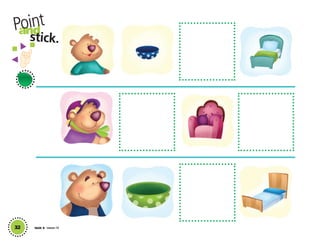
  • 6.
    Student's Book vi The Student’sBook contains full-colored pages with a variety of fun activities. Gumdrops offers a theme-related values page at the end of each unit to help students learn and develop important character traits in all areas of learning. 67 and Listen color. Values Unit 1 02 GM SB2 VALUES.indd 67 The Unit Opener is a reproduction of the poster. This vividly illustrated page at the beginning of each unit facilitates the presentation of new vocabulary and is used to activate prior knowledge of the theme. 3 Un it 1 Back to School 10/17/12 10:43 AM Unit Openers Each class page offers activities that teach language and vocabulary while developing essential skills appropriate to the age, such as sticking, gluing, tracing, coloring, matching, classifying, counting and making patterns. 5 and color. Draw Unit 1 Lesson 1Unit 1 01 GM SB2 U1.indd 5 Class Pages Values Pages Student's Components and Resources The Activity Pad contains detachable pages of stimulating activities that provide extra hands-on practice for developing essential readiness skills and concepts, such as cutting, drawing, coloring, finger- painting and assembling. Instructions are printed in Spanish on the back of each page to enable students to do the activity at home with their parents. Activity Pad Each unit ends with a page that offers students the opportunity to review the vocabulary and language presented in the unit. Review Page 10 and color. Listen Review 01 GM SB2 U1.indd 10 2 and Unit 1 Lesson 1 color. Draw Materiales: • crayolas • marcador amarillo • pegamento • brillantina • lentejuelas de colores Instrucciones: 1. Desprenda la página 1 del Activity Pad.2. Pida al niño o a la niña que se dibuje a sí mismo dentro del marco.3. Dígale que coloree su dibujo. 4. Escriba el nombre del alumno sobre la línea con marcador amarilloy pídale que lo trace con crayola. 5. Diga al niño o a la niña que unte un poco de pegamento sobreel dinosaurio y espolvoree brillantina encima.6. Anímelo a pegar lentejuelas sobre el marco para decorarlo.7. Pida al alumno que pegue su dibujo en su álbum de manualidades. GM AP2 U1.indd 2 lor. w Materiales: Name: ___________ This is me! 1 and Unit 1 Lesson 1 color. Draw 10/15/12 10:14 AM Rebecca Lee Williams Student's BookRichmond 2 00 GM TG2 U0 intro.indd 6 12/6/12 9:23 AM
  • 7.
    vii There are sixpages of appealing holiday-related activities to be used at appropriate times throughout the year. Stickers provide young learners with yet another engaging learning tool to be used alongside the Student’s Book. Each unit is accompanied by two pages of fun, colorful stickers which are designed to develop readiness skills and serve as motivational rewards. Stickers Holiday Pages There are two pages of vibrant mini-flashcards for each unit. These versatile and colorful cards are mainly designed to present, practice and review vocabulary. After using them to build language and critical thinking skills, students create their own Picture Dictionary for their Scrapbooks at the end of each unit. Mini-flashcards Gumdrops gives students one delightful finger puppet for each unit. These can be used to focus students’ attention while working with the Unit Opener, the Student’s Book and the Big Book. Finger Puppets The Student’s Audio/Interactive CD-ROM contains songs, rhymes, chants and stories from Level 2 recorded by native English speakers for students to listen to outside the classroom. Sixteen engaging and fun interactive games are also included on this component. Student’s Audio/Interactive CD-ROM Gumdrops 2 and 3 feature 16 interactive games with fun extension activities. Stories with highlighted text and audio are also included to develop children’s reading and listening skills. These interactive games are excellent tools that parents can use to foster their children’s psychomotor development. Gumdrops 2 and 3 Interactive Games are included on the Student’s Audio/Interactive CD-ROM. Interactive Games Holidays Christmas 75 and Connect color. 03 GM SB2 HOLIDAYS.indd 75 Richmond Listen, drag and drop. Drag and drop Un it Un it 8 Richmond Finger Puppets Unit1 Unit2 Unit3 Unit4 Unit5 Unit6 Unit7 Unit8 Unit 1 Unit 1 Unit 1 Unit 1 Unit 1 Unit 1 2 2 2 2 2 2 Student's Components and Resources Richmond Uni t 1 /17/12 3:26 PM M D.R . © Richmond Publishing, S.A. de C.V., 2013 Stud ent's Audio 2 3 Richmond Intera ctive CD-ROM 00 GM TG2 U0 intro.indd 7 1/4/13 10:27 AM
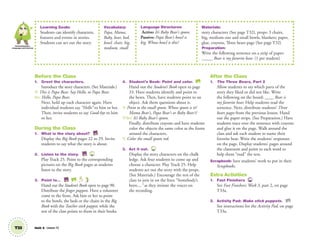
  • 8.
    viii Gumdrops Teacher’s Guideoffers comprehensive, step-by-step notes that are interleaved with the Student’s Book and Activity Pad pages. These easy-to-follow notes allow teachers to organize their classes at a glance and ensure that the content of each lesson contains a variety of activity types that are both developmentally appropriate and appealing to students. The class lesson pages contain easily identifiable icons that indicate when each component has to be used. The first page of each unit provides an overview of areas of learning, vocabulary and language structures that will be covered each week, highlighting the corresponding math concept and value. The Unit Overview page includes suggestions for working with the Unit Opener and the poster to activate prior knowledge and to present new vocabulary. To help teachers make the most of Gumdrops, the Teacher’s Guide includes a page that corresponds to each page in the Student’s Book. The lesson pages present the core material for the program. Teachers can quickly see the learning goals, the vocabulary and sample language that will be taught in the lesson, as well as a list of required materials and preparation. Each class is divided into four phases: 1. Before the Class: This phase offers activities designed to recycle language previously learned and to present new vocabulary. 2. During the Class: This phase offers presentation activities to reinforce new vocabulary and language through structured activities. It provides clear instructions on how to use the corresponding Student’s Book class page. 3. After the Class: This phase offers activities to give further reinforcement through a wide array of games and activities. 4. Extra Activities: This phase indicates the corresponding Fast Finishers or Activity Pad page that can be done after each lesson or at home. Teacher’s Guide Unit Overview Lesson Pages Unit 1 Unit 1 T3a Areas of Learning Vocabulary Language Structures • Personal, Social and Emotional Development • Communication, Language and Literacy book, boy, chair, dinosaur, friend, girl, hello, lunch box, schoolbag, teacher Active: Hello, Miss Carmen. My name’s Alice. It’s a pencil. I’m a boy/girl. Passive: Hello, boys and girls. I’m (Miss Carmen). Hello, what’s your name? What’s this? Hello, Lucy, I’m your friend, Robby. This is Gummy Drop. Gummy Drop and Dinosaur are friends. Who’s this? Who’s your friend? • Communication, Language and Literacy • Problem Solving, Reasoning and Numeracy • Artistic Development crayon, glue stick, marker, paintbrush, pencil, pencil case, scissors; colors Active: It’s a pencil. It’s blue. They’re scissors. Passive: What’s this? What color is your book? What are these? What do we do with scissors? • Communication, Language and Literacy • Artistic Development • Knowledge and Understanding of the World color, cut, dinosaur, draw, glue, paint, play, school, sing, stop; colors Active: I like to cut. Cutting. I like to cut at school. Passive: Where are the dinosaurs? What are they doing? What do you like to do at school? • • Week 1 Week 2 Week 3 Poster 1. Working with the Poster Display Poster 1. Ask students to identify where the characters are. T: Where are the children? Are they at home? Are they at school? Explain that Robby and Lucy are at school. Have students identify if the characters are boys or girls. Finally, ask students how they feel about coming back to school. 2. Working with the Unit Opener 1 Cut out the Gummy Drop, Robby, Teacher and Mandy cutouts and glue them onto a tongue depressor to make stick puppets. Display Poster 1. Distribute finger puppets for Unit 1. Name and point to the actions on the poster, using the Robby stick puppet. Play Track 1, Point To... Invite students to sing along and point to different actions with their finger puppets in their Student’s Books. Math Concept: Sequences Value: I Listen to the Teacher s Richmond Unit 2 GM2 TCH-CO.indd 1 Un it 1 Richmond Richmond Unit 1 10/24/12 8:45 AM T5 Unit 1 Lesson 1 Learning Goals: Students can explore new activities. Students can develop relationships. Students show interest in peers. Vocabulary: boy, dinosaur, friend, girl, hello Language Structures: Active: Hello, Miss Carmen. I’m a boy/girl. Passive: Hello, Lucy. I’m your friend, Robby. This is Gummy Drop. Gummy Drop and Dinosaur are friends.Who’s this? Who’s your friend? Materials: crayons, beanbag Before the Class 1. Greeting Students Have students line up outside the classroom. Encourage them to greet you as they come in the classroom. T: Hello, Sylvia. SS: Hello, Miss Carmen. T: Come in and sit down, please. 2. Song: Hello, My Friend 4 Divide students into pairs. Have them face each other. Play Track 4, Hello, My Friend. Teach students the words to the song and encourage them to sing and act out the song. Personal, Social and Emotional Development During the Class 1. Presentation: Friends Sit in a circle with the class. Show students how the stick puppets introduce themselves. ROBBY PUPPET: Hello, Lucy. I’m your friend, Robby. Then have the Lucy stick puppet talk in the same manner to the next student in the circle. Continue until all students have participated. 2. Presentation: Gummy Drop and Dinosaur Present the Gummy Drop and the Dinosaur stick puppets. T: This is Gummy Drop. Everybody say, “Hello, Gummy Drop.” Repeat with Dinosaur. Tell students that Gummy Drop and Dinosaur are friends. T: Gummy Drop and Dinosaur are friends. (Have the puppets give each other a hug.) 3. Student’s Book: Draw and color. SB Hand out the Student’s Books open to page 5. Have students point to the characters. Say that all the characters are friends. Then focus students’ attention on the blank faces. Distribute crayons. Ask students to draw themselves in one of the faces and a friend in the other. Have students color in the pictures. Finally, ask them about their pictures. T: Who’s this? S: Me. T: Who’s your friend? S: Patty. After the Class 1. Game: Boy Or Girl? Toss the beanbag to a student. Have the student say if he or she is a boy or a girl. S: I’m a boy. Repeat the procedure several times. Extra Activities 1. Fast Finishers TCH See Fast Finishers: Week 1, part 2, on page T5a. 2. Activity Pad: Draw and color. AP See instructions for the Activity Pad, on page T5a. Teacher's Components and Resources Activity Pad AP Student's/Class Audio 1 Big Book BB cutouts finger puppets mini-flashcards poster stick puppets stickers Student’s Book SB Teacher’s Resource TCH CD-ROM Interactive CD-ROM INT Rebecca Lee Williams 2Teacher's Guide Richmond 00 GM TG2 U0 intro.indd 8 12/6/12 9:25 AM
  • 9.
    ix The last pageof every unit contains the teacher’s notes for appropriate activities that highlight key values. Activities for general review are also provided to activate key vocabulary and language structures covered in the lessons. Suggestions are given to assess both individual and class progress and detect any weak areas that need extra attention. The final page of each unit contains step-by- step instructions for using the Review Page in the Student’s Book and the Assessments included on the Teacher’s Resource CD-ROM. Instructions for students to create their own Picture Dictionaries with their mini-flashcards are also found in this section. This section is found after Unit 8 and includes instructions on how to use the Holiday pages in the Student’s Book and Activity Pad, providing fun holiday-related songs, crafts and activities. Use these pages at the appropriate times during the school year. Gumdrops Teacher’s Guide also includes a page with extension activities with detailed instructions related to the corresponding Activity Pad page and the Fast Finishers task per week. These activities help students consolidate the new vocabulary and language. A hands-on optional lesson, called Early Learning Activities, linked to the Areas of Learning and unit theme, is also provided. The activities covered in the extension pages can be used as learning evidence to be included in students’ Scrapbooks. Gumdrops provides a photocopiable Scrapbook cover for each unit on the Teacher’s Resource CD-ROM. Extension Activities Pages Value and General Review Pages Holiday Pages l l ll d Unit 1 Lesson 1 T5a Activity Pad Draw and color. AP Materials: pencils, crayons, yellow marker, glue, glitter, sequins Preparation: Write students’ names with a yellow maker on their pads. Instructions: Distribute materials. Tell students to draw themselves in the space provided. Then have them color the picture. Next, help students trace over their names with crayons. Show students how to spread glue onto the dinosaur and sprinkle some glitter on top of the glue. Have them decorate the frame with sequins or glitter. Scrapbook: Save students’ work for their Scrapbooks. Extra Activities Fast Finishers: Week 1: Color and cut. TCH Part 1: Have students color in the pictures. Give instructions to students for pointing to the different characters. T: Point to Lucy. Part 2: Then, have students cut out the characters and glue them in the corresponding place. Scrapbook: Save students’ work for their Scrapbooks. Early Learning Activities Name Tags 5 Materials: brightly colored construction paper, markers, glue, sequins, glitter Preparation: Cut construction paper into 20 x 10 cm cards (1 per student). Write each student’s name on a card with a marker. Directions: Have students sit in a circle. Hold up the name tags, one at a time. Encourage students to recognize their names, or give them their cards. Then have them trace over their names with their fingers. Have students cover the capital letter of their name with glue and sequins. Repeat with the remaining letters. Choose a name tag and ask whose name it is. Play Track 5,Who’s Here Today? Say the chant first, filling in the blanks at the end of the chant with a student’s name. Have students listen as you sing. Finally, encourage them to join in. Repeat the activity everyday until everybody’s name has been called out. Personal, Social and Emotional Development Scrapbooks. s been called out. Communication, Language and Literacy T67 1. Student’s Book: Connect and color. SB Materials: crayons, markers Instructions: Hand out the Student’s Book open to page 75. Encourage students to point to the presents and to Santa Claus. Distribute crayons. Have students color the presents according to their outlines. Then, focus their attention on the Christmas tree. Count from one to twelve out loud and have students point to each number in their books. Distribute markers and tell students to join the dots. Finally, allow them to color in the tree freely. 2. Christmas Tree Materials: paper plate (1/2 plate per student), green tempera paint, paint brushes, scissors, glue sticks, stapler, sequins, yellow craft foam, stickers, glitter Instructions: Distribute materials. Tell students to paint the paper plate green. Help them form a cone with the paper plate and staple the ends together. Then, help them cut out a star shape out of yellow craft foam and glue it to the top of the cone. Have students decorate their Christmas tree with stickers, glitter and sequins. 3. Song: Five Little Candles 49 Play Track 49, Five Little Candles. Lead students in singing along as they do the corresponding actions and count with their fingers. Repeat the song three times. 4. Activity Pad: Make a Christmas decoration. AP Materials: gold foil paper paper, gold glitter, movable eyes, yarn, scissors, glue, hole punch Instructions: Explain to students that they are going to make an ornament for their Christmas tree. Help them glue gold foil paper onto the star. Show them how to glue around the edge of the star and sprinkle on gold glitter on the glue. Then, ha e students glue on the movable eyes. Help them cut a length of yarn and glue it on the star’s mouth. Finally, punch a hole through the star and thread yarn through the hole and tie a knot. Holidays: Christmas Holidays Christmas 5. Activity Pad: Make a candy can. AP Materials: red finger paint, cotton, glue, scissors, red paint or red construction paper, cans, candy Instructions: Distribute materials. Ask students to paint the gumdrop with the finger paint. Show students how to glue cotton onto the hat and the gloves. Help them cut out the pictures. Glue red construction paper onto the can or have students paint the can with red paint. Next, help them glue the Santa gumdrop onto the can. Show them how to glue the legs and arms as if the gumdrop were sitting down. Finally, ask students to put candy inside the can.candy inside the can. . TC Unit 1 Review Value I Listen to the Teacher Vocabulary: raise your hand, keep quiet, stand up,open/close your book, sit down 1. Talk About the Value Tell students that if they listen to the teacher,they will feel more confident when they do atask. Say how they can pay attention: keepquiet, raise your hand before we speak, and so on. 2. Song: Listen, Listen 8 Play Track 8, Listen, Listen. Encourage students to say the chant. Use this chantwhen you want to get their attention. 3. Student’s Book: Listen and color. SB Hand out the Student’s Book open to page 67.Have students identify the actions and colorthe stars. If the activity is done correctly, theystick the Reward sticker in place. 4. Good Behavior Chains Materials: 10-cm square pieces of construction paper (1 per student), crayons, scissors, glue,paper chains (See page T7a.) Directions: Have students draw a Gummy Drop.Write their names on their drawing. Attachtheir paper chains to their drawings. If astudent misbehaves, ask them to remove oneof the links, so that they monitor their ownbehavior. Reward the student whose chainremains complete. General Review 1. Review: Classroom Objects Distribute the classroom objects mini-flashcards. Have students put their cardsfacing up on their tables. Explain that you will name an object and they willhold the card up. After, have them put the cards face down on their tables.T: Show me scissors. SS: (Students hold up the card and then put it face down.) 2. Review: Actions Distribute action mini-flashcards. Display Poster 1. Point to an action on theposter. Have students hold up the corresponding mini-flashcard.T: (Point to the boy cutting.) I like to cut. Show me cut.SS: (Students hold up the cut mini-flashcard.) 3. Student’s Book: Listen and color. SB Hand out the Student’s Books open to page 10. Have students identify the differentobjects on the page. Give students instructions for coloring in the objects.T: Paintbrush. Find a paintbrush. Color the paintbrush blue.If the activity is done correctly, they stick the Reward sticker in place. 4. Assessment TCH Print out and photocopy the Unit 1 Assessment. Distribute copies and crayonsto students. Describe the actions and have students point to them. Next, givestudents instructions for coloring the circles.T: Find “I like to cut.” Point to the picture. Show me your green crayon. Color the circle green. 5. Picture Dictionary TCH Have children glue each mini-flashcard onto the matching picture in the PictureDictionary. Help students glue the Picture Dictionary onto a colored sheet ofpaper and include it in their Scrapbooks. T10 The Big Book is a beautifully illustrated collection of original and traditional stories and chants that will delight and animate students while exposing them to natural language. There is one theme-related story per unit. The Big Books are accompanied by audio that enables students to hear the stories as told by a native English speaker. A projectable version of the stories is included on the Teacher’s Resource CD-ROM. These visual cue cards vividly illustrate common classroom commands. Use them when you are giving students instructions along with the English command. Students will quickly associate the picture cue with the command, providing understanding. Big Books Classroom Language Flashcards 1 2 3 GM1 CLASS-LANG Flashcards.indd 3 Teacher's Components and Resources 4 I like to say hello in the morning, I like to say hello today. I like to say hello, but now I STOP! It’s time to start our day. School I Like I likeI like to sato sayo sayto say h ll ih lhello ihello iello in the mn the mn then the mhe m ng,g,gorninorningningingng, I liikikeke toto sayay heelelllloo in ththee moorrniinggg, I likeI likee ttoto say hello today.day.day.oday.I liikikeke toto sayay heelelllloo totodadayay.y. I likekekeI likeII to say hello, but nowbut nowt nowbut nowI liikikeke toto sayay heelelllloo, butut nowow STOPP!P!STOSTOI STOI STSTOTOP! s titiItIt’t’s’s time to smme tm tart ouououour dayr day.r day.day.ItIt’t’s tiimee toto statararrt ourr dadayay.y. 5 I like to sing, sing, sing in the morning, I like to sing, sing, sing all day. I like to sing, sing, sing, but now I STOP! It’s time to draw today. GM BB2 U1.indd 5 00 GM TG2 U0 intro.indd 9 12/6/12 9:28 AM
  • 10.
    x Gumdrops posters providethe teacher with an effective visual tool to introduce and reinforce target vocabulary and language. Each unit comes with a large, colorful, theme-related poster. A reproduction of the poster is included in the Unit Opener of the Student’s Book to keep individual students engaged while you are working with a volunteer in front of the class. Suggestions for use are given in both the Teacher’s Guide and the Gumdrops Support Booklet. A projectable version of the posters is included on the Teacher’s Resource CD-ROM. Each unit comes with large, theme- related cut-out cards. These beautifully illustrated visual aids allow the teacher to present and practice language through a variety of games and activities. This includes: • The Gumdrops Support Booklet, which contains the series philosophy and methodology, as well as valuable tips for presenting language and vocabulary, developing skills and making the most of all of the Gumdrops components. • Unit 0 and Track 0, to be used in the first days of classes. • Fast Finishers pages to give students who finish early a purposeful, independent activity to do while you are working with the rest of the class. • Photocopiable assessments for each unit. • A Generic Progress Chart template. • Scrapbook covers for each unit. • Picture Dictionary pages. • Numerous templates that simplify class preparation and further develop and extend a range of skills. Posters r Back to School Richmond Un it 1 2 10/23/12 9:42 AM SCHOOL BUS and cut. Color Unit 1 Fast Finishers Week 1 t 1 Fast Finishers Week 1 Lookand match. Unit 1 Fast Finishers Week 3 Cutouts The Class Audio includes recordings by native English speakers of all the songs, chants, rhymes and stories as well as the songs and chants of the Holidays section. A transcript of all the recordings appears at the back of the Teacher’s Guide as a reference. A digital copy of the transcript is included on the Teacher’s Resource CD-ROM so that you can send it to parents. Class Audio The stick puppets enable the teacher to model language in an entertaining way. They can also be used to encourage more reserved students to participate through role-playing. See the Teacher’s Guide and the Gumdrops Support Booklet for further suggestions on how to use the stick puppets. Stick Puppets Teacher's Resource CD-ROM Teacher's Components and Resources Unit 1 Fast Finishers Week 3 PicturedictionaryUnit 1 School draw glue glue stick crayon cut color draw glue glue stick MyscrapbookUn it 1 School D.R.© Richmond Publishing, S.A. de C.V., 2013 Cla ss Audio 2 Richmond Richmond Unit 2 Unit 1 GM2 TCH-CO.indd 1 00 GM TG2 U0 intro.indd 10 1/4/13 12:18 PM
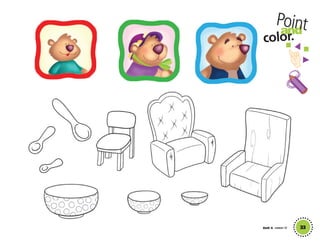
  • 11.
    xi Areas of LearningVocabulary Language Structures Personal, Social and Emotional Development; Communication, Language and Literacy; Problem Solving, Reasoning and Numeracy; Artistic Development; Knowledge and Understanding of the World book, boy, chair, color, crayon, cut, dinosaur, draw, friend, girl, glue stick, hello, lunch box, marker, paint, paintbrush, pencil, pencil case, play, school, schoolbag, scissors, sing, stop, teacher; colors Hello, Miss Carmen. My name’s Alice. It’s a pencil. I’m a boy/girl. It’s blue. They’re scissors. I like to cut at school. Knowledge and Understanding of the World; Problem Solving, Reasoning and Numeracy; Physical Development; Artistic Development; Communication, Language and Literacy; Personal, Social and Emotional Development arm, body, ears, eyes, face, foot, hair, hand, head, leg, mouth, nose, clap, dance, hop, jump, knees, lift, reach, run, toes, touch; clothes, colors, numbers 1 to 10 Good morning, Miss (Carmen). Hello, Lucy. It’s an arm. Head. Run! Yellow. Yes./No. Touch your toes. I have one nose. I have two arms. Knowledge and Understanding of the World; Artistic Development; Problem Solving, Reasoning and Numeracy; Communication, Language and Literacy barn, chick, cow, different, duck, egg, eleven, farm, goat, hen, horse, rooster, same, sheep, ten, turkey, twelve It’s a cow. Yes, it is./No, it isn’t. It’s a horse. They’re chicks. They’re turkeys. One, two, three… ten, eleven, twelve. Twelve eggs. A cow goes moo. Communication, Language and Literacy; Personal, Social and Emotional Development; Problem Solving, Reasoning and Numeracy; Artistic Development baby, bear, bed, big, bowl, brother, chair, chubby, circle, dad, grandma, grandpa, Mama, medium, mom, old, Papa, sister, square, tall, thin, triangle, small, short, young; colors It’s a square. It’s yellow. Hi, Mom. Good-bye, Mom. She’s Mom. She’s old. They’re old. He’s Dad. Dad is tall. Yes./No. She’s Goldilocks. It’s a bowl. It’s green. It’s a big bowl. It’s Baby Bear’s spoon. Communication, Language and Literacy; Personal, Social and Emotional Development; Artistic Development; Problem Solving, Reasoning and Numeracy armchair, bed, bedroom, closet, doll house, house, kitchen, lamp, living room, mice, mouse, night table, playroom, refrigerator, shelf, sink, shower, sofa, stove, tea, teacup, toilet, bathtub, TV; colors, family members, numbers 1 to15 He’s in the living room. She’s in the bedroom. It’s a sofa. It goes in the living room. A stove. It’s blue. On the box. Nina’s on the box. Under the bed. Communication, Language and Literacy; Personal, Social and Emotional Development; Artistic Development; Problem Solving, Reasoning and Numeracy breakfast, brush your teeth, comb your hair, daytime, dress, eat, evening, get dressed, go to sleep, moon, morning, nighttime, pajamas, pants, put on a dress and socks, put on pajamas, put on slippers, read a story, shoes, shorts, skirt, sun, sweater, take a bath; take a shower, take a bath, T-shirt, wake up; colors, days of the week I wake up in the morning. In the morning. Yes./No. It’s day. I take a shower. At night. This is a T-shirt. These are slippers. Nighttime. I wear my T-shirt in the daytime. I brush my teeth. Yes, I can./No, I can’t. Knowledge and Understanding of the World; Problem Solving, Reasoning and Numeracy; Artistic Development; Personal, Social and Emotional Development; Communication, Language and Literacy; Physical Development behind, bench, bird, boy, butterfly, climb, climbing frame, crawl, flower, girl, grass, hop, in front of, jump, march, nuts, on, park, rabbit, run, sit, skip, slide, squirrel, swing, tree, under, walk; colors, numbers 1 to 20 It’s a squirrel. They’re nuts. This is a flower. It’s a tree. It’s on the climbing frame. The rabbit is behind the tree. Yes./No. The rabbit is under the slide. I’m walking. Personal, Social and Emotional Development; Artistic Development; Communication, Language and Literacy; Problem Solving, Reasoning and Numeracy birthday cake, breakfast, bugs, chicken, chocolate, dinner, eggs, fish, fruits, hungry, juice, like, lunch/don’t like meat, milk, monster, nails, pizza, rice, salad, snails, slugs, spaghetti, sugar, thirsty, vegetables, water, yogurt; numbers 1 to 20 It’s spaghetti. Yes./No. I want spaghetti, please. It’s food. He wants meat. She wants milk. It’s a sandwich. Cereal, toast, pancakes. I want eggs and toast. Juice and a sandwich. I like carrots. I don’t like carrots. P L N U Unit 1 C E S Unit 5 K D C Unit 3 K R S L Unit 7 K R D P Unit 2 C E S Unit 6 C E N Unit 4 P D P Unit 8 Scope and Sequence 00 GM TG2 U0 intro.indd 11 12/6/12 9:29 AM
  • 12.
    Unit 1 Unit 1T3a Areasof Learning Vocabulary Language Structures • Personal, Social and Emotional Development • Communication, Language and Literacy book, boy, chair, dinosaur, friend, girl, hello, lunch box, schoolbag, teacher Active: Hello, Miss Carmen. My name’s Alice. It’s a pencil. I’m a boy/girl. Passive: Hello, boys and girls. I’m (Miss Carmen). Hello, what’s your name? What’s this? Hello, Lucy, I’m your friend, Robby. This is Gummy Drop. Gummy Drop and Dinosaur are friends. Who’s this? Who’s your friend? • Communication, Language and Literacy • Problem Solving, Reasoning and Numeracy • Artistic Development crayon, glue stick, marker, paintbrush, pencil, pencil case, scissors; colors Active: It’s a pencil. It’s blue. They’re scissors. Passive: What’s this? What color is your book? What are these? What do we do with scissors? • Communication, Language and Literacy • Artistic Development • Knowledge and Understanding of the World color, cut, dinosaur, draw, glue, paint, play, school, sing, stop; colors Active: I like to cut. Cutting. I like to cut at school. Passive: Where are the dinosaurs? What are they doing? What do you like to do at school? • • Week 1 Week 2 Week 3 Poster 1. Working with the Poster Display Poster 1. Ask students to identify where the characters are. T: Where are the children? Are they at home? Are they at school? Explain that Robby and Lucy are at school. Have students identify if the characters are boys or girls. Finally, ask students how they feel about coming back to school. 2. Working with the Unit Opener 1 Cut out the Gummy Drop, Robby, Teacher and Mandy cutouts and glue them onto a tongue depressor to make stick puppets. Display Poster 1. Distribute finger puppets for Unit 1. Name and point to the actions on the poster, using the Robby stick puppet. Play Track 1, Point To... Invite students to sing along and point to different actions with their finger puppets in their Student’s Books. Math Concept: Sequences Value: I Listen to the Teacher s Richmond Unit 2 Unit 1 GM2 TCH-CO.ind d 1 Unit 1 Richmond U nit 1 01 GM2 STK.indd 1 Richmond Richmond Richmond Uni t 1 10/24/12 8:45 AM 01 GM TG2 U1.indd 12 12/6/12 9:31 AM
  • 13.
    3 Un it 1 Back to School 01GM TG2 U1.indd 13 12/6/12 9:31 AM
  • 14.
    Lookand 4 stick. Unit 1 Lesson1 01 GM TG2 U1.indd 14 12/6/12 9:32 AM
  • 15.
    Communication, Language and Literacy Unit1 Lesson 1 T4 Learning Goals: Students can recreate words they hear and incorporate them in their own language use. Students can recreate conversations. Vocabulary: book, boy, chair, girl, hello, lunch box, schoolbag, teacher Language Structures: Active: Hello, Miss Anna. My name’s Alice. It’s a book. Passive: Hello, boys and girls.What’s this? Hello, what’s your name? I’m (Miss Carmen). Materials: realia: classroom objects (chairs, books, lunch box and schoolbags); glue, tongue depressors Before the Class 1. Greetings Introduce yourself and say hello to students. T: Hello, boys and girls. I’m Miss (Carmen.) Introduce the Teacher stick puppet. Encourage students to reply. TEACHER PUPPET: Hello, boys and girls. I’m Miss Anna. T: Miss Anna is a teacher. Say hello to Miss Anna. T/SS: Hello, Miss Anna. 2. Game: What’s Your Name? Introduce the Robby and Lucy stick puppets to students, using the Teacher stick puppet. TEACHER PUPPET: Hello, what’s your name? ROBBY PUPPET: My name’s Robby. TEACHER PUPPET: Hello, Robby. Say “hello” to Robby. SS: Hello, Robby! Repeat with Lucy. Then ask each student his or her name and greet him or her in the same manner. TEACHER PUPPET: Hello, what’s your name? S: My name’s Alice. During the Class 1. Presentation: School Objects 2 Play Track 2, I Can See… Use the Teacher stick puppet to guide students in pointing to the corresponding objects in the classroom when they are mentioned. 2. More Practice Attach the book, lunch box and schoolbag cutouts to the board. Name each object and have students identify it. T: It’s a book. What’s this? SS: It’s a book. Invite individual students to come to the front, one at a time. Give a student the Teacher stick puppet. Name an object, and have the student point to the corresponding object with the stick puppet. 3. Student’s Book: Look and stick. SB Hand out the Student’s Books open to page 4. Have students identify the Teacher, Robby, and Lucy. Distribute the stickers in the red section. Name a classroom object. Ask students to identify the sticker and then the object in their Student’s Book. Help students peel off the sticker and put it in the corresponding place. T: Look for the chair. Peel off the chair. Put the chair sticker in the correct place. After the Class 1. Song: Time To Go Home 3 Play Track 3, Time To Go Home. Teach students the words to the song and encourage them to sing along. Extra Activities 1. Fast Finishers TCH See Fast Finishers: Week 1, part 1, on page T5a. 01 GM TG2 U1.indd 15 12/6/12 9:32 AM
  • 16.
    T5 Unit 1Lesson 1 Learning Goals: Students can explore new activities. Students can develop relationships. Students show interest in peers. Vocabulary: boy, dinosaur, friend, girl, hello Language Structures: Active: Hello, Miss Carmen. I’m a boy/girl. Passive: Hello, Lucy. I’m your friend, Robby. This is Gummy Drop. Gummy Drop and Dinosaur are friends.Who’s this? Who’s your friend? Materials: crayons, beanbag Before the Class 1. Greeting Students Have students line up outside the classroom. Encourage them to greet you as they come in the classroom. T: Hello, Sylvia. SS: Hello, Miss Carmen. T: Come in and sit down, please. 2. Song: Hello, My Friend 4 Divide students into pairs. Have them face each other. Play Track 4, Hello, My Friend. Teach students the words to the song and encourage them to sing and act out the song. Personal, Social and Emotional Development During the Class 1. Presentation: Friends Sit in a circle with the class. Show students how the stick puppets introduce themselves. ROBBY PUPPET: Hello, Lucy. I’m your friend, Robby. Then have the Lucy stick puppet talk in the same manner to the next student in the circle. Continue until all students have participated. 2. Presentation: Gummy Drop and Dinosaur Present the Gummy Drop and the Dinosaur stick puppets. T: This is Gummy Drop. Everybody say, “Hello, Gummy Drop.” Repeat with Dinosaur. Tell students that Gummy Drop and Dinosaur are friends. T: Gummy Drop and Dinosaur are friends. (Have the puppets give each other a hug.) 3. Student’s Book: Draw and color. SB Hand out the Student’s Books open to page 5. Have students point to the characters. Say that all the characters are friends. Then focus students’ attention on the blank faces. Distribute crayons. Ask students to draw themselves in one of the faces and a friend in the other. Have students color in the pictures. Finally, ask them about their pictures. T: Who’s this? S: Me. T: Who’s your friend? S: Patty. After the Class 1. Game: Boy Or Girl? Toss the beanbag to a student. Have the student say if he or she is a boy or a girl. S: I’m a boy. Repeat the procedure several times. Extra Activities 1. Fast Finishers TCH See Fast Finishers: Week 1, part 2, on page T5a. 2. Activity Pad: Draw and color. AP See instructions for the Activity Pad, on page T5a. 01 GM TG2 U1.indd 16 12/6/12 9:32 AM
  • 17.
    5 and color. Draw Unit 1 Lesson1Unit 1 01 GM TG2 U1.indd 17 12/6/12 9:32 AM
  • 18.
    Unit 1 Lesson1T5a Activity Pad Draw and color. AP Materials: pencils, crayons, yellow marker, glue, glitter, sequins Preparation: Write students’ names with a yellow maker on their pads. Instructions: Distribute materials. Tell students to draw themselves in the space provided. Then have them color the picture. Next, help students trace over their names with crayons. Show students how to spread glue onto the dinosaur and sprinkle some glitter on top of the glue. Have them decorate the frame with sequins or glitter. Scrapbook: Save students’ work for their Scrapbooks. Extra Activities Fast Finishers: Week 1: Color and cut. TCH Part 1: Have students color in the pictures. Give instructions to students for pointing to the different characters. T: Point to Lucy. Part 2: Then, have students cut out the characters and glue them in the corresponding place. Scrapbook: Save students’ work for their Scrapbooks. Early Learning Activities Name Tags 5 Materials: brightly colored construction paper, markers, glue, sequins, glitter Preparation: Cut construction paper into 20 x 10 cm cards (1 per student). Write each student’s name on a card with a marker. Directions: Have students sit in a circle. Hold up the name tags, one at a time. Encourage students to recognize their names, or give them their cards. Then have them trace over their names with their fingers. Have students cover the capital letter of their name with glue and sequins. Repeat with the remaining letters. Choose a name tag and ask whose name it is. Play Track 5,Who’s Here Today? Say the chant first, filling in the blanks at the end of the chant with a student’s name. Have students listen as you sing. Finally, encourage them to join in. Repeat the activity everyday until everybody’s name has been called out. Personal, Social and Emotional Development Scrapbooks. s been called out. Communication, Language and Literacy 01 GM TG2 U1.indd 18 12/6/12 9:32 AM
  • 19.
    Name: ___________ This isme! 1 and Unit 1 Lesson 1 color. Draw 01 GM TG2 U1.indd 19 12/6/12 9:33 AM
  • 20.
    6 and color. Trace Unit 1 Lesson2 01 GM TG2 U1.indd 20 12/6/12 9:33 AM
  • 21.
    Learning Goals: Students can appropriatelyuse new words they have heard in familiar contexts. Vocabulary: crayon, glue stick, marker, paintbrush, pencil, pencil case, scissors; colors Language Structures: Active: It’s a pencil. Passive: What’s this? Materials: pencils, crayons, red, blue, yellow, orange, pink, purple, brown, black, white and green construction paper, scissors, paper fastener, hole punch Preparation: Cut a strip of each color of construction paper (3 x 8 cm). Punch a hole at the bottom. Fasten the strips together with a paper fastener to make a fan (1 per student). Unit 1 Lesson 2 T6 Before the Class 1. Song: Hello, My Friend 4 Divide students into pairs. Have them face each other. Play Track 4. Encourage students to sing and act out the song. Have students change partners and repeat the activity. 2. Review: Red, Yellow, Blue, Green Distribute fans. (See Preparation.) Tell students to work silently with their fans. Then, give them commands for showing you the red, blue, yellow or green strips. T: Show me yellow. SS: (Students hold up the yellow strip.) Walk around the class helping individual students find the correct strip and hold it up. Give individual students a thumbs-up signal if they are correct. Shake your head if they are incorrect, and tell them to look for a different strip. When the activity has finished, show students how to close the fans, then collect and store them away. Communication, Language and Literacy During the Class 1. Presentation: Classroom Objects Display the classroom objects cutouts, one at a time, and present them. Then have students identify them. T: What’s this? (Show the pencil cutout.) T/SS: It’s a pencil. 2. Student’s Book: Trace and color. SB Hand out the Student’s Books open to page 6. Hold up the marker cutout. Ask students to look for the marker and point to it in their books. T: Marker. Point to the marker. Continue in the same manner with scissors, glue stick, crayon, pencil, pencil case and paintbrush. Next, distribute pencils and ask students to trace over the outline of the marker, crayon and paintbrush. T: Marker. Trace over the marker. Distribute crayons. Tell students to color in the objects. After the Class 1. Game: Guessing The Classroom Objects Put the school objects cutouts face down on a table. Choose a cutout without showing it to the class and have individual students guess what is on the cutout. Then have the whole class identify it. T: What’s this? S1: Pencil? T: No. S2: Marker? T: Yes, this is a marker. What’s this? SS: It’s a marker. Have the student who guesses correctly choose the next cutout. 2. Song: English Class Is Over 6 Play Track 6, English Class Is Over. Encourage students to sing and act out the song. Extra Activities 1. Fast Finishers TCH See Fast Finishers: Week 2, part 1, on page T7a. Play Game 1 on the Interactive CD-ROM. INT 01 GM TG2 U1.indd 21 12/11/12 5:55 PM
  • 22.
    T7 Unit 1Lesson 2 Communication, Language and Literacy Learning Goals: Students can appropriately use new words they have heard in familiar contexts. Students are aware of the functions of a range of school objects. Vocabulary: crayon, glue stick, marker, paintbrush, pencil, scissors; colors Language Structures: Active: It’s blue.They’re scissors. Passive: What color is your book? What are these? What do we do with the scissors? Materials: fans (see page T6), crayons Before the Class 1. Song: Hello, My Friend 4 Divide students into pairs. Have them face each other. Play Track 4. Encourage students to sing and act out the song. Have students change partners and repeat the activity. 2. Game: Give Me Distribute the following cutouts to five students: crayon, glue stick, marker, paintbrush and pencil. Then ask the students to go to the front of the class. Display the Gummy Drop stick puppet. Give students commands. T: Rick, give Gummy Drop the crayon. S: (Student gives the Gummy Drop stick puppet the crayon cutout.) Continue in the same manner until all students have participated. During the Class 1. Review: Colors Distribute fans. (See Materials.) Remind students they must work silently. Ask them to show you the red, blue, yellow, orange or green strips. T: Show me orange. Walk around the class helping individual students. When the activity has finished collect and store the fans away. 4. Student’s Book: Match and color. SB Hand out the Student’s Book open to page 7. Distribute crayons. Ask students to point to the crayon in their books. Ask students what color the crayon is. Have students find the other crayon and trace over the dotted line to match them. Then have them color the crayon blue. T: Show me your blue crayon. Match the crayon with the crayon. Color the crayon blue. Repeat the procedure with the rest of the classroom objects. Finally, name an object. Encourage students to say what we use the object for, by miming the actions. T: What are these? SS: They’re scissors. T: What do we do with the scissors? SS: (Students mime cutting paper.) After the Class 1. Game: Go For The Colors Divide the class into five groups and assign red, yellow, blue, green or orange to each one. Tell students that when you say “Go!” they must find as many items in the classroom with their assigned color as they can. When you say, “Stop!” students need to go back and sit in a large circle with their items. Have members of each group place their items in the middle of the circle. Ask the whole class what color the items are. T: What color is your book? SS: It’s blue. 2. Song: English Class Is Over 6 Play Track 6. Encourage students to sing and act out the song Extra Activities 1. Fast Finishers TCH See Fast Finishers: Week 2, part 2, on page T7a. 2. Activity Pad: Color and cut. AP See instructions for the Activity Pad, on page T7a. Play Game 2 on the Interactive CD-ROM. INT 01 GM TG2 U1.indd 22 12/6/12 9:33 AM
  • 23.
    7 and color. Match Unit 1 Lesson2Unit 1 Lesson 2 01 GM TG2 U1.indd 23 12/6/12 9:34 AM
  • 24.
    Activity Pad Color andcut. AP Materials: crayons, yellow marker, scissors Preparation: Write students’ names with a yellow maker in the space provided. Instructions: Distribute materials. Have students color the objects. Help them trace their name with crayons over your handwriting. Cut out the strip and the pencil case. Cut along the dotted lines in the pencil case in order to make two slits. Help students insert the strip in the pencil case and show one classroom object at a time. Ask questions about the color of their objects. T: What color it your glue stick? Scrapbook: Save students’ work for their Scrapbooks. Extra Activities Fast Finishers: Week 2: Look and color. TCH Part 1: Explain to students that they are going to find the classroom objects and then they are going to trace the outlines of each object with markers. Part 2: Finally, have students color in the objects with crayons. Optional: Have students point to the objects and say what color they are. S: It’s a red pencil. Unit 1 Lesson 2 Early Learning Activities Paper Chains Materials: red, blue, yellow, green and orange construction paper, glue, scissors Preparation: Cut paper into 1 x 10 cm strips. Make lots of strips for each color. Directions: Display paper strips. Have each student choose two colors to make a pattern. Ask students to choose five strips of each color. Show them how to glue the strips together, following the color pattern to create paper chains. When students have completed ten links in their chain, have them show it and help them “read” their pattern out loud to the class. Note: Collect students’ paper chains for the Values Activity. T7a the Values Activity. Artistic Development Scrapbooks. Problem Solving, Reasoning and Numeracy 01 GM TG2 U1.indd 24 12/6/12 9:34 AM
  • 25.
    Name: 3Unit 1 Lesson2 cut. Colorand 01 GM TG2 U1.indd 25 12/6/12 9:34 AM
  • 26.
    8 andStick trace. Unit 1 Lesson3 01 GM TG2 U1.indd 26 12/6/12 9:34 AM
  • 27.
    Unit 1 Lesson3 T8 Learning Goals: Students can use new words or phrases they have heard in familiar contexts. Vocabulary: color, cut, dinosaur, draw, house, glue, paint, play, say hello, school, sing, stop Language Structures: Active: I like to cut. Cutting. Passive: Where are the dinosaurs? What are they doing?What do you like to do at school? Materials: crayons, markers, I like school template (from the Teacher’s Resource CD) Preparation: Print out the I like school template or write the text on a piece of paper. (1 per student) Communication, Language and Literacy Before the Class 1. Song: Hello, My Friend 4 Divide students into pairs. Have them face each other. Play Track 4. Encourage students to sing and act out the song. During the Class 1. Presentation: Actions Display Poster 1. Point to a picture and say a sentence about the action. T: I like to cut. (Mime cutting paper.) Encourage students to repeat the sentence and mime the action. Repeat the procedure with paint, glue, color, sing, draw and play. 2. Make Predictions: I Like School BB Display the Big Book page 4. Ask students to make predictions about the story. T: Where are the dinosaurs? What are they doing? SS: Cutting. Display the Big Book pages 4 to 9, one at a time. Have students look at each picture and ask them to name and describe as many things as they can. T: What’s he doing? 3. Listen to the story. BB SB 7 Hand out the Student’s Books open to page 81. Play Track 7, I Like School. Point to the corresponding pictures on the Big Book pages 4 to 9 while students listen to the story and follow along in their books. Invite individual students to come up and use their finger puppets to point to different items on the page. The other students should look for the same items and use their finger puppets to point to them in their books. T: Point to the boy dinosaur. Repeat with girl dinosaur, teacher dinosaur, table, chair and crayon. 4. Student’s Book: Stick and trace. SB Hand out the Student’s Books open to page 8. Explain to students that the pictures show what the dinosaurs do from the moment they get to school until they go home. Distribute crayons and the stickers in the blue sections. Have students identify the actions in their Student’s Books and the stickers. Help them peel the stickers off and put them in the correct places in their Students Books. Next, have students trace over the dotted lines to connect the pictures. Finally, encourage students to say what the dinosaurs like to do at school. SS: The dinosaurs like to cut. After the Class 1. I Like School, Part 1 TCH Copy the text from the I like school template on the board. (See Preparation.) Read the text out loud. Encourage students to repeat. Ask students what they like to do. T: Mariana, what do you like to do at school? S: I like to cut. Write the action on students’ templates. Reread the texts out loud. Distribute markers and templates. Have students draw a picture of what they like to do at school in the middle of the page. Save students’ work for the next lesson. Extra Activities 1. Fast Finishers TCH See Fast Finishers: Week 3, part 1, on page T9a. 01 GM TG2 U1.indd 27 12/6/12 9:35 AM
  • 28.
    T9 Unit 1Lesson 3 Communication, Language and Literacy Learning Goals: Students can listen attentively for five minutes. Students can recognize parts of the story that are missing and complete the story. Vocabulary: color, cut, dinosaur, draw, glue, paint, play; colors Language Structures: Active: I like to cut at school. Passive: What do you like to do at school? Materials: colored pencils, markers, I like school templates from previous lesson Before the Class 1. Song: Hello, My Friend 4 Divide students into pairs. Have them face each other. Play Track 4. Encourage students to sing and act out the song. During the Class 1. What is the story about? BB Display Big Book page 4. Invite students to say where the dinosaurs are and what they are doing. 2. Listen to the story. BB 7 Play Track 7. Point to the corresponding pictures on the Big Book pages as students listen to the story. Encourage them to mime the actions. 3. Complete the story. BB Display the Big Book pages 4 to 9, one at a time. Read the story out loud. Pause at the end of each sentence and have students complete the sentences with the key words. T: I like to say hello in the… SS: morning. T: I like to say hello today. I like to say hello, but now I… SS: stop! T: It’s time to start our day. Follow the same procedure for the remaining pages. 4. Review: Actions Distribute the actions mini-flashcards. Say different actions. Have students hold up the corresponding mini-flashcard. T: Cut. I like to cut. Show me cut. SS: (Students hold up the corresponding card.) 5. Student Book: Look and trace. SB Give instructions to students for drawing circles in the air. Make sure students draw the circles counterclockwise. Hand out the Student’s Books open to page 9. Distribute colored pencils. Name a color and an action. Have students identify the action and circle it counterclockwise several times with the corresponding color. T: Show me your blue pencil. Point to play. Circle play. Continue in the same manner with the rest of the actions and colors. After the Class 1. I Like School, Part 2 TCH Distribute markers and the I like school templates. (See Materials.) Have students finish coloring in their pictures. Walk around the class and ask each student to describe what he or she likes to do at school. Have a student come up with his or her picture. Write the text on the board. Read the line with the class. Encourage the student to show everyone his or her picture. Help the student “read” the text on his or her page. Have the student point to each word as you read. T/S: I like to cut at school. Repeat the procedure with other students. Save students’ work for their Scrapbooks. Extra Activities 1. Fast Finishers TCH See Fast Finishers: Week 3, part 2, on page T9a. 2. Activity Pad: Finger-paint and glue. AP See instructions for the Activity Pad, on page T9a. 01 GM TG2 U1.indd 28 12/6/12 9:35 AM
  • 29.
    9 Lookand trace. Unit 1 Lesson3 01 GM TG2 U1.indd 29 12/6/12 9:35 AM
  • 30.
    Activity Pad Finger-paint and glue.AP Materials: finger paint, crepe paper, glue, glitter, plastic containers Preparation: Cut crepe paper into small squares. Pour paint into plastic containers. Instructions: Distribute materials. Tell students to paint the dinosaur with their fingers. Have them crumple small pieces of crepe paper to make balls. Once the paint is dry, tell students to glue the balls onto the dinosaur’s back. Then, tell students to spread glue onto the body and sprinkle glitter. Optional: Ask students to identify what color the dinosaur is. Scrapbook: Save students’ work to put in their Scrapbooks. Extra Activities Fast Finishers: Week 3: Look and match. TCH Part 1: Have students identify the actions. Then ask them to identify the missing classroom objects in each action. Tell students to match the actions with the objects. Part 2: Have students color in the pictures. Optional: Ask students questions about the missing school objects and the actions. T: What does Dinosaur like to do at school? S: Cut. T: What’s missing? S: Scissors. Scrapbook: Save students’ work for their Scrapbooks. Artistic Development T9a Unit 1 Lesson 3 Early Learning Activities My Face Materials: colored chalks, white construction paper, pencil, moveable eyes, scissors, glue, pieces of yarn for mouth, strips of crepe paper or lengths of yarn in hair tones, mirrors Preparation: Cut a circle out of construction paper for each student. Cut yarn or crepe paper into varying lengths for the hair. Cut black yarn into 8-cm lengths for the mouth. Directions: Tell students to draw their face. Encourage them to look in a mirror to see how they look. Distribute circles and colored chalks. Have students choose the color that best represents their skin tone. Have them color the circle and draw their cheeks and nose. Help them glue on the mouth, eyes and pieces of yarn or crepe paper for hair. Make sure students understand that everybody is different and that is what makes us special. Ask students how they are different physically. p their Scrapbooks. Knowledge and Understanding of the World 01 GM TG2 U1.indd 30 12/6/12 9:35 AM
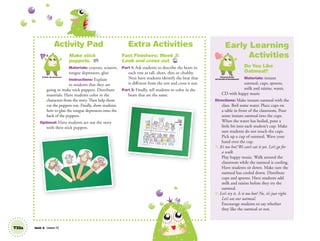
  • 31.
    5Unit 1 Lesson3 and glue. Finger-paint 01 GM TG2 U1.indd 31 12/6/12 9:35 AM
  • 32.
    10 and color. Listen Review 01 GM TG2U1.indd 32 12/6/12 9:36 AM
  • 33.
    Unit 1 Review Value IListen to the Teacher Vocabulary: raise your hand, keep quiet, stand up, open/close your book, sit down 1. Talk About the Value Tell students that if they listen to the teacher, they will feel more confident when they do a task. Say how they can pay attention: keep quiet, raise your hand before we speak, and so on. 2. Song: Listen, Listen 8 Play Track 8, Listen, Listen. Encourage students to say the chant. Use this chant when you want to get their attention. 3. Student’s Book: Listen and color. SB Hand out the Student’s Book open to page 67. Have students identify the actions and color the stars. If the activity is done correctly, they stick the Reward sticker in place. 4. Good Behavior Chains Materials: 10-cm square pieces of construction paper (1 per student), crayons, scissors, glue, paper chains (See page T7a.) Directions: Have students draw a Gummy Drop. Write their names on their drawing. Attach their paper chains to their drawings. If a student misbehaves, ask them to remove one of the links, so that they monitor their own behavior. Reward the student whose chain remains complete. General Review 1. Review: Classroom Objects Distribute the classroom objects mini-flashcards. Have students put their cards facing up on their tables. Explain that you will name an object and they will hold the card up. After, have them put the cards face down on their tables. T: Show me scissors. SS: (Students hold up the card and then put it face down.) 2. Review: Actions Distribute action mini-flashcards. Display Poster 1. Point to an action on the poster. Have students hold up the corresponding mini-flashcard. T: (Point to the boy cutting.) I like to cut. Show me cut. SS: (Students hold up the cut mini-flashcard.) 3. Student’s Book: Listen and color. SB Hand out the Student’s Books open to page 10. Have students identify the different objects on the page. Give students instructions for coloring in the objects. T: Paintbrush. Find a paintbrush. Color the paintbrush blue. If the activity is done correctly, they stick the Reward sticker in place. 4. Assessment TCH Print out and photocopy the Unit 1 Assessment. Distribute copies and crayons to students. Describe the actions and have students point to them. Next, give students instructions for coloring the circles. T: Find “I like to cut.” Point to the picture. Show me your green crayon. Color the circle green. 5. Picture Dictionary TCH Have children glue each mini-flashcard onto the matching picture in the Picture Dictionary. Help students glue the Picture Dictionary onto a colored sheet of paper and include it in their Scrapbooks. T10 01 GM TG2 U1.indd 33 12/6/12 9:37 AM
  • 34.
    Unit 2 Unit 2 Areasof Learning Vocabulary Language Structures • Knowledge and Understanding of the World • Problem Solving, Reasoning and Numeracy arm, body, ears, eyes, face, foot, hair, hand, head, leg, mouth, nose Active: Good morning, Miss (Carmen). Hello, Lucy. It’s an arm. Head. Passive: This is an arm. What is this? Where do the eyes go? Touch your arm. What’s missing? This is a mouth. • Physical Development • Artistic Development clap, dance, ears, eyes, hair, hop, jump, kick, knees, lift, mouth, nose, reach, run, toes, touch; colors Active: Run! Yellow. Yes. Touch your toes. Passive: Can you say “run”? What color is the frame? (Mark), can you run? Touch your toes. • Communication, Language and Literacy • Artistic Development • Personal, Social and Emotional Development facial features; body parts; numbers 1 to 10; clothes Active: I have one nose. I have two arms. Five. Passive: Jump to number 6. What’s this? What number is red? • • Week 1 Week 2 Week 3 Poster 1. Working with the Poster Display Poster 2. Ask students the names of the characters and what they are doing. Point to Robby’s arm as you name it. Have students point to their arms. T: (Point to Robby’s arm on the poster.) Arm. SS: (Students point to their arm) Continue with other body parts. Finally, ask students to shake different body parts. T: (Shake your hand.) Everybody, let’s shake our hand. 2. Working with the Unit Opener 9 Display Poster 2. Distribute finger puppets for Unit 2. Name the body parts as you point to them on the poster. Play Track 9, Point To… (Karaoke Version). Invite students to point to different body parts with their finger puppets in their Student’s Books. Math Concept: Numbers 1 to 10 Value: I Exercise My Body to Stay Healthy T11a Richmond Unit 2 Unit 1 GM2 TCH-CO.ind d 1 Unit 1 Richmond 2 U nit 01 GM2 STK.indd 3 Richmond Richmond Richmond 2 Uni t dd 4 10/17/12 3:26 PM 01 GM TG2 U2.indd 34 12/6/12 9:44 AM
  • 35.
    My Body 11 Un it 2 01GM TG2 U2.indd 35 12/6/12 9:44 AM
  • 36.
    12 and match. Stick Unit 2 Lesson4 01 GM TG2 U2.indd 36 12/6/12 9:45 AM
  • 37.
    Knowledge and Understanding ofthe World Unit 2 Lesson 4 T12 Learning Goals: Students can recognize body parts. Students can name body parts. Vocabulary: arm, body, eyes, foot, hand, head, leg Language Structures: Active: Good morning, Miss (Carmen). Hello, Lucy. It’s an arm. Passive: This is an arm.What is this?Where do the eyes go? Touch your arm. Materials: none Before the Class 1. Greetings Greet students and encourage them to reply. T: Good morning, boys and girls. SS: Good morning, Miss (Carmen). Hold up the Lucy stick puppet and greet students again. T: Hello, Lucy. Say “hello” to Lucy. SS: Hello, Lucy. Repeat with the Robby stick puppet. Use the stick puppets to greet individual students. ROBBY PUPPET: Hello, (Patty). S: Hello. 2. Song: Hello, My Friend 4 Divide students into pairs. Have them face each other. Play Track 4. Encourage students to sing and act out the song. During the Class 1. Presentation: Body Parts Display Poster 2. Present the word arm as you point to the picture on the poster. Have students identify it. T: This is an arm. What is this? SS: It’s an arm. Repeat the procedure with eyes, foot, hand, head and leg. Point to the complete picture and present the word body. Next, point to each body part and have students name it. 2. Student’s Book: Stick and match. SB Hand out the Student’s Book open to page 12. Distribute the stickers in the red section. Ask students to identify each body part. Help students peel off the stickers and put them in the corresponding place. T: Look for eyes. Peel off the eyes. Where do the eyes go? Put the sticker on the eyes. Finally, have students match Lucy’s body parts with the pictures around it. 3. More Practice: Body Parts Display the body parts cutouts on your desk. Name a body part and ask a student to attach the corresponding cutout to the board. T: Take an arm. Attach it to the board. Have students attach all body parts cutouts to make a person. Repeat the procedure several times. 4. Song: Tap It! Part 1 10 Play Track 10, Tap It! Part 1. Teach students the song and encourage them to sing and act out the words. After the Class 1. Game: Listen, Look And Do Give instructions to students for touching different parts of the body. Say the instructions faster and faster each time. 2. Song: Time To Go Home 3 Play Track 3. Teach students the words to the song and encourage them to sing. Extra Activities 1. Fast Finishers TCH See Fast Finishers: Week 1, part 1, on page T13a. Play Game 3 on the Interactive CD-ROM. INT 01 GM TG2 U2.indd 37 12/6/12 9:45 AM
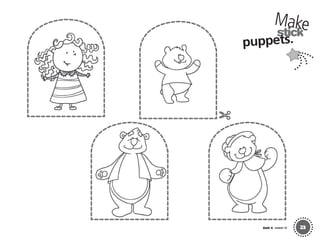
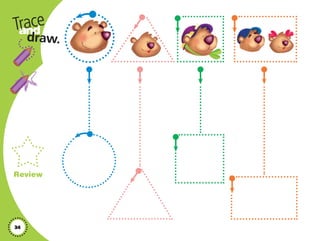
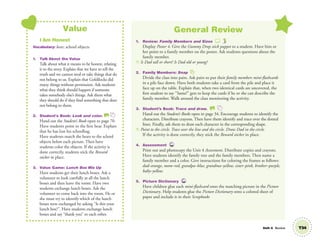
  • 38.
    Knowledge and Understanding ofthe World T13 Unit 2 Lesson 4 Learning Goals: Students can recognize body parts. Students can name body parts. Vocabulary: ears, eyes, face, hair, mouth, nose Language Structures: Active: It’s a mouth. Head. Passive: This is a mouth.What is this?What’s missing? Materials: inflated balloon, crayons, paper Before the Class 1. Song: Hello, My Friend 4 Play Track 4. Encourage students to sing and act out the song. 2. Game: Tap A Balloon Have students stand in a circle. Tap a balloon lightly against a student’s head. Ask the student to name the body part touched by the balloon. T: Here goes the balloon. (Tap the balloon on student’s head.) S1: Head. Have all the students tap their head as they say “head” three times. Next, have the student whose head you tapped, tap another student gently with the balloon. Have that student name the body part touched by the balloon. Continue until all students have participated. During the Class 1. Presentation: Facial Features Name each facial features cutout as you attach it to the board to make a face. Have students identify it. T: This is a mouth. What is this? S: It’s a mouth. Introduce the word face by pointing to the complete image. Next, point to each of the facial features and have students name them. 2. More Practice: What’s Missing? Remove the facial features cutouts, one at a time. Call on individual students to say what’s missing. T: What’s missing? 3. Student’s Book: Trace and draw. SB Draw a face on the board. Trace a circle around it, counterclockwise. Invite students to come to the front and trace over the circle. Hand out the Student’s Book open to page 13. Distribute crayons and have students trace over the circles counterclockwise. Then ask them to point to the facial features of the boy in the red circle. Encourage them to figure out which feature is missing. T: Point to one ear. Point to the other ear. Point to one eye. What’s missing? Ask students to draw in the missing body parts. Repeat with the rest of the pictures. 4. Song: Tap It! Part 2 11 Play Track 11, Tap It! Part 2. Teach students the song and encourage them to sing and act out the words. After the Class 1. Draw a face. Distribute paper and crayons. Draw a picture of your face on the board and say who it is. Have students draw their own face on the paper. Display students’ work around the classroom. Extra Activities 1. Fast Finishers TCH See Fast Finishers: Week 1, part 2, on page T13a. 2. Activity Pad: Do the puzzle. AP See instructions for the Activity Pad, on page T13a. 01 GM TG2 U2.indd 38 12/6/12 9:45 AM
  • 39.
    13 and draw. Trace 13Unit 2 Lesson4 01 GM TG2 U2.indd 39 12/6/12 9:45 AM
  • 40.
    Unit 2 Lesson4T13a Activity Pad Do the puzzle. AP Materials: crayons, scissors, glue sticks, sheets of paper (1 per student) Instructions: Distribute materials. Have students color in the pictures. Then, help them cut out the puzzle pieces. Have students assemble their puzzles. Finally, ask them to glue their finished puzzles onto the sheets of paper. Optional: Name different body parts or facial features. Have students point to them. Scrapbook: Save students’ work for their Scrapbooks. Extra Activities Fast Finishers: Week 1: Draw and color. TCH Part 1: Have students draw themselves in the blank face. Part 2: Then, have students color in the picture. Optional: Invite students to count their fingers first and then the fingers in their pictures. T: How many fingers do you have? Let’s count. T/SS: One, two, three, four… ten! T: Now, let’s count the fingers in the picture. Scrapbook: Save students’ work for their Scrapbooks. Early Learning Activities Drawing Shapes Materials: piece of white construction paper (1 per student), crayons, fine black markers Directions: Elicit names of shapes: circle, triangle, square, and rectangle. Next, have a volunteer come up to the board and draw one of the shapes. Have the rest of the class guess which shape he or she is drawing. The student who guesses correctly draws the next shape. Finally, draw a large triangle on the board. Have different volunteers draw the eyes, ears, nose, mouth, arms, legs, hands and feet. Distribute white paper and crayons. Have students choose a shape and draw in its body parts. Have students trace over their drawings with a fine black marker and then color them in. Display their pictures in the classroom. p Problem Solving, Reasoning and Numeracy Problem Solving, Reasoning and Numeracy 01 GM TG2 U2.indd 40 12/6/12 9:45 AM
  • 41.
    7Unit 2 Lesson4 the puzzle. Do 01 GM TG2 U2.indd 41 12/6/12 9:46 AM
  • 42.
    14 and sing. Trace Unit 2 Lesson5 01 GM TG2 U2.indd 42 12/6/12 9:46 AM
  • 43.
    Physical Development Unit 2Lesson 5 T14 Learning Goals: Students can control body movements. Students can make movements in their places and around the perimeter. Vocabulary: clap, dance, hop, jump, kick, run; colors Language Structures: Active: Run! Yellow. Passive: Can you say “run”? What color is the frame? Materials: fans (See Unit 1, page T6), markers Before the Class 1. Song: Tap It! Part 1 10 Play Track 10. Encourage students to sing and act out the song. 2. Review: Colors Distribute fans. (See Materials.) Ask students to show you the red, blue, yellow, green and orange strips. T: Show me orange. SS: (Students hold up the orange strip.) Give individual students a thumbs-up signal if they are correct. Shake your head if they are incorrect, and tell them to look for a different strip. Collect fans and store them away. During the Class 1. Presentation: Actions Have students stand in a circle. Name an action as you perform it. Encourage students to do it along. T: Run! (Run in your place.) SS: (Students run in their places.) Repeat with clap, dance, hop, kick and jump. 2. Presentation: Let’s Run! Name an action as you do it. Invite students to stand up and say what they can do. T: Let’s run! Can you say, “run”? (Run in your place.) SS: Run! Repeat the activity with clap, dance, hop, kick and jump. 3. Student’s Book: Trace and sing. SB Hand out the Student’s Book open to page 14. Name the actions and have students point to them. Ask students about the color of the frames. T: What color is the frame? SS: Yellow. Distribute markers. Have students trace over the dotted lines with the corresponding marker. 4. Song: Use Your Feet 12 Play Track 12, Use Your Feet. Encourage students to sing along as they act out the words. After the Class 1. Game: Follow The Leader Take students to the playground. Have them form a line behind you. Say, “I can jump” as you jump around the playground. Have students follow your lead. Repeat with different actions. Extra Activities 1. Fast Finishers TCH See Fast Finishers: Week 2, part 1, on page T15a. 01 GM TG2 U2.indd 43 12/6/12 9:46 AM
  • 44.
    Physical Development T15 Unit2 Lesson 5 Learning Goals: Students can incorporate their imagination into their movements. Students can move in their places and around the perimeter. Vocabulary: arm, ears, eyes, foot, head, hair, knees, lift, leg, mouth, nose, reach, toes, touch Language Structures: Active: Yes. Touch your toes. Passive: (Mark), can you run? Touch your toes. Materials: crayons, beanbag Before the Class 1. Song: Use Your Feet 12 Play Track 12. Encourage students to sing and act out the song. 2. Game: Show Me Have students sit in a circle. Ask individual students to show you they can do different actions. T: (Mark), can you run? S: Yes. T: Show me. SS: (Student runs around the circle.) Continue until all the students have participated. During the Class 1. Presentation: Following Instructions Have students stand up. Give an instruction. Mime the action and have students repeat the instruction as they perform the action. T: Touch your toes. (Touch your toes.) SS: Touch your toes. (Students touch their toes.) Repeat with reach up high, touch your nose and lift your knees. 2. More Practice: Instructions Have five students come up to the front. Give them instructions. The student who does not follow an instruction correctly, must go back to his or her seat. The last student who remains standing wins. Have the rest of the class monitor the actions. Repeat until all students have participated. 3. Student’s Book: Trace and stick. SB Hand out the Student’s Book open to page 15. Distribute the stickers in the blue section. Have students identify the actions. Help students peel off the stickers and put them in the correct places. Next, distribute crayons. Have students trace over the dotted lines several times to match the pictures that show similar actions. After the Class 1. Game: The Beanbag Game Have students sit in a circle. Put the facial features and body parts cutouts in the middle of the circle. Toss a beanbag. Ask students to touch the facial feature or body part depicted in the cutout that the beanbag landed on. Invite individual students to throw the beanbag and give instructions. 2. Song: English Class Is Over 6 Play Track 6. Encourage students to sing and act out. Extra Activities 1. Fast Finishers TCH See Fast Finishers: Week 2, part 2, on page T15a. 2. Activity Pad: Make a puppet. AP See instructions for the Activity Pad, on page T15a. 01 GM TG2 U2.indd 44 12/6/12 9:46 AM
  • 45.
    15 and stick. Trace Unit 2 Lesson5 01 GM TG2 U2.indd 45 12/6/12 9:46 AM
  • 46.
    Activity Pad Make apuppet. AP Materials: skin-colored chalk, markers, scissors, hole punch, yarn (different colors), glue, moveable eyes, paper fasteners (4 per student) Preparation: Cut yarn into varying lengths for the hair. Instructions: Distribute the materials. Tell students to color the face, arms and legs with chalk, and the clothes with markers. Show students how to glue on the moveable eyes and the yarn to represent the hair, nose and mouth. Help students cut out the pieces. Punch holes through the dots and help students assemble the puppet, using the paper fasteners. Give instructions and have students make their puppet follow them. Scrapbook: Save students’ work for their Scrapbooks. Extra Activities Fast Finishers: Week 2: Color and cut. TCH Part 1: Have students color in the pictures with crayons. Part 2: Help students cut out Robby, Lucy and Gummy Drop and the two circles at the bottom of each character. Explain to students that they are going to insert their fingers in the holes to represent the character’s legs. Optional: Give instructions. Have the children do the actions with the characters. T: Gummy Drop, run! SS: (Students put on their Gummy Drop puppets and pretend to run with their fingers.) Unit 2 Lesson 5 Early Learning Activities Move Your Body 13 Materials: music CD with contrasting tracks: lively fast music and slow music, CD-player Directions: Have students stand in a circle. Play Track 13, I CanWalk. Encourage them to chant along and do the actions. Next, repeat the activity, doing each verse at a slow pace to begin with and then at a faster pace. Afterwards, play a CD track with fast music. Name an action. Have students perform the corresponding action quickly. Model the action first. T: Run! SS: (Students run quickly.) Then play a track with slow music. Ask students to perform the same action slowly. Repeat with different actions. Finally, play both types of music at random and have the students dance or move freely to the music. Note: If space is limited, do the activity outside. T15a Artistic Development Scrapbooks. Physical Development fingers.) 01 GM TG2 U2.indd 46 12/6/12 9:47 AM
  • 47.
    9Unit 2 Lesson5 a puppet. Make 01 GM TG2 U2.indd 47 12/6/12 9:47 AM
  • 48.
    16 and stick. Trace Unit 2 Lesson6 01 GM TG2 U2.indd 48 12/6/12 9:47 AM
  • 49.
    Learning Goals: Students enjoyhearing new stories. Students can listen attentively for five minutes. Vocabulary facial features; body parts; numbers 1 to 10; clothes Language Structures: Active: I have one nose. Passive: Jump to number 6. What’s this? Materials: construction paper, sheets of paper, crayons, markers, Numbers templates, I’m a Superhero! template (from the Teacher’s Resource CD) Preparation: Print out and laminate the Numbers templates. Print out the I’m a Superhero! template or write the text on a piece of paper (1 per student). Unit 2 Lesson 6 T16 Communication, Language and Literacy Before the Class 1. Chant: One, Two Teach students the words to the following chant and ask them to show the corresponding number of fingers. One, Two One, two, Three, four, Five, six, Seven, eight, Nine and ten. Go ahead, And count again! During the Class 1. Review: Numbers 1 to 10 TCH Display the Numbers templates 1 to 10 on different walls in the classroom. (See Preparation.) Point to the numbers in order and invite students to name them. Repeat the procedure, but this time point to the numbers randomly. Finally, give commands to students to go to the numbers performing different actions, like hopping, running or jumping. T: Jump to number 6. 2. Make Predictions: I’m a Superhero! BB Display the Big Book page 10. Ask students to make predictions about the story. T: What is the girl doing? Where is she? Display pages 10 to 15, one at a time. Have students identify as many things as they can. T: What’s this? Point to the girl’s eyes. 3. Listen to the story. BB 14 Play Track 14, I’m a Superhero! Point to the corresponding pictures on the Big Book pages 10 to 15, while students listen. Invite individual students to come up and use their Teacher stick puppet to point to body parts, facial features and clothes. 4. Student’s Book: Trace and stick. SB Hand out the Student’s Book open to page 16. Encourage students to count out loud from 1 to 10 as they point to each number. Then, distribute crayons and ask students to trace over the numbers. Next, distribute the stickers in the green section and have students identify the skirt and the blouse. Finally, help students peel off the stickers and put them in the corresponding places. After the Class 1. I’m a Superhero! Part 1 Copy the text from the I’m a Superhero! template on the board. (See Preparation.) Read the text out loud. Encourage students to repeat. Invite a student to name a part of the body to complete the sentence. T: I have... (Point to your nose.) S: one nose. Write one nose in the blank to complete the sentence on the board. Reread the complete text. Repeat the procedure with other students and different parts of the body: ten fingers, two arms, and so on. Distribute the templates. Have each student draw a picture of himself or herself dressed up as a superhero. Save students’ work for the next lesson. Extra Activities 1. Fast Finishers TCH See Fast Finishers: Week 3, part 1, on page T17a. 01 GM TG2 U2.indd 49 12/6/12 9:48 AM
  • 50.
    Learning Goals: Students canuse new words or phrases they have heard in familiar contexts. Students can recognize parts of the story that are missing and complete the story. Vocabulary: facial features; body parts; numbers 1 to 10 Language Structures: Active: I have two arms. Five. Passive: What number is color red? Materials: colored pencils, I’m a Superhero! templates from the previous class, fans (See page T6) T17 Unit 2 Lesson 6 Communication, Language and Literacy Before the Class 1. Song: One, Two Teach students the words to the chant and encourage them to show the corresponding number of fingers. (See Page T16.) 2. Review: Body Parts and Actions Distribute the mini-flashcards for Unit 2. Name a body part or an action. Have students hold up the corresponding mini-flashcard. During the Class 1. What is the story about? BB Display the Big Book pages 10 to 15. Invite students to say what the story is about. 2. Listen to the story. BB 14 Play Track 14. Point to the corresponding pictures on the Big Book pages as students listen to the story. 3. Complete the story. BB Display the Big Book pages 10 to 15, one at a time. Read the story, leaving out key words and having students fill them in orally. T: I have ten strong… SS: fingers T: and ten strong… SS: toes. 4. Review: Colors Distribute fans. (See Materials.) Ask students to show you the red, blue, yellow, green and pink strips. Collect fans and store them away. 5. Student’s Book: Look and color. SB Hand out the Student’s Book open to page 17. Distribute colored pencils. Name a color and ask students to tell you the number for that color. T: Point to red. What number is the color red? SS: Five. Continue in the same manner with the remaining colors and numbers. Finally, have students color in the picture using the color code. After the Class 1. I’m a Superhero!, Part 2 Distribute crayons and students’ templates. Have students color in their pictures. Have each student identify a body part. Ask how many of those body parts he or she has. T: How many arms do you have? S: Two. Encourage the students to say, “I have two arms,” as you write his or her response on the template. Help the student “read” the text. Repeat the procedure with the rest of the students. Finally, write examples of the students’ texts on the board. Read them out loud with the whole class. Scrapbook: Save students’ work for their Scrapbooks. Extra Activities 1. Fast Finishers TCH See Fast Finishers: Week 3, part 2, on page T17a. 2. Activity Pad: Color and play. AP See instructions for Activity Pad, on page T17a. Play Game 4 on the Interactive CD-ROM. INT 01 GM TG2 U2.indd 50 12/6/12 9:49 AM
  • 51.
    17 Lookand color. Unit 2 Lesson6 01 GM TG2 U2.indd 51 12/6/12 9:49 AM
  • 52.
    Activity Pad Color andplay. AP Materials: crayons, glitter, glue, scissors, plastic or paper cups (1 per student) Instructions: Tell students to color in Gummy Drop and the gumdrops. Then, have students spread glue onto the pictures and sprinkle glitter on them. Help students cut out the pictures. Fold the Gummy Drop and glue it onto the plastic or paper cup, as if it were sitting down. Say a number and have students put the corresponding number of gumdrops into the cup. T: Three. SS: (Students put three gumdrops inside the cup.) Extra Activities Fast Finishers: Week 3: Make a crown. TCH Preparation: Cut out a strip of colored construction paper long enough to go around students’ heads Part 1: Have students color in the stars. Then, have then spread glue on the stars and sprinkle glitter on them. Part 2: Help students cut out the stars and glue them in order onto a strip of construction paper. Finally, staple both ends of the strips together to make acrown. Artistic Development T17a Unit 2 Lesson 6 Early Learning Activities Superhero Costume TCH Materials: crepe paper, letter-sized piece of construction paper (1 per student), hole punch, markers, glue, glitter, ribbon, elastic, stapler, scissors, Star and mask template Preparation: Make a copy of the template for each student. Cut crepe paper into sections (approximately 1 meter per student). Directions: Distribute the templates and materials. Help students cut out the pictures, glue them onto construction paper and cut them out again. Write the first letter of students’ names on the star. Have them color and decorate the pictures with glitter. Punch a hole through the top of the star and thread a piece of ribbon through it to make a necklace. Staple a piece of elastic to both sides of the mask. Make a cape with crepe paper. Staple a piece of ribbon or elastic to the two top corners to tie the ends together. Have students wear their costumes and retell the story. Personal, Social and Emotional Development 01 GM TG2 U2.indd 52 12/6/12 9:50 AM
  • 53.
    fold 11 and Unit 2 Lesson6 play. Color 01 GM TG2 U2.indd 53 12/6/12 9:50 AM
  • 54.
  • 55.
    Unit 2 Review Value IExercise My Body to Stay Healthy Vocabulary: raise your hands, touch your toes, walk, run, crawl, jump 1. Game: Teacher Says Give students commands like raise your hands up high, touch your toes, walk, run, crawl and jump. Have students follow only those commands preceded by “Teacher says.” 2. Student’s Book: Point and color. SB Hand out the Student’s Book open to page 68. Have students identify the actions. T: Point to Dad. Dad can raise his hands up high. Continue with Mommy can walk, Robby can play, Baby can crawl and Sister can jump rope. Next, have students color in the pictures. If the activity is done correctly, students stick the Reward sticker in place. 3. Talk About the Value Talk to students about the importance of exercising. Explain that when they run, jump and play, they are exercising. Remind them of the activities the family was doing. Ask them what kinds of activities they do with their families to stay active. 4. Song: Exercise 15 Play Track 15, Exercise. Encourage students to sing and do the corresponding actions. General Review 1. Review: Facial Features Display Poster 2. Give the Teacher stick puppet to a student. Have him or her point to the characters’ facial features. T: Point to Lucy. Point to her eyes. Repeat the procedure with different students. 2. Review: Body Parts Attach the body parts cutouts to the board. Ask individual students to come to the board and assemble the body parts to make a complete body. Develop students’ awareness that their bodies are symmetrical, or that they are the same on both sides. T: How many heads does she have? SS: One. Continue in the same manner with the rest of the body parts cutouts. Finally, give students the Teacher stick puppet to point to and name each body part. 3. Student’s Book: Trace and color. SB Hand out the Student’s Book open to page 18. Have students trace over the dotted lines. Then ask them to identify and color the facial features and body parts. T: Point to the eyes. Show me your blue pencil. Color the eyes blue. If the activity is done correctly, students stick the Reward sticker in place. 4. Assessment TCH Print out and photocopy the Unit 2 Assessment. Distribute copies and crayons. Have students color the body parts in the girl’s picture. T: Color the eyes green. Color the head yellow, etc. Then have students count the body parts and circle the correct number next to the corresponding body part in the squares. 5. Picture Dictionary TCH Have children glue each mini-flashcard onto the matching picture in the Picture Dictionary. Help students glue the Picture Dictionary onto a colored sheet of paper and include it in their Scrapbooks. T18 01 GM TG2 U2.indd 55 1/4/13 10:40 AM
  • 56.
    Unit 3 Areas ofLearning Vocabulary Language Structures • Knowledge and Understanding of the World • Artistic Development barn, chick, cow, duck, farm, goat, hen, horse, rooster, sheep, turkey, same, different Active: It’s a cow. Yes, it is./No, it isn’t. It’s a horse. They’re chicks. Passive: What’s this? Is this a cow? What are these? Which animal is different? A chick lives on the farm. • Problem Solving, Reasoning and Numeracy • Artistic Development egg, eleven, ten, twelve; farm animals Active: Eleven. Twelve. They’re turkeys. One, two, three… ten, eleven, twelve. Twelve eggs. Passive: What number is this? What are these? How many eggs are there? • Communication, Language and Literacy • Artistic Development • Knowledge and Understanding of the World farm, farmer; farm animals; numbers 1 to 2 Active: It’s a cow. A cow goes moo. It’s brown. Passive: What animal is this? What sound does the cow make? Unit 3 • • Week 1 Week 2 Week 3 Poster 1. Working with the Poster Display Poster 3. Have students identify the scene. T: This is a farm. What’s this? SS: It’s a farm. Introduce the words barn, fence and farmer by pointing to the pictures. Have students identify them. T: Look. This is the farmer. The farmer lives on the farm. Who’s he? SS: The farmer. 2. Working with the Unit Opener Cut out and glue the farmer cutout onto a tongue depressor. Display Poster 3. Distribute finger puppets for Unit 3. Name the farm animals as you point to them on the poster with the farmer stick puppet. Have students point to them with their finger puppets in their Student’s Books. Math Concept: Numbers 1 to 12 Value: Our Parents Take Care of Us T19a Richmond Unit 4 Unit 3 GM2 TCH-CO.ind d 3 Unit 3 Richmond U nit 3 01 GM2 STK.indd 5 Richmond Richmond Richmond Uni t 3 dd 6 10/17/12 3:26 PM 01 GM TG2 U3.indd 56 12/6/12 9:53 AM
  • 57.
    On the Farm19 Un it 3 Un it 3 01 GM TG2 U3.indd 57 12/6/12 9:53 AM
  • 58.
    20 Lookand stick. Unit 3 Lesson7 01 GM TG2 U3.indd 58 12/6/12 9:57 AM
  • 59.
    Learning Goals: Students canidentify and name farm animals. Vocabulary: barn, chick, cow, duck, farm, goat, hen, horse, rooster, sheep, turkey Language Structures: Active: It’s a cow. Yes, it is./No, it isn’t. Passive: What’s this? Is this a cow? Materials: crayons, paper (1 sheet per student), scissors, red construction paper, tape Preparation: Draw and cut out a large barn from construction paper. Knowledge and Understanding of the World Unit 3 Lesson 7 T20 Before the Class 1. Song: Hello, My Friend 4 Divide students into pairs. Have them face each other. Play Track 4. Encourage them to sing and act out the song. During the Class 1. Presentation: Come To The Farm. 16 17 Hold up a piece of construction paper, and place the cow cutout behind it. Play Track 16, Come To The Farm. Slowly start to reveal the cutout. Have students shout the answer to the question at the end of the song. Play Track 17, Come To The Farm (Karaoke Version). Repeat with the rest of the farm animals cutouts. 2. Questions Display the farm animals cutouts, one at a time, and have students identify them. T: What’s this? SS: It’s a cow. Next, ask questions about the animals. T: (Point to the chick.) Is this a cow? SS: No, it isn’t. 3. Student’s Book: Look and stick. SB Hand out the Student’s Books open to page 20. Have students identify the animals and mimic the sounds they make. Distribute the stickers in the red section. Point to the heads and encourage students to identify the animals they belong to. Help students peel off the stickers. Hold up each one and have students identify the animals again, before they place the stickers in the corresponding places. 4. More Practice: Farm Animals Distribute the farm animals mini-flashcards. Name three farm animals and have students put the corresponding mini-flashcards on their desks in the same order. Repeat the procedure several times. After the Class 1. Farm Animals Collage Display the barn. (See Preparation.) Help the class identify it. T: What’s this? T/SS: It’s a barn. Distribute crayons and sheets of paper. Have students draw a picture of their favorite farm animal. Then invite them to tape their pictures to the barn. Point to the animals and have the students name them. Extra Activities 1. Fast Finishers TCH See Fast Finishers: Week 1, part 1, on page T21a. 01 GM TG2 U3.indd 59 12/6/12 9:59 AM
  • 60.
    Knowledge and Understanding ofthe World T21 Unit 3 Lesson 7 Learning Goals: Students can identify and name farm animals. Vocabulary: chick, cow, duck, goat, horse, rooster, sheep, turkey Language Structures: Active: It’s a horse. They’re chicks. The horse. Passive: What’s this? What are these?What animal is different? A chick lives on the farm. Materials: inflated balloon, crayons Before the Class 1. Song: When Cows Get Up In The Morning 18 Play Track 18, When Cows Get Up In The Morning. Show students the corresponding cutouts when the animals are mentioned. Encourage students to sing along. 2. Game: Tap The Balloon Have students stand in a circle. Tap the balloon to a student and name an animal that lives on a farm. T: A chick lives on the farm. Have the student tap the balloon to another student and name another animal that lives on a farm. S1: (Taps the balloon to a partner.) S2: Cow. Repeat the procedure until all students have named at least one animal. During the Class 1. Presentation: Animal Groups Hold up the animal groups cutouts, one at a time, and ask students to identify them. T: What are these? SS: They’re chicks. 2. Name the animals. Display the farm animals and animal groups cutouts on the chalk ledge. Have the farmer stick puppet point to them and have students name them. FARMER PUPPET: What’s this? S: It’s a horse. FARMER PUPPET: What are they? S: They’re cows. 3. Student’s Book: Cross out and color. SB Hand out the Student’s Books open to page 21. Have students identify the animals. Distribute crayons. Ask students which animal does not belong in each section and have them cross it out. T: Point to the chicks. Point to the horse. Which animal is different? SS: The horse. T: Cross out the horse. Have students color the chicks. Do the same with the rest of the animal groups. After the Class 1. Game: Hide The Cow Ask a volunteer to leave the room. Hide the cow cutout in the classroom, leaving part of it visible. Have the volunteer come back into the room and look for the hidden cow. The rest of the class begins to say, “Moo, moo...” If the student is close to the hidden cow, the class “moos” loudly. If the student moves further away, the class “moos” more softly. Repeat the game with other volunteers and other farm animals. Extra Activities 1. Fast Finishers TCH See Fast Finishers: Week 2, part 2, on page T21a. 2. Activity Pad: Make masks. AP See instructions for the Activity Pad, on page T21a. Play Game 5 on the Interactive CD-ROM. INT 01 GM TG2 U3.indd 60 12/6/12 9:59 AM
  • 61.
    21 and Crossout color. Unit 3 Lesson7 01 GM TG2 U3.indd 61 12/6/12 10:00 AM
  • 62.
    Unit 3 Lesson7T21a Activity Pad Make masks. AP Materials: watercolors, paintbrushes, plastic containers, black and white crepe paper, glue, scissors, hole punch, elastic band Preparation: Cut black and white crepe paper into small squares. Cut elastic bands into lengths long enough to tie around students’ heads. Instructions: Distribute materials. Have students paint the masks with watercolors. Once they are dry, show students how to crumple small balls of crepe paper and glue them onto the cow’s spots and onto the top of the sheep’s head. Help students cut out the masks. Punch holes on either side of the masks. Tie the elastic bands through the holes. Encourage students to put on their masks and walk around the classroom mimicking the animals. Extra Activities Fast Finishers: Week 1: Look and color. TCH Part 1: Have students find the farm animals and color them in with colored pencils. Part 2: Tell students to finish coloring the picture. Optional: Name a farm animal and have students point to it. T: Point to the chick. Ask students what color their animals are. T: What color is your chick? S: Yellow. Scrapbook: Save students’ work for their Scrapbooks. Early Learning Activities Farm Animals Materials: cardboard boxes, plastic bottles, milk cartons, toilet paper rolls, feathers, yarn, moveable eyes, pom-poms, cotton, scraps of paper, glue, paint, masking tape, paintbrush Preparation: Rinse out cartons and bottles. Make samples of farm animals. Directions: Show students your samples. Ask them to choose a farm animal. Have them select the items they need to make that animal. Distribute paint and paint brushes. Have students paint the boxes, bottles or cartons. Finally, help them add collage materials for body parts. Have them show their work and name the animals they made. Artistic Development Artistic Development 01 GM TG2 U3.indd 62 12/6/12 10:00 AM
  • 63.
    HERENIA 13Unit 3 Lesson7 Make masks. 01 GM TG2 U3.indd 63 12/6/12 10:00 AM
  • 64.
    22 and color. Trace Unit 3 Lesson8 01 GM TG2 U3.indd 64 12/6/12 10:00 AM
  • 65.
    Learning Goals: Students canrecognize numbers from 1 to12. Students can match numerals to groups of objects. Vocabulary: eleven, twelve; farm animals Language Structures: Active: Eleven. Twelve. They’re turkeys. Passive: What number is this? What are these? Materials: CD with lively music, paper (1 sheet per student), crayons, Numbers 1 to 12 templates, Turkeys and chicks template (from the Teacher’s Resource CD) Preparation: Print out and laminate the Numbers templates. Print out the Turkeys and chicks template. Make six copies. Color and cut out the animals. Unit 3 Lesson 8 T22 Before the Class 1. Song: When Cows Get Up In The Morning 18 Play Track 18. Show students the farm animals cutouts as the animals are mentioned in the song. Encourage students to sing. 2. Game: Musical Chairs Line up students’ chairs back to back in two rows. Place the farm animals and animal groups cutouts at random on different chairs. Play lively music. Lead students in walking around the chairs. Pause the music and have students sit on the nearest chair. Ask students with cutouts to identify and count the animals. Collect the cutouts and redistribute them. Play the music again. Repeat the procedure several times until all students have described an animal. During the Class 1. Chant: One, Two Encourage students to say the chant One, Two. (See page T16.) Show the corresponding number of fingers. 2. Presentation: Numbers 1 to 12 TCH Divide the board into two sections: numbers and animals. Attach eleven pictures of turkeys to the animals side of the board. Then, attach the Number 11 template on the numbers side. (See Preparation.) Encourage students to count the turkeys out loud as you point to them. T: Look, turkeys. Let’s count them. T/SS: One, two, three… el even. Then point to the Number 11 template. Encourage students to say eleven. Trace the number 11 with your finger over the template. Invite students to trace it in the air. Finally, have different students count the turkeys out loud and trace the number 11 on the board. Repeat the procedure with the chicks and the number 12. 3. Student’s Book: Trace and color. SB Hand out the Student’s Books open to page 22. Have students identify the numbers and the animals on the page. T: What number is this? SS: Ten. T: What are they? SS: They’re turkeys. Distribute crayons. Have students trace over the numbers and color the corresponding number of pictures. After the Class 1. Draw a picture. Distribute paper and crayons. Write a large number 12 on the board. Have students copy it at the top of their sheets. Next, ask them to choose their favorite farm animal and draw twelve of them on their sheet. Finally, have them share their work with the class. Extra Activities 1. Fast Finishers TCH See Fast Finishers: Week 2, part 1, on page T23a. Problem Solving, Reasoning and Numeracy 01 GM TG2 U3.indd 65 1/4/13 11:12 AM
  • 66.
    Problem Solving, Reasoning andNumeracy T23 Unit 3 Lesson 8 Learning Goals: Students can recognize the numbers 1 to 12. Students can match numerals to groups of objects. Vocabulary: egg, eleven, ten, twelve, eleven, hen Language Structures: Active: One, two, three… ten, eleven, twelve. Twelve eggs. Passive: How many eggs are there? Materials: finger paint, plastic containers, Numbers templates Before the Class 1. Song: When Cows Get Up In The Morning 18 Play Track 18. Show students the farm animals cutouts as the animals are mentioned in the song. Encourage students to sing. 2. Review: Numbers 1 to 12 TCH Hold up the Number templates from 1 to 12, first in order and then randomly. Have students identify them. Distribute the templates to twelve students. Ask them to go to the front. Help them put themselves in order from 1 to 12. Ask the rest of the class questions. Have them raise their hands to respond individually. T: Who has number 3? If the student responds correctly, he or she should take the place of the student holding the Numbers template. Continue until everyone has participated. During the Class 1. More Practice: Numbers 1 to 12 Draw ten eggs in a nest on the board. Hold up the Robby and Lucy stick puppets and the hen cutout. Have Robby introduce the character and count the eggs. ROBBY PUPPET: This is Hickety Pickety. She’s a hen. She lays eggs. How many eggs did she lay? Let’s count them.One, two… nine, ten. She laid ten eggs! LUCY PUPPET: How many eggs are there? SS: Ten. Write the number 10 on the board. Draw another egg in the nest. ROBBY PUPPET: Look, she laid another egg. How many eggs are there now? Help students count the eggs. Write the number 11 on the board. Name the number and have students repeat. Repeat the procedure with the number 12. 2. Student’s Book: Count and stick. SB Hand out the Student’s Book open to page 23. Have students look at the nests. Explain what nests are for. T: Hens lay their eggs in nests. Distribute the stickers in the blue section. Point to the top nest. Ask students to count the eggs out loud. T: How many eggs are there in the nest? T/SS: Let’s count. One, two, three…n ine, ten. Have students identify the number 10 in the stickers. Help them peel off the sticker and stick it in the correct place. Finally, distribute finger paint in plastic containers and have students paint the eggs. After the Class 1. Rhyme: Hickety Pickety 19 Ask students if they remember the story about Hickety Pickety, the black hen. Tell them they are going to learn a rhyme about her. Play Track 19, Hickety Pickety. Draw twelve eggs on the board. Teach students the words to the rhyme. Encourage them to say the rhyme as you point to the eggs on the board. Continue saying the rhyme until you reach the number 12. Extra Activities 1. Fast Finishers TCH See Fast Finishers: Week 2, part 2, on page T23a. 2. Activity Pad: Paint and glue. AP See instructions for the Activity Pad, on page T23a. 01 GM TG2 U3.indd 66 12/6/12 10:01 AM
  • 67.
    23 and stick. Count Unit 3 Lesson8 01 GM TG2 U3.indd 67 12/6/12 10:01 AM
  • 68.
    Activity Pad Paint andglue. AP Materials: yellow paint, plastic containers, yellow yarn, glue, crayons, scissors Preparation: Cut yarn into varying lengths. Instructions: Distribute materials. Have students paint the nest with the yellow paint. Once the paint is dry, show students how to glue the yarn onto the nest. Tell students to color in the eggs with crayons. Help students cut out the pictures. Give instructions for putting the eggs in the nest. T: Four. Put four eggs in the nest. SS: (Students put four eggs in the nest.) Scrapbook: Save students’ work for their Scrapbooks. Extra Activities Fast Finishers: Week 2: Count and cut. TCH Part 1: Tell students to count the animals and color in the pictures and the numbers with crayons. Part 2: Distribute scissors and help students cut out the puzzle pieces. Ask students to do the puzzles again. After students have played with their puzzles, give them a sheet of white paper and glue sticks. Have them glue their puzzles on the paper. Optional: Give instructions for counting the animals out loud. T: (Mary), how many sheep are there? Let’s count. S: One, two… ten . Unit 3 Lesson 8 Early Learning Activities Spotty Cows TCH Materials: white paper, Spotty cow template, index cards, black beans, paper cups (1 per group). Preparation: Make a photocopy of the Spotty cow template (1 per student). Write the numbers 9, 10, 11 and 12 on the index cards (1 set per group). Directions: Divide the class into groups of four and distribute the cards. (See Preparation). Give each group a cup with beans in it. Students in each group take turns choosing a number card and placing the corresponding number of beans on their cow. Show students how to count together to verify each other’s work. Optional: Use tissue paper balls instead of beans. T23a Artistic Development Problem Solving, Reasoning and Numeracy 01 GM TG2 U3.indd 68 12/6/12 10:18 AM
  • 69.
    15Unit 3 Lesson8 Paintand glue. 01 GM TG2 U3.indd 69 12/6/12 10:18 AM
  • 70.
    24 and color. Draw Unit 3 Lesson9 01 GM TG2 U3.indd 70 12/6/12 10:20 AM
  • 71.
    Learning Goals: Students enjoyhearing new stories. Students can listen attentively for five minutes. Vocabulary: farm, farmer; farm animals Language Structures: Active: It’s a cow. A cow goes moo. Passive: What animal is this? What sound does the cow make? Materials: CD with lively music, paper, crayons, markers, Old MacDonald template (from the Teacher’s Resource CD) Preparation: Print out the Old MacDonald template or write the text on a sheet of paper (1 per student). Unit 3 Lesson 9 T24 Communication, Language and Literacy Before the Class 1. Song: When Cows Get Up In The Morning 18 Play Track 18. Show students the farm animals cutouts as the animals are mentioned in the song. Encourage students to sing. During the Class 1. Farm Animal Noises Show students the cow cutout. Have them identify it. T: What animal is this? S: It’s a cow. T: What sound does the cow make? S: A cow goes moo. Continue the game with: duck–quack, sheep–baa, horse–neigh and goat–neah. 2. Mime the animal. Have students stand in an open space. Play some music and have them walk around. Pause the music and name a farm animal. Have students mime the animal’s movements and make the corresponding noise. 3. Make Predictions: Old MacDonald BB Display the Big Book page 16. Ask students to make predictions about the story. T: Who is this? Where is he? Is this a barn? Display the Big Book pages 16 to 21, one at a time. Have students look at each picture and ask them to name and point to as many animals as they can. 4. Listen to the story. BB 20 Play Track 20, Old MacDonald. Point to the corresponding pictures on the Big Book pages 16 to 21 while students listen. Distribute finger puppets. Invite individual students to come up and use their finger puppet to point to different items and animals on the page. 5. Student’s Book: Draw and color. SB Hand out the Student’s Books open to page 24. Name an animal and have students point to the picture in their books. Ask students what is wrong with the animals (the faces are missing). Distribute markers. Have students draw and color in the animals’ faces. Finally, ask students questions about the color of their animals. T: What color is your hen, (Monica)? S: It’s brown. After the Class 1. Old MacDonald, Part 1 TCH Copy the text from the Old MacDonald template on the board. (See Preparation.) Read it out loud. Encourage students to repeat. Invite a student to complete the sentences. T: Old MacDonald had a farm, E-I-E-I-O. And on his farm he had a … S: cow. Write the word cow in the blank. Reread the text. Repeat the procedure with different students. Distribute crayons and the Old MacDonald templates or sheets. Have students draw a picture of their favorite farm animal. Save students’ work for the next lesson. Extra Activities 1. Fast Finishers TCH See Fast Finishers: Week 3, part 1, on page T25a. 01 GM TG2 U3.indd 71 12/6/12 10:22 AM
  • 72.
    Learning Goals: Students canrecognize parts of the story that are missing and complete the story. Vocabulary: farm, farmer; farm animals; numbers 1 to 12 Language Structures: Active: It’s a cow. A cow goes moo. Passive: What animal is this? What sound does the cow make? Materials: crayons, markers, Old MacDonald templates or sheets from previous lesson T25 Unit 3 Lesson 9 Communication, Language and Literacy Before the Class 1. Rhyme: Hickety Pickety 19 Play Track 19. Draw ten or twelve eggs on the board. Encourage students to say the rhyme as you point to the eggs on the board. 2. Review: Animal Noises Show students the cow cutout. Have them identify the animal. T: What animal is this? S: It’s a cow. T: What sound does the cow make? S: A cow goes moo. Continue the game with: duck–quack, sheep–baa, horse–neigh and goat–neah. During the Class 1. What is the story about? BB Display the Big Book pages 16 to 21. Invite students to say what the story is about. 2. Listen to the story. BB 20 Play Track 20. Point to the corresponding pictures in the Big Book pages as students listen to the story. Encourage them to join in the song. 3. Complete the story. BB Display the Big Book pages 16 to 21, one at a time. Say the story, leaving out key words and having students fill them in orally. T: Old MacDonald had a farm… SS: E-I-E-I-O. T: And on his farm he had a duck… SS: E-I-E-I-O. T: With a quack, quack here. And a quack, quack there. Here a… SS: quack. T: There a… SS: quack T: Everywhere a… SS: quack, quack. 4. Student Book: Connect and stick. SB Hand out the Student’s Book open to page 25. Distribute the finger puppets for Unit 3. Have students put them on. Ask them to identify and point to the farmer, barn and goat. Next, have students point to and name the numbers from 1 to 10. Distribute markers. Tell students to join the dots using their finger puppets first and then a marker. T: Draw a line from 1 to 2. Next, distribute the stickers in the green section. Tell students to put them in the correct places. After the Class 1. Old MacDonald, Part 2 TCH Write the text from the Old MacDonald template on the board. Distribute crayons and students’ Old MacDonald templates or sheets. Distribute crayons. Have students finish coloring in their pictures. Ask each student to name his or her animal. Write the student’s response in the blank. Ask a student to name his or her animal and fill in the blank on the board. Help the student “read” the text. Repeat the procedure with other students. Scrapbook: Save students’ work for their Scrapbooks. Extra Activities 1. Fast Finishers TCH See Fast Finishers: Week 3, part 2, on page T25a. 2. Activity Pad: Draw and sing. AP See instructions for the Activity Pad, on page T25a. 01 GM TG2 U3.indd 72 12/6/12 10:23 AM
  • 73.
    1 2 4 56 7 8 9 10 3 25Unit 3 Lesson9 Connectand stick. 01 GM TG2 U3.indd 73 12/6/12 10:23 AM
  • 74.
    Activity Pad Draw and sing.AP 20 Materials: colored pencils Instructions: Tell students to draw their faces in the blank farmer’s face. Then encourage them to draw animals on their farm. Next, have students color them. Finally, play Track 20 and encourage students to sing the song. Optional: Ask students to say which animals they have on their farms. S: On my farm I have a duck. Extra Activities Fast Finishers: Week 3: Color and cut. TCH 20 Part 1: Explain to students that they are going to make a barn. Have them color in the pictures with crayons. Part 2: Help students cut out the strip. Then cut along the dotted lines on either side of the barn door to make slits. Demonstrate how to insert the strip into the slits and how to pass the animals through the barn’s door. Optional: Finally, play Track 20 and encourage students to sing the song. Artistic Development T25a Unit 3 Lesson 9 Early Learning Activities Milking a Cow Materials: 2 chairs, broomstick, yarn, powdered milk, purified water, rubber glove, heavy rubber band, construction paper, farmer’s hat, small stool, small bucket, needle, markers, scissors Preparation: Draw a cow’s head and tail on construction paper and cut them out. Directions: Place the chairs facing each other. Place the broomstick between the chairs, making sure it’s at eye level. Attach the cow’s head and tail to the backs of the chairs. Next, mix water and powdered milk and fill the rubber glove with it. Seal the top of the glove with a rubber band. Attach the glove tightly to the center of the stick with the yarn. Poke small holes in the fingers of the glove with the needle. Place the bucket beneath the glove. Have students sit on the stool, put on the farmer’s hat and milk the cow. Knowledge and Understanding of the World 01 GM TG2 U3.indd 74 12/12/12 8:06 AM
  • 75.
    17 and Unit 3 Lesson9 sing. Draw 01 GM TG2 U3.indd 75 12/11/12 5:58 PM
  • 76.
    26 Lookand draw. 26 Review 01 GM TG2U3.indd 76 12/6/12 10:24 AM
  • 77.
    Unit 3 Review Value OurParents Take Care of Us Vocabulary: family members 1. Talk About the Value Talk about how parents take care of their children: they take them to school, they bathe them, and so on. Finally, ask students how they feel when their parents take care of them. 2. Student’s Book: Look and match. SB Hand out the Student’s Book open to page 69. Explain that some characters are the parents and others are their young. Have students identify them. T: Point to father farmer. Point to his son. Tell students to match the parents and their children with a line. If the activity is done correctly, students stick the Reward sticker in place. 3. Song: I’m a Mommy Cow 21 Directions: Have students sit in a circle. Distribute the mini-flashcards. Choose a girl to be the mommy cow and give her the cow cutout. Play Track 21, I’m a Mommy Cow, and have the girl walk around the circle for the first verse. For the remaining verses, have all students holding cow mini-flashcards stand up and follow the girl, as they sing. Repeat until all students have participated. General Review 1. Review: Farm Animals Display Poster 3. Give the farmer stick puppet to different students. Give them instructions for pointing to the farm animals. 2. Farm Animals: Snap Divide the class into pairs. Have them put their farm animals mini-flashcards in a pile face down. Ask both students to take a card and place it face up on the table. When two identical cards are uncovered, the first student to say “Same!” keeps the cards only if he or she can name the animal. Walk around monitoring the activity. 3. Rhyme: Hickety Pickety 19 Play Track 19. Draw twelve eggs on the board. Encourage them to say the rhyme as you point to the eggs. 4. Student’s Book: Look and draw. SB Hand out the Student’s Book open to page 26. Encourage students to identify the farm animals and the pets. Next, have them finish the sequence orally. T: Cow, horse, cow, horse, what comes next? Tell students to draw in the corresponding animal. If the activity is done correctly, they stick the Reward sticker in place. 5. Assessment TCH Print out and photocopy the Unit 3 Assessment. Distribute copies and crayons. Have students identify the animals. Then name a color and give instructions to color in the circles as follows: cow–black, horse–yellow, chick–orange, duck–red, rooster–green, sheep–blue, hen–brown and turkey–purple. T: Show me the yellow crayon. Point to the horse. Color the circle yellow. 6. Picture Dictionary TCH Have children glue each mini-flashcard onto the matching picture in the Picture Dictionary. Help students glue the Picture Dictionary onto a colored sheet of paper and include it in their Scrapbooks. T26 01 GM TG2 U3.indd 77 12/6/12 10:24 AM
  • 78.
    Unit 4 Unit 4 Areasof Learning Vocabulary Language Structures • Communication, Language and Literacy • Personal, Social and Emotional Development baby, brother, circle, dad, grandma, grandpa, mom, old, sister, square, triangle, young; colors Active: It’s a square. It’s yellow. Hi, Mom. Good-bye, Mom. She’s Mom. She’s old. They’re old. Blue. Passive: This is a square. What is it? What color is the square? Who is she? What shape is Grandma’s face? Is Grandma young or old? • Communication, Language and Literacy • Problem Solving, Reasoning and Numeracy chubby, thin, tall, short; family members Active: He’s Dad. Dad is tall. Yes./No. Passive: Who’s this? Is she tall or short? She’s short. Is Grandpa chubby or thin? • Communication, Language and Literacy • Artistic Development • Personal, Social and Emotional Development Papa, Mama, Baby, bear, bed, bowl, chair, small, medium, big Active: She’s Goldilocks. It’s a bowl. It’s green. It’s a big bowl. It’s Baby Bear’s spoon. Passive: This is Goldilocks. Who’s she? Baby Bear’s bowl is small. Papa Bear’s bowl is big. Whose bowl is this? • • Week 1 Week 2 Week 3 Poster 1. Working with the Poster Display Poster 4. Have students identify Lucy. Tell them that she is with her family. Talk about different kinds of families. Explain that some families have moms and dads and others just have a mom or a dad. Explain that the most important part of a family is that they love and take care of each other. Ask students how they show their love for their family. 2. Working with the Unit Opener 9 Display Poster 4. Distribute the finger puppets for Unit 4. Name different family members as you point to them on the poster with the Lucy stick puppet. Have students point to them in their Student’s Books. Play Track 9, Point To... (Karaoke Version). Invite students to sing along and point to different family members with their finger puppets in their books. Math Concept: Classifying Value: I Am Honest T27a mily. nd rt y ke ith Richmond Unit 4 Unit 3 GM2 TCH-CO.ind d 3 3 Richmond U nit 4 01 GM2 STK.indd 7 Richmond Richmond Richmond Richmond Uni t 4 dd 8 10/17/12 3:26 PM 01 GM TG2 U4.indd 78 12/6/12 10:26 AM
  • 79.
    We Are Different!27 Un it 4 Un it 4 01 GM TG2 U4.indd 79 12/6/12 10:27 AM
  • 80.
    28 Lookand stick. Unit 4 Lesson10 01 GM TG2 U4.indd 80 12/6/12 10:27 AM
  • 81.
    Learning Goals: Students canrecreate words they hear and incorporate them into their own language. Students can use new words they have heard appropriately in familiar contexts. Vocabulary: baby, brother, circle, dad, grandma, grandpa, mom, sister, square, triangle Language Structures: Active: It’s a square. It’s yellow. Hi, Mom. Good-bye, Mom. Passive: This is a square. What is it? What color is the square? What shape is Grandma’s face? Materials: paper (1 sheet per student), crayons Communication, Language and Literacy Unit 4 Lesson 10 T28 Before the Class 1. Song: Hello, My Friend 4 Divide students into pairs. Have them face each other. Play Track 4. Encourage students to sing and act out the song. 2. Shapes: Circle, Triangle, Square and Rectangle Place the shapes cutouts along the chalk ledge. Use the Gummy Drop stick puppet to point to and present each shape. GUMMY DROP: This is a square. What is it? T/SS: It’s a square. Then, hold up the shapes, one at a time, and have students trace them in the air and identify them chorally. Finally, ask students what color each shape is. T: What color is the square? SS: It’s yellow. During the Class 1. Presentation: The Family Distribute the family members cutouts to different students. Ask them to step forward, when you name their corresponding family member. Have the rest of the class say hello. Then have the student step back in line as the rest of the class says good-bye. T: This is Mom. Say, “Hello, Mom.” SS: Hello, Mom. T: Say, “Good-bye, Mom.” SS: Good-bye, Mom. 2. Song: Meet The Family 22 Play Track 22, Meet The Family. Have students listen to the song. Ask the students who have a cutout to step forward when they hear their assigned family member. 3. Student’s Book: Look and stick. SB Distribute the stickers in the red section. Ask students to identify the family members and the shapes. T: Point to Grandma. What shape is Grandma’s face? Continue with the other family members. Hand out the Student’s Books open to page 28. Help students peel off the stickers. Hold up each sticker, and have students identify the family members again before they stick the stickers in the corresponding places. After the Class 1. Game: Who’s Missing? Display the family members cutouts on the chalk ledge. Have students put their family members mini-flashcards on their desks. Tell students to close their eyes. Take a cutout from the chalk ledge. Ask who is missing and have the students hold up the corresponding mini-flashcard. T: (Remove the sister cutout.) Who’s missing? SS: Sister. (Hold up the sister mini-flashcard.) 2. Review: Shapes Trace shapes in the air. Have students do the same. Distribute materials. Help students fold the sheet into quarters. Have them draw a shape in each section. T: Draw a circle in the first space. Draw a triangle in the second space (etc.). Extra Activities 1. Fast Finishers TCH See Fast Finishers: Week 1, part 1, on page T29a. Play Game 6 on the Interactive CD-ROM. INT 01 GM TG2 U4.indd 81 12/6/12 10:27 AM
  • 82.
    Communication, Language and Literacy T29Unit 4 Lesson 10 Learning Goals: Students can recreate words they hear and incorporate them into their own language. Students can use new words they have heard appropriately in familiar contexts. Vocabulary: baby, brother, dad, grandma, grandpa, mom, old, sister, young; colors Language Structures: Active: She’s Mom. They are old. She’s old. Blue. Passive: Who’s she? Is Grandma young or old? Materials: paper, crayons Before the Class 1. Review: Who is he? Who is she? Display the family members cutouts on the chalk ledge. Point to each character and ask students who they are. T: (Point to Mom.) Who is she? T/SS: She’s Mom. Have students repeat chorally and individually. 2. Song: Meet The Family 22 Display the family members cutouts on the chalk ledge. Give the Lucy stick puppet to a student. Play Track 22. Have the student with the stick puppet point to each family member when mentioned. Encourage students to sing along. During the Class 1. Presentation: Old And Young Hold up the grandma and grandpa cutouts. Explain to students that grandpa and grandma are old. Have students repeat chorally and individually. T: Look, Grandma and Grandpa are old. T/SS: They are old. Attach the grandma and grandpa cutouts to the left-hand side of the board. Repeat the procedure with baby and young. Then attach the baby cutout to the right-hand side of the board. 2. More Practice: Young Or Old? Hold up the family members cutouts, one at a time. Invite student to identify if they are old or young. 3. Student’s Book: Look and color. SB Hand out the Student’s Book open to page 29. Ask students to look at the photographs on the left side of the page. Ask questions about whether each person is old or young. Then ask questions about the color of the frames. T: Point to Grandma. Is Grandma old or young? SS: She’s old. T: What color is the frame? SS: It’s blue. Have students look at the pictures on the right side. Ask them which family member is old or young. Distribute crayons. Have students color the frames blue if the family members are old, and red if they are young. After the Class 1. Pictures: Young And Old Distribute materials. Help students fold the paper in half. Have students draw a picture of a family member who is young on the left, and one who is old on the right. Have students show their pictures. Ask questions to help students describe their pictures. T: Who’s he? S: Grandpa. T: Is he young or old? S: He is old. Extra Activities 1. Fast Finishers TCH See Fast Finishers: Week 2, part 2, on page T29a. 2. Activity Pad: Make a family tree. AP See instructions for the Activity Pad, on page T29a. 01 GM TG2 U4.indd 82 12/6/12 10:28 AM
  • 83.
    29 and color. Look Unit 4 Lesson10 01 GM TG2 U4.indd 83 12/6/12 10:28 AM
  • 84.
    Unit 4 Lesson10T29a Activity Pad Make a family tree. AP Materials: green and brown paint, small sponges, red construction paper, sheets of paper, crayons, scissors, glue Preparation: Draw apples on red construction paper and cut them out (1 apple per family member for each student) Instructions: Have students paint the tree using the sponges. Tell them to draw their family members on the sheets of paper and then cut them out. Make sure the drawings fit the apple shapes. (See Preparation.) Distribute the apples and have students glue their pictures onto the apples. Help them glue the apples onto the leaves, showing how the family members are related to each other. Scrapbook: Save students’ work for their Scrapbooks. Extra Activities Fast Finishers: Week 1: Look and color. TCH Part 1: Have students identify the mother and father. Have them color in the two family members. Part 2: Then tell students to identify the brother, sister and baby and color them in. Optional: Ask students to point to the family members and answer questions about whether they are young or old. T: Point to Dad. Is he old or young? Scrapbook: Save students’ work for their Scrapbooks. Early Learning Activities My Family TCH Materials: red markers, magazines, scissors, glue sticks, House template Preparation: Print out and make copies of the House template (1 per student). Directions: Distribute the templates and materials. Have students color the roof red. Write each student’s name and address on the line at the bottom of their houses. Then, have them look for pictures in magazines to represent each member of their family. Help students cut out the pictures. Have them glue the pictures onto the templates. Make sure pictures fit. Finally, ask students to identify the family members. Scrapbooks. Personal, Social and Emotional Development Personal, Social and Emotional Development 01 GM TG2 U4.indd 84 12/6/12 10:28 AM
  • 85.
    19Unit 4 Lesson10 Makea family tree. 01 GM TG2 U4.indd 85 12/6/12 10:28 AM
  • 86.
    30 and trace. Stick Unit 4 Lesson11 01 GM TG2 U4.indd 86 12/6/12 10:28 AM
  • 87.
    Learning Goals: Students cansay words they hear and incorporate them into their own language. Vocabulary: short, tall; family members Language Structures: Active: He’s Dad. Dad is tall. Passive: Who’s this? Is she tall or short? She’s short. Materials: crayons Communication, Language and Literacy Unit 4 Lesson 11 T30 Before the Class 1. Song: Meet The Family 22 Display the family members cutouts on the chalk ledge. Give the Lucy stick puppet to a student. Play Track 22. Have the student point to each family member mentioned in the song with the stick puppet. Encourage students to sing along. During the Class 1. Presentation: Tall And Short Attach the cutouts to the board in the following order: mom, dad, grandpa, baby, brother, sister and grandma. Have students identify each family member. T: Who’s this? SS: He’s Dad. Then point to the tall family members and explain that they are tall. Mime tall to convey meaning. Have students repeat chorally and individually. T: Dad is tall. (Mime the adjective tall.) SS: Dad is tall. Follow the same procedure with short. 2. More Practice Display Poster 4. Point to the family members, one at a time, and ask students about whether they are tall or short. T: Who’s this? SS: She’s sister. T: Is she tall or short? SS: She’s short. 3. Student’s Book: Stick and trace. SB Hand out the Student’s Books open to page 30. Distribute the stickers in the blue section. Help students peel off the stickers and stick them in the corresponding places in their books. Distribute crayons. Then have students point to the different family members and trace over the dotted lines. T: Point to the short grandma. Point to the tall grandma. Show me your purple crayon. Trace over the dotted line. After the Class 1. Game: I’m Tall, I’m Short Say “I’m tall” as you stretch your arms way up high and stand on your toes. Ask students to repeat the sentence and mime the movements. Then say “I’m short” as you bend down. Encourage students to repeat the sentence and do the movements. Finally, alternate the sentences. Encourage students to do the corresponding movements. 2. Chant: I’m Tall 23 Play Track 23, I’m Tall. Teach students the words to the chant and encourage them to chant along as they act it out. Extra Activities 1. Fast Finishers TCH See Fast Finishers: Week 2, part 1, on page T31a. 01 GM TG2 U4.indd 87 12/6/12 10:29 AM
  • 88.
    Communication, Language and Literacy T31Unit 4 Lesson 11 Learning Goals: Students can recreate words they hear and incorporate them into their own language. Students can use new words they have heard in familiar contexts. Vocabulary: chubby, thin; family members Language Structures: Active: Yes./No. She’s thin. She’s thin. Is Grandpa chubby or thin? Materials: CD with happy and soft music, crayons Before the Class 1. Chant: I’m Tall 23 Play Track 23. Encourage students to say the chant and act it out. 2. Review: Family Members Put the family members cutouts in a pile. Ask a student to take a cutout, look at it and hide it behind his or her back. Have the rest of the class guess which family member it is. When someone guesses correctly, have the student show the cutout. S1: Is it Mom? S2: Yes. (Shows the cutout.) The student who guesses correctly goes to the front and chooses a different cutout. Repeat the procedure until several students have participated. During the Class 1. Presentation: Chubby and Thin Attach the following cutouts to the board: mom, grandpa, dad, and grandma. Have students look at the cutouts. Explain that some people are tall and others are short; some are chubby and others are thin. Encourage students to be very respectful when talking about people’s height and weight. Remind them that we are all different and that is what makes us unique. Then, point to the mom and grandpa cutouts. Describe them and have students repeat thin chorally and individually. Next, repeat the procedure with the grandma and dad cutouts, and the adjective chubby. 2. Song: This Is An Old Person 24 Play Track 24, This Is An Old Person. Hold up the following cutouts for each verse: first verse, grandma and baby; second verse, grandpa and sister; third verse, dad and mom. Play the track again. Encourage students to sing along as you point to the corresponding cutouts. 3. Student’s Book: Look and circle. SB Hand out the Student’s Books open to page 31. Distribute crayons. Have students focus their attention on the grandpa and grandma in the green rectangle. Ask them if they are chubby or thin. Have students trace over the circles. Then ask them to circle the chubby family members blue, and the thin family members, orange. After the Class 1. Game: Miming Play happy or soft music. Say an adjective: young, old, tall, short, chubby or thin. Have students mime the adjective as they dance to the music. Alternate adjectives and music. T: Tall. SS: (Students stand on their toes and stretch their arms up as they dance to the music.) Extra Activities 1. Fast Finishers TCH See Fast Finishers: Week 2, part 2, on page T31a. 2. Activity Pad: Color and classify. AP See instructions for the Activity Pad, on page T31a. 01 GM TG2 U4.indd 88 12/6/12 10:29 AM
  • 89.
    31 Lookand circle. Unit 4 Lesson11 01 GM TG2 U4.indd 89 12/6/12 10:29 AM
  • 90.
    Activity Pad Color and classify.AP Materials: crayons, scissors, paper (1 sheet per student), markers, glue sticks Instructions: Have students color in the pictures with their crayons. Then tell them to classify the family members into the following categories: thin and chubby, and tall and short. Fold sheets of paper in half and use markers to write chubby on one side and thin on the other. Finally, have students glue the pictures on the corresponding side of the sheet. Scrapbook: Save students’ work for their Scrapbooks. Extra Activities Fast Finishers: Week 2: Match and color. TCH Part 1: First, have students identify the silhouettes and match them to the corresponding family member. Part 2: Then, encourage students to color in the pictures. Optional: Ask students questions about the family members. T: Who is thin? SS: Dad and Sister. Unit 4 Lesson 11 Early Learning Activities People Come in All Shapes and Sizes Materials: 6 large pieces of construction paper, scissors, glue sticks, marker, magazines Preparation: Make posters by writing one of the following headings on each piece of construction paper: Tall, Short, Chubby, Thin, Young and Old. Directions: Divide the class into six groups. Give each group a poster. Distribute magazines, scissors and glue sticks. Ask groups to cut out pictures of people who have one of the six characteristics. Then, have them glue their pictures on the posters. Display them around the classroom. T31a Problem Solving, Reasoning and Numeracy Problem Solving, Reasoning and Numeracy 01 GM TG2 U4.indd 90 12/12/12 8:18 AM
  • 91.
    21Unit 4 Lesson11 Colorand classify. 01 GM TG2 U4.indd 91 12/6/12 10:37 AM
  • 92.
    32 and stick. Point Unit 4 Lesson12 01 GM TG2 U4.indd 92 12/6/12 10:37 AM
  • 93.
    Unit 4 Lesson12 T32 Communication, Language and Literacy Before the Class 1. Chant: I’m Tall 23 Play Track 23. Encourage students to say the chant and act it out. During the Class 1. Presentation: Characters TCH Introduce the story characters. (See Preparation.) T: This is Goldilocks. Distribute characters. Give instructions for holding up the character you name. T: Show me Goldilocks. Finally, hold up each character again and have individual students identify them. T: Who’s she? She’s Goldilocks. Who’s she? S: She’s Goldilocks. 2. Listen to the story. BB 25 Display the Big Book page 22. Point to the title and read it out loud. Play Track 25, Three Bears. Point to the corresponding pictures on the Big Book pages 22 to 29, while students listen. 3. Ask questions about the story. BB Ask students questions similar to the following about the pictures on each page: Who’s this? What’s this? What color is this? Is this Papa Bear’s bowl? What color is Papa Bear’s bowl? Is this Baby Bear’s bed? What color is his bed? Does Goldilocks like Baby Bear’s bed? 4. Presentation: Big, Medium and Small Draw three bowls and three chairs on the board, with the following characteristics: big, medium and small. Point to each picture and describe it. Have students repeat chorally and individually T: This is Papa Bear’s bowl. It’s a big bowl. Repeat. 5. Student’s Book: Point and stick. SB Hand out the Student’s Book open to page 32. Distribute the stickers in the green section. Have students identify the characters, the objects and the size of each object. Have students put the stickers in the corresponding place. T: Look, it’s Baby Bear. Point to Baby Bear’s bowl. Baby Bear’s bowl is small. What color is Baby Bear’s bowl? Show me Baby Bear’s chair. Stick Baby Bear’s chair here. After the Class 1. The Three Bears, Part 1 Distribute crayons and paper. Have students draw and color in a picture of the three bears. Distribute sequins, glue and glitter. Encourage them to decorate the border of the page. Save students’ work for the next lesson. Extra Activities 1. Fast Finishers TCH See Fast Finishers: Week 3, part 1, on page T33a. Learning Goals: Students can identify characters, features and events in stories. Vocabulary: Papa, Mama, Baby, bear, bed, bowl, chair, big, medium, small Language Structures: Active: She’s Goldilocks. It’s a bowl. It’s green. It’s a big bowl. Passive: This is Goldilocks. Who’s she? Baby Bear’s bowl is small. Materials: paper, crayons, glue, sequins, glitter, Story characters template (from the Teacher’s Resource CD) Preparation: Print out the template. Color and laminate the characters. 01 GM TG2 U4.indd 93 12/6/12 10:38 AM
  • 94.
    Learning Goals: Students canidentify characters, features and events in stories. Students can act out the story. Vocabulary: Papa, Mama, Baby, bear, bed, bowl, chair, big, medium, small Language Structures: Active: It’s Baby Bear’s spoon. Passive: Papa Bear’s bowl is big. Whose bowl is this? Materials: story characters (See page T32), props: 3 chairs, big, medium-size and small bowls, blankets; paper, glue, crayons, Three bears page (See page T32) Preparation: Write the following sentence on a strip of paper: _____ Bear is my favorite bear. (1 per student) T33 Unit 4 Lesson 12 Communication, Language and Literacy Before the Class 1. Greet the characters. Introduce the story characters. (See Materials.) T: This is Papa Bear. Say Hello, to Papa Bear. SS: Hello, Papa Bear. Next, hold up each character again. Have individual students say “Hello” to him or her. Then, invite students to say Good-bye to him or her. During the Class 1. What is the story about? BB Display the Big Book pages 22 to 29. Invite students to say what the story is about. 2. Listen to the story. BB 25 Play Track 25. Point to the corresponding pictures on the Big Book pages as students listen to the story. 3. Point to… BB SB Hand out the Student’s Book open to page 90. Distribute the finger puppets. Have a volunteer come to the front. Ask him or her to point to the bowls, the beds or the chairs in the Big Book with the Teacher stick puppet, while the rest of the class points to them in their books. 4. Student’s Book: Point and color. SB Hand out the Student’s Book open to page 33. Have students identify and point to the bears. Then, have students point to an object. Ask them questions about it. T: Point to the small spoon. Whose spoon is it? Mama Bear’s, Papa Bear’s or Baby Bear’s? T/SS: It’s Baby Bear’s spoon. Finally, distribute crayons and have students color the objects the same color as the frame around the characters. T: Color the small spoon red. 3. Act it out. 25 Display the story characters on the chalk ledge. Ask four students to come up and choose a character. Play Track 25. Help students act out the story with the props. (See Materials.) Encourage the rest of the class to join in on the lines “Somebody’s been...,” as they imitate the voices on the recording. After the Class 1. The Three Bears, Part 2 Allow students to say which parts of the story they liked or did not like. Write the following on the board: ____ Bear is my favorite bear. Help students read the sentence. Next, distribute students’ Three bears pages from the previous lesson. Hand out the paper strips. (See Preparation.) Have students trace over the sentence with crayons and glue it on the page. Walk around the class and ask each student to name their favorite bear. Write the students’ responses on the page. Display students’ pages around the classroom and point to each word to help them “read” the text. Scrapbook: Save students’ work to put in their Scrapbooks. Extra Activities 1. Fast Finishers TCH See Fast Finishers: Week 3, part 2, on page T33a. 2. Activity Pad: Make stick puppets. AP See instructions for the Activity Pad, on page T33a. 01 GM TG2 U4.indd 94 12/6/12 10:38 AM
  • 95.
    33 and color. Point Unit 4 Lesson12 01 GM TG2 U4.indd 95 12/6/12 10:38 AM
  • 96.
    Activity Pad Make stick puppets.AP Materials: crayons, scissors, tongue depressors, glue Instructions: Explain to students that they are going to make stick puppets. Distribute materials. Have students color in the characters from the story. Then help them cut the puppets out. Finally, show students how to glue the tongue depressors onto the back of the puppets. Optional: Have students act out the story with their stick puppets. Extra Activities Fast Finishers: Week 3: Look and cross out. TCH Part 1: Ask students to describe the bears in each row as tall, short, thin or chubby. Next have students identify the bear that is different from the rest and cross it out. Part 2: Finally, tell students to color in the bears that are the same. Artistic Development T33a Unit 4 Lesson 12 Early Learning Activities Do You Like Oatmeal? Materials: instant oatmeal, cups, spoons, milk and raisins, water, CD with happy music Directions: Make instant oatmeal with the class. Boil some water. Place cups on a table in front of the classroom. Pour some instant oatmeal into the cups. When the water has boiled, pour a little bit into each student’s cup. Make sure students do not touch the cups. Pick up a cup of oatmeal. Wave your hand over the cup. T: It’s too hot! We can’t eat it yet. Let’s go for a walk. Play happy music. Walk around the classroom while the oatmeal is cooling. Have students sit down. Make sure the oatmeal has cooled down. Distribute cups and spoons. Have students add milk and raisins before they try the oatmeal. T: Let’s try it. Is it too hot? No, it’s just right. Let’s eat our oatmeal. Encourage students to say whether they like the oatmeal or not. Personal, Social and Emotional Development 01 GM TG2 U4.indd 96 12/12/12 8:22 AM
  • 97.
    23 stick Unit 4 Lesson12 puppets. Make 01 GM TG2 U4.indd 97 12/6/12 10:39 AM
  • 98.
    34 and draw. Trace Review 01 GM TG2U4.indd 98 12/6/12 10:39 AM
  • 99.
    Unit 4 Review Value IAm Honest Vocabulary: bear; school objects 1. Talk About the Value Talk about what it means to be honest, relating it to the story. Explain that we have to tell the truth and we cannot steal or take things that do not belong to us. Explain that Goldilocks did many things without permission. Ask students what they think should happen if someone takes somebody else’s things. Ask them what they should do if they find something that does not belong to them. 2. Student’s Book: Look and color. SB Hand out the Student’s Book open to page 70. Have students point to the first bear. Explain that he has lost his schoolbag. Have students match the bears to the school objects below each picture. Then have students color the objects. If the activity is done correctly, students stick the Reward sticker in place. 3. Value Game: Lunch Box Mix Up Have students get their lunch boxes. Ask a volunteer to look carefully at all the lunch boxes and then leave the room. Have two students exchange lunch boxes. Ask the volunteer to come back into the room. He or she must try to identify which of the lunch boxes were exchanged by asking “Is this your lunch box?”. Have students exchange lunch boxes and say “thank you” to each other. General Review 1. Review: Family Members and Sizes Display Poster 4. Give the Gummy Drop stick puppet to a student. Have him or her point to a family member on the poster. Ask students questions about the family member. T: Is Dad tall or short? Is Dad old or young? 2. Family Members: Snap Divide the class into pairs. Ask pairs to put their family members mini-flashcards in a pile face down. Have both students take a card from the pile and place it face up on the table. Explain that, when two identical cards are uncovered, the first student to say “Same!” gets to keep the cards if he or she can describe the family member. Walk around the class monitoring the activity. 3. Student’s Book: Trace and draw. SB Hand out the Student’s Books open to page 34. Encourage students to identify the characters. Distribute crayons. Then have them identify and trace over the dotted lines. Finally, ask them to draw each character in the corresponding shape. T: Point to the circle. Trace over the line and the circle. Draw Dad in the circle. If the activity is done correctly, they stick the Reward sticker in place. 4. Assessment TCH Print out and photocopy the Unit 4 Assessment. Distribute copies and crayons. Have students identify the family tree and the family members. Then name a family member and a color. Give instructions for coloring the frames as follows: dad–orange, mom–red, grandpa–blue, grandma–yellow, sister–pink, brother–purple, baby–yellow. 5. Picture Dictionary TCH Have children glue each mini-flashcard onto the matching picture in the Picture Dictionary. Help students glue the Picture Dictionary onto a colored sheet of paper and include it in their Scrapbooks T34 01 GM TG2 U4.indd 99 12/6/12 10:39 AM
  • 100.
    Unit 5 Areas ofLearning Vocabulary Language Structures • Communication, Language and Literacy • Personal, Social and Emotional Development • Artistic Development house, living room, bedroom, kitchen; colors; family members Active: He’s in the living room. She’s in the bedroom. Father. Passive: Look at the rooms in my house. This is the kitchen. Where’s the blue Gummy Drop? Where’s sister? Who is it? • Personal, Social and Emotional Development • Problem Solving, Reasoning and Numeracy armchair, bed, closet, night table, lamp, refrigerator, shelf, sink, shower, sofa, stove, toilet, bathtub, TV; colors; rooms of the house Active: It’s a sofa. It goes in the living room. A stove. It’s blue. Passive: This is a sofa. What’s this? Where does it go? (James), what color is the TV? • Communication, Language and Literacy • Artistic Development • Personal, Social and Emotional Development mouse, mice, playroom, doll house, tea, teacup; colors; rooms in a house; furniture; numbers 1 to 15 Active: On the box. Nina’s on the box. Under the bed. One, two, three, four… fifteen. Thirteen. Passive: What color is this mouse? Where is the red mouse? Is Nina mouse in the bedroom, hiding under her bed? Who’s in the bedroom hiding under the bed? What number is this? Unit 5 • • Week 1 Week 2 Week 3 Poster 1. Working with the Poster Display Poster 5. Have students identify the house. T: What’s this? T/SS: It’s a house. Ask students if they live in a house or an apartment. Next, have them look at the poster and say what objects they have at home. 2. Working with the Unit Opener 26 Display Poster 5. Distribute the finger puppets for Unit 5. Name an object at a time. Have students point to each object in their Student’s Books. Play Track 26, What Do You Have? Teach the words to the song and encourage students to sing and point to the corresponding objects with their finger puppets in their books. Math Concept: Numbers 1 to15 Value: I Follow the Rules at Home T35a g e Richmond Unit 6 Unit 5 fold fold fold fold fold fold fold fold fold fold fold fold fold fold fold fold fold fold fold fold fold foldfold fold fold fold fold fold GM2 TCH-CO.ind d 5 Unit 5 Richmond U nit 5 01 GM2 STK.indd 9 Richmond fold fold fold fold fold fold fold fold fold fold fold f fold fold foldfold fold fold fold Richmond Richmond Uni t 5 dd 10 10/17/12 3:26 PM 01 GM TG2 U5.indd 100 12/6/12 10:42 AM
  • 101.
    35 Un it 5 Home Un it 5 01 GM TG2U5.indd 101 12/6/12 10:43 AM
  • 102.
    Unit 5 Lesson1336 say. Colorand 01 GM TG2 U5.indd 102 12/6/12 10:43 AM
  • 103.
    Learning Goals: Students canuse new words they have heard appropriately in familiar contexts. Vocabulary: house, living room, bedroom, kitchen, bathroom; colors Language Structures: Active: He’s in the living room. Passive: Look at the rooms in my house. This is the kitchen. Where’s the blue Gummy Drop? Materials: response fan (See page T6), crayons Communication, Language and Literacy Unit 5 Lesson 13 T36 Before the Class 1. Song: It’s Time To Start The Class 27 Play Track 27, It’s Time To Start The Class. Teach students the words to the song and encourage them to sing. 2. Review: Colors Distribute the response fans. (See Materials.) Give students commands for showing you different colors T: Show me purple. SS: (Students hold up the purple strip.) Walk around the class helping students find the correct strip and hold it up. Give individual students a thumbs-up signal if they are correct. Shake your head if they are incorrect, and tell them to look for a different strip. When the activity has finished, collect and store the fans away. During the Class 1. Presentation: Rooms Display Poster 5. Use the Gummy Drop stick puppet to introduce the rooms in the house. GUMMY DROP PUPPET: (Puppet points to the kitchen.) Look at the rooms in my house. This is the kitchen. Say “Kitchen.” SS: Kitchen. Repeat with the rest of the rooms. 2. Student’s Book: Color and say. SB Hand out the Student’s Books open to page 36. Have students point to the gumdrops. Then ask them where each gumdrop is located. T: Point to the blue gumdrop. Where’s the blue Gummy Drop? T/SS: He’s in the living room. Continue in the same manner with the rest of the activity. Finally, distribute crayons and have students color the gumdrops according to the outline. 3. Song: Rooms In My House SB 28 Distribute finger puppets. Play Track 28, Rooms In My House. Encourage them to sing as they point to the corresponding rooms in their Student’s Books, page 36, using their finger puppets. Finally, name different rooms and have students point to them. After the Class 1. Game: Where’s Gummy Drop? Display Poster 5. Attach the Gummy Drop stick puppet to different rooms. Ask students questions. T: (Put Gummy Drop in the living room.) Where’s Gummy Drop? SS: He’s in the living room. Change the locations of the stick puppet and continue the activity. Extra Activities 1. Fast Finishers TCH See Fast Finishers: Week 1, part 1, on page T37a. Play Game 7 on the Interactive CD-ROM. INT 01 GM TG2 U5.indd 103 12/6/12 10:44 AM
  • 104.
    Communication, Language and Literacy LearningGoals: Students can say words they hear and incorporate them into their own language. Vocabulary: house, living room, bedroom, kitchen, bathroom; family members Language Structures: Active: She’s in the bedroom. Father. Passive: Where’s sister? Who is it? Materials: family members cutouts (from Unit 4) T37 Unit 5 Lesson 13 Before the Class 1. Song: Rooms In My House SB 28 Distribute finger puppets. Play Track 28. Teach students the words to the song and encourage them to sing as they use their finger puppets to point to the corresponding rooms in their Student’s Book, pages 36 and 37. Finally, name different rooms and have students point to them. During the Class 1. Presentation: Where’s Dad? Display the family members cutouts (see Materials) on the chalk ledge. Display Poster 5. Attach the cutouts to different rooms on the Poster. Ask students where each family member is. T: Where’s Dad? SS: He’s in the living room. Repeat with other family members and change the location of the cutouts. 2. Student’s Book: Look and stick. SB Hand out the Student’s Books open to page 37. Name the rooms and have students point to them in their books. Then, distribute the stickers in the red section. Have students identify each family member. Help students peel off the stickers and put them in the correct places in their books. T: Where is sister? SS: She’s in the bedroom. Continue in the same manner with the rest of the activity. Finally, say a sentence and have students say which family member the sentence refers to. T: He’s in the kitchen. Who is it? SS: Father. After the Class 1. Game: Where Is The Family? Display the family members cutouts on the chalk ledge. Display Poster 5. Divide the class into two teams. Attach the cutouts to different rooms in the poster. Invite one student from each team to go to the front and examine the poster carefully for a few seconds. Then, have the two students stand facing the class with their backs to the poster. Ask them a question. T: Where’s Dad? The first student to answer correctly wins a point for his or her team. Change the locations of the cutouts and repeat the procedure with different students. Continue playing until all students have participated. Extra Activities 1. Fast Finishers TCH See Fast Finishers: Week 2, part 2, on page T37a. 2. Activity Pad: Color and glue. AP See instructions for the Activity Pad, on page T37a. 01 GM TG2 U5.indd 104 12/6/12 10:51 AM
  • 105.
    Unit 5 Lesson13 37 Lookand stick. 01 GM TG2 U5.indd 105 12/6/12 10:51 AM
  • 106.
    Unit 5 Lesson13T37a Activity Pad Color and glue. AP Materials: crayons, scissors, glue sticks Instructions: Distribute materials. Have students color in the pictures. Help them cut out the family members and the house. Show students how to place the family members in different rooms. Finally, tell students to glue each family member onto any room they like. Optional: Ask students questions about where each family member is located. T: Where is Mom? S: She’s in the bathroom. Scrapbook: Save students’ work for their Scrapbooks. Extra Activities Fast Finishers: Week 1: Cut and glue. TCH Part 1: First, have students identify the rooms. Then ask them to color all the pictures. Part 2: Then, help students cut the faces out and glue them onto any of the bodies. Optional: Ask students which family member is in each room. T: Where is Dad? S: In the bedroom. Scrapbook: Save students’ work for their Scrapbooks. Early Learning Activities Family at Home Materials: large cardboard box, clothes for all family members, household items Preparation: Bring in various articles of clothing and accessories for each member of the family. Bring in items such as cups and plates, soap and towel, blankets, pillows and cushions. Push a few chairs together and cover them with cushions to make a sofa. Directions: Display clothing and ask students to identify which family member the items belong to. Have four to six volunteers get dressed up. Next, display the props for the kitchen. Set them up and invite a group to role- play being in the kitchen. Follow the same procedure for the other rooms. Then rotate the groups, until everyone has participated. Ask students which family member they are and what room they are in. Personal, Social and Emotional Development Artistic Development 01 GM TG2 U5.indd 106 12/6/12 10:52 AM
  • 107.
    25 Colorand glue. Unit 5 Lesson13 01 GM TG2 U5.indd 107 12/6/12 10:52 AM
  • 108.
    Unit 5 Lesson14Unit 5 Lesson 1438 Lookand stick. 01 GM TG2 U5.indd 108 12/6/12 11:25 AM
  • 109.
    Learning Goals: Students cantalk about objects from home. Vocabulary: armchair, bed, closet, night table, lamp, refrigerator, shelf, sink, shower, sofa, stove, toilet, bathtub, TV; rooms in a house Language Structures: Active: It’s a sofa. It goes in the living room. A stove. Passive: This is a sofa. What’s this? Where does it go? Materials: box Personal, Social and Emotional Development Unit 5 Lesson 14 T38 Before the Class 1. Song: It’s Time To Start The Class 27 Play Track 27. Encourage students to sing along. 2. Game: Where’s Gummy Drop? Display Poster 5. Attach the Gummy Drop stick puppet to different rooms. Ask students questions about Gummy Drop. T: Where’s Gummy Drop? SS: He’s in the living room. Change the locations of the stick puppet. During the Class 1. Presentation: Furniture Hold up the sofa cutout. Name it and have students identify it. T: This is a sofa. What’s this? SS: It’s a sofa. Encourage students to repeat. Repeat with the other furniture cutouts. Next, pick out another cutout. Ask a student in which room of the house they can find that item of furniture. Then, have him or her hold the cutout next to the corresponding room and object on Poster 5. T: What’s this? S: It’s a sofa. T: Where does it go? T/S: It goes in the living room. 2. Song: What Do You Have? (Karaoke Version) 29 Attach the furniture cutouts to the board. Have students name each object. Play Track 29, What Do You Have? (Karaoke Version). Encourage students to sing the song. 3. Student’s Book: Look and stick. SB Hand out the Student’s Books open to page 38. Distribute the stickers in the blue section. Name each piece of furniture and have students point to it. Then help them peel off the stickers and stick them in the corresponding place in their books. Ask questions about where each object goes. T: Where does the sofa go? SS: It goes in the living room. After the Class 1. Game: What Do You Have? Put the furniture cutouts in the box. Divide the class into two groups. Have a member from one group choose a cutout from the box. Lead the class in asking the student what he or she has. T/SS: What do you have? S: A stove. T/SS: Where does it go? S: It goes in the kitchen. Continue, alternating between the two groups until everyone has participated. Extra Activities 1. Fast Finishers TCH See Fast Finishers: Week 2, part 1, on page T39a. 01 GM TG2 U5.indd 109 12/6/12 11:26 AM
  • 110.
    Personal, Social and EmotionalDevelopment T39 Unit 5 Lesson 14 Learning Goals: Students can say words they hear and incorporate them into their own language. Students can talk about household items Vocabulary: armchair, bed, closet, night table, lamp, refrigerator, shelf, sink, shower, sofa, stove, toilet, bathtub, TV; colors; rooms of the house Language Structures: Active: It goes in the living room. It’s blue. Passive: Where does the sofa go? (James), what color is the TV? Materials: crayons, Bingo board template (from Teacher’s Resource CD) Preparation: Print out the Bingo board template (1 per student). Before the Class 1. Song: It’s Time To Start The Class 27 Play Track 27. Teach students the words to the song and encourage them to sing. 2. Review: Furniture Hold up a book. Hide a furniture cutout inside the book. Slowly start to show part of a cutout. Have students guess which cutout it is. Repeat with the remaining cutouts. During the Class 1. Song: Where Does It Go? 30 Display Poster 5. Hold up the sofa cutout. Ask students where it goes. Give the cutout to the first student that raises his or her hand. Have him or her put the cutout in the correct room on the poster. T: Where does the sofa go? S: It goes in the living room. Play Track 30, Where Does It Go? Teach students the words to the song and encourage them to finish it accordingly. Repeat the procedure with the rest of the items. 3. Student’s Book: Point and color. SB Hand out the Student’s Books open to page 39. First, ask them to point to the objects in order. T: Point to the sink. Point to the shower. Then, ask them to point to the objects in random order. T: Point to the toilet. Point to the shelf. Next, distribute crayons and ask them to color in the objects. Finally, ask students about the color of the objects. T: (James), what color is the TV? S: It’s black. After the Class 1. Game: Bingo! TCH Distribute the Bingo board templates (See Preparation.) Show students how to put a different furniture mini-flashcard in each space. Call out the names of the furniture. Then have children turn the mini-flashcards over. The first student who gets three mini- flashcards in a row, says “Bingo!” Extra Activities 1. Fast Finishers TCH See Fast Finishers: Week 2, part 2, on page T39a. 2. Activity Pad: Color and glue. AP See instructions for the Activity Pad, on page T39a. Play Game 8, on the Interactive CD-ROM. INT 01 GM TG2 U5.indd 110 12/6/12 11:26 AM
  • 111.
    Unit 5 Lesson14Unit 5 Lesson 14 39 and color. Point 01 GM TG2 U5.indd 111 12/6/12 11:26 AM
  • 112.
    Activity Pad Color andglue. AP Materials: crayons, scissors, glue sticks Instructions: Distribute materials. Have students color in the rooms and the furniture. Help them cut out all the pictures. Next, have have them place the furniture item in the correct row. Finally, have them glue the pictures in place. Optional: Ask students where each object goes. T: Where does the bed go? SS: It goes in the bedroom. Scrapbook: Save students’ work for their Scrapbooks. Extra Activities Fast Finishers: Week 2: Do the puzzle. TCH Part 1: First, have students color in the rooms in the house. Part 2: Then, show students how to cut out the puzzle pieces. Distribute sheets of paper. Have students do the puzzle and glue it onto a sheet of paper. Unit 5 Lesson 14 Early Learning Activities House Poster Materials: crayons, scissors, glue, home decorating magazines, 4 large pieces of construction paper Preparation: Look for pictures of furnished rooms. Cut out a simple house shape from construction paper (1 per group). Directions: Display pictures of furnished rooms. (See Preparation.) Ask students to identify them. Help students sort them into four sets: bedrooms, bathrooms, kitchens, and living rooms. Divide the class into groups of four and give each group a house shape. (See Preparation.) Have each group choose a picture from each set. Ask students to cut out furniture, and glue it onto their posters. Have them point to and describe a different room. T39a and describe a different room. Problem Solving, Reasoning and Numeracy p Problem Solving, Reasoning and Numeracy 01 GM TG2 U5.indd 112 12/6/12 11:26 AM
  • 113.
    27Unit 5 Lesson14 Colorand glue. 01 GM TG2 U5.indd 113 2/13/14 11:59 AM
  • 114.
    Unit 5 Lesson1540 andColor point. 01 GM TG2 U5.indd 114 12/6/12 11:27 AM
  • 115.
    Learning Goals: Students canlisten attentively for five minutes. Students can identify characters, features and events in stories. Vocabulary: mouse, playroom, doll house, tea, teacup; colors; rooms in a house; furniture Language Structures: Active: On the box. Nina’s on the box. Under the bed. Passive: What color is this mouse? Where is the red mouse? Is Nina mouse in the bedroom, hiding under her bed? Materials: box, crayons, scissors, paper plate (1 per student), markers, elastic band, hole punch, Nina mouse template (from Teacher’s Resource CD) Preparation: Print out the Nina mouse template. Color the picture and laminate it. Unit 5 Lesson 15 T40 Communication, Language and Literacy Before the Class 1. Song: It’s Time To Start The Class 27 Play Track 27. Teach students the words to the song and encourage them to sing. During the Class 1. Presentation: In, On, Under, Behind TCH Present Nina mouse to students. (See Preparation.) T: This is Nina. Nina is a mouse. She’s Nina Mouse. Display a box. Put Nina mouse on the box. T: Look at Nina. Nina is on the box. Lead the students in chanting as follows: “On the box, on the box. Nina’s on the box.” Repeat with in, under and behind the box. Next, invite individual students to the front of the class and give them commands for placing Nina mouse in, on, under and behind different places. Have them chant the location T: Put Nina mouse on your chair. S: (Student puts the picture on their chair.) T/SS: On the chair, on the chair, Nina’s on the chair. 2. Listen to the story. BB 31 Display the Big Book page 30. Point to the title and read it out loud. Play Track 31, Where Is Nina Mouse? Point to the corresponding pictures on the Big Book pages 30 to 35, while students listen to the story. 3. Ask questions about the story. BB Ask students questions similar to the following about the pictures on each page: Is this mouse Nina? What color is this mouse? Where is the red mouse? Is Nina mouse in the bedroom, hiding under her bed? 4. Student’s Book: Color and point SB Hand out the Student’s Books open to page 40. Have students listen and point to the picture you describe. T: The mouse is under the bed. Continue with in the dollhouse, behind the armchair and in the teacup.Then distribute crayons and have students color the mice, according to their outlines. Finally, ask them where each mouse is. After the Class 1. Mouse Mask Distribute paper plates and markers. Have students draw and color in a mouse face on the paper plate to make a mask. Punch holes on either side of the paper plate and tie the elastic band through the holes. Cut out holes for the eyes. Finally, encourage students to put on their masks and walk around the classroom mimicking a mouse. Keep mask for later use. Extra Activities 1. Fast Finishers TCH See Fast Finishers: Week 3, part 1, on page T41a. 01 GM TG2 U5.indd 115 12/6/12 11:27 AM
  • 116.
    Learning Goals: Students canidentify characters, features and events in stories. Students can act out a story. Vocabulary: mice, mouse; numbers 1 to 15; colors Language Structures: Active: One, two, three, four... fifteen. Thirteen. Passive: What number is this? Materials: Nina mouse, mouse mask ( See page T40), props: 3 chairs, blankets, 4 boxes big enough for students to sit in, crayons, finger paint Preparation: Draw a cupboard, a shower, a teacup and a dollhouse at the side of each box. T41 Unit 5 Lesson 15 Communication, Language and Literacy Before the Class 1. Song: It’s Time To Start The Class 27 Play Track 27. Teach students the words to the song and encourage them to sing. 2. Review: Prepositions Attach the furniture cutouts to the board. Give a student the Nina mouse picture. (See Materials.) Ask him or her to put Nina mouse in, on, under or behind one of the pieces of furniture. T: Put Nina Mouse under the sofa. During the Class 1. What is the story about? BB Display the Big Book pages 30 to 35. Invite students to say what the story is about. 2. Listen to the story. BB 31 Play Track 31. Point to the corresponding pictures on the Big Book pages as students listen to the story. 3. Point to… BB SB Hand out the Student’s Book open to page 94. Distribute finger puppets. Have a volunteer come to the front. Give him or her instructions for pointing to different items in the Big Book with the Teacher stick puppet, while the rest of the class points to them with their finger puppets in their books. 4. Presentation: Numbers 1 to 15 Draw fifteen mice on the board. Count them out loud. Encourage students to join in. 5. Student’s Book: Trace and finger- paint. SB Hand out the Student’s Books open to page 41. Draw thirteen mice on the board. Write 13 next to the mice and have students identify it. T: What number is this? T/SS: Thirteen. Point to each mouse and encourage students to count the mice out loud. T: Let’s count. One, two, three… thirteen. Distribute crayons and ask students to show you a blue crayon and trace over the number 13 several times in their books. Distribute finger paint and have students count and color thirteen mice in their books. Repeat the procedure with the numbers 14 and 15. After the Class 1. Act It Out 31 Have students put on their mouse masks. (See Materials.) Ask six students to come up and choose a character from the story Where Is Nina Mouse? Play Track 31. Help students act out the story with the props. (See Materials.) Encourage the rest of the class to join in on the lines, “No, it’s me!” Extra Activities 1. Fast Finishers TCH See Fast Finishers: Week 3, part 2, on page T41a. 2. Activity Pad: Color and count. AP See instructions for the Activity Pad, on page T41a. 01 GM TG2 U5.indd 116 12/6/12 11:27 AM
  • 117.
    Unit 5 Lesson15 41 and Trace finger-paint. 01 GM TG2 U5.indd 117 12/6/12 11:27 AM
  • 118.
    Activity Pad Color andcount. AP Materials: watercolors, water containers, paintbrushes, scissors Instructions: Distribute the materials. Then, tell students to paint the mice with watercolors. Help them out cut out the mice and the number cards. Have students pick out a number and count the corresponding number of mice. Extra Activities Fast Finishers: Week 3: Look and color. TCH Part 1: Ask students to find the mice and color them in. Part 2: Finally ask students to color the rest of the picture. Optional: Encourage students to talk about where the mice are. T/S: The red mouse is under the table. Artistic Development T41a Unit 5 Lesson 15 Early Learning Activities Where’s the Mouse? TCH Materials: crayons, scissors, tape, movable eyes, glue, Mouse template Preparation: Print out the Mouse template (1 per student). Directions: Distribute crayons and Mouse templates and have students color the pictures in. Help them cut out the pieces. Roll the half circle into a cone and tape it together. Help students fold the tabs for the ears. Have them glue the ears onto the corresponding places. Distribute glue and movable eyes. Have students glue the eyes onto the mouse. Ask students to put their mice in different locations and say where they are. p g Personal, Social and Emotional Development 01 GM TG2 U5.indd 118 12/6/12 11:27 AM
  • 119.
    29 and Unit 5 Lesson15 count. Color 01 GM TG2 U5.indd 119 12/6/12 11:27 AM
  • 120.
    42 and color. Point Review 01 GM TG2U5.indd 120 12/6/12 11:28 AM
  • 121.
    Unit 5 Review Value IFollow the Rules at Home Vocabulary: share, rules, happy, sad 1. Talk About the Value Ask students if they have rules to follow at home. Have students give you different samples of the rules at home. Explain that parents set rules so that the family gets along better and in some cases to keep them safe from accidents. Finally, invite students to say what the consequences are when they do not follow the rules. 2. Student’s Book: Look and color. SB Hand out the Student’s Book open to page 71. Have students say what happens in each scene. Encourage them to say if the characters are following house rules or not. Then, have students color the happy gumdrop if the characters are following the rules, or the sad gumdrop if they are not. If the activity is done correctly, they stick the Reward sticker in place. 3. We Follow Rules at Home Materials: props: blanket, doll, ball, book, bowls, spoons, chairs, tables Directions: Put a blanket, a pillow and some toys in front of the room. Set up a bedroom scene. Invite a student to come up. Tell him or her to act out either behaving or misbehaving. Discuss each student’s behavior, then change props and follow do the same with other rooms, scenes and students. General Review 1. Review: Furniture Display Poster 5. Give the Gummy Drop stick puppet to a student. Have him or her point to the different rooms and the objects in the rooms. Ask questions about the objects. T: Point to the sink. Where does the sink go? 2. Game: Concentration Distribute the furniture mini-flashcards. Divide the class into pairs. Give each pair two sets of mini-flashcards. Have students place the cards face down on their tables. Ask the first student to choose any two cards and turn them over. If the pictures match, he or she keeps the cards and takes another turn. If the pictures do not match, the cards are turned face down again and the second student takes a turn. Have students play until all pairs have been found. 3. Student’s Book: Point and color. SB Hand out the Student’s Books open to page 42. Encourage students to identify the rooms and the objects in the room. Ask students which object does not belong in that room. T: Which object doesn’t belong in the bedroom? SS: The fridge. Have students color the objects that belong in that room. Repeat the procedure with the rest of the rooms and objects in the left column. If the activity is done correctly, students stick the Reward sticker in place. 4. Assessment TCH Print out and photocopy the Unit 5 Assessment. Distribute copies and crayons. Give instructions for coloring the objects as follows: toilet–blue, bed–yellow, stove–green, and sofa–gray. Finally, ask students to match the objects to the corresponding rooms. 5. Picture Dictionary TCH Have children glue each mini-flashcard onto the matching picture in the Picture Dictionary. Help students glue the Picture Dictionary onto a colored sheet of paper and include it in their Scrapbooks. T42 01 GM TG2 U5.indd 121 12/12/12 8:27 AM
  • 122.
    Unit 6 Unit 6 Week 2 Week 3 T43a Areasof Learning Vocabulary Language Structures • Communication, Language and Literacy • Personal, Social and Emotional Development • Artistic Development brush your teeth, daytime, eat breakfast, evening, get dressed, morning, sun, wake up, go to sleep, moon, nighttime, put on pajamas, read a story, take a shower, take a bath Active: Day. I wake up in the morning. In the morning. Yes./No. It’s day. I take a shower. At night. Passive: This is the sun. What’s this? When do we see the sun, during the day or at night? Is it day or night? It’s daytime. Is it morning or night? Do you wake up in the morning or at night? Is he waking up? • Personal, Social and Emotional Development • Artistic Development daytime, dress, nighttime, pajamas, pants, shoes, shorts, skirt, sweater, T-shirt; colors Active: This is a T-shirt. These are slippers. Yes./No. Pink. Nighttime. I wear my T-shirt in the daytime Passive: What do we wear in the daytime? Is Robby or Lucy in the daytime? It’s daytime. Is Lucy wearing a dress? What color are the pajamas? • Communication, Language and Literacy • Artistic Development • Problem Solving, Reasoning and Numeracy brush teeth, comb hair, put on a dress and socks, put on slippers, take a bath; days of the week Active: I brush my teeth. Yes, I can./No, I can’t. They’re buttons. One, two, three,… eighteen. Passive: Can you take a bath by yourself? What day is it? What are these? Poster 1. Working with the Poster Display Poster 6. Have students look at the poster and explain that these are actions we do every day. Point to each picture, name the actions and ask students to raise their hands if they can do them on their own. T: (Point to get dressed.) Robby can get dressed. Can you get dressed? 2. Working with the Unit Opener 32 Display Poster 6. Distribute the finger puppets for Unit 6. Name an action and have students point to it in their Student’s Books. Play Track 32, This Is The Way I Wake Up. Encourage students to sing and point to the corresponding action with their finger puppets in their books. Math Concept: Numbers 1 to 18 Value: I Am Independent s ave e Richmond Unit 6 Unit 5 fold fold fold fold fold fold fold fold fold fold fold fold fold fold fold fold fold fold fold fold fold foldfold fold fold fold fold fold GM2 TCH-CO.ind d 5 Unit 5 Richmond U nit 6 01 GM2 STK.indd 11 Richmond fold fold fold fold fold fold fold fold fold fold fold f fold fold foldfold fold fold fold Richmond Richmond Uni t 6 dd 12 10/17/12 3:26 PM • • Week 1 01 GM TG2 U6.indd 122 12/6/12 11:52 AM
  • 123.
    43 Un it 6 My Routine Un it 6 01 GMTG2 U6.indd 123 12/6/12 11:52 AM
  • 124.
    44 Lookand color. Unit 6 Lesson16 01 GM TG2 U6.indd 124 12/6/12 11:52 AM
  • 125.
    Unit 6 Lesson16 T44 Learning Goals: Students can use new words they have heard appropriately in familiar contexts. Students can communicate with others about daily routines. Vocabulary: brush your teeth, daytime, eat breakfast, get dressed, morning, sun, wake up Language Structures: Active: Day. I wake up in the morning. In the morning. Passive: This is the sun. What’s this? When do we see the sun, during the day or at night? Is it day or night? It’s daytime. Is it morning or night? Do you wake up in the morning or at night? Materials: crayons, paper Communication, Language and Literacy Before the Class 1. Song: It’s Time To Start The Class 27 Play Track 27. Encourage students to sing the song. 2. Presentation: Night or Day? Hold up the sun cutout. Ask questions and encourage students to identify it. T: This is the sun. What’s this? SS: The sun. T: When do we see the sun, in the day or at night? T/SS: Day. Repeat with the moon cutout and at night. During the Class 1. Presentation: Morning Actions Display Poster 6. Point to the first picture and describe it. T: Look. It’s daytime. The sun is up. Robby is waking up. Use the Robby stick puppet to describe the actions Robby does in the morning. Have students repeat after you. ROBBY PUPPET: It’s daytime. I wake up. SS: I wake up. Repeat the procedure with get dressed, brush teeth and have breakfast. 2. Song: I Wake Up In The Morning 33 Present the word morning using the sun cutout. Play Track 33, I Wake Up In The Morning. Encourage students to sing and act out the song. 3. Student’s Book: Look and color. SB Hand out the Student’s Book open to page 44. Ask students if it is morning or night. T: Is it morning or night? SS: Morning. Then have students point to the actions and ask them if they are done during the morning or at night. T: Robby is waking up. Point to wake up. Do you wake up in the morning or at night? SS: In the morning. Finally, distribute crayons and have students color each picture. T: I eat breakfast in the morning. Color the picture. After the Class 1. Routine Pictures Distribute paper and crayons. Have students draw a picture of themselves doing one of the morning actions. Have them come to the front and describe their pictures. S1: I wake up in the morning. Extra Activities 1. Fast Finishers TCH See Fast Finishers: Week 1, part 1, on page T45a. 01 GM TG2 U6.indd 125 12/12/12 8:29 AM
  • 126.
    T45 Unit 6Lesson 16 Communication, Language and Literacy Learning Goals: Students can say words they hear and incorporate them into their own language. Students can communicate with others about home experiences. Vocabulary: go to sleep, moon, nighttime, evening, put on pajamas, read a story, take a shower, take a bath Language Structures Active: Yes./No. It’s day. I take a shower. At night. Passive: Is he waking up? Is it day or night? Do you take a shower in the morning or at night? Materials: none Before the Class 1. Song: I Wake Up In The Morning 33 Play Track 33. Encourage students to sing and act out the song. 2. Review: Day and Night Display Poster 6. Use the Lucy stick puppet to point to each action and ask questions. Encourage students to answer yes or no. LUCY PUPPET: What’s Robby doing? Is he waking up? SS: Yes. Then have students tell you if it is night or day. T: Is it night or day? SS: It’s day. Continue in the same manner with the remaining actions. During the Class 1. Presentation: Nighttime Actions Display Poster 6. Hold up the moon cutout. Ask students if it is day or night. T: Look, is it day or night? SS: It’s night. Then use the Robby stick puppet to describe the actions on the poster. Have students repeat after you. ROBBY PUPPET: It’s nighttime. I take a shower. SS: I take a shower. Follow the same procedure with put on my pajamas and go to sleep. 2. Song: I Take A Bath In The Evening 34 Play Track 34, I Take A Bath In The Evening. Encourage students to sing and act out the song. 3. Student’s Book: Look and stick. SB Hand out the Student’s Book open to page 45. Have students identify if is day or night. Then, name the actions and have students point to them. Ask students if the actions are done in the day or at night. T: Point to take a bath. Do you take a bath in the morning or at night? SS: At night. Then distribute the stickers in the red section. Have students peel off the stickers and put them in the correct places in their books. Finally, describe the pictures and have students point to them. After the Class 1. Game: Touch It! Display Poster 6 and divide the class into two teams. Name one of the actions and have a member from each team touch the corresponding picture on the poster. The first student who touches the correct picture gets a point for his or her team. Repeat with the remaining actions until all students have participated. The team with the most points wins. Extra Activities 1. Fast Finishers TCH See Fast Finishers: Week 2, part 2, on page T45a. 2. Activity Pad: Make a booklet. AP See instructions for the Activity Pad, on page T45a. Play Game 9, on the Interactive CD-ROM. INT 01 GM TG2 U6.indd 126 12/6/12 11:53 AM
  • 127.
    45 Lookand stick. Unit 6 Lesson16 01 GM TG2 U6.indd 127 12/6/12 11:53 AM
  • 128.
    Unit 6 Lesson16T45a Activity Pad Make a booklet. AP Materials: colored pencils, scissors, stapler Instructions: Have students draw their face in the four blank faces. Next, ask them to color in the pictures. Help students cut out the booklet along the dotted lines. Help them staple the pages together to make a booklet. Optional: Encourage students to “read” the actions in their booklets out loud. T/S: I wake up in the morning. Scrapbook: Save students’ work for their Scrapbooks. Extra Activities Fast Finishers: Week 1: Look and color. TCH Part 1: Have students color in the pictures and decide if the activities are done in the daytime or at night. Part 2: Help students cut out the suns and the moons and glue them in the corresponding squares. Optional: Ask students to tell you when each activity is done, in the daytime or at night. T: Do you eat breakfast in the daytime or at nighttime? SS: In the daytime. Scrapbook: Save students’ work for their Scrapbooks. Early Learning Activities Songbook TCH 33 Materials: Busy mornings and Busy evenings templates, crayons, construction paper, markers, stapler Preparation: Print out the templates (1 per student) Directions: Distribute templates. Have students draw and color in a picture of themselves performing an activity they do in the morning and an activity they do at night. Ask individual students to describe their pictures. Write their responses in the blanks with a marker. Make a cover for the book with the title Busy Mornings. Staple all the pages together to make a class songbook. Lead the class in “singing” each page, following the same tune as Track 33. Scrapbooks. Personal, Social and Emotional Development Artistic Development 01 GM TG2 U6.indd 128 12/6/12 11:53 AM
  • 129.
    Milk 31 a booklet. Make Unit 6 Lesson16 01 GM TG2 U6.indd 129 12/6/12 11:53 AM
  • 130.
    46 Lookand color. Unit 6 Lesson17 01 GM TG2 U6.indd 130 12/6/12 11:54 AM
  • 131.
    Unit 6 Lesson17 T46 Learning Goals: Students can follow instructions for dressing and undressing stick puppets. Vocabulary: daytime, dress, nighttime, pajamas, pants, shoes, shorts, skirt, slippers, sweater, T-shirt; colors Language Structures: Active: This is a T-shirt. These are slippers. Passive: I wear my T-shirt in the daytime. It’s daytime. What do we wear in the daytime? Materials: response fans (See page T6), crayons, sticky tack Personal, Social and Emotional Development Before the Class 1. Song: I Take A Bath In The Evening 34 Play Track 34. Encourage students to sing and act out the song. 2. Review: Colors Distribute response fans. (See Materials.) Give students commands for showing you different colors. T: Show me orange. SS: (Students hold up the orange strip.) During the Class 1. Presentation: Clothes Hold up and name the clothes cutouts. Have students repeat chorally and individually. T/SS: This is a T-shirt. These are slippers. Distribute the clothes cutouts to different students. Name the clothing items and have the student with the corresponding cutout stand up. Redistribute the cutouts and repeat the procedure until all students have participated. 2. Dress Lucy and Robby. Cut out the Robby and Lucy cutouts and glue them onto a tongue depressor to make stick puppets. Attach the Lucy and Robby stick puppets to the board. Put all the clothes cutouts on the chalk ledge. Tell students that Lucy and Robby are going to give them instructions so that they can help them get dressed. ROBBY PUPPET: I wear my T-shirt in the daytime. Distribute sticky tack. Have individual students stick the corresponding clothes cutouts on the stick puppets to dress them. Repeat with different students. 3. Student’s Book: Look and color. SB Hand out the Student’s Books open to page 46. Distribute crayons and have students color the clothes that Lucy wears in the daytime. T: Point to Lucy. It’s daytime. What do we wear in the daytime? SS: Skirt. Dress. Shoes. Repeat the procedure with Robby and at nighttime. After the Class 1. Game: I Spy Display the clothes cutouts on the chalk ledge. Lead students in the following game. T: I spy with my little eye... something yellow. What is it? SS: The shoes. T: No. SS: The T-shirt. T: Yes, it’s the yellow T-shirt. Repeat the game until all the cutouts have been described. Extra Activities 1. Fast Finishers TCH See Fast Finishers: Week 2, part 1, on page T47a. Play Game 10 on the Interactive CD-ROM. INT 01 GM TG2 U6.indd 131 12/6/12 11:54 AM
  • 132.
    T47 Unit 6Lesson 17 Personal, Social and Emotional Development Learning Goals: Student can follow instructions for dressing and undressing stick puppets. Vocabulary: daytime, dress, nighttime, pajamas, pants, shoes, shorts, skirt, slippers, sweater,T-shirt; colors Language Structures: Active: Pink. Nighttime. I wear my T-shirt in the daytime. Passive: It’s daytime. Is Lucy wearing a dress? Materials: crayons, paper, pencil, sticky tack, realia: 2 pairs of pants, 2 T-shirts, 2 sweaters, 2 pairs of shoes Before the Class 1. Song: Let’s Get Dressed For School 35 Play Track 35, Let’s Get Dressed For School. Encourage students to sing. Then ask two students to come up to the front. Give each student a set of clothes. (See Materials.) Play Track 35 again. Encourage the rest of the class to sing while the two students get dressed. Repeat until all students have participated. 2. Dress Lucy and Robby. Attach the Lucy and Robby stick puppets to the board. (See page T46.) Put all the clothes cutouts on the chalk ledge. Tell students that Lucy and Robby are going to give them instructions for getting them dressed. LUCY PUPPET: I wear my pajamas at night. Distribute sticky tack. Have students stick the corresponding clothes cutouts on the stick puppets to dress them. Repeat with different students. Next, give individual students instructions for taking the clothes off the stick puppets. During the Class 1. Student’s Book: Look and stick. SB Hand out the Student’s Book open to page 47. Point to the sun and ask students questions. T: Is it daytime or nighttime? SS: Daytime. Repeat with moon and nighttime. Distribute the stickers in the blue sections. Have students carefully peel off the stickers and put them in the corresponding places in their books to dress the characters. Finally, ask students questions about the pictures. T: Is Lucy wearing a dress? SS: No. T: Is Lucy wearing pajamas? SS: Yes. T: What color are the pajamas? SS: Pink. T: Do we wear pajamas in the daytime or at nighttime? SS: At nighttime. After the Class 1. Game: Daytime And Nighttime Clothes Distribute paper and crayons. Have students draw a sun on one side and a moon on the other. Next have them draw themselves dressed for daytime below the sun, and for nighttime below the moon. When they have finished, encourage them to describe their pictures. S: I wear my red dress in the daytime. Use a pencil to write what students say underneath their pictures and have them trace over it with crayons. Display students’ drawings around the classroom. Extra Activities 1. Fast Finishers TCH See Fast Finishers: Week 2, part 2, on page T47a. 2. Activity Pad: Make mixed pictures. AP See instructions for the Activity Pad, on page T47a. Play Game 11 on the Interactive CD-ROM. INT 01 GM TG2 U6.indd 132 12/6/12 11:54 AM
  • 133.
    47 Lookand stick. School Bedroom Unit 6Lesson 17 01 GM TG2 U6.indd 133 12/6/12 11:54 AM
  • 134.
    Unit 6 Lesson17T47a Activity Pad Make mixed pictures. AP Materials: colored pencils, scissors, glue sticks, cardboard Instructions: Have students draw and color in their face and hair onto the blank face. Then, ask them to color in the rest of the pictures. Help them cut out the pictures on the dotted lines. Next, encourage students to make different outfits with the pieces. Finally, have students glue the pieces onto cardboard to make complete outfits. Extra Activities Fast Finishers: Week 2: Color and cut. TCH Part 1: Have students draw their faces onto the blank face and color in the pictures. Part 2: Help students cut out the clothes. Finally, have them put on and take off the paper doll’s clothes. Optional: Have students describe what the doll is wearing. T: What are you wearing? SS: I’m wearing pajamas and slippers. T: Do you wear pajamas and slippers in the daytime or at night? SS: In the nighttime. Early Learning Activities Stick Puppets TCH Materials: old pajamas and school uniforms or clothes students wear to school, scissors, glue, crayons, tongue depressor (1 per student), Two-sided stick puppet template Preparation: Photocopy the template (1 per student). Cut the old clothing up into small squares. (See Materials.) Directions: Distribute templates. (See Materials.) Have students draw and color in their faces and hair on both sides of the puppets. Tell students that on one side they will be dressed for school, and on the other they will be dressed for bed. Distribute cloth squares and glue. Show students how to cover the school side with material scraps to make it look like they are dressed for school. Have them cover the pajama side with scraps from pajamas. Next help them cut out the pictures, fold them and glue a tongue depressor in the middle to make a stick puppet. Ask students what they are wearing on both sides. Personal, Social and Emotional Development Artistic Development 01 GM TG2 U6.indd 134 12/6/12 11:54 AM
  • 135.
    33 pictures. Makemixed Unit 6 Lesson17 01 GM TG2 U6.indd 135 12/6/12 11:55 AM
  • 136.
    48 and stick. Unit 6 Lesson18 Look 01 GM TG2 U6.indd 136 12/6/12 11:55 AM
  • 137.
    Unit 6 Lesson18 T48 Learning Goals: Students can listen attentively for five minutes. Students can identify characters, features and events in stories. Vocabulary: brush teeth, comb hair, put on a dress and socks, put on slippers, take a bath; days of the week Language Structures: Active: I brush my teeth. Yes, I can./No, I can’t. Passive: Can you take a bath by yourself? What day is it? Materials: calendar, realia: slippers, soap, toothbrush, comb, sweater, crayons, glue sticks, construction paper, paper, scissors, hole punch, elastic band, Cat mask template (from the Teacher’s Resource CD) Preparation: Print out the template (1 per student) Communication, Language and Literacy Before the Class 1. Song: Let’s Get Dressed For School 35 Play Track 35. Encourage students to sing and act out the song. During the Class 1. Presentation: Days Of The Week 36 Point to and name the days of the week on a calendar. Have students repeat. (See Materials.) Play Track 36, Days Of The Week. Teach the students the words to the chant and encourage them to chant along as you point to each day. 2. Review: Daily Actions Show students a toothbrush. (See Materials.) Encourage students to say what they do with a toothbrush and mime the action. T: I brush my teeth. SS: (Students mime brushing their teeth). I brush my teeth. Repeat the procedure with slippers and put on slippers, soap and take a bath, comb and comb my hair, and sweater and put on my sweater. 3. Listen to the story. BB 37 Display the Big Book page 36. Point to the title and read it aloud. Play Track 37, Little Kitty Gets Dressed. Point to the corresponding pictures on the Big Book pages 36 to 41 while students listen to the story. 4. Ask questions about the story. BB Ask students questions similar to the following about the pictures on each page of the Big Book: Who is she? Is it morning or night? Can Kitty get up by herself? Is she happy? Can Kitty brush her teeth by herself? Can Kitty comb her hair by herself? Can Kitty put on a dress and socks by herself? Is Kitty going to school? Is there school today? What day is it? 5. Student’s Book: Look and stick. SB Hand the out the Student’s Book open to page 48. Distribute the stickers in the green section. Name a picture and have students listen and point to it. T: Kitty is taking a bath. SS: (Students point to the first picture.) Help students peel off the stickers and put then in the correct places in their books. Finally, ask students if they can do the actions by themselves. T: Can you take a bath by yourself? SS: Yes, I can./No, I can’t. After the Class 1. Cat Mask TCH Distribute crayons, glue sticks, scissors and Cat mask templates. (See Preparation.) Have students color in the mask and help them cut it out. Then have them glue the mask onto construction paper and help them cut it out again. Punch holes on either side of the mask and tie an elastic band through the holes. Cut out holes for the eyes. Encourage students to put on their masks and walk around the classroom pretending to be cats. Save the masks for the following lesson. Extra Activities 1. Fast Finishers TCH See Fast Finishers: Week 3, part 1, on page T49a. Play Game 16 on the Interactive CD-ROM. INT 01 GM TG2 U6.indd 137 12/12/12 8:31 AM
  • 138.
    T49 Unit 6Lesson 18 Learning Goals: Students can identify characters, features and events in stories. Students can act out the story. Vocabulary: brush teeth, comb hair, put on a dress and socks, put on slippers, take a bath; days of the week Language Structures: Active: They’re buttons. One, two, three... eighteen. Passive: What are these? Materials: Cat mask (See page T48), props: 3 chairs, blankets, toothbrush, slippers, comb, dress and socks; calendar, crayons, Numbers 10 to 18 templates (from the Teacher’s Resource CD) Preparation: Print out the Numbers templates. Laminate them for further use. Communication, Language and Literacy Before the Class 1. Song: Days Of The Week 36 Play Track 36. Encourage students to sing. Point to the days of the week on the calendar and have students repeat. (See Materials.) During the Class 1. Presentation: Numbers 10 to 18 TCH Attach the Numbers templates to the board. (See Preparation.) Have students identify numbers 10 to 15. Draw seventeen buttons. Introduce the word button. Have students count out loud. T: They’re buttons. What are these? T/SS: They’re buttons. T: Let’s count the buttons. T/SS: One, two, three,…sixteen. Encourage students to repeat seventeen, chorally and individually, as you point to the corresponding template. Trace over the number 16 with your finger, while students do the same in the air. Finally, ask volunteers to come to the board and lead the rest of the class in counting the buttons chorally as they point to each one. Repeat the procedure with the numbers 17 and 18. 2. What is the story about? BB Display the Big Book pages 36 to 41. Invite students to say what the story is about. 3. Listen to the story. BB 37 Play Track 37. Point to the corresponding pictures on the Big Book pages as students listen to the story. 4. Point to… BB SB Hand out the Student’s Book open to page 97. Distribute the finger puppets. Have a volunteer come to the front. Give him or her instructions for pointing to different items in the Big Book with the Teacher stick puppet while the rest of the class points to them with their finger puppets in their books. 5. Student’s Book: Look and color. SB Hand out the Student’s Book open to page 49. Count from 10 to 18 out loud. Have students count along as they point to the corresponding numbers in the boxes. Ask students what color the numbers are. T: Point to number 10. What color is number 10? SS: Orange. Distribute crayons. Give instructions for coloring the circles on Kitty’s nightgown according to the color of the boxes. After the Class 1. Game: Act It Out 37 Have a student put on his or her cat mask. Play Track 37. Help him or her act out the story with the props. (See Materials.) Encourage the rest of the class to join in telling the story. Extra Activities 1. Fast Finishers TCH See Fast Finishers: Week 3, part 2, on page T49a. 2. Activity Pad: Make a Kitty necklace. AP See instructions for the Activity Pad, on page T49a. Play Game 12 on the Interactive CD-ROM. INT 01 GM TG2 U6.indd 138 12/6/12 11:55 AM
  • 139.
    49 Lookand color. Unit 6 Lesson18 01 GM TG2 U6.indd 139 12/6/12 11:56 AM
  • 140.
    T49a Unit 6Lesson 18 Activity Pad Make a Kitty necklace. AP Materials: watercolors, plastic containers, toothbrush, scissors, hole punch, yarn Instructions: Distribute the materials. Tell students to paint Kitty with watercolors, using the toothbrush. Help them cut out Kitty. Punch a hole at the top and help students thread a piece of yarn through the hole. Have students put on their necklace. Extra Activities Fast Finishers: Week 3: Count and draw. TCH Part 1: Ask students to trace over the numbers several times with crayons. Part 2: Then ask students to color and count the dots in the first pair of pajamas. Finally, have students draw the corresponding number of dots for each pair of pajamas. Artistic Development Early Learning Activities Number Review TCH Materials: Numbers 1 to 18 templates, beanbag, construction paper, scissors, glue, CD with lively music Preparation: Glue the templates on construction paper and laminate them. Directions: Use the following games to review number recognition. Toss a Beanbag: Place the Numbers templates 1 to 18 on the floor face up. Have students sit in a circle around the templates. Ask a student to toss a beanbag onto a number. Encourage the rest of the students to shout out the number. Repeat until all students have participated. Musical Chairs: Line up two rows of chairs back to back. Place the templates at random on different chairs. Play lively music. Lead students in marching around the chairs. Pause the music and have students sit on the nearest chair. Ask students with templates to identify the number on their chairs. necklace. Problem Solving, Reasoning and Numeracy 01 GM TG2 U6.indd 140 12/12/12 8:32 AM
  • 141.
    35Unit 6 Lesson18 a Kitty necklace. Make 01 GM TG2 U6.indd 141 12/6/12 11:56 AM
  • 142.
    50 and circle. Color Review 01 GM TG2U6.indd 142 12/6/12 11:56 AM
  • 143.
    Unit 6 ReviewT50 Value I Am Independent Vocabulary: actions; morning, night 1. Talk About the Value Ask students if they can do different activities on their own. T: Can you get up by yourself? Raise your hand. Ask them how they feel when they do things by themselves. Explain that, little by little, they will be able to do most things on their own without adults’ help. 2. Student’s Book: Look and color. SB Hand out the Student’s Book open to page 72. Have students look at and describe the scenes. Encourage them to say if they can do the actions by themselves or not. Distribute crayons and have students color the frame yellow it the action is done in the morning, or blue if the action is done at night. If the activity is done correctly, students stick the Reward sticker in place. 3. Game: I Am Independent 38 Directions: Have students stand in a circle. Ask a girl to stand in the middle and act out something she can do by herself. Have the girl choose a boy and repeat the activity. Play Track 38, What Can You Do? Encourage students to sing along and act out the song. General Review 1. Review: Actions Display Poster 6. Give the Gummy Drop stick puppet to a student. Have him or her point to an action. Have the rest of the students name the action and mime it. 2. Game: Show Me! Invite a student to come to the front of the class. Whisper an action and have him or her mime it. Have the rest of the students hold up the corresponding mini-flashcard. T: (Whispers.) Wake up. S1: (Mimes the action.) SS: (Hold up the wake up mini-flashcard.) 3. Student’s Book: Color and circle. SB Hand out the Student’s Book open to page 50. Encourage students to identify what each character is doing. Then have them say what is wrong with each picture. T: What’s wrong with the first picture? SS: She’s wearing slippers. T: Do we wear slippers in the daytime? SS: No! Distribute markers and have students color in the pictures. If the activity is done correctly, they stick the Reward sticker in place. 4. Assessment TCH Print out and photocopy the Unit 6 Assessment. Distribute copies and crayons to students. Have students identify the activities. Then ask them to draw the sun if the activity is done in the morning, or the moon if it is done at night. Finally, ask students to color the frames. T: Point to wake up. Color the frame blue. 5. Picture Dictionary TCH Have children glue each mini-flashcard onto the matching picture in the Picture Dictionary. Help students glue the Picture Dictionary onto a colored sheet of paper and include it in their Scrapbooks. 01 GM TG2 U6.indd 143 12/6/12 11:56 AM
  • 144.
    Unit 7 Unit 7 Week 2 Week 3 T51a Areasof Learning Vocabulary Language Structures • Knowledge and Understanding of the World • Problem Solving, Reasoning and Numeracy • Artistic Development bench, bird, flower, grass, park, rabbit, squirrel, tree, nuts; numbers 1 to 20 Active: It’s a squirrel. They’re nuts. Nineteen. This is a flower. Passive: Look, it’s a park. It’s a squirrel. What is it? There are some flowers. These are nuts. What are these? This is number 19. • Personal, Social and Emotional Development • Problem Solving, Reasoning and Numeracy • Artistic Development behind, bench, bird, butterfly, boy, in front of, girl, on, rabbit, squirrel, tree, under Active: It’s a tree. The rabbit is behind the tree. Yes./No. The rabbit is under the slide. Passive: What’s this? Where is the rabbit? Where is the squirrel? Lucy is next to the bench. (Susan), put Lucy in front of the swings. • Communication, Language and Literacy • Artistic Development • Physical Development bench, bird, climb, climbing frame, crawl, hop, jump, march, park, rabbit, run, sit, skip, slide, swing, walk; colors Active: I’m walking. Yellow. Slide on the slides. Yes./No. Come on, everybody! Let’s play in the park today! Passive: What color is number 16? What color are the swings? Let’s swing on the swings. (Alejandro), do you like the story? Poster 1. Working with the Poster Display Poster 7. Have students look at the poster and have them identify the place. T: Where are Lucy and Robby? Are they at school? At the park? T/SS: They are at the park. Ask students to raise their hands if they like going to the park. Finally, ask them which activities they like to do at the park. 2. Working with the Unit Opener Display Poster 7. Distribute the finger puppets for Unit 7. Name one object at a time. Have students point to them in their Student’s Books. T: Point to flower. Math Concept: Numbers 1 to 20 Value: I Take Turns e. Richmond Unit 7 Unit 8 GM2 TCH-CO.ind d 7 Unit 7 Richmond U nit 7 01 GM2 STK.indd 13 Richmond Richmond Richmond Uni t 7 dd 14 10/17/12 3:27 PM • • • Week 1 01 GM TG2 U7.indd 144 12/6/12 11:57 AM
  • 145.
    51 At the Park Un it 7 01GM TG2 U7.indd 145 12/6/12 11:58 AM
  • 146.
    52 Lookand stick. Unit 7 Lesson19 01 GM TG2 U7.indd 146 12/6/12 11:58 AM
  • 147.
    Unit 7 Lesson19 T52 Learning Goals: Students can identify features in the natural world. Vocabulary: bench, bird, flower, grass, park, rabbit, squirrel, tree Language Structures: Active: It’s a squirrel. Passive: Look, it’s a park. It’s a squirrel. What is it? There are some flowers. Materials: none Knowledge and Understanding of the World Before the Class 1. Song: It’s Time To Start The Class 27 Play Track 27. Encourage students to sing the song. 2. Presentation: Park Words Display Poster 7. Use the Gummy Drop stick puppet to point to and ask about each item. Have students repeat chorally and individually. GUMMY DROP Look, it’s a park. Look, it’s a squirrel. What is it? T/SS: It’s a squirrel. Repeat with bench, bird, flower, grass, park, rabbit and tree. During the Class 1. Practice: Park Words Display Poster 7. Ask individual students to come up. Give the Gummy Drop stick puppet to a student and have him or her point to different park objects on the poster. Continue until all students have participated. 2. Student’s Book: Look and stick. SB Distribute the stickers in the red section. Have students identify the elements on them. T: Look, there are some flowers. Point to the flowers. Then hand out the Student’s Book open to page 52. Have students identify all the park objects in the picture, including the missing ones. T: Look, there’s a bench. Point to the bench. Finally, have students stick the stickers in the corresponding places. After the Class 1. Song: Follow Me 39 Distribute the park cutouts. Have the class stand in line behind you. Play Track 39, Follow Me. Lead students in singing as they march around the classroom. Have the students with the cutouts hold them up when the objects are mentioned in the song. Extra Activities 1. Fast Finishers TCH See Fast Finishers: Week 1, part 1, on page T53a. 01 GM TG2 U7.indd 147 12/6/12 11:59 AM
  • 148.
    T53 Unit 7Lesson 19 Problem Solving, Reasoning and Numeracy Learning Goals: Students can use new words or phrases they have heard in familiar contexts. Students can recognize parts of the story that are missing and complete the story. Vocabulary: nuts, squirrel, tree; numbers 1 to 20 Language Structures: Active: It’s a squirrel. They’re nuts. Nineteen. This is a flower. Passive: What is it? These are nuts. What are these? This is number 19. Materials: crayons, colored chalks, white construction paper, Numbers 10 to 20 templates (from the Teacher’s Resource CD) Preparation: Print out the Numbers templates and laminate them for further use. Before the Class 1. Song: Follow Me 39 Distribute the park cutouts to students. Play Track 39, Follow Me. Lead them in singing as they march around the classroom. Have the students with the cutouts hold them up for each verse. During the Class 1. Presentation: Numbers 10 to 20 TCH Attach the squirrel cutout to the left-hand side of the board and the tree cutout to the right-hand side. Draw twenty nuts on the board in between the squirrel and the tree. Have students identify the pictures T: It’s a squirrel. What is it? SS: It’s a squirrel. T: These are nuts. What are these? T/SS: They’re nuts. T: Let’s help the squirrel get to the tree. Attach the Numbers templates to the board. (See Preparation.) Point to and say the number 19. Encourage students to repeat chorally and individually. T: This is number 19. SS: Nineteen. Trace the number 19 with your finger over the template. Invite students to do the same in the air. Count the nuts out loud. Encourage students to join in. Then, have different students count the nuts and trace the number 19 on the board. Repeat with the number 20. 2. Student’s Book: Count and trace. SB Hand out the Student’s Book open to page 53. Have students identify the pictures. Encourage them to count the nuts out loud. Then distribute crayons and have them trace over the numbers 19 and 20. Finally, have students color the nuts. After the Class 1. Color with chalk. Attach white construction paper to the classroom walls at students’ eye level. Distribute colored chalks. Ask students to draw different park objects on the construction paper. Finally, have them show their pictures to the rest of the class. Encourage them to describe the pictures. S: This is a flower. Extra Activities 1. Fast Finishers TCH See Fast Finishers: Week 2, part 2, on page T53a. 2. Activity Pad: Make a park. AP See instructions for the Activity Pad, on page T53a. 01 GM TG2 U7.indd 148 12/6/12 11:59 AM
  • 149.
    53 andtrace. Count Unit 7 Lesson19 01 GM TG2 U7.indd 149 12/6/12 11:59 AM
  • 150.
    Unit 7 Lesson19T53a Activity Pad Make a park. AP Materials: markers, scissors, cardboard paper or shoe box lid, green paint, paintbrushes, green onion- skin paper, glue sticks Preparation: Cut green onion-skin paper into small squares. Instructions: Distribute materials. Have students color in the pictures with markers. Then, help them cut out the pictures. Show students how to fold the bottom section of the pictures, so they stand up. Next, have have students paint the cardboard paper or shoe box top with green paint and glue the green paper squares. Finally, have students glue the pictures onto the cardboard paper or shoe box top. Optional: Encourage students to describe their parks. T/S: This is a tree. This is a bench. Extra Activities Fast Finishers: Week 1: Cut and play. TCH Part 1: First, have students color in the squirrel and the nuts with crayons. Help them cut out the squirrel and glue it onto a plastic cup. Part 2: Then, tell students to cut out the nuts. Have them make ten dough balls. Explain to students how to play the game. Say a number from 1 to 10. Ask students to hold up the corresponding nut card and put the correct number of dough balls into the cup. T: Show me number 5. SS: (Students hold up the nut with the corresponding number.) T: Put five nuts into the cup. SS: (Students put five dough balls into the paper cup.) Early Learning Activities Number Recognition TCH Materials: piece of red and blue construction paper and a small resealable plastic bag per student, scissors, glue, Number cards Preparation: Print out the cards (1 set per student). Directions: Distribute the Number cards, glue, scissors and construction paper. Have one half of the students glue their cards onto red construction paper and the other half glue them onto blue. Then, help them cut out the cards along the dotted lines. Distribute plastic resealable bags. Have students store their cards in the bags. Play the following game: Number Hunt: Hide the cards face down in the classroom while students close their eyes. Call out a number at random and have students look for it. The student who finds the number has to identify it. If he or she does it correctly, he or she gets a point. Repeat until you have called out all the numbers Artistic Development Problem Solving, Reasoning and Numeracy /S: This is a tree. This is a bench. 01 GM TG2 U7.indd 150 12/6/12 12:03 PM
  • 151.
    foldfoldfold fold fold fold foldfold 37Unit 7 Lesson19 a park. Make 01 GM TG2 U7.indd 151 12/6/12 12:03 PM
  • 152.
    behind on in front of under 54 Lookand color. Unit7 Lesson 20 01 GM TG2 U7.indd 152 12/6/12 12:04 PM
  • 153.
    Unit 7 Lesson20 T54 Learning Goals: Students can describe where objects are using prepositions. Students can respond to instructions by placing objects appropriately. Vocabulary: behind, bench, bird, butterfly, in front of, on, rabbit, squirrel, tree, under Language Structures: Active: It’s a tree. It’s on the climbing frame. The rabbit is behind the tree. Passive: What’s this? Where is the rabbit? Material: crayons, bag, CD with lively music Personal, Social and Emotional Development Before the Class 1. Review: Park Words Have five students come to the front of the class. Give a park cutout to each student. Name one item at a time. Have the student holding the corresponding cutout step forward. T: Bench, step forward. S: (Student holding the bench cutout steps forward.) Repeat until all students have participated. During the Class 1. Prepositions: In, On, Under and Behind Hold up the park cutouts and have students identify them. T: What’s this? SS: It’s a tree. Then, put the rabbit cutout behind the tree cutout. Ask students where the rabbit is and help them answer. T: Where is the rabbit? T/SS: The rabbit is behind the tree. Have students repeat. Continue in the same manner with squirrel in front of the tree, butterfly on the bench, bird under the bench and flower in front of the tree. Next, have students come to the front to place the animals, on, under, behind or in front of the tree and bench. 2. Student’s Book: Look and color. SB Hand out the Student’s Book open to page 54. Have students point to and name the pictures. Then, ask them where each animal is located. T: Where is the rabbit? SS: The rabbit is behind the tree. Distribute crayons and give instructions for students to color the animals. T: Color the rabbit brown. After the Class 1. Game: Pass The Bag Around Have students sit on the floor in a circle. Put the park cutouts into a bag. Take the cutouts, one by one, and have students name them. T: What’s this? SS: It’s a butterfly. Next, put the bench, tree and slide cutouts in the center of the circle. Put the butterfly, bird, rabbit and squirrel cutouts in the bag. Play lively music. Have students pass the bag around the circle. Pause the music and have the student with the bag take out a cutout and name it. Give instructions to the student to put the animal in a location. T: Put the bird under the swing. Continue until all students have participated. Extra Activities 1. Fast Finishers TCH See Fast Finishers: Week 2, part 1, on page T55a. Play Game 14 on the Interactive CD-ROM. INT 01 GM TG2 U7.indd 153 12/6/12 12:04 PM
  • 154.
    T55 Unit 7Lesson 20 Problem Solving, Reasoning and Numeracy Learning Goals: Students can describe where objects are using prepositions. Students can respond to instructions by placing objects appropriately. Vocabulary: behind, bench, bird, butterfly, boy, in front of, girl, on, rabbit, squirrel, tree, under Language Structures: Active: Yes./No. The rabbit is under the slide. Passive: Lucy is next to the bench. Where is the squirrel? (Susan), put Lucy in front of the swings. Materials: none Before the Class 1. Song: Follow Me! 39 Play Track 39. Encourage students to sing along. Attach the park cutouts to the board. Put them in the places mentioned in the song. 2. Review: Prepositions Display Poster 7. Say true and false sentences about the locations of the different objects. Have students answer yes or no. T: Lucy is next to the bench. SS: No. T: Lucy is behind the tree. SS: Yes. During the Class 1. Student’s Book: Look and stick. SB Hand out the Student’s Book open to page 55. Have students point to the slide, the tree, the climbing frame and the bench. Distribute the stickers in the blue section. Say sentences and have students complete them. T: The ______ is under the slide. SS: The rabbit is under the slide. Then have students carefully peel off the corresponding sticker and stick it in the correct place in their books. Finally, ask students about the location of the objects. T: Where is the squirrel? SS: It’s on the climbing frame. 2. Where are Lucy and Robby? Attach the bench, climbing frame, slide and swings cutouts to the board. Give a student the Lucy stick puppet. Ask him or her to put it in different locations. T: (Susan), put Lucy in front of the swings. Repeat the procedure with the Robby stick puppet and alternate the locations. After the Class 1. Vocabulary: Same! Divide the class into pairs. Have them put their park mini-flashcards in a pile facedown. Ask both students to take a card from the pile and place it face up on the table. When two identical cards are uncovered, the first student to say, “Same!” keeps the cards if he or she can name the object. Walk around the class monitoring the activity. Extra Activities 1. Fast Finishers TCH See Fast Finishers: Week 2, part 2, on page T55a. 2. Activity Pad: Color and glue. AP See instructions for the Activity Pad, on page T55a. 01 GM TG2 U7.indd 154 12/6/12 12:05 PM
  • 155.
    55 Lookand stick. Unit 7 Lesson20 01 GM TG2 U7.indd 155 12/6/12 12:05 PM
  • 156.
    Unit 7 Lesson20T55a Activity Pad Color and glue. AP Materials: crayons, scissors, green onion-skin paper, yarn, glue, toilet paper roll Instructions: Have students color in the pictures and cut them out. Show students how to crumple small balls of green onion-skin paper and glue them onto the tree. Have students glue yarn onto the bench. Then, help students cut out the toilet paper roll into two. Then, tell them to glue the bench onto one half of the roll and the tree onto the the other half. Finally, have students fold the animals and the flaps so the animals stand. Optional: Give instructions to students for putting the different objects on different locations. T: Put the squirrel in front of the tree. Extra Activities Fast Finishers: Week 2: Look and circle. TCH Part 1: Have students find the three differences in the two pictures. Tell them to circle the differences in the picture on the right. Part 2: Then, have students color in the picture on the left. Optional: Ask students about the location of the characters and animals. T: Look at the picture on the left. Where is Robby? Early Learning Activities My Park Materials: piece of white and colored construction paper (1 per student), crayons, watered-down blue tempera paint Preparation: Make a sample picture of a park. Directions: Draw sample pictures on the board of a rabbit in different locations: in front of, next to, or behind a tree. Show students your sample picture and tell them that they are going to draw a park scene. Distribute white construction paper and crayons. Tell students to draw a rabbit, a bird, a butterfly or a squirrel in the park. Encourage them to include flowers, grass, trees and a bench. Have students color in their pictures with crayons, and then paint over it with watered- down blue paint. When the pictures are dry, mount them on a piece of colored construction paper. Have students point to and name different objects in their pictures and describe the location of the animal they drew. Problem Solving, Reasoning and Numeracy Artistic Development 01 GM TG2 U7.indd 156 12/6/12 12:05 PM
  • 157.
    Fold 39 and Unit 7 Lesson20 glue. Color fold fold fold fold 01 GM TG2 U7.indd 157 12/6/12 12:06 PM
  • 158.
    56 by 16 16 17 17 18 18 19 19 20 20 number. Color Unit 7 Lesson21 01 GM TG2 U7.indd 158 12/6/12 12:07 PM
  • 159.
    Unit 7 Lesson21 T56 Learning Goals: Students can identify characters, features and events in stories. Vocabulary: bench, bird, climb, climbing frame, crawl, hop, jump, march, park, rabbit, run, sit, skip, slide, swing, walking; colors Language Structures: Active: I’m walking. Yellow. Come on, everybody! Let’s play on the park today. Passive: What color is number 16? What color are the swings? Materials: crayons, CD with lively music, Children in the park template (from the Teacher’s Resource CD) Preparation: Print out the template (1 per student). Communication, Language and Literacy Before the Class 1. Song: Follow Me! 39 Play Track 39. Encourage students to sing along. Attach the park cutouts to the board. Put them in the places mentioned in the song. 2. Game: Musical Chairs Line up students’ chairs back to back in two rows. Place the park cutouts on each chair. Play lively music. Have students walk around the chairs. Pause the music. Have students sit down on the chair closest to them. Ask them to identify the cutout on their chair. During the Class 1. Presentation: Actions Say and mime an action. Encourage students to do the same. T: I’m walking. (Mime the action.) SS: I’m walking. (Students mime the action.) Repeat with climb, crawl, jump, hop, march, swing and jump. 2. Song: Children In The Park 40 Play Track 40, Children In The Park. Encourage students to sing and act out the song. 3. Listen to the story. BB 41 Display the Big Book page 42. Point to the title and read it out loud. Play Track 41, Let’s Go to the Park. Point to the corresponding pictures on the Big Book pages 42 to 45 while students listen to the story. 4. Ask questions about the story. BB Ask students questions similar to the following about the pictures on each page: Are they at school? Where are they? What is she doing? What’s this? What color is the slide? What are they doing? Do you like climbing on the frame? 5. Student’s Book: Color by number. SB Hand out the Student’s Book open to page 56. Distribute crayons. Ask students to color the picture by number. T: Point to the number 16. What color is the number 16? SS: Yellow. T: Color the number 16 yellow. After the Class 1. Children In The Park, Part 1 TCH Copy the text from the template on the board. (See Preparation.) Read the text out loud. Encourage students to repeat. Invite them to finish the sentences. T: Come on, everybody! Let’s… S: slide on the slide. T: Let’s play in the park today! Write the words slide on the slide in the blank. Reread the complete text. Repeat the procedure several times. Distribute the templates and crayons. Have students each draw a picture of an activity they can do at the park. Save students’ work for next lesson. Extra Activities 1. Fast Finishers TCH See Fast Finishers Week 3, part 1, on page T57a. 01 GM TG2 U7.indd 159 12/6/12 12:08 PM
  • 160.
    T57 Unit 7Lesson 21 Learning Goals: Students enjoy hearing new stories. Students can recognize parts of the story that are missing and complete it. Vocabulary: bench, bird, climb, climbing frame, crawl, hop, jump, march, park, rabbit, run, sit, skip, slide, swing, walk; colors Language Structures: Active: Yes./No. Come on, everybody! Let’s play in the park today! Passive: Let’s swing on the swings. (Alejandro), do you like the story? Materials: paper, markers, crayons, Children in the park template (See page T56) Communication, Language and Literacy Before the Class 1. Song: Children In The Park 40 Play Track 40. Encourage students to sing and act out the song. During the Class 1. Game: Simon Says Have students stand up. Tell them they must follow only the commands that are preceded by “Simon Says.” T: Simon says, “I’m climbing.” If a student follows a command that is not preceded by “Simon Says,” he or she must sit down. 2. What is the story about? BB Display the Big Book pages 42 to 45. Invite students to say what the story is about. 3. Listen to the story. BB 41 Play Track 41. Point to the corresponding pictures on the Big Book pages as students listen to the story. 4. Point to… BB SB Hand out the Student’s Book open to page 100. Distribute the finger puppets. Have a volunteer come to the front. Ask him or her to point to different items in the Big Book with the Teacher stick puppet. Have the rest of the class point to them with their finger puppets in their books. 5. Student’s Book: Trace and stick. SB Hand out the Student’s Book open to page 57. Distribute the stickers in the green section. Have students identify the playground equipment. Then, give them instructions to put the stickers in the correct places in their books. Distribute crayons and have students trace over the lines to match the characters to the playground equipment. T: Point to Robby. Point to the swings. Let’s swing on the swings like Robby. Show me your red crayon. Trace over the line. 6. Did you like the story? Distribute paper and markers. Have students draw a picture of the story. Ask students if they like the story or not. T: (Alejandro), do you like the story? Display pictures on the bulletin board. After the Class 1. Children In The Park, Part 2 TCH Write the text of the template on the board. Distribute crayons and students’ Children in the park templates. Have students finish coloring in their pictures. Walk around the class and ask each student to name the action represented in his or her picture. Write the student’s response in the blank. Next, have volunteers come to the board with their pictures, one at a time. Ask the volunteer to name his or her action. Fill in the blank on the board. Help the student “read” the text. Repeat the procedure with other students. Scrapbook: Save students’ work to put in their Scrapbooks. Extra Activities 1. Fast Finishers TCH See Fast Finishers: Week 3, part 2, on page T57a. 2. Activity Pad: Make a slide. AP See instructions for the Activity Pad, on page T57a. Play Game 13 on the Interactive CD-ROM. INT 01 GM TG2 U7.indd 160 12/6/12 12:08 PM
  • 161.
    57 and stick. Trace Unit 7 Lesson21 01 GM TG2 U7.indd 161 12/6/12 12:08 PM
  • 162.
    T57a Unit 7Lesson 21 Activity Pad Make a slide. AP Materials: colored pencils, scissors, tongue depressors (1 per student), glue sticks Instructions: Distribute materials. First, have students draw themselves in the blank face and color in the rest of pictures. Help them cut out the pictures and along the dotted line down the slide. Then, show students how to glue the figure onto the tongue depressor. Slide each students’ figure into the slide and show them how to move the figure up and down as if the character is sliding down the slide. Extra Activities Fast Finishers: Week 3: Do the maze and color. TCH Part 1: First, ask students to complete the maze in order to get to the park. Part 2: Then, ask students to color in the pictures. Artistic Development Early Learning Activities Relay Races Materials: a long piece of string or chalk Directions: Take students out to the patio or playground (or make an open space in the classroom). Have them sit one behind the other in four parallel lines. Put the string on the floor in a straight line five meters in front of the first person in each row. Ask the first person in the row to stand up. Give students a command, for example, ask students to hop to the string, come back and sit at the back of their line. Repeat with the second student in each line, giving them a different command. Continue until all students have participated. Next, repeat the activity as a relay race. down the slide. Physical Development 01 GM TG2 U7.indd 162 12/6/12 12:09 PM
  • 163.
    41 a slide. Unit 7 Lesson21 Make 01 GM TG2 U7.indd 163 12/6/12 12:09 PM
  • 164.
    58 and play. Listen Review 01 GM TG2U7.indd 164 12/6/12 12:09 PM
  • 165.
    Unit 7 ReviewT58 Value I Take Turns Vocabulary: playground equipment; actions 1. Talk About the Value Preparation: If playground equipment is unavailable, bring in a few jump ropes, hoops or balls to share. Instructions: Take students out to the school playground. Talk about the importance of following safety rules and taking turns while they are playing in the park. Have them help you demonstrate the rules for playing on each piece of equipment. Once all the students understand the rules, divide them into groups, one for each piece of equipment: swings, slide, climbing frames, and so on. Tell them that we have to take turns when we are playing. Allow each group between 5 and 10 minutes on each piece of equipment, then clap your hands or ring a bell to signal that they should move on to the next one. 2. Student’s Book: Look and color. SB Hand out the Student’s Book open to page 73. Have students look at the different scenes and have them discuss each one. Encourage students to say if they children are taking turns or not. Then, have them color in the happy face if they are taking turns, or the sad face if they are not. If the activity is done correctly, they stick the Reward sticker in place. General Review 1. Review: Park Words Display Poster 7. Give the Gummy Drop stick puppet to a student. Have him or her point to the different park objects on the poster. Ask the class to say what object it is. S1: (Points to the flowers.) SS: They’re flowers. 2. Review: Prepositions Have students put the mini-flashcards on their desk. Give instructions to students to put different animals mini-flashcards in different locations. T: Put the bird on the bench. 3. Student’s Book: Listen and play. SB Materials: paper, marker, scissors, tokens Preparation: Write the numbers 1 to 3 on separate pieces of paper and fold them up (1 set per pair.) Fold each paper. Hand out the Student’s Book open to page 58. Encourage students to identify the park elements. Then divide the class into pairs. Give each pair of students the folded papers and the tokens. Ask students to put their tokens on the red gumdrop. Have them take a paper and look at the number in it. Ask them to move the corresponding number of spaces on the board and name the park element. The first student to arrive at the park wins the game. If the activity is done correctly, they stick the Reward sticker in place. 4. Assessment TCH Print out and photocopy the Unit 7 Assessment. Distribute copies and crayons. Have students identify the park objects and color them. T: Point to the bench. Color it brown. Continue in the same manner with flowers–red, tree–green, slide–blue, squirrel–yellow, grass–green, rabbit–black and climbing frame–purple. Finally, have students solve the maze. 5. Picture Dictionary TCH Have children glue each mini-flashcard onto the matching picture in the Picture Dictionary. Help students glue the Picture Dictionary onto a colored sheet of paper and include it in their Scrapbooks. 01 GM TG2 U7.indd 165 12/6/12 12:10 PM
  • 166.
    Unit 8 Unit 8 Week 2 Week 3 T59a Areasof Learning Vocabulary Language Structures • Personal, Social and Emotional Development • Artistic Development chicken, fish, hungry, juice, meat, milk, pizza, rice, salad, spaghetti, thirsty, vegetables, water Active: It’s spaghetti. Yes./No. I want spaghetti, please. It’s food. He wants meat. She wants milk. Passive: What is it? (Susan), are you hungry? What do you want to eat? Is the fish food or drink? What does he want to eat? What does she want to drink? • Communication, Language and Literacy • Personal, Social and Emotional Development • Artistic Development breakfast, dinner, fruits, lunch, vegetables, yogurt; food Active: It’s a sandwich. Cereal, toast, pancakes. For breakfast. I want eggs and toast. Juice and a sandwich. Passive: What is it? We eat breakfast in the morning. What’s for breakfast? Do you eat pancakes for breakfast, lunch or dinner? (Monica), what do want for breakfast? • Communication, Language and Literacy • Problem Solving, Reasoning and Numeracy nails, snails, bugs, slugs, sugar, chocolate, eggs, milk, like, don’t like, monster, birthday cake; numbers 1 to 20 Active: Nails. I like carrots. I don’t like carrots. Yes./No. Passive: I don’t like sugar. I like snails. Does the monster like sugar? (Alex), do you like the story? Poster 1. Working with the Poster Display Poster 8. Have students look at it and ask them to identify the food. T: What food can you see? Explain that Lucy and Roby are hungry. Have students repeat. T/SS: Lucy and Robby are hungry. Finally, lead a discussion about students’ favorite food and drink. 2. Working with the Unit Opener 42 Display Poster 8. Distribute the finger puppets for Unit 8. Have students point to the chicken in their Student’s Books. Play Track 42, Point To The Chicken. Teach students the chant and encourage them to point to the chicken. Complete the chant mentioning the rest of the food and have students point to the rest of the pictures in their books with their finger puppets. Math Concept: Numbers 1 to 20 Value: I Eat Healthy Snacks Richmond Unit 7 Unit 8 GM2 TCH-CO.ind d 7 Unit 7 Richmond U nit 8 01 GM2 STK.indd 15 Richmond Richmond Richmond Uni t 8 dd 16 10/17/12 3:27 PM • • Week 1 01 GM TG2 U8.indd 166 12/6/12 12:47 PM
  • 167.
    59 Mealtime! Un it 8 01 GM TG2U8.indd 167 12/6/12 12:49 PM
  • 168.
    60 andLook color. Unit 8 Lesson22 01 GM TG2 U8.indd 168 12/6/12 12:49 PM
  • 169.
    Unit 8 Lesson22 T60 Personal, Social and Emotional Development Learning Goals: Students can express what they want. Vocabulary: chicken, fish, hungry, juice, meat, milk, pizza, rice, salad, spaghetti, thirsty, vegetables, water Language Structures: Active: It’s spaghetti. Yes./No. I want spaghetti, please. It’s food. Passive:What is it? (Susan), are you hungry?What do you want to eat? Is the fish food or drink? Materials: CD with soft music, crayons Before the Class 1. Song: It’s Time To Start The Class 27 Play Track 27. Encourage students to sing the song. 2. Presentation: Food Display the food and drinks cutouts on the board. Point to and name each one. Have students repeat chorally and individually. T: This is spaghetti. What is it? SS: It’s spaghetti. During the Class 1. Presentation: What Does He Want To Eat? Display the spaghetti, fish, meat, pizza and chicken cutouts on the board. Point to the chicken cutout and rub your tummy. T: I’m hungry! I want chicken! Ask students if they are hungry and what they would like to eat. Help them answer. T: (Susan), are you hungry? S: Yes. T: What do you want to eat? T/S: I want spaghetti, please. Give the students the cutout their names. Repeat the procedure until all students have participated. Continue in the same manner with Are you thirsty? What do you want to drink? 2. Song: Everyone Is Hungry 43 Play Track 43, Everyone Is Hungry. Encourage students to sing along and act out the song. Point to each cutout when it is mentioned. 3. Song: Everyone Is Thirsty 44 Play Track 44, Everyone Is Thirsty. Encourage students to sing along and act out the song. Point to each cutout when it is mentioned. 4. Student’s Book: Look and color. SB Hand out the Student’s Book open to page 60. Have students point to Robby and ask them if he is hungry or thirsty. Distribute crayons. Then tell students to identify the food. Have them color the corresponding frames orange. T: Point to the fish. Is the fish food or drink? SS: It’s food. Next, ask students if Lucy is hungry or thirsty. Ask them to identify the drinks and color the corresponding frames blue. After the Class 1. Musical Fruit Have students sit in a circle and distribute the food and drinks cutouts at random. Play soft music. Have students pass the cutouts around the circle. Pause the music. Name a food or drink and have the student with that cutout hold it up and name it. Extra Activities 1. Fast Finishers TCH See Fast Finishers: Week 1, part 1, on page T61a. 01 GM TG2 U8.indd 169 12/6/12 12:49 PM
  • 170.
    T61 Unit 8Lesson 22 Personal, Social and Emotional Development Learning Goals: Students can express what they want. Vocabulary: chicken, fish, hungry, juice, meat, milk, pizza, rice, salad, spaghetti, thirsty, vegetables, water Language Structures: Active: He wants meat. She wants milk. Passive: What does he want to eat? What does she want to drink? Materials: crayons Before the Class 1. Song: Everyone Is Hungry 43 Play Track 43. Ask five students to come up to the front. Give each student a food cutout. Encourage the class to sing and act out the song. Have the student holding the corresponding cutout step forward when it is mentioned in the song. 2. Song: Everyone Is Thirsty 44 Play Track 44. Ask three students to come up. Give each student a drinks cutout. Encourage the class to sing and act out the song. Have the student holding the corresponding cutout step forward when it is mentioned in the song. During the Class 1. Presentation: What Does He Want To Eat? Attach the food cutouts to one side of the board and the drinks cutouts to the other. Have students identify the food and drinks. Have the Robby stick puppet “stand” in front of the meat cutout. T: Look, Robby is hungry. What does he want to eat? He wants meat. T/SS: He wants meat. Repeat the procedure alternating the food cutouts. Do the same with the Lucy stick puppet and the drinks cutouts. T: Look, Lucy is thirsty. What does she want to drink? She wants milk. SS: She wants milk. 2. Student’s Book: Listen and stick. SB Hand out the Student’s Book open to page 61. Have students identify Lucy. Distribute the stickers in the red section. Explain that you are going to say what Lucy wants to eat and drink and that they are going to identify the corresponding stickers, peel them off and stick them in the correct places in their books. T: Lucy wants fish, rice and juice. Repeat with Robby and chicken, salad and milk; Gummy Drop and spaghetti, vegetables and water. Then, distribute crayons and have students trace over the dotted lines. Finally, ask them what each character wants to eat and drink. T: What does Lucy want to eat? After the Class 1. Game: Who Is It? Display Poster 8. Have students look at it. Make up sentences about what the characters want to eat. Ask students to raise their hand to say who the sentence is about—Lucy or Robby. T: This person wants to eat spaghetti. Who is it? S: Robby. Repeat until all students have participated. Extra Activities 1. Fast Finishers TCH See Fast Finishers: Week 2, part 2, on page T61a. 2. Activity Pad: Decorate and glue. AP See instructions for the Activity Pad, on page T61a. Play Game 15 on the Interactive CD-ROM. INT 01 GM TG2 U8.indd 170 12/6/12 12:49 PM
  • 171.
    61 and stick. Listen Unit 8 Lesson22 01 GM TG2 U8.indd 171 12/6/12 12:50 PM
  • 172.
    Unit 8 Lesson22T61a Activity Pad Decorate and glue. AP Materials: crayons, aluminum foil, glue, scissors, pictures of different food, colored sheets of paper, magazines Preparation: Have students look for pictures of food in magazines and cut them out. Instructions: Have students color in the plate with crayons and glue small pieces of aluminum foil onto the fork, spoon and knife. Then, help them cut out the pictures. Tell students to choose two or three different food pictures and glue them onto the plate. Finally, show them how to glue the plate, fork, spoon and knife onto a colored sheet of paper. Scrapbook: Save students’ work for their Scrapbooks. Extra Activities Fast Finishers: Week 1: Color and count. TCH Part 1: Have students color in the fruit. Part 2: Ask students to count the fruit and answer the questions under the graph. Tell students to write the number in the corresponding box. Optional: Ask students questions about the number of fruits. T: How many bananas are there? SS: Five. Early Learning Activities My Favorite Food Quilt Materials: white paper (1 sheet per student), black markers, scissors, glue, yellow, red, blue and green construction paper Preparation: Cut yellow construction paper into 30-cm squares (1 per student). Cut the other colors into 5-cm squares (7 of each color per student). Make two sample squares for yourself. Directions: Show students your sample quilt squares. Explain what a quilt is. Distribute materials. Have students draw a picture of their favorite food and color it in. Help them outline their drawings in black marker and cut them out. Have students glue their pictures onto the middle of the larger square. Help them glue the small squares around the edge. Finally, ask them to come to the front and describe their pictures. Display the squares next to each other on the wall to make a quilt. Optional: Follow the same procedure to make a favorite drink quilt. Artistic Development Artistic Development Scrapbooks. 01 GM TG2 U8.indd 172 12/6/12 12:50 PM
  • 173.
    43 and Decorate glue. Unit 8 Lesson22 01 GM TG2 U8.indd 173 12/6/12 12:50 PM
  • 174.
    62 Lookand stick. Breakfast Lunch Dinner Unit 8Lesson 23 01 GM TG2 U8.indd 174 12/6/12 12:51 PM
  • 175.
    Unit 8 Lesson23 T62 Learning Goals: Students can use new words they have heard appropriately in familiar contexts. Vocabulary: breakfast, dinner, fruits, lunch, vegetables, yogurt; food Language Structures: Active: It’s a sandwich. Cereal, toast, pancakes Passive: What is it?We eat breakfast in the morning. What’s for breakfast? Material: none Communication, Language and Literacy Before the Class 1. Game: Around The World Have students stand in a row side by side. Have the first student in the row stand behind the second student. Show both students a food or drink cutout. If the first student correctly identifies the food or drink before the second, have the first student stand behind the next student in line. If the second student identifies the food first, have him or her stand behind the next student in line, and have the first student stand in the second student’s place. Repeat the procedure moving along the row. 2. Food Display sandwich, fruits, vegetables, cereal, pancakes, toast, eggs, apple and carrots cutouts on the board. Point to and name each cutout. Have students repeat. T: This is a sandwich. What is it? SS: It’s a sandwich During the Class 1. Vocabulary: Morning, Afternoon and Evening Draw three suns on the board: on the left, draw the sun low in the sky; in the middle, draw the sun high in the sky; and on the right, draw the sun setting. Describe the first picture and have students repeat. T: The sun is coming up. It’s morning. I eat my breakfast in the morning. Repeat. T/SS: I eat my breakfast in the morning. Continue with The sun is high in the sky/ afternoon/lunch and The sun is going down/ evening/dinner. 2. Vocabulary: Meals Write breakfast, lunch, and dinner on the board. Draw a large plate below each word. Next, point to and read the word breakfast. Use the Robby stick puppet and the food cutouts to describe his meals. ROBBY PUPPET: We eat breakfast in the morning. What’s for breakfast? (Puppet puts the cereal cutout on the plate.) SS: Cereal. Repeat with sandwiches for lunch and meat for dinner. Continue with the Lucy stick puppet and pancakes for breakfast, pizza for lunch and chicken for dinner. 3. Student’s Book: Look and stick. SB Hand out the Student’s Book open to page 62. Have students identify the morning, afternoon and evening. Explain when we eat breakfast. T: We eat breakfast in the morning. Distribute the stickers in the blue section. Have students look at the pictures in their books and say what we eat for breakfast. T: What’s for breakfast? SS: Cereal, toast, pancakes. Ask students to find the corresponding sticker for breakfast. T: What else is there for breakfast? Look at your stickers. SS: Yogurt. Finally, have students put the sticker in the correct place. Repeat the procedure for lunch and dinner. After the Class 1. Chant: I Eat Pancakes 45 Display the food cutouts on the board. Play Track 45, I Eat Pancakes. Have the Robby stick puppet point to the corresponding cutouts. Encourage students to chant along. Extra Activities 1. Fast Finishers TCH See Fast Finishers: Week 2, part 1, on page T63a. 01 GM TG2 U8.indd 175 12/12/12 8:37 AM
  • 176.
    T63 Unit 8Lesson 23 Communication, Language and Literacy Learning Goals: Students can say words they hear and incorporate them into their own language. Students can use new words they have heard appropriately in familiar contexts. Vocabulary: breakfast, dinner lunch; food Language Structures: Active: For breakfast. I want eggs and toast. Juice and a sandwich. Passive: Do you eat pancakes for breakfast, lunch or dinner? (Monica), what do want for breakfast? Materials: beanbag, colored pencils Before Class 1. Chant: I Eat Pancakes 45 Display the food cutouts on the board. Play Track 45. Have the Robby stick puppet point to the corresponding cutouts. Encourage students to chant along. 2. Game: Toss A Beanbag Have students sit in a circle. Place the food cutouts in the middle of the circle. Explain to students that they are going to take turns throwing the beanbag at the cutouts, identifying the food that the beanbag lands on and naming the meal during which they eat that food. SS: Pancakes. T: Do you eat pancakes for breakfast, lunch or dinner? S: For breakfast. During the Class 1. Student’s Book: Draw and circle. SB Hand out the Student’s Book open to page 63. Have students point to the food items in each row as you describe them. Then ask students to draw their face in each blank. Distribute colored pencils. Explain to students that they are going to circle what they want for each meal. Walk around the class monitoring the activity. Then, name individual students and have them describe what they want to eat. T: (Monica), what do you want for breakfast? SS: I want eggs and toast. Continue asking other students about what they want to eat for each meal. After the Class 1. Game: What’s For Lunch? Have students sit in a circle. Ask them to show and tell one of the things they have to eat in their lunch boxes. Help students with any new vocabulary. T: (Sarah), what’s for lunch today? S: Juice and a sandwich. Repeat until all students have participated. Extra Activities 1. Fast Finishers TCH See Fast Finishers: Week 2, part 2, on page T63a. 2. Activity Pad: Color and cut. AP See instructions for the Activity Pad, on page T63a. 01 GM TG2 U8.indd 176 1/4/13 11:33 AM
  • 177.
    63 and circle. Unit 8 Lesson23 Dinner Lunch Breakfast Draw 01 GM TG2 U8.indd 177 12/6/12 12:52 PM
  • 178.
    Unit 8 Lesson23T63a Activity Pad Color and cut. AP Materials: crayons, scissors Instructions: Have students color in the pictures. Have them draw themselves on the blank face. Then ask them to cut out the pictures. Say breakfast, lunch or dinner. Encourage students to glue the pictures of food and drinks they want onto the corresponding spaces. Scrapbook: Save students’ work for their Scrapbooks. Extra Activities Fast Finishers: Week 2: Trace and draw. TCH Part 1: Have students identify the meals and color in the pictures. Part 2: Have students trace over the dotted lines. Finally, ask students to draw and color what they like to eat for each meal. Optional: Ask students what they eat for each meal. T: What do you eat for breakfast? S: Eggs and cereal. Early Learning Activities My Place Mat Materials: construction paper, ruler, scissors, glue Preparation: Fold a large piece of construction paper in half (1 per student). Draw borders 2 cm from the edge along three edges of one of the halves. Do not draw a border along the edge with the fold. Along that side, divide the space between the borders into seven 3-cm spaces. Draw lines from the marks on the fold to the opposite border. Cut along the lines. Next, cut 3-cm x 30-cm strips in colored construction paper. (See pictures below.) Directions: Distribute place mats and paper strips. Have students weave strips of paper in and out through the spaces. Glue the strips in place. Personal, Social and Emotional Development Artistic Development 01 GM TG2 U8.indd 178 12/6/12 12:52 PM
  • 179.
    Orange Juice Milk 45 and cut. Color Unit 8 Lesson23 01 GM TG2 U8.indd 179 12/6/12 12:53 PM
  • 180.
    64 Lookand stick. I don’t like...I like... Unit 8 Lesson 24 01 GM TG2 U8.indd 180 12/6/12 12:53 PM
  • 181.
    Unit 8 Lesson24 T64 Learning Goals: Students can listen attentively for five minutes. Students can communicate likes and dislikes. Vocabulary: nails, snails, bugs, slugs, sugar, chocolate, eggs, milk, like, don´t like Language Structures: Active: I like carrots. Nails. Yes./No. Passive: I don’t like sugar. I like snails. What are they? Does the monster like sugar? Materials: markers, I like/don’t like template (from the Teacher’s Resource CD) Preparation: Print out the template (1 copy per student) Communication, Language and Literacy Before the Class 1. Chant: I Eat Pancakes 45 Play Track 45. Teach students the words to the song and encourage them to sing along. During the Class 1. Presentation: I like… I don’t like… Place the food cutouts on the chalk ledge. Show one cutout at a time and have students identify the food. Take the carrot cutout and rub your tummy. Tell students you like carrots. Encourage students to repeat as they mime the action T: Mmm… I like carrots. SS: I like carrots. Repeat with other food cutouts. Then, hold up the fish cutout and make a face that expresses dislike. T: I don’t like fish! Yuck! Encourage students to repeat the sentence as they act out that they dislike the food. Repeat with other food cutouts. 2. Listen to the story. BB 46 Display the Big Book page 46. Point to the title and read it out loud. Play Track 46, Little Monster’s Birthday Cake. Point to the corresponding pictures on the Big Book pages 46 to 51, while students listen to the story. 3. Presentation: Vocabulary BB Display the Big Book pages 46 to 51. Introduce the new vocabulary. T: These are nails. What are they? SS: Nails. 4. Ask questions about the story. BB Ask questions like the following about the pictures on each page: Does the monster like sugar? Does he like snails? Does he like chocolate? Does he like nails? Does he like eggs? 5. Student’s Book: Look and stick. SB Hand out the Student’s Book open to page 64. Distribute the stickers in the green section. Have students identify the sugar, bugs, snails and eggs. Help them peel off the stickers and stick them in the corresponding places. Finally, have students complete the sentences. T: I don’t like… SS: eggs. After the Class 1. I Like/Don’t Like, Part 1 TCH Copy the text from the template on the board. (See Preparation.) Read the text out loud. Encourage students to repeat. Invite one of them to finish the sentence. T: I like… S: chicken. Write the student’s answer in the blank. Reread the complete text. Repeat the procedure with I don’t like... Distribute the templates and markers. Have students draw themselves and the corresponding food. Save students’ work for the next lesson. Extra Activities 1. Fast Finishers TCH See Fast Finishers: Week 3, part 1, on page T65a. 01 GM TG2 U8.indd 181 1/4/13 11:43 AM
  • 182.
    T65 Unit 8Lesson 24 Learning Goals: Students can listen attentively for five minutes. Students can count up to 20. Vocabulary: monster, birthday cake, nails, snails, bugs, slugs; numbers 1 to 20 Language Structures: Active: I like carrots. I don’t like carrots. Passive: (Alex), do you like the story? Materials: paper, markers, I like/don’t like templates (See page T64), Numbers 1 to 20 templates (from the Teacher’s Resource CD) Preparation: Print out and laminate the Numbers templates. Communication, Language and Literacy Before the Class 1. Review: Numbers 1 to 20 TCH Attach the Numbers 1 to 20 templates to the classroom walls. (See Preparation.) First, point to each number and have students name it. SS: One, two, three… twenty. Then, give students instructions for walking, hopping, jumping or running to different numbers. T: (Simon), jump to number two. During the Class 1. Review: I like… I don’t like… Place the food cutouts on the chalk ledge. Show one cutout at a time and have students raise their hand and say if they like or don’t like the food. S1: I like carrots. S2: I don’t like carrots. 2. What is the story about? BB Display the Big Book pages 46 to 51. Invite students to say what the story is about. 3. Listen to the story. BB 46 Play Track 46. Point to the corresponding pictures on the Big Book pages as students listen to the story. 4. Point to… BB SB Hand out the Student’s Book open to page 102. Distribute the finger puppets. Have a volunteer come to the front. Give him or her instructions for pointing to different items in the Big Book with the Teacher stick puppet while the rest of the class points to them with their finger puppets in their books. 5. Student’s Book: Connect and color. SB Hand out the Student’s Book open to page 65. First, have students point to each number with their index fingers. Then, distribute markers and have them draw a line from number 1 to number 2. T: Draw a line from one to two. Repeat with the remaining numbers up to 20. Finally, have students color in the picture. 6. Did you like the story? Distribute paper and markers. Have students draw a picture of the story. Ask them if they like the story or not. T: (Alex), do you like the story? Display the pictures on the bulletin board. After the Class 1. I Like/Don’t Like, Part 2 TCH Distribute markers and templates. (See Materials.) Have students color in their pictures. Walk around the class and ask each student to name the food they drew. Write the students’ response in the blank spaces. Afterwards, have volunteers come to the board with their pictures, one at a time. Ask them what they like and don’t like. Help the students “read” the text. Repeat the procedure with other students. SCRAPBOOK: Save students’ work to put in their Scrapbooks. Extra Activities 1. Fast Finishers TCH See Fast Finishers: Week 3, part 2, on page T65a. 2. Activity Pad: Color and cut. AP See instructions for the Activity Pad, on page T65a. 01 GM TG2 U8.indd 182 1/4/13 12:55 PM
  • 183.
  • 184.
    T65a Unit 8Lesson 24 Activity Pad Color and cut. AP Materials: crayons, scissors, glue sticks, paper fasteners Instructions: Distribute materials. Have students color and cut out the pictures. Then, help them cut the two slits in the monster’s tummy. Assist students in sliding the food strips through the slits. Cut out the cross in the monster’s face and the mouth. Attach the mouth to the monster’s face with a paper fastener and make sure the mouth moves. Show students how to select a food picture, put it in the monster’s belly and turn the mouth to happy if the monster likes the food and to sad if he doesn’t. Extra Activities Fast Finishers: Week 3: Color and cut. TCH Part 1: Ask students to color in the pictures. Part 2: Help students cut out the wheel and the arrow. Help them attach the arrow to the wheel with a paper fastener. Explain how to play with the food wheel. Divide the class into pairs. Have students take turns spinning the wheel. Ask them to say whether they like or don’t like the food the arrow is pointing to. S: I like chocolate. Early Learning Activities Count to 20. TCH Materials: 2 to 3 boxes of O-shaped cereal or square-shaped cereal, plastic resealable bags and paper plates (1 per student), Numbers 10 to 20 templates (See page T65) Directions: Ask students to wash their hands. Divide the class into small groups. Give each group a large bowl of cereal. Distribute plastic resealable bags and a paper plates. Ask students to count out twenty pieces of cereal and put them in their plastic bags. Put the templates face down on a table. (See Materials.) Have different students come up, pick a number and identify it. Guide the rest of the class in counting out the corresponding number of pieces of cereal on their plates chorally. After each number, have students put the cereal back in their plastic bags. Afterwards, students can eat their cereal. Communication, Language and Literacy Problem Solving, Reasoning and Numeracy 01 GM TG2 U8.indd 184 12/6/12 12:55 PM
  • 185.
    47 and cut. Color Unit 8 Lesson24 01 GM TG2 U8.indd 185 12/6/12 12:55 PM
  • 186.
    66 and draw. Point Review 01 GM TG2U8.indd 186 12/6/12 12:56 PM
  • 187.
    Unit 8 ReviewT66 Value I Eat Healthy Snacks Vocabulary: food; I like…, I don’t like… 1. Talk About the Value If possible, bring some soda cans, cookies, cakes, chips, various fruits, carrots and and drinking water into the classroom. Explain to students that all the food and drinks are snacks. Tell students that it’s good to eat snacks in between meals, but these should be healthy. Have students classify the snacks as either healthy or unhealthy. Make sure students understand that we can eat all kinds of foods, but that they should limit the amounts of unhealthy snacks they eat. 2. Student’s Book: Look and cross out. SB Hand out the Student’s Book open to page 74. Have students look at the different foods and identify them. Explain to students that some food items are healthy and others are unhealthy. T: Soda. Is the soda a healthy or unhealthy snack? SS: Unhealthy. Distribute crayons. Have students cross out the unhealthy snacks and circle the healthy ones. T: Cross out the soda. If the activity is done correctly, they stick the Reward sticker in place. General Review 1. Review: Food Display Poster 8. Give the Gummy Drop stick puppet to a student. Have him or her point to different foods. Ask the rest of the class what food it is. S1: (Points to the chicken.) SS: It’s chicken. 2. Meals Write breakfast, lunch and dinner on sheets of white paper (1 per student). Distribute the mini-flashcards for Unit 8 and have students classify the food and drinks for each meal on their papers. Ask questions about what they eat for each meal. T: Do you eat yogurt for breakfast? S: Yes. 3. Student’s Book: Point and draw. SB Hand out the Student’s Book open to page 66. Have students point to the food and drinks. Then, distribute colored pencils and ask them to draw a happy face if they like the food or a sad face if they don’t. If the activity is done correctly, they stick the Reward sticker in place. 4. Assessment TCH Print out and photocopy the Unit 8 Assessment. Distribute copies and crayons to students. Give instructions to students to draw food in each plate and drinks next to it. T: Show me your red crayon. Draw an apple on the first plate. Show me your orange crayon. Draw a glass of juice next to the plate… 5. Picture Dictionary TCH Have children glue each mini-flashcard onto the matching picture in the Picture Dictionary. Help students glue the Picture Dictionary onto a colored sheet of paper and include it in their Scrapbooks. 01 GM TG2 U8.indd 187 12/6/12 12:56 PM
  • 188.
    T67 1. Student’s Book:Connect and color. SB Materials: crayons, markers Instructions: Hand out the Student’s Book open to page 75. Encourage students to point to the presents and to Santa Claus. Distribute crayons. Have students color the presents according to their outlines. Then, focus their attention on the Christmas tree. Count from one to twelve out loud and have students point to each number in their books. Distribute markers and tell students to join the dots. Finally, allow them to color in the tree freely. 2. Christmas Tree Materials: paper plate (1/2 plate per student), green tempera paint, paint brushes, scissors, glue sticks, stapler, sequins, yellow craft foam, stickers, glitter Instructions: Distribute materials. Tell students to paint the paper plate green. Help them form a cone with the paper plate and staple the ends together. Then, help them cut out a star shape out of yellow craft foam and glue it to the top of the cone. Have students decorate their Christmas tree with stickers, glitter and sequins. 3. Song: Five Little Candles 47 Play Track 47, Five Little Candles. (See Class Audio.) Lead students in singing along as they do the corresponding actions and count with their fingers. Repeat the song three times. 4. Activity Pad: Make a Christmas decoration. AP Materials: gold foil paper paper, gold glitter, movable eyes, yarn, scissors, glue, hole punch Instructions: Explain to students that they are going to make an ornament for their Christmas tree. Help them glue gold foil paper onto the star. Show them how to glue around the edge of the star and sprinkle on gold glitter on the glue. Then, have students glue on the movable eyes. Help them cut a length of yarn and glue it on the star’s mouth. Finally, punch a hole through the star and thread yarn through the hole and tie a knot. Holidays: Christmas Holidays Christmas 5. Activity Pad: Make a candy can. AP Materials: red finger paint, cotton, glue, scissors, red paint or red construction paper, cans, candy Instructions: Distribute materials. Ask students to paint the gumdrop with the finger paint. Show students how to glue cotton onto the hat and the gloves. Help them cut out the pictures. Glue red construction paper onto the can or have students paint the can with red paint. Next, help them glue the Santa gumdrop onto the can. Show them how to glue the legs and arms as if the gumdrop were sitting down. Finally, ask students to put candy inside the can.candy inside the can. 02 GM TG1 Holydays.indd 188 1/4/13 11:53 AM
  • 189.
    Holidays Christmas 49 aChristmas decoration. Make 02 GM TG1 Holydays.indd 189 12/6/12 12:59 PM
  • 190.
    1. Student’s Book:Color by number. SB Materials: crayons Instructions: Hand out the Student’s Book open to page 76. Draw a heart on the board. Present the word heart and have students repeat. T: What’s this? It’s a heart. Repeat. SS: It’s a heart. Distribute crayons. Have students identify the farm animals and make sure they realize that their heads are made up of hearts. Name a color and have students say the corresponding number. T: Red. What number is it? SS: Six. Then, have students color the pictures using the color code. 2. Chant: Valentines, Valentines 48 Play Track 48, Valentines, Valentines. (See Class Audio.) Lead students in saying the chant as they count. Repeat the chant three times. 3. Activity Pad: Make a headband. AP Materials: crayons, scissors, glue, red construction paper, staplers Preparation: Precut 40 x 7cm strips out of red construction paper for the headbands (1 per student). Instructions: Distribute materials. Tell students to trace over the numbers in the hearts. Then, have them color in and cut out the hearts. Ask them to glue their hearts in order onto the headband. Finally, staple both ends of the headband together. Put the headband around each student’s head. 4. Heart Butterfly TCH Materials: red, pink and white craft foam or construction paper, scissors, glue, tape, movable eyes, lollipops (1 per student), black marker, Valentine’s template (from the Teacher’s Resource CD) Preparation: Print out the template and cut the hearts out. Trace the two small hearts onto pink foam, and the two big hearts and the two antennae onto red foam. Instructions: Distribute materials. Have students cut out the shapes. Show them how to tape the lollipop onto the center of the wings. Tell students to glue the antennae onto the lollipop. Show students how to glue on the movable eyes and draw a smile with the marker on the lollipop. Finally, ask students to tape or glue the pink hearts onto the wings. Assign each student a classmate. Write the words “to…” and “from…” and the corresponding names on the pink hearts. Have student exchange lollipops. Holidays: Valentine's Day T68 Holidays Valentine´s Day lollipops. 02 GM TG1 Holydays.indd 190 1/4/13 11:55 AM
  • 191.
    Holidays Valentine´s Day53 a headband. Make 02 GM TG1 Holydays.indd 191 12/6/12 12:59 PM
  • 192.
    T69 1. Student’s Book:Count and finger-paint. SB Materials: finger paint Instructions: Hand out the Student’s Book open to page 77. Present the words Easter egg and basket, and have students repeat. Distribute finger paint. Ask students to print their fingerprints onto the baskets as if they were eggs. Say a number and have students point to the corresponding basket. Have students print the corresponding number of “eggs” on to the baskets. Continue onto the same manner with the rest of the activity. 2. Activity Pad: Make an Easter basket. AP Materials: crayons, scissors, glue Instructions: Distribute materials. Ask students to color the picture. Have them cut out the numbers and the picture. Then, ask students to choose a number and glue it onto the basket. Then ask them to glue the corresponding number of eggs onto the basket. 3. Activity Pad: Play a Memory Game. AP Materials: markers, scissors, colored construction paper, glue sticks, glitter, hole punch, ribbon Instructions: Distribute materials. Have students color and cut out the eggs. Next, explain how to play the memory game. Divide the class into pairs. Have each pair use only one set of cards. Have students place the cards face down on their desks and take turns turning over two cards at a time. If the cards match, students keep the pair of cards, if not, they turn them over again. The student with the most pairs wins the game. After playing the game, help students decorate the cards with glitters, glue them onto construction paper and cut them out again. Punch holes through the cards and thread a ribbon through each card to make an Easter decoration. 4. Song: I’m A Bunny 49 Play Track 49, I’m A Bunny. (See Class Audio.) Lead students in singing along as they do the corresponding actions. Repeat the song three times. 5. Rabbit Feet TCH Materials: white and pink felt or craft foam, scissors, glue, bells, black marker, movable eyes, Rabbit template (from Teacher’s Resource CD) Preparation: Print out the template. Trace a the head onto white felt and the ears onto pink felt. (Make 2 rabbits per student.) Instructions: Distribute the felt templates and have students cut out the pieces. Show them how to glue the pink felt onto the ears and glue the eyes onto the rabbit’s face. Help students cut out two slits for the nose. Thread a bell through each shoelace. Next, thread the ends of the laces through the nose slits. Finally, lace up the shoes and tie them as usual. Holidays: Easter Holidays Easter number of eggs onto the basket. lidays Easter as usual. 02 GM TG1 Holydays.indd 192 1/4/13 11:58 AM
  • 193.
    Holidays Easter 55 anEaster basket. Make 02 GM TG1 Holydays.indd 193 12/6/12 12:59 PM
  • 194.
    1. Student’s Book:Trace and color. SB Materials: colored pencils Instructions: Hand out the Student’s Book open to page 78. Present the word Earth and have students repeat chorally and individually. T: What’s this? It’s the Earth. This is where we live. Say, “Earth.” SS: Earth. Have students trace over the dotted lines and color in the picture. Repeat the procedure with tree and flower. 2. Song: Go Round The Earth 50 Play Track 50, Go Round The Earth. (See Class Audio.) Lead students in singing along. Repeat the song three times. 3. Activity Pad: Make a flower pot. AP Materials: crepe paper, glue, movable eyes, yarn, tracing paper, crayons, scissors, clean can, garden shovel, soil, flower seeds Preparation: Crumple small balls of crepe paper. Cut the tracing paper into small squares. Instructions: Explain to students that they are going to make a flower pot. First, have them glue the crumpled balls onto the letters. Then, distribute the rest of the materials. Ask students to color in the picture. Have them glue on the movable eyes and the yarn onto the mouth. Next, tell them to glue the tracing paper squares onto the strips. Ask them to cut out the strips and glue them onto the empty can. Finally, have students put soil into the can and plant their seeds. 4. Eco Friendly Crayons Materials: used or broken wax crayons, aluminum foil, cookie cutters, a paper plate, sunny spot Note: If the day is very hot, use broken crayons. If the day is cool, shave crayons to melt faster. Instructions: First, have students cover their plate with aluminum foil. Then, put the crayons into a cookie cutter. Put the cookie cutters on the plates and place them in a sunny spot. Allow the crayons to melt. Once the crayons have melted, let them cool inside and pop them out of the cookie cutters. Holidays: Earth Day T70 Holidays Earth Day 02 GM TG1 Holydays.indd 194 1/4/13 12:03 PM
  • 195.
    Holidays Earth Day Earth Day! 59 Makea flowerpot. 02 GM TG1 Holydays.indd 195 12/6/12 1:00 PM
  • 196.
    T71 1. Student’s Book:Look and draw. SB Materials: colored pencils Instructions: Draw a square, a rectangle, a triangle, a heart, a circle and a star on the board. Present the shapes. Have students repeat chorally and individually. Explain that Mother’s Day is the day we celebrate our mothers. Lead students in talking about why they love their mothers and all the things that mothers do for them. Hand out the Student’s Book open to page 79. Explain that in the picture we can see a box of chocolates, but it is incomplete. Tell students that we have to complete the pattern. T: Square, rectangle, square, rectangle. What comes next? SS: Square. Then distribute colored pencils and have students draw a square in the corresponding place. 2. Song: This Little Heart 51 Play Track 51, This Little Heart. (See Class Audio.) Lead students in singing along. Repeat the song three times. 3. Activity Pad: Make a card. AP Materials: colored pencils, scissors, glue, sheet of construction paper (1 per student) Instructions: Distribute materials. Have students draw themselves and their mothers in the corresponding faces. Then, ask them to color the card in and cut it out. Explain to students that they are going to make a card. Have them fold a sheet of construction paper in half and glue the picture of the flower pot onto the front of the card, and the picture of themselves and their moms on the inside of the card. 4. Mother’s Day Flower Materials: white and green construction paper, markers, red finger paint, scissors, glue, plastic container big enough for students’ hands, clear laminate sheets Preparation: Write on a strip of white construction paper, “I love you, Mom” (1 per student). Cut out green stems and leaves for each student from green construction paper. Instructions: First, put paint into plastic containers and have students put their hand into the paint. Make sure the palm of the hand is completely covered with red paint. Then make a handprint on the white construction paper. When the paint is dry, have students cut out the handprint. Show students how to glue the handprint, the leaves and the message onto the stem. Laminate so that it will last. Holidays: Mother's Day Holidays Mother´s Day 02 GM TG1 Holydays.indd 196 1/4/13 12:05 PM
  • 197.
    Holidays Mother´s Day HAPPY MOTHER’S DAY Love,_______. 61 Makea card. 02 GM TG1 Holydays.indd 197 12/6/12 1:00 PM
  • 198.
    4. Dad’s PencilHolder Materials: large wooden popsicle sticks, empty cans, hot glue, paint, paintbrushes, white yarn, makers, stickers, paper plate, tape ribbon Instructions: Tape the popsicle sticks to the paper plate for students to paint. Distribute the rest of the materials. Ask students to paint the popsicle sticks. Once the paint is dry, use hot glue to glue the sticks together around the can. Make sure the bottoms of the sticks line up with the bottom of the can. Tie yarn around the top and bottom of the pencil holder for extra security. Help students write their names and the message, #1 Dad. Glue ribbon on top of the yarn. Allow students to decorate the pencil holder with stickers. 1. Student’s Book: Draw and join. SB Materials: colored pencils Instructions: Hand out the Student’s Book open to page 80. Present the word Father’s Day, and have students repeat. Talk to students about Father’s Day. Encourage them to say why we celebrate it and what they do to celebrate their fathers. Then, distribute colored pencils and have students draw their faces. Finally, ask them to find the path that takes them to their dad in their books. 2. Song: Happy Father’s Day 52 Play Track 52, Happy Father’s Day. (See Class Audio.) Lead students in singing along. Repeat the song three times. 3. Activity Pad: Make a card. AP Materials: crayons, pencils, scissors, glue, yarn, colored sheets of paper, sheets of construction paper (1 per student) Preparation: Cut colored paper into small squares. Instructions: Distribute materials. Have students color in the card and draw themselves and their fathers in the corresponding faces. Then, have them glue yarn and colored paper onto the shirt and tie. Tell them to cut out the card. Explain to students that they are going to make a card. Have them fold a sheet of construction paper in half and glue the shirt onto the front of the card and the picture themselves with their dad on the inside of the card. Holidays: Father's Day T72 Holidays Father´s Day 02 GM TG1 Holydays.indd 198 1/4/13 12:08 PM
  • 199.
    HAPPY FATHER’S DAY Love, _______. Holidays Father´sDay Makea 63 card. 02 GM TG1 Holydays.indd 199 12/6/12 1:00 PM
  • 200.
    Tracks Track 1. Pointto… Point to cut, to cut, to cut. Point to cut like this and like that. Following verses: 2. Point to paint 3. Point to glue 4. Point to color 5. Point to sing 6. Point to draw 7. Point to play Track 2. I Can See… I can see a chair, a chair, a chair, I can see a chair. Point, point, point. Following verses: 2. book 3. lunch box 4. schoolbag Track 3. Time to Go Home Time to go home, time to go home. All of the children are saying good-bye. Time to go, time to go. Everyone’s waving good-bye. Track 4. Hello, My Friend Hello, my friend. How are you today? I can shake your hand and say hello today. Hello, my friend, hello I say. Hello, my friend. Track 5. Who’s Here Today? Is Tommy here today? Is Tommy here today? If Tommy’s here, stand up and say: "I am here today." Yes, Tommy’s here today, yeah! Yes, Tommy’s here today, yeah! Let’s clap our hands and shout hooray. Our friend... is here today. Yeah! ...is here today, yeah! Track 6. English Class Is Over English class is over. Now the class is done. I learned a lot of English. I had a lot of fun. I say good-bye to my teacher. I say good-bye to my friends. I’ll see you all tomorrow When we meet again. Track 7. I Like School I like to say hello in the morning, I like to say hello today. I like to say hello, but now I stop! It’s time to start our day. I like to sing, sing, sing in the morning, I like to sing, sing, sing all day. I like to sing, sing, sing, but now I stop! It’s time to draw today. I like to draw, draw, draw in the morning, I like to draw, draw, draw all day. I like to draw, draw, draw, but now I stop! It’s time to cut today. I like to cut, cut, cut in the morning, I like to cut, cut, cut all day. I like to cut, cut, cut, but now I stop! It’s time to paint today. I like to paint, paint, paint in the morning, I like to paint, paint, paint all day. I like to paint, paint, paint, but now I stop! It’s time to play today. I like to play, play, play in the morning, I like to play, play, play all day, I like play, play, play, but now I stop! It’s time to end our day. Track 8. Listen, Listen Listen, listen, one, two, three. Are we ready? Let me see. Fold your hands and look at me. Now we’re listening carefully. Track 9. Point to… (Karaoke Version) Track 10. Tap It! Part 1 Head, head, tap your head, Tap your head with me. Tap it once, Tap it twice, Tap it one, two, three. Following verses: 2. arm 3. hand 4. legs 5. feet Track 11. Tap It! Part 2 Nose, nose, tap your nose, Tap your nose with me. Tap it once, Tap it twice, Tap it one, two, three. Following verses: 2. eyes 3. ears 4. head 5. mouth Track 12. Use Your Feet Use your feet and jump with me, Jump with me, jump with me. Use your feet and jump with me, Use your feet and jump. Following verses: 2. hands/clap 3. arms/dance 4. legs/run 5. foot/kick Track 13. I Can Walk I can walk, I can walk, I can walk and I can stop, yeah! Following verses: 2. I can hop. 3. I can run. 4. I can jump. 5. I can skip. 6. I can crawl. T73 03 GM TG1 TRAKS.indd 200 12/6/12 1:00 PM
  • 201.
    T74 Track 14. I’ma Superhero! I have ten strong fingers and ten strong toes. I have two big eyes and one small nose. One mouth to grin, two ears, one chin. My legs are long. And my arms are strong! But that’s not all, because you see… I’m a superhero! Yes! That’s me! Track 15. Exercise Exercise, exercise, keep your body strong. Everybody exercise as you sing along. Following verses: 2. Touch your toes… 3. Lift your knees… 4. Reach up high… 5. Move your arms… Track 16. Come to the Farm Come to the farm, come with me. I see a cow and the cow sees me. Diddle, diddle, dum, dum. Diddle, diddle dee. I see a cow. What do you see? Track 17. Come to the Farm (Karaoke Version) Track 18. When Cows Get Up in the Morning When cows get up in the morning, This is what they say, Moo, moo, moo, moo. It’s time to start our day. Moo, moo, moo, moo. It’s time to start our day. Following verses: 2. sheep/baa, baa, baa, baa 3. ducks/quack, quack, quack, quack 4. chicks/peep, peep, peep, peep 5. horses/neigh, neigh, neigh, neigh Track 19. Hickety Pickety This is Hickety Pickety. She’s a black hen. She’s our friend. She lays eggs. How many eggs did she lay? Let’s count them. 1, 2, 3, 4, 5, 6, 7, 8, 9,10. She laid ten eggs! Following verses: 2. eleven 3. twelve Track 20. Old MacDonald Old MacDonald had a farm, E-I-E-I-O! And on his farm he had a hen, E-I-E-I-O! With a cluck-cluck here, And a cluck-cluck there, Here a cluck, There a cluck, Everywhere a cluck-cluck. Old MacDonald had a farm, E-I-E-I-O! Following verses: 2. duck/quack, quack 3. cow/moo, moo 4. sheep/baa, baa 5. horse/neigh, neigh 6. goat/neah, neah Track 21. I’m a Mommy Cow I’m a mommy cow and I can’t find my babies, Can’t find my babies, can’t find my babies. I’m a mommy cow and I can’t find my babies. Where, oh, where can they be? If you’re a baby cow, then please come home. Please come home, please come home. If you’re a baby cow then please come home. Stand up and follow me. La, la, la, la, la, now we’re all together, All together, all together. La, la, la, la, la, now we’re all together, We’re all going back to the barn. Track 22. Meet the Family Meet my mom. She’s really sweet. The nicest mom you’ll ever meet. Say hello to the beat. Hello, mom. Good-bye, mom. Following verses 2. dad/neat 3. sister/sweet 4. brother/neat 5. baby/sweet 6. grandma/sweet 7. grandpa/neat Track 23. I’m Tall I’m tall, tall, tall. Look at me. I’m tall, tall, tall. Just like this. I’m short, short, short. Look at me. I’m short, short, short. Just like this. I’m tall, tall, tall. I can stretch so high. I’m tall, tall, tall. Up to the sky. I’m short, short, short. I bend down low. I’m short, short, short. I can touch my toe. But I will grow. Track 24. This Is an Old Person This is an old person. This is a young person. This is an old person. This is a young person. This is an old person. This is a young person. Fa-la-la-la-la. This is a tall person. This is a short person. This is a tall person. That is a short person. Tracks 03 GM TG1 TRAKS.indd 201 12/6/12 1:00 PM
  • 202.
    This is atall person. That is a short person. Fa-la-la-la-la. This is fat person. This is a thin person. This is fat person. This is a thin person. This is fat person. This is a thin person. Fa-la-la-la-la. Track 25. Three Bears Once upon a time, there were three bears— a papa bear, a mama bear and a baby bear. One day, Mama Bear made some oatmeal. The bears tasted the oatmeal. It was too hot! So they decided to go for a walk. Papa Bear said, “Don’t forget to close the door.” Mama Bear said, “Don’t forget to close the door.” Baby Bear said, “Don’t forget to close the door.” But nobody closed the door. While they were out, a little girl named Goldilocks saw the door. She walked right in. She saw three bowls. First, she tasted Papa Bear’s oatmeal. “Too hot!” she said. Next, she tasted Mama Bear’s oatmeal. “Too cold!” she said. Finally, she tasted Baby Bear’s oatmeal. “Just right!” she said. And she ate it all up. Then, she saw three chairs. She sat down in Papa Bear’s chair. “Too hard!” she said. Next, she sat down in Mama Bear’s chair. “Too soft!” she said. Finally, she sat down in Baby Bear’s chair. “Just right!” she said. Boom! The chair broke, and Goldilocks fell down. Goldilocks was sleepy. She went upstairs. She saw three beds. She sat down on Papa Bear’s bed. “Too hard!” she said. Next, she sat down on Mama Bear’s bed. “Too soft!” she said. Finally, she sat down on Baby Bear’s bed. “Just right!” she said. And she went to sleep. Before long, the three bears came home. They saw the bowls. Papa Bear said, “Somebody’s been eating my oatmeal.” Mama Bear said, “Somebody’s been eating my oatmeal.” And Baby Bear said, “Somebody’s been eating my oatmeal, too! And it’s all gone!” The three bears saw the chairs. Papa Bear said, “Somebody’s been sitting in my chair!” Mama Bear said, “Somebody’s been sitting in my chair!” And Baby Bear said, “Somebody’s been sitting in my chair, too. And look! It’s broken!” The three bears went upstairs. Papa Bear said, “Somebody’s been sleeping in my bed!” Mama Bear said, “Somebody’s been sleeping in my bed, too!” And Baby Bear said, “Somebody’s been sleeping in my bed, too. And look! There she is!” Goldilocks woke up, jumped out of bed, and ran home. Then, Papa Bear, Mama Bear and Baby Bear went downstairs and closed the door. Track 26. What Do You Have? What do you have? Three times please tell me. I have a sink, can’t you see? Sink, sink, sink, Point with me. Point to the sink 1, 2, 3. Following verses: 2. bed 3. sofa 4. fridge Track 27. It’s Time to Start the Class It’s time to start the class. It’s time to start the class. La, la, la, la, la, la. It’s time to start the class. Following verses: 2. It’s time to say hello. Track 28. Rooms in My House Look at the rooms in my house. Look at the rooms in my house. This is the bedroom, The bedroom, the bedroom. Look at the rooms in my house. Following verses: 1. living room 2. bathroom 3. kitchen Track 29. What Do You Have?( Karaoke Version) Track 30. Where Does It Go? Where does it go? Where does it go? Where does it go? Please tell me. It goes in the… It goes in the… It goes in the… Can’t you see? Track 31. Where Is Nina Mouse? Where is Nina Mouse? Where is Nina Mouse? Where can she be? Where can she be? Is she in the bedroom, hiding under her bed? Let’s go see! “No, it’s me!” Where is Nina Mouse? Where is Nina Mouse? Where can she be? Where can she be? Is she in the kitchen, hiding in the cupboard? Let’s go see! “No, it’s me!” Where is Nina Mouse? Where is Nina Mouse? Where can she be? Where can she be? Is she in the living room, hiding behind the sofa? Let’s go see! “No, it’s me!” Where is Nina Mouse? Where is Nina Mouse? Where can she be? Where can she be? Is she in the bathroom, hiding in the shower? Let’s go see! “No, it’s me!” Where is Nina Mouse? Where is Nina Mouse? Where can she be? Where can she be? Is she in the dining room, hiding in the teacup? Let’s go see! “No, it’s me!” Where is Nina Mouse? Where is Nina Mouse? Where can she be? Where can she be? Is she in the playroom, hiding in the dollhouse? “Yes, it’s me! Come to tea.” T75 Tracks 03 GM TG1 TRAKS.indd 202 12/6/12 1:00 PM
  • 203.
    T76 Track 32. ThisIs the Way I Wake Up This is the way I wake up early, Wake up early, wake up early. This is the way I wake up early, So early in the morning. Following verses: 2. get dressed fast 3. have breakfast 4. brush my teeth 5. take a shower/late in the evening 6. put on my pajamas/at night 7. I go to sleep/at night Track 33. I Wake Up in the Morning I wake up in the morning, the morning, The morning. I wake up in the morning, 1, 2, 3. Stretch, stretch this a way. Stretch, stretch that a way. Stretch, stretch this a way. Stretch, stretch that a way. I wake up in the morning, 1, 2, 3. Following verses: 2. I dress myself for school/Clothes this a way/ Clothes that a way 3. I eat my breakfast quickly/Eat this a way/Drink that a way 4. I brush my teeth in the bathroom/Brush this a way/Brush that a way 5. I say good-bye to my family/Hugs this a way/ Hugs that a way/Kiss this a way/Kiss that a way I say good-bye to my family and I go to school. Track 34. I Take a Bath in the Evening I take a bath in the evening, in the evening, In the evening. I take a bath in the evening, 1, 2, 3. Take a bath this a way. Take a bath that a way. I take a bath in the evening, 1, 2, 3. Following verses: 2. I put on my pajamas 3. My dad reads me a story 4. I go to sleep with my teddy bear Track 35. Let’s Get Dressed for School Take out your T-shirt and put it on, Put it on, put it on. Take out your T-shirt and put it on. Let’s get dressed for school. Following verses: 2. Take out your pants and put them on 3. Take out your sweater and put it on 4. Take out your shoes and put them on Now we’re dressed for school. Track 36. Days of the Week Monday, Tuesday, Wednesday, Thursday and Friday, go to school. Saturday and Sunday are fun days! Weekends are so cool! Track 37. Little Kitty Gets Dressed In the morning, I open my eyes. I wake up. It’s a sunny day. I get up all by myself. I put on my slippers. Where are Mommy and Daddy? I go to the bathroom. I brush my teeth and comb my hair all by myself. I put on my pink dress. I put on my white socks and my purple shoes. I can dress myself. Wow! I’m big. Mommy and Daddy are asleep. I wake them up. “Good morning! It’s time to get up! I’m ready for school! Look! I got dressed all by myself!” But today is Sunday! There is no school today! Let’s go back to bed! Track 38. What Can You Do? What can you do little girl, little girl? What can you do little girl, all by yourself? I can brush my hair, brush my hair, Brush my hair. I can brush my hair, brush my hair… All by myself. We can do it too, little girl, little girl. We can do it too! We can do it just like you! Following verse: 2. Little boy/jump up high Track 39. Follow Me Come to the park, follow me. I see a rabbit behind the tree. Rabbit, rabbit, that’s what I see. I see a rabbit behind the tree. Following verses: 2. squirrel in front of the tree 3. butterfly on the bench 4. bird under the bench 5. flower in front of the tree Track 40. Children in the Park Children, children, Running in the park. Children, children, Running in the park. I can run with you. That’s what I can do. Running here and there, Running everywhere. Following verses: 2. walking 3. hopping 4. jumping 5. skipping 6. crawling 7. marching Track 41. Let’s Go to the Park Come on, everybody! Let’s go to the park. Go to the park, go to the park! Come on, everybody! Let’s go to the park. Let’s swing on the swings today! Come on everybody! Let’s slide on the slide. Slide on the slide, slide on the slide! Come on, everybody! Let’s slide on the slide. Let’s play in the park today! Come on, everybody! Let’s climb on the frame. Climb on the frame, climb on the frame! Come on, everybody! Let’s climb on the frame. Let’s play in the park today! Come on, everybody! Let’s sit on the bench. Sit on the bench, sit on the bench! Tracks 03 GM TG1 TRAKS.indd 203 12/6/12 1:00 PM
  • 204.
    Come on, everybody!Let’s sit on the bench. Let’s rest in the park today! Track 42. Point to the Chicken Chicken, chicken, point to the chicken. Chicken, chicken, point to the chicken. Chicken, chicken, point to the chicken. Point to the chicken, children. Track 43. Everyone Is Hungry Everyone is hungry. Hurry, take your seat. The chicken’s on the table. Come on, now let’s eat. Mmmh, chicken. Following verses: 2. fish 3. meat 4. pizza 5. spaghetti Track 44. Everyone Is Thirsty Everyone is thirsty, Let’s all have a drink. The milk is on the table. Drink, drink, drink. Ahhhh, milk. Following Verses: 2. juice 3. water Track 45. I Eat Pancakes I eat pancakes for breakfast. I eat sandwiches for lunch. I eat spaghetti for dinner. Munch, munch, munch! Track 46. Little Monster’s Birthday Cake I don’t like sugar… But I do like snails. I don’t like chocolate… But I do like nails. I don’t like eggs… But I do like slugs. I don’t like milk… But I do like bugs. Mix it, bash it, give it a shake… And here it is, the perfect birthday cake! Track 47. Five Little Candles Five little candles, Five little candles, Shine, shine, shine! Along comes the wind. Here it blows. Whoosh! One little candle has to go. Following verses: 2. Four/candles/All in a line 3. Three/candles/All in a line 4. Two/candles/All in a line 5. One/candle/Left in the line Track 48. Valentines, Valentines Valentines, valentines. How many do you see? Pretty little valentines. Count them all with me. One for Father. One for Mother. One for Baby, too. One for Sister. One for Brother. And here is one for you! Track 49. I’m a Bunny I’m a bunny. I’m a bunny. Hop, hop, hop. Hop, hop, hop. Jumping, jumping, jumping. Jumping, jumping, jumping. Now we flop. Now we flop. Track 50. Go Round the Earth Go round and round the Earth. Go round and round the Earth. Go round and round the Earth. Children of the world. Now let’s all work together. Now let’s all work together. Now let’s all work together. To keep our planet clean. Track 51. This Little Heart This little heart I give to you. You’re always in my heart. You know it’s true. Thank you, Mommy, for all you do! Track 52. Happy Father’s Day! I’m so happy you’re my dad. Yes, I am. I’m so happy you’re my dad. Yes, I am. I’m so happy you’re my dad. Yes, I’m really, really glad. I’m so happy you’re my dad. Yes, I am. T77 Tracks 03 GM TG1 TRAKS.indd 204 1/4/13 12:16 PM