TEACCH
TEACCH : Treatment and Education of Autistic and Communication related handicapped
CHildren.
Focuses on structured instruction that is used:
• to make environment predictable
•To help child understand the environment
•To function feeling safe
HISTORY
oclinical, training, and research program based at the University of North Carolina .
odeveloped by Drs. Eric Schopler and Robert Reichler in the 1960s, was established as a
statewide program by the North Carolina legislature in 1972
The TEACCH approach is called ‘‘Structured Teaching.’’ Structured Teaching is based on evidence
and observation that individuals with autism share a pattern of neuropsychological deficits and
strengths.
PRIORITIES
ofocusing on the person, their skills, interests and needs
o understanding and identifying differences based on individualised assessments
o using visual structures to organise the environment and tasks when teaching skills
o being broad-based, ie support people at work, teach skills but also ensure that people are
supported during leisure and/or social activities
o being flexible and teaching flexibility
This framework includes:
1. Physical organization
2. Individualized schedules
3. Work (Activity) systems
4. Visual structure of materials in tasks and activities
STRUCTURED TEACHING INCLUDES
(a) structuring the environment and activities in ways that are understandable to the individual;
(b) using individuals’ relative strengths in visual skills and interest in visual details to supplement
relatively weaker skills;
(c) using individuals’ special interests to engage them in learning;
(d) supporting self-initiated use of meaningful communication
Structure :
The first is physical structure; examples are (a) using elements such as furniture arrangement or
visual cues that show a student/client which activities occur in specific areas and where to stand
or sit in the area, and (b) reducing environmental sources of distraction or overstimulation by
seating a student facing away from a door or window.
The second type of structure involves organizing and communicating the sequence of events of
the day by making this organization (i.e. a schedule) understandable and meaningful to the
student/client. The most basic type of ‘schedule’ uses objects to help the student make the
transition to the next activity (e.g., actual facecloth to be used in the bath; actual spoon to be
used for the snack).
The third kind of structure is the organization of individual tasks using visual means to show the
student/client the following information: (a) What he is supposed to do, (b) How long the
activity will last or how many repetitions he will do, (c) How he can see that he is making
progress toward being finished,
The fourth kind of structure is linking individual tasks into a sequence of activities, called the
work/activity system, in order to increase the amount of time that the individual is meaningfully
engaged in productive activities.
It relies strongly on using visual information to promote engagement in productive activities and
to reduce the confusion and distress that can be caused when too much language processing is
required.
To use clients’ special interests to reward successful completion of tasks.
It considers that receptive understanding is the foundation for expressive use of communication.
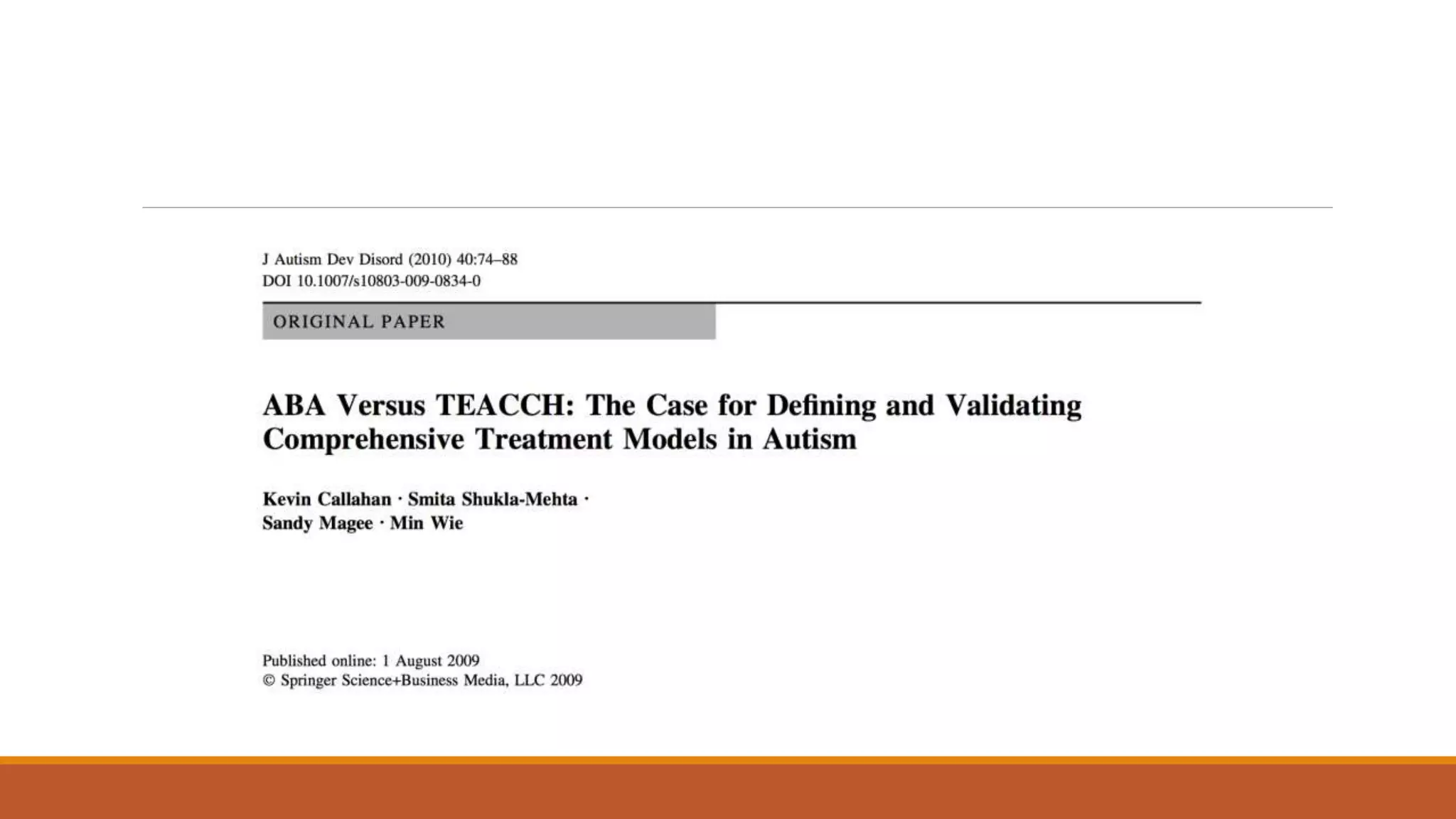
Consumers of autism services indicated strong, consistent support for specific treatment
components falling within five key functional areas of a comprehensive public school intervention
model, known by the acronym IDEAL: (a) Individualized programming (n = 16), (b) Data collection
(n = 8), (c) the use of Empirically demonstrated strategies (n = 38), (d) Active collaboration (n =
15), and (e) a focus on Long-term outcomes (n = 7).
The research team :
1. two university faculty members who teach doctoral and master’s level courses focusing on
autism intervention
2. two doctoral students in an autism leadership and research program (these students had
either participated in Basic Certification in Behavior Analysis (BCBA) or TEACCH- sponsored
training) and a BCBA-qualified doctoral level student.
RESULTS
Teachers who teach a mix of students including autism as well as other exceptionality categories
tended to rate the TEACCH items higher.
Respondents who reported lower levels of autism training generally rated the ABA items lower;
similarly, persons with less self-reported knowledge of autism rated ABA interventions as less
socially valid.
The severity and functioning levels of the respondents’ children with autism also had no
significant effect on ratings.
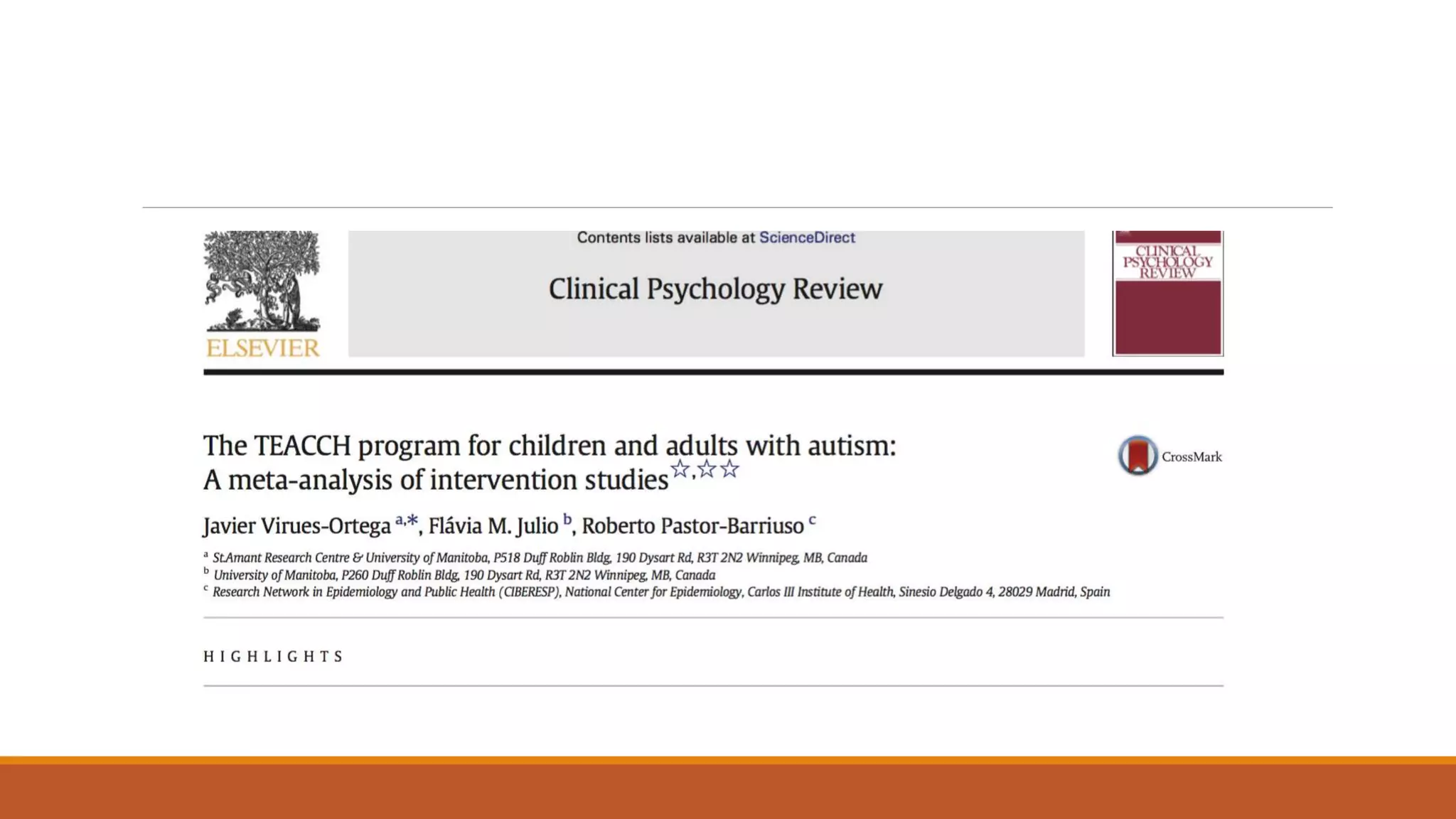
A total of 13 studies were selected for meta-analysis totaling 172 individuals with autism
exposed to TEACCH. Standardized measures of perceptual, motor, adaptive, verbal and cognitive
skills were identified as treatment outcomes.
Effects over adaptive behavioral repertoires including communication, activities of daily living,
and motor functioning were within the negligible to small range. There were moderate to large
gains in social behavior and maladaptive behavior.
None of the individuals in the control groups received TEACCH for the duration of each of the
studies. Control groups attended mainstream schools with special education support or received
some form of specialized eclectic treatment for autism .
The standardized assessments included the Vineland Adaptive Behavior Scale for the outcomes:
activities of daily living, motor functioning, social repertoire, maladaptive behavior, and VABS
summary index.
The Psychoeducational Profile informed perception, cognitive functioning, communication skills,
language skills, eye–hand co- ordination, fine motor skills, gross motor skills, imitation,
developmental age, and PEP summary index.
RESULT
(a) TEACCH effects over perceptual, motor, verbal and cognitive skills may be of small
magnitude;
(b) effects over adaptive behavioral repertoires including communication, and activities of daily
living may be within the negligible to small range;
(c) effects over social behavior and mal- adaptive behavior may be moderate to large;
(d) the evidence base currently available does not allow to identify specific characteristics of the
intervention (duration, intensity, and setting) and the target population (developmental age)
that could be driving the magnitude of effects; and
(e) effects are replicated across age groups, although the magnitude and consistency of
intervention effects are greater among school-age children and adults.
TEACCH.pptx
TEACCH.pptx

TEACCH.pptx

  • 1.
  • 3.
    TEACCH : Treatmentand Education of Autistic and Communication related handicapped CHildren. Focuses on structured instruction that is used: • to make environment predictable •To help child understand the environment •To function feeling safe
  • 4.
    HISTORY oclinical, training, andresearch program based at the University of North Carolina . odeveloped by Drs. Eric Schopler and Robert Reichler in the 1960s, was established as a statewide program by the North Carolina legislature in 1972 The TEACCH approach is called ‘‘Structured Teaching.’’ Structured Teaching is based on evidence and observation that individuals with autism share a pattern of neuropsychological deficits and strengths.
  • 5.
    PRIORITIES ofocusing on theperson, their skills, interests and needs o understanding and identifying differences based on individualised assessments o using visual structures to organise the environment and tasks when teaching skills o being broad-based, ie support people at work, teach skills but also ensure that people are supported during leisure and/or social activities o being flexible and teaching flexibility
  • 6.
    This framework includes: 1.Physical organization 2. Individualized schedules 3. Work (Activity) systems 4. Visual structure of materials in tasks and activities
  • 7.
    STRUCTURED TEACHING INCLUDES (a)structuring the environment and activities in ways that are understandable to the individual; (b) using individuals’ relative strengths in visual skills and interest in visual details to supplement relatively weaker skills; (c) using individuals’ special interests to engage them in learning; (d) supporting self-initiated use of meaningful communication
  • 8.
    Structure : The firstis physical structure; examples are (a) using elements such as furniture arrangement or visual cues that show a student/client which activities occur in specific areas and where to stand or sit in the area, and (b) reducing environmental sources of distraction or overstimulation by seating a student facing away from a door or window. The second type of structure involves organizing and communicating the sequence of events of the day by making this organization (i.e. a schedule) understandable and meaningful to the student/client. The most basic type of ‘schedule’ uses objects to help the student make the transition to the next activity (e.g., actual facecloth to be used in the bath; actual spoon to be used for the snack).
  • 9.
    The third kindof structure is the organization of individual tasks using visual means to show the student/client the following information: (a) What he is supposed to do, (b) How long the activity will last or how many repetitions he will do, (c) How he can see that he is making progress toward being finished, The fourth kind of structure is linking individual tasks into a sequence of activities, called the work/activity system, in order to increase the amount of time that the individual is meaningfully engaged in productive activities.
  • 10.
    It relies stronglyon using visual information to promote engagement in productive activities and to reduce the confusion and distress that can be caused when too much language processing is required. To use clients’ special interests to reward successful completion of tasks. It considers that receptive understanding is the foundation for expressive use of communication.
  • 12.
    Consumers of autismservices indicated strong, consistent support for specific treatment components falling within five key functional areas of a comprehensive public school intervention model, known by the acronym IDEAL: (a) Individualized programming (n = 16), (b) Data collection (n = 8), (c) the use of Empirically demonstrated strategies (n = 38), (d) Active collaboration (n = 15), and (e) a focus on Long-term outcomes (n = 7). The research team : 1. two university faculty members who teach doctoral and master’s level courses focusing on autism intervention 2. two doctoral students in an autism leadership and research program (these students had either participated in Basic Certification in Behavior Analysis (BCBA) or TEACCH- sponsored training) and a BCBA-qualified doctoral level student.
  • 13.
    RESULTS Teachers who teacha mix of students including autism as well as other exceptionality categories tended to rate the TEACCH items higher. Respondents who reported lower levels of autism training generally rated the ABA items lower; similarly, persons with less self-reported knowledge of autism rated ABA interventions as less socially valid. The severity and functioning levels of the respondents’ children with autism also had no significant effect on ratings.
  • 15.
    A total of13 studies were selected for meta-analysis totaling 172 individuals with autism exposed to TEACCH. Standardized measures of perceptual, motor, adaptive, verbal and cognitive skills were identified as treatment outcomes. Effects over adaptive behavioral repertoires including communication, activities of daily living, and motor functioning were within the negligible to small range. There were moderate to large gains in social behavior and maladaptive behavior.
  • 17.
    None of theindividuals in the control groups received TEACCH for the duration of each of the studies. Control groups attended mainstream schools with special education support or received some form of specialized eclectic treatment for autism . The standardized assessments included the Vineland Adaptive Behavior Scale for the outcomes: activities of daily living, motor functioning, social repertoire, maladaptive behavior, and VABS summary index. The Psychoeducational Profile informed perception, cognitive functioning, communication skills, language skills, eye–hand co- ordination, fine motor skills, gross motor skills, imitation, developmental age, and PEP summary index.
  • 18.
    RESULT (a) TEACCH effectsover perceptual, motor, verbal and cognitive skills may be of small magnitude; (b) effects over adaptive behavioral repertoires including communication, and activities of daily living may be within the negligible to small range; (c) effects over social behavior and mal- adaptive behavior may be moderate to large; (d) the evidence base currently available does not allow to identify specific characteristics of the intervention (duration, intensity, and setting) and the target population (developmental age) that could be driving the magnitude of effects; and (e) effects are replicated across age groups, although the magnitude and consistency of intervention effects are greater among school-age children and adults.