ARTIFICIAL INTELLIGENCE (AI) AND
MACHINE LEARNING IN 6G WIRELESS
NETWORKS
BENJAMIN NEWTON TETTEY KWAO
2526500099
INTRODUCTION – WHY AI IS IMPORTANT
FOR 6G
• 6G wireless networks are expected to deliver terabit-per-second (Tbps) data
rates, ultra-low latency (<1 ms), and massive connectivity for IoT devices,
smart cities, and autonomous systems (Letaief et al., 2019; Saad et al.,
2020).
• However, the high complexity of future networks, including dense
deployments and mmWave/THz communication, makes traditional network
management approaches insufficient (Zhang et al., 2019).
• Therefore, Artificial Intelligence (AI) is essential to enable real-time
decision-making and automation, allowing 6G networks to become self-
optimizing and self-healing (Saad et al., 2020).
OVERVIEW OF AI & MACHINE LEARNING IN
NETWORKS
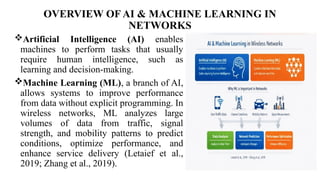
Artificial Intelligence (AI) enables
machines to perform tasks that usually
require human intelligence, such as
learning and decision-making.
Machine Learning (ML), a branch of AI,
allows systems to improve performance
from data without explicit programming. In
wireless networks, ML analyzes large
volumes of data from traffic, signal
strength, and mobility patterns to predict
conditions, optimize performance, and
enhance service delivery (Letaief et al.,
2019; Zhang et al., 2019).
TYPES OF MACHINE LEARNING
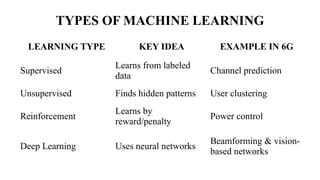
LEARNING TYPE KEY IDEA EXAMPLE IN 6G
Supervised
Learns from labeled
data
Channel prediction
Unsupervised Finds hidden patterns User clustering
Reinforcement
Learns by
reward/penalty
Power control
Deep Learning Uses neural networks
Beamforming & vision-
based networks
SUPERVISED LEARNING
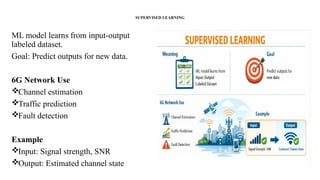
ML model learns from input-output
labeled dataset.
Goal: Predict outputs for new data.
6G Network Use
Channel estimation
Traffic prediction
Fault detection
Example
Input: Signal strength, SNR
Output: Estimated channel state
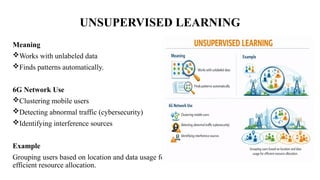
UNSUPERVISED LEARNING
Meaning
Works with unlabeled data
Finds patterns automatically.
6G Network Use
Clustering mobile users
Detecting abnormal traffic (cybersecurity)
Identifying interference sources
Example
Grouping users based on location and data usage for
efficient resource allocation.
REINFORCEMENT LEARNING (RL)
Meaning
RL is a type of machine learning where an agent learns by interacting with its environment.
The agent takes actions, observes outcomes, and receives rewards or penalties to improve future decisions.
Core Components
State: Current situation of the environment.
Action: Decision or move made by the agent.
Reward: Feedback signal indicating success or failure of an action.
6G Network Applications
Dynamic Spectrum Sharing: Efficiently allocate frequency bands among users.
Power Allocation: Optimize energy use across network nodes.
Handover Optimization: Decide the best time to switch a user from one base station to another.
Edge Computing Scheduling: Assign tasks to edge servers for low-latency processing.
Key Advantage
Adapts in real-time and handles dynamic, changing network environments effectively.
DEEP LEARNING (DL)
Meaning
Uses multi-layer neural networks.
Suitable for complex data (signals, images, massive MIMO) (Zhang et al., 2024).
6G Applications
Beamforming optimization
Channel estimation at mmWave/THz
Intelligent reflecting surface (IRS) control
Signal classification
Why it matters
Handles large-scale data and high-dimensional networks.
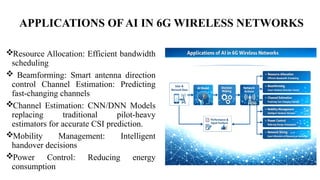
APPLICATIONS OF AI IN 6G WIRELESS NETWORKS
Resource Allocation: Efficient bandwidth
scheduling
 Beamforming: Smart antenna direction
control Channel Estimation: Predicting
fast-changing channels
Channel Estimation: CNN/DNN Models
replacing traditional pilot-heavy
estimators for accurate CSI prediction.
Mobility Management: Intelligent
handover decisions
Power Control: Reducing energy
consumption
BENEFITS OF AI IN 6G
Performance Benefits
Higher throughput and spectral efficiency
Lower latency and better QoS
Improved user experience
Operational Benefits
Self-organizing networks (SON)
Automatic fault detection and healing
Reduced network cost and human intervention
Energy Benefits
AI optimizes energy use for green 6G communication.
CHALLENGES AND LIMITATIONS OF AI IN 6G
Data Privacy and Security Issues: Collection and processing of large amounts of user
and network data can expose sensitive information to unauthorized access or breaches.
High Computation Cost: Advanced AI models, especially deep learning algorithms,
require significant computational resources, which can be costly and difficult to
deploy on edge devices.
Need for Large Datasets: AI models perform best with extensive and diverse datasets,
but gathering and labeling such data in 6G networks is challenging.
AI Model Risks
Deployment Challenges in Real-Time Systems
Lack of Standardized AI Frameworks for 6G: There is currently no unified framework
or standard for AI integration across different 6G network layers, leading to
interoperability and consistency issues.
CONCLUSION
6G networks will be highly complex and dynamic,
requiring intelligent management and optimization.
Artificial Intelligence (AI) is essential for automation, real-
time optimization, and efficient resource allocation.
By integrating AI, 6G will enable advanced applications
such as holographic communication, smart cities, and
autonomous systems, making future networks more
intelligent, efficient, and adaptive.
REFERENCES
Letaief, K. B., Chen, W., Shi, Y., Zhang, J., & Zhang, Y. (2019). Toward
intelligent and reconfigurable wireless networks: A survey on artificial
intelligence for 5G and beyond. IEEE Communications Magazine, 57(1), 84–
90.
Saad, W., Bennis, M., & Chen, M. (2020). A vision of 6G wireless systems:
Applications, trends, technologies, and open research problems. IEEE
Network, 34(3), 134–142.
Zhang, J., et al. (2019). AI-enabled wireless networks: Challenges,
opportunities, and solutions. IEEE Network, 33(6), 214–221.
Zhang, H., et al. (2024). Deep learning for 6G wireless communications:
Techniques, applications, and challenges. IEEE Wireless Communications,
31(1), 162–169.

EMERGING TECHNOLOGY PRESENTATION NOTES .pptx

  • 1.
    ARTIFICIAL INTELLIGENCE (AI)AND MACHINE LEARNING IN 6G WIRELESS NETWORKS BENJAMIN NEWTON TETTEY KWAO 2526500099
  • 2.
    INTRODUCTION – WHYAI IS IMPORTANT FOR 6G • 6G wireless networks are expected to deliver terabit-per-second (Tbps) data rates, ultra-low latency (<1 ms), and massive connectivity for IoT devices, smart cities, and autonomous systems (Letaief et al., 2019; Saad et al., 2020). • However, the high complexity of future networks, including dense deployments and mmWave/THz communication, makes traditional network management approaches insufficient (Zhang et al., 2019). • Therefore, Artificial Intelligence (AI) is essential to enable real-time decision-making and automation, allowing 6G networks to become self- optimizing and self-healing (Saad et al., 2020).
  • 3.
    OVERVIEW OF AI& MACHINE LEARNING IN NETWORKS Artificial Intelligence (AI) enables machines to perform tasks that usually require human intelligence, such as learning and decision-making. Machine Learning (ML), a branch of AI, allows systems to improve performance from data without explicit programming. In wireless networks, ML analyzes large volumes of data from traffic, signal strength, and mobility patterns to predict conditions, optimize performance, and enhance service delivery (Letaief et al., 2019; Zhang et al., 2019).
  • 4.
    TYPES OF MACHINELEARNING LEARNING TYPE KEY IDEA EXAMPLE IN 6G Supervised Learns from labeled data Channel prediction Unsupervised Finds hidden patterns User clustering Reinforcement Learns by reward/penalty Power control Deep Learning Uses neural networks Beamforming & vision- based networks
  • 5.
    SUPERVISED LEARNING ML modellearns from input-output labeled dataset. Goal: Predict outputs for new data. 6G Network Use Channel estimation Traffic prediction Fault detection Example Input: Signal strength, SNR Output: Estimated channel state
  • 6.
    UNSUPERVISED LEARNING Meaning Works withunlabeled data Finds patterns automatically. 6G Network Use Clustering mobile users Detecting abnormal traffic (cybersecurity) Identifying interference sources Example Grouping users based on location and data usage for efficient resource allocation.
  • 7.
    REINFORCEMENT LEARNING (RL) Meaning RLis a type of machine learning where an agent learns by interacting with its environment. The agent takes actions, observes outcomes, and receives rewards or penalties to improve future decisions. Core Components State: Current situation of the environment. Action: Decision or move made by the agent. Reward: Feedback signal indicating success or failure of an action. 6G Network Applications Dynamic Spectrum Sharing: Efficiently allocate frequency bands among users. Power Allocation: Optimize energy use across network nodes. Handover Optimization: Decide the best time to switch a user from one base station to another. Edge Computing Scheduling: Assign tasks to edge servers for low-latency processing. Key Advantage Adapts in real-time and handles dynamic, changing network environments effectively.
  • 8.
    DEEP LEARNING (DL) Meaning Usesmulti-layer neural networks. Suitable for complex data (signals, images, massive MIMO) (Zhang et al., 2024). 6G Applications Beamforming optimization Channel estimation at mmWave/THz Intelligent reflecting surface (IRS) control Signal classification Why it matters Handles large-scale data and high-dimensional networks.
  • 9.
    APPLICATIONS OF AIIN 6G WIRELESS NETWORKS Resource Allocation: Efficient bandwidth scheduling  Beamforming: Smart antenna direction control Channel Estimation: Predicting fast-changing channels Channel Estimation: CNN/DNN Models replacing traditional pilot-heavy estimators for accurate CSI prediction. Mobility Management: Intelligent handover decisions Power Control: Reducing energy consumption
  • 10.
    BENEFITS OF AIIN 6G Performance Benefits Higher throughput and spectral efficiency Lower latency and better QoS Improved user experience Operational Benefits Self-organizing networks (SON) Automatic fault detection and healing Reduced network cost and human intervention Energy Benefits AI optimizes energy use for green 6G communication.
  • 11.
    CHALLENGES AND LIMITATIONSOF AI IN 6G Data Privacy and Security Issues: Collection and processing of large amounts of user and network data can expose sensitive information to unauthorized access or breaches. High Computation Cost: Advanced AI models, especially deep learning algorithms, require significant computational resources, which can be costly and difficult to deploy on edge devices. Need for Large Datasets: AI models perform best with extensive and diverse datasets, but gathering and labeling such data in 6G networks is challenging. AI Model Risks Deployment Challenges in Real-Time Systems Lack of Standardized AI Frameworks for 6G: There is currently no unified framework or standard for AI integration across different 6G network layers, leading to interoperability and consistency issues.
  • 12.
    CONCLUSION 6G networks willbe highly complex and dynamic, requiring intelligent management and optimization. Artificial Intelligence (AI) is essential for automation, real- time optimization, and efficient resource allocation. By integrating AI, 6G will enable advanced applications such as holographic communication, smart cities, and autonomous systems, making future networks more intelligent, efficient, and adaptive.
  • 13.
    REFERENCES Letaief, K. B.,Chen, W., Shi, Y., Zhang, J., & Zhang, Y. (2019). Toward intelligent and reconfigurable wireless networks: A survey on artificial intelligence for 5G and beyond. IEEE Communications Magazine, 57(1), 84– 90. Saad, W., Bennis, M., & Chen, M. (2020). A vision of 6G wireless systems: Applications, trends, technologies, and open research problems. IEEE Network, 34(3), 134–142. Zhang, J., et al. (2019). AI-enabled wireless networks: Challenges, opportunities, and solutions. IEEE Network, 33(6), 214–221. Zhang, H., et al. (2024). Deep learning for 6G wireless communications: Techniques, applications, and challenges. IEEE Wireless Communications, 31(1), 162–169.