Globalcode	–	Open4education
Trilha – Programação Funcional
Roberto Pepato Mellado
Engenheiro de Software
Globalcode	–	Open4education
Haskell 101
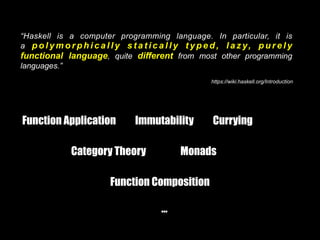
“Haskell is a computer programming language. In particular, it is
a p o l y m o r p h i c a l l y s t a t i c a l l y t y p e d , l a z y, p u r e l y
functional language, quite different from most other programming
languages.”
https://wiki.haskell.org/Introduction
Function Application Immutability Currying
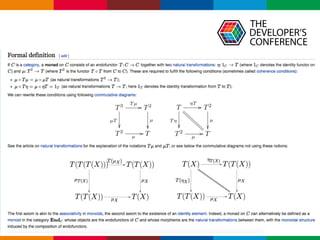
Category Theory Monads
Function Composition
…
Globalcode	–	Open4education
Understandability

Formalism
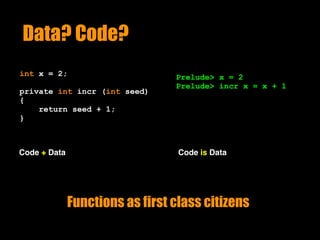
Data? Code?
int x = 2;
private int incr (int seed)
{
return seed + 1;
}
Code + Data
Prelude> x = 2
Prelude> incr x = x + 1
Code is Data
Functions as first class citizens
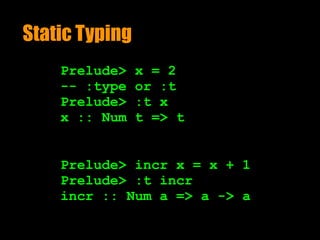
Static Typing
Prelude> x = 2
-- :type or :t 

Prelude> :t x

x :: Num t => t
Prelude> incr x = x + 1
Prelude> :t incr

incr :: Num a => a -> a
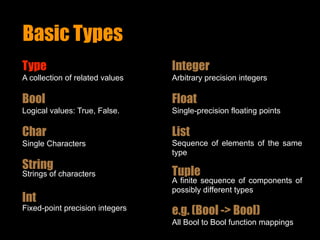
Basic Types
Type
A collection of related values
Bool
Logical values: True, False.
Char
Single Characters
String
Strings of characters
Int
Fixed-point precision integers
Integer
Arbitrary precision integers
Float
Single-precision floating points
List
Sequence of elements of the same
type
Tuple
A finite sequence of components of
possibly different types
e.g. (Bool -> Bool)
All Bool to Bool function mappings
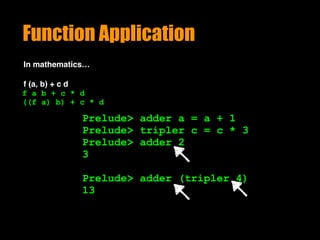
Function Application
In mathematics…
f (a, b) + c d
Prelude> adder a = a + 1
Prelude> tripler c = c * 3
Prelude> adder 2
3
Prelude> adder (tripler 4)
13
f a b + c * d
((f a) b) + c * d
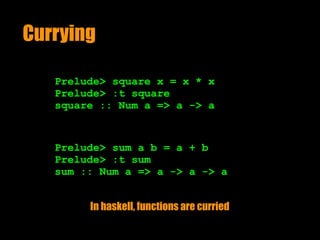
Currying
Prelude> sum a b = a + b
Prelude> :t sum

sum :: Num a => a -> a -> a
Prelude> square x = x * x
Prelude> :t square

square :: Num a => a -> a
In haskell, functions are curried
Currying
Prelude> :t map
map :: (a -> b) -> [a] -> [b]
Prelude> map (+ 1) [1,2,3,4,5]
[2,3,4,5,6]
Prelude> squares = map square
:t squares
squares :: Num b => [b] -> [b]
squares [1,2,3,4,5]
[1,4,9,16,25]
High Order Functions
Prelude> twice f x = f (f x)
Prelude> twice (*2) 3

12
Prelude> twice reverse [1,2,3]
[1,2,3]
Sum of the squares of all even numbers from 1 to 100?
sum: adds items from a list

square: already defined

filter: filter list elements

even: true if a number is even, false otherwise
Prelude> sumsqreven ns = sum(map (square)
(filter even ns))
Prelude> sumsqreven [1..100]
171700
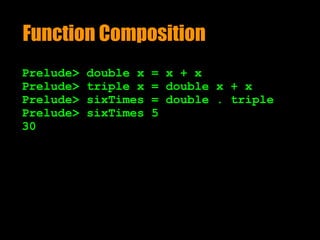
Function Composition
Prelude> double x = x + x
Prelude> triple x = double x + x
Prelude> sixTimes = double . triple
Prelude> sixTimes 5
30
Function Composition
Prelude> fsum = sum . map (square) . filter even
Prelude> [1..100]
[1,2,3,4,5,6,7,…]
Prelude> fsum [1..100]
171700
Prelude> verifyStatus = …
Prelude> checkCredit = …
Prelude> validate = …
Prelude> generateOrder = …
Prelude> sendEmail = …
Prelude> applyTransaction = sendEmail . generateOrder
. validate . checkCredit . verifyStatus
Pattern Matching
Prelude> head [1..10]
1
Prelude> tail [1..10]
[2,3,4,5,6,7,8,9,10]
Prelude> length [] = 0
Prelude> length (_:xs) = 1 + length xs
Prelude> length []
0
Prelude> length [2,2,2,2,2,2,2]
7
Prelude> cabeca (x:xs) = x
1
Prelude> cauda(x:xs) = xs
[2,3,4,5,6,7,8,9,10]
Prelude> cabeca (x:_) = x
Prelude> cauda(_:xs) = xs
Pattern Matching
Prelude> check (403, ip, timestamp) = ip
Prelude> check (_, _, _) = “ok”
Prelude> analyzelog xs = [check x | x <- xs]
Prelude> analyzelog [

(200, “200.251.192.13”, 1467313969905), 

(403, “200.168.175.28”, 1467314005735), 

(500, “201.52.164.78, 1467314029977)
]
“ok”
“200.168.175.28”
“ok”
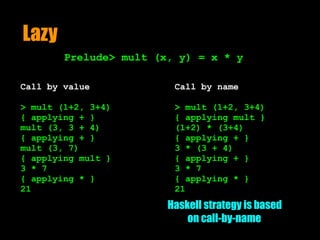
Lazy
Prelude> mult (x, y) = x * y
Call by value
> mult (1+2, 3+4)
{ applying + }
mult (3, 3 + 4)
{ applying + }
mult (3, 7)
{ applying mult }
3 * 7
{ applying * }
21
Call by name
> mult (1+2, 3+4)
{ applying mult }
(1+2) * (3+4)
{ applying + }
3 * (3 + 4)
{ applying + }
3 * 7
{ applying * }
21
Haskell strategy is based
on call-by-name
Lazy
Prelude> list = 1 : 2 : []
[1,2]
Call by value
> head ones
{ applying ones }
head (1 : ones)

{ applying ones }
head (1 : (1 : ones))

{ applying ones }
.
.
.
> ones = 1 : ones
> ones
{ applying ones }
1 : ones
{ applying ones }
1 : (1 : ones )
{ applying ones }
1 : (1 : (1 : ones))
[1, 1, 1, 1, 1, 1, 1, 1, 1…]
Lazy
Prelude> list = 1 : 2 : []
> ones = 1 : ones
> ones
{ applying ones }
1 : ones
{ applying ones }
1 : (1 : ones )
{ applying ones }
1 : (1 : (1 : ones))
[1, 1, 1, 1, 1, 1, 1, 1, 1…]
Call by name
> head ones
{ applying ones }
head (1 : ones)

{ applying head }
1
Immutability
> combine a b = a ++ b
> combine [1,2,3] [4]
[1,2,3,4]
> let x = [1,2,3]
> combine x [4]
[1,2,3,4]

> x
[1,2,3]

> drop 1 x
[2,3]

> x
[1,2,3]
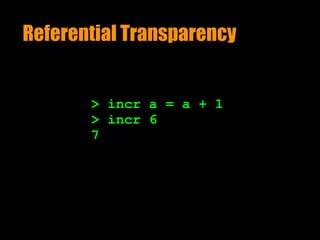
Referential Transparency
> incr a = a + 1
> incr 6
7
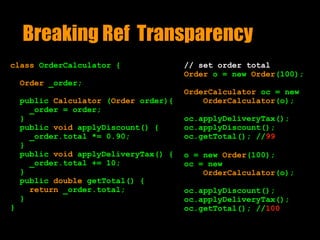
Breaking Ref Transparency
class OrderCalculator {
Order _order;
public Calculator (Order order){

_order = order;
}
public void applyDiscount() {

_order.total *= 0.90;
}
public void applyDeliveryTax() {
_order.total += 10;
}
public double getTotal() {
return _order.total;
}
}
// set order total
Order o = new Order(100);
OrderCalculator oc = new
OrderCalculator(o);
oc.applyDeliveryTax();
oc.applyDiscount();
oc.getTotal(); //99
o = new Order(100);
oc = new
OrderCalculator(o);
oc.applyDiscount();
oc.applyDeliveryTax();
oc.getTotal(); //100
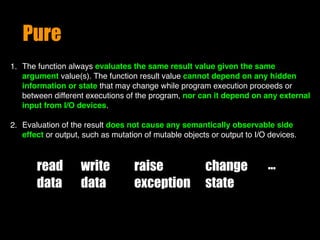
Pure
1. The function always evaluates the same result value given the same
argument value(s). The function result value cannot depend on any hidden
information or state that may change while program execution proceeds or
between different executions of the program, nor can it depend on any external
input from I/O devices.

2. Evaluation of the result does not cause any semantically observable side
effect or output, such as mutation of mutable objects or output to I/O devices.
read
data
write
data
raise
exception
change
state
…
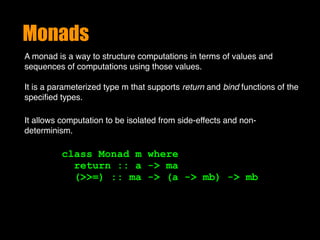
Monads
A monad is a way to structure computations in terms of values and
sequences of computations using those values.

It is a parameterized type m that supports return and bind functions of the
specified types.
class Monad m where

return :: a -> ma

(>>=) :: ma -> (a -> mb) -> mb
It allows computation to be isolated from side-effects and non-
determinism.
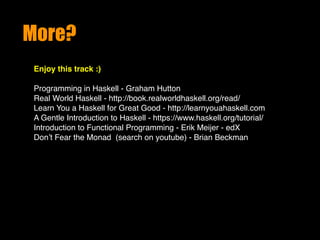
More?
Enjoy this track :)
Programming in Haskell - Graham Hutton
Real World Haskell - http://book.realworldhaskell.org/read/
Learn You a Haskell for Great Good - http://learnyouahaskell.com
A Gentle Introduction to Haskell - https://www.haskell.org/tutorial/

Introduction to Functional Programming - Erik Meijer - edX
Don’t Fear the Monad (search on youtube) - Brian Beckman
Globalcode	–	Open4education
Thanks!
http://www.slideshare.net/rpepato
@rpepato

TDC2016SP - Trilha Programação Funcional

  • 1.
    Globalcode – Open4education Trilha – ProgramaçãoFuncional Roberto Pepato Mellado Engenheiro de Software
  • 2.
  • 3.
    “Haskell is acomputer programming language. In particular, it is a p o l y m o r p h i c a l l y s t a t i c a l l y t y p e d , l a z y, p u r e l y functional language, quite different from most other programming languages.” https://wiki.haskell.org/Introduction Function Application Immutability Currying Category Theory Monads Function Composition …
  • 4.
  • 5.
  • 6.
    Data? Code? int x= 2; private int incr (int seed) { return seed + 1; } Code + Data Prelude> x = 2 Prelude> incr x = x + 1 Code is Data Functions as first class citizens
  • 7.
    Static Typing Prelude> x= 2 -- :type or :t 
 Prelude> :t x
 x :: Num t => t Prelude> incr x = x + 1 Prelude> :t incr
 incr :: Num a => a -> a
  • 8.
    Basic Types Type A collectionof related values Bool Logical values: True, False. Char Single Characters String Strings of characters Int Fixed-point precision integers Integer Arbitrary precision integers Float Single-precision floating points List Sequence of elements of the same type Tuple A finite sequence of components of possibly different types e.g. (Bool -> Bool) All Bool to Bool function mappings
  • 9.
    Function Application In mathematics… f(a, b) + c d Prelude> adder a = a + 1 Prelude> tripler c = c * 3 Prelude> adder 2 3 Prelude> adder (tripler 4) 13 f a b + c * d ((f a) b) + c * d
  • 10.
    Currying Prelude> sum ab = a + b Prelude> :t sum
 sum :: Num a => a -> a -> a Prelude> square x = x * x Prelude> :t square
 square :: Num a => a -> a In haskell, functions are curried
  • 11.
    Currying Prelude> :t map map:: (a -> b) -> [a] -> [b] Prelude> map (+ 1) [1,2,3,4,5] [2,3,4,5,6] Prelude> squares = map square :t squares squares :: Num b => [b] -> [b] squares [1,2,3,4,5] [1,4,9,16,25]
  • 12.
    High Order Functions Prelude>twice f x = f (f x) Prelude> twice (*2) 3
 12 Prelude> twice reverse [1,2,3] [1,2,3] Sum of the squares of all even numbers from 1 to 100? sum: adds items from a list
 square: already defined
 filter: filter list elements
 even: true if a number is even, false otherwise Prelude> sumsqreven ns = sum(map (square) (filter even ns)) Prelude> sumsqreven [1..100] 171700
  • 13.
    Function Composition Prelude> doublex = x + x Prelude> triple x = double x + x Prelude> sixTimes = double . triple Prelude> sixTimes 5 30
  • 14.
    Function Composition Prelude> fsum= sum . map (square) . filter even Prelude> [1..100] [1,2,3,4,5,6,7,…] Prelude> fsum [1..100] 171700 Prelude> verifyStatus = … Prelude> checkCredit = … Prelude> validate = … Prelude> generateOrder = … Prelude> sendEmail = … Prelude> applyTransaction = sendEmail . generateOrder . validate . checkCredit . verifyStatus
  • 15.
    Pattern Matching Prelude> head[1..10] 1 Prelude> tail [1..10] [2,3,4,5,6,7,8,9,10] Prelude> length [] = 0 Prelude> length (_:xs) = 1 + length xs Prelude> length [] 0 Prelude> length [2,2,2,2,2,2,2] 7 Prelude> cabeca (x:xs) = x 1 Prelude> cauda(x:xs) = xs [2,3,4,5,6,7,8,9,10] Prelude> cabeca (x:_) = x Prelude> cauda(_:xs) = xs
  • 16.
    Pattern Matching Prelude> check(403, ip, timestamp) = ip Prelude> check (_, _, _) = “ok” Prelude> analyzelog xs = [check x | x <- xs] Prelude> analyzelog [
 (200, “200.251.192.13”, 1467313969905), 
 (403, “200.168.175.28”, 1467314005735), 
 (500, “201.52.164.78, 1467314029977) ] “ok” “200.168.175.28” “ok”
  • 17.
    Lazy Prelude> mult (x,y) = x * y Call by value > mult (1+2, 3+4) { applying + } mult (3, 3 + 4) { applying + } mult (3, 7) { applying mult } 3 * 7 { applying * } 21 Call by name > mult (1+2, 3+4) { applying mult } (1+2) * (3+4) { applying + } 3 * (3 + 4) { applying + } 3 * 7 { applying * } 21 Haskell strategy is based on call-by-name
  • 18.
    Lazy Prelude> list =1 : 2 : [] [1,2] Call by value > head ones { applying ones } head (1 : ones)
 { applying ones } head (1 : (1 : ones))
 { applying ones } . . . > ones = 1 : ones > ones { applying ones } 1 : ones { applying ones } 1 : (1 : ones ) { applying ones } 1 : (1 : (1 : ones)) [1, 1, 1, 1, 1, 1, 1, 1, 1…]
  • 19.
    Lazy Prelude> list =1 : 2 : [] > ones = 1 : ones > ones { applying ones } 1 : ones { applying ones } 1 : (1 : ones ) { applying ones } 1 : (1 : (1 : ones)) [1, 1, 1, 1, 1, 1, 1, 1, 1…] Call by name > head ones { applying ones } head (1 : ones)
 { applying head } 1
  • 20.
    Immutability > combine ab = a ++ b > combine [1,2,3] [4] [1,2,3,4] > let x = [1,2,3] > combine x [4] [1,2,3,4]
 > x [1,2,3]
 > drop 1 x [2,3]
 > x [1,2,3]
  • 21.
    Referential Transparency > incra = a + 1 > incr 6 7
  • 22.
    Breaking Ref Transparency classOrderCalculator { Order _order; public Calculator (Order order){
 _order = order; } public void applyDiscount() {
 _order.total *= 0.90; } public void applyDeliveryTax() { _order.total += 10; } public double getTotal() { return _order.total; } } // set order total Order o = new Order(100); OrderCalculator oc = new OrderCalculator(o); oc.applyDeliveryTax(); oc.applyDiscount(); oc.getTotal(); //99 o = new Order(100); oc = new OrderCalculator(o); oc.applyDiscount(); oc.applyDeliveryTax(); oc.getTotal(); //100
  • 23.
    Pure 1. The functionalways evaluates the same result value given the same argument value(s). The function result value cannot depend on any hidden information or state that may change while program execution proceeds or between different executions of the program, nor can it depend on any external input from I/O devices.
 2. Evaluation of the result does not cause any semantically observable side effect or output, such as mutation of mutable objects or output to I/O devices. read data write data raise exception change state …
  • 24.
    Monads A monad isa way to structure computations in terms of values and sequences of computations using those values.
 It is a parameterized type m that supports return and bind functions of the specified types. class Monad m where
 return :: a -> ma
 (>>=) :: ma -> (a -> mb) -> mb It allows computation to be isolated from side-effects and non- determinism.
  • 25.
    More? Enjoy this track:) Programming in Haskell - Graham Hutton Real World Haskell - http://book.realworldhaskell.org/read/ Learn You a Haskell for Great Good - http://learnyouahaskell.com A Gentle Introduction to Haskell - https://www.haskell.org/tutorial/
 Introduction to Functional Programming - Erik Meijer - edX Don’t Fear the Monad (search on youtube) - Brian Beckman
  • 26.