S
TIVA and TCI
Dr Jim Hoyle FRCA FFICM
Consultant in Neuroanaesthesia and Neuro Critical Care
1A02
Objectives
1. Benefits and priniciples of TIVA 1A02
2. Pharmacokinetics
3. Manual vs. TCI TIVA
4. Schnider vs. Marsh
5. Weight
6. Future improvements
S
Why TIVA
Benefits of TIVA
S Rapid recovery of consciousnessand psychomotorfunction
S Earlierrecovery and dischargefrom PACU
S Use with neurophysiological monitoring
S Anti-emetic benefits
S No adverse effects on theatre personnel or the environment
S No Malignant Hyperthermia
S PreservesHypoxic Pulmonary Vasoconstriction
S
TIVA principles
TIVA anaesthesia requirements:
S Rapidly achieve an appropriateblood and brain concentration
of Propofol
S Maintain that concentration of Propofol
S Adjust the level as required
S Can use manual or automated infusions
S How achieved requiressome knowledge of Propofol
pharmacokinetics
S
Pharmacokinetics
S
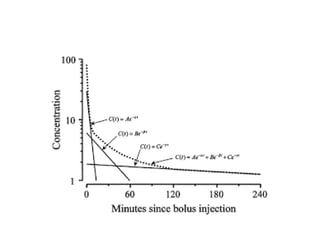
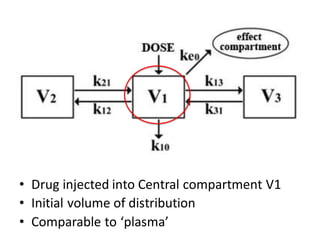
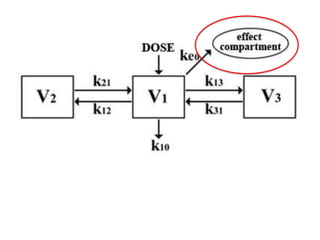
3 Compartment Model
• Drug injected into Central compartment V1
• Initial volume of distribution
• Comparable to ‘plasma’
• Redistribution into second compartment (V2)
• “vessel-rich” or “fast”
• Redistribution into third compartment (V3)
• “vessel-poor” or “slow”
• Governed by rate constant/ concentration
gradient
• Exponentialprocess
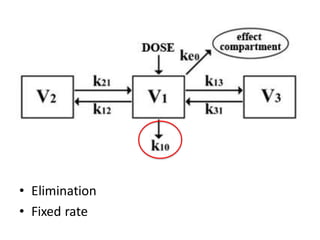
• Elimination
• Fixed rate
Achieving a constant plasma
level
S Initial bolus quite easy to calculate
= Concentration x Volume of distribution (V1)
S Maintenance infusion rate more difficult
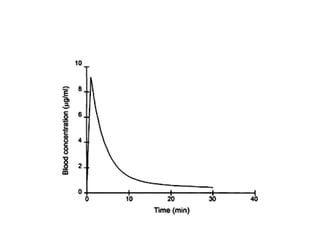
S Has to match rate of decline of plasma Propofol level
S Initially high rate due to rapid redistribution
S Reduces over time as V2 & V3 fill up
S Ultimately just matches elimination
Manual infusions
S Fixedrate infusions take 5 half-lives to reach steady state -
up to 24 hours for Propofol
Bristol regime
3 mcg/ml
But:
S Changes to infusion rate will not lead to changes in blood
concentration for some time
S Manual boluses have to be given to rapidly change depth
S Size of bolus has to be ‘guestimated’
S May result in excessiveside effects or awareness
S TCI systems automate the whole process
TCI
S Target Controlled Infusions
S Multi-compartment pharmacokinetic modelsused to
calculateinfusion rate required to achieve the target
concentration.
S “open-loop”systems
S Comprisedof a user interface,a microprocessorand an
infusion device
Alaris Asena® PK (Alaris
Medical Systems)
Base Primea (Fresenius)
How does it work?
S Models have sizes and rate constants for the various
compartmentsprogrammedin
S Allows pump to calculaterate of Propofol redistribution and
eliminationat a given time
S Initial bolus to achieve rapid rise in plasma level
S 3 superimposedinfusion rates to match the rate at which drug is
being removed from the central compartment
How does it work?
S If user wishes to increase the plasmalevel then pump will
calculateand give a bolus
S If user wishes to decreasethe level then the pump will stop
and allow the level to fall before restarting
S
Plasma vs Effect site
Targeting
S The clinicaleffect of Propofol is related to brain
concentration = effect site
S With plasma targeting there is a lag between achieving the
plasma level and the brain level catching up
S Therefore lag in induction and lag in changing depth of
anaesthesia
Equilibriumbetween blood and effect-site depends on several
factors:
• Rate of drug delivery to effect-site
• Pharmacologicalpropertiesof the drug
• Mathematicallydescribed by Keo time constant
• Concentration gradient
Only factor we can control is concentration gradient
Time to peak effect (TTPE)
S After a bolus, maximumeffect-site concentration occurs at
the point where the blood and effect-site concentration
curves cross
Time to peak effect (TTPE)
S After a bolus, maximumeffect-site concentration occurs at
the point where the blood and effect-site concentration
curves cross.
S Time delay between bolus and this point is known as the
“time to peak effect” TTPE
S Independent of size of bolus
S Propofol TTPE is 1.6 minutes
Time to peak effect (TTPE)
S By knowing the Keo and TTPE it is possible to ‘target’ the effect-
site concentration
Nomenclatureof TCI:
Ce = Effect site concentration
Cp = Plasma concentration
t suffix = ‘Target’ Cet / Cpt
Effect Site Targeting
S System manipulatesthe blood concentration to achieve the
effect-site target as quickly as possible
S “over-pressures”blood concentration to produce gradient
that results in fastest rise in effect-site level yet preventing
any overshoot
S Faster induction; faster changesin depth of anaesthesia
Which to use ?
S No evidence that one method better than the other
S I would suggest that effect-site TCI is easier to use and closer to
drug physiology
S When using plasmatargeting,be aware of the lag and
‘overpressure’as required
S With effect-site targeting,biggerbolus given per dose increase
which may effect haemodynamics
S
Manual or TCI?
Evidence for Manual vs. TCI
Cochrane review in 2008
S Looked at results of 20 poor quality trials
S 1759 patients
S No significant difference in quality of anaesthesia or
adverse outcomes
S Couldn’t recommendone over the other
S
Propofol TCI Models
Marsh vs. Schnider
2 availablemodelsfor Propofol TCI in adults:
S Marsh
S Schnider
Marsh Model
S Published in 1991
S Model employedin the original Diprifusor®
S Based on study of 3 groups of 6 patients
S Detaileddemographicsnever published
S Weight is only variable
S Effects size of V1, V2 & V3
S Age entered but has no effect on model
S Unless < 16 in which case pump wont run
Marsh Model
S A ‘modified’ Marsh model was published by Struys et al in
2000
S This uses a faster Keo
S Results in less overshoot and undershoot when using Marsh
effect-site targeting
S Model used in modern TCI systems
S But PK pumps only allow plasma targeting
Schnider Model
S Published in 1998
S Based on 24 volunteers (11 women, 13 men)
S Uses age,height, weight, age and gender
S V1 fixed - 4.27 L
S V3 fixed - 238 L
S V2 variable of age
S Elimination uses weight, height & LBM
S Uses a TTPE of 1.6 minutes and calculates a Keo for each
individual patient
70 kg man Marsh Schnider
V1 15.9L 4.27L (f)
V2 32.4L 24.0L
V3 202L 238L (f)
K10 0.119 (f) 0.384
K12 0.112 (f) 0.375
K13 0.042 (f) 0.196
K21 0.055 (f) 0.067
K31 0.0033 (f) 0.0035
Keo 0.26 (f) 0.456 (f)
TTPE (min) 4.5 (f) 1.69 (f)
S
Main differences
1. Time To Peak Effect
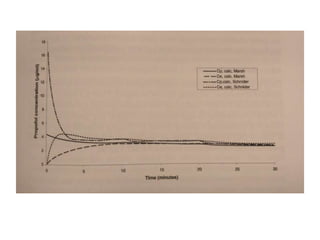
S Schnider model has faster TTPE (1.6 vs 4.5 min)
S Less ‘overshoot’ and ‘undershoot’ with Schnider effect-site
targeting than with Marsh
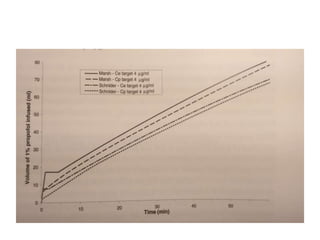
S Net effect is less Propofol administered with Schnider vs.
Marsh in effect-site targeting
S Probably safer in elderly and compromisedpatients
But: PK pumps do not allow Marsh effect-site targeting!!
2. Size of central compartment
S Schnider has fixed V1 (4.27 L)
S Marsh is a function of weight (15.9 L for 70kg)
S Striking differences in estimated plasmaand effect-site
concentrationsin first 10 minutes after the bolus
2. Size of central compartment
One minute after bolus:
S Marsh Cp = 4 mcg/ml Ce = 0.9 mcg/ml
S Schnider Cp= 8.2 mcg/mlCe = 3.6 mcg/ml
S Differences less significant after 10 minutes
S After 30 minutes both estimate the same levels
S Net effect is Schnider administers less Propofol
3. Age
S Well describedage related changes in Propofol PK and PD
S Volume of central compartment reduces with increasingage
S EC50 decreasesby 50% from 25 to 75 years
S Marsh model doesn’t account for age
S Schnider does
Weight
Marsh model
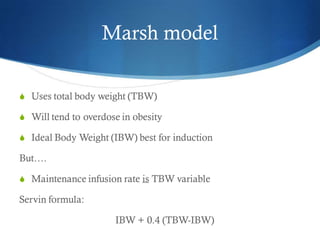
S Uses total body weight (TBW)
S Will tend to overdose in obesity
S Ideal Body Weight (IBW) best for induction
But….
S Maintenance infusion rate is TBW variable
Servin formula:
IBW + 0.4 (TBW-IBW)
Schnider model
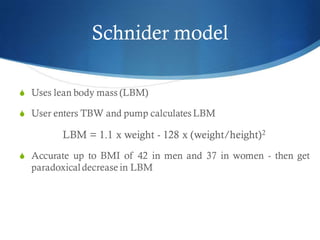
S Uses lean body mass (LBM)
S User enters TBW and pump calculatesLBM
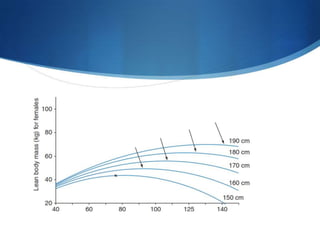
LBM = 1.1 x weight - 128 x (weight/height)2
S Accurate up to BMI of 42 in men and 37 in women - then get
paradoxicaldecrease in LBM
Schnider model
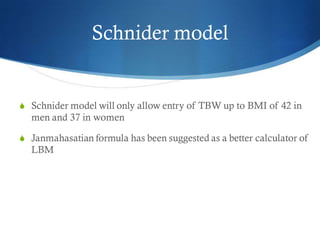
S Schnider model will only allow entry of TBW up to BMI of 42 in
men and 37 in women
S Janmahasatian formula has been suggested as a better calculator of
LBM
Janmahasatian Formula
Male = [9270 x weight (kg)] / [6680+216 x BMI]
Female = [9270 x weight (kg)] / [8780+244 x BMI]
S
Remifentanil
Minto model
S Minto model 1997
S 3 compartment model
S Weight, height, gender and age
S Uses LBM calculated from TBW
S Keo adjusted for age
S Plasma vs Effect site is less of an issue due to rapid equilibrium
between plasma and brain
S Takes less than 5 minutes
S
Reducing the risk of
awareness
Preventing awareness
Awarenessarises because:
S Failure to deliverthe correct amount of the correct drug to
the correct patient at the correct time
S Can be human or equipment failure - or both!
S Certain steps can be taken to minimise the risks
S SALG October 2009:
“Guaranteeing Drug Deliveryin Total Intravenous
Anaesthesia”
Preventing awareness
1. Infusion pumps
S Maintained
S Appropriate alarms
S Deliver the drug how you want to deliver it
S You are competent and trained in their use
2. Drugs
S Correct drug in correct concentration in correct pump
S Appropriate model and dosing selected
Preventing awareness
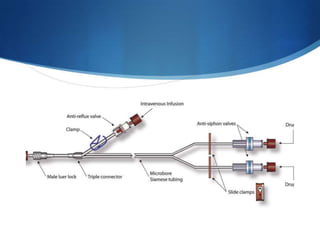
3. Anti-syphon valve on every drug line
4. One way valve on any fluid line administeredwith TIVA
Preventing awareness
3. Anti-syphon valve on every drug line
4. One way valve on any fluid line administeredwith TIVA
5. IV cannula site visible throughout the case and checked at
regular intervals
6. Avoid muscle paralysiswhen possible
7. Use depth of anaesthesia monitoring!
S
The Future….
Improving TCI
1. Closed loop systems
S Depth of anaesthesia monitoring
S End tidal Propofol
S Clinical sensitivity to Propofol
2. Multi-drug models
Summary
1. TIVA rocks
2. Effect-site targeting rocks
3. Use Schnider for effect-site targeting
4. Use Marsh for plasma targeting
5. IBW + ‘a bit’ for Marsh model
6. TBW for Schnider and Minto models
7. Use BIS……
tci-models-for-dummies.pdf

tci-models-for-dummies.pdf

  • 1.
    S TIVA and TCI DrJim Hoyle FRCA FFICM Consultant in Neuroanaesthesia and Neuro Critical Care 1A02
  • 2.
    Objectives 1. Benefits andpriniciples of TIVA 1A02 2. Pharmacokinetics 3. Manual vs. TCI TIVA 4. Schnider vs. Marsh 5. Weight 6. Future improvements
  • 3.
  • 4.
    Benefits of TIVA SRapid recovery of consciousnessand psychomotorfunction S Earlierrecovery and dischargefrom PACU S Use with neurophysiological monitoring S Anti-emetic benefits S No adverse effects on theatre personnel or the environment S No Malignant Hyperthermia S PreservesHypoxic Pulmonary Vasoconstriction
  • 5.
  • 6.
    TIVA anaesthesia requirements: SRapidly achieve an appropriateblood and brain concentration of Propofol S Maintain that concentration of Propofol S Adjust the level as required S Can use manual or automated infusions S How achieved requiressome knowledge of Propofol pharmacokinetics
  • 8.
  • 11.
  • 13.
    • Drug injectedinto Central compartment V1 • Initial volume of distribution • Comparable to ‘plasma’
  • 14.
    • Redistribution intosecond compartment (V2) • “vessel-rich” or “fast”
  • 15.
    • Redistribution intothird compartment (V3) • “vessel-poor” or “slow”
  • 16.
    • Governed byrate constant/ concentration gradient • Exponentialprocess
  • 17.
  • 19.
    Achieving a constantplasma level S Initial bolus quite easy to calculate = Concentration x Volume of distribution (V1) S Maintenance infusion rate more difficult S Has to match rate of decline of plasma Propofol level S Initially high rate due to rapid redistribution S Reduces over time as V2 & V3 fill up S Ultimately just matches elimination
  • 20.
    Manual infusions S Fixedrateinfusions take 5 half-lives to reach steady state - up to 24 hours for Propofol
  • 22.
  • 23.
    But: S Changes toinfusion rate will not lead to changes in blood concentration for some time S Manual boluses have to be given to rapidly change depth S Size of bolus has to be ‘guestimated’ S May result in excessiveside effects or awareness S TCI systems automate the whole process
  • 24.
    TCI S Target ControlledInfusions S Multi-compartment pharmacokinetic modelsused to calculateinfusion rate required to achieve the target concentration. S “open-loop”systems S Comprisedof a user interface,a microprocessorand an infusion device
  • 25.
    Alaris Asena® PK(Alaris Medical Systems) Base Primea (Fresenius)
  • 26.
    How does itwork? S Models have sizes and rate constants for the various compartmentsprogrammedin S Allows pump to calculaterate of Propofol redistribution and eliminationat a given time S Initial bolus to achieve rapid rise in plasma level S 3 superimposedinfusion rates to match the rate at which drug is being removed from the central compartment
  • 27.
    How does itwork? S If user wishes to increase the plasmalevel then pump will calculateand give a bolus S If user wishes to decreasethe level then the pump will stop and allow the level to fall before restarting
  • 32.
    S Plasma vs Effectsite Targeting
  • 33.
    S The clinicaleffectof Propofol is related to brain concentration = effect site S With plasma targeting there is a lag between achieving the plasma level and the brain level catching up S Therefore lag in induction and lag in changing depth of anaesthesia
  • 34.
    Equilibriumbetween blood andeffect-site depends on several factors: • Rate of drug delivery to effect-site • Pharmacologicalpropertiesof the drug • Mathematicallydescribed by Keo time constant • Concentration gradient Only factor we can control is concentration gradient
  • 35.
    Time to peakeffect (TTPE) S After a bolus, maximumeffect-site concentration occurs at the point where the blood and effect-site concentration curves cross
  • 37.
    Time to peakeffect (TTPE) S After a bolus, maximumeffect-site concentration occurs at the point where the blood and effect-site concentration curves cross. S Time delay between bolus and this point is known as the “time to peak effect” TTPE S Independent of size of bolus S Propofol TTPE is 1.6 minutes
  • 38.
    Time to peakeffect (TTPE) S By knowing the Keo and TTPE it is possible to ‘target’ the effect- site concentration Nomenclatureof TCI: Ce = Effect site concentration Cp = Plasma concentration t suffix = ‘Target’ Cet / Cpt
  • 39.
    Effect Site Targeting SSystem manipulatesthe blood concentration to achieve the effect-site target as quickly as possible S “over-pressures”blood concentration to produce gradient that results in fastest rise in effect-site level yet preventing any overshoot S Faster induction; faster changesin depth of anaesthesia
  • 41.
    Which to use? S No evidence that one method better than the other S I would suggest that effect-site TCI is easier to use and closer to drug physiology S When using plasmatargeting,be aware of the lag and ‘overpressure’as required S With effect-site targeting,biggerbolus given per dose increase which may effect haemodynamics
  • 42.
  • 43.
    Evidence for Manualvs. TCI Cochrane review in 2008 S Looked at results of 20 poor quality trials S 1759 patients S No significant difference in quality of anaesthesia or adverse outcomes S Couldn’t recommendone over the other
  • 44.
  • 45.
    2 availablemodelsfor PropofolTCI in adults: S Marsh S Schnider
  • 46.
    Marsh Model S Publishedin 1991 S Model employedin the original Diprifusor® S Based on study of 3 groups of 6 patients S Detaileddemographicsnever published S Weight is only variable S Effects size of V1, V2 & V3 S Age entered but has no effect on model S Unless < 16 in which case pump wont run
  • 47.
    Marsh Model S A‘modified’ Marsh model was published by Struys et al in 2000 S This uses a faster Keo S Results in less overshoot and undershoot when using Marsh effect-site targeting S Model used in modern TCI systems S But PK pumps only allow plasma targeting
  • 48.
    Schnider Model S Publishedin 1998 S Based on 24 volunteers (11 women, 13 men) S Uses age,height, weight, age and gender S V1 fixed - 4.27 L S V3 fixed - 238 L S V2 variable of age S Elimination uses weight, height & LBM S Uses a TTPE of 1.6 minutes and calculates a Keo for each individual patient
  • 49.
    70 kg manMarsh Schnider V1 15.9L 4.27L (f) V2 32.4L 24.0L V3 202L 238L (f) K10 0.119 (f) 0.384 K12 0.112 (f) 0.375 K13 0.042 (f) 0.196 K21 0.055 (f) 0.067 K31 0.0033 (f) 0.0035 Keo 0.26 (f) 0.456 (f) TTPE (min) 4.5 (f) 1.69 (f)
  • 50.
  • 51.
    1. Time ToPeak Effect S Schnider model has faster TTPE (1.6 vs 4.5 min) S Less ‘overshoot’ and ‘undershoot’ with Schnider effect-site targeting than with Marsh S Net effect is less Propofol administered with Schnider vs. Marsh in effect-site targeting S Probably safer in elderly and compromisedpatients But: PK pumps do not allow Marsh effect-site targeting!!
  • 52.
    2. Size ofcentral compartment S Schnider has fixed V1 (4.27 L) S Marsh is a function of weight (15.9 L for 70kg) S Striking differences in estimated plasmaand effect-site concentrationsin first 10 minutes after the bolus
  • 54.
    2. Size ofcentral compartment One minute after bolus: S Marsh Cp = 4 mcg/ml Ce = 0.9 mcg/ml S Schnider Cp= 8.2 mcg/mlCe = 3.6 mcg/ml S Differences less significant after 10 minutes S After 30 minutes both estimate the same levels S Net effect is Schnider administers less Propofol
  • 56.
    3. Age S Welldescribedage related changes in Propofol PK and PD S Volume of central compartment reduces with increasingage S EC50 decreasesby 50% from 25 to 75 years S Marsh model doesn’t account for age S Schnider does
  • 57.
  • 58.
    Marsh model S Usestotal body weight (TBW) S Will tend to overdose in obesity S Ideal Body Weight (IBW) best for induction But…. S Maintenance infusion rate is TBW variable Servin formula: IBW + 0.4 (TBW-IBW)
  • 59.
    Schnider model S Useslean body mass (LBM) S User enters TBW and pump calculatesLBM LBM = 1.1 x weight - 128 x (weight/height)2 S Accurate up to BMI of 42 in men and 37 in women - then get paradoxicaldecrease in LBM
  • 61.
    Schnider model S Schnidermodel will only allow entry of TBW up to BMI of 42 in men and 37 in women S Janmahasatian formula has been suggested as a better calculator of LBM
  • 62.
    Janmahasatian Formula Male =[9270 x weight (kg)] / [6680+216 x BMI] Female = [9270 x weight (kg)] / [8780+244 x BMI]
  • 63.
  • 64.
    Minto model S Mintomodel 1997 S 3 compartment model S Weight, height, gender and age S Uses LBM calculated from TBW S Keo adjusted for age S Plasma vs Effect site is less of an issue due to rapid equilibrium between plasma and brain S Takes less than 5 minutes
  • 65.
    S Reducing the riskof awareness
  • 66.
    Preventing awareness Awarenessarises because: SFailure to deliverthe correct amount of the correct drug to the correct patient at the correct time S Can be human or equipment failure - or both! S Certain steps can be taken to minimise the risks S SALG October 2009: “Guaranteeing Drug Deliveryin Total Intravenous Anaesthesia”
  • 67.
    Preventing awareness 1. Infusionpumps S Maintained S Appropriate alarms S Deliver the drug how you want to deliver it S You are competent and trained in their use 2. Drugs S Correct drug in correct concentration in correct pump S Appropriate model and dosing selected
  • 68.
    Preventing awareness 3. Anti-syphonvalve on every drug line 4. One way valve on any fluid line administeredwith TIVA
  • 70.
    Preventing awareness 3. Anti-syphonvalve on every drug line 4. One way valve on any fluid line administeredwith TIVA 5. IV cannula site visible throughout the case and checked at regular intervals 6. Avoid muscle paralysiswhen possible 7. Use depth of anaesthesia monitoring!
  • 71.
  • 72.
    Improving TCI 1. Closedloop systems S Depth of anaesthesia monitoring S End tidal Propofol S Clinical sensitivity to Propofol 2. Multi-drug models
  • 73.
    Summary 1. TIVA rocks 2.Effect-site targeting rocks 3. Use Schnider for effect-site targeting 4. Use Marsh for plasma targeting 5. IBW + ‘a bit’ for Marsh model 6. TBW for Schnider and Minto models 7. Use BIS……