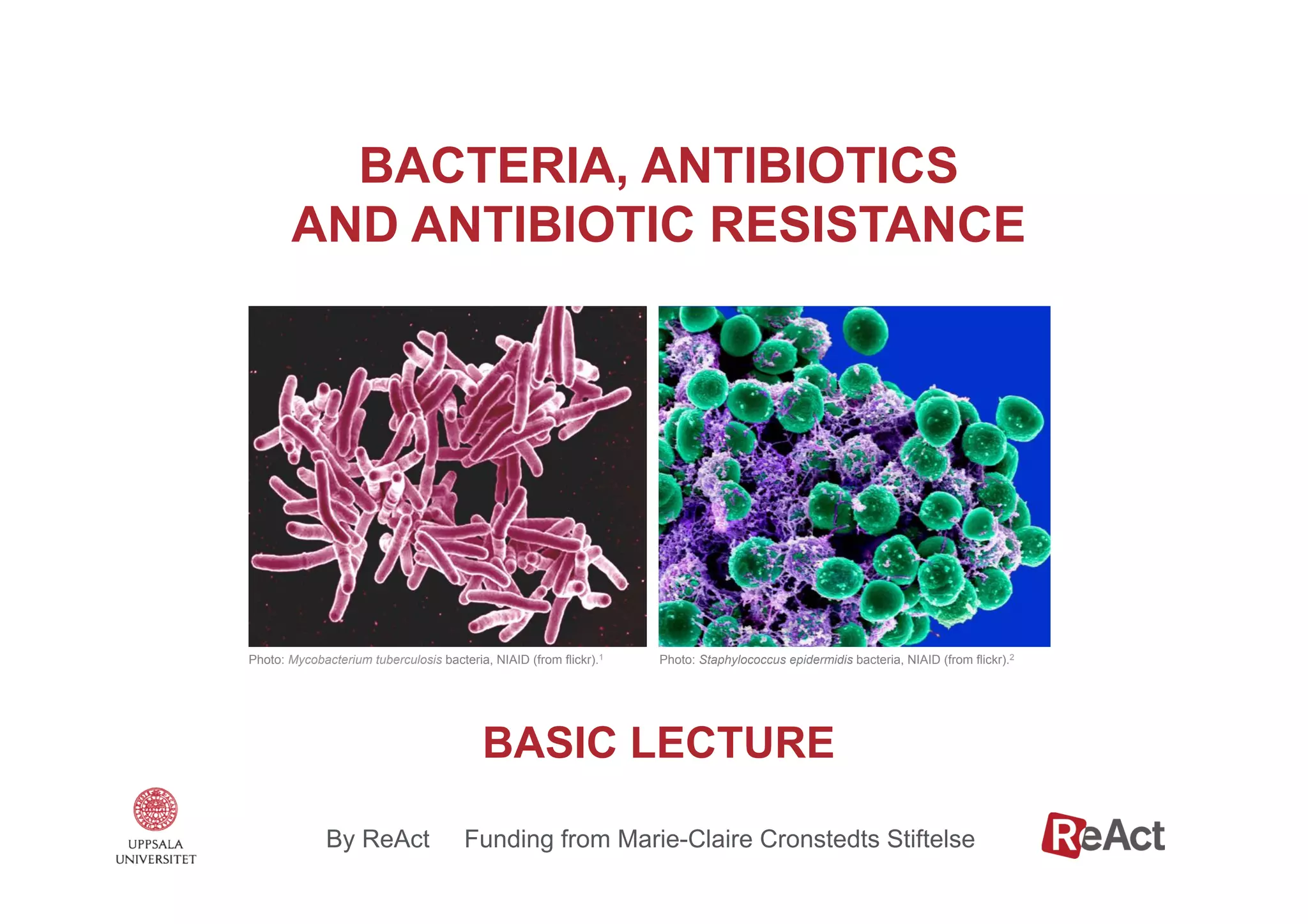
BACTERIA, ANTIBIOTICS
AND ANTIBIOTIC RESISTANCE
Photo: Mycobacterium tuberculosis bacteria, NIAID (from flickr).1 Photo: Staphylococcus epidermidis bacteria, NIAID (from flickr).2
By ReAct Funding from Marie-Claire Cronstedts Stiftelse
BASIC LECTURE
OUTLINE OF THIS LECTURE
•  About bacteria
•  About antibiotics
•  Antibiotic resistance
–  How does it form and spread?
–  What are the consequences for global health?
•  What can you do?
ABOUT BACTERIA
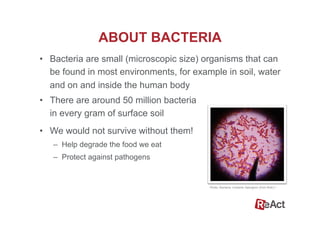
•  Bacteria are small (microscopic size) organisms that can
be found in most environments, for example in soil, water
and on and inside the human body
•  There are around 50 million bacteria
in every gram of surface soil
•  We would not survive without them!
–  Help degrade the food we eat
–  Protect against pathogens
Photo: Bacteria, Umberto Salvagnin (from flickr).3
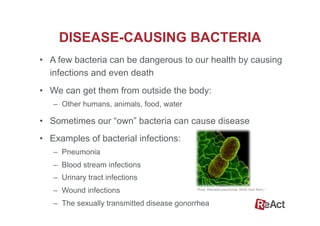
•  A few bacteria can be dangerous to our health by causing
infections and even death
•  We can get them from outside the body:
–  Other humans, animals, food, water
•  Sometimes our “own” bacteria can cause disease
•  Examples of bacterial infections:
–  Pneumonia
–  Blood stream infections
–  Urinary tract infections
–  Wound infections
–  The sexually transmitted disease gonorrhea
DISEASE-CAUSING BACTERIA
Photo: Klebsiella pneumoniae, NIAID (from flickr). 4
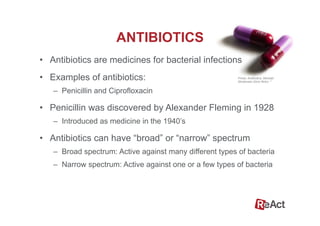
•  Antibiotics are medicines for bacterial infections
•  Examples of antibiotics:
–  Penicillin and Ciprofloxacin
•  Penicillin was discovered by Alexander Fleming in 1928
–  Introduced as medicine in the 1940’s
•  Antibiotics can have “broad” or “narrow” spectrum
–  Broad spectrum: Active against many different types of bacteria
–  Narrow spectrum: Active against one or a few types of bacteria
ANTIBIOTICS
Photo: Antibiotics, Michael
Mortensen (from flickr). 5
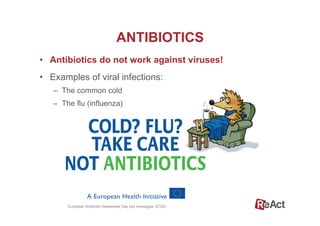
•  Antibiotics do not work against viruses!
ANTIBIOTICS
European Antibiotic Awareness Day key messages, ECDC.
•  Examples of viral infections:
–  The common cold
–  The flu (influenza)
ANTIBIOTICS
•  Antibiotics are effective against bacteria
–  However, antibiotics have only marginal effect against
some bacterial infections such as uncomplicated sinus
infections and ear infections (bacterial otitis)
–  The body’s immune system can normally take care of
these infections without antibiotics
•  But for some bacterial infections antibiotics are
life-saving medicines!
–  For example for blood stream infections (sepsis) and
pneumonia
•  Before antibiotics there was no effective cure for
bacterial infections
•  Antibiotics were considered “a miracle cure”
•  Antibiotics cure infections, prevent infections
upon surgery, and make transplantations and
cancer treatment safer
ANTIBIOTICS
è Saved countless lives!
è Made modern medicine possible!
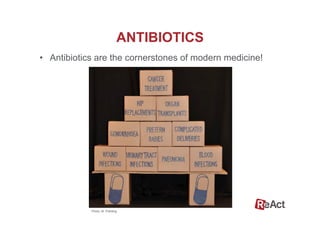
•  Antibiotics are the cornerstones of modern medicine!
ANTIBIOTICS
Photo: M. Pränting
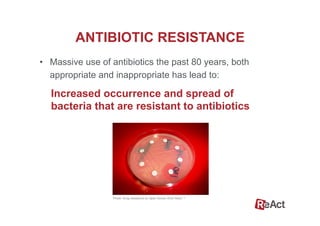
•  Massive use of antibiotics the past 80 years, both
appropriate and inappropriate has lead to:
ANTIBIOTIC RESISTANCE
Photo: Drug resistance by Iqbal Osman (from flickr). 6
Increased occurrence and spread of
bacteria that are resistant to antibiotics
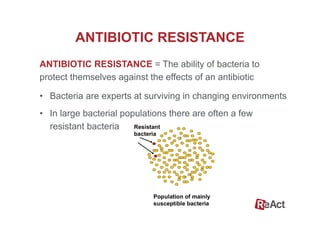
ANTIBIOTIC RESISTANCE = The ability of bacteria to
protect themselves against the effects of an antibiotic
ANTIBIOTIC RESISTANCE
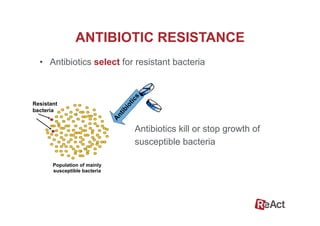
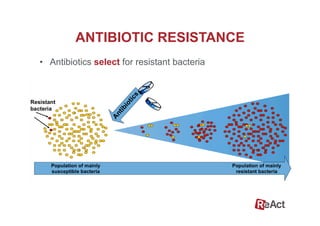
•  Bacteria are experts at surviving in changing environments
•  In large bacterial populations there are often a few
resistant bacteria
•  Antibiotics select for resistant bacteria
ANTIBIOTIC RESISTANCE
Population of mainly
susceptible bacteria
Antibiotics kill or stop growth of
susceptible bacteria
ANTIBIOTIC RESISTANCE
•  Antibiotics select for resistant bacteria
ANTIBIOTIC RESISTANCE
Is antibiotic resistance a problem?
•  Antibiotic resistance leads to treatment failures
•  Antibiotic resistance threatens our ability to perform
modern medical procedures
•  Antibiotic resistance imposes a major economic burden
on society
•  Antibiotic resistant bacteria already cause many deaths
around the world
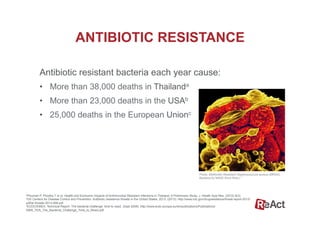
Antibiotic resistant bacteria each year cause:
•  More than 38,000 deaths in Thailanda
•  More than 23,000 deaths in the USAb
•  25,000 deaths in the European Unionc
ANTIBIOTIC RESISTANCE
Photo: Methicillin-Resistant Staphylococcus aureus (MRSA)
Bacteria by NIAID (from flickr) 7
aPhumart P, Phodha T et al. Health and Economic Impacts of Antimicrobial Resistant Infections in Thailand: A Preliminary Study. J. Health Syst Res. (2012) 6(3).
bUS Centers for Disease Control and Prevention. Antibiotic resistance threats in the United States, 2013. (2013). http://www.cdc.gov/drugresistance/threat-report-2013/
pdf/ar-threats-2013-508.pdf
cECDC/EMEA. Technical Report. The bacterial challenge: time to react. (Sept 2009). http://www.ecdc.europa.eu/en/publications/Publications/
0909_TER_The_Bacterial_Challenge_Time_to_React.pdf
… but the consequences of antibiotic resistance are
most severe for the poor. For example:
•  In South Asia (India, Pakistan, Afghanistan, Nepal, Bangladesh)
one newborn child dies every 5 minutes from blood
stream infections (sepsis) because the antibiotics given
are not effective due to bacterial resistancea
ANTIBIOTIC RESISTANCE
aBhutta Z, Presentation at the Global Need for Effective Antibiotics - Moving towards Concerted Action. http://www.reactgroup.org/uploads/publications/presentations/
opening-session-zulfiqar-bhutta.pdf
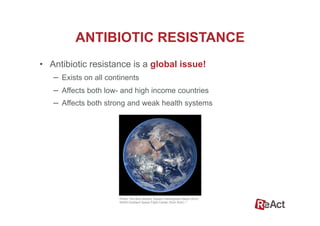
•  Antibiotic resistance is a global issue!
–  Exists on all continents
–  Affects both low- and high income countries
–  Affects both strong and weak health systems
ANTIBIOTIC RESISTANCE
Photo: The Blue Marble, Eastern Hemisphere March 2014,
NASA Goddard Space Flight Center (from flickr). 8
How did we end up here?
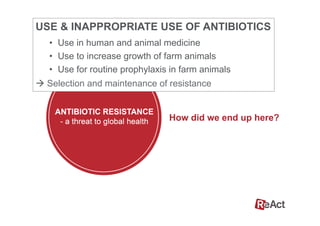
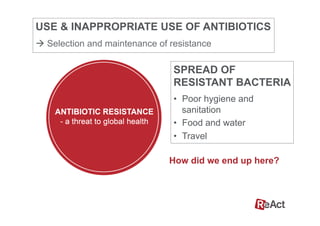
USE & INAPPROPRIATE USE OF ANTIBIOTICS
•  Use in human and animal medicine
•  Use to increase growth of farm animals
•  Use for routine prophylaxis in farm animals
à Selection and maintenance of resistance
SPREAD OF
RESISTANT BACTERIA
•  Poor hygiene and
sanitation
•  Food and water
•  Travel
How did we end up here?
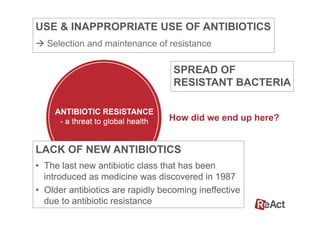
USE & INAPPROPRIATE USE OF ANTIBIOTICS
à Selection and maintenance of resistance
How did we end up here?
SPREAD OF
RESISTANT BACTERIA
USE & INAPPROPRIATE USE OF ANTIBIOTICS
à Selection and maintenance of resistance
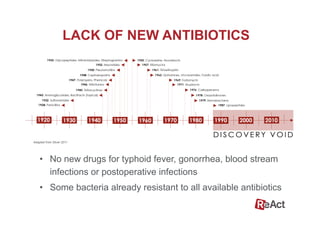
LACK OF NEW ANTIBIOTICS
•  The last new antibiotic class that has been
introduced as medicine was discovered in 1987
•  Older antibiotics are rapidly becoming ineffective
due to antibiotic resistance
•  No new drugs for typhoid fever, gonorrhea, blood stream
infections or postoperative infections
•  Some bacteria already resistant to all available antibiotics
LACK OF NEW ANTIBIOTICS
Adapted from Silver 2011
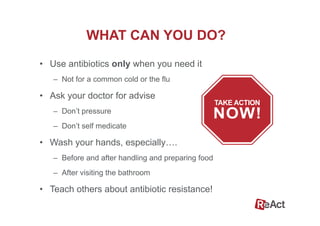
WHAT CAN YOU DO?
•  Use antibiotics only when you need it
–  Not for a common cold or the flu
•  Ask your doctor for advise
–  Don’t pressure
–  Don’t self medicate
•  Wash your hands, especially….
–  Before and after handling and preparing food
–  After visiting the bathroom
•  Teach others about antibiotic resistance!
Thank you for your attention!
For more information about antibiotic resistance, please visit:
www.reactgroup.org
www.reactgroup.org/toolbox
1 Photo: Mycobacterium tuberculosis Bacteria, the Cause of TB by NIAID
(from flickr)
https://www.flickr.com/photos/niaid/5149398656/
https://www.flickr.com/photos/niaid/
License: https://creativecommons.org/licenses/by/2.0/
2 Photo: Staphylococcus epidermidis Bacteria by NIAID (from flickr)
https://www.flickr.com/photos/niaid/5613984108
https://www.flickr.com/photos/niaid/
License: https://creativecommons.org/licenses/by/2.0/
3 Photo: Bacteria by Umberto Salvagnin (from flickr)
https://www.flickr.com/photos/kaibara/2234750993/
https://www.flickr.com/photos/kaibara/
License: https://creativecommons.org/licenses/by/2.0/
4 Photo: Klebsiella pneumoniae by NIAID (from flickr)
https://www.flickr.com/photos/niaid/13383560994
https://www.flickr.com/photos/niaid/
License: https://creativecommons.org/licenses/by/2.0/
5 Photo: Antibiotics by Michael Mortensen (from flickr)
https://www.flickr.com/photos/-mic-/754962309/
https://www.flickr.com/photos/-mic-/
License: https://creativecommons.org/licenses/by-sa/2.0/
6 Photo: Drug resistance by Iqbal Osman (from flickr)
https://www.flickr.com/photos/82066314@N06/9502114881/
https://www.flickr.com/photos/82066314@N06/
License: https://creativecommons.org/licenses/by/2.0/legalcode
Downloaded 2015-02-05
7 Photo: Methicillin-Resistant Staphylococcus aureus (MRSA) Bacteria by
NIAID (from flickr)
https://www.flickr.com/photos/niaid/5927204872/
https://www.flickr.com/photos/niaid/
License: https://creativecommons.org/licenses/by/2.0/legalcode
Downloaded 2015-02-05
8 Photo: The Blue Marble, Eastern Hemisphere March 2014 by NASA
Goddard Space Flight Center (from flickr)
https://www.flickr.com/photos/gsfc/14990033062/
https://www.flickr.com/photos/gsfc/
License: https://creativecommons.org/licenses/by/2.0/
All images downloaded 5th of Nov 2014 unless otherwise specified
Image references

tbx-basic-lecture-abr.pdf

  • 1.
    BACTERIA, ANTIBIOTICS AND ANTIBIOTICRESISTANCE Photo: Mycobacterium tuberculosis bacteria, NIAID (from flickr).1 Photo: Staphylococcus epidermidis bacteria, NIAID (from flickr).2 By ReAct Funding from Marie-Claire Cronstedts Stiftelse BASIC LECTURE
  • 2.
    OUTLINE OF THISLECTURE •  About bacteria •  About antibiotics •  Antibiotic resistance –  How does it form and spread? –  What are the consequences for global health? •  What can you do?
  • 3.
    ABOUT BACTERIA •  Bacteriaare small (microscopic size) organisms that can be found in most environments, for example in soil, water and on and inside the human body •  There are around 50 million bacteria in every gram of surface soil •  We would not survive without them! –  Help degrade the food we eat –  Protect against pathogens Photo: Bacteria, Umberto Salvagnin (from flickr).3
  • 4.
    •  A fewbacteria can be dangerous to our health by causing infections and even death •  We can get them from outside the body: –  Other humans, animals, food, water •  Sometimes our “own” bacteria can cause disease •  Examples of bacterial infections: –  Pneumonia –  Blood stream infections –  Urinary tract infections –  Wound infections –  The sexually transmitted disease gonorrhea DISEASE-CAUSING BACTERIA Photo: Klebsiella pneumoniae, NIAID (from flickr). 4
  • 5.
    •  Antibiotics aremedicines for bacterial infections •  Examples of antibiotics: –  Penicillin and Ciprofloxacin •  Penicillin was discovered by Alexander Fleming in 1928 –  Introduced as medicine in the 1940’s •  Antibiotics can have “broad” or “narrow” spectrum –  Broad spectrum: Active against many different types of bacteria –  Narrow spectrum: Active against one or a few types of bacteria ANTIBIOTICS Photo: Antibiotics, Michael Mortensen (from flickr). 5
  • 6.
    •  Antibiotics donot work against viruses! ANTIBIOTICS European Antibiotic Awareness Day key messages, ECDC. •  Examples of viral infections: –  The common cold –  The flu (influenza)
  • 7.
    ANTIBIOTICS •  Antibiotics areeffective against bacteria –  However, antibiotics have only marginal effect against some bacterial infections such as uncomplicated sinus infections and ear infections (bacterial otitis) –  The body’s immune system can normally take care of these infections without antibiotics •  But for some bacterial infections antibiotics are life-saving medicines! –  For example for blood stream infections (sepsis) and pneumonia
  • 8.
    •  Before antibioticsthere was no effective cure for bacterial infections •  Antibiotics were considered “a miracle cure” •  Antibiotics cure infections, prevent infections upon surgery, and make transplantations and cancer treatment safer ANTIBIOTICS è Saved countless lives! è Made modern medicine possible!
  • 9.
    •  Antibiotics arethe cornerstones of modern medicine! ANTIBIOTICS Photo: M. Pränting
  • 10.
    •  Massive useof antibiotics the past 80 years, both appropriate and inappropriate has lead to: ANTIBIOTIC RESISTANCE Photo: Drug resistance by Iqbal Osman (from flickr). 6 Increased occurrence and spread of bacteria that are resistant to antibiotics
  • 11.
    ANTIBIOTIC RESISTANCE =The ability of bacteria to protect themselves against the effects of an antibiotic ANTIBIOTIC RESISTANCE •  Bacteria are experts at surviving in changing environments •  In large bacterial populations there are often a few resistant bacteria
  • 12.
    •  Antibiotics selectfor resistant bacteria ANTIBIOTIC RESISTANCE Population of mainly susceptible bacteria Antibiotics kill or stop growth of susceptible bacteria
  • 13.
    ANTIBIOTIC RESISTANCE •  Antibioticsselect for resistant bacteria
  • 14.
    ANTIBIOTIC RESISTANCE Is antibioticresistance a problem? •  Antibiotic resistance leads to treatment failures •  Antibiotic resistance threatens our ability to perform modern medical procedures •  Antibiotic resistance imposes a major economic burden on society •  Antibiotic resistant bacteria already cause many deaths around the world
  • 15.
    Antibiotic resistant bacteriaeach year cause: •  More than 38,000 deaths in Thailanda •  More than 23,000 deaths in the USAb •  25,000 deaths in the European Unionc ANTIBIOTIC RESISTANCE Photo: Methicillin-Resistant Staphylococcus aureus (MRSA) Bacteria by NIAID (from flickr) 7 aPhumart P, Phodha T et al. Health and Economic Impacts of Antimicrobial Resistant Infections in Thailand: A Preliminary Study. J. Health Syst Res. (2012) 6(3). bUS Centers for Disease Control and Prevention. Antibiotic resistance threats in the United States, 2013. (2013). http://www.cdc.gov/drugresistance/threat-report-2013/ pdf/ar-threats-2013-508.pdf cECDC/EMEA. Technical Report. The bacterial challenge: time to react. (Sept 2009). http://www.ecdc.europa.eu/en/publications/Publications/ 0909_TER_The_Bacterial_Challenge_Time_to_React.pdf
  • 16.
    … but theconsequences of antibiotic resistance are most severe for the poor. For example: •  In South Asia (India, Pakistan, Afghanistan, Nepal, Bangladesh) one newborn child dies every 5 minutes from blood stream infections (sepsis) because the antibiotics given are not effective due to bacterial resistancea ANTIBIOTIC RESISTANCE aBhutta Z, Presentation at the Global Need for Effective Antibiotics - Moving towards Concerted Action. http://www.reactgroup.org/uploads/publications/presentations/ opening-session-zulfiqar-bhutta.pdf
  • 17.
    •  Antibiotic resistanceis a global issue! –  Exists on all continents –  Affects both low- and high income countries –  Affects both strong and weak health systems ANTIBIOTIC RESISTANCE Photo: The Blue Marble, Eastern Hemisphere March 2014, NASA Goddard Space Flight Center (from flickr). 8
  • 18.
    How did weend up here?
  • 19.
    How did weend up here? USE & INAPPROPRIATE USE OF ANTIBIOTICS •  Use in human and animal medicine •  Use to increase growth of farm animals •  Use for routine prophylaxis in farm animals à Selection and maintenance of resistance
  • 20.
    SPREAD OF RESISTANT BACTERIA • Poor hygiene and sanitation •  Food and water •  Travel How did we end up here? USE & INAPPROPRIATE USE OF ANTIBIOTICS à Selection and maintenance of resistance
  • 21.
    How did weend up here? SPREAD OF RESISTANT BACTERIA USE & INAPPROPRIATE USE OF ANTIBIOTICS à Selection and maintenance of resistance LACK OF NEW ANTIBIOTICS •  The last new antibiotic class that has been introduced as medicine was discovered in 1987 •  Older antibiotics are rapidly becoming ineffective due to antibiotic resistance
  • 22.
    •  No newdrugs for typhoid fever, gonorrhea, blood stream infections or postoperative infections •  Some bacteria already resistant to all available antibiotics LACK OF NEW ANTIBIOTICS Adapted from Silver 2011
  • 23.
    WHAT CAN YOUDO? •  Use antibiotics only when you need it –  Not for a common cold or the flu •  Ask your doctor for advise –  Don’t pressure –  Don’t self medicate •  Wash your hands, especially…. –  Before and after handling and preparing food –  After visiting the bathroom •  Teach others about antibiotic resistance!
  • 24.
    Thank you foryour attention! For more information about antibiotic resistance, please visit: www.reactgroup.org www.reactgroup.org/toolbox
  • 25.
    1 Photo: Mycobacteriumtuberculosis Bacteria, the Cause of TB by NIAID (from flickr) https://www.flickr.com/photos/niaid/5149398656/ https://www.flickr.com/photos/niaid/ License: https://creativecommons.org/licenses/by/2.0/ 2 Photo: Staphylococcus epidermidis Bacteria by NIAID (from flickr) https://www.flickr.com/photos/niaid/5613984108 https://www.flickr.com/photos/niaid/ License: https://creativecommons.org/licenses/by/2.0/ 3 Photo: Bacteria by Umberto Salvagnin (from flickr) https://www.flickr.com/photos/kaibara/2234750993/ https://www.flickr.com/photos/kaibara/ License: https://creativecommons.org/licenses/by/2.0/ 4 Photo: Klebsiella pneumoniae by NIAID (from flickr) https://www.flickr.com/photos/niaid/13383560994 https://www.flickr.com/photos/niaid/ License: https://creativecommons.org/licenses/by/2.0/ 5 Photo: Antibiotics by Michael Mortensen (from flickr) https://www.flickr.com/photos/-mic-/754962309/ https://www.flickr.com/photos/-mic-/ License: https://creativecommons.org/licenses/by-sa/2.0/ 6 Photo: Drug resistance by Iqbal Osman (from flickr) https://www.flickr.com/photos/82066314@N06/9502114881/ https://www.flickr.com/photos/82066314@N06/ License: https://creativecommons.org/licenses/by/2.0/legalcode Downloaded 2015-02-05 7 Photo: Methicillin-Resistant Staphylococcus aureus (MRSA) Bacteria by NIAID (from flickr) https://www.flickr.com/photos/niaid/5927204872/ https://www.flickr.com/photos/niaid/ License: https://creativecommons.org/licenses/by/2.0/legalcode Downloaded 2015-02-05 8 Photo: The Blue Marble, Eastern Hemisphere March 2014 by NASA Goddard Space Flight Center (from flickr) https://www.flickr.com/photos/gsfc/14990033062/ https://www.flickr.com/photos/gsfc/ License: https://creativecommons.org/licenses/by/2.0/ All images downloaded 5th of Nov 2014 unless otherwise specified Image references