For educators,educator,and students with TBI, TBI a student with TBI, is like one word—Devastating. Pieper student has always gottenby stating “thosepoint B by taking a direct route. Now the brain needs to find an additional route to get toat ‘“losing”” the child that is very difficult, and frustrating. This website will to alleviate this parents, and Some of withways to alleviate frustrationand information. Elsa Arroyos-Jurado, Jane strategies, to dealEhly and Jeffery Max stated it best that, with the design of an do educators need towith practical research-based they also strategies, that
                              As an parents, understanding the brain of can be translated into just understanding a road map. The in 2001 best described it from point A to experiencing traumatic brain injury (TBI) is that they often express frustration and pain the same place, and they knew.” (p 5). The purpose of this project is to try assist teachers, frustration. persons the TBI, by giving them tools are to acquire information, knowledge, and Paulsen, Stewart with issues. This project does just as an educator “Not only interactive website, draw on student’s strengths, learning need to come
                       demonstrate and model effective toolslearning strategies.” (2001,p.137). This project is based on this statement. Each of the strategies that are used and will be used are novel approaches for each individual person. This project’s goal is to assist the student, parent and teacher to be successful in educating themselves and others and to assist all persons who suffer from TBI.
                       up with novel approaches to teaching for working with students with TBI.


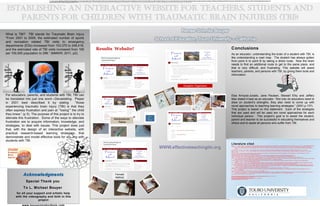
                                                                                                                                                    Results Website!                                                                                                                                                                                                                                                                                                                                                              Conclusions
                                                                                                                                                                                                                                                                                                                                                                                                                                                                                                                                  As an educator, understanding the brain of a student with TBI, is
                                                                                                                                                                                                                                                                                                                                                                                                                                                                                                                                  like understanding a road map. The student has always gotten
                                                                                                                                                                                                                                                                                                                                                                                                                                                                                                                                  from point A to point B by taking a direct route. Now the brain
                                                                                                                                                                                                                                                                                                                                                                                                                                                                                                                                  needs to find an additional route to get to the same place, and
                                                                                                                                                                                                                                                                                                                                                                                                                                                                                                                                  that is very difficult, and frustrating. This website will assist
                                                                                                                                                                                                                                                                                                                                                                                                                                                                                                                                  teachers, parents, and persons with TBI, by giving them tools and
                                                                                                                                                                                                                                                                                                                                                                                                                                                                                                                                  information.


                                                                                                                                                                                                                                                                                                                                                                                                Greaphic Organizers


                                                                                                                                                                                                                                                                                                                                                                                                                                                                                                                                  Elsa Arroyos-Jurado, Jane Paulsen, Stewart Ehly and Jeffery
                                                                                                                                                                                                                                                                                                                                                                                                                                                                                                                                  Max stated it best as an educator “Not only do educators need to
                                                                                                                                                                                                                                                                                                                                                                                                                                                                                                                                  draw on student’s strengths, they also need to come up with
                                                                                                                                                                                                                                                                                                                                                                                                                                                                                                                                  novel approaches to teaching learning strategies.” (2001,p.137).
                                                                                                                                                                                                                                                                                                                                                                                                                                                                                                                                  This project is based on this statement. Each of the strategies
                                                                                                                                                                                                                                                                                                                                                                                                                                                                                                                                  that are used and will be used are novel approaches for each
                                                                                                                                                                                                                                                                                                                                                                                                                                                                                                                                  individual person. This project’s goal is to assist the student,
                                                                                                                                                                                                     Manipulatives                                                                                                                                                                                                                                                                                                                parent and teacher to be successful in educating themselves and
                                                                                                                                                                                                        Ratios                                                                                                                                                                                                                                                                                                                    others and to assist all persons who suffer from TBI.


                                                                                                                                                                                                                                                                                                                                                                                                                                                                                                                                  Literature cited
                                                                                                                                                                                                                                                                                                                                                                                                                                                                                                                                  Alferink, L. A., & Farmer-Dougan, V. (2010). Brain-(not) Based Education: Dangers of Misunderstanding and Misapplication of Neuroscience Research. Exceptionality, 18(1), 42-52. doi:10.1080/09362830903462573
                                                                                                                                                                                                                                                                                                                                                                                                                                                                                                                                  Anderson, R. C. (1991). The notion of schemata and the educational enterprise: General discussion ofthe conference. In Anderson, Richard C., R. J., Spiro & W. E. Montague (eds). (1984).Schooling and the
                                                                                                                                                                                                                                                                                                                                                                                                                                                                                                                                            acquisition of knowledge. Hillsdale, NJ: Lawrencerlbaum Craik, F.I.M., and R.S. Lockhart. 1972. Levels of processing: A framework for memory research. Journal of Verbal Learning and Verbal Behavior 11:
                                                                                                                                                                                                                                                                                                                                                                                                                                                                                                                                            671–84.
                                                                                                                                                                                                                                                                                                                                                                                                                                                                                                                                  Arroyos-Jurado, E, Paulsen, J., Ehly, S. Max, J. Traumatic Brain Injury in children and Adolescents: Acedemic and Intellectural outcome following Injury, (2006), EXCEPTIONALITY, 14(3), 125-140
                                                                                                                                                                                                                                                                                                                                                                                                                                                                                                                                  Arroyo, I., Royer, J. M., & Woolf, B. P. (2011). Using an Intelligent Tutor and Math Fluency Training to Improve Math Performance. International Journal Of Artificial Intelligence In Education, 21(1-2), 135-152.
                                                                                                                                                                                                                                                                                                                                                                                                                                                                                                                                  CDC, 2000, 1-36
                                                                                                                                                                                                                                                                                                                                                                                                                                                                                                                                  Fabry, D. L. (2010). Combining Research-based Effective Teacher Characteristics with Effective Instructional Strategies to Influence Pedagogy. Journal Of Research In Innovative Teaching, 3(1), 24-32.
                                                                                                                                                                                                                                                                                                                                                                                                                                                                                                                                  Family caregiver alliance, California Department of Mental Health, 2004, 1-4
                                                                                                                                                                                                                                                                                                                                                                                                                                                                                                                                  Hibbard,M.,Gordan,W., Martin, T., Raskin,B., Brown,M.(2001). Students with Traumatic Brain Injury:Identification, assessment and classroom accommodations (1-17)
                                                                                                                                                                                                                                                                                                                                                                                                                                                                                                                                  Julie Louise Gerberding, M.D,Report to Congress on Mild Traumatic Brain Injury in the United States: Steps to Prevent a serious Public Health Problem (2003) 1-44
                                                                                                                                                                                                                                                                                                                                                                                                                                                                                                                                  Krach, L. E., Gormley Jr., M. E., & Ward, M. (2009). Chapter 10: Traumatic Brain Injury. In Pediatric Rehabilitation: Principles & Practice (pp. 231-260). Demos Medical Publishing, LLC.
                                                                                                                                                                                                                                                                                                                                                                                                                                                                                                                                  Langlois, Jean, Traumatic Bran Injury in the United States: Assessing Outcomes in Children, Montague, M., Enders, C., & Dietz, S. (2011). Effects of Cognitive Strategy Instruction on Math Problem Solving of Middle
                                                                                                                                                                                                                                                                                                                                                                                                                                                                                                                                            School Students With Learning Disabilities. Learning Disability Quarterly, 34(4), 262-272. doi:10.1177/0731948711421762
                                                                                                                                                                                                                                                                                                                                                                                                                                                                                                                                  Lifshitz, H., Shtein, S., Weiss, I., & Svisrsky, N. (2011). Explicit memory among individuals with mild and moderate intellectual disability: educational implications. European Journal Of Special Needs
                                                                                                                                                                                                                                                                                                                                                                                                                                                                                                                                            Education, 26(1), 113-124. doi:10.1080/08856257.2011.543536
                                                                                                                                                                                                                                                                                                                                                                                                                                                                                                                                  Louie, J., Brodesky, A., Brett, J., Yang, L., Tan, Y., & Regional Educational Laboratory Northeast & Islands, (. (2008). Math Education Practices for Students with Disabilities and Other Struggling Learners: Case
                                                                                                                                                                                                                                                                                                                                                                                                                                                                                                                                            Studies of Six Schools in Two Northeast and Islands Region States. Issues & Answers. REL 2008-No. 053. Regional Educational Laboratory Northeast & Islands,
                                                                                                                                                                                                                                                                                                                                                                                                                                                                                                                                  Montague, M., Applegate, B., & Marquard. K. (1993). Cognitivestrategy instruction and mathematical problem-solving performance of students with leaming disabilities. Learning Disabilities Research and Practice,
                                                                                                                                                                                                                                                                                                                                                                                                                                                                                                                                            29. 251-261.Nonfatal traumatic brain injuries related to sports and recreation activities among persons aged <=19 years --- United States, 2001--2009. (2011). MMWR: Morbidity & Mortality Weekly Report,
                                                                                                                                                                                                                                                                                                                                                                                                                                                                                                                                            Courville, 1945; Gentry,Godersky, & Thompson, 1988; Hadley et al.,1988, 601337-1342.
                                                                                                                                                                                                                                                                                                                                                                                                                                                                                                                                  Othman, Y. (2010). Application of Metacognition Strategies and Awareness when Reading Texts. International Journal Of Learning, 17(3), 457-471.
                                                                                                                                                                                                                                                                                                                                                                                                                                                                                                                                  Pavawalla, S. P., Schmitter-Edgecombe, M., & Smith, R. E. (2012). Prospective memory after moderate-to-severe traumatic brain injury: A multinomial modeling approach. Neuropsychology, 26(1), 91-101.
                                                                                                                                                                                                                                                                                                                                                                                                                                                                                                                                            doi:10.1037/a0025866
                                                                                                                                                                                                                                                                                                                                                                                                                                                                                                                                  Pieper, (1991) Traumatic Brain Injury: What the Teacher needs to Know HI-33A80023 , 1-22
                                                                                                                                                                                                                                                                                                                                                                                                                                                                                                                                  Polito, M., Thompson, J. G., & DeFina, P. A. (2010). A review of the International Brain Research Foundation novel approach to mild traumatic brain injury presented at the International Conference on Behavioral
                                                                                                                                                                                                                                                                                                                                                                                                                                                                                                                                            Health and Traumatic Brain Injury. Journal Of The American Academy Of Nurse Practitioners, 22(9), 504-509. doi:10.1111/j.1745-7599.2010.00540.x

     Acknowledgments                                                                                                                                                                                     Fernald                                                                                                                                                                                                                                                                                                                  TEACHING Exceptional Children, Vol. 34, No. 4, pp. 62-67.

                                                                                                                                                                                                                                                                                                                                                                                                                                                                                                                                  http://www.brainandspinalcord.org/traumatic-brain-injury-types/anoxic-brain-injury/index.html retrived on 4/12/2012

                                                                                                                                                                                                         Method                                                                                                                                                                                                                                                                                                                   http://www.netc.org/focus/strategies/ retrived on 3/20/2012
                                                                                                                                                                                                                                                                                                                                                                                                                                                                                                                                  http://emedicine.medscape.com/article/326510-overview retrived on 3/20/2012
                                                                                                                                                                                                                                                                                                                                                                                                                                                                                                                                  http://www.acrm.org/ retrived on 4/12/2012


      Special Thank you
     To L. Michael Bouyer
for all your support and artistic help
with the videography and faith in this
                project

Tbi poster

  • 1.
    For educators,educator,and studentswith TBI, TBI a student with TBI, is like one word—Devastating. Pieper student has always gottenby stating “thosepoint B by taking a direct route. Now the brain needs to find an additional route to get toat ‘“losing”” the child that is very difficult, and frustrating. This website will to alleviate this parents, and Some of withways to alleviate frustrationand information. Elsa Arroyos-Jurado, Jane strategies, to dealEhly and Jeffery Max stated it best that, with the design of an do educators need towith practical research-based they also strategies, that As an parents, understanding the brain of can be translated into just understanding a road map. The in 2001 best described it from point A to experiencing traumatic brain injury (TBI) is that they often express frustration and pain the same place, and they knew.” (p 5). The purpose of this project is to try assist teachers, frustration. persons the TBI, by giving them tools are to acquire information, knowledge, and Paulsen, Stewart with issues. This project does just as an educator “Not only interactive website, draw on student’s strengths, learning need to come demonstrate and model effective toolslearning strategies.” (2001,p.137). This project is based on this statement. Each of the strategies that are used and will be used are novel approaches for each individual person. This project’s goal is to assist the student, parent and teacher to be successful in educating themselves and others and to assist all persons who suffer from TBI. up with novel approaches to teaching for working with students with TBI. Results Website! Conclusions As an educator, understanding the brain of a student with TBI, is like understanding a road map. The student has always gotten from point A to point B by taking a direct route. Now the brain needs to find an additional route to get to the same place, and that is very difficult, and frustrating. This website will assist teachers, parents, and persons with TBI, by giving them tools and information. Greaphic Organizers Elsa Arroyos-Jurado, Jane Paulsen, Stewart Ehly and Jeffery Max stated it best as an educator “Not only do educators need to draw on student’s strengths, they also need to come up with novel approaches to teaching learning strategies.” (2001,p.137). This project is based on this statement. Each of the strategies that are used and will be used are novel approaches for each individual person. This project’s goal is to assist the student, Manipulatives parent and teacher to be successful in educating themselves and Ratios others and to assist all persons who suffer from TBI. Literature cited Alferink, L. A., & Farmer-Dougan, V. (2010). Brain-(not) Based Education: Dangers of Misunderstanding and Misapplication of Neuroscience Research. Exceptionality, 18(1), 42-52. doi:10.1080/09362830903462573 Anderson, R. C. (1991). The notion of schemata and the educational enterprise: General discussion ofthe conference. In Anderson, Richard C., R. J., Spiro & W. E. Montague (eds). (1984).Schooling and the acquisition of knowledge. Hillsdale, NJ: Lawrencerlbaum Craik, F.I.M., and R.S. Lockhart. 1972. Levels of processing: A framework for memory research. Journal of Verbal Learning and Verbal Behavior 11: 671–84. Arroyos-Jurado, E, Paulsen, J., Ehly, S. Max, J. Traumatic Brain Injury in children and Adolescents: Acedemic and Intellectural outcome following Injury, (2006), EXCEPTIONALITY, 14(3), 125-140 Arroyo, I., Royer, J. M., & Woolf, B. P. (2011). Using an Intelligent Tutor and Math Fluency Training to Improve Math Performance. International Journal Of Artificial Intelligence In Education, 21(1-2), 135-152. CDC, 2000, 1-36 Fabry, D. L. (2010). Combining Research-based Effective Teacher Characteristics with Effective Instructional Strategies to Influence Pedagogy. Journal Of Research In Innovative Teaching, 3(1), 24-32. Family caregiver alliance, California Department of Mental Health, 2004, 1-4 Hibbard,M.,Gordan,W., Martin, T., Raskin,B., Brown,M.(2001). Students with Traumatic Brain Injury:Identification, assessment and classroom accommodations (1-17) Julie Louise Gerberding, M.D,Report to Congress on Mild Traumatic Brain Injury in the United States: Steps to Prevent a serious Public Health Problem (2003) 1-44 Krach, L. E., Gormley Jr., M. E., & Ward, M. (2009). Chapter 10: Traumatic Brain Injury. In Pediatric Rehabilitation: Principles & Practice (pp. 231-260). Demos Medical Publishing, LLC. Langlois, Jean, Traumatic Bran Injury in the United States: Assessing Outcomes in Children, Montague, M., Enders, C., & Dietz, S. (2011). Effects of Cognitive Strategy Instruction on Math Problem Solving of Middle School Students With Learning Disabilities. Learning Disability Quarterly, 34(4), 262-272. doi:10.1177/0731948711421762 Lifshitz, H., Shtein, S., Weiss, I., & Svisrsky, N. (2011). Explicit memory among individuals with mild and moderate intellectual disability: educational implications. European Journal Of Special Needs Education, 26(1), 113-124. doi:10.1080/08856257.2011.543536 Louie, J., Brodesky, A., Brett, J., Yang, L., Tan, Y., & Regional Educational Laboratory Northeast & Islands, (. (2008). Math Education Practices for Students with Disabilities and Other Struggling Learners: Case Studies of Six Schools in Two Northeast and Islands Region States. Issues & Answers. REL 2008-No. 053. Regional Educational Laboratory Northeast & Islands, Montague, M., Applegate, B., & Marquard. K. (1993). Cognitivestrategy instruction and mathematical problem-solving performance of students with leaming disabilities. Learning Disabilities Research and Practice, 29. 251-261.Nonfatal traumatic brain injuries related to sports and recreation activities among persons aged <=19 years --- United States, 2001--2009. (2011). MMWR: Morbidity & Mortality Weekly Report, Courville, 1945; Gentry,Godersky, & Thompson, 1988; Hadley et al.,1988, 601337-1342. Othman, Y. (2010). Application of Metacognition Strategies and Awareness when Reading Texts. International Journal Of Learning, 17(3), 457-471. Pavawalla, S. P., Schmitter-Edgecombe, M., & Smith, R. E. (2012). Prospective memory after moderate-to-severe traumatic brain injury: A multinomial modeling approach. Neuropsychology, 26(1), 91-101. doi:10.1037/a0025866 Pieper, (1991) Traumatic Brain Injury: What the Teacher needs to Know HI-33A80023 , 1-22 Polito, M., Thompson, J. G., & DeFina, P. A. (2010). A review of the International Brain Research Foundation novel approach to mild traumatic brain injury presented at the International Conference on Behavioral Health and Traumatic Brain Injury. Journal Of The American Academy Of Nurse Practitioners, 22(9), 504-509. doi:10.1111/j.1745-7599.2010.00540.x Acknowledgments Fernald TEACHING Exceptional Children, Vol. 34, No. 4, pp. 62-67. http://www.brainandspinalcord.org/traumatic-brain-injury-types/anoxic-brain-injury/index.html retrived on 4/12/2012 Method http://www.netc.org/focus/strategies/ retrived on 3/20/2012 http://emedicine.medscape.com/article/326510-overview retrived on 3/20/2012 http://www.acrm.org/ retrived on 4/12/2012 Special Thank you To L. Michael Bouyer for all your support and artistic help with the videography and faith in this project