Research Journal of Finance and Accounting                                                           www.iiste.org
ISSN 2222-1697 (Paper) ISSN 2222-2847 (Online)
Vol 3, No 5, 2012

     Tax Administration and Revenue Generation of Lagos State
                       Government, Nigeria
                                        John A. Enahoro1* OLABISI Jayeola1.2
                      1. Department of Accounting, Babcock University, Ogun State, Nigeria.
                  2. Department of Financial Studies, Redeemer’s University, Ogun State, Nigeria.
                          *
                            E-mail of the corresponding author: jayeolaolabisi@yahoo.com
Abstract
The study examines the overall effectiveness of tax administration in relation to assessment, collection and
remittance of tax in Lagos State, Nigeria. A survey questionnaire of the machinery of tax administration was
carried out where 130 questionnaires were administered to analyse the opinion of civil servants directly
connected with tax administration in the five Local government areas of Lagos State (Somulu, Mushin, Ikeja,
Kosofe and Surulere). Hypothesis tested for the relationship which exists between tax administration, tax
regulation and revenue generation. The Kendall measure was adopted and finding is that the tax administration
in Lagos state is not totally efficient. Hence, tax administration affects the revenue generated by the government;
also, there is a significant relationship between tax administration, tax policies and tax laws. The study therefore
recommends that Lagos State Government could put in place a tax system that can enhance better administration
of tax systems and tax collections should be left in the hands of private organisations.
Keywords: Taxation, Administration, Revenue and Tax laws

1. Introduction

Ariwodola (2001) described tax as a compulsory levy imposed by the government authority through its agents on
its subjects or his property to achieve some goals. Arnold and Mclntyre, (2002) define tax as a compulsory levy
on income, consumption and production of goods and services as provided by the relevant legislation. Tax is a
charge imposed by government authority upon property, individuals, or transactions to raise money for public
purposes. This definition is however imperfect. The study of the teachings of Christianity, Islamic and other
prominent religions in the world shows that tax is a religious duty based on social and civil responsibilities
(Agbetunde 2004). They all support and encourage tax imposition either to redistribute wealth or to finance
government project. The Nigerian tax administration is in line with the British model of tax administration since
1960 and has been operating this up to 1990 when the self-assessment scheme came into play which seems
similar to the American model of tax administration system (Adesola 2004). The British model of tax
administration assumes tax payers are incompetent as to tax process and tax authorities do not rely on
information supplied by tax payers. Returns of the tax payer are carefully verified through the application of the
American model in reference to the rigid British model. The American model despite the advantages that can be
derived from its application has not found a good place in Nigeria because all the phenomenon that made it a
success in America such as voluntary compliance system, competence of tax payer, efficient data processing
system which aids detection of fraud are still not present the Nigeria context. Consequently disadvantage has
adversely impacted on local government tax system since they are part of the ruling process in the state. Such
impact has generally been based on problems associated with collection, assessment and returns procedures in
the local government area. There is doubt on how efficient the tax authority and other bodies participating in the
collection of tax and make returns to the local and state government. In an economy like Nigeria where great
reliance is placed on one source of revenue by the state government, the understanding and appreciation of the
significance of tax as a source of revenue is of paramount importance. This is not only to enable one the
opportunity to examine potential revenue generated in the state but to enable the decision makers and
government to appreciate the need for administration changes within the context of tax system.
 In this study, effort was made to assess Lagos State tax administration system and how it could serve as a
veritable tool for revenue generation of the state. The result of the study shows that tax administration affects the
revenue generated by the government and that there is a significant relationship between tax administration, tax
policies and tax laws.

1.1The Issue
In most countries, tax system is seen as an embodiment of contention and controversy whether in its policy
formulation, legislation or administration (Bariyama & Gladson 2009). There is huge scale of corrupt practices
prevalent in Nigeria. Under the administration of tax in Nigeria, Ayua (1996) pointed out that the major problem
lies in the procedures, machinery and approaches adopted in collection, assessment and corrupt practices of tax

                                                        133
Research Journal of Finance and Accounting                                                         www.iiste.org
ISSN 2222-1697 (Paper) ISSN 2222-2847 (Online)
Vol 3, No 5, 2012

officials in implementing the tax system. Ayua (1996) opines that the tax system is grossly inadequate as it is
characterized with tax evasion, avoidance and record falsifications which account for the consistent low tax
yields. The problems associated with an enquiry into the tax administration in Nigeria are pretty numerous but
little or no studies have been done to comprehensively examine the system in a manner that attempts to relate the
tax administration to tax laws and policies in Nigeria. This dearth of economic literature on comprehensive
analysis of tax administration, policies and law in our economy apparently leaves a gap between what the people
perceive to be reliable tax revenue administration and what it is in reality.

With this as the background together with the fact that tax administration is one of the most important but least
studied aspects of fiscal reform in developing economies, there appears considerable scope for the study. This
study therefore, seeks to study how tax administration in Nigeria could affect the overall effectiveness of Lagos
State revenue generation in relation to assessment, collection and remittance of tax.

The general objective of the study is to analyse and assess the tax system in Nigeria with emphasis on tax
administration in Lagos State which includes collections, assessment, filling returns and tax proceeds of Lagos
State. The specific objectives are; to
     • evaluate the effectiveness of the assessment, collection and remittance of tax system in Lagos State;

    •    assess the future prospect of Lagos State tax administration, in the light of better administration for
         revenue generation; and

    •    proffering suitable solutions to the problems facing the tax administration system in Lagos State.

2. Overview of Tax System in Nigeria

Odusola (2006) is of the opinion that Nigeria is governed by a federal system, hence its fiscal operations also
adhere to the same principle which has serious implications on how the tax system is managed in the country. In
Nigeria, the government’s fiscal power is based on a three-tiered tax structure i.e. the Federal, State and Local
Governments, each of which has different tax jurisdictions. In 2002, about 40 different taxes and levies are
shared by all three levels of government. Odusola (2006) stated that Nigeria’s tax system is characterized by
unnecessary complexity, distortion and largely inequitable tax laws that have limited application in the informal
sector that dominates the economy. Abubakar (2008) further opined that the Nigerian tax system has undergone
significant changes in recent times. The tax system is the process of taxation involving sets of rules, regulations
and procedures with the organs of administration interacting with one another to generate fund for government
(Agbetunde 2010). The Nigerian system is of tripartite activities which include the tax laws, tax policies and tax
administration (Adesola 2004). Under current Nigerian law, taxation is enforced by the three tiers of
Government, i.e. Federal, State, and Local Government with each having its sphere clearly spelt out in the Taxes
and Levies (approved list for Collection) Decree, 1998 (Abubakar, 2008). In as much as the Nigerian Tax system
is structured as a tool for revenue generation, Naiyeju (2010) and Odusola (2006) asserted that the system is seen
as being lopsided, and dominated by oil revenue. The most veritable tax handles are under the control of the
federal government while the lower tiers are responsible for the less buoyant sources, which imply that the
federal government tax corporate bodies while state and local governments’ tax individuals. The federal
government on average accounts for 90 per cent of the overall tax revenue annually but, only accounts for about
70 per cent of total government expenditure. In 1995, the breakdown of total tax and levy collection of the three
tiers was 96.4 per cent for the federal government, 3.2 per cent for the state and 0.4 per cent for the local
government (Phillips 1997). Ahmad (2005) pointed out that the objectives of tax system are multi-dimensional in
nature which includes revenue generation, resources allocation, a fiscal tool for stimulating economic growth
and development and Social functions, like redressing the rural-urban population drift, and making everybody to
be a responsible. Taxes, and tax systems, are fundamental components of any attempts to build nations, and this
is particularly the case in developing or transitional nations. As Brautigam (2008) has noted, taxes underwrite the
capacity of local government to carry out their goal, they form one of the central arenas for the conduct of local
government-state relations, and they shape the balance between accumulation and redistribution that gives local
government their social character. Tax builds capacity such as provision of security, meeting basic needs or
fostering economic development. It also builds legitimacy and consent such as creation of consensual,

                                                       134
Research Journal of Finance and Accounting                                                           www.iiste.org
ISSN 2222-1697 (Paper) ISSN 2222-2847 (Online)
Vol 3, No 5, 2012

accountable and representative government. Edemode (2009) opines that the unfriendliness in our current tax
system ranges from inadequate information to taxpayers and the general public, sporadic, ad-hoc
communication and linkages between taxpayers and tax administrators, multiple taxation, aggressive and
unorthodox methods of tax collection, insufficient and inappropriate deployment of tax revenue to critical needs
of the public and system leakages. In order to evolve a good tax system, therefore, the people have a right to
access all information relevant to taxes. Tax authorities should also note what tax payers need to know not only
about tax but how governance interface with their economic and social living. This information should be
provided regularly, at the appropriate time and through appropriate communication channels. A tax
administration that encourages voluntary compliance resolutely and legally enforces compliance, treats the tax
payer as partner, rewards pro-tax behaviour and operates in an environment of accountability is a preferred tax
system (Edemode 2009). However, there are emerging evidence in the urgency signs and evidence in the
urgency to make tax payment easy, people friendly and efficient exercise in Nigeria. These signs and evidence
are coming from the Nigeria Federal Inland Revenue Service (FIRS) which is the key government agency with
the responsibility for assessment, collection and deposit of taxes to the nation treasury. The need to interface
with the public is sustained through interactions by the FIRS with the mass media and practitioners, meeting
with various stakeholders, other organisations, professional bodies, market women’s associations’ students at
secondary and tertiary levels and the sponsorship of programmes and activities of groups including the physical
challenged individuals.

2.1 Challenges of Tax Administration in Lagos State

Odusola (2002) is of the opinion that the tax administration in Lagos State is similar to what obtains in other
parts of the country. The tax administration problems encountered in Lagos State are also evident in other States
of the Federation. The incessant review of revenue capacity of all revenue units is a major challenge which has
impacted negatively on efficient collection of tax. Naiyeju (2005) pointed out that most of the tax authorities in
Lagos State Local Government lack the desired institutional capacity to administer tax system effectively. The
bulk of tax today is paid by only the employees and less privileged individuals in the state. Politicians, the rich,
the professionals and the privileged individuals are not equitably taxed. Fashola (2009) noted that the corruption
risk erodes the tax yield and confidence in the tax system and also at the Local Governments level, there is
dearth of capable hands to administer the relevant tax provisions efficiently. According to Ekpo and Ndebbio
(1998) other problem of tax administration centres on inadequate personnel in terms of quantity and quality. The
shortage of qualified tax personnel is partly responsible for the poor enforcement. At the local government level,
tax collectors include messengers and some daily-rated employees are supervised by the tax clerks who are not
knowledgeable in tax practices. The category of staff is generally not adequately equipped to carry out the tax
operations. It is observed that due to their low level of education, tax officials are not conversant with the tax
laws and regulations. The sharp and dishonest practices by some tax officials, especially at the local government
level, pose a serious threat to tax administration in Nigeria. All these and other related practices are probably
capable of having a demoralizing effect on the taxpayers who may evade tax. The problem of tax evasion and
default may not only stem from the lack of voluntary compliance by tax payers but also from the fact that not all
the taxes collected reach the public treasury. This is stealing by some tax officials as distinct from alleged bribes
given to them. The raiding of tax defaulters by the local government tax clerks and employees has become a nest
of corruption for some tax officials. A tax defaulter who does not want to appear in court negotiates and buys his
freedom from arrest on payment of an agreed fee which goes entirely into the pocket of the corrupt clerk. This
generalization must not be misconstrued because there are honest clerks, but the percentage of the dishonest ones
is higher when compared with the honest ones. The Ayoola Commission also provides sufficient evidence to
show that tax clerks live above their incomes and their ostensible livings have been found to be totally unrelated
to their salaries and status (Naiyeju 2005).

3. Population, Sample size and Procedures

The sample for the study consisted of 5 Local Government Areas purposively selected out of 20 Local
Government Areas in Lagos state, Nigeria being homogeneous and has no selection bias. Out of the total number
of 125 questionnaires properly filled and retrieved, 85 were used to capture the opinion of Local Government

                                                        135
Research Journal of Finance and Accounting                                                           www.iiste.org
ISSN 2222-1697 (Paper) ISSN 2222-2847 (Online)
Vol 3, No 5, 2012

Areas in Lagos state (i.e 17 questionnaires administered in each local government areas) and the remaining 40
administered to officials in the Lagos State Local Government Revenue Committee which is responsible for the
collection, assessment of all taxes, rates and fines in Lagos State local Government Areas. The respondents
consisted of all officials who have a direct relationship with the administration of tax in Local government
Areas. They include treasurer, auditor, tax collector, cashier, clerks.

3.1. Instrument for Data Collection

A total of one hundred and thirty questionnaires were administered out of which one hundred and twenty-five
were properly filled and returned. One hundred and twenty-five questionnaires were administered on 85
respondents from the 5 local government areas and 40 to officials in the local government revenue committee).
The data were analyzed using simple percentages and kendall’s measure of concordance at 0.05 level of
significance. This was used to ascertain whether or not there is correlation between the variables of interest.

3.3. Data Analysis and Interpretation


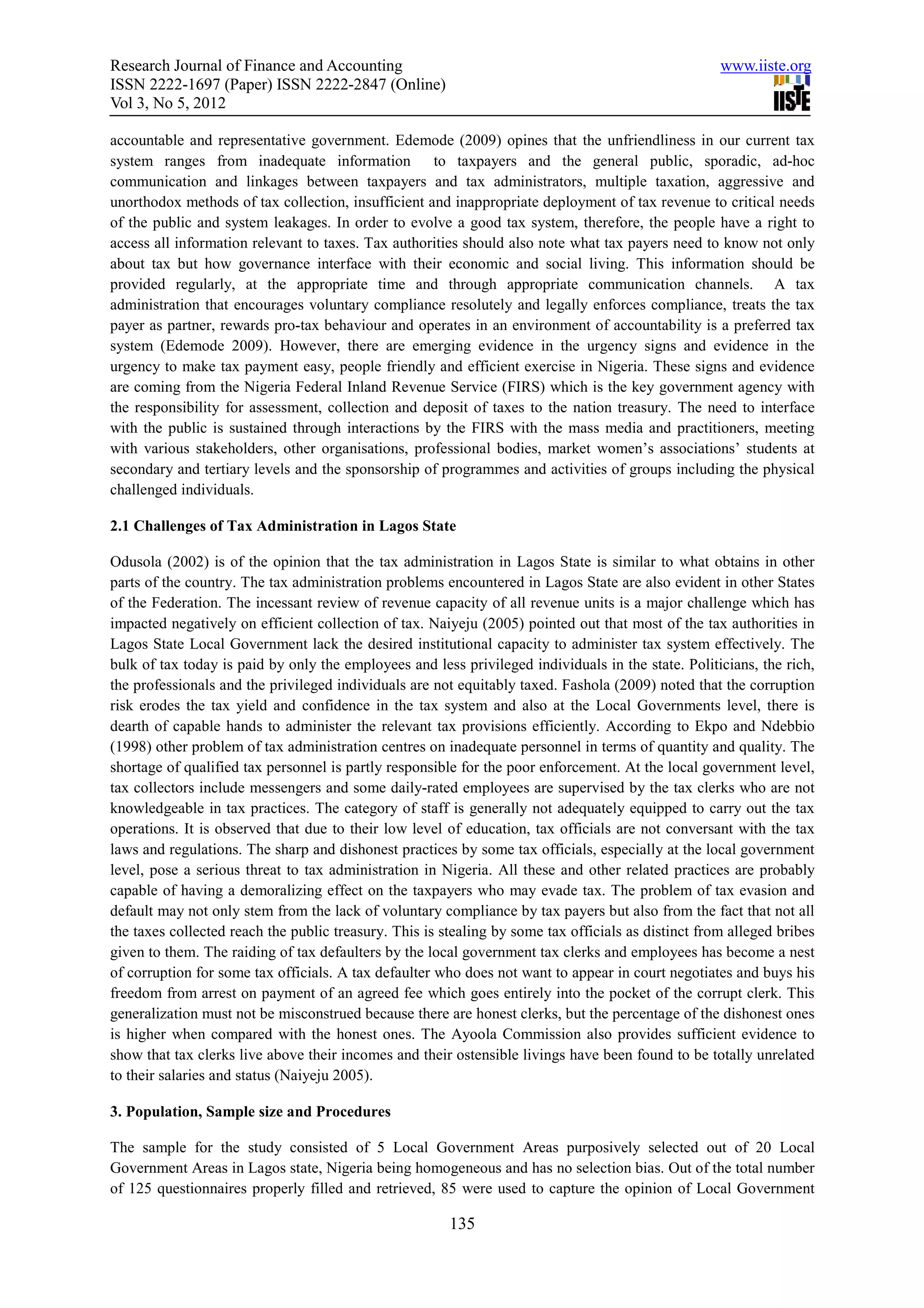
Table 2: Distribution of Respondents
Work categories                                                   No of respondents         %of response
Tax collectors                                                    40                        32.7%
Tax inspectors                                                    38                        30.4%
Head of departments                                               47                        37.6%
Total                                                             125                       100%
Source: Questionnaire administered 2011.
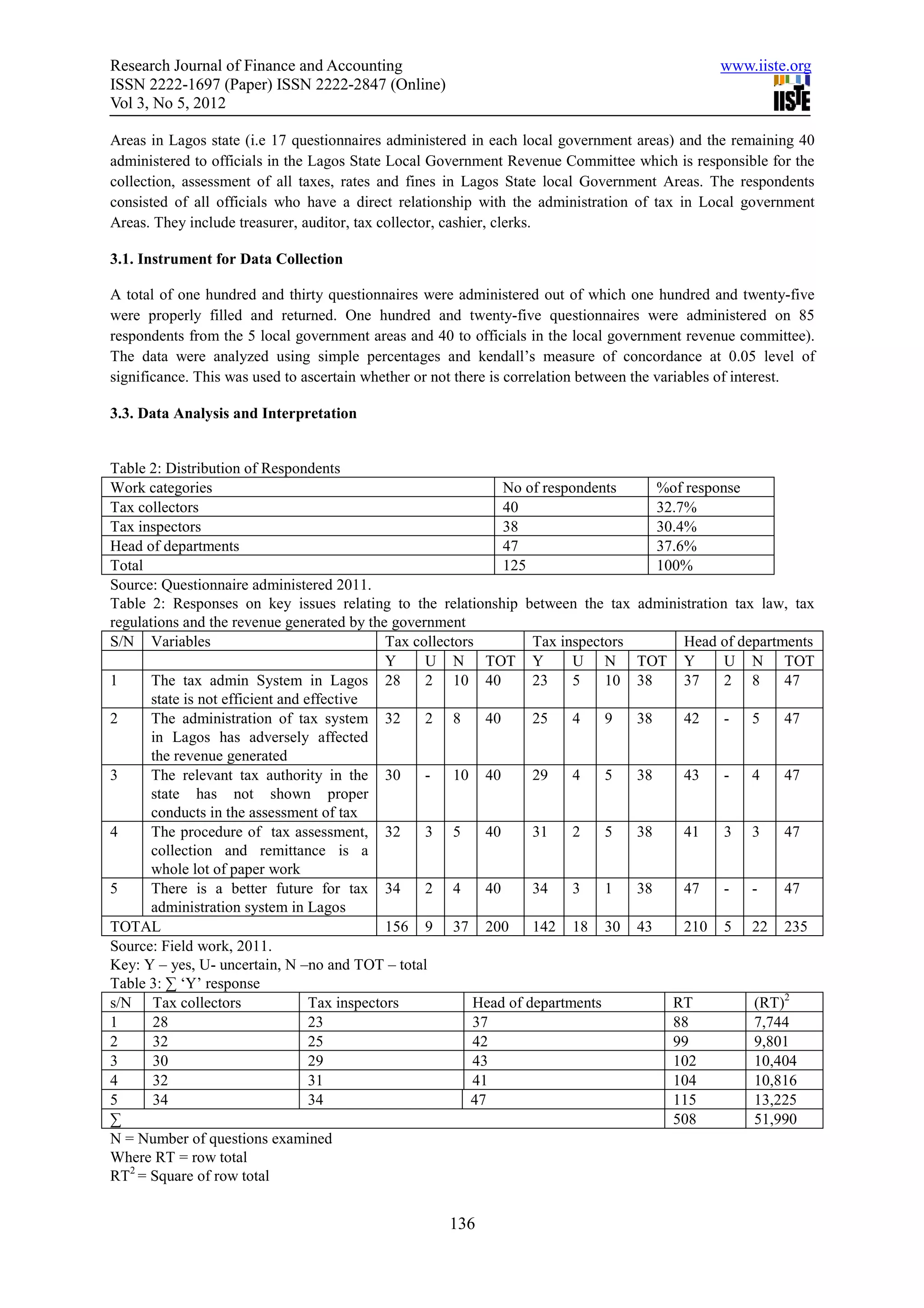
Table 2: Responses on key issues relating to the relationship between the tax          administration tax law, tax
regulations and the revenue generated by the government
S/N Variables                                  Tax collectors         Tax inspectors           Head of departments
                                               Y     U N TOT Y               U N       TOT     Y    U N TOT
1      The tax admin System in Lagos 28              2 10 40          23     5   10    38      37   2 8       47
       state is not efficient and effective
2      The administration of tax system 32           2 8       40     25     4   9     38      42    -     5    47
       in Lagos has adversely affected
       the revenue generated
3      The relevant tax authority in the 30          - 10 40          29     4   5     38      43    -     4    47
       state has not shown proper
       conducts in the assessment of tax
4      The procedure of tax assessment, 32           3 5       40     31     2   5     38      41    3     3    47
       collection and remittance is a
       whole lot of paper work
5      There is a better future for tax 34           2 4       40     34     3   1     38      47    -     -    47
       administration system in Lagos
TOTAL                                          156 9 37 200           142 18 30        43      210   5     22   235
Source: Field work, 2011.
Key: Y – yes, U- uncertain, N –no and TOT – total
Table 3: ∑ ‘Y’ response
s/N Tax collectors                 Tax inspectors            Head of departments              RT           (RT)2
1      28                          23                        37                               88           7,744
2      32                          25                        42                               99           9,801
3      30                          29                        43                               102          10,404
4      32                          31                        41                               104          10,816
5      34                          34                        47                               115          13,225
∑                                                                                             508          51,990
N = Number of questions examined
Where RT = row total
RT2 = Square of row total


                                                      136
Research Journal of Finance and Accounting                                                          www.iiste.org
ISSN 2222-1697 (Paper) ISSN 2222-2847 (Online)
Vol 3, No 5, 2012

The Sum of the Square of Row (SSR) = ∑ RT2 - ∑ (RT) 2
                                                 N
SSR = 51,990 - (508)2
                     5
          =51,990 – 51613
           = 377.2
Computation of Kendall’s W using the sum of the squares computed to obtain Kendall’s W:
W=          3 SSR
          K2 N (N2-1)
Where K = number of observed constituencies which are fifteen items on the questionnaire
Therefore      , 3 × 377.2 = 1,131.6
              (15)2 ×5 (52 -1)   27,000

Computed W          = 0.0419
Using X2 table to measure X2 = K (N – 1) W
                             = 15 (5-1) 0.0419
                                     = 2.51
                     DF= N-1 =5 -1 =4
      Level of significance 0.05 and the table value of X2 = 9.49
At 0.05 level of significance and 4 degree of freedom (df) the computed X2 is 2.51. Since it is less than the
critical X2 (9.49)2. The conclusions are that the tax administration system in Lagos state has tremendously
affected the quantum of revenue the state supposes to generate every year. In addition, the relevant tax authority
in the state has not shown proper conducts in the assessment of tax. Nevertheless, the investigation showed that
with the latest development in respect of tax administration in the state, there is a better future for tax
administration in the state.


4. Findings

The study investigated the revenue generation of Lagos state through analysis of the tax administration system in
the state. Based on the analysis carried out in the course of this study, the following findings were arrived at;
     • tax administration i.e. the assessment, collection and remittance have a significant relationship with the
          revenue generated by local government in the state. The implication of this is the fact that when the
          system of tax administration is not efficient, the revenue generated in the state is affected;
     • most tax payers avoid and evade tax as a result of the corrupt practices of tax officials which in turn
          affect revenue generated by the state;
     • the relationship that exist between the tax administration and tax regulation is that of a direct
          relationship in that when government passes regulation and policies on tax, the administration of tax
          will also be equally affected which could either be in the positive or negative depending on the direction
          of policies and regulations made and tax officials attitude to this laws and policies;
     • tax administration in Lagos state, from the analysis, is found to follow due process.
     • the system of tax administration in Lagos involve a whole lot of paper work and for a better tax
          administration, private organisation should be allowed to take over the administration of tax; and
     •     the study shows that the Lagos State government tax system is not efficient in its totality but during
          recent years the Lagos state government has put in place better means of achieving the best tax
          administration through rigorous campaign on the need for better tax system and curbing the activities of
          corrupt tax officials by putting in place various devices to curb the excesses of these tax officials.


4.1. Conclusions

The effect of tax administration on the revenue generated by local government cannot be overemphasized and as
such the current tax system should be checked and all loopholes should be checked and look into to bring about a
better tax administration in Lagos state. Effective tax administration designed to enhance revenue generation
requires both the commitment of government and time. It is not a process to be rushed into and as such, caution
is needed particularly in respect of getting the right balance of policies and laws to guide tax administration. The
key lesson this study has attempted to convey is that there is no single appropriate tax system for any developing

                                                       137
Research Journal of Finance and Accounting                                                          www.iiste.org
ISSN 2222-1697 (Paper) ISSN 2222-2847 (Online)
Vol 3, No 5, 2012

country that can be plucked off the shelf and implemented without taking into consideration tax policies, laws
and administration. Each system of tax is unique in its administration and therefore every state must be
conversant with the manner in which it is administered.


5. Recommendations

Based on the study, the following are recommended
    i. A conscious effort should be made to enhance the effectiveness of revenue officers of the Local
         Government Revenue Committee. This should be done through conscious effort at training and
         retraining, provision of greater motivation for the personnel and provision of better working
         environment for an enhanced productivity;
    ii. For a better tax administration, adequate machinery should be put in place and strengthened. The level
         of the deterrent punishment should also be made stricter and there should be continuous education for
         the citizens on the importance of tax payment and the problems attached to non- performance of their
         civil obligations;
    iii. Local Government areas on their own part should make good use of the revenue generated to better the
         areas in which they operate. When government does her part, the citizens will not default in the
         payment of tax which at the end will affect the overall tax system;
    iv. As part of the overall strategy to put in place for a better tax administration in Lagos state, some of the
         activities of the local Government Revenue Committee should be handed over to private companies. It
         is clear that private companies which performs outsourcing function undertake core tax administration
         activities which are necessary and functioning properly than those performed in-house by tax officials
         of the committee;
    v. To further encourage effective tax administration, a simplified income tax assessment form and a tax
         table should be introduced to assist people in determining their own tax liability. Mini tax offices should
         be established in all the major markets to effect and simplify the collection of tax by tax collectors.
         More importantly, Local governments in Lagos state should partner with collecting Banks which will
         enable an individual tax payer to conveniently assess himself by reference to a table which shows
         various income brackets, the allowances and tax payable in respect of each; and
    vi. In addition to liaising with collecting banks, the database for tax administration at the local government
         areas should be computerized to ensure that the system of information storage, processing and retrieval
         is efficient. Tax clearance certificate should also be presented where an individual wants to transact
         business with government agencies.


References

Adebayo, A. (1970): Local Government Finance in Nigeria: Problems and Prospects, Ile-Ife: University of Ife
Press Ltd.

Adedokun, A.A.(2004):The Development of Local Government in Nigeria since Pre-Colonial               Era to 1999
Constitution. Polycom Journal, Vol.2, No. 2, Pg115-120.
Adesola, S.M. (2004): Income Tax Law and Administration in Nigeria, Ile-Ife: University of           Ife Press Ltd.

Adejuwon, J. A. (1998): Analysis of Tax Principles for Nigerian Students, Lagos: Adejuwon            and       Co–
Publishers.

Agbetunde, L. A. (2010): Principles and Practice of Nigerian Personal Income Tax, Lagos:             2nd ed. EL-
Toda Venture Ltd.

Ariyo, A. (1997): Productivity of the Nigerian Tax System: 1970-1990’ African Economics Research
Consortium (AFRC), Nairobi, Research Paper 67, 1997.

Arnold, J. B. & Mclntyre, J. M. (2002) International Tax Primer, Second edition, Kluwer Law International, The
Hague, the Netherlands.


                                                       138
Research Journal of Finance and Accounting                                                     www.iiste.org
ISSN 2222-1697 (Paper) ISSN 2222-2847 (Online)
Vol 3, No 5, 2012

Ayua, I.A. (1996): The Nigerian Tax Law, Ibadan: Oyo Spectrum Law Publishing

Bahl, R.W. (1999): Fiscal Decentralization as Development Policy, Public Budgeting &
Finance IXX (summer): Pg. 59 – 75

Bariyama, D.K. and Nwokah N.G (2009): Boston Revenue Generation by Governments in
Nigeria: The Tax Consultant Option Revisited. European Journal of Social Sciences, Vol 8, No 4, 2009

Brautigam, D. (2008):‘Introduction to Taxation and State-Building in Developing Countries, in Brautigam, D.,
Fjeldstad, O-H and M. Moore (Eds) Taxation and State-Building in Developing Countries: Capacity and
Consent, Cambridge University Press,       Cambridge, pg. 1-33, pg

Edemode J. (2009): Towards a People-Focused Tax System in Nigeria, Guage – A Quarterly
Publication of Federal Inland Revenue Service (FIRS) Oct-Dec 2009

Ekpo, A.H. & Ndebbio, E.U. (1998), Local Government Fiscal Operations in Nigeria,        African    Economic
Research Consortium (AERC) Research Paper 73, Nairobi March        1998.Available        from: http:// www.
Aercafrica. Org/ documents/rp73.pdf (Accessed    20/11/2010)

Ipaye A. (2008): Lagos State government to harmonise tax collection. The Vanguard, 7th
November, Pg. 15

Mikisell, J. L. (2003): Internal Experiences with Administration of Local Taxes: A Review of
Practices and Issues, Current Draft of July 2003

Mckerchar M. & Evans C. (2009): Sustaining Growth in Developing Economies through Improved Tax Payer
Compliance: Challenges for Policy Makers and Revenue    Authorities.

E-journal of Tax Research (2009) Vol. 7, No. 2, Pg. 171 -201

Naiyeju J. K (2010): Nigerian Speaks on Taxation: A tool for Social Change   Administration in Nigeria and
the Issue of Tax Refund. A paper presented as part of Nigerian 50th Anniversary Celebration at Aso Hall Oct
1, 2010.

Odusola, A. F. (2002): ‘Kwara State Public Expenditure Review’. A Technical Report on State Public
Expenditure Review in Nigeria Submitted to the World Bank. Abuja, May, 2002

Odusola, A. F. (2006): Tax Policy Reforms in Nigeria’. A Research work of UNU-WIDER
(United Nations University-World Institute for Development Economies Research), Research Paper No. 2006/03
Pg. 1-45
Phillips, A. (1997): Nigeria’s Fiscal Policy, 1998–2000. NISER Monograph Series No.17. Ibadan: Nigeria
Institute for Social and Economic Research.

Fashola, B.R (2009): My Fellow Citizens of Lagos State, Speech Delivered at the        Inauguration      and
Fund Raising Ceremony of Eko Club (London) of Nigeria Official Gazette, Act 27 (86) Lagos


                                                      139
This academic article was published by The International Institute for Science,
Technology and Education (IISTE). The IISTE is a pioneer in the Open Access
Publishing service based in the U.S. and Europe. The aim of the institute is
Accelerating Global Knowledge Sharing.

More information about the publisher can be found in the IISTE’s homepage:
http://www.iiste.org


The IISTE is currently hosting more than 30 peer-reviewed academic journals and
collaborating with academic institutions around the world. Prospective authors of
IISTE journals can find the submission instruction on the following page:
http://www.iiste.org/Journals/

The IISTE editorial team promises to the review and publish all the qualified
submissions in a fast manner. All the journals articles are available online to the
readers all over the world without financial, legal, or technical barriers other than
those inseparable from gaining access to the internet itself. Printed version of the
journals is also available upon request of readers and authors.

IISTE Knowledge Sharing Partners

EBSCO, Index Copernicus, Ulrich's Periodicals Directory, JournalTOCS, PKP Open
Archives Harvester, Bielefeld Academic Search Engine, Elektronische
Zeitschriftenbibliothek EZB, Open J-Gate, OCLC WorldCat, Universe Digtial
Library , NewJour, Google Scholar

Tax administration and revenue generation of lagos state government, nigeria

  • 1.
    Research Journal ofFinance and Accounting www.iiste.org ISSN 2222-1697 (Paper) ISSN 2222-2847 (Online) Vol 3, No 5, 2012 Tax Administration and Revenue Generation of Lagos State Government, Nigeria John A. Enahoro1* OLABISI Jayeola1.2 1. Department of Accounting, Babcock University, Ogun State, Nigeria. 2. Department of Financial Studies, Redeemer’s University, Ogun State, Nigeria. * E-mail of the corresponding author: jayeolaolabisi@yahoo.com Abstract The study examines the overall effectiveness of tax administration in relation to assessment, collection and remittance of tax in Lagos State, Nigeria. A survey questionnaire of the machinery of tax administration was carried out where 130 questionnaires were administered to analyse the opinion of civil servants directly connected with tax administration in the five Local government areas of Lagos State (Somulu, Mushin, Ikeja, Kosofe and Surulere). Hypothesis tested for the relationship which exists between tax administration, tax regulation and revenue generation. The Kendall measure was adopted and finding is that the tax administration in Lagos state is not totally efficient. Hence, tax administration affects the revenue generated by the government; also, there is a significant relationship between tax administration, tax policies and tax laws. The study therefore recommends that Lagos State Government could put in place a tax system that can enhance better administration of tax systems and tax collections should be left in the hands of private organisations. Keywords: Taxation, Administration, Revenue and Tax laws 1. Introduction Ariwodola (2001) described tax as a compulsory levy imposed by the government authority through its agents on its subjects or his property to achieve some goals. Arnold and Mclntyre, (2002) define tax as a compulsory levy on income, consumption and production of goods and services as provided by the relevant legislation. Tax is a charge imposed by government authority upon property, individuals, or transactions to raise money for public purposes. This definition is however imperfect. The study of the teachings of Christianity, Islamic and other prominent religions in the world shows that tax is a religious duty based on social and civil responsibilities (Agbetunde 2004). They all support and encourage tax imposition either to redistribute wealth or to finance government project. The Nigerian tax administration is in line with the British model of tax administration since 1960 and has been operating this up to 1990 when the self-assessment scheme came into play which seems similar to the American model of tax administration system (Adesola 2004). The British model of tax administration assumes tax payers are incompetent as to tax process and tax authorities do not rely on information supplied by tax payers. Returns of the tax payer are carefully verified through the application of the American model in reference to the rigid British model. The American model despite the advantages that can be derived from its application has not found a good place in Nigeria because all the phenomenon that made it a success in America such as voluntary compliance system, competence of tax payer, efficient data processing system which aids detection of fraud are still not present the Nigeria context. Consequently disadvantage has adversely impacted on local government tax system since they are part of the ruling process in the state. Such impact has generally been based on problems associated with collection, assessment and returns procedures in the local government area. There is doubt on how efficient the tax authority and other bodies participating in the collection of tax and make returns to the local and state government. In an economy like Nigeria where great reliance is placed on one source of revenue by the state government, the understanding and appreciation of the significance of tax as a source of revenue is of paramount importance. This is not only to enable one the opportunity to examine potential revenue generated in the state but to enable the decision makers and government to appreciate the need for administration changes within the context of tax system. In this study, effort was made to assess Lagos State tax administration system and how it could serve as a veritable tool for revenue generation of the state. The result of the study shows that tax administration affects the revenue generated by the government and that there is a significant relationship between tax administration, tax policies and tax laws. 1.1The Issue In most countries, tax system is seen as an embodiment of contention and controversy whether in its policy formulation, legislation or administration (Bariyama & Gladson 2009). There is huge scale of corrupt practices prevalent in Nigeria. Under the administration of tax in Nigeria, Ayua (1996) pointed out that the major problem lies in the procedures, machinery and approaches adopted in collection, assessment and corrupt practices of tax 133
  • 2.
    Research Journal ofFinance and Accounting www.iiste.org ISSN 2222-1697 (Paper) ISSN 2222-2847 (Online) Vol 3, No 5, 2012 officials in implementing the tax system. Ayua (1996) opines that the tax system is grossly inadequate as it is characterized with tax evasion, avoidance and record falsifications which account for the consistent low tax yields. The problems associated with an enquiry into the tax administration in Nigeria are pretty numerous but little or no studies have been done to comprehensively examine the system in a manner that attempts to relate the tax administration to tax laws and policies in Nigeria. This dearth of economic literature on comprehensive analysis of tax administration, policies and law in our economy apparently leaves a gap between what the people perceive to be reliable tax revenue administration and what it is in reality. With this as the background together with the fact that tax administration is one of the most important but least studied aspects of fiscal reform in developing economies, there appears considerable scope for the study. This study therefore, seeks to study how tax administration in Nigeria could affect the overall effectiveness of Lagos State revenue generation in relation to assessment, collection and remittance of tax. The general objective of the study is to analyse and assess the tax system in Nigeria with emphasis on tax administration in Lagos State which includes collections, assessment, filling returns and tax proceeds of Lagos State. The specific objectives are; to • evaluate the effectiveness of the assessment, collection and remittance of tax system in Lagos State; • assess the future prospect of Lagos State tax administration, in the light of better administration for revenue generation; and • proffering suitable solutions to the problems facing the tax administration system in Lagos State. 2. Overview of Tax System in Nigeria Odusola (2006) is of the opinion that Nigeria is governed by a federal system, hence its fiscal operations also adhere to the same principle which has serious implications on how the tax system is managed in the country. In Nigeria, the government’s fiscal power is based on a three-tiered tax structure i.e. the Federal, State and Local Governments, each of which has different tax jurisdictions. In 2002, about 40 different taxes and levies are shared by all three levels of government. Odusola (2006) stated that Nigeria’s tax system is characterized by unnecessary complexity, distortion and largely inequitable tax laws that have limited application in the informal sector that dominates the economy. Abubakar (2008) further opined that the Nigerian tax system has undergone significant changes in recent times. The tax system is the process of taxation involving sets of rules, regulations and procedures with the organs of administration interacting with one another to generate fund for government (Agbetunde 2010). The Nigerian system is of tripartite activities which include the tax laws, tax policies and tax administration (Adesola 2004). Under current Nigerian law, taxation is enforced by the three tiers of Government, i.e. Federal, State, and Local Government with each having its sphere clearly spelt out in the Taxes and Levies (approved list for Collection) Decree, 1998 (Abubakar, 2008). In as much as the Nigerian Tax system is structured as a tool for revenue generation, Naiyeju (2010) and Odusola (2006) asserted that the system is seen as being lopsided, and dominated by oil revenue. The most veritable tax handles are under the control of the federal government while the lower tiers are responsible for the less buoyant sources, which imply that the federal government tax corporate bodies while state and local governments’ tax individuals. The federal government on average accounts for 90 per cent of the overall tax revenue annually but, only accounts for about 70 per cent of total government expenditure. In 1995, the breakdown of total tax and levy collection of the three tiers was 96.4 per cent for the federal government, 3.2 per cent for the state and 0.4 per cent for the local government (Phillips 1997). Ahmad (2005) pointed out that the objectives of tax system are multi-dimensional in nature which includes revenue generation, resources allocation, a fiscal tool for stimulating economic growth and development and Social functions, like redressing the rural-urban population drift, and making everybody to be a responsible. Taxes, and tax systems, are fundamental components of any attempts to build nations, and this is particularly the case in developing or transitional nations. As Brautigam (2008) has noted, taxes underwrite the capacity of local government to carry out their goal, they form one of the central arenas for the conduct of local government-state relations, and they shape the balance between accumulation and redistribution that gives local government their social character. Tax builds capacity such as provision of security, meeting basic needs or fostering economic development. It also builds legitimacy and consent such as creation of consensual, 134
  • 3.
    Research Journal ofFinance and Accounting www.iiste.org ISSN 2222-1697 (Paper) ISSN 2222-2847 (Online) Vol 3, No 5, 2012 accountable and representative government. Edemode (2009) opines that the unfriendliness in our current tax system ranges from inadequate information to taxpayers and the general public, sporadic, ad-hoc communication and linkages between taxpayers and tax administrators, multiple taxation, aggressive and unorthodox methods of tax collection, insufficient and inappropriate deployment of tax revenue to critical needs of the public and system leakages. In order to evolve a good tax system, therefore, the people have a right to access all information relevant to taxes. Tax authorities should also note what tax payers need to know not only about tax but how governance interface with their economic and social living. This information should be provided regularly, at the appropriate time and through appropriate communication channels. A tax administration that encourages voluntary compliance resolutely and legally enforces compliance, treats the tax payer as partner, rewards pro-tax behaviour and operates in an environment of accountability is a preferred tax system (Edemode 2009). However, there are emerging evidence in the urgency signs and evidence in the urgency to make tax payment easy, people friendly and efficient exercise in Nigeria. These signs and evidence are coming from the Nigeria Federal Inland Revenue Service (FIRS) which is the key government agency with the responsibility for assessment, collection and deposit of taxes to the nation treasury. The need to interface with the public is sustained through interactions by the FIRS with the mass media and practitioners, meeting with various stakeholders, other organisations, professional bodies, market women’s associations’ students at secondary and tertiary levels and the sponsorship of programmes and activities of groups including the physical challenged individuals. 2.1 Challenges of Tax Administration in Lagos State Odusola (2002) is of the opinion that the tax administration in Lagos State is similar to what obtains in other parts of the country. The tax administration problems encountered in Lagos State are also evident in other States of the Federation. The incessant review of revenue capacity of all revenue units is a major challenge which has impacted negatively on efficient collection of tax. Naiyeju (2005) pointed out that most of the tax authorities in Lagos State Local Government lack the desired institutional capacity to administer tax system effectively. The bulk of tax today is paid by only the employees and less privileged individuals in the state. Politicians, the rich, the professionals and the privileged individuals are not equitably taxed. Fashola (2009) noted that the corruption risk erodes the tax yield and confidence in the tax system and also at the Local Governments level, there is dearth of capable hands to administer the relevant tax provisions efficiently. According to Ekpo and Ndebbio (1998) other problem of tax administration centres on inadequate personnel in terms of quantity and quality. The shortage of qualified tax personnel is partly responsible for the poor enforcement. At the local government level, tax collectors include messengers and some daily-rated employees are supervised by the tax clerks who are not knowledgeable in tax practices. The category of staff is generally not adequately equipped to carry out the tax operations. It is observed that due to their low level of education, tax officials are not conversant with the tax laws and regulations. The sharp and dishonest practices by some tax officials, especially at the local government level, pose a serious threat to tax administration in Nigeria. All these and other related practices are probably capable of having a demoralizing effect on the taxpayers who may evade tax. The problem of tax evasion and default may not only stem from the lack of voluntary compliance by tax payers but also from the fact that not all the taxes collected reach the public treasury. This is stealing by some tax officials as distinct from alleged bribes given to them. The raiding of tax defaulters by the local government tax clerks and employees has become a nest of corruption for some tax officials. A tax defaulter who does not want to appear in court negotiates and buys his freedom from arrest on payment of an agreed fee which goes entirely into the pocket of the corrupt clerk. This generalization must not be misconstrued because there are honest clerks, but the percentage of the dishonest ones is higher when compared with the honest ones. The Ayoola Commission also provides sufficient evidence to show that tax clerks live above their incomes and their ostensible livings have been found to be totally unrelated to their salaries and status (Naiyeju 2005). 3. Population, Sample size and Procedures The sample for the study consisted of 5 Local Government Areas purposively selected out of 20 Local Government Areas in Lagos state, Nigeria being homogeneous and has no selection bias. Out of the total number of 125 questionnaires properly filled and retrieved, 85 were used to capture the opinion of Local Government 135
  • 4.
    Research Journal ofFinance and Accounting www.iiste.org ISSN 2222-1697 (Paper) ISSN 2222-2847 (Online) Vol 3, No 5, 2012 Areas in Lagos state (i.e 17 questionnaires administered in each local government areas) and the remaining 40 administered to officials in the Lagos State Local Government Revenue Committee which is responsible for the collection, assessment of all taxes, rates and fines in Lagos State local Government Areas. The respondents consisted of all officials who have a direct relationship with the administration of tax in Local government Areas. They include treasurer, auditor, tax collector, cashier, clerks. 3.1. Instrument for Data Collection A total of one hundred and thirty questionnaires were administered out of which one hundred and twenty-five were properly filled and returned. One hundred and twenty-five questionnaires were administered on 85 respondents from the 5 local government areas and 40 to officials in the local government revenue committee). The data were analyzed using simple percentages and kendall’s measure of concordance at 0.05 level of significance. This was used to ascertain whether or not there is correlation between the variables of interest. 3.3. Data Analysis and Interpretation Table 2: Distribution of Respondents Work categories No of respondents %of response Tax collectors 40 32.7% Tax inspectors 38 30.4% Head of departments 47 37.6% Total 125 100% Source: Questionnaire administered 2011. Table 2: Responses on key issues relating to the relationship between the tax administration tax law, tax regulations and the revenue generated by the government S/N Variables Tax collectors Tax inspectors Head of departments Y U N TOT Y U N TOT Y U N TOT 1 The tax admin System in Lagos 28 2 10 40 23 5 10 38 37 2 8 47 state is not efficient and effective 2 The administration of tax system 32 2 8 40 25 4 9 38 42 - 5 47 in Lagos has adversely affected the revenue generated 3 The relevant tax authority in the 30 - 10 40 29 4 5 38 43 - 4 47 state has not shown proper conducts in the assessment of tax 4 The procedure of tax assessment, 32 3 5 40 31 2 5 38 41 3 3 47 collection and remittance is a whole lot of paper work 5 There is a better future for tax 34 2 4 40 34 3 1 38 47 - - 47 administration system in Lagos TOTAL 156 9 37 200 142 18 30 43 210 5 22 235 Source: Field work, 2011. Key: Y – yes, U- uncertain, N –no and TOT – total Table 3: ∑ ‘Y’ response s/N Tax collectors Tax inspectors Head of departments RT (RT)2 1 28 23 37 88 7,744 2 32 25 42 99 9,801 3 30 29 43 102 10,404 4 32 31 41 104 10,816 5 34 34 47 115 13,225 ∑ 508 51,990 N = Number of questions examined Where RT = row total RT2 = Square of row total 136
  • 5.
    Research Journal ofFinance and Accounting www.iiste.org ISSN 2222-1697 (Paper) ISSN 2222-2847 (Online) Vol 3, No 5, 2012 The Sum of the Square of Row (SSR) = ∑ RT2 - ∑ (RT) 2 N SSR = 51,990 - (508)2 5 =51,990 – 51613 = 377.2 Computation of Kendall’s W using the sum of the squares computed to obtain Kendall’s W: W= 3 SSR K2 N (N2-1) Where K = number of observed constituencies which are fifteen items on the questionnaire Therefore , 3 × 377.2 = 1,131.6 (15)2 ×5 (52 -1) 27,000 Computed W = 0.0419 Using X2 table to measure X2 = K (N – 1) W = 15 (5-1) 0.0419 = 2.51 DF= N-1 =5 -1 =4 Level of significance 0.05 and the table value of X2 = 9.49 At 0.05 level of significance and 4 degree of freedom (df) the computed X2 is 2.51. Since it is less than the critical X2 (9.49)2. The conclusions are that the tax administration system in Lagos state has tremendously affected the quantum of revenue the state supposes to generate every year. In addition, the relevant tax authority in the state has not shown proper conducts in the assessment of tax. Nevertheless, the investigation showed that with the latest development in respect of tax administration in the state, there is a better future for tax administration in the state. 4. Findings The study investigated the revenue generation of Lagos state through analysis of the tax administration system in the state. Based on the analysis carried out in the course of this study, the following findings were arrived at; • tax administration i.e. the assessment, collection and remittance have a significant relationship with the revenue generated by local government in the state. The implication of this is the fact that when the system of tax administration is not efficient, the revenue generated in the state is affected; • most tax payers avoid and evade tax as a result of the corrupt practices of tax officials which in turn affect revenue generated by the state; • the relationship that exist between the tax administration and tax regulation is that of a direct relationship in that when government passes regulation and policies on tax, the administration of tax will also be equally affected which could either be in the positive or negative depending on the direction of policies and regulations made and tax officials attitude to this laws and policies; • tax administration in Lagos state, from the analysis, is found to follow due process. • the system of tax administration in Lagos involve a whole lot of paper work and for a better tax administration, private organisation should be allowed to take over the administration of tax; and • the study shows that the Lagos State government tax system is not efficient in its totality but during recent years the Lagos state government has put in place better means of achieving the best tax administration through rigorous campaign on the need for better tax system and curbing the activities of corrupt tax officials by putting in place various devices to curb the excesses of these tax officials. 4.1. Conclusions The effect of tax administration on the revenue generated by local government cannot be overemphasized and as such the current tax system should be checked and all loopholes should be checked and look into to bring about a better tax administration in Lagos state. Effective tax administration designed to enhance revenue generation requires both the commitment of government and time. It is not a process to be rushed into and as such, caution is needed particularly in respect of getting the right balance of policies and laws to guide tax administration. The key lesson this study has attempted to convey is that there is no single appropriate tax system for any developing 137
  • 6.
    Research Journal ofFinance and Accounting www.iiste.org ISSN 2222-1697 (Paper) ISSN 2222-2847 (Online) Vol 3, No 5, 2012 country that can be plucked off the shelf and implemented without taking into consideration tax policies, laws and administration. Each system of tax is unique in its administration and therefore every state must be conversant with the manner in which it is administered. 5. Recommendations Based on the study, the following are recommended i. A conscious effort should be made to enhance the effectiveness of revenue officers of the Local Government Revenue Committee. This should be done through conscious effort at training and retraining, provision of greater motivation for the personnel and provision of better working environment for an enhanced productivity; ii. For a better tax administration, adequate machinery should be put in place and strengthened. The level of the deterrent punishment should also be made stricter and there should be continuous education for the citizens on the importance of tax payment and the problems attached to non- performance of their civil obligations; iii. Local Government areas on their own part should make good use of the revenue generated to better the areas in which they operate. When government does her part, the citizens will not default in the payment of tax which at the end will affect the overall tax system; iv. As part of the overall strategy to put in place for a better tax administration in Lagos state, some of the activities of the local Government Revenue Committee should be handed over to private companies. It is clear that private companies which performs outsourcing function undertake core tax administration activities which are necessary and functioning properly than those performed in-house by tax officials of the committee; v. To further encourage effective tax administration, a simplified income tax assessment form and a tax table should be introduced to assist people in determining their own tax liability. Mini tax offices should be established in all the major markets to effect and simplify the collection of tax by tax collectors. More importantly, Local governments in Lagos state should partner with collecting Banks which will enable an individual tax payer to conveniently assess himself by reference to a table which shows various income brackets, the allowances and tax payable in respect of each; and vi. In addition to liaising with collecting banks, the database for tax administration at the local government areas should be computerized to ensure that the system of information storage, processing and retrieval is efficient. Tax clearance certificate should also be presented where an individual wants to transact business with government agencies. References Adebayo, A. (1970): Local Government Finance in Nigeria: Problems and Prospects, Ile-Ife: University of Ife Press Ltd. Adedokun, A.A.(2004):The Development of Local Government in Nigeria since Pre-Colonial Era to 1999 Constitution. Polycom Journal, Vol.2, No. 2, Pg115-120. Adesola, S.M. (2004): Income Tax Law and Administration in Nigeria, Ile-Ife: University of Ife Press Ltd. Adejuwon, J. A. (1998): Analysis of Tax Principles for Nigerian Students, Lagos: Adejuwon and Co– Publishers. Agbetunde, L. A. (2010): Principles and Practice of Nigerian Personal Income Tax, Lagos: 2nd ed. EL- Toda Venture Ltd. Ariyo, A. (1997): Productivity of the Nigerian Tax System: 1970-1990’ African Economics Research Consortium (AFRC), Nairobi, Research Paper 67, 1997. Arnold, J. B. & Mclntyre, J. M. (2002) International Tax Primer, Second edition, Kluwer Law International, The Hague, the Netherlands. 138
  • 7.
    Research Journal ofFinance and Accounting www.iiste.org ISSN 2222-1697 (Paper) ISSN 2222-2847 (Online) Vol 3, No 5, 2012 Ayua, I.A. (1996): The Nigerian Tax Law, Ibadan: Oyo Spectrum Law Publishing Bahl, R.W. (1999): Fiscal Decentralization as Development Policy, Public Budgeting & Finance IXX (summer): Pg. 59 – 75 Bariyama, D.K. and Nwokah N.G (2009): Boston Revenue Generation by Governments in Nigeria: The Tax Consultant Option Revisited. European Journal of Social Sciences, Vol 8, No 4, 2009 Brautigam, D. (2008):‘Introduction to Taxation and State-Building in Developing Countries, in Brautigam, D., Fjeldstad, O-H and M. Moore (Eds) Taxation and State-Building in Developing Countries: Capacity and Consent, Cambridge University Press, Cambridge, pg. 1-33, pg Edemode J. (2009): Towards a People-Focused Tax System in Nigeria, Guage – A Quarterly Publication of Federal Inland Revenue Service (FIRS) Oct-Dec 2009 Ekpo, A.H. & Ndebbio, E.U. (1998), Local Government Fiscal Operations in Nigeria, African Economic Research Consortium (AERC) Research Paper 73, Nairobi March 1998.Available from: http:// www. Aercafrica. Org/ documents/rp73.pdf (Accessed 20/11/2010) Ipaye A. (2008): Lagos State government to harmonise tax collection. The Vanguard, 7th November, Pg. 15 Mikisell, J. L. (2003): Internal Experiences with Administration of Local Taxes: A Review of Practices and Issues, Current Draft of July 2003 Mckerchar M. & Evans C. (2009): Sustaining Growth in Developing Economies through Improved Tax Payer Compliance: Challenges for Policy Makers and Revenue Authorities. E-journal of Tax Research (2009) Vol. 7, No. 2, Pg. 171 -201 Naiyeju J. K (2010): Nigerian Speaks on Taxation: A tool for Social Change Administration in Nigeria and the Issue of Tax Refund. A paper presented as part of Nigerian 50th Anniversary Celebration at Aso Hall Oct 1, 2010. Odusola, A. F. (2002): ‘Kwara State Public Expenditure Review’. A Technical Report on State Public Expenditure Review in Nigeria Submitted to the World Bank. Abuja, May, 2002 Odusola, A. F. (2006): Tax Policy Reforms in Nigeria’. A Research work of UNU-WIDER (United Nations University-World Institute for Development Economies Research), Research Paper No. 2006/03 Pg. 1-45 Phillips, A. (1997): Nigeria’s Fiscal Policy, 1998–2000. NISER Monograph Series No.17. Ibadan: Nigeria Institute for Social and Economic Research. Fashola, B.R (2009): My Fellow Citizens of Lagos State, Speech Delivered at the Inauguration and Fund Raising Ceremony of Eko Club (London) of Nigeria Official Gazette, Act 27 (86) Lagos 139
  • 8.
    This academic articlewas published by The International Institute for Science, Technology and Education (IISTE). The IISTE is a pioneer in the Open Access Publishing service based in the U.S. and Europe. The aim of the institute is Accelerating Global Knowledge Sharing. More information about the publisher can be found in the IISTE’s homepage: http://www.iiste.org The IISTE is currently hosting more than 30 peer-reviewed academic journals and collaborating with academic institutions around the world. Prospective authors of IISTE journals can find the submission instruction on the following page: http://www.iiste.org/Journals/ The IISTE editorial team promises to the review and publish all the qualified submissions in a fast manner. All the journals articles are available online to the readers all over the world without financial, legal, or technical barriers other than those inseparable from gaining access to the internet itself. Printed version of the journals is also available upon request of readers and authors. IISTE Knowledge Sharing Partners EBSCO, Index Copernicus, Ulrich's Periodicals Directory, JournalTOCS, PKP Open Archives Harvester, Bielefeld Academic Search Engine, Elektronische Zeitschriftenbibliothek EZB, Open J-Gate, OCLC WorldCat, Universe Digtial Library , NewJour, Google Scholar