R E B E C C A C O U G H L I N
MY VEGAN TREND
LEAFLET ANALYSIS
THE LEAFLET
IN ORDER
FRONT COVER
I received three versions of people’s feedback evaluation on my booklet, and I’m going to
compare their opinions with my own evaluation on it.
They said that my strongest design in my booklet was my front cover, which I agree with as in my
opinion, the front cover needs to be the most visually appealing aspect of a booklet due to it being
the first thing a reader would see to make them want to read it. One comment from my feedback
said that the images and large title was my strongest part of the front cover. Another thought it
was nicely designed and I had made it clear on what the booklet was about, as well as having a
consistent theme that fits well together.
I had made another front cover beforehand, [image
on the left] but I felt as though it didn’t stand out as
much and it wasn’t colourful enough, which is why I
decided to change it.
I feel like I made the right decision from the feedback
I got, as well as my own opinion on it.
AUDIENCE
I made my booklet with a young adult audience in mind, as I think that age group can
be influenced the most to change their lifestyle for something new. This is why I
decided to research social media and the influence it has on veganism in general. I did
a lot of research and found lots of helpful information that I could write an article about
for my booklet as well as an infographic for it.
From the feedback I got, I found that they thought that having the
infographic have an image of a phone to feature the vegan trend
as well as using the social media logos was a goof was to attract
younger, teenage readers.
I tried to make my booklet as appealing as I could to a younger
audience of both genders by using unisex and neutral colours in
the theme of my booklet throughout it. I feel that by doing this, it
can attract a wider range of readers and therefore educate them
more on the benefits to becoming vegan.
CONTENT
MY BOOKLET INCLUDES 1 FACT FILE, 2 ART ICLES, 3
IN FOGR APHIC S AND 4 MULTI-PAGES.
FACT FILE
The fact file followed my theme of social media by showing which celebrities were
vegan and their reasoning behind it. I really liked this multi-page as it I tried to make it
as simple as I could, while trying to give the readers as much information as I could. I
did this by only using two colours that fit the theme of my booklet, and making use of
the space by using negative space to ‘frame’ the information.
From the feedback I got, they said this fact file was very good due to it showing
popular celebrities who are vegan, and their reasoning behind it. They also said
they thought it grabs the attention of the readers
due to knowing the celebrities, and that this fact file
could influence them in their opinion on veganism in
general.
I am very happy with this feedback as a agree with
it. I purposefully picked doing a fact file on
celebrities as I knew celebrities can be very
influential and they use social media which fits with
the theme of my booklet.
ARTICLE
Main Article: My main article was based on how veganism is becoming more popular
on social media. I used a bright image to act as a header image at the top of the
article, and then pull-quotes to split up the text and to grab the readers attention more.
From my feedback, the only criticism for this article was that the first page is too simple
and doesn’t stand out like the rest of it which I agree with. If I could improve it, I’d add
a pull-quote to it and more images.
Veganuary Article: I decided to add another article to my booklet as I had so many
images. I wrote a small article explaining what ‘Veganuary’ was and why
it’s really good to
take part in.
I used their logo
on one of their
own images to
make sure the
readers knew
what to look out
for online.
INFOGRAPHICS
The Facts Of The Vegan Trend: This infogrpahic was the first one I created, I wanted
to create a simple visual the readers could gather information about before reading the
article which went into even more detail.
Fictional Non-eaters And How They Are Perceived On The TV: Again, I wanted to carry
on with the media theme, so I researched fictional characters who didn’t eat meat and
compared how they were perceived on TV, be it positive or negative. I also
Animals Lives Saved: I made this
small, simple infographic to go
along side the small article on
‘Veganaury’. I really like how it
came out due to it being simple yet
effective with only a little bit of text
on the page.
MULTI-PAGE ARTICLE
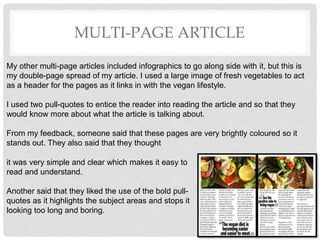
My other multi-page articles included infographics to go along side with it, but this is
my double-page spread of my article. I used a large image of fresh vegetables to act
as a header for the pages as it links in with the vegan lifestyle.
I used two pull-quotes to entice the reader into reading the article and so that they
would know more about what the article is talking about.
From my feedback, someone said that these pages are very brightly coloured so it
stands out. They also said that they thought
it was very simple and clear which makes it easy to
read and understand.
Another said that they liked the use of the bold pull-
quotes as it highlights the subject areas and stops it
looking too long and boring.
WHAT I SHOULD CONSIDER:
PRODUCTION
STYLE
I tried to create a simple style through my booklet so it looked clean and easy to read. I
did this by sticking to a small colour scheme of green, red and white. All the colours
complimented each other, which meant they fit together well and I could use them to
make pages more visually appealing, as well allowing important information stand out
from the page.
From my feedback, one person said that my colour scheme was eye catching, which is
what I was aiming for when I picked the three colours. Another said my theme is
consistent through my booklet, and that it fits together really well.
I tried to keep the theme the same as I could on every page without it being boring. I
did this by using the three colours in different way, as well as setting the layouts of the
pages a little different from the others.
SKILLS I HAVE USED
To create my pages, I used Photoshop. I did this by creating one A4 document, and
then splitting it in half, to make two A5s. This then acted as my leaflet.
I used rotor-scoping to create some of the images on my infographics, which was a
skill I learnt in the previous year.
I also used my writing skills when planning and drafting my articles and information.
SKILLS I HAVE DEVELOPED
I had never used InDesign before, so after being taught how to use it, I developed
some basic skills for it. I created my articles on InDesign by using the margins to set
out the writing in a way to match my already drafted templates for the articles. After
doing this, I measured the space I had left for my photos, and made sure there was
enough room for when I exported the article onto Photoshop.
Other skills I learnt was how to plan a leaflet so it would work once put together. This
meant I had to plan the pages and their order, as well as measurements for the
double-page spreads so that they fit together once side-by-side.
IMPROVEMENT
I sent out a small questionnaire to the public to ask them questions about my booklet,
and one of those questions was ‘Is there anything you don't like, or would change?’,
and from the answers, I got many answers with their opinion on how I could improve
parts of my booklet.
One of the respondents said that they don’t like that the words are split across different
lines due to the hyphens. I noticed this myself and wanted to change it, but due to
time, I could only correct my small article and not the main one.
Also, one thought that the first page of my article was too boring, compared to my
multi-page article, which I agree with. If I could have, I would have improved this part
by adding more images and pull-quotes on this page to entice the reader into reading
about it more.
IMPROVEMENT: FRONT PAGE
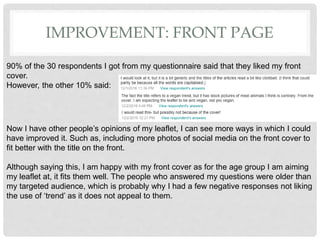
90% of the 30 respondents I got from my questionnaire said that they liked my front
cover.
However, the other 10% said:
Now I have other people’s opinions of my leaflet, I can see more ways in which I could
have improved it. Such as, including more photos of social media on the front cover to
fit better with the title on the front.
Although saying this, I am happy with my front cover as for the age group I am aiming
my leaflet at, it fits them well. The people who answered my questions were older than
my targeted audience, which is probably why I had a few negative responses not liking
the use of ‘trend’ as it does not appeal to them.
IMPROVEMENT: COLOUR SCHEME AND
STYLE
93% of the 30 respondents said the colours were cohesive throughout my leaflet and
that they really liked the colour scheme as it contrasts well as fits in with the theme,
such as the green connoting veganism.
However, the other 7% said:
Most of my respondents were happy with my chosen colour scheme and style of the
leaflet, but some said my colours aren’t consistent enough throughout the booklet and
that the colour red doesn’t fit well with the theme. Although I can see where they are
coming from, I disagree with this opinion as I was very careful to only use my chosen
colours which I though worked well together. I also chose to use the red shade
because it contrasted well with the other colours, making important information stand
out more.
If I were to improve the leaflet, I would make sure the colour is used more, such as in
the background to make the leaflet stand out more.
IMPROVEMENT: READABILITY
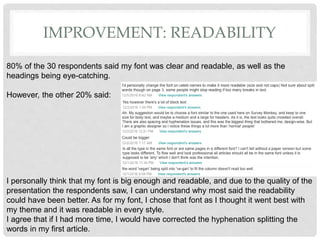
80% of the 30 respondents said my font was clear and readable, as well as the
headings being eye-catching.
However, the other 20% said:
I personally think that my font is big enough and readable, and due to the quality of the
presentation the respondents saw, I can understand why most said the readability
could have been better. As for my font, I chose that font as I thought it went best with
my theme and it was readable in every style.
I agree that if I had more time, I would have corrected the hyphenation splitting the
words in my first article.
IMPROVEMENT: LAYOUT
87% of the 30 respondents said they like the layout and that it works very well so it’s
clear and easy to follow when reading the leaflet.
However, the other 3% said:
I really enjoyed making my layout as I thought it all worked well with the theme and
young audience aim, but there is always room for improvement. From my respondents,
I have found out that some would prefer the text to be a bit bigger and spread out more
on the pages, as well making sure every page is well-spaced out.
IMPROVEMENT: INFORMATION
90% of the 30 respondents said my information was great and influential, especially
the info-graphics.
However, the other 10% said:
To improve my information more, I could have focused a bit more on the vegan
lifestyle, although the main aim of my booklet was to inform people about the growing
vegan trend, not so much about what they can eat. I also feel that my first page isn’t
negative, as it’s about the increase of research done into veganism and vegetarianism.
But, I can see why it could be confusing, so if I had more time, I would make the points
clearer.
IMPROVEMENT: INFOGRAPHICS
97% of the 30 respondents said that the infographics were interesting and had good
layouts. ‘Eye catching and giving enough information without over crowding.’
However, the other 3% said:
As my leaflet was more based on social media trends, it wasn’t necessarily meant to
be used as a persuasion leaflet, I was making it more of an informative one.
However, I could have added more positive facts throughout it to make it a bit more
persuasive.
I SHOULD DISCUSS MY:
POST-PRODUCTION
PLANNING
To plan my leaflet, I first decided on the topic I was going to research, I decided to stick
with my knowledge of media and research more about the vegan trend on social
media and how it is affecting people and the way they see the life-style.
After doing this, I created a mood board so I would be able to play around with themes,
layouts and colours. I chose many different fonts that I thought would work well in my
booklet, and many colours. I finally decided on the final colour scheme and font which
is when I
focused more on the different layouts I could
use for inside the booklet. I found many
templates of layouts I could use or get
inspiration from.
I also created the leaflet layout with paper so
I could see what my leaflet would look like,
What size it would be, and which page would
be which. I found this really helpful to visually
see it.
PREPARATION
I prepared to make my booklet by doing a lot of research on veganism. I first found out
the basics to educate myself a bit more on the subject matter, but then I picked a topic
I was more passionate about while still including veganism.
I researched a lot about veganism in the media and how it is portrayed, it was harder
than I thought it would be as there wasn’t a lot of information out there or any facts
about it, this meant I had to find them myself. It took longer than I had planned, but it
meant I knew the facts were correct and I could write more about them in my booklet.
After getting my research done, I needed to find images and plan my layout for the
booklet. I looked at many different leaflets to get inspiration from their designs, which is
how I came up with mine.
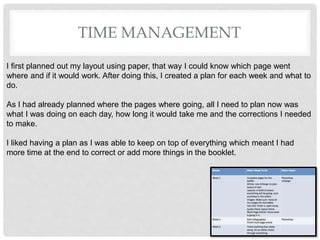
TIME MANAGEMENT
I first planned out my layout using paper, that way I could know which page went
where and if it would work. After doing this, I created a plan for each week and what to
do.
As I had already planned where the pages where going, all I need to plan now was
what I was doing on each day, how long it would take me and the corrections I needed
to make.
I liked having a plan as I was able to keep on top of everything which meant I had
more time at the end to correct or add more things in the booklet.
When looking at my front cover and another
vegan leaflet front cover, I can compare the
designs of them. In the other leaflet, like
mine, it tells you what’s in the leaflet to
interest readers. They have unique looks to
it and a large title. Both have the writing on
the left-hand side with the photo(s) on the
right.
The other leaflet is more professional
looking with brighter colours because it
stands out more and fits in with the subject
of veganism more.
My infographic uses blue tones like the one
next to it I’m comparing it to, and like the
other one, mine also has a contrasting
colour in it.
They both use the same shapes and simple
font style. It also uses percentages and
images like mine.
Both are very similar, and I feel like the other
infographic looks more professional due to
the use of space and information.
My article looks more like it’s from a
magazine than a leaflet where as the other
comparison looks like it would belong to a
leaflet.
I prefer my article to the other as it’s easier
to read and looks more professional,
however, the other is more exciting due to
there being more images and diagrams to
go with the article.
Although these fact finds are very different,
they have a similar layout with the way the
information is presented.
The information is very clear and has
images to match, and so does mine.
There is a theme running though both fact
finds, but I prefer mine as I think the colours
compliment each other better than the other
and it’s easier to read.

Task 6 evaluation finished2

  • 1.
    R E BE C C A C O U G H L I N MY VEGAN TREND LEAFLET ANALYSIS
  • 2.
  • 4.
    FRONT COVER I receivedthree versions of people’s feedback evaluation on my booklet, and I’m going to compare their opinions with my own evaluation on it. They said that my strongest design in my booklet was my front cover, which I agree with as in my opinion, the front cover needs to be the most visually appealing aspect of a booklet due to it being the first thing a reader would see to make them want to read it. One comment from my feedback said that the images and large title was my strongest part of the front cover. Another thought it was nicely designed and I had made it clear on what the booklet was about, as well as having a consistent theme that fits well together. I had made another front cover beforehand, [image on the left] but I felt as though it didn’t stand out as much and it wasn’t colourful enough, which is why I decided to change it. I feel like I made the right decision from the feedback I got, as well as my own opinion on it.
  • 5.
    AUDIENCE I made mybooklet with a young adult audience in mind, as I think that age group can be influenced the most to change their lifestyle for something new. This is why I decided to research social media and the influence it has on veganism in general. I did a lot of research and found lots of helpful information that I could write an article about for my booklet as well as an infographic for it. From the feedback I got, I found that they thought that having the infographic have an image of a phone to feature the vegan trend as well as using the social media logos was a goof was to attract younger, teenage readers. I tried to make my booklet as appealing as I could to a younger audience of both genders by using unisex and neutral colours in the theme of my booklet throughout it. I feel that by doing this, it can attract a wider range of readers and therefore educate them more on the benefits to becoming vegan.
  • 6.
    CONTENT MY BOOKLET INCLUDES1 FACT FILE, 2 ART ICLES, 3 IN FOGR APHIC S AND 4 MULTI-PAGES.
  • 7.
    FACT FILE The factfile followed my theme of social media by showing which celebrities were vegan and their reasoning behind it. I really liked this multi-page as it I tried to make it as simple as I could, while trying to give the readers as much information as I could. I did this by only using two colours that fit the theme of my booklet, and making use of the space by using negative space to ‘frame’ the information. From the feedback I got, they said this fact file was very good due to it showing popular celebrities who are vegan, and their reasoning behind it. They also said they thought it grabs the attention of the readers due to knowing the celebrities, and that this fact file could influence them in their opinion on veganism in general. I am very happy with this feedback as a agree with it. I purposefully picked doing a fact file on celebrities as I knew celebrities can be very influential and they use social media which fits with the theme of my booklet.
  • 8.
    ARTICLE Main Article: Mymain article was based on how veganism is becoming more popular on social media. I used a bright image to act as a header image at the top of the article, and then pull-quotes to split up the text and to grab the readers attention more. From my feedback, the only criticism for this article was that the first page is too simple and doesn’t stand out like the rest of it which I agree with. If I could improve it, I’d add a pull-quote to it and more images. Veganuary Article: I decided to add another article to my booklet as I had so many images. I wrote a small article explaining what ‘Veganuary’ was and why it’s really good to take part in. I used their logo on one of their own images to make sure the readers knew what to look out for online.
  • 9.
    INFOGRAPHICS The Facts OfThe Vegan Trend: This infogrpahic was the first one I created, I wanted to create a simple visual the readers could gather information about before reading the article which went into even more detail. Fictional Non-eaters And How They Are Perceived On The TV: Again, I wanted to carry on with the media theme, so I researched fictional characters who didn’t eat meat and compared how they were perceived on TV, be it positive or negative. I also Animals Lives Saved: I made this small, simple infographic to go along side the small article on ‘Veganaury’. I really like how it came out due to it being simple yet effective with only a little bit of text on the page.
  • 10.
    MULTI-PAGE ARTICLE My othermulti-page articles included infographics to go along side with it, but this is my double-page spread of my article. I used a large image of fresh vegetables to act as a header for the pages as it links in with the vegan lifestyle. I used two pull-quotes to entice the reader into reading the article and so that they would know more about what the article is talking about. From my feedback, someone said that these pages are very brightly coloured so it stands out. They also said that they thought it was very simple and clear which makes it easy to read and understand. Another said that they liked the use of the bold pull- quotes as it highlights the subject areas and stops it looking too long and boring.
  • 11.
    WHAT I SHOULDCONSIDER: PRODUCTION
  • 12.
    STYLE I tried tocreate a simple style through my booklet so it looked clean and easy to read. I did this by sticking to a small colour scheme of green, red and white. All the colours complimented each other, which meant they fit together well and I could use them to make pages more visually appealing, as well allowing important information stand out from the page. From my feedback, one person said that my colour scheme was eye catching, which is what I was aiming for when I picked the three colours. Another said my theme is consistent through my booklet, and that it fits together really well. I tried to keep the theme the same as I could on every page without it being boring. I did this by using the three colours in different way, as well as setting the layouts of the pages a little different from the others.
  • 13.
    SKILLS I HAVEUSED To create my pages, I used Photoshop. I did this by creating one A4 document, and then splitting it in half, to make two A5s. This then acted as my leaflet. I used rotor-scoping to create some of the images on my infographics, which was a skill I learnt in the previous year. I also used my writing skills when planning and drafting my articles and information.
  • 14.
    SKILLS I HAVEDEVELOPED I had never used InDesign before, so after being taught how to use it, I developed some basic skills for it. I created my articles on InDesign by using the margins to set out the writing in a way to match my already drafted templates for the articles. After doing this, I measured the space I had left for my photos, and made sure there was enough room for when I exported the article onto Photoshop. Other skills I learnt was how to plan a leaflet so it would work once put together. This meant I had to plan the pages and their order, as well as measurements for the double-page spreads so that they fit together once side-by-side.
  • 15.
    IMPROVEMENT I sent outa small questionnaire to the public to ask them questions about my booklet, and one of those questions was ‘Is there anything you don't like, or would change?’, and from the answers, I got many answers with their opinion on how I could improve parts of my booklet. One of the respondents said that they don’t like that the words are split across different lines due to the hyphens. I noticed this myself and wanted to change it, but due to time, I could only correct my small article and not the main one. Also, one thought that the first page of my article was too boring, compared to my multi-page article, which I agree with. If I could have, I would have improved this part by adding more images and pull-quotes on this page to entice the reader into reading about it more.
  • 16.
    IMPROVEMENT: FRONT PAGE 90%of the 30 respondents I got from my questionnaire said that they liked my front cover. However, the other 10% said: Now I have other people’s opinions of my leaflet, I can see more ways in which I could have improved it. Such as, including more photos of social media on the front cover to fit better with the title on the front. Although saying this, I am happy with my front cover as for the age group I am aiming my leaflet at, it fits them well. The people who answered my questions were older than my targeted audience, which is probably why I had a few negative responses not liking the use of ‘trend’ as it does not appeal to them.
  • 17.
    IMPROVEMENT: COLOUR SCHEMEAND STYLE 93% of the 30 respondents said the colours were cohesive throughout my leaflet and that they really liked the colour scheme as it contrasts well as fits in with the theme, such as the green connoting veganism. However, the other 7% said: Most of my respondents were happy with my chosen colour scheme and style of the leaflet, but some said my colours aren’t consistent enough throughout the booklet and that the colour red doesn’t fit well with the theme. Although I can see where they are coming from, I disagree with this opinion as I was very careful to only use my chosen colours which I though worked well together. I also chose to use the red shade because it contrasted well with the other colours, making important information stand out more. If I were to improve the leaflet, I would make sure the colour is used more, such as in the background to make the leaflet stand out more.
  • 18.
    IMPROVEMENT: READABILITY 80% ofthe 30 respondents said my font was clear and readable, as well as the headings being eye-catching. However, the other 20% said: I personally think that my font is big enough and readable, and due to the quality of the presentation the respondents saw, I can understand why most said the readability could have been better. As for my font, I chose that font as I thought it went best with my theme and it was readable in every style. I agree that if I had more time, I would have corrected the hyphenation splitting the words in my first article.
  • 19.
    IMPROVEMENT: LAYOUT 87% ofthe 30 respondents said they like the layout and that it works very well so it’s clear and easy to follow when reading the leaflet. However, the other 3% said: I really enjoyed making my layout as I thought it all worked well with the theme and young audience aim, but there is always room for improvement. From my respondents, I have found out that some would prefer the text to be a bit bigger and spread out more on the pages, as well making sure every page is well-spaced out.
  • 20.
    IMPROVEMENT: INFORMATION 90% ofthe 30 respondents said my information was great and influential, especially the info-graphics. However, the other 10% said: To improve my information more, I could have focused a bit more on the vegan lifestyle, although the main aim of my booklet was to inform people about the growing vegan trend, not so much about what they can eat. I also feel that my first page isn’t negative, as it’s about the increase of research done into veganism and vegetarianism. But, I can see why it could be confusing, so if I had more time, I would make the points clearer.
  • 21.
    IMPROVEMENT: INFOGRAPHICS 97% ofthe 30 respondents said that the infographics were interesting and had good layouts. ‘Eye catching and giving enough information without over crowding.’ However, the other 3% said: As my leaflet was more based on social media trends, it wasn’t necessarily meant to be used as a persuasion leaflet, I was making it more of an informative one. However, I could have added more positive facts throughout it to make it a bit more persuasive.
  • 22.
    I SHOULD DISCUSSMY: POST-PRODUCTION
  • 23.
    PLANNING To plan myleaflet, I first decided on the topic I was going to research, I decided to stick with my knowledge of media and research more about the vegan trend on social media and how it is affecting people and the way they see the life-style. After doing this, I created a mood board so I would be able to play around with themes, layouts and colours. I chose many different fonts that I thought would work well in my booklet, and many colours. I finally decided on the final colour scheme and font which is when I focused more on the different layouts I could use for inside the booklet. I found many templates of layouts I could use or get inspiration from. I also created the leaflet layout with paper so I could see what my leaflet would look like, What size it would be, and which page would be which. I found this really helpful to visually see it.
  • 24.
    PREPARATION I prepared tomake my booklet by doing a lot of research on veganism. I first found out the basics to educate myself a bit more on the subject matter, but then I picked a topic I was more passionate about while still including veganism. I researched a lot about veganism in the media and how it is portrayed, it was harder than I thought it would be as there wasn’t a lot of information out there or any facts about it, this meant I had to find them myself. It took longer than I had planned, but it meant I knew the facts were correct and I could write more about them in my booklet. After getting my research done, I needed to find images and plan my layout for the booklet. I looked at many different leaflets to get inspiration from their designs, which is how I came up with mine.
  • 25.
    TIME MANAGEMENT I firstplanned out my layout using paper, that way I could know which page went where and if it would work. After doing this, I created a plan for each week and what to do. As I had already planned where the pages where going, all I need to plan now was what I was doing on each day, how long it would take me and the corrections I needed to make. I liked having a plan as I was able to keep on top of everything which meant I had more time at the end to correct or add more things in the booklet.
  • 26.
    When looking atmy front cover and another vegan leaflet front cover, I can compare the designs of them. In the other leaflet, like mine, it tells you what’s in the leaflet to interest readers. They have unique looks to it and a large title. Both have the writing on the left-hand side with the photo(s) on the right. The other leaflet is more professional looking with brighter colours because it stands out more and fits in with the subject of veganism more. My infographic uses blue tones like the one next to it I’m comparing it to, and like the other one, mine also has a contrasting colour in it. They both use the same shapes and simple font style. It also uses percentages and images like mine. Both are very similar, and I feel like the other infographic looks more professional due to the use of space and information.
  • 27.
    My article looksmore like it’s from a magazine than a leaflet where as the other comparison looks like it would belong to a leaflet. I prefer my article to the other as it’s easier to read and looks more professional, however, the other is more exciting due to there being more images and diagrams to go with the article.
  • 28.
    Although these factfinds are very different, they have a similar layout with the way the information is presented. The information is very clear and has images to match, and so does mine. There is a theme running though both fact finds, but I prefer mine as I think the colours compliment each other better than the other and it’s easier to read.