T3: Product Research
Henry Buckham
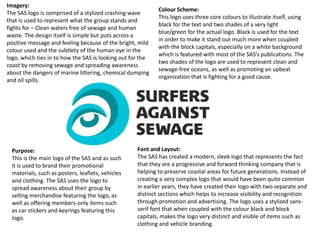
Imagery:
The SAS logo is comprised of a stylized crashing wave
that is used to represent what the group stands and
fights for – Clean waters free of sewage and human
waste. The design itself is simple but puts across a
positive message and feeling because of the bright, mild
colour used and the subtlety of the human eye in the
logo, which ties in to how the SAS is looking out for the
coast by removing sewage and spreading awareness
about the dangers of marine littering, chemical dumping
and oil spills.
Purpose:
This is the main logo of the SAS and as such
it is used to brand their promotional
materials, such as posters, leaflets, vehicles
and clothing. The SAS uses the logo to
spread awareness about their group by
selling merchandise featuring the logo, as
well as offering members-only items such
as car stickers and keyrings featuring this
logo.
Colour Scheme:
This logo uses three core colours to illustrate itself, using
black for the text and two shades of a very light
blue/green for the actual logo. Black is used for the text
in order to make it stand out much more when coupled
with the block capitals, especially on a white background
which is featured with most of the SAS’s publications. The
two shades of the logo are used to represent clean and
sewage-free oceans, as well as promoting an upbeat
organization that is fighting for a good cause.
Font and Layout:
The SAS has created a modern, sleek logo that represents the fact
that they are a progressive and forward thinking company that is
helping to preserve coastal areas for future generations. Instead of
creating a very complex logo that would have been quite common
in earlier years, they have created their logo with two separate and
distinct sections which helps to increase visibility and recognition
through promotion and advertising. The logo uses a stylized sans-
serif font that when coupled with the colour black and block
capitals, makes the logo very distinct and visible of items such as
clothing and vehicle branding.
Purpose:
This leaflet produced by the SAS has been created to inform the public about the
organization and spread awareness about their charity work to clean up coastal and
marine areas. Its intended audience is people it can entice to become members of the
SAS by listing the benefits that members will receive over non-members, as well as
including a membership form on the back of the leaflet for people to send off.
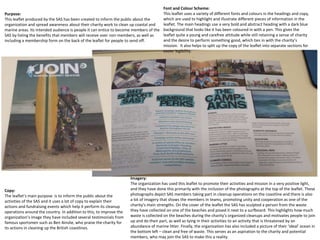
Font and Colour Scheme:
This leaflet uses a variety of different fonts and colours in the headings and copy,
which are used to highlight and illustrate different pieces of information in the
leaflet. The main headings use a very bold and abstract heading with a dark blue
background that looks like it has been coloured in with a pen. This gives the
leaflet quite a young and carefree attitude while still retaining a sense of charity
and the desire to perform something good, which ties in with the charity’s
mission. It also helps to split up the copy of the leaflet into separate sections for
easier legibility.
Copy:
The leaflet’s main purpose is to inform the public about the
activities of the SAS and it uses a lot of copy to explain their
actions and fundraising events which help it perform its cleanup
operations around the country. In addition to this, to improve the
organization’s image they have included several testimonials from
famous sportsmen such as Ben Ainslie, who praise the charity for
its actions in cleaning up the British coastlines.
Imagery:
The organization has used this leaflet to promote their activities and mission in a very positive light,
and they have done this primarily with the inclusion of the photographs at the top of the leaflet. These
photographs depict SAS members taking part in cleanup operations on the coastline and there is also
a lot of imagery that shows the members in teams, promoting unity and cooperation as one of the
charity’s main strengths. On the cover of the leaflet the SAS has sculpted a person from the waste
they have collected on one of the beaches and posed it next to a surfboard. This highlights how much
waste is collected on the beaches during the charity’s organized cleanups and motivates people to join
up and do their part, as well as tying in their activities to an activity that is threatened by an
abundance of marine litter. Finally, the organization has also included a picture of their ‘ideal’ ocean in
the bottom left – clean and free of waste. This serves as an aspiration to the charity and potential
members, who may join the SAS to make this a reality.
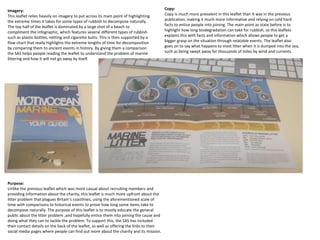
Imagery:
This leaflet relies heavily on imagery to put across its main point of highlighting
the extreme times it takes for some types of rubbish to decompose naturally.
The top half of the leaflet is dominated by a large shot of a beach to
compliment the infographic, which features several different types of rubbish
such as plastic bottles, netting and cigarette butts. This is then supported by a
flow chart that really highlights the extreme lengths of time for decomposition
by comparing them to ancient events in history. By giving them a comparison
the SAS helps people reading the leaflet to understand the problem of marine
littering and how it will not go away by itself.
Copy:
Copy is much more prevalent in this leaflet than It was in the previous
publication, making it much more informative and relying on cold hard
facts to entice people into joining. The main point as state before is to
highlight how long biodegradation can take for rubbish, so this leaflets
explains this with facts and information which allows people to get a
bigger grasp on the situation through relatable events. The leaflet also
goes on to say what happens to most litter when it is dumped into the sea,
such as being swept away for thousands of miles by wind and currents.
Purpose:
Unlike the previous leaflet which was more casual about recruiting members and
providing information about the charity, this leaflet is much more upfront about the
litter problem that plagues Britain’s coastlines, using the aforementioned scale of
time with comparisons to historical events to prove how long some items take to
decompose naturally. The purpose of this leaflet is to mostly educate the general
public about the litter problem ,and hopefully entice them into joining the cause and
doing what they can to tackle the problem. To support this, the SAS has included
their contact details on the back of the leaflet, as well as offering the links to their
social media pages where people can find out more about the charity and its mission.
Purpose:
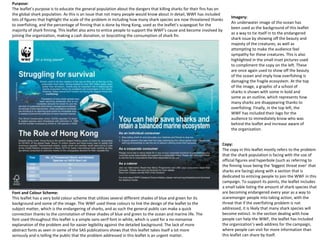
The leaflet’s purpose is to educate the general population about the dangers that killing sharks for their fins has on
the global shark population. As this is an issue that not many people would know about in detail, WWF has included
lots of figures that highlight the scale of the problem in including how many shark species are now threatened thanks
to overfishing, and the percentage of finning that is done by Hong Kong, used as the leaflet’s scapegoat for the
majority of shark finning. This leaflet also aims to entice people to support the WWF’s cause and become involved by
joining the organization, making a cash donation, or boycotting the consumption of shark fin.
Font and Colour Scheme:
This leaflet has a very bold colour scheme that utilizes several different shades of blue and green for its
background and some of the image. The WWF used these colours to link the design of the leaflet to the
subject matter, which is the endangering of sharks, and as such the general public can make a quick
connection thanks to the connotation of these shades of blue and green to the ocean and marine life. The
font used throughout this leaflet is a simple sans-serif font in white, which is used for a no-nonsense
explanation of the problem and for easier legibility against the detailed background. The lack of more
abstract fonts as seen in some of the SAS publications shows that this leaflet takes itself a lot more
seriously and is telling the public that the problem addressed in this leaflet is an urgent matter.
Copy:
The copy in this leaflet mostly refers to the problem
that the shark population is facing with the use of
official figures and hyperbole (such as referring to
the finning issue being the ‘biggest threat ever’ that
sharks are facing) along with a section that is
dedicated to enticing people to join the WWF in this
campaign. To support its points, the leaflet includes
a small table listing the amount of shark species that
are becoming endangered every year as a way to
scaremonger people into taking action, with the
threat that if the overfishing problem is not
addressed, it is likely that many shark species will
become extinct. In the section dealing with how
people can help the WWF, the leaflet has included
the organization’s web address for the campaign,
where people can visit for more information than
this leaflet can share by itself.
Imagery:
An underwater image of the ocean has
been used as the background of this leaflet
as a way to tie itself in to the endangered
shark issue by showing off the beauty and
majesty of the creatures, as well as
attempting to make the audience feel
sympathy for these creatures. This is also
highlighted in the small inset pictures used
to compliment the copy on the left. These
are once again used to show off the beauty
of the ocean and imply how overfishing is
damaging the fragile ecosystem. At the top
of the image, a graphic of a school of
sharks is shown with some in bold and
some as an outline, which represents how
many sharks are disappearing thanks to
overfishing. Finally, in the top left, the
WWF has included their logo for the
audience to immediately know who was
behind the leaflet and increase aware of
the organization.

Task 3 product research

  • 1.
  • 2.
    Imagery: The SAS logois comprised of a stylized crashing wave that is used to represent what the group stands and fights for – Clean waters free of sewage and human waste. The design itself is simple but puts across a positive message and feeling because of the bright, mild colour used and the subtlety of the human eye in the logo, which ties in to how the SAS is looking out for the coast by removing sewage and spreading awareness about the dangers of marine littering, chemical dumping and oil spills. Purpose: This is the main logo of the SAS and as such it is used to brand their promotional materials, such as posters, leaflets, vehicles and clothing. The SAS uses the logo to spread awareness about their group by selling merchandise featuring the logo, as well as offering members-only items such as car stickers and keyrings featuring this logo. Colour Scheme: This logo uses three core colours to illustrate itself, using black for the text and two shades of a very light blue/green for the actual logo. Black is used for the text in order to make it stand out much more when coupled with the block capitals, especially on a white background which is featured with most of the SAS’s publications. The two shades of the logo are used to represent clean and sewage-free oceans, as well as promoting an upbeat organization that is fighting for a good cause. Font and Layout: The SAS has created a modern, sleek logo that represents the fact that they are a progressive and forward thinking company that is helping to preserve coastal areas for future generations. Instead of creating a very complex logo that would have been quite common in earlier years, they have created their logo with two separate and distinct sections which helps to increase visibility and recognition through promotion and advertising. The logo uses a stylized sans- serif font that when coupled with the colour black and block capitals, makes the logo very distinct and visible of items such as clothing and vehicle branding.
  • 3.
    Purpose: This leaflet producedby the SAS has been created to inform the public about the organization and spread awareness about their charity work to clean up coastal and marine areas. Its intended audience is people it can entice to become members of the SAS by listing the benefits that members will receive over non-members, as well as including a membership form on the back of the leaflet for people to send off. Font and Colour Scheme: This leaflet uses a variety of different fonts and colours in the headings and copy, which are used to highlight and illustrate different pieces of information in the leaflet. The main headings use a very bold and abstract heading with a dark blue background that looks like it has been coloured in with a pen. This gives the leaflet quite a young and carefree attitude while still retaining a sense of charity and the desire to perform something good, which ties in with the charity’s mission. It also helps to split up the copy of the leaflet into separate sections for easier legibility. Copy: The leaflet’s main purpose is to inform the public about the activities of the SAS and it uses a lot of copy to explain their actions and fundraising events which help it perform its cleanup operations around the country. In addition to this, to improve the organization’s image they have included several testimonials from famous sportsmen such as Ben Ainslie, who praise the charity for its actions in cleaning up the British coastlines. Imagery: The organization has used this leaflet to promote their activities and mission in a very positive light, and they have done this primarily with the inclusion of the photographs at the top of the leaflet. These photographs depict SAS members taking part in cleanup operations on the coastline and there is also a lot of imagery that shows the members in teams, promoting unity and cooperation as one of the charity’s main strengths. On the cover of the leaflet the SAS has sculpted a person from the waste they have collected on one of the beaches and posed it next to a surfboard. This highlights how much waste is collected on the beaches during the charity’s organized cleanups and motivates people to join up and do their part, as well as tying in their activities to an activity that is threatened by an abundance of marine litter. Finally, the organization has also included a picture of their ‘ideal’ ocean in the bottom left – clean and free of waste. This serves as an aspiration to the charity and potential members, who may join the SAS to make this a reality.
  • 4.
    Imagery: This leaflet reliesheavily on imagery to put across its main point of highlighting the extreme times it takes for some types of rubbish to decompose naturally. The top half of the leaflet is dominated by a large shot of a beach to compliment the infographic, which features several different types of rubbish such as plastic bottles, netting and cigarette butts. This is then supported by a flow chart that really highlights the extreme lengths of time for decomposition by comparing them to ancient events in history. By giving them a comparison the SAS helps people reading the leaflet to understand the problem of marine littering and how it will not go away by itself. Copy: Copy is much more prevalent in this leaflet than It was in the previous publication, making it much more informative and relying on cold hard facts to entice people into joining. The main point as state before is to highlight how long biodegradation can take for rubbish, so this leaflets explains this with facts and information which allows people to get a bigger grasp on the situation through relatable events. The leaflet also goes on to say what happens to most litter when it is dumped into the sea, such as being swept away for thousands of miles by wind and currents. Purpose: Unlike the previous leaflet which was more casual about recruiting members and providing information about the charity, this leaflet is much more upfront about the litter problem that plagues Britain’s coastlines, using the aforementioned scale of time with comparisons to historical events to prove how long some items take to decompose naturally. The purpose of this leaflet is to mostly educate the general public about the litter problem ,and hopefully entice them into joining the cause and doing what they can to tackle the problem. To support this, the SAS has included their contact details on the back of the leaflet, as well as offering the links to their social media pages where people can find out more about the charity and its mission.
  • 5.
    Purpose: The leaflet’s purposeis to educate the general population about the dangers that killing sharks for their fins has on the global shark population. As this is an issue that not many people would know about in detail, WWF has included lots of figures that highlight the scale of the problem in including how many shark species are now threatened thanks to overfishing, and the percentage of finning that is done by Hong Kong, used as the leaflet’s scapegoat for the majority of shark finning. This leaflet also aims to entice people to support the WWF’s cause and become involved by joining the organization, making a cash donation, or boycotting the consumption of shark fin. Font and Colour Scheme: This leaflet has a very bold colour scheme that utilizes several different shades of blue and green for its background and some of the image. The WWF used these colours to link the design of the leaflet to the subject matter, which is the endangering of sharks, and as such the general public can make a quick connection thanks to the connotation of these shades of blue and green to the ocean and marine life. The font used throughout this leaflet is a simple sans-serif font in white, which is used for a no-nonsense explanation of the problem and for easier legibility against the detailed background. The lack of more abstract fonts as seen in some of the SAS publications shows that this leaflet takes itself a lot more seriously and is telling the public that the problem addressed in this leaflet is an urgent matter. Copy: The copy in this leaflet mostly refers to the problem that the shark population is facing with the use of official figures and hyperbole (such as referring to the finning issue being the ‘biggest threat ever’ that sharks are facing) along with a section that is dedicated to enticing people to join the WWF in this campaign. To support its points, the leaflet includes a small table listing the amount of shark species that are becoming endangered every year as a way to scaremonger people into taking action, with the threat that if the overfishing problem is not addressed, it is likely that many shark species will become extinct. In the section dealing with how people can help the WWF, the leaflet has included the organization’s web address for the campaign, where people can visit for more information than this leaflet can share by itself. Imagery: An underwater image of the ocean has been used as the background of this leaflet as a way to tie itself in to the endangered shark issue by showing off the beauty and majesty of the creatures, as well as attempting to make the audience feel sympathy for these creatures. This is also highlighted in the small inset pictures used to compliment the copy on the left. These are once again used to show off the beauty of the ocean and imply how overfishing is damaging the fragile ecosystem. At the top of the image, a graphic of a school of sharks is shown with some in bold and some as an outline, which represents how many sharks are disappearing thanks to overfishing. Finally, in the top left, the WWF has included their logo for the audience to immediately know who was behind the leaflet and increase aware of the organization.