
THE SOCIETIES REGISTRATION ACT 1860
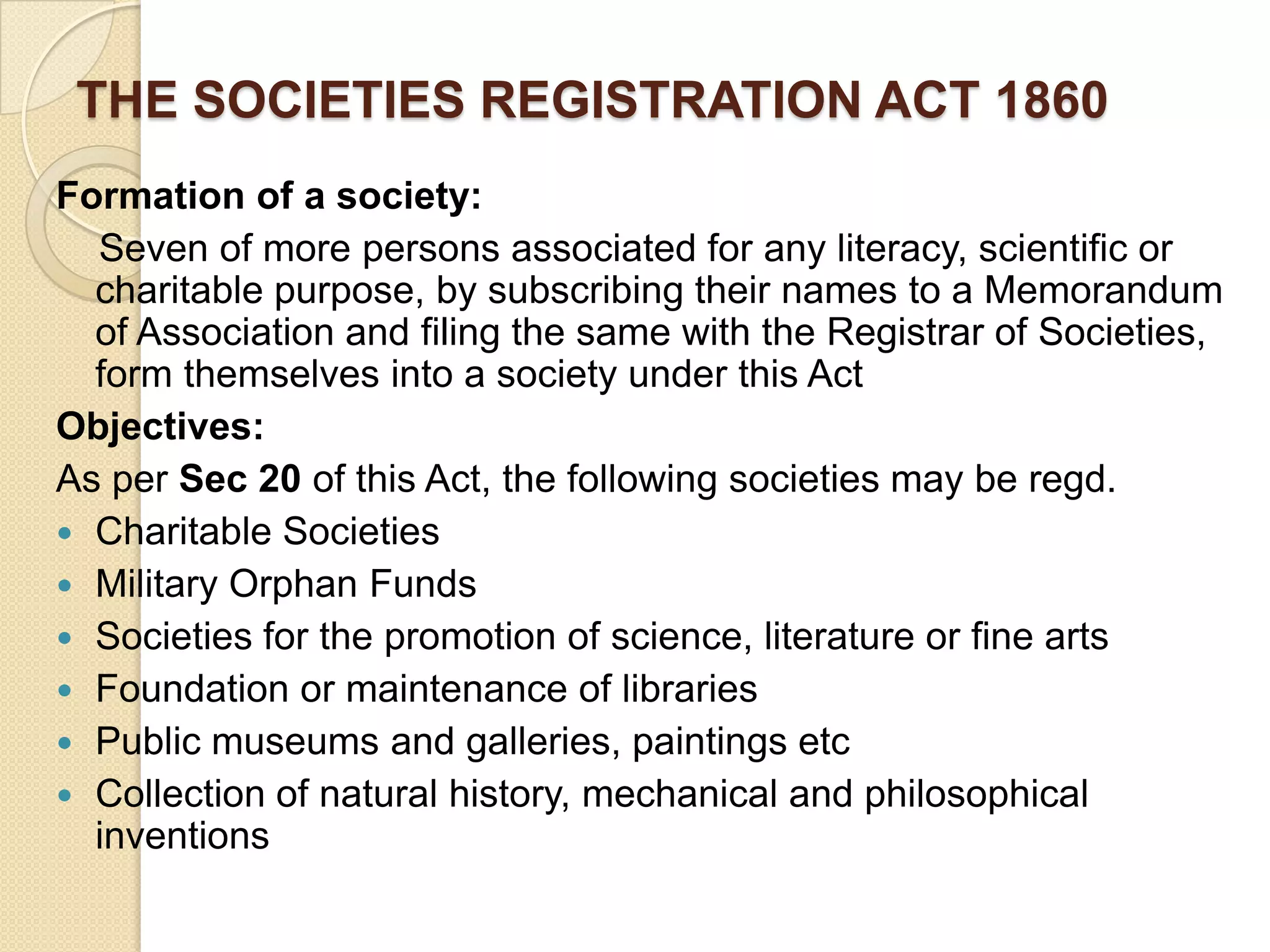
Formation of a society:
Seven of more persons associated for any literacy, scientific or
charitable purpose, by subscribing their names to a Memorandum
of Association and filing the same with the Registrar of Societies,
form themselves into a society under this Act
Objectives:
As per Sec 20 of this Act, the following societies may be regd.
 Charitable Societies
 Military Orphan Funds
 Societies for the promotion of science, literature or fine arts
 Foundation or maintenance of libraries
 Public museums and galleries, paintings etc
 Collection of natural history, mechanical and philosophical
inventions
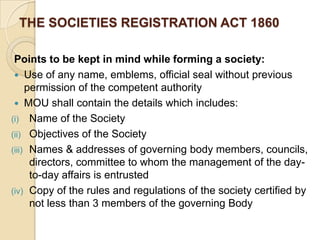
THE SOCIETIES REGISTRATION ACT 1860
Points to be kept in mind while forming a society:
 Use of any name, emblems, official seal without previous
permission of the competent authority
 MOU shall contain the details which includes:
(i) Name of the Society
(ii) Objectives of the Society
(iii) Names & addresses of governing body members, councils,
directors, committee to whom the management of the dayto-day affairs is entrusted
(iv) Copy of the rules and regulations of the society certified by
not less than 3 members of the governing Body
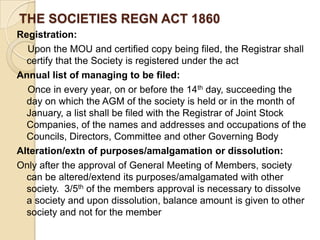
THE SOCIETIES REGN ACT 1860
Registration:
Upon the MOU and certified copy being filed, the Registrar shall
certify that the Society is registered under the act
Annual list of managing to be filed:
Once in every year, on or before the 14th day, succeeding the
day on which the AGM of the society is held or in the month of
January, a list shall be filed with the Registrar of Joint Stock
Companies, of the names and addresses and occupations of the
Councils, Directors, Committee and other Governing Body
Alteration/extn of purposes/amalgamation or dissolution:
Only after the approval of General Meeting of Members, society
can be altered/extend its purposes/amalgamated with other
society. 3/5th of the members approval is necessary to dissolve
a society and upon dissolution, balance amount is given to other
society and not for the member
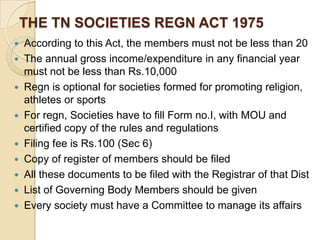
THE TN SOCIETIES REGN ACT 1975
According to this Act, the members must not be less than 20
 The annual gross income/expenditure in any financial year
must not be less than Rs.10,000
 Regn is optional for societies formed for promoting religion,
athletes or sports
 For regn, Societies have to fill Form no.I, with MOU and
certified copy of the rules and regulations
 Filing fee is Rs.100 (Sec 6)
 Copy of register of members should be filed
 All these documents to be filed with the Registrar of that Dist
 List of Governing Body Members should be given
 Every society must have a Committee to manage its affairs

THE TN SOCIETIES REGN ACT 1975








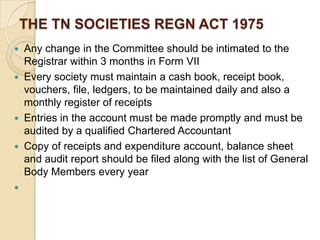
Any change in the Committee should be intimated to the
Registrar within 3 months in Form VII
Every society must maintain a cash book, receipt book,
vouchers, file, ledgers, to be maintained daily and also a
monthly register of receipts
Entries in the account must be made promptly and must be
audited by a qualified Chartered Accountant
Copy of receipts and expenditure account, balance sheet
and audit report should be filed along with the list of General
Body Members every year
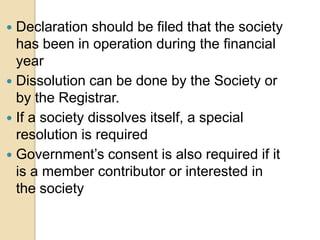
Declaration should be filed that the society
has been in operation during the financial
year
 Dissolution can be done by the Society or
by the Registrar.
 If a society dissolves itself, a special
resolution is required
 Government’s consent is also required if it
is a member contributor or interested in
the society

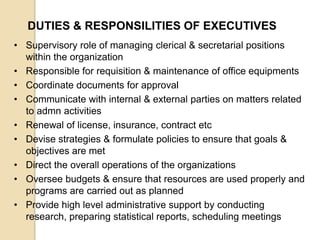
DUTIES & RESPONSILITIES OF EXECUTIVES
• Supervisory role of managing clerical & secretarial positions
within the organization
• Responsible for requisition & maintenance of office equipments
• Coordinate documents for approval
• Communicate with internal & external parties on matters related
to admn activities
• Renewal of license, insurance, contract etc
• Devise strategies & formulate policies to ensure that goals &
objectives are met
• Direct the overall operations of the organizations
• Oversee budgets & ensure that resources are used properly and
programs are carried out as planned
• Provide high level administrative support by conducting
research, preparing statistical reports, scheduling meetings
THANK ‘U’

Tamil nadu socities reg act

  • 1.
    THE SOCIETIES REGISTRATIONACT 1860 Formation of a society: Seven of more persons associated for any literacy, scientific or charitable purpose, by subscribing their names to a Memorandum of Association and filing the same with the Registrar of Societies, form themselves into a society under this Act Objectives: As per Sec 20 of this Act, the following societies may be regd.  Charitable Societies  Military Orphan Funds  Societies for the promotion of science, literature or fine arts  Foundation or maintenance of libraries  Public museums and galleries, paintings etc  Collection of natural history, mechanical and philosophical inventions
  • 2.
    THE SOCIETIES REGISTRATIONACT 1860 Points to be kept in mind while forming a society:  Use of any name, emblems, official seal without previous permission of the competent authority  MOU shall contain the details which includes: (i) Name of the Society (ii) Objectives of the Society (iii) Names & addresses of governing body members, councils, directors, committee to whom the management of the dayto-day affairs is entrusted (iv) Copy of the rules and regulations of the society certified by not less than 3 members of the governing Body
  • 3.
    THE SOCIETIES REGNACT 1860 Registration: Upon the MOU and certified copy being filed, the Registrar shall certify that the Society is registered under the act Annual list of managing to be filed: Once in every year, on or before the 14th day, succeeding the day on which the AGM of the society is held or in the month of January, a list shall be filed with the Registrar of Joint Stock Companies, of the names and addresses and occupations of the Councils, Directors, Committee and other Governing Body Alteration/extn of purposes/amalgamation or dissolution: Only after the approval of General Meeting of Members, society can be altered/extend its purposes/amalgamated with other society. 3/5th of the members approval is necessary to dissolve a society and upon dissolution, balance amount is given to other society and not for the member
  • 4.
    THE TN SOCIETIESREGN ACT 1975 According to this Act, the members must not be less than 20  The annual gross income/expenditure in any financial year must not be less than Rs.10,000  Regn is optional for societies formed for promoting religion, athletes or sports  For regn, Societies have to fill Form no.I, with MOU and certified copy of the rules and regulations  Filing fee is Rs.100 (Sec 6)  Copy of register of members should be filed  All these documents to be filed with the Registrar of that Dist  List of Governing Body Members should be given  Every society must have a Committee to manage its affairs 
  • 5.
    THE TN SOCIETIESREGN ACT 1975      Any change in the Committee should be intimated to the Registrar within 3 months in Form VII Every society must maintain a cash book, receipt book, vouchers, file, ledgers, to be maintained daily and also a monthly register of receipts Entries in the account must be made promptly and must be audited by a qualified Chartered Accountant Copy of receipts and expenditure account, balance sheet and audit report should be filed along with the list of General Body Members every year
  • 6.
    Declaration should befiled that the society has been in operation during the financial year  Dissolution can be done by the Society or by the Registrar.  If a society dissolves itself, a special resolution is required  Government’s consent is also required if it is a member contributor or interested in the society 
  • 7.
    DUTIES & RESPONSILITIESOF EXECUTIVES • Supervisory role of managing clerical & secretarial positions within the organization • Responsible for requisition & maintenance of office equipments • Coordinate documents for approval • Communicate with internal & external parties on matters related to admn activities • Renewal of license, insurance, contract etc • Devise strategies & formulate policies to ensure that goals & objectives are met • Direct the overall operations of the organizations • Oversee budgets & ensure that resources are used properly and programs are carried out as planned • Provide high level administrative support by conducting research, preparing statistical reports, scheduling meetings
  • 8.