When Tribal Sovereignty
Challenges Democracy

 Lomawaima and McCarty
     By: Marya Tambawala
          Spring 2013
Tsianina Lomawaima
 Earned her PhD at Stanford University
 Professor at University of Arizona
 Publications include:
   To Remain an Indian: Lessons in Democracy from a
    Century of Native American Education
   Uneven Ground: American Indian Sovereignty and
    Federal Law
   Away from Home: American Indian Boarding School
    Experiences
   They called it prairie light : the story of Chilocco Indian
    School
Check out Lomawaima’s interview
with PBS
                   Think About It:
Are Native American children better served by Native
American teachers? If so, is that the case for other
minority groups?

According to Lomawaima, most Native people would
prefer a segregated, rather than an integrated school.
What are the advantages and disadvantages of this?
Read Me!
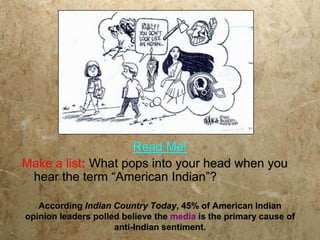
Make a list: What pops into your head when you
 hear the term “American Indian”?

   According Indian Country Today, 45% of American Indian
opinion leaders polled believe the media is the primary cause of
                     anti-Indian sentiment.
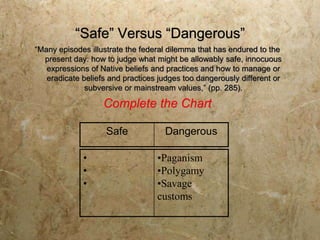
“Safe” Versus “Dangerous”
“Many episodes illustrate the federal dilemma that has endured to the
  present day: how to judge what might be allowably safe, innocuous
   expressions of Native beliefs and practices and how to manage or
   eradicate beliefs and practices judges too dangerously different or
              subversive or mainstream values,” (pp. 285).

                   Complete the Chart

                    Safe            Dangerous

             •                    •Paganism
             •                    •Polygamy
             •                    •Savage
                                  customs
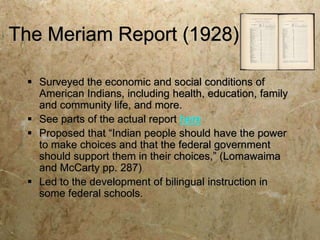
The Meriam Report (1928)

  Surveyed the economic and social conditions of
   American Indians, including health, education, family
   and community life, and more.
  See parts of the actual report here
  Proposed that “Indian people should have the power
   to make choices and that the federal government
   should support them in their choices,” (Lomawaima
   and McCarty pp. 287)
  Led to the development of bilingual instruction in
   some federal schools.
“Some Indians proud of their race and
devoted to their culture have no desire
to be as the white man is..” (Meriam
Report)
                      Questions:
1.How does this perception of American Indians
differ from Freire’s characteristics of the
oppressed?
2. Why might native-americans have different Goals
than other oppressed groups?
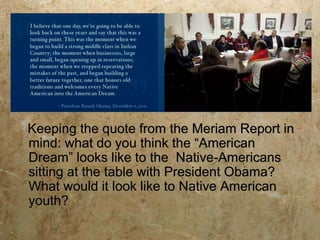
Keeping the quote from the Meriam Report in
mind: what do you think the “American
Dream” looks like to the Native-Americans
sitting at the table with President Obama?
What would it look like to Native American
youth?
The Rise of Indigenous Community-
        Controlled Schools
 1970 marked a turning point in Native
  American education
 Widely publicized critiques and reports forced
  President Nixon to declare that “every Indian
  community wishing to do so should be able to
  control its own schools”
 Rough Rock was the first American-Indian
  community controlled school
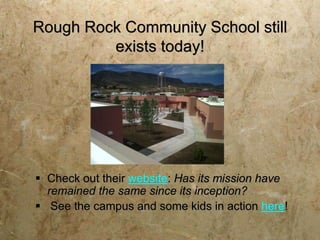
Rough Rock Community School still
         exists today!


 Check out their website: Has its mission have
  remained the same since its inception?
 See the campus and some kids in action here!
Short-Lived Success
 By 1978, there were 34 Indigenous
  community-controlled schools with a
  bilingual/bicultural curriculum
 Academic achievement was high, with
  students at community-controlled schools
  performing as well as, if not better than,
  students from traditional schools
 Restored self-confidence and pride among
  Native children
Until…


Budget consolidations, policy changes, and
        financial instability, oh my!

  “No other U.S. school system functions under
such a cloud of uncertainty…This constellation of
      conditions can only be described as
        institutionalized racism” (pp. 294)
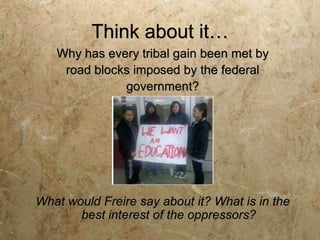
Think about it…
   Why has every tribal gain been met by
    road blocks imposed by the federal
              government?


What would Freire say about it? What is in the
       best interest of the oppressors?
Listen to this NPR interview with
 Native American professor and
      author Anton Treuer

   How do you/would you approach the topic
      of Thanksgiving in your classroom?
    Check out this current Native American
  boarding school’s website and this student
   profile. In what ways is Santa Fe Indian
   School succeeding or failing to provide a
      bicultural and bilingual education?
Read this Article
 Are off reservation boarding schools a better option
  for Native- American students?

 How would Schlesinger feel about teaching Native-
  American history and traditions to the current
  generation of Navajo children? Is it as “irrelevant” as
  the Afrocentric curriculum

 Are off reservation schools, with their focus on
  preserving language and culture, preparing students
  to succeed in society?
In Closing…
Most of the articles and interviews I found
around the subject of Native-American
education were from PBS and NPR.

  What does that say about the significance given to
       the Native-American achievement gap in
           mainstream media and society?
References
   (2011). AS-IA Larry Echo Hawk Dedicates Rough Rock Community School. YouTube. Retrieved from
    http://www.youtube.com/watch?v=JMldnOmcMH0.

   (2013). Face-To-Face with Santa Fe Indian School’s Bridget Lee. ABQJournal. Retrieved from
    http://www.abqjournal.com/main/2013/03/08/north/headline-256.html.

   Bear, C. (2008). American Indian school a far cry from the past. National Public Radio. Retrieved from
    http://www.npr.org/templates/story/story.php?storyId=17645287.

   Headlee, C. (2012). Behind the Native American acheivement gap. National Public Radio. Retrieved from
    http://www.npr.org/2012/11/22/165662639/behind-the-native-american-achievement-gap.

   K. Tsianina Lomawaima. Retrieved from http://www.ais.arizona.edu/people/k-tsianina-lomawaima.

   Lomawaima, T.K. & McCarty, T.L.(2002). When tribal sovereignty challenges democracy: American Indian
    education and the democratic ideal. American Education Research Journal, 39:2, 279-305.

   Miller, F.C. (1928/1971). Meriam report: The problem of indian administration. National Law Library. Retrieved
    from http://www.narf.org/nill/resources/meriam.htm.
References (cont’d)
   PBS. Interview with Tsianina Lomawaima. Only a Teacher. Retrieved from
    http://www.pbs.org/onlyateacher/today7.html.

   President Obama and the Native American community. Retrieved from
    http://www.whitehouse.gov/nativeamericans.

   Rough Rock Community School. Retrieved from http://www.roughrock.k12.az.us/Welcome.htm.

   Santa Fe Inidan School. Retrieved from http://www.sfis.k12.nm.us/.

   Schmidt, R. (2007). The harm of Native stereotyping: Facts and evidence. Retrieved from
    http://www.bluecorncomics.com/stharm.htm.

   Treuer, D. (2012). Kill the Indians, then copy them. The New York Times. Retrieved from
    http://www.nytimes.com/2012/09/30/opinion/sunday/kill-the-indians-then-copy-them.html?_r=2&.

Tambawala lm 2013

  • 1.
    When Tribal Sovereignty ChallengesDemocracy Lomawaima and McCarty By: Marya Tambawala Spring 2013
  • 2.
    Tsianina Lomawaima  Earnedher PhD at Stanford University  Professor at University of Arizona  Publications include:  To Remain an Indian: Lessons in Democracy from a Century of Native American Education  Uneven Ground: American Indian Sovereignty and Federal Law  Away from Home: American Indian Boarding School Experiences  They called it prairie light : the story of Chilocco Indian School
  • 3.
    Check out Lomawaima’sinterview with PBS Think About It: Are Native American children better served by Native American teachers? If so, is that the case for other minority groups? According to Lomawaima, most Native people would prefer a segregated, rather than an integrated school. What are the advantages and disadvantages of this?
  • 4.
    Read Me! Make alist: What pops into your head when you hear the term “American Indian”? According Indian Country Today, 45% of American Indian opinion leaders polled believe the media is the primary cause of anti-Indian sentiment.
  • 5.
    “Safe” Versus “Dangerous” “Manyepisodes illustrate the federal dilemma that has endured to the present day: how to judge what might be allowably safe, innocuous expressions of Native beliefs and practices and how to manage or eradicate beliefs and practices judges too dangerously different or subversive or mainstream values,” (pp. 285). Complete the Chart Safe Dangerous • •Paganism • •Polygamy • •Savage customs
  • 6.
    The Meriam Report(1928)  Surveyed the economic and social conditions of American Indians, including health, education, family and community life, and more.  See parts of the actual report here  Proposed that “Indian people should have the power to make choices and that the federal government should support them in their choices,” (Lomawaima and McCarty pp. 287)  Led to the development of bilingual instruction in some federal schools.
  • 7.
    “Some Indians proudof their race and devoted to their culture have no desire to be as the white man is..” (Meriam Report) Questions: 1.How does this perception of American Indians differ from Freire’s characteristics of the oppressed? 2. Why might native-americans have different Goals than other oppressed groups?
  • 8.
    Keeping the quotefrom the Meriam Report in mind: what do you think the “American Dream” looks like to the Native-Americans sitting at the table with President Obama? What would it look like to Native American youth?
  • 9.
    The Rise ofIndigenous Community- Controlled Schools  1970 marked a turning point in Native American education  Widely publicized critiques and reports forced President Nixon to declare that “every Indian community wishing to do so should be able to control its own schools”  Rough Rock was the first American-Indian community controlled school
  • 10.
    Rough Rock CommunitySchool still exists today!  Check out their website: Has its mission have remained the same since its inception?  See the campus and some kids in action here!
  • 11.
    Short-Lived Success  By1978, there were 34 Indigenous community-controlled schools with a bilingual/bicultural curriculum  Academic achievement was high, with students at community-controlled schools performing as well as, if not better than, students from traditional schools  Restored self-confidence and pride among Native children
  • 12.
    Until… Budget consolidations, policychanges, and financial instability, oh my! “No other U.S. school system functions under such a cloud of uncertainty…This constellation of conditions can only be described as institutionalized racism” (pp. 294)
  • 13.
    Think about it… Why has every tribal gain been met by road blocks imposed by the federal government? What would Freire say about it? What is in the best interest of the oppressors?
  • 14.
    Listen to thisNPR interview with Native American professor and author Anton Treuer  How do you/would you approach the topic of Thanksgiving in your classroom?  Check out this current Native American boarding school’s website and this student profile. In what ways is Santa Fe Indian School succeeding or failing to provide a bicultural and bilingual education?
  • 15.
    Read this Article Are off reservation boarding schools a better option for Native- American students?  How would Schlesinger feel about teaching Native- American history and traditions to the current generation of Navajo children? Is it as “irrelevant” as the Afrocentric curriculum  Are off reservation schools, with their focus on preserving language and culture, preparing students to succeed in society?
  • 16.
    In Closing… Most ofthe articles and interviews I found around the subject of Native-American education were from PBS and NPR. What does that say about the significance given to the Native-American achievement gap in mainstream media and society?
  • 17.
    References  (2011). AS-IA Larry Echo Hawk Dedicates Rough Rock Community School. YouTube. Retrieved from http://www.youtube.com/watch?v=JMldnOmcMH0.  (2013). Face-To-Face with Santa Fe Indian School’s Bridget Lee. ABQJournal. Retrieved from http://www.abqjournal.com/main/2013/03/08/north/headline-256.html.  Bear, C. (2008). American Indian school a far cry from the past. National Public Radio. Retrieved from http://www.npr.org/templates/story/story.php?storyId=17645287.  Headlee, C. (2012). Behind the Native American acheivement gap. National Public Radio. Retrieved from http://www.npr.org/2012/11/22/165662639/behind-the-native-american-achievement-gap.  K. Tsianina Lomawaima. Retrieved from http://www.ais.arizona.edu/people/k-tsianina-lomawaima.  Lomawaima, T.K. & McCarty, T.L.(2002). When tribal sovereignty challenges democracy: American Indian education and the democratic ideal. American Education Research Journal, 39:2, 279-305.  Miller, F.C. (1928/1971). Meriam report: The problem of indian administration. National Law Library. Retrieved from http://www.narf.org/nill/resources/meriam.htm.
  • 18.
    References (cont’d)  PBS. Interview with Tsianina Lomawaima. Only a Teacher. Retrieved from http://www.pbs.org/onlyateacher/today7.html.  President Obama and the Native American community. Retrieved from http://www.whitehouse.gov/nativeamericans.  Rough Rock Community School. Retrieved from http://www.roughrock.k12.az.us/Welcome.htm.  Santa Fe Inidan School. Retrieved from http://www.sfis.k12.nm.us/.  Schmidt, R. (2007). The harm of Native stereotyping: Facts and evidence. Retrieved from http://www.bluecorncomics.com/stharm.htm.  Treuer, D. (2012). Kill the Indians, then copy them. The New York Times. Retrieved from http://www.nytimes.com/2012/09/30/opinion/sunday/kill-the-indians-then-copy-them.html?_r=2&.