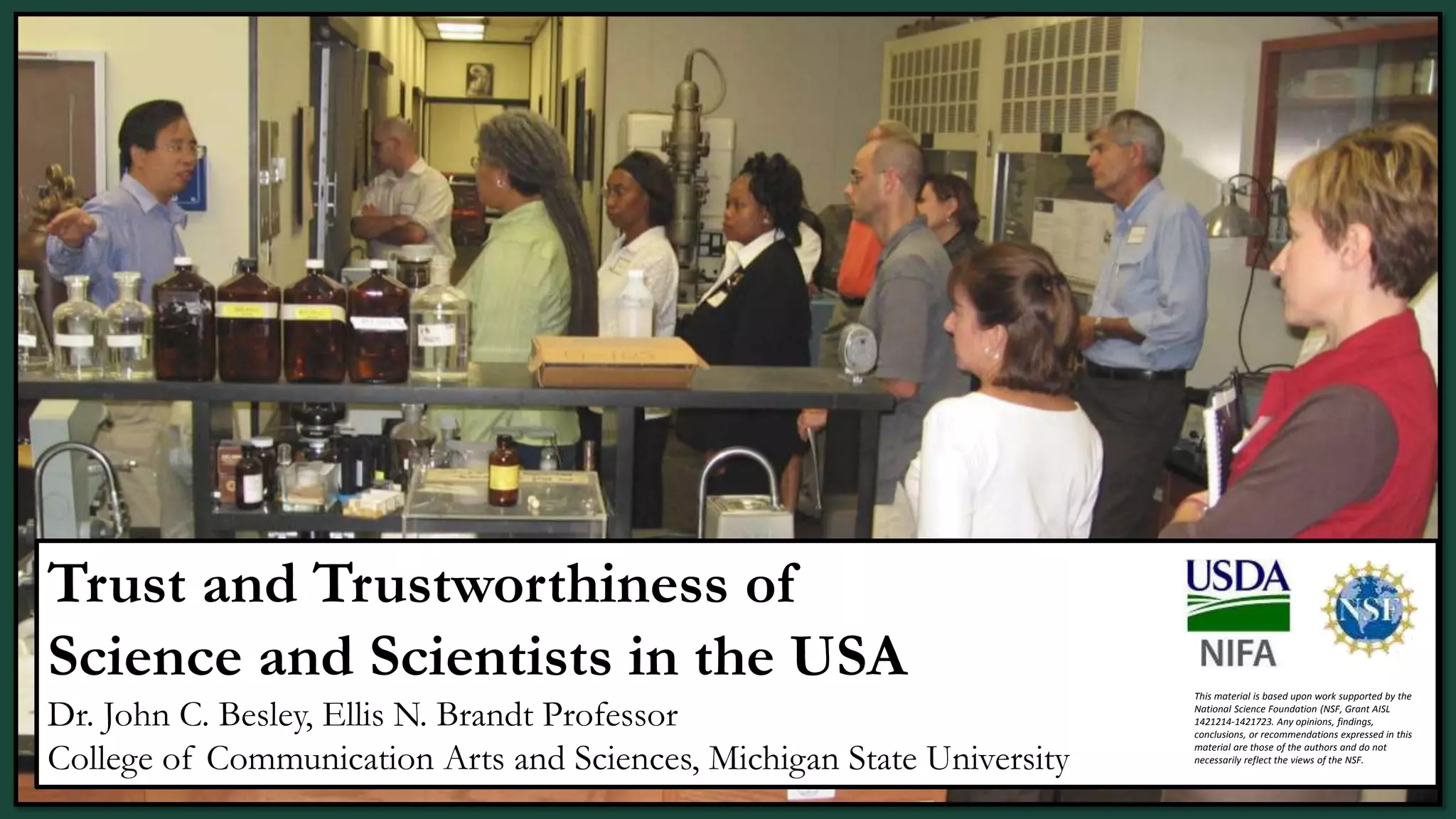
Trust and Trustworthiness of
Science and Scientists in the USA
Dr. John C. Besley, Ellis N. Brandt Professor
College of Communication Arts and Sciences, Michigan State University
This material is based upon work supported by the
National Science Foundation (NSF, Grant AISL
1421214-1421723. Any opinions, findings,
conclusions, or recommendations expressed in this
material are those of the authors and do not
necessarily reflect the views of the NSF.
A grounding conceptual premise for talking about trust …
Honest/Integrity Benevolent/Caring Willing to listen/Open Similar/Shared Values Able/Competent
Smile, eparles; Listen, Montse PB; Charlotte, Sisters 4; Lindsay Bremer, Lamu Kenya: Stonetown Academy Suggestion Box, State Farm, Graduation & Safe Driving, all via Flickr Creative Commons
… ‘trustworthiness-’ and ‘fairness’ as beliefs
Behavioral trust as a willingness to make oneself vulnerable is different from …
[The ‘bank run’ in It’s a Wonderful Life]
Some data from the USA …
Military
Scientific community
Medicine
U.S. Supreme Court
Education
Major companies
Press
The classic Question:
As far as the people
running these institutions
are concerned, would you
say that you have
a great deal of confidence,
only some confidence, or
hardly any confidence at all
in them?
[Figure shows only
responses for "a great deal
of confidence.“]
National Center for Science and
Engineering Statistics, National
Science Foundation, Survey of
Public Attitudes Toward and
Understanding of Science and
Technology (1983–2001); NORC
at the University of Chicago,
General Social Survey (2012–18).
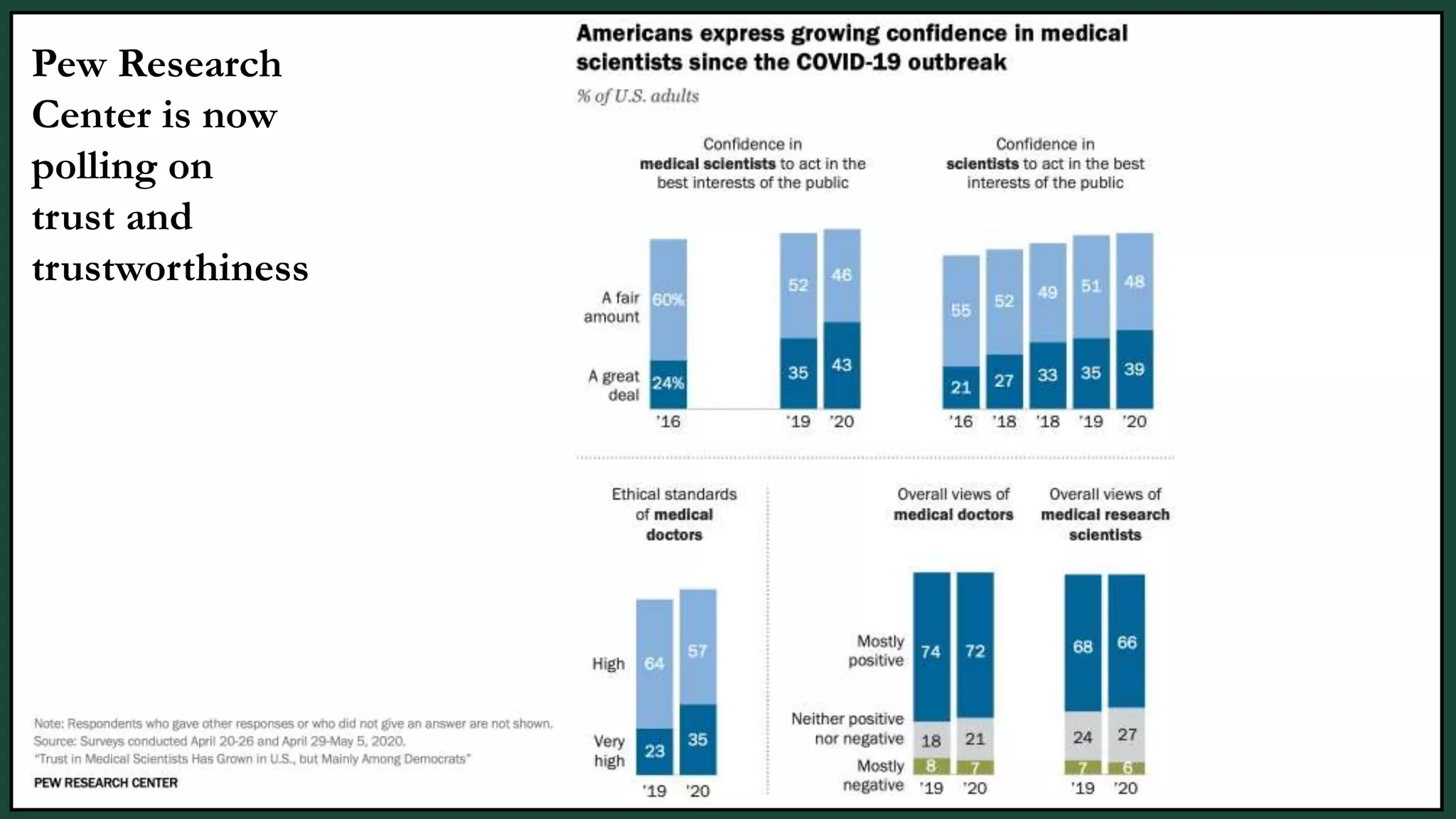
Pew Research
Center is now
polling on
trust and
trustworthiness
National Center for Science and
Engineering Statistics, National
Science Foundation, Survey of
Public Attitudes Toward and
Understanding of Science and
Technology (1983–2001); NORC
at the University of Chicago,
General Social Survey (2012–18).
Pew Research
Center is now
polling on
trust and
trustworthiness
Why does differentiating behavioral trust and
trustworthiness beliefs matter to communication strategy?
Option 1:
You need to build trust
Option 2:
You need to foster beliefs
about your willingness
eagerness to listen …
Imagine someone suggests that …
Option 1:
You need to build trust
Option 2:
You need to foster beliefs
about your willingness
eagerness to listen …
How do
you behave?
What do
you say?
How do
you say it?
Where do you
communicate?
Why does differentiating behavioral trust and
trustworthiness beliefs matter to communication strategy?
Imagine someone suggests that …
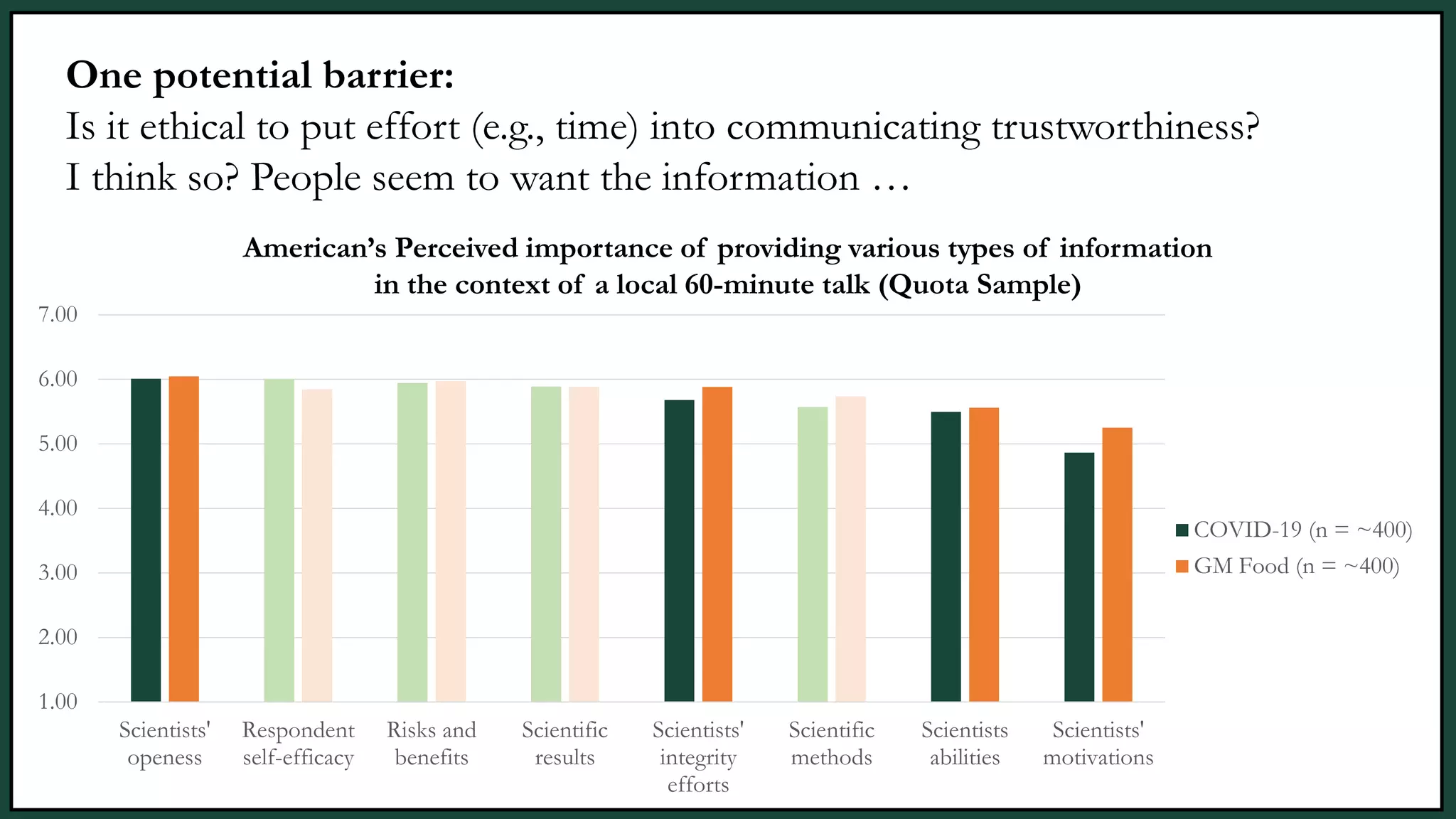
One potential barrier:
Is it ethical to put effort (e.g., time) into communicating trustworthiness?
I think so? People seem to want the information …
1.00
2.00
3.00
4.00
5.00
6.00
7.00
Scientists'
openess
Respondent
self-efficacy
Risks and
benefits
Scientific
results
Scientists'
integrity
efforts
Scientific
methods
Scientists
abilities
Scientists'
motivations
COVID-19 (n = ~400)
GM Food (n = ~400)
American’s Perceived importance of providing various types of information
in the context of a local 60-minute talk (Quota Sample)
Where to …
1. Scientific organizations should make sure they are genuinely trustworthy …
and only then …
2. Scientific organizations should track how they are perceived
(perceived benevolence, integrity, ability, openness, shared values).
3. Science communicators should strategize to address key weaknesses
in how they are perceived (through behavior + communication).
Serenity Prayer
Reinhold Nieburh
God, give me grace to accept with serenity
the things that cannot be changed,
Courage to change the things
which should be changed,
and the Wisdom to distinguish
the one from the other.
[Which I always find relevant to the idea that fostering trustworthiness beliefs is
something that’ll take time; and the reality that you’ll never reach everyone.]

Talk on Trust and Trustworthiness in the USA

  • 1.
    Trust and Trustworthinessof Science and Scientists in the USA Dr. John C. Besley, Ellis N. Brandt Professor College of Communication Arts and Sciences, Michigan State University This material is based upon work supported by the National Science Foundation (NSF, Grant AISL 1421214-1421723. Any opinions, findings, conclusions, or recommendations expressed in this material are those of the authors and do not necessarily reflect the views of the NSF.
  • 2.
    A grounding conceptualpremise for talking about trust …
  • 3.
    Honest/Integrity Benevolent/Caring Willingto listen/Open Similar/Shared Values Able/Competent Smile, eparles; Listen, Montse PB; Charlotte, Sisters 4; Lindsay Bremer, Lamu Kenya: Stonetown Academy Suggestion Box, State Farm, Graduation & Safe Driving, all via Flickr Creative Commons … ‘trustworthiness-’ and ‘fairness’ as beliefs Behavioral trust as a willingness to make oneself vulnerable is different from … [The ‘bank run’ in It’s a Wonderful Life]
  • 4.
    Some data fromthe USA …
  • 5.
    Military Scientific community Medicine U.S. SupremeCourt Education Major companies Press The classic Question: As far as the people running these institutions are concerned, would you say that you have a great deal of confidence, only some confidence, or hardly any confidence at all in them? [Figure shows only responses for "a great deal of confidence.“] National Center for Science and Engineering Statistics, National Science Foundation, Survey of Public Attitudes Toward and Understanding of Science and Technology (1983–2001); NORC at the University of Chicago, General Social Survey (2012–18).
  • 6.
    Pew Research Center isnow polling on trust and trustworthiness
  • 7.
    National Center forScience and Engineering Statistics, National Science Foundation, Survey of Public Attitudes Toward and Understanding of Science and Technology (1983–2001); NORC at the University of Chicago, General Social Survey (2012–18). Pew Research Center is now polling on trust and trustworthiness
  • 8.
    Why does differentiatingbehavioral trust and trustworthiness beliefs matter to communication strategy? Option 1: You need to build trust Option 2: You need to foster beliefs about your willingness eagerness to listen … Imagine someone suggests that …
  • 9.
    Option 1: You needto build trust Option 2: You need to foster beliefs about your willingness eagerness to listen … How do you behave? What do you say? How do you say it? Where do you communicate? Why does differentiating behavioral trust and trustworthiness beliefs matter to communication strategy? Imagine someone suggests that …
  • 10.
    One potential barrier: Isit ethical to put effort (e.g., time) into communicating trustworthiness? I think so? People seem to want the information … 1.00 2.00 3.00 4.00 5.00 6.00 7.00 Scientists' openess Respondent self-efficacy Risks and benefits Scientific results Scientists' integrity efforts Scientific methods Scientists abilities Scientists' motivations COVID-19 (n = ~400) GM Food (n = ~400) American’s Perceived importance of providing various types of information in the context of a local 60-minute talk (Quota Sample)
  • 11.
    Where to … 1.Scientific organizations should make sure they are genuinely trustworthy … and only then … 2. Scientific organizations should track how they are perceived (perceived benevolence, integrity, ability, openness, shared values). 3. Science communicators should strategize to address key weaknesses in how they are perceived (through behavior + communication).
  • 12.
    Serenity Prayer Reinhold Nieburh God,give me grace to accept with serenity the things that cannot be changed, Courage to change the things which should be changed, and the Wisdom to distinguish the one from the other. [Which I always find relevant to the idea that fostering trustworthiness beliefs is something that’ll take time; and the reality that you’ll never reach everyone.]

Editor's Notes

  • #11 Similar pattern for time … people want scientists to spend time sharing information about why they should be trusted …