TALIA Policy Briefing n. 3
CASE STUDY: CO-WORKING
TALIA Policy Briefing n. 3
CO-WORKING FOR SOCIAL INNOVATION
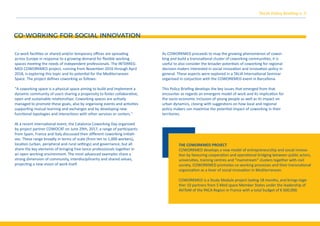
Co-work facilities or shared and/or temporary offices are spreading
across Europe in response to a growing demand for flexible working
spaces meeting the needs of independent professionals. The INTERREG-
MED COWORKMED project, running from November 2016 through April
2018, is exploring this topic and its potential for the Mediterranean
Space. The project defines coworking as follows:
"A coworking space is a physical space aiming to build and implement a
dynamic community of users sharing a propensity to foster collaborative,
open and sustainable relationships. Coworking spaces are actively
managed to promote these goals, also by organising events and activities
supporting mutual learning and exchanges and by developing new
functional typologies and interactions with other services or centers."
At a recent international event, the Catalonia Coworking Day organised
by project partner COWOCAT on June 29th, 2017, a range of participants
from Spain, France and Italy discussed their different coworking initiati-
ves. These range broadly in terms of scale (from ten to 1,000 workers),
location (urban, peripheral and rural settings) and governance, but all
share the key elements of bringing free-lance professionals together in
an open working environment. The most advanced examples share a
strong dimension of community, interdisciplinarity and shared values,
projecting a new vision of work itself.
As COWORKMED proceeds to map the growing phenomenon of cowor-
king and build a transnational cluster of coworking communities, it is
useful to also consider the broader potentials of coworking for regional
decision makers interested in social innovation and innovation policy in
general. These aspects were explored in a TALIA International Seminar
organised in conjuction with the COWORKMED event in Barcellona.
This Policy Briefing develops the key issues that emerged from that
encounter as regards an emergent model of work and its implication for
the socio-economic inclusion of young people as well as its impact on
urban dynamics, closing with suggestions on how local and regional
policy makers can maximise the potential impact of coworking in their
territories.
THE COWORKMED PROJECT
COWORKMED develops a new model of entrepreneurship and social innova-
tion by favouring cooperation and operational bridging between public actors,
universities, training centres and “mainstream” clusters together with civil
society. COWORKMED promotes co-working processes and their transnational
organization as a lever of social innovation in Mediterranean.
COWORKMED is a Study Module project lasting 18 months, and brings toge-
ther 10 partners from 5 Med space Member States under the leadership of
AViTeM of the PACA Region in France with a total budget of € 600,000.
SPATIAL IMPACT OF “THIRD PLACES”
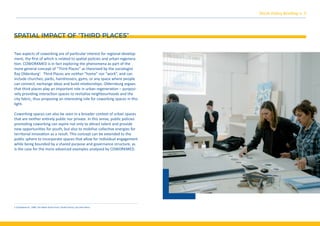
Two aspects of coworking are of particular interest for regional develop-
ment, the first of which is related to spatial policies and urban regenera-
tion. COWORKMED is in fact exploring the phenomena as part of the
more general concept of “Third Places” as theorised by the sociologist
Ray Oldenburg1
. Third Places are neither “home” nor “work”, and can
include churches, parks, hairdressers, gyms, or any space where people
can connect, exchange ideas and build relationships. Oldernburg argues
that third places play an important role in urban regeneration – purposi-
vely providing interaction spaces to revitalise neighbourhoods and the
city fabric, thus proposing an interesting role for coworking spaces in this
light.
Coworking spaces can also be seen in a broader context of urban spaces
that are neither entirely public nor private. In this sense, public policies
promoting coworking can aspire not only to attract talent and provide
new opportunities for youth, but also to mobilise collective energies for
territorial innovation as a result. This concept can be extended to the
public sphere to incorporate spaces that allow for individual engagement
while being bounded by a shared purpose and governance structure, as
is the case for the more advanced examples analysed by COWORKMED.
TALIA Policy Briefing n. 3
1 O�������� R., 1989, T�� G���� G��� P���� (T���� P�����), D� C��� P����.
Coworking also directly addresses broader issues related to jobs and
work, a key issue given the high rates of youth unemployment in
Mediterranean regions. While policy makers continue to aim to apply
traditional development approaches for ‘job creation’, an increasing
number of analysts predict the replacement of many of those jobs by
advanced technologies such as robotics and artificial intelligence.
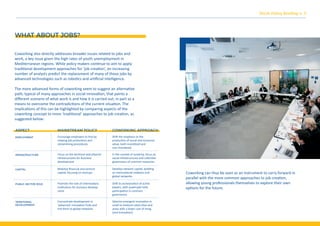
The more advanced forms of coworking seem to suggest an alternative
path, typical of many approaches in social innovation, that paints a
different scenario of what work is and how it is carried out, in part as a
means to overcome the contradictions of the current situation. The
implications of this can be highlighted by comparing aspects of the
coworking concept to more ‘traditional’ approaches to job creation, as
suggested below:
Coworking can thus be seen as an instrument to carry forward in
parallel with the more common approaches to job creation,
allowing young professionals themselves to explore their own
options for the future.
WHAT ABOUT JOBS?
TALIA Policy Briefing n. 3
EMPLOYMENT
INFRASTRUCTURE
CAPITAL
PUBLIC SECTOR ROLE
TERRITORIAL
DEVELOPMENT
Encourage employers to hire by
relaxing job protections and
streamlining procedures.
Focus on the technical and physical
infrastructures for business
development.
Mobilise financial and venture
capital, focusing on startups.
Promote the role of intermediary
institutions for business develop-
ment.
Concentrate development in
‘advanced’ innovation hubs and
link them to global networks.
Shift the emphasis to the
production of social and economic
value, both monetized and
non-monetized.
In the context of austerity, focus on
social infrastructures and collective
governance of common resources.
Develop network capital, building
on transnational relations and
global networks.
Shift to orchestration of active
players, with quadruple helix
participation in common
governance.
Valorise emergent innovation in
small to medium sized cities and
areas with a lower cost of living
(and innovation).
ASPECT MAINSTREAM POLICY COWORKING APPROACH
TALIA Policy Briefing n. 3
SOCIAL INNOVATION AND THE TALIA PROJECT
Social innovation is a term used to describe the entire process
by which new responses (products, services and models) to
social needs are developed in order to deliver better social
outcomes, creating new social relations or cooperation.
Amongst others, social innovation relates to sectors as
employment, public services, culture and leisure, and health
(namely demographic challenges as the ageing population).
A key role in promoting social innovation is played by the
diffusion of social enterprises, “whose main objective is to
have a social impact rather than make a profit for their owners
or shareholders. It operates by providing goods and services
for the market in an entrepreneurial and innovative fashion
and uses its profits primarily to achieve social objectives.”2
The Interreg-MED programme includes Social Innovation as an
objective of its work programme, identifying three sub-topics:
Open Data, Social Enterprises, and Public Sector Innovation.
The horizontal TALIA project (Territorial Appropriation of
Leading-edge Innovation Actions) is coordinating the different
projects active in this area together with those promoting
Creative and Cultural Industries, all under the common
objective of Innovation.
2 INTERREG-MED T���� �� R�������� ��� O�������� 1.1
POLICY TIPS
TALIA Policy Briefing n. 3
As can be seen from the analyses carried out by the COWORKMED
project, coworking can be a powerful tool to integrate into Innovation
and Smart Specialisation strategies. For those interested, following are
concrete suggestions of steps you can take to maximise the impact of
coworking for your region.
1. Identify specific territories in your region – a rural district, an urban
neighbourhood, etc. – where the introduction of coworking spaces can
have the strongest impact.
2. Make a mapping of coworking initiatives already active in your region,
and make contact with the responsibles for these initiatives to build a
regional working group.
3. Use the COWORKMED study results as a baseline on which to open
discussions with your working group, to identify shared goals for your
area and the possible role of the public sector.
4. Make a census of available public properties at all levels, from the
municipality to the region, and identify, together with your working
group, those spaces best adapted to host coworking.
5. Using COWORKMED case studies, develop governance guidelines for
the management of possible coworking spaces in public properties and
define the terms and conditions for concessions.
6. Identify on-going public actions and initiatives that could benefit from
the competencies offered by coworking communities and the
procurement mechanisms through which to promote engagement.
7. Get involved with the COWORKMED transnational cluster of
coworking initiatives to benefit from network effects and the possibilities
for the exchange of services across the MED sace.
Above all, contact the COWORKMED partner closest to your territory; for
further information contact: Mr. Léonard Lévêque (AViTeM) Project
Manager, l.leveque@avitem.org. In addition, learn how to learn from
the pro-active engagement of your region’s people and organisations in
the Interreg-MED programme, and use the opportunities offered by the
TALIA Project to connect with transnational social innovation activities to
enhance and reinforce the effectiveness of your regional policies as a
trans-local innovation ecosystem.
Want to stay up to date with activities and events related to creative and
social innovation in the MED programme? Join the Talia project social
networks as a Twitter follower at https://twitter.com/MEDSocialcreat
and a Facebook fan at https://www.facebook.com/SocialCreativeMED/.
TALIA Policy Briefing n. 3
CASE STUDY: CO-WORKING

TALIA Policy Briefing n. 3

  • 1.
    TALIA Policy Briefingn. 3 CASE STUDY: CO-WORKING
  • 2.
    TALIA Policy Briefingn. 3 CO-WORKING FOR SOCIAL INNOVATION Co-work facilities or shared and/or temporary offices are spreading across Europe in response to a growing demand for flexible working spaces meeting the needs of independent professionals. The INTERREG- MED COWORKMED project, running from November 2016 through April 2018, is exploring this topic and its potential for the Mediterranean Space. The project defines coworking as follows: "A coworking space is a physical space aiming to build and implement a dynamic community of users sharing a propensity to foster collaborative, open and sustainable relationships. Coworking spaces are actively managed to promote these goals, also by organising events and activities supporting mutual learning and exchanges and by developing new functional typologies and interactions with other services or centers." At a recent international event, the Catalonia Coworking Day organised by project partner COWOCAT on June 29th, 2017, a range of participants from Spain, France and Italy discussed their different coworking initiati- ves. These range broadly in terms of scale (from ten to 1,000 workers), location (urban, peripheral and rural settings) and governance, but all share the key elements of bringing free-lance professionals together in an open working environment. The most advanced examples share a strong dimension of community, interdisciplinarity and shared values, projecting a new vision of work itself. As COWORKMED proceeds to map the growing phenomenon of cowor- king and build a transnational cluster of coworking communities, it is useful to also consider the broader potentials of coworking for regional decision makers interested in social innovation and innovation policy in general. These aspects were explored in a TALIA International Seminar organised in conjuction with the COWORKMED event in Barcellona. This Policy Briefing develops the key issues that emerged from that encounter as regards an emergent model of work and its implication for the socio-economic inclusion of young people as well as its impact on urban dynamics, closing with suggestions on how local and regional policy makers can maximise the potential impact of coworking in their territories. THE COWORKMED PROJECT COWORKMED develops a new model of entrepreneurship and social innova- tion by favouring cooperation and operational bridging between public actors, universities, training centres and “mainstream” clusters together with civil society. COWORKMED promotes co-working processes and their transnational organization as a lever of social innovation in Mediterranean. COWORKMED is a Study Module project lasting 18 months, and brings toge- ther 10 partners from 5 Med space Member States under the leadership of AViTeM of the PACA Region in France with a total budget of € 600,000.
  • 3.
    SPATIAL IMPACT OF“THIRD PLACES” Two aspects of coworking are of particular interest for regional develop- ment, the first of which is related to spatial policies and urban regenera- tion. COWORKMED is in fact exploring the phenomena as part of the more general concept of “Third Places” as theorised by the sociologist Ray Oldenburg1 . Third Places are neither “home” nor “work”, and can include churches, parks, hairdressers, gyms, or any space where people can connect, exchange ideas and build relationships. Oldernburg argues that third places play an important role in urban regeneration – purposi- vely providing interaction spaces to revitalise neighbourhoods and the city fabric, thus proposing an interesting role for coworking spaces in this light. Coworking spaces can also be seen in a broader context of urban spaces that are neither entirely public nor private. In this sense, public policies promoting coworking can aspire not only to attract talent and provide new opportunities for youth, but also to mobilise collective energies for territorial innovation as a result. This concept can be extended to the public sphere to incorporate spaces that allow for individual engagement while being bounded by a shared purpose and governance structure, as is the case for the more advanced examples analysed by COWORKMED. TALIA Policy Briefing n. 3 1 O�������� R., 1989, T�� G���� G��� P���� (T���� P�����), D� C��� P����.
  • 4.
    Coworking also directlyaddresses broader issues related to jobs and work, a key issue given the high rates of youth unemployment in Mediterranean regions. While policy makers continue to aim to apply traditional development approaches for ‘job creation’, an increasing number of analysts predict the replacement of many of those jobs by advanced technologies such as robotics and artificial intelligence. The more advanced forms of coworking seem to suggest an alternative path, typical of many approaches in social innovation, that paints a different scenario of what work is and how it is carried out, in part as a means to overcome the contradictions of the current situation. The implications of this can be highlighted by comparing aspects of the coworking concept to more ‘traditional’ approaches to job creation, as suggested below: Coworking can thus be seen as an instrument to carry forward in parallel with the more common approaches to job creation, allowing young professionals themselves to explore their own options for the future. WHAT ABOUT JOBS? TALIA Policy Briefing n. 3 EMPLOYMENT INFRASTRUCTURE CAPITAL PUBLIC SECTOR ROLE TERRITORIAL DEVELOPMENT Encourage employers to hire by relaxing job protections and streamlining procedures. Focus on the technical and physical infrastructures for business development. Mobilise financial and venture capital, focusing on startups. Promote the role of intermediary institutions for business develop- ment. Concentrate development in ‘advanced’ innovation hubs and link them to global networks. Shift the emphasis to the production of social and economic value, both monetized and non-monetized. In the context of austerity, focus on social infrastructures and collective governance of common resources. Develop network capital, building on transnational relations and global networks. Shift to orchestration of active players, with quadruple helix participation in common governance. Valorise emergent innovation in small to medium sized cities and areas with a lower cost of living (and innovation). ASPECT MAINSTREAM POLICY COWORKING APPROACH
  • 5.
    TALIA Policy Briefingn. 3 SOCIAL INNOVATION AND THE TALIA PROJECT Social innovation is a term used to describe the entire process by which new responses (products, services and models) to social needs are developed in order to deliver better social outcomes, creating new social relations or cooperation. Amongst others, social innovation relates to sectors as employment, public services, culture and leisure, and health (namely demographic challenges as the ageing population). A key role in promoting social innovation is played by the diffusion of social enterprises, “whose main objective is to have a social impact rather than make a profit for their owners or shareholders. It operates by providing goods and services for the market in an entrepreneurial and innovative fashion and uses its profits primarily to achieve social objectives.”2 The Interreg-MED programme includes Social Innovation as an objective of its work programme, identifying three sub-topics: Open Data, Social Enterprises, and Public Sector Innovation. The horizontal TALIA project (Territorial Appropriation of Leading-edge Innovation Actions) is coordinating the different projects active in this area together with those promoting Creative and Cultural Industries, all under the common objective of Innovation. 2 INTERREG-MED T���� �� R�������� ��� O�������� 1.1
  • 6.
    POLICY TIPS TALIA PolicyBriefing n. 3 As can be seen from the analyses carried out by the COWORKMED project, coworking can be a powerful tool to integrate into Innovation and Smart Specialisation strategies. For those interested, following are concrete suggestions of steps you can take to maximise the impact of coworking for your region. 1. Identify specific territories in your region – a rural district, an urban neighbourhood, etc. – where the introduction of coworking spaces can have the strongest impact. 2. Make a mapping of coworking initiatives already active in your region, and make contact with the responsibles for these initiatives to build a regional working group. 3. Use the COWORKMED study results as a baseline on which to open discussions with your working group, to identify shared goals for your area and the possible role of the public sector. 4. Make a census of available public properties at all levels, from the municipality to the region, and identify, together with your working group, those spaces best adapted to host coworking. 5. Using COWORKMED case studies, develop governance guidelines for the management of possible coworking spaces in public properties and define the terms and conditions for concessions. 6. Identify on-going public actions and initiatives that could benefit from the competencies offered by coworking communities and the procurement mechanisms through which to promote engagement. 7. Get involved with the COWORKMED transnational cluster of coworking initiatives to benefit from network effects and the possibilities for the exchange of services across the MED sace. Above all, contact the COWORKMED partner closest to your territory; for further information contact: Mr. Léonard Lévêque (AViTeM) Project Manager, l.leveque@avitem.org. In addition, learn how to learn from the pro-active engagement of your region’s people and organisations in the Interreg-MED programme, and use the opportunities offered by the TALIA Project to connect with transnational social innovation activities to enhance and reinforce the effectiveness of your regional policies as a trans-local innovation ecosystem. Want to stay up to date with activities and events related to creative and social innovation in the MED programme? Join the Talia project social networks as a Twitter follower at https://twitter.com/MEDSocialcreat and a Facebook fan at https://www.facebook.com/SocialCreativeMED/.
  • 7.
    TALIA Policy Briefingn. 3 CASE STUDY: CO-WORKING