TALIA Policy Briefing n. 2
BUILDING TRANS-LOCAL INNOVATION ECOSYSTEMS
TALIA Policy Briefing n. 2
THE TRANS-LOCAL DIMENSION
Trans-local innova�on systems are those that develop in a double
dynamic: on the one hand they are deeply embedded into trans-na�onal
networks and, at the same �me, they are strongly grounded in local
innova�on communi�es. The resul�ng interplay between the local and
global dimensions strongly reinforces innova�on capacity. This trans-local
dimension is easy to proclaim – witness the diffused use of the catch
phrase ‘glocal’ – but not so easy to achieve in prac�ce.
One of the main difficul�es is the fact that the predomina�ng model of
how innova�on works has very li�le to do with the features of the place
where it happens. Innova�on is generally considered to be a
predominantly economic process having as its object a given technology,
process, or organisa�onal model. It is widely recognised that different
sectoral or disciplinary perspec�ves contribute to the success of an
innova�on, but these are not related to cultural factors or any specific
a�ribute of place. This leads to an “aspa�al” model of innova�on (lacking
spa�al features) where we all speak business English, offices are located
near to airports, and markets are global. In this context, the contribu�on
of the local dimension – beyond a recogni�on of differences in local
markets – is considered irrelevant.
In addi�on, innova�on funding inevitably shapes the behaviour of actors
and the collabora�on models they adopt. When innova�on ini�a�ves are
funded by a specific corpora�on, a�en�on is generally paid to bringing
value to the company; even open innova�on approaches are ul�mately
company-centric. If the source is regional funding, then the focus is
generally on bringing together local actors and building regional clusters;
even regional interna�onalisa�on programmes focus more on commercial
rela�ons more than coopera�on. If the source is European funding
(including ini�a�ves such as the Interreg-MED programme), the focus is
on bringing added value at the transna�onal level; even when local
authori�es are involved, the funding mechanisms rarely allow to build a
cri�cal mass of players at the local or even na�onal level.
As a result of these differences, the competencies and organisa�onal
models for the people and ins�tu�ons engaged in innova�on at different
scales are o�en quite separate. As a result, within a given region, those
working in corporate, European, and/or local and regional innova�on
ini�a�ves are o�en separated by language, methodology, and norma�ve
prac�ces. Quite o�en an ins�tu�on or company will have a separate
“European office”, based on the networking and linguis�c competencies
required, that too o�en risks being cut off from the mainstream ac�vi�es
and policies that are more “internal”.
Overcoming the dividing gap between the local dimension and
outward-looking networks can however bring important benefits
to all types of innova�on ini�a�ves, from three main perspec�ves:
• In the emergent “place-based” model, innova�on capacity is
directly related to collec�ve crea�vity, which in turn is based on
how local communi�es extract value from their specific territorial
assets (natural and physical capital, human, symbolic and cultural
capital, etc.). Such cultural and territorial anchoring adds
significant value to the innova�on processes themselves.
• Enhanced local iden�ty reinforces the value and contribu�on of
regional par�cipants in European and global innova�on value
chains, and increases their likelihood of playing a leading role in
transna�onal partnerships.
• Linking local and networked innova�on ini�a�ves quite simply
puts people in contact with each other and allows for
circumscribed project partnerships to open up, connect research
and pilo�ng from a bo�om-up perspec�ve, and significantly
increase their market and policy impact. In addi�on, linking local
ini�a�ves to global networks and vice versa improves policy
coherence, as individual ini�a�ves connect to form regional
innova�on ecosystems that contribute more effec�vely to the
high-level innova�on policy objec�ves.
Par�cipa�on of local organisa�ons and ins�tu�ons in European
projects therefore cons�tutes an important opportunity for a
given region, but the benefits are not automa�c. This Policy
Briefing gives examples and sugges�ons on how local and regional
policy makers can maximise the poten�al for impact.
TALIA Policy Briefing n. 2
TALIA, Territorial Appropria�on of Leading-edge Innova�on Ac�ons, is the
Interreg-MED Programme’s horizontal project promo�ng the coherence
and impact of individual modular projects dealing with social and crea�ve
innova�on ini�a�ves. TALIA operates in three main direc�ons:
engagement and support, communica�on, and a�aining impact. TALIA
builds on these on-going ac�vi�es to translate results as they unfold – in
real �me, so to speak – into useful instruments for policy ac�on, through
the aggrega�on of evidence, iden�fica�on of relevant indicators for
crea�ve and social innova�on, and development of a common model of
Mediterranean innova�on.
More specifically, the TALIA project is working to promote trans-local
innova�on clusters for crea�ve and social innova�on by providing
instruments that allow trans-na�onal MED modular projects to connect
with local innova�on communi�es, star�ng from the regions of
par�cipa�ng partners. The main steps include:
• A thema�c mapping of innova�on actors across the Mediterranean.
This allows to iden�fy local and regional communi�es of those
par�cipa�ng in modular projects, local pilot ini�a�ves, and so forth.
• A series of regular networking events aiming to build local communi�es
of interest by bringing together par�cipants sharing the same local and
regional contexts who work in different but related innova�on ini�a�ves.
• A series of 6-monthly interna�onal events each built on top of a specific
mee�ng of a modular project and linking the local community to different
transna�onal modular project networks as well as the European and
global networks brought in by the TALIA partnership.
SUPPORTING TRANS-LOCAL INNOVATION
TALIA Policy Briefing n. 2
These ini�a�ves thus reinforce both aspects of the trans-local dimension,
allowing transna�onal networks to dive into and be�er understand regional
contexts and projec�ng local innova�on ini�a�ves onto the global stage.
This both empowers the richness of territorial grounding and the iden�fica�on
of individual innova�on communi�es, and at the same �me allows global
networks to connect with local reali�es.
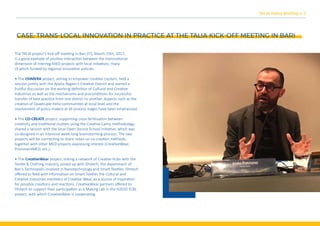
CASE: TRANS-LOCAL INNOVATION IN PRACTICE AT THE TALIA KICK-OFF MEETING IN BARI
TALIA Policy Briefing n. 2
The TALIA project’s kick-off mee�ng in Bari (IT), March 15th, 2017,
is a good example of posi�ve interac�on between the transna�onal
dimension of Interreg-MED projects with local ini�a�ves, many
of which funded by regional innova�on policies.
• The ChIMERA project, aiming to empower crea�ve clusters, held a
session jointly with the Apulia Region’s Crea�ve District and started a
frui�ul discussion on the working defini�on of Cultural and Crea�ve
Industries as well as the mechanisms and precondi�ons for successful
transfer of best prac�ce from one district to another. Aspects such as the
crea�on of Quadruple Helix communi�es at local level and the
involvement of policy makers at all process stages have been emphasized.
• The CO-CREATE project, suppor�ng cross-fer�lisa�on between
crea�vity and tradi�onal clusters using the Crea�ve Camp methodology,
shared a session with the local Open Source School ini�a�ve, which was
co-designed in an intensive week-long brainstorming process. The two
projects will be connec�ng to share notes on co-crea�on methods,
together with other MED projects expressing interest (Crea�veWear,
ProminentMED, etc.).
• The Crea�veWear project, linking a network of Crea�ve Hubs with the
Tex�le & Clothing industry, joined up with Dhitech, the department of
Bari’s Technopolis involved in Nanotechnology and Smart Tex�les. Dhitech
offered to feed with informa�on on Smart Tex�les the Cultural and
Crea�ve Industries members of Crea�ve Wear, as a source of inspira�on
for possible crea�ons and reac�ons. Crea�veWear partners offered to
Dhitech to support their par�cipa�on as a Making Lab in the H2020 TCBL
project, with which Crea�veWear is coopera�ng.
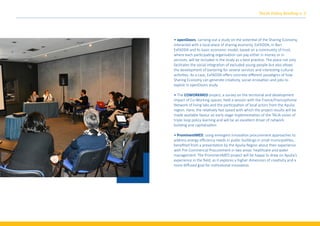
• openDoors, carrying out a study on the poten�al of the Sharing Economy,
interacted with a local place of sharing economy, ExFADDA, in Bari.
ExFADDA and its basic economic model, based on a community of trust,
where each par�cipa�ng organisa�on can pay either in money or in
services, will be included in the study as a best prac�ce. The place not only
facilitates the social integra�on of excluded young people but also allows
the development of bartering for several services and interes�ng cultural
ac�vi�es. As a case, ExFADDA offers concrete different paradigms of how
Sharing Economy can generate crea�vity, social innova�on and jobs to
exploit in openDoors study.
• The COWORKMED project, a survey on the territorial and development
impact of Co-Working spaces, held a session with the France/Francophonie
Network of living labs and the par�cipa�on of local actors from the Apulia
region. Here, the rela�vely fast speed with which the project results will be
made available favour an early stage implementa�on of the TALIA vision of
triple loop policy learning and will be an excellent driver of network
building and capitalisa�on
• ProminentMED, using emergent innova�on procurement approaches to
address energy efficiency needs in public buildings in small municipali�es,
benefited from a presenta�on by the Apulia Region about their experience
with Pre-Commercial Procurement in two areas: healthcare and water
management. The ProminentMED project will be happy to draw on Apulia’s
experience in the field, as it explores a higher dimension of crea�vity and a
more diffused goal for ins�tu�onal innova�on.
TALIA Policy Briefing n. 2
POLICY TIPS
Following are concrete sugges�ons of steps you can take to improve
trans-local innova�on in your region.
1. Make a regional mapping of people and organisa�ons involved in
innova�on ini�a�ves of any sort, together with the thema�c sector and
funding regime.
2. As you do this, go beyond the stakeholders you normally work with – as
with “entrepreneurial discovery” in the Smart Specialisa�on process – to
find out what’s really happening in your area. Make a special effort to
iden�fy those ac�ve in crea�ve and social innova�on.
3. Support the organisa�on of both formal and informal networking
opportuni�es to allow local players to discover each other and connect:
this can include public sessions linked to EU project mee�ngs being held
in your territory.
4. Provide ins�tu�onal and organisa�onal support to the forma�on of
cross-programme thema�c working groups. This can help iden�fy areas of
excellence in your region as well as provide input to policy making
through posi�on papers on specific topics.
5. Allow for the kind of flexibility in local and regional funding ini�a�ves
that may be required for different projects and programmes to join
forces, share resources, and align workplans.
6. Make a census of the trans-European and global networks your
regional actors are ac�ve in and signal similar opportuni�es for others to
join the same networks and enhance your region’s presence.
7. Iden�fy the priority themes where your region excels and par�cipate
directly in network events, to show ins�tu�onal commitment and
exchange good prac�ce with other public authori�es.
Above all, learn how to learn from the pro-ac�ve engagement of your
region’s people and organisa�ons in the Interreg-MED programme, and
use the opportuni�es offered by the TALIA Project to connect with
transna�onal ac�vi�es to enhance and reinforce the effec�veness of your
regional policies as a trans-local innova�on ecosystem.
Want to stay up to date with ac�vi�es and events related to crea�ve and
social innova�on in the MED programme?
More informa�on at:
· h�p://interreg-med.eu/al/thema�cs/social-crea�ve/
· infotalia@regione.puglia.it
TALIA Policy Briefing n. 2
BUILDING TRANS-LOCAL INNOVATION ECOSYSTEMS

TALIA Policy Briefing n. 2

  • 1.
    TALIA Policy Briefingn. 2 BUILDING TRANS-LOCAL INNOVATION ECOSYSTEMS
  • 2.
    TALIA Policy Briefingn. 2 THE TRANS-LOCAL DIMENSION Trans-local innova�on systems are those that develop in a double dynamic: on the one hand they are deeply embedded into trans-na�onal networks and, at the same �me, they are strongly grounded in local innova�on communi�es. The resul�ng interplay between the local and global dimensions strongly reinforces innova�on capacity. This trans-local dimension is easy to proclaim – witness the diffused use of the catch phrase ‘glocal’ – but not so easy to achieve in prac�ce. One of the main difficul�es is the fact that the predomina�ng model of how innova�on works has very li�le to do with the features of the place where it happens. Innova�on is generally considered to be a predominantly economic process having as its object a given technology, process, or organisa�onal model. It is widely recognised that different sectoral or disciplinary perspec�ves contribute to the success of an innova�on, but these are not related to cultural factors or any specific a�ribute of place. This leads to an “aspa�al” model of innova�on (lacking spa�al features) where we all speak business English, offices are located near to airports, and markets are global. In this context, the contribu�on of the local dimension – beyond a recogni�on of differences in local markets – is considered irrelevant. In addi�on, innova�on funding inevitably shapes the behaviour of actors and the collabora�on models they adopt. When innova�on ini�a�ves are funded by a specific corpora�on, a�en�on is generally paid to bringing value to the company; even open innova�on approaches are ul�mately company-centric. If the source is regional funding, then the focus is generally on bringing together local actors and building regional clusters; even regional interna�onalisa�on programmes focus more on commercial rela�ons more than coopera�on. If the source is European funding (including ini�a�ves such as the Interreg-MED programme), the focus is on bringing added value at the transna�onal level; even when local authori�es are involved, the funding mechanisms rarely allow to build a cri�cal mass of players at the local or even na�onal level. As a result of these differences, the competencies and organisa�onal models for the people and ins�tu�ons engaged in innova�on at different scales are o�en quite separate. As a result, within a given region, those working in corporate, European, and/or local and regional innova�on ini�a�ves are o�en separated by language, methodology, and norma�ve prac�ces. Quite o�en an ins�tu�on or company will have a separate “European office”, based on the networking and linguis�c competencies required, that too o�en risks being cut off from the mainstream ac�vi�es and policies that are more “internal”.
  • 3.
    Overcoming the dividinggap between the local dimension and outward-looking networks can however bring important benefits to all types of innova�on ini�a�ves, from three main perspec�ves: • In the emergent “place-based” model, innova�on capacity is directly related to collec�ve crea�vity, which in turn is based on how local communi�es extract value from their specific territorial assets (natural and physical capital, human, symbolic and cultural capital, etc.). Such cultural and territorial anchoring adds significant value to the innova�on processes themselves. • Enhanced local iden�ty reinforces the value and contribu�on of regional par�cipants in European and global innova�on value chains, and increases their likelihood of playing a leading role in transna�onal partnerships. • Linking local and networked innova�on ini�a�ves quite simply puts people in contact with each other and allows for circumscribed project partnerships to open up, connect research and pilo�ng from a bo�om-up perspec�ve, and significantly increase their market and policy impact. In addi�on, linking local ini�a�ves to global networks and vice versa improves policy coherence, as individual ini�a�ves connect to form regional innova�on ecosystems that contribute more effec�vely to the high-level innova�on policy objec�ves. Par�cipa�on of local organisa�ons and ins�tu�ons in European projects therefore cons�tutes an important opportunity for a given region, but the benefits are not automa�c. This Policy Briefing gives examples and sugges�ons on how local and regional policy makers can maximise the poten�al for impact. TALIA Policy Briefing n. 2
  • 4.
    TALIA, Territorial Appropria�onof Leading-edge Innova�on Ac�ons, is the Interreg-MED Programme’s horizontal project promo�ng the coherence and impact of individual modular projects dealing with social and crea�ve innova�on ini�a�ves. TALIA operates in three main direc�ons: engagement and support, communica�on, and a�aining impact. TALIA builds on these on-going ac�vi�es to translate results as they unfold – in real �me, so to speak – into useful instruments for policy ac�on, through the aggrega�on of evidence, iden�fica�on of relevant indicators for crea�ve and social innova�on, and development of a common model of Mediterranean innova�on. More specifically, the TALIA project is working to promote trans-local innova�on clusters for crea�ve and social innova�on by providing instruments that allow trans-na�onal MED modular projects to connect with local innova�on communi�es, star�ng from the regions of par�cipa�ng partners. The main steps include: • A thema�c mapping of innova�on actors across the Mediterranean. This allows to iden�fy local and regional communi�es of those par�cipa�ng in modular projects, local pilot ini�a�ves, and so forth. • A series of regular networking events aiming to build local communi�es of interest by bringing together par�cipants sharing the same local and regional contexts who work in different but related innova�on ini�a�ves. • A series of 6-monthly interna�onal events each built on top of a specific mee�ng of a modular project and linking the local community to different transna�onal modular project networks as well as the European and global networks brought in by the TALIA partnership. SUPPORTING TRANS-LOCAL INNOVATION TALIA Policy Briefing n. 2 These ini�a�ves thus reinforce both aspects of the trans-local dimension, allowing transna�onal networks to dive into and be�er understand regional contexts and projec�ng local innova�on ini�a�ves onto the global stage. This both empowers the richness of territorial grounding and the iden�fica�on of individual innova�on communi�es, and at the same �me allows global networks to connect with local reali�es.
  • 5.
    CASE: TRANS-LOCAL INNOVATIONIN PRACTICE AT THE TALIA KICK-OFF MEETING IN BARI TALIA Policy Briefing n. 2 The TALIA project’s kick-off mee�ng in Bari (IT), March 15th, 2017, is a good example of posi�ve interac�on between the transna�onal dimension of Interreg-MED projects with local ini�a�ves, many of which funded by regional innova�on policies. • The ChIMERA project, aiming to empower crea�ve clusters, held a session jointly with the Apulia Region’s Crea�ve District and started a frui�ul discussion on the working defini�on of Cultural and Crea�ve Industries as well as the mechanisms and precondi�ons for successful transfer of best prac�ce from one district to another. Aspects such as the crea�on of Quadruple Helix communi�es at local level and the involvement of policy makers at all process stages have been emphasized. • The CO-CREATE project, suppor�ng cross-fer�lisa�on between crea�vity and tradi�onal clusters using the Crea�ve Camp methodology, shared a session with the local Open Source School ini�a�ve, which was co-designed in an intensive week-long brainstorming process. The two projects will be connec�ng to share notes on co-crea�on methods, together with other MED projects expressing interest (Crea�veWear, ProminentMED, etc.). • The Crea�veWear project, linking a network of Crea�ve Hubs with the Tex�le & Clothing industry, joined up with Dhitech, the department of Bari’s Technopolis involved in Nanotechnology and Smart Tex�les. Dhitech offered to feed with informa�on on Smart Tex�les the Cultural and Crea�ve Industries members of Crea�ve Wear, as a source of inspira�on for possible crea�ons and reac�ons. Crea�veWear partners offered to Dhitech to support their par�cipa�on as a Making Lab in the H2020 TCBL project, with which Crea�veWear is coopera�ng.
  • 6.
    • openDoors, carryingout a study on the poten�al of the Sharing Economy, interacted with a local place of sharing economy, ExFADDA, in Bari. ExFADDA and its basic economic model, based on a community of trust, where each par�cipa�ng organisa�on can pay either in money or in services, will be included in the study as a best prac�ce. The place not only facilitates the social integra�on of excluded young people but also allows the development of bartering for several services and interes�ng cultural ac�vi�es. As a case, ExFADDA offers concrete different paradigms of how Sharing Economy can generate crea�vity, social innova�on and jobs to exploit in openDoors study. • The COWORKMED project, a survey on the territorial and development impact of Co-Working spaces, held a session with the France/Francophonie Network of living labs and the par�cipa�on of local actors from the Apulia region. Here, the rela�vely fast speed with which the project results will be made available favour an early stage implementa�on of the TALIA vision of triple loop policy learning and will be an excellent driver of network building and capitalisa�on • ProminentMED, using emergent innova�on procurement approaches to address energy efficiency needs in public buildings in small municipali�es, benefited from a presenta�on by the Apulia Region about their experience with Pre-Commercial Procurement in two areas: healthcare and water management. The ProminentMED project will be happy to draw on Apulia’s experience in the field, as it explores a higher dimension of crea�vity and a more diffused goal for ins�tu�onal innova�on. TALIA Policy Briefing n. 2
  • 7.
    TALIA Policy Briefingn. 2 POLICY TIPS Following are concrete sugges�ons of steps you can take to improve trans-local innova�on in your region. 1. Make a regional mapping of people and organisa�ons involved in innova�on ini�a�ves of any sort, together with the thema�c sector and funding regime. 2. As you do this, go beyond the stakeholders you normally work with – as with “entrepreneurial discovery” in the Smart Specialisa�on process – to find out what’s really happening in your area. Make a special effort to iden�fy those ac�ve in crea�ve and social innova�on. 3. Support the organisa�on of both formal and informal networking opportuni�es to allow local players to discover each other and connect: this can include public sessions linked to EU project mee�ngs being held in your territory. 4. Provide ins�tu�onal and organisa�onal support to the forma�on of cross-programme thema�c working groups. This can help iden�fy areas of excellence in your region as well as provide input to policy making through posi�on papers on specific topics. 5. Allow for the kind of flexibility in local and regional funding ini�a�ves that may be required for different projects and programmes to join forces, share resources, and align workplans. 6. Make a census of the trans-European and global networks your regional actors are ac�ve in and signal similar opportuni�es for others to join the same networks and enhance your region’s presence. 7. Iden�fy the priority themes where your region excels and par�cipate directly in network events, to show ins�tu�onal commitment and exchange good prac�ce with other public authori�es. Above all, learn how to learn from the pro-ac�ve engagement of your region’s people and organisa�ons in the Interreg-MED programme, and use the opportuni�es offered by the TALIA Project to connect with transna�onal ac�vi�es to enhance and reinforce the effec�veness of your regional policies as a trans-local innova�on ecosystem. Want to stay up to date with ac�vi�es and events related to crea�ve and social innova�on in the MED programme? More informa�on at: · h�p://interreg-med.eu/al/thema�cs/social-crea�ve/ · infotalia@regione.puglia.it
  • 8.
    TALIA Policy Briefingn. 2 BUILDING TRANS-LOCAL INNOVATION ECOSYSTEMS