Taking pride
in our work?
Lived experience
of LGBTQ+ staff
at a UK university
Agenda
• Why a good workplace experience matters
• Being LGBTQ+ in the UK
• Case study study methodology overview
• Successes of the university studied
• Lived experiences of LGBTQ+ staff summarised
• The LGBTQ+ Staff Network
• Failings of the university studied
• Strategic concerns – relating LGBTQ+ staff experience
to business outcomes
• Key points summarised
• Take home tips
Why lived work experience
matters
• Suffering at work is traumatic
• Around 25% of the working week is
spent at work (plus commuting,
thinking about work)
• Work experience therefore impacts
mental and physical health
• Work experience impacts
relationships outside of work
The workplace as a safe haven
• Work is a very controlled environment
• Physical and sexual violence completely
and effectively prohibited
• Social behaviours are constrained to
create a relatively safe social space
• A refuge from abuse
• Only safe space available to some people
The value of work
• Socialised experience
• Engage in meaningful activities with
satisfying outcomes
• Career success provides satisfaction and
funds the lifestyle to which staff would like
to become accustomed
• Supports self-actualisation
• May create a sense of legacy
Aims
• Examine the lived experience of
LGBTQ+ staff
• Identify key factors supporting and
harming this lived experience
• Assess the cost to business performance
• Recommend inexpensive improvements
National context
“British culture is heteronormative, privileging
heterosexual norms and binary gender conformity, using
social, cultural and economic forms of violence to deny
LGBTQ+ people “full participation in essential social and
economic activities and institutions”, and which
“perpetuates economic injustice, and reduces their
opportunities for fulfilling human potential”
(Anastas, 1998, p. 84)
Reference:
Anastas, J. W. (1998). Working against discrimination.
Journal of Gay & Lesbian Social Services, 8(3), 83-98
Organisational context
Study conducted at a conscientiously inclusive
employer: this is what ‘good’ looks like now
• Stonewall Diversity Champion
• Published staff and student equality data
• Staff LGBTQ+ network
• Regarded by almost universally by study
participants as a comparatively good place
to work
About the research
• Qualitative case study analysis
• Documentary analysis
• Pilot case study and 14 respondents
• Informed by personal experience and
observation over 13 years
Sampling
• Sample frame was the LGBTQ+
Staff Forum
• Purposive and snowball sampling
• Care taken to ensure
comprehensive representation
• Invitations sent by email
• Respondents were all volunteers
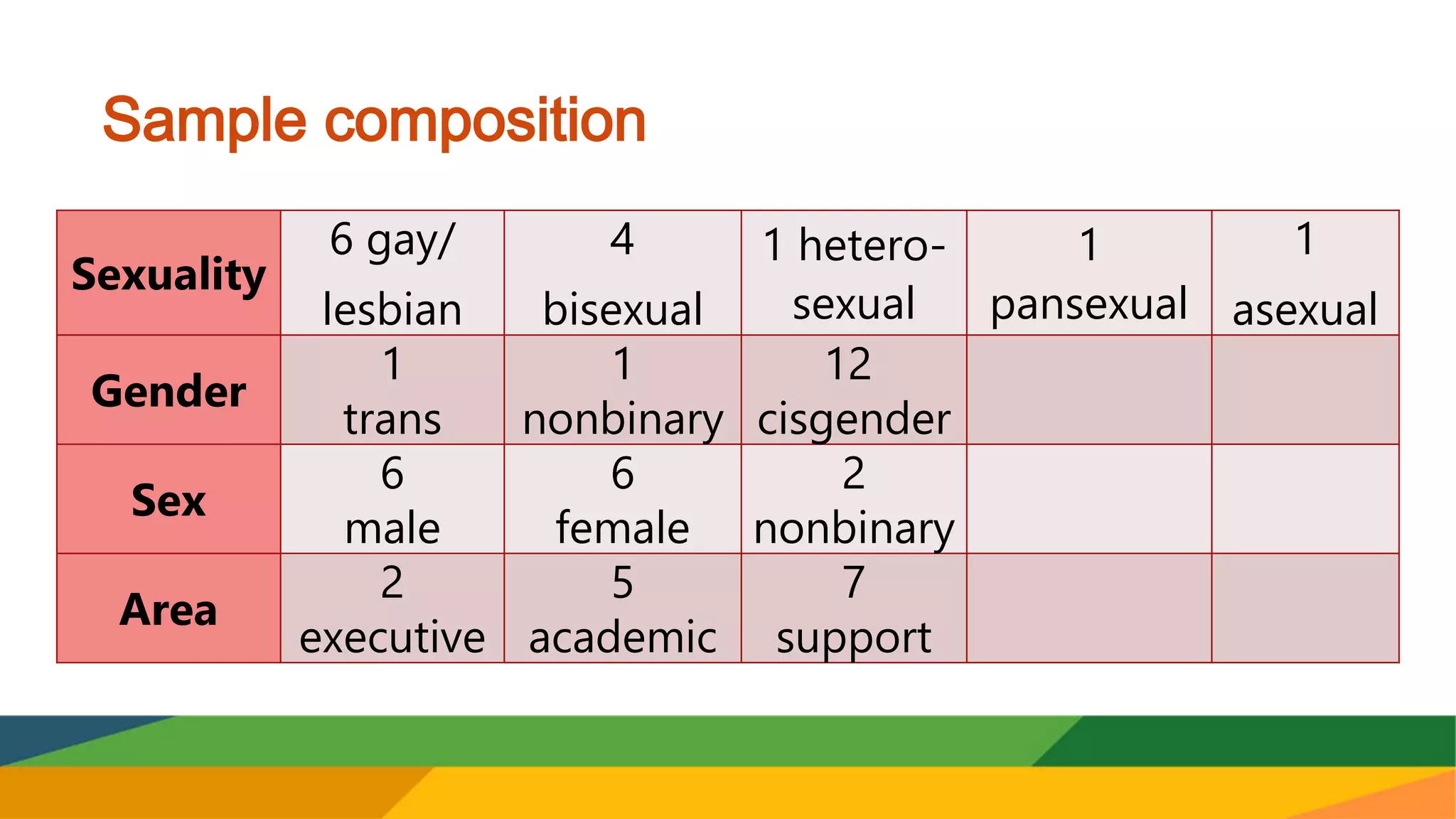
Sample composition
Sexuality
6 gay/
lesbian
4
bisexual
1 hetero-
sexual
1
pansexual
1
asexual
Gender
1
trans
1
nonbinary
12
cisgender
Sex
6
male
6
female
2
nonbinary
Area
2
executive
5
academic
7
support
Interviews and analysis
• Pilot interview
• Semi-structured qualitative
interviews
• Online video interviews
• Audio recording and manual notes
• Pragmatic manual transcription
• Thematic analysis
Lived experiences over time
1980s 2000s 2015 Present
Liberal tolerance
Gay men had no
expectations
of promotion to a
man-agament role
Workplace
experience
depends on
role and rank
True
LGBTQ+
acceptance
begins
Patchwork
experience
Acceptance
LGBTQ+ staff in general
• Staff downplayed the impact of co-workers’ homophobic and transphobic
remarks as a result of habituation and in order to feel safer
• Even without active discrimination, minority stress meant many LGBTQ+
staff lacked the confidence to put themselves forward for things, which
slowed their rate of promotion
• Dealing with coming out takes effort and slows career progress for many
• Most people interviewed were fearful of coming out beyond their closest
work friends because they had picked up on discriminatory remarks from
others in the office and feared that this would upset work relations
• Everyone had to don a heteroprofessional persona when approaching
external clients because of heteroprofessional British working culture
Why do experiences vary?
• Departmental leadership
• Existing team composition – the biggest predictor of experience is
the number of openly LGBTQ+ staff in the team already
(demonstrate equity and successful employment)
• Past experiences, increasing financial security and age mediate
self-monitoring and minority stress.
• Line management support – especially for respondents needing to
feel supported in challenging unwanted co-worker behaviours
Bisexual (bi) staff
• Worse quality of work experience than lesbian and gay
respondents
• Regular microaggressions - particularly ‘jokes’ made at
their expense
• Colleagues often incorrectly ascribe sexuality to romantic
relationships rather than people
o If you have a same-sex partner, you are seen as gay
o If you have an opposite sex partner, you are seen as straight
Asexual and aromantic staff
• Asexual, aromantic and bi respondents reported a greater
burden of having to educate coworkers
• Coworkers frequently refused to accept a person was really
asexual, suggesting they would eventually find someone
• This suggests the existing diversity training fails to adequately
cover these minority groups
• Fears expressed that asexuality and aromanticism were
associated with a lack of empathy might prejudice promotion to
a management position
Trans and nonbinary staff
Trans people have unique needs:
• non-gendered spaces
• having to unlearn and relearn how to ‘perform’ gender as they
transition
• struggling with the refusal of the majority to validate their trans
identity if they don’t surgically transition
• experiencing an extended period of anatomically nonbinary
appearance if they do surgically transition
Nonbinary staff
• Nonbinary expression is repressed by the heteroprofessional
culture (men don’t wear makeup)
• Nonbinary gender identities are frequently stigmatised and
‘delegitimised’ because they challenge the culturally ingrained
binary gender concept
o It is easier to mislabel a masculine identified nonbinary woman as
a lesbian accept binary gender is a myth
• People often come out as ‘bi’ before judging the safety of
coming out as nonbinary
Family privilege
• Childless staff are expected to take on more work and work antisocial
hours more often than staff with families
• Those asking for a personal life without citing children or family are seen
as selfish – single private lives are not valued as highly as family lives.
• Displaying a photo of a same sex partner at work was common
• Ability to converse about same-sex relationships with others much less so
– many respondents found colleagues would not converse about LGBTQ+
families but always enthusiastically discussed heterosexual families
Careerlimitations?
• No members of the executive have ever been openly
LGBTQ+
• People come out at the end of their careers or are not
promoted beyond head of department level
• Subtle exclusion from processes of socialisation, where
the knowledge of how to get along in an organisation is
transmitted might also seriously harm the promotion
chances of LGBTQ+ staff
The staff LGBTQ+ network
• Widely seen as a signal of an inclusive employer
• Connects isolated staff from across the University:
oSafe space to come out
oNetworking and socialisation opportunities
oFacilitates collective action
Minority groups and the LGBTQ+ Staff Network
• Minority subgroups (bisexual, asexual, aromantic, trans and
nonbinary people) felt lost among the majority of homosexual
people and allies in LGBTQ+ staff networks
• These groups benefit much more from dedicated sub-networks
so they can discuss their unique challenges without introjected
ideas from others
• Awakening sexuality/gender identity and transitioning from ally
to member of the community may trigger feelings of ‘imposter
syndrome’
What is wrong? (1)
• Lack of visible direction from the executive – culture is led from the top!
• EDI is not included in the University Vision and Strategy
• LGBTQ+ initiatives were resisted
• Executive suspected of balancing a perceived need to maintain a
conservative corporate image to court conservative business partners with
local aspirations to appear liberal to recruit UK students and staff
• Grievance procedures are subordinate to a protectionist culture designed
to protect corporate image rather than ensuring effective resolutions
What is wrong? (2)
• Student experience valued more highly than staff experience
• Respect and sensitivity among students varies between faculties
• EDI elearning was introduced recently and many existing staff
do not complete it
Strategic relevance: why LGBTQ+ staff wellbeing is
good for business
High investment HRM strategy is used that relies on work commitment,
discretionary effort and a low rate of absenteeism and turnover to achieve
return on investment
Long term minority stress reduces the effectiveness of staff by causing:
• depression
• reduced productivity
• team conflicts – reducing efficiency
• reduced job and life satisfaction
• Increased turnover intention
Key points
Supporting LGBTQ+ staff is a good thing because:
• Happy staff are productive staff
• Diverse staff support diverse students better
• Diverse experiences inform decision making and often lead to better
decisions
You can help make LGBTQ+ staff happy by:
• Taking a real interest in the lives of LGBTQ+ staff in your department
• Demonstrating mutual respect and demanding it of others
• As line managers, identifying and resolving conflicts at an early stage
Top 5 take away tips
1. Set a good example – people look to those above them to see what
behaviours will be rewarded
2. Support your co-workers – call out disrespectful and offensive humour
and question apparent disparity of opportunity
3. Introduce a mentoring scheme – let successful LGBTQ+ staff help junior
LGBTQ+ staff up the career ladder
4. Introduce a reverse mentoring scheme – so interested managers can
learn from LGBTQ+ staff
5. Leverage your coaching culture – use coaching to help team members
who are resistant to change

Taking pride in our work

  • 1.
    Taking pride in ourwork? Lived experience of LGBTQ+ staff at a UK university
  • 2.
    Agenda • Why agood workplace experience matters • Being LGBTQ+ in the UK • Case study study methodology overview • Successes of the university studied • Lived experiences of LGBTQ+ staff summarised • The LGBTQ+ Staff Network • Failings of the university studied • Strategic concerns – relating LGBTQ+ staff experience to business outcomes • Key points summarised • Take home tips
  • 3.
    Why lived workexperience matters • Suffering at work is traumatic • Around 25% of the working week is spent at work (plus commuting, thinking about work) • Work experience therefore impacts mental and physical health • Work experience impacts relationships outside of work
  • 4.
    The workplace asa safe haven • Work is a very controlled environment • Physical and sexual violence completely and effectively prohibited • Social behaviours are constrained to create a relatively safe social space • A refuge from abuse • Only safe space available to some people
  • 5.
    The value ofwork • Socialised experience • Engage in meaningful activities with satisfying outcomes • Career success provides satisfaction and funds the lifestyle to which staff would like to become accustomed • Supports self-actualisation • May create a sense of legacy
  • 6.
    Aims • Examine thelived experience of LGBTQ+ staff • Identify key factors supporting and harming this lived experience • Assess the cost to business performance • Recommend inexpensive improvements
  • 7.
    National context “British cultureis heteronormative, privileging heterosexual norms and binary gender conformity, using social, cultural and economic forms of violence to deny LGBTQ+ people “full participation in essential social and economic activities and institutions”, and which “perpetuates economic injustice, and reduces their opportunities for fulfilling human potential” (Anastas, 1998, p. 84) Reference: Anastas, J. W. (1998). Working against discrimination. Journal of Gay & Lesbian Social Services, 8(3), 83-98
  • 8.
    Organisational context Study conductedat a conscientiously inclusive employer: this is what ‘good’ looks like now • Stonewall Diversity Champion • Published staff and student equality data • Staff LGBTQ+ network • Regarded by almost universally by study participants as a comparatively good place to work
  • 9.
    About the research •Qualitative case study analysis • Documentary analysis • Pilot case study and 14 respondents • Informed by personal experience and observation over 13 years
  • 10.
    Sampling • Sample framewas the LGBTQ+ Staff Forum • Purposive and snowball sampling • Care taken to ensure comprehensive representation • Invitations sent by email • Respondents were all volunteers
  • 11.
    Sample composition Sexuality 6 gay/ lesbian 4 bisexual 1hetero- sexual 1 pansexual 1 asexual Gender 1 trans 1 nonbinary 12 cisgender Sex 6 male 6 female 2 nonbinary Area 2 executive 5 academic 7 support
  • 12.
    Interviews and analysis •Pilot interview • Semi-structured qualitative interviews • Online video interviews • Audio recording and manual notes • Pragmatic manual transcription • Thematic analysis
  • 13.
    Lived experiences overtime 1980s 2000s 2015 Present Liberal tolerance Gay men had no expectations of promotion to a man-agament role Workplace experience depends on role and rank True LGBTQ+ acceptance begins Patchwork experience Acceptance
  • 14.
    LGBTQ+ staff ingeneral • Staff downplayed the impact of co-workers’ homophobic and transphobic remarks as a result of habituation and in order to feel safer • Even without active discrimination, minority stress meant many LGBTQ+ staff lacked the confidence to put themselves forward for things, which slowed their rate of promotion • Dealing with coming out takes effort and slows career progress for many • Most people interviewed were fearful of coming out beyond their closest work friends because they had picked up on discriminatory remarks from others in the office and feared that this would upset work relations • Everyone had to don a heteroprofessional persona when approaching external clients because of heteroprofessional British working culture
  • 15.
    Why do experiencesvary? • Departmental leadership • Existing team composition – the biggest predictor of experience is the number of openly LGBTQ+ staff in the team already (demonstrate equity and successful employment) • Past experiences, increasing financial security and age mediate self-monitoring and minority stress. • Line management support – especially for respondents needing to feel supported in challenging unwanted co-worker behaviours
  • 16.
    Bisexual (bi) staff •Worse quality of work experience than lesbian and gay respondents • Regular microaggressions - particularly ‘jokes’ made at their expense • Colleagues often incorrectly ascribe sexuality to romantic relationships rather than people o If you have a same-sex partner, you are seen as gay o If you have an opposite sex partner, you are seen as straight
  • 17.
    Asexual and aromanticstaff • Asexual, aromantic and bi respondents reported a greater burden of having to educate coworkers • Coworkers frequently refused to accept a person was really asexual, suggesting they would eventually find someone • This suggests the existing diversity training fails to adequately cover these minority groups • Fears expressed that asexuality and aromanticism were associated with a lack of empathy might prejudice promotion to a management position
  • 18.
    Trans and nonbinarystaff Trans people have unique needs: • non-gendered spaces • having to unlearn and relearn how to ‘perform’ gender as they transition • struggling with the refusal of the majority to validate their trans identity if they don’t surgically transition • experiencing an extended period of anatomically nonbinary appearance if they do surgically transition
  • 19.
    Nonbinary staff • Nonbinaryexpression is repressed by the heteroprofessional culture (men don’t wear makeup) • Nonbinary gender identities are frequently stigmatised and ‘delegitimised’ because they challenge the culturally ingrained binary gender concept o It is easier to mislabel a masculine identified nonbinary woman as a lesbian accept binary gender is a myth • People often come out as ‘bi’ before judging the safety of coming out as nonbinary
  • 20.
    Family privilege • Childlessstaff are expected to take on more work and work antisocial hours more often than staff with families • Those asking for a personal life without citing children or family are seen as selfish – single private lives are not valued as highly as family lives. • Displaying a photo of a same sex partner at work was common • Ability to converse about same-sex relationships with others much less so – many respondents found colleagues would not converse about LGBTQ+ families but always enthusiastically discussed heterosexual families
  • 21.
    Careerlimitations? • No membersof the executive have ever been openly LGBTQ+ • People come out at the end of their careers or are not promoted beyond head of department level • Subtle exclusion from processes of socialisation, where the knowledge of how to get along in an organisation is transmitted might also seriously harm the promotion chances of LGBTQ+ staff
  • 22.
    The staff LGBTQ+network • Widely seen as a signal of an inclusive employer • Connects isolated staff from across the University: oSafe space to come out oNetworking and socialisation opportunities oFacilitates collective action
  • 23.
    Minority groups andthe LGBTQ+ Staff Network • Minority subgroups (bisexual, asexual, aromantic, trans and nonbinary people) felt lost among the majority of homosexual people and allies in LGBTQ+ staff networks • These groups benefit much more from dedicated sub-networks so they can discuss their unique challenges without introjected ideas from others • Awakening sexuality/gender identity and transitioning from ally to member of the community may trigger feelings of ‘imposter syndrome’
  • 24.
    What is wrong?(1) • Lack of visible direction from the executive – culture is led from the top! • EDI is not included in the University Vision and Strategy • LGBTQ+ initiatives were resisted • Executive suspected of balancing a perceived need to maintain a conservative corporate image to court conservative business partners with local aspirations to appear liberal to recruit UK students and staff • Grievance procedures are subordinate to a protectionist culture designed to protect corporate image rather than ensuring effective resolutions
  • 25.
    What is wrong?(2) • Student experience valued more highly than staff experience • Respect and sensitivity among students varies between faculties • EDI elearning was introduced recently and many existing staff do not complete it
  • 26.
    Strategic relevance: whyLGBTQ+ staff wellbeing is good for business High investment HRM strategy is used that relies on work commitment, discretionary effort and a low rate of absenteeism and turnover to achieve return on investment Long term minority stress reduces the effectiveness of staff by causing: • depression • reduced productivity • team conflicts – reducing efficiency • reduced job and life satisfaction • Increased turnover intention
  • 27.
    Key points Supporting LGBTQ+staff is a good thing because: • Happy staff are productive staff • Diverse staff support diverse students better • Diverse experiences inform decision making and often lead to better decisions You can help make LGBTQ+ staff happy by: • Taking a real interest in the lives of LGBTQ+ staff in your department • Demonstrating mutual respect and demanding it of others • As line managers, identifying and resolving conflicts at an early stage
  • 28.
    Top 5 takeaway tips 1. Set a good example – people look to those above them to see what behaviours will be rewarded 2. Support your co-workers – call out disrespectful and offensive humour and question apparent disparity of opportunity 3. Introduce a mentoring scheme – let successful LGBTQ+ staff help junior LGBTQ+ staff up the career ladder 4. Introduce a reverse mentoring scheme – so interested managers can learn from LGBTQ+ staff 5. Leverage your coaching culture – use coaching to help team members who are resistant to change