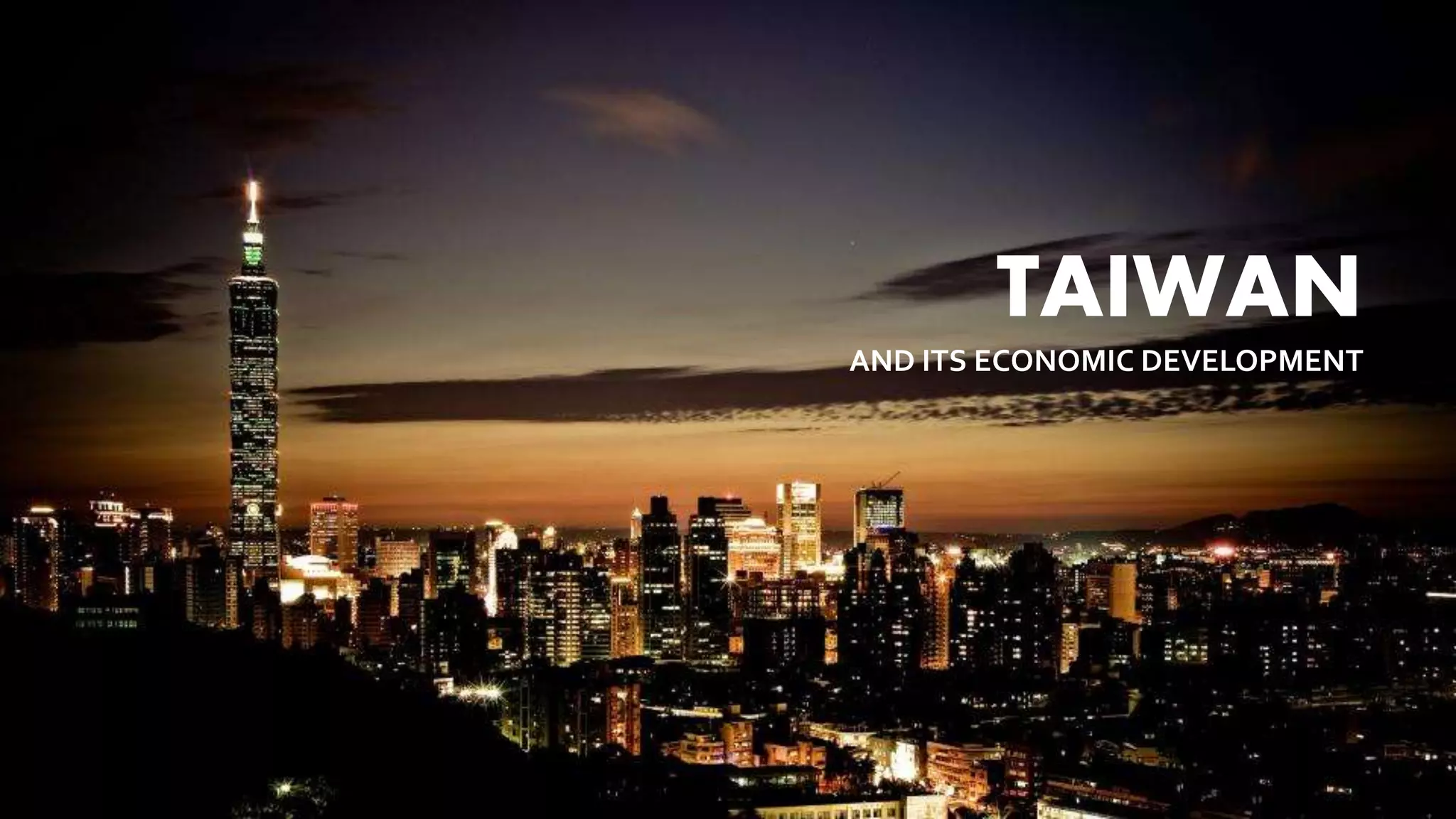
TAIWAN
AND ITS ECONOMIC DEVELOPMENT
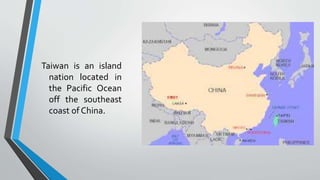
Taiwan is an island
nation located in
the Pacific Ocean
off the southeast
coast of China.
History
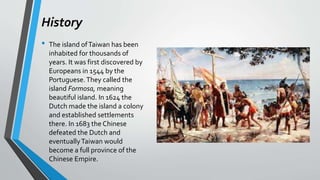
• The island ofTaiwan has been
inhabited for thousands of
years. It was first discovered by
Europeans in 1544 by the
Portuguese.They called the
island Formosa, meaning
beautiful island. In 1624 the
Dutch made the island a colony
and established settlements
there. In 1683 the Chinese
defeated the Dutch and
eventuallyTaiwan would
become a full province of the
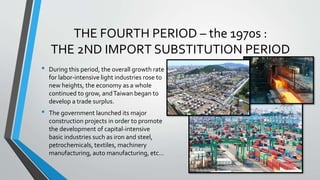
Chinese Empire.
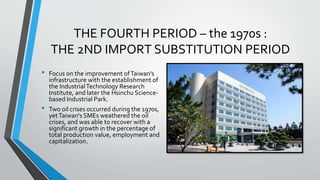
History
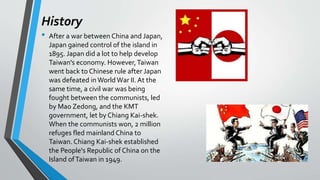
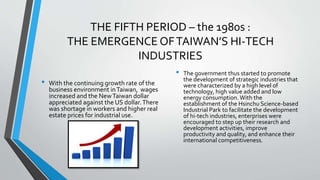
• After a war between China and Japan,
Japan gained control of the island in
1895. Japan did a lot to help develop
Taiwan's economy. However,Taiwan
went back to Chinese rule after Japan
was defeated inWorld War II.At the
same time, a civil war was being
fought between the communists, led
by Mao Zedong, and the KMT
government, let by Chiang Kai-shek.
When the communists won, 2 million
refuges fled mainland China to
Taiwan. Chiang Kai-shek established
the People's Republic of China on the
Island ofTaiwan in 1949.
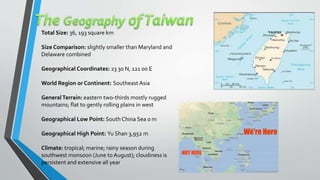
Total Size: 36, 193 square km
Size Comparison: slightly smaller than Maryland and
Delaware combined
Geographical Coordinates: 23 30 N, 121 00 E
World Region or Continent: Southeast Asia
GeneralTerrain: eastern two-thirds mostly rugged
mountains; flat to gently rolling plains in west
Geographical Low Point: South China Sea 0 m
Geographical High Point: Yu Shan 3,952 m
Climate: tropical; marine; rainy season during
southwest monsoon (June to August); cloudiness is
persistent and extensive all year
Official language ofTaiwan
is MandarinChinese.
Taiwanese (Min), Hakka
dialects
The population inTaiwan
is 23, 373,517.
female: 11,688,843 male: 11,684,674
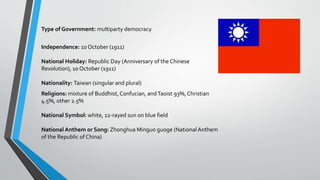
Type of Government: multiparty democracy
Independence: 10 October (1911)
National Holiday: Republic Day (Anniversary of the Chinese
Revolution), 10 October (1911)
Nationality: Taiwan (singular and plural)
Religions: mixture of Buddhist, Confucian, andTaoist 93%, Christian
4.5%, other 2.5%
National Symbol: white, 12-rayed sun on blue field
National Anthem or Song: Zhonghua Minguo guoge (National Anthem
of the Republic of China)
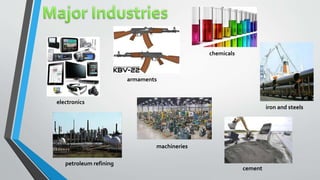
electronics
petroleum refining
armaments
chemicals
iron and steels
machineries
cement
rice
corn
vegetables
fruits
poultry
fish
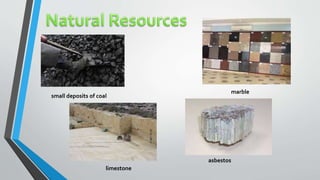
small deposits of coal
limestone
marble
asbestos
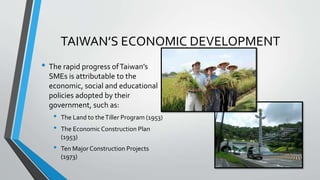
TAIWAN’S ECONOMIC DEVELOPMENT
• The rapid progress ofTaiwan’s
SMEs is attributable to the
economic, social and educational
policies adopted by their
government, such as:
• The Land to theTiller Program (1953)
• The EconomicConstruction Plan
(1953)
• Ten Major Construction Projects
(1973)
TAIWAN’S ECONOMIC DEVELOPMENT
• Along with other measures adopted in the areas of economic development,
manpower resources, social stability and public construction, provided the
SMEs with excellent environment in which to grow and develop.
• After the Asian financial crisis in 1987,Taiwan was able to readily recover
from the impact of the crisis, hence, its SMEs became models for other
Asian countries to follow.
THE DEVELOPMENT OFTAIWAN’S
SMALL & MEDIUM ENTERPRISES
(SMEs)
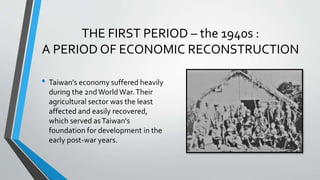
THE FIRST PERIOD – the 1940s :
A PERIOD OF ECONOMIC RECONSTRUCTION
• Taiwan's economy suffered heavily
during the 2ndWorldWar.Their
agricultural sector was the least
affected and easily recovered,
which served asTaiwan's
foundation for development in the
early post-war years.
THE FIRST PERIOD – the 1940s :
A PERIOD OF ECONOMIC RECONSTRUCTION
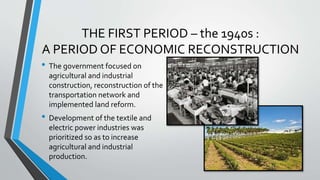
• The government focused on
agricultural and industrial
construction, reconstruction of the
transportation network and
implemented land reform.
• Development of the textile and
electric power industries was
prioritized so as to increase
agricultural and industrial
production.
THE SECOND PERIOD – the 1950s :
THE IMPORT SUBSTITUTION PERIOD
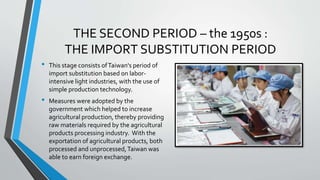
• This stage consists ofTaiwan's period of
import substitution based on labor-
intensive light industries, with the use of
simple production technology.
• Measures were adopted by the
government which helped to increase
agricultural production, thereby providing
raw materials required by the agricultural
products processing industry. With the
exportation of agricultural products, both
processed and unprocessed,Taiwan was
able to earn foreign exchange.
THE SECOND PERIOD – the 1950s :
THE IMPORT SUBSTITUTION PERIOD
• Private enterprises were encouraged to import raw materials, semi-finished
products and machinery to produce consumer goods which could replace
imports in the domestic market.
• The progress of SMEs speeded up, and enterprises with ten or fewer
employees came to account for over 90% of all enterprises inTaiwan. Most
of these enterprises were producing for the domestic market.
THETHIRD PERIOD – the 1960s :
A PERIOD OF RAPID EXPORT GROWTH
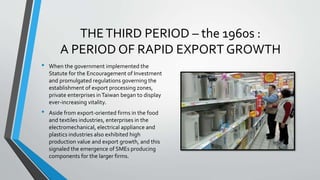
• When the government implemented the
Statute for the Encouragement of Investment
and promulgated regulations governing the
establishment of export processing zones,
private enterprises inTaiwan began to display
ever-increasing vitality.
• Aside from export-oriented firms in the food
and textiles industries, enterprises in the
electromechanical, electrical appliance and
plastics industries also exhibited high
production value and export growth, and this
signaled the emergence of SMEs producing
components for the larger firms.
THETHIRD PERIOD – the 1960s :
A PERIOD OF RAPID EXPORT GROWTH
• Flexibility, coupled with abundant supply of cheap labor, madeTaiwan's
SMEs very competitive in the international scene.The percentage of
enterprises accounted for by enterprises with ten or fewer employees fell to
under 70%, while the percentage accounted for by medium-sized
enterprises rose to over 25%. Large enterprises accounted for around 5% of
the total.
THE FOURTH PERIOD – the 1970s :
THE 2ND IMPORT SUBSTITUTION PERIOD
• During this period, the overall growth rate
for labor-intensive light industries rose to
new heights, the economy as a whole
continued to grow, andTaiwan began to
develop a trade surplus.
• The government launched its major
construction projects in order to promote
the development of capital-intensive
basic industries such as iron and steel,
petrochemicals, textiles, machinery
manufacturing, auto manufacturing, etc…
THE FOURTH PERIOD – the 1970s :
THE 2ND IMPORT SUBSTITUTION PERIOD
• Focus on the improvement ofTaiwan's
infrastructure with the establishment of
the IndustrialTechnology Research
Institute, and later the Hsinchu Science-
based Industrial Park.
• Two oil crises occurred during the 1970s,
yetTaiwan's SMEs weathered the oil
crises, and was able to recover with a
significant growth in the percentage of
total production value, employment and
capitalization.
THE FIFTH PERIOD – the 1980s :
THE EMERGENCE OFTAIWAN’S HI-TECH
INDUSTRIES
• With the continuing growth rate of the
business environment inTaiwan, wages
increased and the NewTaiwan dollar
appreciated against the US dollar.There
was shortage in workers and higher real
estate prices for industrial use.
• The government thus started to promote
the development of strategic industries that
were characterized by a high level of
technology, high value added and low
energy consumption. With the
establishment of the Hsinchu Science-based
Industrial Park to facilitate the development
of hi-tech industries, enterprises were
encouraged to step up their research and
development activities, improve
productivity and quality, and enhance their
international competitiveness.
THE FIFTH PERIOD – the 1980s :
THE EMERGENCE OFTAIWAN’S HI-TECH
INDUSTRIES
• Taiwanese enterprises began to transform
and upgrade themselves and invest
overseas.
• While the importance of SMEs to the
economy as a whole continued to
increase, a structural transformation was
taking place in the production and sales
mechanism.A new breed of SMEs in
technology-intensive industries began to
emerge.
THE SIXTH PERIOD – the 1990s :
A PERIOD OF CHANGING INDUSTRIAL
STRUCTURE
• Taiwan government worked hard to improve the investment environment
and foreign technology, so as to help in the upgrading of their domestic
industry.
• Taiwan gradually lost its competitive advantage in labor-intensive products
with low added value. Hence, the government promulgated the Statute for
Small and Medium Enterprise Development, along with the Statute for
Upgrading industries and the Six-year National Development Plan.
THE SIXTH PERIOD – the 1990s :
A PERIOD OF CHANGING INDUSTRIAL
STRUCTURE
• In 1997, the SMEs Protection Clause was incorporated into the Constitution,
and the government began to pay more attention to the survival and
development of SMEs.
• Public construction was initiated, and tax incentives were used to stimulate
research and development, manpower training, the automation of
production and pollution prevention.
• SMEs gradually upgraded or transformed themselves so that they became
more knowledge-intensive, technology-intensive and innovation-intensive.
THE SEVENTH PERIOD – from the 2000s to the
present :
A PERIOD OF INNOVATION AND R&D
• The arrival of the knowledge-based economy era,
aided by the application of the Internet, e-commerce
and IT, has provided SMEs with new operating
model and has enhanced the speed and efficiency of
business operations.
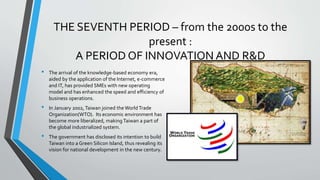
• In January 2002,Taiwan joined theWorldTrade
Organization(WTO). Its economic environment has
become more liberalized, making Taiwan a part of
the global industrialized system.
• The government has disclosed its intention to build
Taiwan into a Green Silicon Island, thus revealing its
vision for national development in the new century.
THE SEVENTH PERIOD – from the 2000s to the
present :
A PERIOD OF INNOVATION AND R&D
• It has also continued to promote its Global Logistic
Development Plan, Knowledge-based Economic
Development Proposal, Plan to Stimulate
Conventional Industries, its Concrete Action Plan for
the Implementation of Resolutions reached at the
National Economic Development Conference and its
Challenge for 2008: Focal Plan for National
Development.
• The 2008 Challenge includes the promotion of
innovation-oriented industrial policy, the creation of
R&D centers inTaiwan by foreign corporations, the
setting up inTaiwan of local innovation and
incubation centers for SMEs, the establishment of
the Nankang Software Incubation Center, Southern
Science Incubation Center, and Nankang Biotech
Incubation Center.
THE SEVENTH PERIOD – from the 2000s to the
present :
A PERIOD OF INNOVATION AND R&D
• The ultimate objective of all these projects is to lead SMEs towards a high value-
added industrial era featured by innovation, invention, and research and
development.
• The economic development in 2012 emphasizes knowledge-intensive innovation.
Economic development today involves far more than just traditional
manufacturing industry; the key drivers of growth forTaiwan in the future will be
the innovation economy and environmental protection-related demand.
• The last few years have seen a pronounced trend towards the formation of
multilateral and bilateral free trade agreements (FTAs) and comprehensive
economic partnership agreements (CEPAs) within the Asia region.
THE SEVENTH PERIOD – from the 2000s to the
present :
A PERIOD OF INNOVATION AND R&D
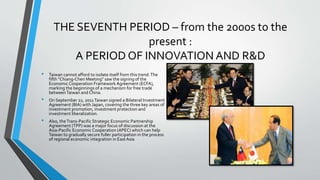
• Taiwan cannot afford to isolate itself from this trend.The
fifth "Chiang-Chen Meeting" saw the signing of the
Economic Cooperation Framework Agreement (ECFA),
marking the beginnings of a mechanism for free trade
betweenTaiwan and China.
• On September 22, 2011Taiwan signed a Bilateral Investment
Agreement (BIA) with Japan, covering the three key areas of
investment promotion, investment protection and
investment liberalization.
• Also, theTrans-Pacific Strategic Economic Partnership
Agreement (TPP) was a major focus of discussion at the
Asia-Pacific Economic Cooperation (APEC) which can help
Taiwan to gradually secure fuller participation in the process
of regional economic integration in EastAsia

Taiwan (1)

  • 1.
  • 2.
    Taiwan is anisland nation located in the Pacific Ocean off the southeast coast of China.
  • 3.
    History • The islandofTaiwan has been inhabited for thousands of years. It was first discovered by Europeans in 1544 by the Portuguese.They called the island Formosa, meaning beautiful island. In 1624 the Dutch made the island a colony and established settlements there. In 1683 the Chinese defeated the Dutch and eventuallyTaiwan would become a full province of the Chinese Empire.
  • 4.
    History • After awar between China and Japan, Japan gained control of the island in 1895. Japan did a lot to help develop Taiwan's economy. However,Taiwan went back to Chinese rule after Japan was defeated inWorld War II.At the same time, a civil war was being fought between the communists, led by Mao Zedong, and the KMT government, let by Chiang Kai-shek. When the communists won, 2 million refuges fled mainland China to Taiwan. Chiang Kai-shek established the People's Republic of China on the Island ofTaiwan in 1949.
  • 5.
    Total Size: 36,193 square km Size Comparison: slightly smaller than Maryland and Delaware combined Geographical Coordinates: 23 30 N, 121 00 E World Region or Continent: Southeast Asia GeneralTerrain: eastern two-thirds mostly rugged mountains; flat to gently rolling plains in west Geographical Low Point: South China Sea 0 m Geographical High Point: Yu Shan 3,952 m Climate: tropical; marine; rainy season during southwest monsoon (June to August); cloudiness is persistent and extensive all year
  • 6.
    Official language ofTaiwan isMandarinChinese. Taiwanese (Min), Hakka dialects
  • 7.
    The population inTaiwan is23, 373,517. female: 11,688,843 male: 11,684,674
  • 8.
    Type of Government:multiparty democracy Independence: 10 October (1911) National Holiday: Republic Day (Anniversary of the Chinese Revolution), 10 October (1911) Nationality: Taiwan (singular and plural) Religions: mixture of Buddhist, Confucian, andTaoist 93%, Christian 4.5%, other 2.5% National Symbol: white, 12-rayed sun on blue field National Anthem or Song: Zhonghua Minguo guoge (National Anthem of the Republic of China)
  • 9.
  • 10.
  • 11.
    small deposits ofcoal limestone marble asbestos
  • 12.
    TAIWAN’S ECONOMIC DEVELOPMENT •The rapid progress ofTaiwan’s SMEs is attributable to the economic, social and educational policies adopted by their government, such as: • The Land to theTiller Program (1953) • The EconomicConstruction Plan (1953) • Ten Major Construction Projects (1973)
  • 13.
    TAIWAN’S ECONOMIC DEVELOPMENT •Along with other measures adopted in the areas of economic development, manpower resources, social stability and public construction, provided the SMEs with excellent environment in which to grow and develop. • After the Asian financial crisis in 1987,Taiwan was able to readily recover from the impact of the crisis, hence, its SMEs became models for other Asian countries to follow.
  • 14.
    THE DEVELOPMENT OFTAIWAN’S SMALL& MEDIUM ENTERPRISES (SMEs)
  • 15.
    THE FIRST PERIOD– the 1940s : A PERIOD OF ECONOMIC RECONSTRUCTION • Taiwan's economy suffered heavily during the 2ndWorldWar.Their agricultural sector was the least affected and easily recovered, which served asTaiwan's foundation for development in the early post-war years.
  • 16.
    THE FIRST PERIOD– the 1940s : A PERIOD OF ECONOMIC RECONSTRUCTION • The government focused on agricultural and industrial construction, reconstruction of the transportation network and implemented land reform. • Development of the textile and electric power industries was prioritized so as to increase agricultural and industrial production.
  • 17.
    THE SECOND PERIOD– the 1950s : THE IMPORT SUBSTITUTION PERIOD • This stage consists ofTaiwan's period of import substitution based on labor- intensive light industries, with the use of simple production technology. • Measures were adopted by the government which helped to increase agricultural production, thereby providing raw materials required by the agricultural products processing industry. With the exportation of agricultural products, both processed and unprocessed,Taiwan was able to earn foreign exchange.
  • 18.
    THE SECOND PERIOD– the 1950s : THE IMPORT SUBSTITUTION PERIOD • Private enterprises were encouraged to import raw materials, semi-finished products and machinery to produce consumer goods which could replace imports in the domestic market. • The progress of SMEs speeded up, and enterprises with ten or fewer employees came to account for over 90% of all enterprises inTaiwan. Most of these enterprises were producing for the domestic market.
  • 19.
    THETHIRD PERIOD –the 1960s : A PERIOD OF RAPID EXPORT GROWTH • When the government implemented the Statute for the Encouragement of Investment and promulgated regulations governing the establishment of export processing zones, private enterprises inTaiwan began to display ever-increasing vitality. • Aside from export-oriented firms in the food and textiles industries, enterprises in the electromechanical, electrical appliance and plastics industries also exhibited high production value and export growth, and this signaled the emergence of SMEs producing components for the larger firms.
  • 20.
    THETHIRD PERIOD –the 1960s : A PERIOD OF RAPID EXPORT GROWTH • Flexibility, coupled with abundant supply of cheap labor, madeTaiwan's SMEs very competitive in the international scene.The percentage of enterprises accounted for by enterprises with ten or fewer employees fell to under 70%, while the percentage accounted for by medium-sized enterprises rose to over 25%. Large enterprises accounted for around 5% of the total.
  • 21.
    THE FOURTH PERIOD– the 1970s : THE 2ND IMPORT SUBSTITUTION PERIOD • During this period, the overall growth rate for labor-intensive light industries rose to new heights, the economy as a whole continued to grow, andTaiwan began to develop a trade surplus. • The government launched its major construction projects in order to promote the development of capital-intensive basic industries such as iron and steel, petrochemicals, textiles, machinery manufacturing, auto manufacturing, etc…
  • 22.
    THE FOURTH PERIOD– the 1970s : THE 2ND IMPORT SUBSTITUTION PERIOD • Focus on the improvement ofTaiwan's infrastructure with the establishment of the IndustrialTechnology Research Institute, and later the Hsinchu Science- based Industrial Park. • Two oil crises occurred during the 1970s, yetTaiwan's SMEs weathered the oil crises, and was able to recover with a significant growth in the percentage of total production value, employment and capitalization.
  • 23.
    THE FIFTH PERIOD– the 1980s : THE EMERGENCE OFTAIWAN’S HI-TECH INDUSTRIES • With the continuing growth rate of the business environment inTaiwan, wages increased and the NewTaiwan dollar appreciated against the US dollar.There was shortage in workers and higher real estate prices for industrial use. • The government thus started to promote the development of strategic industries that were characterized by a high level of technology, high value added and low energy consumption. With the establishment of the Hsinchu Science-based Industrial Park to facilitate the development of hi-tech industries, enterprises were encouraged to step up their research and development activities, improve productivity and quality, and enhance their international competitiveness.
  • 24.
    THE FIFTH PERIOD– the 1980s : THE EMERGENCE OFTAIWAN’S HI-TECH INDUSTRIES • Taiwanese enterprises began to transform and upgrade themselves and invest overseas. • While the importance of SMEs to the economy as a whole continued to increase, a structural transformation was taking place in the production and sales mechanism.A new breed of SMEs in technology-intensive industries began to emerge.
  • 25.
    THE SIXTH PERIOD– the 1990s : A PERIOD OF CHANGING INDUSTRIAL STRUCTURE • Taiwan government worked hard to improve the investment environment and foreign technology, so as to help in the upgrading of their domestic industry. • Taiwan gradually lost its competitive advantage in labor-intensive products with low added value. Hence, the government promulgated the Statute for Small and Medium Enterprise Development, along with the Statute for Upgrading industries and the Six-year National Development Plan.
  • 26.
    THE SIXTH PERIOD– the 1990s : A PERIOD OF CHANGING INDUSTRIAL STRUCTURE • In 1997, the SMEs Protection Clause was incorporated into the Constitution, and the government began to pay more attention to the survival and development of SMEs. • Public construction was initiated, and tax incentives were used to stimulate research and development, manpower training, the automation of production and pollution prevention. • SMEs gradually upgraded or transformed themselves so that they became more knowledge-intensive, technology-intensive and innovation-intensive.
  • 27.
    THE SEVENTH PERIOD– from the 2000s to the present : A PERIOD OF INNOVATION AND R&D • The arrival of the knowledge-based economy era, aided by the application of the Internet, e-commerce and IT, has provided SMEs with new operating model and has enhanced the speed and efficiency of business operations. • In January 2002,Taiwan joined theWorldTrade Organization(WTO). Its economic environment has become more liberalized, making Taiwan a part of the global industrialized system. • The government has disclosed its intention to build Taiwan into a Green Silicon Island, thus revealing its vision for national development in the new century.
  • 28.
    THE SEVENTH PERIOD– from the 2000s to the present : A PERIOD OF INNOVATION AND R&D • It has also continued to promote its Global Logistic Development Plan, Knowledge-based Economic Development Proposal, Plan to Stimulate Conventional Industries, its Concrete Action Plan for the Implementation of Resolutions reached at the National Economic Development Conference and its Challenge for 2008: Focal Plan for National Development. • The 2008 Challenge includes the promotion of innovation-oriented industrial policy, the creation of R&D centers inTaiwan by foreign corporations, the setting up inTaiwan of local innovation and incubation centers for SMEs, the establishment of the Nankang Software Incubation Center, Southern Science Incubation Center, and Nankang Biotech Incubation Center.
  • 29.
    THE SEVENTH PERIOD– from the 2000s to the present : A PERIOD OF INNOVATION AND R&D • The ultimate objective of all these projects is to lead SMEs towards a high value- added industrial era featured by innovation, invention, and research and development. • The economic development in 2012 emphasizes knowledge-intensive innovation. Economic development today involves far more than just traditional manufacturing industry; the key drivers of growth forTaiwan in the future will be the innovation economy and environmental protection-related demand. • The last few years have seen a pronounced trend towards the formation of multilateral and bilateral free trade agreements (FTAs) and comprehensive economic partnership agreements (CEPAs) within the Asia region.
  • 30.
    THE SEVENTH PERIOD– from the 2000s to the present : A PERIOD OF INNOVATION AND R&D • Taiwan cannot afford to isolate itself from this trend.The fifth "Chiang-Chen Meeting" saw the signing of the Economic Cooperation Framework Agreement (ECFA), marking the beginnings of a mechanism for free trade betweenTaiwan and China. • On September 22, 2011Taiwan signed a Bilateral Investment Agreement (BIA) with Japan, covering the three key areas of investment promotion, investment protection and investment liberalization. • Also, theTrans-Pacific Strategic Economic Partnership Agreement (TPP) was a major focus of discussion at the Asia-Pacific Economic Cooperation (APEC) which can help Taiwan to gradually secure fuller participation in the process of regional economic integration in EastAsia