Preparing for the revised ePrivacy Directive
26 April 2012
Our Challenge

   The revised EU ePrivacy Directive is part of a broader policy debate about
    privacy.

   It is a debate about the evolution of the digital environment - and how it
    aims to benefit the citizen, business, government and the public sector.

   The UK has the most advanced internet economy in the world (Boston
    Consulting Group). We are the most advanced ‘digital citizens’ in the world
    (Ofcom).

   This continued success depends upon the use of data, enabling consumers
    to access tailored content, services and applications.

   But this must be used responsibly and transparently to empower the
    consumer.
What is the ePrivacy Directive?

   The revised EU ePrivacy Directive is part of a broader piece of European
    legislation – the EU Electronic Communications Framework.

   Implemented into UK law in May 2011 – the revised Privacy & Electronic
    Communications Regulations 2011.

   New law replaces ‘notice and opt out’ requirements for cookies and other
    technologies with a requirement to obtain informed consent.

   There is an exemption for when uses are “strictly necessary” for the service
    explicitly requested by the user (eg shopping baskets).

   Revised Directive needs to be implemented into the national laws of each EU
    country.

   Many haven’t done it yet – and there are also different transpositions.
What does it mean?

   The new law goes beyond advertising and impacts every organisation – big
    or small – doing business in a digital environment (online and mobile).

   It is not just about ‘cookies’. It applies to all technologies used to store /
    process information (on a user’s device).

   A strict interpretation (ie opt in) would have a detrimental impact upon the
    internet – to advertising, to publishing, to commerce, to consumers!

   The UK Government recognises that the new law is a “well meaning
    regulation that will be very difficult to work in practice”.

   It has adopted a pragmatic approach – enshrined in the ICO’s guidance.

   There are good examples of what you should consider.
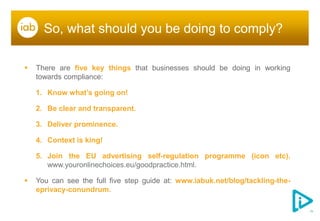
So, what should you be doing to comply?

   There are five key things that businesses should be doing in working
    towards compliance:

    1. Know what’s going on!

    2. Be clear and transparent.

    3. Deliver prominence.

    4. Context is king!

    5. Join the EU advertising self-regulation programme (icon etc).
       www.youronlinechoices.eu/goodpractice.html.

   You can see the full five step guide at: www.iabuk.net/blog/tackling-the-
    eprivacy-conundrum.
Thanks!


         nick@iabuk.net
      www.iabuk.net/policy
    www.twitter.com/nickstringer

Nick Stringer, IAB UK - Preparing for the revised ePrivacy directive

  • 1.
    Preparing for therevised ePrivacy Directive 26 April 2012
  • 2.
    Our Challenge  The revised EU ePrivacy Directive is part of a broader policy debate about privacy.  It is a debate about the evolution of the digital environment - and how it aims to benefit the citizen, business, government and the public sector.  The UK has the most advanced internet economy in the world (Boston Consulting Group). We are the most advanced ‘digital citizens’ in the world (Ofcom).  This continued success depends upon the use of data, enabling consumers to access tailored content, services and applications.  But this must be used responsibly and transparently to empower the consumer.
  • 3.
    What is theePrivacy Directive?  The revised EU ePrivacy Directive is part of a broader piece of European legislation – the EU Electronic Communications Framework.  Implemented into UK law in May 2011 – the revised Privacy & Electronic Communications Regulations 2011.  New law replaces ‘notice and opt out’ requirements for cookies and other technologies with a requirement to obtain informed consent.  There is an exemption for when uses are “strictly necessary” for the service explicitly requested by the user (eg shopping baskets).  Revised Directive needs to be implemented into the national laws of each EU country.  Many haven’t done it yet – and there are also different transpositions.
  • 4.
    What does itmean?  The new law goes beyond advertising and impacts every organisation – big or small – doing business in a digital environment (online and mobile).  It is not just about ‘cookies’. It applies to all technologies used to store / process information (on a user’s device).  A strict interpretation (ie opt in) would have a detrimental impact upon the internet – to advertising, to publishing, to commerce, to consumers!  The UK Government recognises that the new law is a “well meaning regulation that will be very difficult to work in practice”.  It has adopted a pragmatic approach – enshrined in the ICO’s guidance.  There are good examples of what you should consider.
  • 5.
    So, what shouldyou be doing to comply?  There are five key things that businesses should be doing in working towards compliance: 1. Know what’s going on! 2. Be clear and transparent. 3. Deliver prominence. 4. Context is king! 5. Join the EU advertising self-regulation programme (icon etc). www.youronlinechoices.eu/goodpractice.html.  You can see the full five step guide at: www.iabuk.net/blog/tackling-the- eprivacy-conundrum.
  • 6.
    Thanks! nick@iabuk.net www.iabuk.net/policy www.twitter.com/nickstringer