Traditional Arts and
 Ethnology Centre


         Museum Education as a Sustainable
            Approach to Community-Driven
                    Heritage Management

                   Alicia Akins, Programmes Director
Contents
• Background of TAEC
  – Mission
  – Areas of Activity
• Challenges of Developing Country Context
• Education as a Sustainability Approach
• Enduring Questions & Possibilities
Traditional Arts and
Ethnology Centre

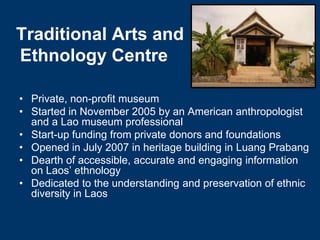
• Private, non-profit museum
• Started in November 2005 by an American anthropologist
  and a Lao museum professional
• Start-up funding from private donors and foundations
• Opened in July 2007 in heritage building in Luang Prabang
• Dearth of accessible, accurate and engaging information
  on Laos’ ethnology
• Dedicated to the understanding and preservation of ethnic
  diversity in Laos
Mission & Objectives
  To facilitate pride and investment in Laos’
  ethnic diversity and cultural resources by
helping visitors and locals to understand and
 value the changing lifestyles of Laos’ many
ethnic groups, and providing an outlet for the
development and selling of their handicrafts.
Operational vs. Missional

• Operationally functional: financially
  sustainable

• Missionally sustainable: local investment
  in mission beyond our organization

• Both necessary for long term success
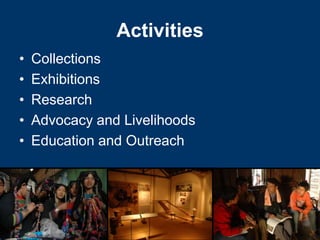
Activities
•   Collections
•   Exhibitions
•   Research
•   Advocacy and Livelihoods
•   Education and Outreach
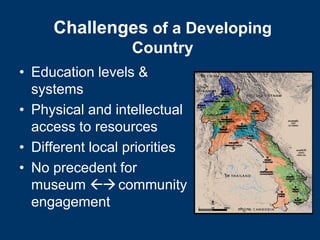
Challenges of a Developing
                  Country
• Education levels &
  systems
• Physical and intellectual
  access to resources
• Different local priorities
• No precedent for
  museum  community
  engagement
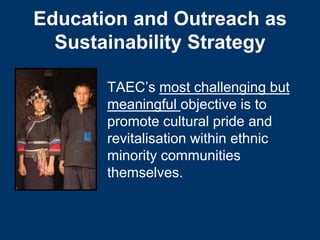
Education and Outreach as
  Sustainability Strategy

       TAEC’s most challenging but
       meaningful objective is to
       promote cultural pride and
       revitalisation within ethnic
       minority communities
       themselves.
Limits of traditional museum
         activity areas
Exhibits, research, and collection are
based on a model that assumes:
• comfort with self-guided discovery and
  reflection
• an ability to engage with large
  quantities of information at higher
  cognitive levels
Community Integrated Education:
  A Sustainability Opportunity

• Moves beyond more static education
  approaches to more community-led,
  dynamic ways of sustaining heritage

• Meets people in their communities
  with learning opportunities based on
  their needs
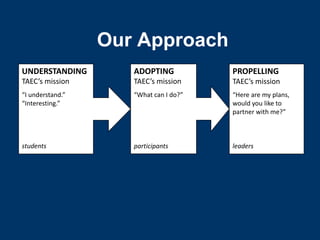
Our Approach
UNDERSTANDING        ADOPTING           PROPELLING
TAEC’s mission       TAEC’s mission     TAEC’s mission
“I understand.”      “What can I do?”   “Here are my plans,
“Interesting.”                          would you like to
                                        partner with me?”


students             participants       leaders
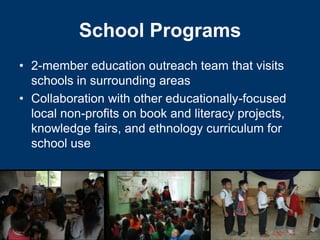
School Programs
• 2-member education outreach team that visits
  schools in surrounding areas
• Collaboration with other educationally-focused
  local non-profits on book and literacy projects,
  knowledge fairs, and ethnology curriculum for
  school use
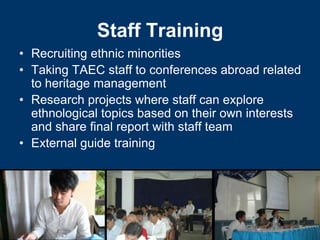
Staff Training
• Recruiting ethnic minorities
• Taking TAEC staff to conferences abroad related
  to heritage management
• Research projects where staff can explore
  ethnological topics based on their own interests
  and share final report with staff team
• External guide training
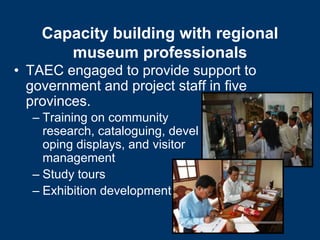
Capacity building with regional
       museum professionals
• TAEC engaged to provide support to
  government and project staff in five
  provinces.
  – Training on community
    research, cataloguing, devel
    oping displays, and visitor
    management
  – Study tours
  – Exhibition development
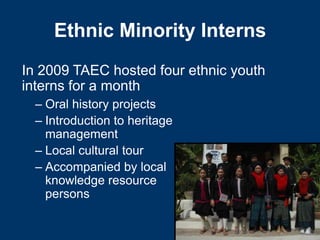
Ethnic Minority Interns
In 2009 TAEC hosted four ethnic youth
interns for a month
  – Oral history projects
  – Introduction to heritage
    management
  – Local cultural tour
  – Accompanied by local
    knowledge resource
    persons
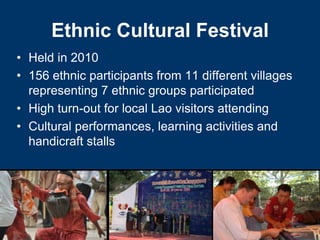
Ethnic Cultural Festival
• Held in 2010
• 156 ethnic participants from 11 different villages
  representing 7 ethnic groups participated
• High turn-out for local Lao visitors attending
• Cultural performances, learning activities and
  handicraft stalls
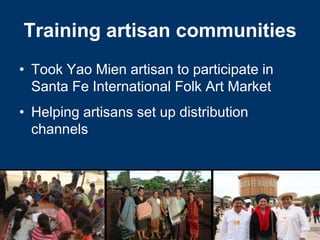
Training artisan communities
• Took Yao Mien artisan to participate in
  Santa Fe International Folk Art Market
• Helping artisans set up distribution
  channels
Enduring Questions & Possibilities
• How else could we encourage greater
  engagement and ownership of preservation of
  traditions and informed adoption of new ones?

• How can we use the challenges of our context to
  help shape a locally sustainable model of
  museums?

• What can and does our experience add to the
  broader discussion of the relevance of
  museums?
Enduring Questions & Possibilities
• Given the correlation between rise in education
  levels and decline in practice of traditional arts,
  how can we integrate traditional arts within
  schools so attendance does not lead to decline
  but to a flourishing, “reimagining”, and fresh
  appreciation of traditional skills?
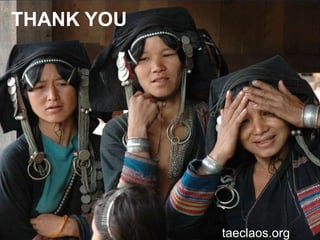
THANK YOU


            taeclaos.org

TAEC ASEMUS 2012 Presentation

  • 1.
    Traditional Arts and Ethnology Centre Museum Education as a Sustainable Approach to Community-Driven Heritage Management Alicia Akins, Programmes Director
  • 2.
    Contents • Background ofTAEC – Mission – Areas of Activity • Challenges of Developing Country Context • Education as a Sustainability Approach • Enduring Questions & Possibilities
  • 3.
    Traditional Arts and EthnologyCentre • Private, non-profit museum • Started in November 2005 by an American anthropologist and a Lao museum professional • Start-up funding from private donors and foundations • Opened in July 2007 in heritage building in Luang Prabang • Dearth of accessible, accurate and engaging information on Laos’ ethnology • Dedicated to the understanding and preservation of ethnic diversity in Laos
  • 4.
    Mission & Objectives To facilitate pride and investment in Laos’ ethnic diversity and cultural resources by helping visitors and locals to understand and value the changing lifestyles of Laos’ many ethnic groups, and providing an outlet for the development and selling of their handicrafts.
  • 5.
    Operational vs. Missional •Operationally functional: financially sustainable • Missionally sustainable: local investment in mission beyond our organization • Both necessary for long term success
  • 6.
    Activities • Collections • Exhibitions • Research • Advocacy and Livelihoods • Education and Outreach
  • 7.
    Challenges of aDeveloping Country • Education levels & systems • Physical and intellectual access to resources • Different local priorities • No precedent for museum  community engagement
  • 8.
    Education and Outreachas Sustainability Strategy TAEC’s most challenging but meaningful objective is to promote cultural pride and revitalisation within ethnic minority communities themselves.
  • 9.
    Limits of traditionalmuseum activity areas Exhibits, research, and collection are based on a model that assumes: • comfort with self-guided discovery and reflection • an ability to engage with large quantities of information at higher cognitive levels
  • 10.
    Community Integrated Education: A Sustainability Opportunity • Moves beyond more static education approaches to more community-led, dynamic ways of sustaining heritage • Meets people in their communities with learning opportunities based on their needs
  • 11.
    Our Approach UNDERSTANDING ADOPTING PROPELLING TAEC’s mission TAEC’s mission TAEC’s mission “I understand.” “What can I do?” “Here are my plans, “Interesting.” would you like to partner with me?” students participants leaders
  • 12.
    School Programs • 2-membereducation outreach team that visits schools in surrounding areas • Collaboration with other educationally-focused local non-profits on book and literacy projects, knowledge fairs, and ethnology curriculum for school use
  • 13.
    Staff Training • Recruitingethnic minorities • Taking TAEC staff to conferences abroad related to heritage management • Research projects where staff can explore ethnological topics based on their own interests and share final report with staff team • External guide training
  • 14.
    Capacity building withregional museum professionals • TAEC engaged to provide support to government and project staff in five provinces. – Training on community research, cataloguing, devel oping displays, and visitor management – Study tours – Exhibition development
  • 15.
    Ethnic Minority Interns In2009 TAEC hosted four ethnic youth interns for a month – Oral history projects – Introduction to heritage management – Local cultural tour – Accompanied by local knowledge resource persons
  • 16.
    Ethnic Cultural Festival •Held in 2010 • 156 ethnic participants from 11 different villages representing 7 ethnic groups participated • High turn-out for local Lao visitors attending • Cultural performances, learning activities and handicraft stalls
  • 17.
    Training artisan communities •Took Yao Mien artisan to participate in Santa Fe International Folk Art Market • Helping artisans set up distribution channels
  • 18.
    Enduring Questions &Possibilities • How else could we encourage greater engagement and ownership of preservation of traditions and informed adoption of new ones? • How can we use the challenges of our context to help shape a locally sustainable model of museums? • What can and does our experience add to the broader discussion of the relevance of museums?
  • 19.
    Enduring Questions &Possibilities • Given the correlation between rise in education levels and decline in practice of traditional arts, how can we integrate traditional arts within schools so attendance does not lead to decline but to a flourishing, “reimagining”, and fresh appreciation of traditional skills?
  • 20.
    THANK YOU taeclaos.org