Tackifiers in adhesives
(teaser)


Dr Evert Smit

December 2009
Content

• Introduction Arizona Chemical

• Tackifiers
  – Their action – looking at molecular scale
  – Chemistries
  – Effect in formulations
  – DMA

• Conclusions
Our company
•   10 Manufacturing facilities

•   Broad-based research and development

•   Regional headquarters in Jacksonville, Florida and Almere, Netherlands

•   2 Research, Development
    & Technical Service labs

    –   Almere, The Netherlands

    –   Savannah, Georgia US
Sustainability
Biorefining- A New Word for
our Decades of Experience!
  Biorefinery:
  “A facility that integrates biomass conversion processes and equipment to
  produce fuels, power and added-value chemicals from biomass”
  Source: Wikipedia


  Renewable raw       Co-product of pulp     Refining and      Providing sophisticated products
     material            production      producing chemicals   for the global chemical industry


                                         Arizona
                        PULP MILL
                                         Chemical
Introduction

• What is a tackifier ?

• What does it do ?

• How does it do this?
Introduction:
What is a tackifier ?
•   Low molecular weight material
    (resin) (Mn 300-2000)

•   Compatible or partially compatible
    with rubber/elastomer
    or adhesive base polymer

•   Has a Tg (glass transition
    temperature) higher than that of the
    rubber/elastomer or base polymer
Introduction:
What does a tackifier do ?
•   The tackifier modifies the adhesive
    polymer matrix
      1. It (partly) breaks up the existing structure
          Enhances the mobility,
           thus enhances the tack
             size effect depends on compatibility

      2. Increases adhesive force by providing “anchor
         points” for specific adhesion and bridging
         – almost like a surfactant
         – Again, compatibility is key

      3. But also increases the Tg of the formulated
         adhesive (=tackifier+polymer+additives)
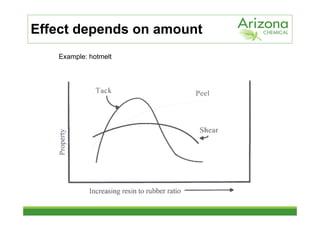
Effect depends on amount
   Example: hotmelt
Tackifying Resins

• Types of Tackifying Resins

  – Chemistry


  – Characteristics
Tackifying Resins – Types

• Rosin derivatives
  – Pure
  – Dispersion

• Hydrocarbons
  – C5, C9, C5/C9, AMS

• Terpenes
  – Polymerised
  – Styrenated
  – Phenolated
Tackifying resins based on rosin

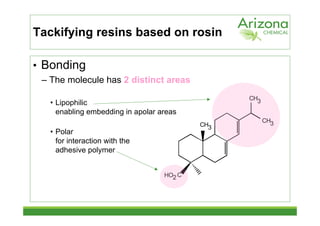
• Bonding
 – The molecule has 2 distinct areas
                                                 CH3
   • Lipophilic
     enabling embedding in apolar areas
                                                       CH3
                                           CH3
   • Polar
     for interaction with the
     adhesive polymer


                                   HO2 C
Tackifying Resins –
  Hydrocarbon Resins
• Chemistry
  – Aliphatic C5
     • cis, trans 1,3-Pentadiene, cyclopentene,
       cyclopentadiene
     • -C=C- and –C=C-C=C- functionality
     • (Non) low polar
     • ‘like like’ compatibility
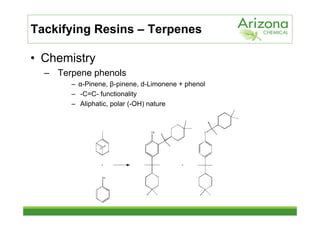
Tackifying Resins – Terpenes

• Chemistry
  – Terpene phenols
       – α-Pinene, β-pinene, d-Limonene + phenol
       – -C=C- functionality
       – Aliphatic, polar (-OH) nature
Effect of Tackifiers in Formulations

• EVA
  – Typically packaging & non-woven
• Acrylates
  – Solvent based
  – Dispersions
• Block copolymers
  – SBS
  – SIS
  – … not yet: OBC / metallocenes
Synthetic Rubber


       Styrene   Mid-Block        Styrene


                             Styrene End-blocks
                             •Sharp, crystalline melt point
                             •Allows for melt processing
                             •Provides cohesive strength

                             Mid-blocks
                             •Soft, flexible
                             •Elastomeric
                             •Readily tackified
SIS Adhesive
Room Temperature Shear


          350
          300
          250
                         100C polyterpene
          200            100C rosin ester
minutes
          150            C5 hydrocarbon
                         95C terpene phenol
          100
          50
            0
DMA
How to measure the effect of a tackifier and a
plasticiser ?

•   Measure tack, peel and shear performance
    – Generates real-life numbers

          Or

•   Dynamical Mechanical Analysis
    – Makes molecular interactions visible
    – Helps to predict adhesive performance
      and processability
Contact Details
            Dr Evert Smit
            Technical Leader Adhesives

            Arizona Chemical
            Transistorstraat 16
            1322 CE Almere
            The Netherlands

            Mobile: +31 653 29 50 32
            Office: +31 36 54 62 924

            evert.smit@azchem.com

            http://www.arizonachemical.com

Tackifiers In Adhesives Teaser

  • 1.
    Tackifiers in adhesives (teaser) DrEvert Smit December 2009
  • 2.
    Content • Introduction ArizonaChemical • Tackifiers – Their action – looking at molecular scale – Chemistries – Effect in formulations – DMA • Conclusions
  • 3.
    Our company • 10 Manufacturing facilities • Broad-based research and development • Regional headquarters in Jacksonville, Florida and Almere, Netherlands • 2 Research, Development & Technical Service labs – Almere, The Netherlands – Savannah, Georgia US
  • 4.
    Sustainability Biorefining- A NewWord for our Decades of Experience! Biorefinery: “A facility that integrates biomass conversion processes and equipment to produce fuels, power and added-value chemicals from biomass” Source: Wikipedia Renewable raw Co-product of pulp Refining and Providing sophisticated products material production producing chemicals for the global chemical industry Arizona PULP MILL Chemical
  • 5.
    Introduction • What isa tackifier ? • What does it do ? • How does it do this?
  • 6.
    Introduction: What is atackifier ? • Low molecular weight material (resin) (Mn 300-2000) • Compatible or partially compatible with rubber/elastomer or adhesive base polymer • Has a Tg (glass transition temperature) higher than that of the rubber/elastomer or base polymer
  • 7.
    Introduction: What does atackifier do ? • The tackifier modifies the adhesive polymer matrix 1. It (partly) breaks up the existing structure  Enhances the mobility, thus enhances the tack size effect depends on compatibility 2. Increases adhesive force by providing “anchor points” for specific adhesion and bridging – almost like a surfactant – Again, compatibility is key 3. But also increases the Tg of the formulated adhesive (=tackifier+polymer+additives)
  • 8.
    Effect depends onamount Example: hotmelt
  • 9.
    Tackifying Resins • Typesof Tackifying Resins – Chemistry – Characteristics
  • 10.
    Tackifying Resins –Types • Rosin derivatives – Pure – Dispersion • Hydrocarbons – C5, C9, C5/C9, AMS • Terpenes – Polymerised – Styrenated – Phenolated
  • 11.
    Tackifying resins basedon rosin • Bonding – The molecule has 2 distinct areas CH3 • Lipophilic enabling embedding in apolar areas CH3 CH3 • Polar for interaction with the adhesive polymer HO2 C
  • 12.
    Tackifying Resins – Hydrocarbon Resins • Chemistry – Aliphatic C5 • cis, trans 1,3-Pentadiene, cyclopentene, cyclopentadiene • -C=C- and –C=C-C=C- functionality • (Non) low polar • ‘like like’ compatibility
  • 13.
    Tackifying Resins –Terpenes • Chemistry – Terpene phenols – α-Pinene, β-pinene, d-Limonene + phenol – -C=C- functionality – Aliphatic, polar (-OH) nature
  • 14.
    Effect of Tackifiersin Formulations • EVA – Typically packaging & non-woven • Acrylates – Solvent based – Dispersions • Block copolymers – SBS – SIS – … not yet: OBC / metallocenes
  • 15.
    Synthetic Rubber Styrene Mid-Block Styrene Styrene End-blocks •Sharp, crystalline melt point •Allows for melt processing •Provides cohesive strength Mid-blocks •Soft, flexible •Elastomeric •Readily tackified
  • 16.
    SIS Adhesive Room TemperatureShear 350 300 250 100C polyterpene 200 100C rosin ester minutes 150 C5 hydrocarbon 95C terpene phenol 100 50 0
  • 17.
    DMA How to measurethe effect of a tackifier and a plasticiser ? • Measure tack, peel and shear performance – Generates real-life numbers Or • Dynamical Mechanical Analysis – Makes molecular interactions visible – Helps to predict adhesive performance and processability
  • 18.
    Contact Details Dr Evert Smit Technical Leader Adhesives Arizona Chemical Transistorstraat 16 1322 CE Almere The Netherlands Mobile: +31 653 29 50 32 Office: +31 36 54 62 924 evert.smit@azchem.com http://www.arizonachemical.com