Module II
International Relevance
in the Telecom Sector
COMPILED BY: RUPENDRA SINGH
International regulation related to
Telecommunications.
 The long term evolution of new technologies and services has continued, focusing attention on the
growing importance of telecommunications for
 National economies and
 Growth of international trade in telecommunications services.
 In turn this has fuelled the transition in recent decades from monopoly structures to competitive
ones.
 In such a rapidly evolving field, it is necessary to ensure that regulation adapts to new
developments.
 Countries around the world have been reviewing their existing frameworks, enacting legislation
and creating new regulatory authorities to implement their legal and regulatory framework.
 A key characteristic of ICTs is that they are regulated by national administrative agencies that
are keen on ensuring that principles such as fair competition and universal access are upheld in
the public interest.
 Government regulation of ICTs extends into many disparate areas, ranging from pricing
regulation, mergers and market entry to content, copyright, and privacy.
 Given the speed of technological innovation, it is not surprising that the substance of ICT
regulation has had to evolve rapidly.
 The liberalization of ICT markets has stimulated cumulative interacting innovations in products,
services and technologies with a general convergence or blurring of distinctions between
platforms, products and services.
 These developments necessitate some form of regulatory response to keep them in check.
Nature of International
Telecommunications
 The telecommunications industry, in every respect, has grown vastly over the past two
decades.
 Changes in technology-Fiber optics, wireless and other signal-processing.
 Created new markets and made new network infrastructure far more affordable,
increasing competition.
 In recent years. Competitive nature:-
 It is very competitive, Increased competition could lead to price reductions, declining
sales volumes, loss of market share, higher marketing costs and reduced operating
margins.
 High-speed fiber optic networks or satellite telecommunications services.
 Provide traditional telephone services over nontraditional network infrastructures, like
electric utilities.
History of International
Telecommunications
 The history of telecommunication began with the use of smoke signals and drums in
Africa, New Guinea and North America, China and parts of Asia in the 1790s.
 The first Electrical Telecommunication systems started in 1830 in Europe.
 The foundation stone of modern telecommunications is the use of Telegraphy Singles in
Mid-19th Century.
 Alfred Vail developed the registered 5km Telegraph in 1830.
 Its spread over 32,000 km in U.S in 1851.
 The first Electrical Telephone invented in 1870, Patented in 1876 by Alexander Graham
bell.
 First Commercial Telephone Service setup 1878 and 1879.
 Bell and Charles conducted First wireless Telephone call in 1880.
Scope of International
Telecommunications
 Engineers
 Test Engineers,
 Product work,
 Communication Equipment
 Customer Support Service,
 Software or Applications Engineers
 Career opportunities,
 Public Relations and Government Relations
Why Regulate?
 The need for regulation varies depending on the conditions of the marketplace.
 While the design of the regulatory framework may differ, certain critical elements
should be included in an effective regulatory framework, Such as
 The functional aspects of the regulatory authority;
 Decision-making processes;
 Accountability;
 Consumer protection,
 Dispute resolution and enforcement powers.
 Consideration and proper implementation of these features are key elements for
creating an enabling environment for development of the sector and for increased
consumer welfare.
Need for Regulation
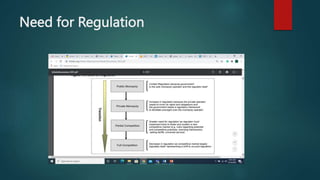
Goals of Regulation
To Avoid Market Failure
To foster Competition
To Protect the Consumer Interest and To Ensure New ICT
Source of International
Telecommunications
 The ITU together with the Universal Postal Union – The Sleeping Beauty of ITU.
 United Nations -Regulations .
 WTO-Regulations.
 Regional Regulations.
 ITU- A new source of International Telecommunication Law.
 ITU has on the international plane is made within its three main sectors,
 Telecommunication Standardization (ITU-T),
 Radio communication (ITU-R) .
 Telecommunication Development (ITU-D).
About International Telecommunication
Union (ITU)
 International organization where governments and private sector coordinate global
telecom networks and services.
 UN specialized agency, concerned with the development of telecommunication
networks and services worldwide.
 For a century and a half since 1865, the International Telecommunication Union
(ITU) has been at the centre of advances in communications -- from telegraphy
through to the modern world of satellites, mobile phones and the Internet.
 The story of ITU is one of international cooperation, among governments, private
companies and other stakeholders.
 The continuing mission is to achieve the best practical solutions for integrating
new technologies as they develop, and to spread their benefits to all.
 The International Telecommunication Union (ITU), originally the International
Telegraph Union-founded in Paris in 1865.
 It took its present name International Telecommunication Union in 1932.
 It became a specialized agency of the United Nations in 1947.
 Digital broadcasting to the Internet,
 From mobile technologies to 3D TV.
 An organization of public-private partnership since its inception.
 ITU currently has a membership of 193 countries and some 900 privatesector
entities.
 Headquartered in Geneva, Switzerland, and has twelve regional and area offices
around the world.
Vidio Link
 https://youtu.be/EBPiWhp4KG4 (What is ITU)
 https://www.youtube.com/watch?v=R0jYVjs_dyQ
(History of ITU)
https://www.itu.int/en/history/Pages/ITUsHistory.aspx (Study Material for ITU)
Brief Functions of International
Telecommunications Union
 It plays an important role in radio frequency.
 The organization acts as a forum for governments.
 The private sector to coordinate technical and policy matters related to
global telecommunications networks and services.
 ITU-T mission is to ensure the efficient and timely production of standards
covering all fields of telecommunications on a worldwide basis.
 Defining tariff and accounting principles for international
telecommunication services.
 The Recommendations will become Mandatory when the State adopted as
part of a national law.
ITU Sectors
 The ITU comprises three Sectors, each managing a different aspect of the
matters handled by the Union, as well as ITU Telecom.
 The sectors were created during the restructuring of ITU at its 1992
Plenipotentiary Conference.
 Radio communication (ITU-R)
 Established in 1927 as the International Radio Consultative Committee or
CCIR (from its French name Comité consultatif international pour la radio),
this Sector manages the international radio-frequency spectrum and
satellite orbit resources.
 In 1992, the CCIR became the ITU-R.
 https://www.youtube.com/watch?v=aqreCTYjp1I
 Standardization (ITU-T):
 Standardization was the original purpose of ITU since its inception.
 Established in 1956 as the International Telephone and Telegraph Consultative
Committee or CCITT , this Sector standardizes global telecommunications (except for
radio).
 In 1993, the CCITT became the ITU-T.
 The Standardization work is undertaken by Study Groups, such as Study Group 13 on
Networks and Study Group 16 on Multimedia.
 The parent body of the Study Groups is the quadrennial World Telecommunication
Standardization Assembly.
 New work areas can be developed in Focus Groups, such as the Focus Group on
Machine Learning for 5G and the ITU-WHO Focus Group on Artificial Intelligence for
Health.
 https://www.youtube.com/watch?v=FsVemofz8DQ
 Development (ITU-D)
 Established in 1992, this Sector helps spread equitable, sustainable and
affordable access to information and communication technologies (ICT). It
also provides the Secretariat for the Broadband Commission for
Sustainable Development
 https://youtu.be/mh-LvltU2zM
 ITU Telecom
 ITU Telecom organizes majorr events for the world's ICT community.
 A permanent General Secretariat, headed by the Secretary General,
manages the day-to-day work of the Union and its sectors.vents for the
world's ICT community.
Legal framework of ITU
 The basic texts of the ITU are adopted by the ITU Plenipotentiary
Conference.
 The founding document of the ITU was the 1865 International Telegraph
Convention, which has since been amended several times and is now
entitled the "Constitution and Convention of the International
Telecommunication Union".
 In addition to the Constitution and Convention, the consolidated basic
texts include the Optional Protocol on the settlement of disputes, the
Decisions, Resolutions and Recommendations in force, as well as the
General Rules of Conferences, Assemblies and Meetings of the Union
CONSTITUTION OF THE INTERNATIONAL
TELECOMMUNICATION UNION
While fully recognizing the sovereign right of each State to regulate its
telecommunication and having regard to the growing importance of
telecommunication for the preservation of peace and the economic and social
development of all States, the States Parties to this Constitution, as the basic
instrument of the International Telecommunication Union, and to the
Convention of the International Telecommunication Union (hereinafter
referred to as "the Convention") which complements it, with the object of
facilitating peaceful relations, international cooperation among peoples and
economic and social development by means of efficient telecommunication
services, have agreed as follows:
Purposes of the Union ARTICLE 1
 1 The purposes of the Union are to maintain and extend international
cooperation among all its Member States for the improvement and
rational use of telecommunications of all kinds;
 A bis) to promote and enhance participation of entities and organizations
in the activities of the Union and foster fruitful cooperation and
partnership between them and Member States for the fulfilment of the
overall objectives as embodied in the purposes of the Union;
 B) to promote and to offer technical assistance to developing countries in
the field of telecommunications, and also to promote the mobilization of
the material, human and financial resources needed for its
implementation, as well as access to information;
 c) to promote the development of technical facilities and their most
efficient operation with a view to improving the efficiency of
telecommunication services, increasing their usefulness and making them,
so far as possible, generally available to the public;
 d) to promote the extension of the benefits of the new telecommunication
technologies to all the world’s inhabitants;
 e) to promote the use of telecommunication services with the objective of
facilitating peaceful relations;
 f) to harmonize the actions of Member States and promote fruitful and
constructive cooperation and partnership between Member States and
Sector Members in the attainment of those ends;
 G) to promote, at the international level, the adoption of a broader
approach to the issues of telecommunications in the global information
economy and society, by cooperating with other world and regional
intergovernmental organizations and those non-governmental
organizations concerned with telecommunications.
Composition of the International
Telecommunication Union ART 2
 The ITU comprises of Member States, Sector Members and Associates.
Member States
Member states have the right to vote in the ITU proceedings. Each member state nominates one
member to represent the State in ITU proceedings. Currently, 193 member states participate in the
ITU proceedings. For example, India, the United States of America, Sudan, etc.
Sector Members
 Any interested organization can become a member of any of the sectors or all the sectors (ITU-T,
ITU-R and ITU-D) for a payment of a fee. Sector members can be from industry, international or
regional organizations. The rights and obligations of the Sector Members are laid down in Article 3
of the Constitution of the ITU.[2] The Internet Society is an ITU-D and ITU-T sector member.
Associates and Academia
Any interested industry, international or regional organization can become Associates on a payment
of a fee. University and research organizations can also become members from academia.
ARTICLE 3 Rights and Obligations of Member
States and Sector Members
 All Member States shall be entitled to participate in conferences, shall be
eligible for election to the Council and shall have the right to nominate
candidates for election as officials of the Union or as members of the
Radio Regulations Board.
 Each Member State shall have one vote at all plenipotentiary conferences,
all world conferences and all Sector assemblies and study group meetings
and, if it is a Member State of the Council, all sessions of that Council.
 Each Member State shall also have one vote in all consultations carried out
by correspondence In respect of their participation in activities of the
Union, Sector Members shall be entitled to participate fully in the activities
of the Sector of which they are members
ARTICLE 4
Instruments of the Union
 1 The instruments of the Union are: – this Constitution of the International
Telecommunication Union, – the Convention of the International Telecommunication
Union, and – the Administrative Regulations.
 2 This Constitution, the provisions of which are complemented by those of the
Convention, is the basic instrument of the Union.
 3 The provisions of both this Constitution and the Convention are further
complemented by those of the Administrative Regulations, enumerated below,
which regulate the use of telecommunications and shall be binding on all Member
States: – International Telecommunication Regulations, – Radio Regulations.
 In the case of inconsistency between a provision of this Constitution and a provision
of the Convention or of the Administrative Regulations, the Constitution shall
prevail. In the case of inconsistency between a provision of the Convention and a
provision of the Administrative Regulations, the Convention shall prevail.
ARTICLE 6 Execution of the
Instruments of the Union
 1 The Member States are bound to abide by the provisions of this Constitution, the
Convention and the Administrative Regulations in all telecommunication offices
and stations established or operated by them which engage in international
services or which are capable of causing harmful interference to radio services of
other countries, except in regard to services exempted from these obligations in
accordance with the provisions of Article 48 of this Constitution.
 2 The Member States are also bound to take the necessary steps to impose the
observance of the provisions of this Constitution, the Convention and the
Administrative Regulations upon operating agencies authorized by them to
establish and operate telecommunications and which engage in international
services or which operate stations capable of causing harmful interference to the
radio services of other countries.
Structure of the International
Telecommunication Union ART 7
 The ITU has certain bodies which are convened as per the Constitution.
 The Plenipotentiary Conference is convened every four years which
decides upon the future mandates of the ITU.
 Similarly the world conferences on international telecommunication are
convened as decided upon in the Plenipotentiary Conference.
 Although these bodies are not permanent, they play a major role in
functioning of the ITU.
 The structure of the International Telecommunication Union is laid down
under Article 7 of the Constitution of the ITU
 The Union shall comprise:
 a) the Plenipotentiary Conference, which is the supreme organ of the Union;
 b) the Council, which acts on behalf of the Plenipotentiary Conference;
 c) world conferences on international telecommunications;
 d) the Radiocommunication Sector, including world and regional
radiocommunication conferences, radiocommunication assemblies and the Radio
Regulations Board;
 e) the Telecommunication Standardization Sector, including world
telecommunication standardization assemblies;
 f) the Telecommunication Development Sector, including world and regional
telecommunication development conferences;
 g) the General Secretariat.
General Secretariat ART 11
 1) The General Secretariat shall be directed by a Secretary-General, assisted by
one Deputy Secretary General.
 The Secretary-General shall act as the legal representative of the Union.
 2) The functions of the Secretary-General are specified in the Convention. In
addition, the Secretary General shall:
 a) coordinate the Union’s activities, with the assistance of the Coordination
Committee;
 b) prepare, with the assistance of the Coordination Committee, and provide to
the Member States and Sector Members, such specific information as may be
required for the preparation of a report on the policies and strategic plan for the
Union, and coordinate the implementation of the plan; this report shall be
communicated to the Member States and Sector Members for review during the
last two regularly scheduled sessions of the Council before a plenipotentiary
conference;
 c) take all the actions required to ensure economic use of the Union’s
resources and be responsible to the Council for all the administrative and
financial aspects of the Union’s activities;
ARTICLE 8
Plenipotentiary Conference
 1 The Plenipotentiary Conference shall be composed of delegations
representing Member States. It shall be convened every four years.
 2 On the basis of proposals by Member States and taking account of reports
by the Council, the Plenipotentiary Conference shall:
 a) determine the general policies for fulfilling the purposes of the Union
prescribed in Article 1 of this Constitution;
 b) consider the reports by the Council on the activities of the Union since the
previous plenipotentiary conference and on the policy and strategic planning
of the Union;
 C) in the light of its decisions taken on the reports referred to in No. 50 above,
establish the strategic plan for the Union and the basis for the budget of the
Union, and determine related financial limits, until the next plenipotentiary
conference, after considering all relevant aspects of the work of the Union in
that period;
ARTICLE 56 Settlement of Disputes
 1. Member States may settle their disputes on questions relating to the
interpretation or application of this Constitution, of the Convention or of the
Administrative Regulations by negotiation, through diplomatic channels, or
according to procedures established by bilateral or multilateral treaties
concluded between them for the settlement of international disputes, or by
any other method mutually agreed upon.
 2. If none of these methods of settlement is adopted, any Member State party
to a dispute may have recourse to arbitration in accordance with the
procedure defined in the Convention.
 3 The Optional Protocol on the Compulsory Settlement of Disputes Relating
to this Constitution, to the Convention, and to the Administrative Regulations
shall be applicable as between Member States parties to that Protocol.

MODULE 2.pptx

  • 1.
    Module II International Relevance inthe Telecom Sector COMPILED BY: RUPENDRA SINGH
  • 2.
    International regulation relatedto Telecommunications.  The long term evolution of new technologies and services has continued, focusing attention on the growing importance of telecommunications for  National economies and  Growth of international trade in telecommunications services.  In turn this has fuelled the transition in recent decades from monopoly structures to competitive ones.  In such a rapidly evolving field, it is necessary to ensure that regulation adapts to new developments.  Countries around the world have been reviewing their existing frameworks, enacting legislation and creating new regulatory authorities to implement their legal and regulatory framework.
  • 3.
     A keycharacteristic of ICTs is that they are regulated by national administrative agencies that are keen on ensuring that principles such as fair competition and universal access are upheld in the public interest.  Government regulation of ICTs extends into many disparate areas, ranging from pricing regulation, mergers and market entry to content, copyright, and privacy.  Given the speed of technological innovation, it is not surprising that the substance of ICT regulation has had to evolve rapidly.  The liberalization of ICT markets has stimulated cumulative interacting innovations in products, services and technologies with a general convergence or blurring of distinctions between platforms, products and services.  These developments necessitate some form of regulatory response to keep them in check.
  • 4.
    Nature of International Telecommunications The telecommunications industry, in every respect, has grown vastly over the past two decades.  Changes in technology-Fiber optics, wireless and other signal-processing.  Created new markets and made new network infrastructure far more affordable, increasing competition.  In recent years. Competitive nature:-  It is very competitive, Increased competition could lead to price reductions, declining sales volumes, loss of market share, higher marketing costs and reduced operating margins.  High-speed fiber optic networks or satellite telecommunications services.  Provide traditional telephone services over nontraditional network infrastructures, like electric utilities.
  • 5.
    History of International Telecommunications The history of telecommunication began with the use of smoke signals and drums in Africa, New Guinea and North America, China and parts of Asia in the 1790s.  The first Electrical Telecommunication systems started in 1830 in Europe.  The foundation stone of modern telecommunications is the use of Telegraphy Singles in Mid-19th Century.  Alfred Vail developed the registered 5km Telegraph in 1830.  Its spread over 32,000 km in U.S in 1851.  The first Electrical Telephone invented in 1870, Patented in 1876 by Alexander Graham bell.  First Commercial Telephone Service setup 1878 and 1879.  Bell and Charles conducted First wireless Telephone call in 1880.
  • 6.
    Scope of International Telecommunications Engineers  Test Engineers,  Product work,  Communication Equipment  Customer Support Service,  Software or Applications Engineers  Career opportunities,  Public Relations and Government Relations
  • 7.
    Why Regulate?  Theneed for regulation varies depending on the conditions of the marketplace.  While the design of the regulatory framework may differ, certain critical elements should be included in an effective regulatory framework, Such as  The functional aspects of the regulatory authority;  Decision-making processes;  Accountability;  Consumer protection,  Dispute resolution and enforcement powers.  Consideration and proper implementation of these features are key elements for creating an enabling environment for development of the sector and for increased consumer welfare.
  • 8.
  • 9.
    Goals of Regulation ToAvoid Market Failure To foster Competition To Protect the Consumer Interest and To Ensure New ICT
  • 10.
    Source of International Telecommunications The ITU together with the Universal Postal Union – The Sleeping Beauty of ITU.  United Nations -Regulations .  WTO-Regulations.  Regional Regulations.  ITU- A new source of International Telecommunication Law.  ITU has on the international plane is made within its three main sectors,  Telecommunication Standardization (ITU-T),  Radio communication (ITU-R) .  Telecommunication Development (ITU-D).
  • 11.
    About International Telecommunication Union(ITU)  International organization where governments and private sector coordinate global telecom networks and services.  UN specialized agency, concerned with the development of telecommunication networks and services worldwide.  For a century and a half since 1865, the International Telecommunication Union (ITU) has been at the centre of advances in communications -- from telegraphy through to the modern world of satellites, mobile phones and the Internet.  The story of ITU is one of international cooperation, among governments, private companies and other stakeholders.  The continuing mission is to achieve the best practical solutions for integrating new technologies as they develop, and to spread their benefits to all.
  • 12.
     The InternationalTelecommunication Union (ITU), originally the International Telegraph Union-founded in Paris in 1865.  It took its present name International Telecommunication Union in 1932.  It became a specialized agency of the United Nations in 1947.  Digital broadcasting to the Internet,  From mobile technologies to 3D TV.  An organization of public-private partnership since its inception.  ITU currently has a membership of 193 countries and some 900 privatesector entities.  Headquartered in Geneva, Switzerland, and has twelve regional and area offices around the world.
  • 13.
    Vidio Link  https://youtu.be/EBPiWhp4KG4(What is ITU)  https://www.youtube.com/watch?v=R0jYVjs_dyQ (History of ITU) https://www.itu.int/en/history/Pages/ITUsHistory.aspx (Study Material for ITU)
  • 14.
    Brief Functions ofInternational Telecommunications Union  It plays an important role in radio frequency.  The organization acts as a forum for governments.  The private sector to coordinate technical and policy matters related to global telecommunications networks and services.  ITU-T mission is to ensure the efficient and timely production of standards covering all fields of telecommunications on a worldwide basis.  Defining tariff and accounting principles for international telecommunication services.  The Recommendations will become Mandatory when the State adopted as part of a national law.
  • 15.
    ITU Sectors  TheITU comprises three Sectors, each managing a different aspect of the matters handled by the Union, as well as ITU Telecom.  The sectors were created during the restructuring of ITU at its 1992 Plenipotentiary Conference.  Radio communication (ITU-R)  Established in 1927 as the International Radio Consultative Committee or CCIR (from its French name Comité consultatif international pour la radio), this Sector manages the international radio-frequency spectrum and satellite orbit resources.  In 1992, the CCIR became the ITU-R.  https://www.youtube.com/watch?v=aqreCTYjp1I
  • 16.
     Standardization (ITU-T): Standardization was the original purpose of ITU since its inception.  Established in 1956 as the International Telephone and Telegraph Consultative Committee or CCITT , this Sector standardizes global telecommunications (except for radio).  In 1993, the CCITT became the ITU-T.  The Standardization work is undertaken by Study Groups, such as Study Group 13 on Networks and Study Group 16 on Multimedia.  The parent body of the Study Groups is the quadrennial World Telecommunication Standardization Assembly.  New work areas can be developed in Focus Groups, such as the Focus Group on Machine Learning for 5G and the ITU-WHO Focus Group on Artificial Intelligence for Health.  https://www.youtube.com/watch?v=FsVemofz8DQ
  • 17.
     Development (ITU-D) Established in 1992, this Sector helps spread equitable, sustainable and affordable access to information and communication technologies (ICT). It also provides the Secretariat for the Broadband Commission for Sustainable Development  https://youtu.be/mh-LvltU2zM  ITU Telecom  ITU Telecom organizes majorr events for the world's ICT community.  A permanent General Secretariat, headed by the Secretary General, manages the day-to-day work of the Union and its sectors.vents for the world's ICT community.
  • 18.
    Legal framework ofITU  The basic texts of the ITU are adopted by the ITU Plenipotentiary Conference.  The founding document of the ITU was the 1865 International Telegraph Convention, which has since been amended several times and is now entitled the "Constitution and Convention of the International Telecommunication Union".  In addition to the Constitution and Convention, the consolidated basic texts include the Optional Protocol on the settlement of disputes, the Decisions, Resolutions and Recommendations in force, as well as the General Rules of Conferences, Assemblies and Meetings of the Union
  • 19.
    CONSTITUTION OF THEINTERNATIONAL TELECOMMUNICATION UNION While fully recognizing the sovereign right of each State to regulate its telecommunication and having regard to the growing importance of telecommunication for the preservation of peace and the economic and social development of all States, the States Parties to this Constitution, as the basic instrument of the International Telecommunication Union, and to the Convention of the International Telecommunication Union (hereinafter referred to as "the Convention") which complements it, with the object of facilitating peaceful relations, international cooperation among peoples and economic and social development by means of efficient telecommunication services, have agreed as follows:
  • 20.
    Purposes of theUnion ARTICLE 1  1 The purposes of the Union are to maintain and extend international cooperation among all its Member States for the improvement and rational use of telecommunications of all kinds;  A bis) to promote and enhance participation of entities and organizations in the activities of the Union and foster fruitful cooperation and partnership between them and Member States for the fulfilment of the overall objectives as embodied in the purposes of the Union;  B) to promote and to offer technical assistance to developing countries in the field of telecommunications, and also to promote the mobilization of the material, human and financial resources needed for its implementation, as well as access to information;
  • 21.
     c) topromote the development of technical facilities and their most efficient operation with a view to improving the efficiency of telecommunication services, increasing their usefulness and making them, so far as possible, generally available to the public;  d) to promote the extension of the benefits of the new telecommunication technologies to all the world’s inhabitants;  e) to promote the use of telecommunication services with the objective of facilitating peaceful relations;  f) to harmonize the actions of Member States and promote fruitful and constructive cooperation and partnership between Member States and Sector Members in the attainment of those ends;
  • 22.
     G) topromote, at the international level, the adoption of a broader approach to the issues of telecommunications in the global information economy and society, by cooperating with other world and regional intergovernmental organizations and those non-governmental organizations concerned with telecommunications.
  • 23.
    Composition of theInternational Telecommunication Union ART 2  The ITU comprises of Member States, Sector Members and Associates. Member States Member states have the right to vote in the ITU proceedings. Each member state nominates one member to represent the State in ITU proceedings. Currently, 193 member states participate in the ITU proceedings. For example, India, the United States of America, Sudan, etc. Sector Members  Any interested organization can become a member of any of the sectors or all the sectors (ITU-T, ITU-R and ITU-D) for a payment of a fee. Sector members can be from industry, international or regional organizations. The rights and obligations of the Sector Members are laid down in Article 3 of the Constitution of the ITU.[2] The Internet Society is an ITU-D and ITU-T sector member. Associates and Academia Any interested industry, international or regional organization can become Associates on a payment of a fee. University and research organizations can also become members from academia.
  • 24.
    ARTICLE 3 Rightsand Obligations of Member States and Sector Members  All Member States shall be entitled to participate in conferences, shall be eligible for election to the Council and shall have the right to nominate candidates for election as officials of the Union or as members of the Radio Regulations Board.  Each Member State shall have one vote at all plenipotentiary conferences, all world conferences and all Sector assemblies and study group meetings and, if it is a Member State of the Council, all sessions of that Council.  Each Member State shall also have one vote in all consultations carried out by correspondence In respect of their participation in activities of the Union, Sector Members shall be entitled to participate fully in the activities of the Sector of which they are members
  • 25.
    ARTICLE 4 Instruments ofthe Union  1 The instruments of the Union are: – this Constitution of the International Telecommunication Union, – the Convention of the International Telecommunication Union, and – the Administrative Regulations.  2 This Constitution, the provisions of which are complemented by those of the Convention, is the basic instrument of the Union.  3 The provisions of both this Constitution and the Convention are further complemented by those of the Administrative Regulations, enumerated below, which regulate the use of telecommunications and shall be binding on all Member States: – International Telecommunication Regulations, – Radio Regulations.  In the case of inconsistency between a provision of this Constitution and a provision of the Convention or of the Administrative Regulations, the Constitution shall prevail. In the case of inconsistency between a provision of the Convention and a provision of the Administrative Regulations, the Convention shall prevail.
  • 26.
    ARTICLE 6 Executionof the Instruments of the Union  1 The Member States are bound to abide by the provisions of this Constitution, the Convention and the Administrative Regulations in all telecommunication offices and stations established or operated by them which engage in international services or which are capable of causing harmful interference to radio services of other countries, except in regard to services exempted from these obligations in accordance with the provisions of Article 48 of this Constitution.  2 The Member States are also bound to take the necessary steps to impose the observance of the provisions of this Constitution, the Convention and the Administrative Regulations upon operating agencies authorized by them to establish and operate telecommunications and which engage in international services or which operate stations capable of causing harmful interference to the radio services of other countries.
  • 27.
    Structure of theInternational Telecommunication Union ART 7  The ITU has certain bodies which are convened as per the Constitution.  The Plenipotentiary Conference is convened every four years which decides upon the future mandates of the ITU.  Similarly the world conferences on international telecommunication are convened as decided upon in the Plenipotentiary Conference.  Although these bodies are not permanent, they play a major role in functioning of the ITU.  The structure of the International Telecommunication Union is laid down under Article 7 of the Constitution of the ITU
  • 28.
     The Unionshall comprise:  a) the Plenipotentiary Conference, which is the supreme organ of the Union;  b) the Council, which acts on behalf of the Plenipotentiary Conference;  c) world conferences on international telecommunications;  d) the Radiocommunication Sector, including world and regional radiocommunication conferences, radiocommunication assemblies and the Radio Regulations Board;  e) the Telecommunication Standardization Sector, including world telecommunication standardization assemblies;  f) the Telecommunication Development Sector, including world and regional telecommunication development conferences;  g) the General Secretariat.
  • 29.
    General Secretariat ART11  1) The General Secretariat shall be directed by a Secretary-General, assisted by one Deputy Secretary General.  The Secretary-General shall act as the legal representative of the Union.  2) The functions of the Secretary-General are specified in the Convention. In addition, the Secretary General shall:  a) coordinate the Union’s activities, with the assistance of the Coordination Committee;  b) prepare, with the assistance of the Coordination Committee, and provide to the Member States and Sector Members, such specific information as may be required for the preparation of a report on the policies and strategic plan for the Union, and coordinate the implementation of the plan; this report shall be communicated to the Member States and Sector Members for review during the last two regularly scheduled sessions of the Council before a plenipotentiary conference;
  • 30.
     c) takeall the actions required to ensure economic use of the Union’s resources and be responsible to the Council for all the administrative and financial aspects of the Union’s activities;
  • 31.
    ARTICLE 8 Plenipotentiary Conference 1 The Plenipotentiary Conference shall be composed of delegations representing Member States. It shall be convened every four years.  2 On the basis of proposals by Member States and taking account of reports by the Council, the Plenipotentiary Conference shall:  a) determine the general policies for fulfilling the purposes of the Union prescribed in Article 1 of this Constitution;  b) consider the reports by the Council on the activities of the Union since the previous plenipotentiary conference and on the policy and strategic planning of the Union;  C) in the light of its decisions taken on the reports referred to in No. 50 above, establish the strategic plan for the Union and the basis for the budget of the Union, and determine related financial limits, until the next plenipotentiary conference, after considering all relevant aspects of the work of the Union in that period;
  • 32.
    ARTICLE 56 Settlementof Disputes  1. Member States may settle their disputes on questions relating to the interpretation or application of this Constitution, of the Convention or of the Administrative Regulations by negotiation, through diplomatic channels, or according to procedures established by bilateral or multilateral treaties concluded between them for the settlement of international disputes, or by any other method mutually agreed upon.  2. If none of these methods of settlement is adopted, any Member State party to a dispute may have recourse to arbitration in accordance with the procedure defined in the Convention.  3 The Optional Protocol on the Compulsory Settlement of Disputes Relating to this Constitution, to the Convention, and to the Administrative Regulations shall be applicable as between Member States parties to that Protocol.