Putting our words to work: Re-thinking Teacher Talking Time Hugh Dellar Heinle Cengage / The University of Westminster
The bad press that TTT gets: My CTEFLA course The literature - Scrivener, etc.
The results of this: Reducing my Czech student to tears! “ What’s the difference between working in a mine and working in a hotel?” ‘ Facilitating’ self-directed learning!
However, TTT is still alive and well! Bad  TTT is still with us: Back-packers vs. School lectures 15 uses of The Present Simple Blueprint Elementary
TTT has profound implications for classroom dynamics and the kind of learning experience we provide. How much we say - and WHAT we say - are very important. If we really want to improve both the quality and the quantity of STT, then TTT has a central role to play.
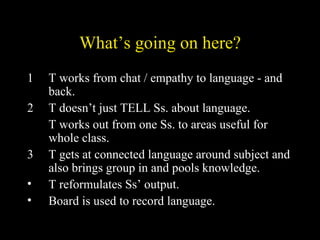
What’s going on here? 1 T works from chat / empathy to language - and back. 2 T doesn’t just TELL Ss. about language.  T works out from one Ss. to areas useful for whole class. 3 T gets at connected language around subject and also brings group in and pools knowledge. T reformulates Ss’ output. Board is used to record language.
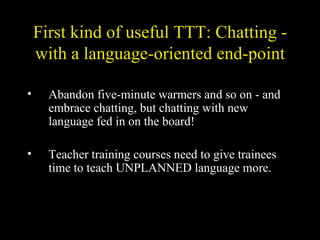
First kind of useful TTT: Chatting - with a language-oriented end-point Abandon five-minute warmers and so on - and embrace chatting, but chatting with new language fed in on the board! Teacher training courses need to give trainees time to teach UNPLANNED language more.
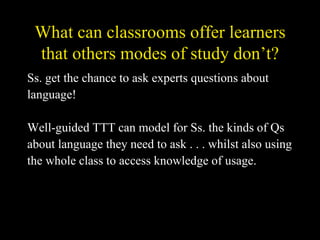
What can classrooms offer learners that others modes of study don’t? Ss. get the chance to ask experts questions about  language! Well-guided TTT can model for Ss. the kinds of Qs  about language they need to ask . . . whilst also using  the whole class to access knowledge of usage.
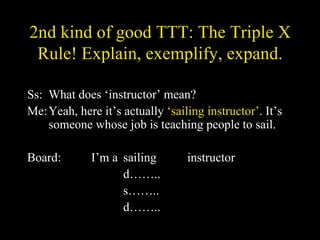
2nd kind of good TTT: The Triple X Rule! Explain, exemplify, expand. Ss: What does ‘instructor’ mean? Me: Yeah, here it’s actually  ‘sailing instructor’ . It’s someone whose job is teaching people to sail. Board: I’m a sailing instructor d…….. s…….. d……..
Ss: What does ‘guilty’ mean? Me: Well, usually you  feel guilty  because you didn’t do something you should’ve done - like buy your mum a birthday present! Board: I feel really guilty about . . .  . . . forgetting my mum’s birthday!  I shouldn’t have done it!
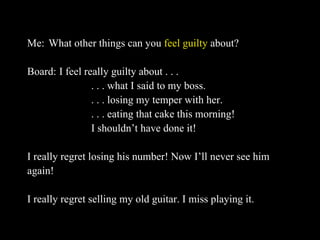
Me: What other things can you  feel guilty  about? Board: I feel really guilty about . . .  . . . what I said to my boss.  . . . losing my temper with her. . . . eating that cake this morning! I shouldn’t have done it! I really regret losing his number! Now I’ll never see him  again! I really regret selling my old guitar. I miss playing it.
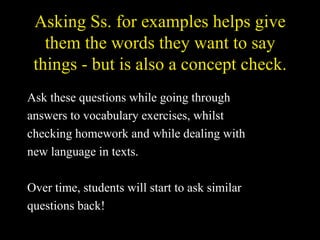
Asking Ss. for examples helps give them the words they want to say things - but is also a concept check. Ask these questions while going through  answers to vocabulary exercises, whilst  checking homework and while dealing with  new language in texts. Over time, students will start to ask similar  questions back!
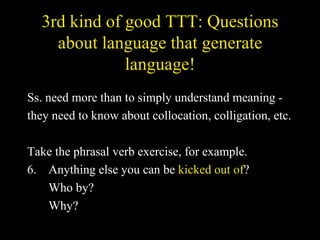
3rd kind of good TTT: Questions about language that generate language! Ss. need more than to simply understand meaning -  they need to know about collocation, colligation, etc. Take the phrasal verb exercise, for example. Anything else you can be  kicked out of ? Who by? Why?
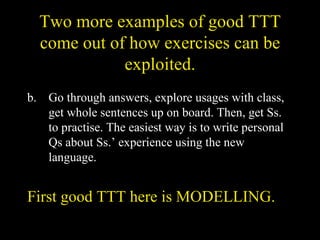
Two more examples of good TTT come out of how exercises can be exploited. Go through answers, explore usages with class, get whole sentences up on board. Then, get Ss. to practise. The easiest way is to write personal Qs about Ss.’ experience using the new language. First good TTT here is MODELLING.
Modelling is vital for three reasons. Gives Ss. an idea of what kind of turn you want them to take. Exposes them to useful lexis / grammar for their own STT - Krashen’s  i+1 :  i  = language just studied,  +1  = an anecdote. Posits T as a human being!
T then wanders round, listens in, contributes to  discussions, corrects and - crucially - gets language  on the board for the round-up. My  round-up  isn’t just single words, but models of usage. That said, only single words are gapped. To elicit,  re-tell stories in better English. Retelling is a form of inclusion Reformulation of Ss.’ output - content is understood, leaving Ss. free to focus on language. It’s more input-rich talk - and Ss. get a record of it.
One final kind of good TTT:  Re-eliciting texts Ss. remember content and meanings, but forget language. T can thus intervene in the process of forgetting.
Implications for materials Grammar-dominated materials reduce the chances we have to ask these kinds of Qs.  More human connections possible with lexically-based  material! We need material which . . . is lexically dense is rich in useful language gives Ss. lots of chances to practise in meaningful ways.
Follow us on  facebook Hugh Dellar & Andrew Walkley

T T T

  • 1.
    Putting our wordsto work: Re-thinking Teacher Talking Time Hugh Dellar Heinle Cengage / The University of Westminster
  • 2.
    The bad pressthat TTT gets: My CTEFLA course The literature - Scrivener, etc.
  • 3.
    The results ofthis: Reducing my Czech student to tears! “ What’s the difference between working in a mine and working in a hotel?” ‘ Facilitating’ self-directed learning!
  • 4.
    However, TTT isstill alive and well! Bad TTT is still with us: Back-packers vs. School lectures 15 uses of The Present Simple Blueprint Elementary
  • 5.
    TTT has profoundimplications for classroom dynamics and the kind of learning experience we provide. How much we say - and WHAT we say - are very important. If we really want to improve both the quality and the quantity of STT, then TTT has a central role to play.
  • 6.
    What’s going onhere? 1 T works from chat / empathy to language - and back. 2 T doesn’t just TELL Ss. about language. T works out from one Ss. to areas useful for whole class. 3 T gets at connected language around subject and also brings group in and pools knowledge. T reformulates Ss’ output. Board is used to record language.
  • 7.
    First kind ofuseful TTT: Chatting - with a language-oriented end-point Abandon five-minute warmers and so on - and embrace chatting, but chatting with new language fed in on the board! Teacher training courses need to give trainees time to teach UNPLANNED language more.
  • 8.
    What can classroomsoffer learners that others modes of study don’t? Ss. get the chance to ask experts questions about language! Well-guided TTT can model for Ss. the kinds of Qs about language they need to ask . . . whilst also using the whole class to access knowledge of usage.
  • 9.
    2nd kind ofgood TTT: The Triple X Rule! Explain, exemplify, expand. Ss: What does ‘instructor’ mean? Me: Yeah, here it’s actually ‘sailing instructor’ . It’s someone whose job is teaching people to sail. Board: I’m a sailing instructor d…….. s…….. d……..
  • 10.
    Ss: What does‘guilty’ mean? Me: Well, usually you feel guilty because you didn’t do something you should’ve done - like buy your mum a birthday present! Board: I feel really guilty about . . . . . . forgetting my mum’s birthday! I shouldn’t have done it!
  • 11.
    Me: What otherthings can you feel guilty about? Board: I feel really guilty about . . . . . . what I said to my boss. . . . losing my temper with her. . . . eating that cake this morning! I shouldn’t have done it! I really regret losing his number! Now I’ll never see him again! I really regret selling my old guitar. I miss playing it.
  • 12.
    Asking Ss. forexamples helps give them the words they want to say things - but is also a concept check. Ask these questions while going through answers to vocabulary exercises, whilst checking homework and while dealing with new language in texts. Over time, students will start to ask similar questions back!
  • 13.
    3rd kind ofgood TTT: Questions about language that generate language! Ss. need more than to simply understand meaning - they need to know about collocation, colligation, etc. Take the phrasal verb exercise, for example. Anything else you can be kicked out of ? Who by? Why?
  • 14.
    Two more examplesof good TTT come out of how exercises can be exploited. Go through answers, explore usages with class, get whole sentences up on board. Then, get Ss. to practise. The easiest way is to write personal Qs about Ss.’ experience using the new language. First good TTT here is MODELLING.
  • 15.
    Modelling is vitalfor three reasons. Gives Ss. an idea of what kind of turn you want them to take. Exposes them to useful lexis / grammar for their own STT - Krashen’s i+1 : i = language just studied, +1 = an anecdote. Posits T as a human being!
  • 16.
    T then wandersround, listens in, contributes to discussions, corrects and - crucially - gets language on the board for the round-up. My round-up isn’t just single words, but models of usage. That said, only single words are gapped. To elicit, re-tell stories in better English. Retelling is a form of inclusion Reformulation of Ss.’ output - content is understood, leaving Ss. free to focus on language. It’s more input-rich talk - and Ss. get a record of it.
  • 17.
    One final kindof good TTT: Re-eliciting texts Ss. remember content and meanings, but forget language. T can thus intervene in the process of forgetting.
  • 18.
    Implications for materialsGrammar-dominated materials reduce the chances we have to ask these kinds of Qs. More human connections possible with lexically-based material! We need material which . . . is lexically dense is rich in useful language gives Ss. lots of chances to practise in meaningful ways.
  • 19.
    Follow us on facebook Hugh Dellar & Andrew Walkley