Verification
Presentation to
SystemVerilog Basic
Committee
Peter Flake
Nov 15, 2002
© 2002 Synopsys, Inc. (2) CONFIDENTIAL
Agenda AM
• Interfaces
• Instantiation syntax
• Logic type
• Type use before definition
© 2002 Synopsys, Inc. (3) CONFIDENTIAL
Interfaces
• Fundamental idea
 Modules encapsulate behavior
 Interfaces encapsulate communication
• Structural communication
 Named bundles of wires
• Procedural communication
 Prototype tasks and functions
© 2002 Synopsys, Inc. (4) CONFIDENTIAL
Structural Communication
• Wires in interface default to inout
• Need to specify direction for documentation,
linting, synthesis QOR
• So introduce modports
 refer to names in enclosing interface
© 2002 Synopsys, Inc. (5) CONFIDENTIAL
Procedural Communication
• Point to point messages
 process in one module calls a task in another
• Needs hierarchical name - hard to maintain and
re-use
• Interface prototype means name is local to
module
 import to calling module
 export from called module
© 2002 Synopsys, Inc. (6) CONFIDENTIAL
Broadcast Messages
• One module sends a message and does not know
how many receive it
• forkjoin task
• Allows address to be coded in receiver module -
correct encapsulation
• Allows registration of receivers e.g. count
• No slower than fork join and task call
© 2002 Synopsys, Inc. (7) CONFIDENTIAL
Slippery Slope
• How about being able to translate task calls
to values on wires?
• Put in tasks and continuous assignment
 No new scheduling semantics
• How about being able to translate signals to
task calls, and check bus activity?
• Put in always blocks
© 2002 Synopsys, Inc. (8) CONFIDENTIAL
Conclusion
• Interfaces are not modules
 The design intent is connectivity, checkers,
testbench
 They synthesize to P&R wires, not logic blocks
• Interfaces are not structures
 Interfaces are static objects, never automatic
 Interfaces can contain wires and modports
 Interfaces can contain always blocks
© 2002 Synopsys, Inc. (9) CONFIDENTIAL
Instantiation Syntax
• Parentheses required
moduleType instance ( );
interfaceType instance ( );
© 2002 Synopsys, Inc. (10) CONFIDENTIAL
Logic Type
• Two basic communication mechanisms
 Resolved drivers - Verilog wire or VHDL signal
 Shared variable - last write wins
• Verilog reg is a mixture (legacy)
 Shared variable inside module
 Gets converted to a wire through a port
• Reals and 2 state variables (e.g. bit) must be shared
• Useful to have a 4 valued data type that behaves like
a shared variable through ports
• Must not be driven with strengths
© 2002 Synopsys, Inc. (11) CONFIDENTIAL
Type Use Before Definition
• typedef foo;
• Minor convenience in SV 3.0 allows less
attention to file order
• Type checking must be at elaboration time
anyway
 parameters, generate
• Essential with classes in Testbench donation
© 2002 Synopsys, Inc. (12) CONFIDENTIAL
Agenda PM
• Time precision and time scale
• Time data type
• Typedef syntax
• Strings as array and structure literals
• Unions and 4 state members
• Masked and unmasked
• Short real to 32 bits
• Constants
• always_comb
• Increment and decrement
© 2002 Synopsys, Inc. (13) CONFIDENTIAL
Time Precision and Time Scale
• For $root, use timeunit & timeprecision as
first thing in source.
• `timescale does not affect $root
• timeunit & timeprecision override `timescale
in their module or interface definition
• `timescale applies to any subsequent module
or interface
© 2002 Synopsys, Inc. (14) CONFIDENTIAL
Time Data Type
• Time variable is a logic [63:0] for backward compatibility
• Time literal is 3.4ns
• Time literals can be considered as floating point numbers scaled to
the current time unit
• When passed as a parameter the floating point number may have to
be re-scaled
• When used in an expression the number is rounded to the current
time precision
• Only operators that are valid for reals can be used with time literals
© 2002 Synopsys, Inc. (15) CONFIDENTIAL
Typedef Syntax
• ?
© 2002 Synopsys, Inc. (16) CONFIDENTIAL
Strings as Array and Structure Literals
• A structure member or an array element
should behave like a scalar of the same type
• A shortreal can be set to a real literal
shortreal a = 4.5
• An array can be set to a string
© 2002 Synopsys, Inc. (17) CONFIDENTIAL
Unions and 4 State Members
• If a union contains a 2 state member and a 4
state member, the union is 4 state
• If the 2 state member is written and then the 4
state member is read, there is no Z or X
• Like assigment var4state = var2state
© 2002 Synopsys, Inc. (18) CONFIDENTIAL
Masked and Unmasked
• Masked and unmasked are the terms in the
Superlog manual and in the Co-Design
donation
• They were changed to 4 state and 2 state by
the Accellera committee
• Some changes were missed
© 2002 Synopsys, Inc. (19) CONFIDENTIAL
Short Real to 32 Bits
• Real and short real should be cast to integer
or 32 bits with rounding
• To get same bit pattern use union (like C)
© 2002 Synopsys, Inc. (20) CONFIDENTIAL
Constants
• A parameter or localparam can only be set to
an expression of literals, parameters or local
parameters, or a constant function of these
• A const in a static scope can also be set to an
expression containing a hierarchical name
• A const in an automatic scope can also be set
to an expression containing arguments
© 2002 Synopsys, Inc. (21) CONFIDENTIAL
always_comb
• Used to model combinational logic
 indicates design intent
 execution at time 0 is guaranteed unlike @*
• Cannot drive from anywhere else - no resolution
• Functions can be used to partition the combinational logic &
so add to sensitivity
 useful with large case statement
• No timing or event controls should be allowed
© 2002 Synopsys, Inc. (22) CONFIDENTIAL
always_comb continued
• Sensitivity list should be like @* with
functions inlined
• Static function locals should be treated like
static variables in modules
© 2002 Synopsys, Inc. (23) CONFIDENTIAL
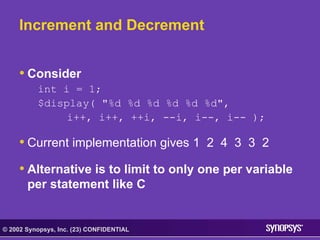
Increment and Decrement
• Consider
int i = 1;
$display( "%d %d %d %d %d %d",
i++, i++, ++i, --i, i--, i-- );
• Current implementation gives 1 2 4 3 3 2
• Alternative is to limit to only one per variable
per statement like C

system verilog concepts for digital vlsi

  • 1.
  • 2.
    © 2002 Synopsys,Inc. (2) CONFIDENTIAL Agenda AM • Interfaces • Instantiation syntax • Logic type • Type use before definition
  • 3.
    © 2002 Synopsys,Inc. (3) CONFIDENTIAL Interfaces • Fundamental idea  Modules encapsulate behavior  Interfaces encapsulate communication • Structural communication  Named bundles of wires • Procedural communication  Prototype tasks and functions
  • 4.
    © 2002 Synopsys,Inc. (4) CONFIDENTIAL Structural Communication • Wires in interface default to inout • Need to specify direction for documentation, linting, synthesis QOR • So introduce modports  refer to names in enclosing interface
  • 5.
    © 2002 Synopsys,Inc. (5) CONFIDENTIAL Procedural Communication • Point to point messages  process in one module calls a task in another • Needs hierarchical name - hard to maintain and re-use • Interface prototype means name is local to module  import to calling module  export from called module
  • 6.
    © 2002 Synopsys,Inc. (6) CONFIDENTIAL Broadcast Messages • One module sends a message and does not know how many receive it • forkjoin task • Allows address to be coded in receiver module - correct encapsulation • Allows registration of receivers e.g. count • No slower than fork join and task call
  • 7.
    © 2002 Synopsys,Inc. (7) CONFIDENTIAL Slippery Slope • How about being able to translate task calls to values on wires? • Put in tasks and continuous assignment  No new scheduling semantics • How about being able to translate signals to task calls, and check bus activity? • Put in always blocks
  • 8.
    © 2002 Synopsys,Inc. (8) CONFIDENTIAL Conclusion • Interfaces are not modules  The design intent is connectivity, checkers, testbench  They synthesize to P&R wires, not logic blocks • Interfaces are not structures  Interfaces are static objects, never automatic  Interfaces can contain wires and modports  Interfaces can contain always blocks
  • 9.
    © 2002 Synopsys,Inc. (9) CONFIDENTIAL Instantiation Syntax • Parentheses required moduleType instance ( ); interfaceType instance ( );
  • 10.
    © 2002 Synopsys,Inc. (10) CONFIDENTIAL Logic Type • Two basic communication mechanisms  Resolved drivers - Verilog wire or VHDL signal  Shared variable - last write wins • Verilog reg is a mixture (legacy)  Shared variable inside module  Gets converted to a wire through a port • Reals and 2 state variables (e.g. bit) must be shared • Useful to have a 4 valued data type that behaves like a shared variable through ports • Must not be driven with strengths
  • 11.
    © 2002 Synopsys,Inc. (11) CONFIDENTIAL Type Use Before Definition • typedef foo; • Minor convenience in SV 3.0 allows less attention to file order • Type checking must be at elaboration time anyway  parameters, generate • Essential with classes in Testbench donation
  • 12.
    © 2002 Synopsys,Inc. (12) CONFIDENTIAL Agenda PM • Time precision and time scale • Time data type • Typedef syntax • Strings as array and structure literals • Unions and 4 state members • Masked and unmasked • Short real to 32 bits • Constants • always_comb • Increment and decrement
  • 13.
    © 2002 Synopsys,Inc. (13) CONFIDENTIAL Time Precision and Time Scale • For $root, use timeunit & timeprecision as first thing in source. • `timescale does not affect $root • timeunit & timeprecision override `timescale in their module or interface definition • `timescale applies to any subsequent module or interface
  • 14.
    © 2002 Synopsys,Inc. (14) CONFIDENTIAL Time Data Type • Time variable is a logic [63:0] for backward compatibility • Time literal is 3.4ns • Time literals can be considered as floating point numbers scaled to the current time unit • When passed as a parameter the floating point number may have to be re-scaled • When used in an expression the number is rounded to the current time precision • Only operators that are valid for reals can be used with time literals
  • 15.
    © 2002 Synopsys,Inc. (15) CONFIDENTIAL Typedef Syntax • ?
  • 16.
    © 2002 Synopsys,Inc. (16) CONFIDENTIAL Strings as Array and Structure Literals • A structure member or an array element should behave like a scalar of the same type • A shortreal can be set to a real literal shortreal a = 4.5 • An array can be set to a string
  • 17.
    © 2002 Synopsys,Inc. (17) CONFIDENTIAL Unions and 4 State Members • If a union contains a 2 state member and a 4 state member, the union is 4 state • If the 2 state member is written and then the 4 state member is read, there is no Z or X • Like assigment var4state = var2state
  • 18.
    © 2002 Synopsys,Inc. (18) CONFIDENTIAL Masked and Unmasked • Masked and unmasked are the terms in the Superlog manual and in the Co-Design donation • They were changed to 4 state and 2 state by the Accellera committee • Some changes were missed
  • 19.
    © 2002 Synopsys,Inc. (19) CONFIDENTIAL Short Real to 32 Bits • Real and short real should be cast to integer or 32 bits with rounding • To get same bit pattern use union (like C)
  • 20.
    © 2002 Synopsys,Inc. (20) CONFIDENTIAL Constants • A parameter or localparam can only be set to an expression of literals, parameters or local parameters, or a constant function of these • A const in a static scope can also be set to an expression containing a hierarchical name • A const in an automatic scope can also be set to an expression containing arguments
  • 21.
    © 2002 Synopsys,Inc. (21) CONFIDENTIAL always_comb • Used to model combinational logic  indicates design intent  execution at time 0 is guaranteed unlike @* • Cannot drive from anywhere else - no resolution • Functions can be used to partition the combinational logic & so add to sensitivity  useful with large case statement • No timing or event controls should be allowed
  • 22.
    © 2002 Synopsys,Inc. (22) CONFIDENTIAL always_comb continued • Sensitivity list should be like @* with functions inlined • Static function locals should be treated like static variables in modules
  • 23.
    © 2002 Synopsys,Inc. (23) CONFIDENTIAL Increment and Decrement • Consider int i = 1; $display( "%d %d %d %d %d %d", i++, i++, ++i, --i, i--, i-- ); • Current implementation gives 1 2 4 3 3 2 • Alternative is to limit to only one per variable per statement like C