Chapter One
Concept, and characteristics of a system
Introduction
• The world has become more complex in recent years due to many factors,
including our growing population and its demands for more food, water, and
energy,
• The limited arable land for expanding food production, and increasing pressures
on natural resources needs more integration with different stakeholders.
• An agricultural system is an assemblage of components which are united by
some form of interaction and interdependence and which operate within a
prescribed boundary to achieve a specified agricultural objective on behalf
of the beneficiaries of the system.
Chapter One
Concept, and characteristics of a system
What is system?
• The word system is derived from the Greek word “systema” which means the
organized relationship among the functioning units.
• A system is “an orderly grouping of independent components linked together
according to plan to achieve a specific objective”. “A system is more than the
sum of its parts.”
• System can be defined as a group of interrelated or interacting elements
forming a unified whole.
• A system is a group of interrelated components working together towards a
common goal, by accepting inputs and producing outputs in an organized
transformation process.
Cont.…..ed
• The Interrelated components which are systematically arranged
to form a system are called subsystems. In simple words, system is
a set of elements which operate together to accomplish an
objective.
• It may be either physical or abstract.
• An abstract system ls an orderly arrangement of interdependent
ideas or contracts.
• a physical system is defined as a set of elements which operate
together to accomplish a goal;
• It is made up of objects such as land, building, machines, people
and other tangible things.
Cont.…..ed
• For example, A car can be described as a system, made of lots of
bits that function together. If we take out the engine, the car does not
work, nor do the wheels alone get us where we want to go.
• Also, it is defined as “a set or arrangement of things so related or
connected as to form a unity or organic whole,”. Examples:
 Solar system
 School system
 Computer system
Class work
1. What is system?
2. Is it necessary in our life or work place ?
Support with practical examples(10
minute).
3. Do you think that the course, have any
relation with RDAE ?
Cont.…..ed
System as science and Analysis
o System Science: is usually associated with observations, identification,
description, experimental investigation, and theoretical modeling and
explanations that are associated with natural phenomena in fields, such as
biology, chemistry and physics.
o System analysis: is ongoing analytical processes of evaluating
various alternatives in design and model construction by
employing mathematical methods.
Characteristics of system
I. Orientation towards the objective: A system is an assembled set of
elements, acting together to accomplish a common goal, purpose or objective.
 The subsystems are oriented towards the common objective of the system and
they interact in order to achieve the objective.
 All the elements in a system are organized in a specific manner to
achieve the system's goal.
II. Structure of the system: The component parts of a system are arranged in
a systematic manner, according to a specific design, and each of them has definite
function to perform in the system.
 The structure of the system deals with the design of components in a particular
arrangement.
Characteristics of system
III. Inputs: Inputs for a system involve elements that enter the system to be
processed. They include raw materials, energy, data, information and human efforts.
IV. Processing of inputs: It is the process of transformation through which
inputs are converted into outputs, for instance, manufacturing process, data
calculation etc.
V. Outputs: They are the result of the transformation process, like human
services, finished products, etc.
VI. Interdependence: The components of a system are interdependent. They
interact with each other to achieve the common goal.
 The subsystems cannot exist in isolation; they are interrelated and the function of
one would depend upon the function of another.
Characteristics of system
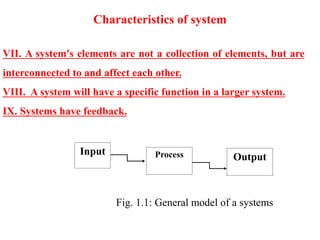
VII. A system's elements are not a collection of elements, but are
interconnected to and affect each other.
VIII. A system will have a specific function in a larger system.
IX. Systems have feedback.
Process Output
Input
Fig. 1.1: General model of a systems pr
Cont….ed
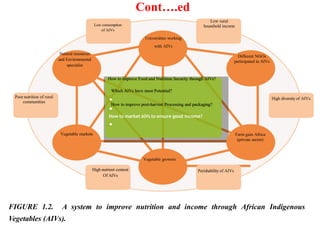
FIGURE 1.2. A system to improve nutrition and income through African Indigenous
Vegetables (AIVs).
Low consumption
of AIVs
Low rural
household income
Universities working
with AIVs
Natural resources
and Environmental
specialist
Different NGOs
participated in AIVs
Poor nutrition of rural
communities
How to improve Food and Nutrition Security through AIVs?
Which AIVs have most Potential?
How to improve post-harvest Processing and packaging?
How to market AIVs to ensure good income?
High diversity of AIVs
Vegetable markets Farm gain Africa
(private sector)
High nutrient content
Of AIVs
Vegetable growers
Perishability of AIVs
Cent….ed
Properties of systems
A system ca be categorize based on;
A. Components and sub-systems; functioning units means the basic
elements of the system which are interrelated, are the basic components of
the system.
 So, these basic elements are nothing but the identifiable and moving
parts of the system
 The components of a system consist of the actors (or stakeholders) within the
system (see circles in Figure 1.2), and the functions they have (which
represent “sub-systems” within the larger system).
B. Purpose/Goal ; A system can be defined by the purpose/goal
assigned by the stakeholders and actors within a system.
Cont….ed
• If different stakeholders have different interests and hence purposes, they are
visualizing different systems, and
• Their actions are likely to be uncoordinated or disjointed (in fact, a common
situation).
In order to achieve the goal of the system, we should first understand
the meaning of
I. Central objective
II. Integration
III. Synergistic effect
Cont….ed
I. Central Objective: Central objective means the common goal, because
without common goal system will not start moving in all directions.
 As a result, coordination among all the parts (Components) will be
lost.
II. Integration: It is combined work of all the components in order to
achieve the goal of the system.
 There must be coordination among all parts of the system
 So in order to have such coordination the system must work as a’
whole’, integrating all its activities to achieve the desired result.
III. Synergistic effect: From the integration concept it is clear that the
system has to be viewed as ‘whole’ rather than just as sum of its parts.
 This integrating effect is called as synergistic effect.
Cont….ed
C. Interaction and feedback
 An important feature of the system is the basic components must interact
among themselves.
 It is not only collection or grouping of elements.
 If an organization is considered as a system, then purchase department
must interact with stores and production department.
 Also, they are interdependent on each other. If we consider, computer as a
system then if some information is keyed it gets processed by arithmetic or
logic unit or both and the final result is displayed on the screen.
 So, this interrelation activity of the components makes the system
dynamic.
Cont….ed
Such a relationship among the components which define the boundary
between the system and environment is called as the structure of the
system.
 The components and processes within a system interact.
 Changing one component causes a change in another, which may then
“feed-back” to affect the first. Feedback may be negative
(compensatory/balancing) or positive (exaggerating/reinforcing).
 In complex systems, such feedback is not always predictable.
 Introducing insecticides to control pests can backfire if insect predators of
these pests are also killed, or if the target pest develops resistance to the
insecticide.
Cont….ed
D. Boundaries/environment
• In ARD partnerships, the boundaries of what partners consider to be “the
system of interest” is drawn around the factors they can change.
• External factors outside their immediate control, which can still affect the
“system” are considered as the “environment”.
• ARD partnerships need to consider which factors are likely to be critical to
the success of their partnership,
• Which partners are needed to achieve this, and hence where they draw
the boundaries of their system.
• Typically, ARD partnerships increase the boundaries of their “system of
interest” as they grow and evolve – progressively adding marketing or
policy issues, to an initial focus on production.
Cont….ed
E. Behavior:
 Behavior is the way the system reacts to its surrounding environment.
 Behavior is determined by the procedures designed to make sure that
components behave in ways that will allow system to achieve common
goal.
 For example: If we touch an object which is hot, the nervous system
makes our body to withdraw immediately from the hot source.
 So, heat is input from environment, reaction is the behavior and
instruction in the nervous system (how to react) is the procedure.
 Procedure describes what ought to be done and behavior describes what is
actually done.
Cont….ed
F. Hierarchies and scale
 Many ARD issues require linked actions at local level, national or even international level
 In other words, the areas of action can be considered to cover a “hierarchy” of systems,
consisting of interlinked “sub-systems” at these different levels.
G. Inputs and outputs
 Systems are regarded as a means of transforming inputs into outputs.
 Actors typically start with a focus on physical inputs (e.g., seed, fertilizer) or technical
information.
 However, innovation often requires organizational and institutional change, to complement
technical change.
 Farmers may not be able to source inputs or market products, if they are not organized into
groups or cooperatives, or do not trust other actors in the value chain.
 Actions to build the functional capacity of actors in the system to trust and relate to each
other, are therefore also critical inputs to the system.
Cont….ed
H. Emergent/Evolving properties
 The properties and performance of a system result from the interaction between its
components and are often difficult to predict by studying the components separately.
 The outcomes of an ARD partnership, may be difficult to predict from the actions of
individual partners, or when planning activities at the outset of a project.
 ARD partnerships therefore need to be flexible and responsive to emerging outcomes, and
establish procedures for reflection of ongoing experience, re-planning and reassessing
expectations.
 More flexible and process-oriented methods such as “Theories of Change” and “Outcome
Mapping” therefore offer advantages in ARD partnerships over more rigid methods such as
“Logical Frameworks.”
Cont….ed
I. Life cycle:
• Every system has life cycle and according to human life it has birth that is
evolution, life, aging, repairs and finally the end of the existence of the system
(death).
So finally, we can define system as follows.
I. System is integrated collection of the components which satisfy functions
necessary to achieve the system goals and which have relationship to one
another that defines structure of the system.
II. A system is a set of elements forming an activity or scheme seeking a
common goal by operating on data in time reference to yield information.
Types of Systems
• The important system classifications include:
1. Conceptual Systems: Conceptual systems deal with theoretical structures
which may or may not have any counterpart in the world.
• They are composed of ideas. They are typified by those of science, such as
economic theory, the general system of relativity etc.
• These are systems of explanation or classification. They may also take the
form of plans, policies, procedures, accounting system, etc.
2. Empirical systems are concrete operational systems made up of people,
machines, materials, energy, and other physical things.
• Electrical, thermal, chemical, and other such systems also fall under this
category of systems.
Types of Systems
3. Permanent and temporary systems: Systems enduring for a long-time
span, in relation to the operations of humans in the systems, are called permanent
systems.
• Temporary systems are designed to last for a specified period of time and then
to dissolve. They are important for the accomplishment of specific tasks.
4. Natural systems: Natural systems are found abundantly in nature, like solar
system, water system etc.
• They originated from nature itself and are not the result of any human effort.
5. Manufactured systems or artificial systems are formed by human
efforts. Transport system, communication system, etc. are examples.
Types of Systems
6. Deterministic systems: In deterministic systems, the interaction
among the parts is known with certainty.
• It operates in a predictable manner.
• It is possible to predict the outputs accurately, if a description of the
state of affairs at a particular point of time plus a description of the
inputs and the operation is available.
• A computer program which performs exactly according to the set of
instructions is an example of a deterministic system.
Types of Systems
7. The probabilistic system: is described in terms of probable
behavior.
• The output can be predicted only with a certain degree of error. In
such a system, we can predict the results but the exact values of
these results at a given time are not known.
• For instance, in an inventory system, we can predict the average
time taken to get the material, average demand, etc., but the exact
values cannot be calculated.
Types of Systems
8. Subsystems and super system: smaller systems within the system
or the components of a system are called subsystems.
• Super system is the whole complex of subsystems, or it denotes any
extremely large and complex system.
9. Stationary and non-stationary systems: A stationary system is
one whose properties and operations either do not vary significantly
or vary in a repetitive manner.
• The automatic factory, super market operations, etc. are examples.
• In non-stationary system, the properties and operations are
subject to variations at a faster rate, for instance, the human
being, research and development laboratory etc.
Types of Systems
10. Open and Closed system: Open systems interact with their
environment exchange information, and material energy with it.
• Open systems adapt themselves to the changes in environment
so as to continue their existence.
• All living systems are open systems. Cells, plants, human
beings, etc., are examples of open systems.
• A closed system is a self-contained system. It does not
exchange material information or energy with its environment.
For example, chemical reaction in a sealed and insulated
container is a closed system.
Types of Systems
11. Adaptive and non-adaptive systems: A system, which reaches
out to its environment in such a way as to improve its functioning,
achievement or probability of survival, is called an adaptive system.
• Most biological systems are adaptive systems. A system which does
not change with changes in the environment is called a non-
adaptive system.
Types of Systems
12. Social, people-machine, and machine systems: A social system is a
system purely made up of people. Examples are business organizations, social clubs, etc.
• People-Machine systems use both people and equipment to
achieve the goal. Information system is an example of people-
machine system.
• Pure machine systems are made up of machine only. They have to
obtain their own input and maintain themselves. Electric power
generating system is an example of a pure machine system.
Chapter Two
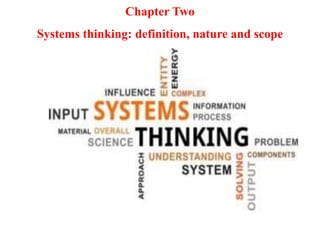
Systems thinking: definition, nature and scope
Chapter Two
Systems thinking: definition, nature and scope
 Systems thinking in practice encourages us to explore inter-
relationships (context and connections), perspectives (each actor
has their own unique perception of the situation)
and boundaries (agreeing on scope, scale and what might
constitute an improvement).
 Systems thinking is particularly useful in addressing complex or
wicked problem situations. These problems cannot be solved by
any one actor, any more than a complex system can be fully
understood from only one perspective.
Chapter Two
Systems thinking: definition, nature and scope
Systems thinking, or “systemic” thinking, is thinking about the
whole, and the relationship between the parts of the system instead
of focusing on the parts themselves in isolation.
 It is” contextual” thinking - understanding the system within the
circumstances and broader environment.
 Smallholder farmers and business people, who balance many
interrelated factors, resources and risks, are more likely to think in a
systemic way.
Cont…..ed
• Hard systems thinkers assume systems exist objectively, have a clear
purpose and well-defined boundaries.
• Their concern is mainly how to improve the efficiency of the system, by
improving the components and/or the interaction between them.
• Hard systems thinkers experience biophysical but also social phenomena
as constant, regular, recurring and predictable.
• Much of the thinking that goes into project planning follows a “hard
systems” logic.
 Soft systems thinkers, on the other hand, assume that systems are fuzzy:
difficult to define, dynamic, chaotic, changing and unpredictable.
 They consider systems to be negotiable social constructs, only existing to the
extent that people agree on their goals, boundaries, membership, and usefulness.
Cont…..ed
• They argue that problems occur when reductionist or hard systems thinking is applied to
problem situations in which human perceptions and behavior dominate, and where goals,
objectives and even the interpretation of events are all contested by different actors in the
system.
• Their focus is more on getting stakeholders to understand each other and agree on a joint
vision of the “system” that needs improvement.
 Peter Senge (2006) says, "systems thinking is a discipline for seeing wholes. It is
a framework for seeing interrelationships rather than things, for seeing patterns
of change rather than static 'snapshots’
• Manning (1967) stated that: "An interrelationship exists between all elements and
constituents of society. The essential factors in public problems, issues, policies,
and programs must always be considered and evaluated as interdependent
components of a total system."
Cont…..ed
Principles of systems thinking. They are:
 Consider the big picture
 Balance short-term and long-term perspectives
 Recognize the dynamic, complex, and interdependent nature of
systems
 Consider both measurable and non-measurable nature of systems,
and
 Keep in mind we are all part of the systems in which we function,
and that we each influence those systems even as we are being
influenced by them
Cont…..ed
Why systems thinking important?

System Thinking.pptx

  • 1.
    Chapter One Concept, andcharacteristics of a system Introduction • The world has become more complex in recent years due to many factors, including our growing population and its demands for more food, water, and energy, • The limited arable land for expanding food production, and increasing pressures on natural resources needs more integration with different stakeholders. • An agricultural system is an assemblage of components which are united by some form of interaction and interdependence and which operate within a prescribed boundary to achieve a specified agricultural objective on behalf of the beneficiaries of the system.
  • 2.
    Chapter One Concept, andcharacteristics of a system What is system? • The word system is derived from the Greek word “systema” which means the organized relationship among the functioning units. • A system is “an orderly grouping of independent components linked together according to plan to achieve a specific objective”. “A system is more than the sum of its parts.” • System can be defined as a group of interrelated or interacting elements forming a unified whole. • A system is a group of interrelated components working together towards a common goal, by accepting inputs and producing outputs in an organized transformation process.
  • 3.
    Cont.…..ed • The Interrelatedcomponents which are systematically arranged to form a system are called subsystems. In simple words, system is a set of elements which operate together to accomplish an objective. • It may be either physical or abstract. • An abstract system ls an orderly arrangement of interdependent ideas or contracts. • a physical system is defined as a set of elements which operate together to accomplish a goal; • It is made up of objects such as land, building, machines, people and other tangible things.
  • 4.
    Cont.…..ed • For example,A car can be described as a system, made of lots of bits that function together. If we take out the engine, the car does not work, nor do the wheels alone get us where we want to go. • Also, it is defined as “a set or arrangement of things so related or connected as to form a unity or organic whole,”. Examples:  Solar system  School system  Computer system
  • 5.
    Class work 1. Whatis system? 2. Is it necessary in our life or work place ? Support with practical examples(10 minute). 3. Do you think that the course, have any relation with RDAE ?
  • 6.
    Cont.…..ed System as scienceand Analysis o System Science: is usually associated with observations, identification, description, experimental investigation, and theoretical modeling and explanations that are associated with natural phenomena in fields, such as biology, chemistry and physics. o System analysis: is ongoing analytical processes of evaluating various alternatives in design and model construction by employing mathematical methods.
  • 7.
    Characteristics of system I.Orientation towards the objective: A system is an assembled set of elements, acting together to accomplish a common goal, purpose or objective.  The subsystems are oriented towards the common objective of the system and they interact in order to achieve the objective.  All the elements in a system are organized in a specific manner to achieve the system's goal. II. Structure of the system: The component parts of a system are arranged in a systematic manner, according to a specific design, and each of them has definite function to perform in the system.  The structure of the system deals with the design of components in a particular arrangement.
  • 8.
    Characteristics of system III.Inputs: Inputs for a system involve elements that enter the system to be processed. They include raw materials, energy, data, information and human efforts. IV. Processing of inputs: It is the process of transformation through which inputs are converted into outputs, for instance, manufacturing process, data calculation etc. V. Outputs: They are the result of the transformation process, like human services, finished products, etc. VI. Interdependence: The components of a system are interdependent. They interact with each other to achieve the common goal.  The subsystems cannot exist in isolation; they are interrelated and the function of one would depend upon the function of another.
  • 9.
    Characteristics of system VII.A system's elements are not a collection of elements, but are interconnected to and affect each other. VIII. A system will have a specific function in a larger system. IX. Systems have feedback. Process Output Input Fig. 1.1: General model of a systems pr
  • 10.
    Cont….ed FIGURE 1.2. Asystem to improve nutrition and income through African Indigenous Vegetables (AIVs). Low consumption of AIVs Low rural household income Universities working with AIVs Natural resources and Environmental specialist Different NGOs participated in AIVs Poor nutrition of rural communities How to improve Food and Nutrition Security through AIVs? Which AIVs have most Potential? How to improve post-harvest Processing and packaging? How to market AIVs to ensure good income? High diversity of AIVs Vegetable markets Farm gain Africa (private sector) High nutrient content Of AIVs Vegetable growers Perishability of AIVs
  • 11.
    Cent….ed Properties of systems Asystem ca be categorize based on; A. Components and sub-systems; functioning units means the basic elements of the system which are interrelated, are the basic components of the system.  So, these basic elements are nothing but the identifiable and moving parts of the system  The components of a system consist of the actors (or stakeholders) within the system (see circles in Figure 1.2), and the functions they have (which represent “sub-systems” within the larger system). B. Purpose/Goal ; A system can be defined by the purpose/goal assigned by the stakeholders and actors within a system.
  • 12.
    Cont….ed • If differentstakeholders have different interests and hence purposes, they are visualizing different systems, and • Their actions are likely to be uncoordinated or disjointed (in fact, a common situation). In order to achieve the goal of the system, we should first understand the meaning of I. Central objective II. Integration III. Synergistic effect
  • 13.
    Cont….ed I. Central Objective:Central objective means the common goal, because without common goal system will not start moving in all directions.  As a result, coordination among all the parts (Components) will be lost. II. Integration: It is combined work of all the components in order to achieve the goal of the system.  There must be coordination among all parts of the system  So in order to have such coordination the system must work as a’ whole’, integrating all its activities to achieve the desired result. III. Synergistic effect: From the integration concept it is clear that the system has to be viewed as ‘whole’ rather than just as sum of its parts.  This integrating effect is called as synergistic effect.
  • 14.
    Cont….ed C. Interaction andfeedback  An important feature of the system is the basic components must interact among themselves.  It is not only collection or grouping of elements.  If an organization is considered as a system, then purchase department must interact with stores and production department.  Also, they are interdependent on each other. If we consider, computer as a system then if some information is keyed it gets processed by arithmetic or logic unit or both and the final result is displayed on the screen.  So, this interrelation activity of the components makes the system dynamic.
  • 15.
    Cont….ed Such a relationshipamong the components which define the boundary between the system and environment is called as the structure of the system.  The components and processes within a system interact.  Changing one component causes a change in another, which may then “feed-back” to affect the first. Feedback may be negative (compensatory/balancing) or positive (exaggerating/reinforcing).  In complex systems, such feedback is not always predictable.  Introducing insecticides to control pests can backfire if insect predators of these pests are also killed, or if the target pest develops resistance to the insecticide.
  • 16.
    Cont….ed D. Boundaries/environment • InARD partnerships, the boundaries of what partners consider to be “the system of interest” is drawn around the factors they can change. • External factors outside their immediate control, which can still affect the “system” are considered as the “environment”. • ARD partnerships need to consider which factors are likely to be critical to the success of their partnership, • Which partners are needed to achieve this, and hence where they draw the boundaries of their system. • Typically, ARD partnerships increase the boundaries of their “system of interest” as they grow and evolve – progressively adding marketing or policy issues, to an initial focus on production.
  • 17.
    Cont….ed E. Behavior:  Behavioris the way the system reacts to its surrounding environment.  Behavior is determined by the procedures designed to make sure that components behave in ways that will allow system to achieve common goal.  For example: If we touch an object which is hot, the nervous system makes our body to withdraw immediately from the hot source.  So, heat is input from environment, reaction is the behavior and instruction in the nervous system (how to react) is the procedure.  Procedure describes what ought to be done and behavior describes what is actually done.
  • 18.
    Cont….ed F. Hierarchies andscale  Many ARD issues require linked actions at local level, national or even international level  In other words, the areas of action can be considered to cover a “hierarchy” of systems, consisting of interlinked “sub-systems” at these different levels. G. Inputs and outputs  Systems are regarded as a means of transforming inputs into outputs.  Actors typically start with a focus on physical inputs (e.g., seed, fertilizer) or technical information.  However, innovation often requires organizational and institutional change, to complement technical change.  Farmers may not be able to source inputs or market products, if they are not organized into groups or cooperatives, or do not trust other actors in the value chain.  Actions to build the functional capacity of actors in the system to trust and relate to each other, are therefore also critical inputs to the system.
  • 19.
    Cont….ed H. Emergent/Evolving properties The properties and performance of a system result from the interaction between its components and are often difficult to predict by studying the components separately.  The outcomes of an ARD partnership, may be difficult to predict from the actions of individual partners, or when planning activities at the outset of a project.  ARD partnerships therefore need to be flexible and responsive to emerging outcomes, and establish procedures for reflection of ongoing experience, re-planning and reassessing expectations.  More flexible and process-oriented methods such as “Theories of Change” and “Outcome Mapping” therefore offer advantages in ARD partnerships over more rigid methods such as “Logical Frameworks.”
  • 20.
    Cont….ed I. Life cycle: •Every system has life cycle and according to human life it has birth that is evolution, life, aging, repairs and finally the end of the existence of the system (death). So finally, we can define system as follows. I. System is integrated collection of the components which satisfy functions necessary to achieve the system goals and which have relationship to one another that defines structure of the system. II. A system is a set of elements forming an activity or scheme seeking a common goal by operating on data in time reference to yield information.
  • 21.
    Types of Systems •The important system classifications include: 1. Conceptual Systems: Conceptual systems deal with theoretical structures which may or may not have any counterpart in the world. • They are composed of ideas. They are typified by those of science, such as economic theory, the general system of relativity etc. • These are systems of explanation or classification. They may also take the form of plans, policies, procedures, accounting system, etc. 2. Empirical systems are concrete operational systems made up of people, machines, materials, energy, and other physical things. • Electrical, thermal, chemical, and other such systems also fall under this category of systems.
  • 22.
    Types of Systems 3.Permanent and temporary systems: Systems enduring for a long-time span, in relation to the operations of humans in the systems, are called permanent systems. • Temporary systems are designed to last for a specified period of time and then to dissolve. They are important for the accomplishment of specific tasks. 4. Natural systems: Natural systems are found abundantly in nature, like solar system, water system etc. • They originated from nature itself and are not the result of any human effort. 5. Manufactured systems or artificial systems are formed by human efforts. Transport system, communication system, etc. are examples.
  • 23.
    Types of Systems 6.Deterministic systems: In deterministic systems, the interaction among the parts is known with certainty. • It operates in a predictable manner. • It is possible to predict the outputs accurately, if a description of the state of affairs at a particular point of time plus a description of the inputs and the operation is available. • A computer program which performs exactly according to the set of instructions is an example of a deterministic system.
  • 24.
    Types of Systems 7.The probabilistic system: is described in terms of probable behavior. • The output can be predicted only with a certain degree of error. In such a system, we can predict the results but the exact values of these results at a given time are not known. • For instance, in an inventory system, we can predict the average time taken to get the material, average demand, etc., but the exact values cannot be calculated.
  • 25.
    Types of Systems 8.Subsystems and super system: smaller systems within the system or the components of a system are called subsystems. • Super system is the whole complex of subsystems, or it denotes any extremely large and complex system. 9. Stationary and non-stationary systems: A stationary system is one whose properties and operations either do not vary significantly or vary in a repetitive manner. • The automatic factory, super market operations, etc. are examples. • In non-stationary system, the properties and operations are subject to variations at a faster rate, for instance, the human being, research and development laboratory etc.
  • 26.
    Types of Systems 10.Open and Closed system: Open systems interact with their environment exchange information, and material energy with it. • Open systems adapt themselves to the changes in environment so as to continue their existence. • All living systems are open systems. Cells, plants, human beings, etc., are examples of open systems. • A closed system is a self-contained system. It does not exchange material information or energy with its environment. For example, chemical reaction in a sealed and insulated container is a closed system.
  • 27.
    Types of Systems 11.Adaptive and non-adaptive systems: A system, which reaches out to its environment in such a way as to improve its functioning, achievement or probability of survival, is called an adaptive system. • Most biological systems are adaptive systems. A system which does not change with changes in the environment is called a non- adaptive system.
  • 28.
    Types of Systems 12.Social, people-machine, and machine systems: A social system is a system purely made up of people. Examples are business organizations, social clubs, etc. • People-Machine systems use both people and equipment to achieve the goal. Information system is an example of people- machine system. • Pure machine systems are made up of machine only. They have to obtain their own input and maintain themselves. Electric power generating system is an example of a pure machine system.
  • 29.
    Chapter Two Systems thinking:definition, nature and scope
  • 30.
    Chapter Two Systems thinking:definition, nature and scope  Systems thinking in practice encourages us to explore inter- relationships (context and connections), perspectives (each actor has their own unique perception of the situation) and boundaries (agreeing on scope, scale and what might constitute an improvement).  Systems thinking is particularly useful in addressing complex or wicked problem situations. These problems cannot be solved by any one actor, any more than a complex system can be fully understood from only one perspective.
  • 31.
    Chapter Two Systems thinking:definition, nature and scope Systems thinking, or “systemic” thinking, is thinking about the whole, and the relationship between the parts of the system instead of focusing on the parts themselves in isolation.  It is” contextual” thinking - understanding the system within the circumstances and broader environment.  Smallholder farmers and business people, who balance many interrelated factors, resources and risks, are more likely to think in a systemic way.
  • 32.
    Cont…..ed • Hard systemsthinkers assume systems exist objectively, have a clear purpose and well-defined boundaries. • Their concern is mainly how to improve the efficiency of the system, by improving the components and/or the interaction between them. • Hard systems thinkers experience biophysical but also social phenomena as constant, regular, recurring and predictable. • Much of the thinking that goes into project planning follows a “hard systems” logic.  Soft systems thinkers, on the other hand, assume that systems are fuzzy: difficult to define, dynamic, chaotic, changing and unpredictable.  They consider systems to be negotiable social constructs, only existing to the extent that people agree on their goals, boundaries, membership, and usefulness.
  • 33.
    Cont…..ed • They arguethat problems occur when reductionist or hard systems thinking is applied to problem situations in which human perceptions and behavior dominate, and where goals, objectives and even the interpretation of events are all contested by different actors in the system. • Their focus is more on getting stakeholders to understand each other and agree on a joint vision of the “system” that needs improvement.  Peter Senge (2006) says, "systems thinking is a discipline for seeing wholes. It is a framework for seeing interrelationships rather than things, for seeing patterns of change rather than static 'snapshots’ • Manning (1967) stated that: "An interrelationship exists between all elements and constituents of society. The essential factors in public problems, issues, policies, and programs must always be considered and evaluated as interdependent components of a total system."
  • 34.
    Cont…..ed Principles of systemsthinking. They are:  Consider the big picture  Balance short-term and long-term perspectives  Recognize the dynamic, complex, and interdependent nature of systems  Consider both measurable and non-measurable nature of systems, and  Keep in mind we are all part of the systems in which we function, and that we each influence those systems even as we are being influenced by them
  • 35.