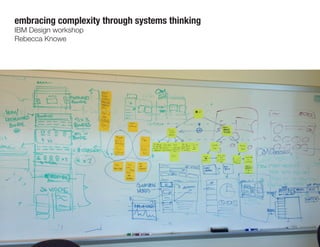
embracing complexity for better teamwork
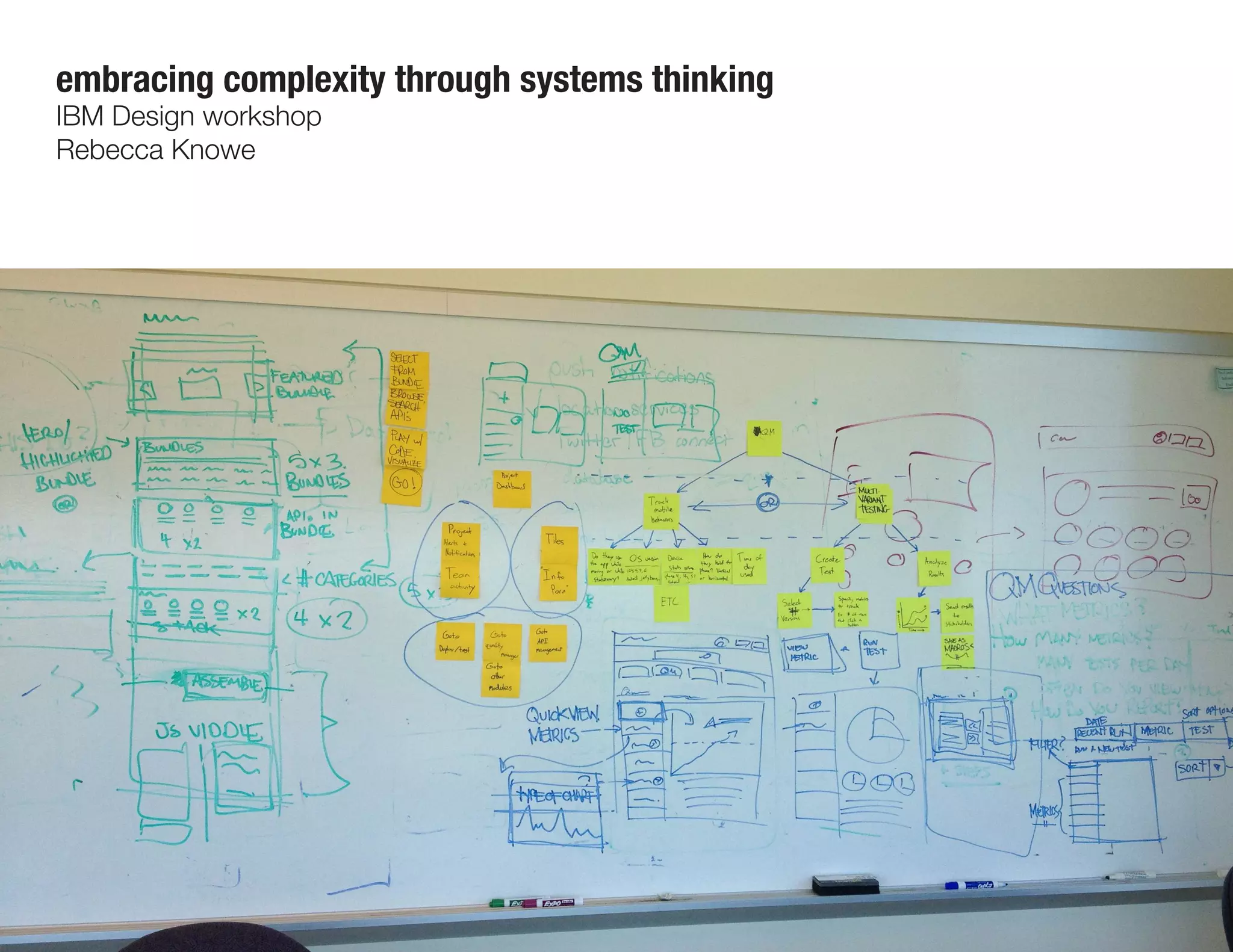
IBM Design workshop
Rebecca Knowe
embracing complexity through systems thinking
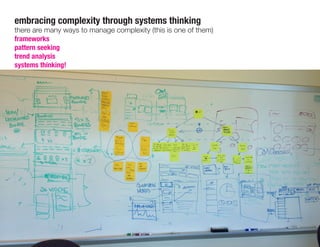
there are many ways to manage complexity (this is one of them)
frameworks
pattern seeking
trend analysis
systems thinking!
embracing complexity through systems thinking
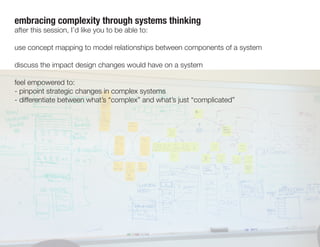
after this session, I’d like you to be able to:
use concept mapping to model relationships between components of a system
discuss the impact design changes would have on a system
feel empowered to:
- pinpoint strategic changes in complex systems
- differentiate between what’s “complex” and what’s just “complicated”
embracing complexity through systems thinking
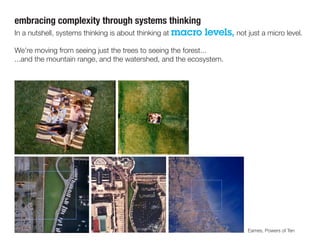
In a nutshell, systems thinking is about thinking at macro levels, not just a micro level.
We’re moving from seeing just the trees to seeing the forest...
...and the mountain range, and the watershed, and the ecosystem.
Eames, Powers of Ten
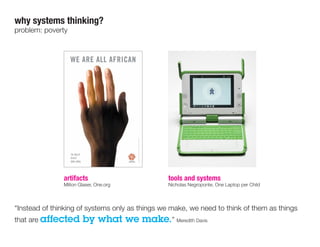
artifacts
Milton Glaser, One.org
why systems thinking?
problem: poverty
artifacts
Milton Glaser, One.org
tools and systems
Nicholas Negroponte, One Laptop per Child
why systems thinking?
problem: poverty
“Instead of thinking of systems only as things we make, we need to think of them as things
that are affected by what we make.” Meredith Davis
why systems thinking?
problem: poverty
artifacts
Milton Glaser, One.org
tools and systems
Nicholas Negroponte, One Laptop per Child
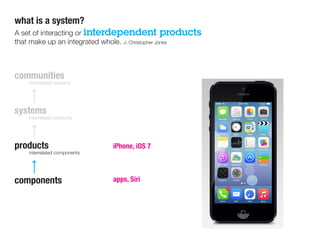
what is a system?
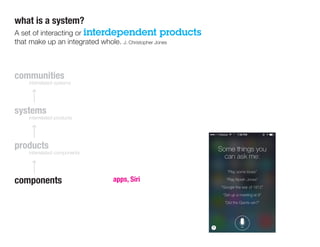
A set of interacting or interdependent products
that make up an integrated whole. J. Christopher Jones
communities
	 interrelated systems
systems
	 interrelated products
products
	 interrelated components
components
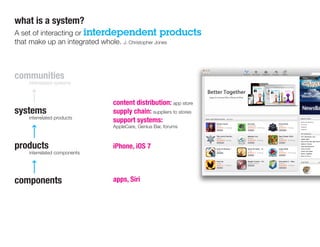
what is a system?
A set of interacting or interdependent products
that make up an integrated whole. J. Christopher Jones
apps, Siri
communities
	 interrelated systems
systems
	 interrelated products
products
	 interrelated components
components
what is a system?
A set of interacting or interdependent products
that make up an integrated whole. J. Christopher Jones
apps, Siri
iPhone, iOS 7
communities
	 interrelated systems
systems
	 interrelated products
products
	 interrelated components
components
what is a system?
A set of interacting or interdependent products
that make up an integrated whole. J. Christopher Jones
apps, Siri
iPhone, iOS 7
content distribution: app store
supply chain: suppliers to stores
support systems:
AppleCare, Genius Bar, forums
communities
	 interrelated systems
systems
	 interrelated products
products
	 interrelated components
components
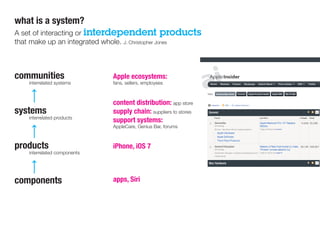
what is a system?
A set of interacting or interdependent products
that make up an integrated whole. J. Christopher Jones
apps, Siri
iPhone, iOS 7
Apple ecosystems:
fans, sellers, employees
content distribution: app store
supply chain: suppliers to stores
support systems:
AppleCare, Genius Bar, forums
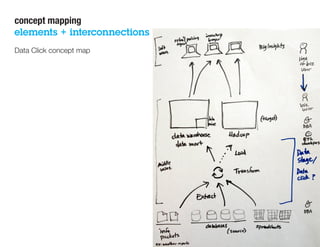
concept mapping
elements + interconnections
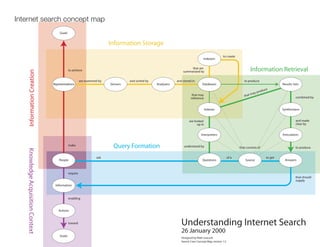
Data Click concept map
Goals
Actions
Information
People
Representations
Goals
Indexers
Sensors Analyzers
Questions
Interpreters
Indexes
Source Answers
Articulators
Synthesizers
Results Sets
are examined by and sorted by and stored in
to create
to produce
understood by
are looked
up in
that may
reference
that are
summarized by
that may produce
combined by
and made
clear by
to produce
that should
supply
enabling
toward
require
ask of a to get
that consists of
make
to achieve
Databases
KnowledgeAcquisitionContext
InformationCreation
Information Storage
Information Retrieval
Query Formation
Understanding Internet Search
26 January 2000
Designed by Matt Leacock
Search Core Concept Map, version 1.5
Internet search concept map
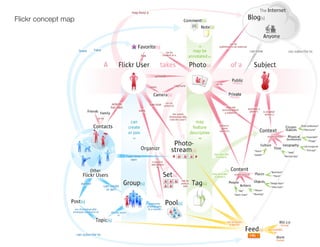
Flickr concept map
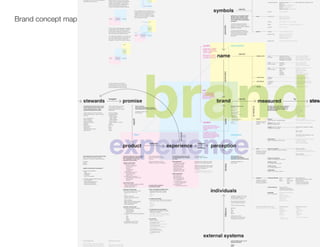
Brand concept map
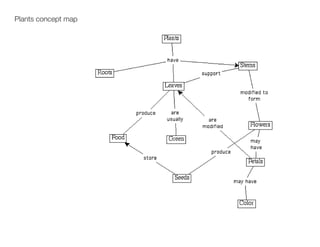
Plants concept map
concept mapping
exercise
Map your product and the system it fits into.
Or use one of these systems:
How weather works
How food gets from farm to table
How the digestive system works
concept mapping
exercise
Map your product and the system it fits into.
Or use one of these systems:
How weather works
How food gets from farm to table
How the digestive system works
Where do I start?
What’s most important to include?
What words do I choose?
Do I use a sentence?
concept mapping
exercise
Map your product and the system it fits into.
Or use one of these systems:
How weather works
How food gets from farm to table
How the digestive system works
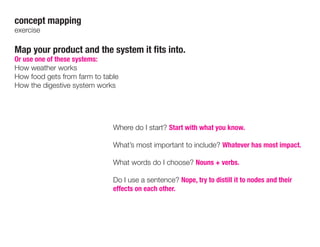
Where do I start? Start with what you know.
What’s most important to include? Whatever has most impact.
What words do I choose? Nouns + verbs.
Do I use a sentence? Nope, try to distill it to nodes and their
effects on each other.
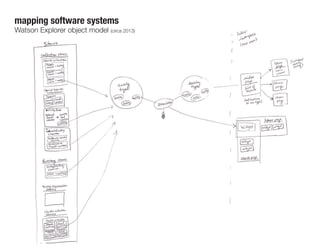
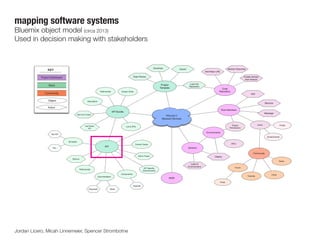
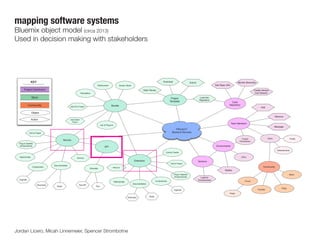
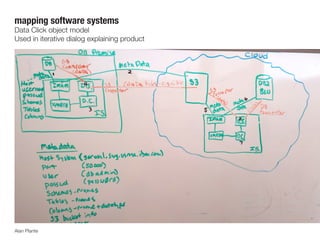
mapping software systems
Collaboration through system maps
Systems comprise: elements + interconnections + a function/purpose
How do we design for software systems?
“A systems approach looks at users in relation to a context and in terms of
their interaction with devices, with each other, and with themselves.” Hugh Dubberly
Leverage points
Places in the system where a small change could lead to a large shift in behavior
Donella H. Meadows
Leverage points
1. Transcending paradigms
2. Paradigms
3. Goals
4. Self-organization
5. Rules
6. Information flows
7. Reinforcing feedback loops
8. Balancing feedback loops
9. Delays
10. Stock-and-flow structures
11. Buffers
12. Numbers
Leverage points
1. Transcending paradigms
2. Paradigms
3. Goals
4. Self-organization
5. Rules
6. Information flows
7. Reinforcing feedback loops
8. Balancing feedback loops
9. Delays
10. Stock-and-flow structures
11. Buffers
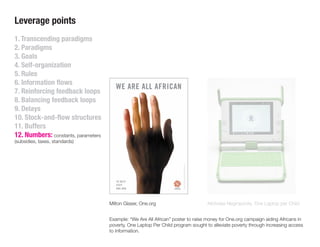
12. Numbers: constants, parameters
(subsidies, taxes, standards)
Example: “We Are All African” poster to raise money for One.org campaign aiding Africans in
poverty. One Laptop Per Child program sought to alleviate poverty through increasing access
to information.
Milton Glaser, One.org Nicholas Negroponte, One Laptop per Child
Leverage points
1. Transcending paradigms
2. Paradigms
3. Goals
4. Self-organization: the power to
add, change, evolve system structure
5. Rules
6. Information flows: structure of
who does and does not have access to
information
7. Reinforcing feedback loops:
strength of the gain of driving loops
8. Balancing feedback loops
9. Delays
10. Stock-and-flow structures
11. Buffers
12. Numbers
Example: “We Are All African” poster to raise money for One.org campaign aiding Africans in
poverty. One Laptop Per Child program sought to alleviate poverty through increasing access
to information.
Milton Glaser, One.org Nicholas Negroponte, One Laptop per Child
Leverage points
1. Transcending paradigms
2. Paradigms
3. Goals
4. Self-organization
5. Rules: incentives, punishments,
contraints
6. Information flows
7. Reinforcing feedback loops
8. Balancing feedback loops
9. Delays
10. Stock-and-flow structures
11. Buffers
12. Numbers
Example: In 2013, Twitter changed API usage rules to limit the number of users who could
access its feeds through third-party applications, like Falcon Pro. This move dampened the
existing market for Twitter client applications, drove users instead toward the native Twitter
app, and enabled Twitter to incorporate advertising.
Leverage points
1. Transcending paradigms
2. Paradigms: mind set out of which
the system (its goals, structure, rules,
delays, parameters) arises
3. Goals
4. Self-organization
5. Rules
6. Information flows
7. Reinforcing feedback loops
8. Balancing feedback loops
9. Delays
10. Stock-and-flow structures:
physical systems and their nodes
of intersection
11. Buffers
12. Numbers
Find out more:
Interactions Magazine, Hugh Dubberly
Graphic Design Theory: Graphic Design in Context, Meredith Davis
Thinking in Systems, Donella H. Meadows
Thanks!

Embracing Complexity for Better Teamwork

  • 1.
    embracing complexity forbetter teamwork IBM Design workshop Rebecca Knowe
  • 2.
    embracing complexity throughsystems thinking there are many ways to manage complexity (this is one of them) frameworks pattern seeking trend analysis systems thinking!
  • 3.
    embracing complexity throughsystems thinking after this session, I’d like you to be able to: use concept mapping to model relationships between components of a system discuss the impact design changes would have on a system feel empowered to: - pinpoint strategic changes in complex systems - differentiate between what’s “complex” and what’s just “complicated”
  • 4.
    embracing complexity throughsystems thinking In a nutshell, systems thinking is about thinking at macro levels, not just a micro level. We’re moving from seeing just the trees to seeing the forest... ...and the mountain range, and the watershed, and the ecosystem. Eames, Powers of Ten
  • 5.
    artifacts Milton Glaser, One.org whysystems thinking? problem: poverty
  • 6.
    artifacts Milton Glaser, One.org toolsand systems Nicholas Negroponte, One Laptop per Child why systems thinking? problem: poverty
  • 7.
    “Instead of thinkingof systems only as things we make, we need to think of them as things that are affected by what we make.” Meredith Davis why systems thinking? problem: poverty artifacts Milton Glaser, One.org tools and systems Nicholas Negroponte, One Laptop per Child
  • 8.
    what is asystem? A set of interacting or interdependent products that make up an integrated whole. J. Christopher Jones
  • 9.
    communities interrelated systems systems interrelated products products interrelated components components what is a system? A set of interacting or interdependent products that make up an integrated whole. J. Christopher Jones apps, Siri
  • 10.
    communities interrelated systems systems interrelated products products interrelated components components what is a system? A set of interacting or interdependent products that make up an integrated whole. J. Christopher Jones apps, Siri iPhone, iOS 7
  • 11.
    communities interrelated systems systems interrelated products products interrelated components components what is a system? A set of interacting or interdependent products that make up an integrated whole. J. Christopher Jones apps, Siri iPhone, iOS 7 content distribution: app store supply chain: suppliers to stores support systems: AppleCare, Genius Bar, forums
  • 12.
    communities interrelated systems systems interrelated products products interrelated components components what is a system? A set of interacting or interdependent products that make up an integrated whole. J. Christopher Jones apps, Siri iPhone, iOS 7 Apple ecosystems: fans, sellers, employees content distribution: app store supply chain: suppliers to stores support systems: AppleCare, Genius Bar, forums
  • 13.
    concept mapping elements +interconnections Data Click concept map
  • 14.
    Goals Actions Information People Representations Goals Indexers Sensors Analyzers Questions Interpreters Indexes Source Answers Articulators Synthesizers ResultsSets are examined by and sorted by and stored in to create to produce understood by are looked up in that may reference that are summarized by that may produce combined by and made clear by to produce that should supply enabling toward require ask of a to get that consists of make to achieve Databases KnowledgeAcquisitionContext InformationCreation Information Storage Information Retrieval Query Formation Understanding Internet Search 26 January 2000 Designed by Matt Leacock Search Core Concept Map, version 1.5 Internet search concept map
  • 15.
  • 16.
  • 17.
  • 18.
    concept mapping exercise Map yourproduct and the system it fits into. Or use one of these systems: How weather works How food gets from farm to table How the digestive system works
  • 19.
    concept mapping exercise Map yourproduct and the system it fits into. Or use one of these systems: How weather works How food gets from farm to table How the digestive system works Where do I start? What’s most important to include? What words do I choose? Do I use a sentence?
  • 20.
    concept mapping exercise Map yourproduct and the system it fits into. Or use one of these systems: How weather works How food gets from farm to table How the digestive system works Where do I start? Start with what you know. What’s most important to include? Whatever has most impact. What words do I choose? Nouns + verbs. Do I use a sentence? Nope, try to distill it to nodes and their effects on each other.
  • 21.
    mapping software systems Collaborationthrough system maps Systems comprise: elements + interconnections + a function/purpose
  • 22.
    How do wedesign for software systems? “A systems approach looks at users in relation to a context and in terms of their interaction with devices, with each other, and with themselves.” Hugh Dubberly
  • 23.
    Leverage points Places inthe system where a small change could lead to a large shift in behavior Donella H. Meadows
  • 24.
    Leverage points 1. Transcendingparadigms 2. Paradigms 3. Goals 4. Self-organization 5. Rules 6. Information flows 7. Reinforcing feedback loops 8. Balancing feedback loops 9. Delays 10. Stock-and-flow structures 11. Buffers 12. Numbers
  • 25.
    Leverage points 1. Transcendingparadigms 2. Paradigms 3. Goals 4. Self-organization 5. Rules 6. Information flows 7. Reinforcing feedback loops 8. Balancing feedback loops 9. Delays 10. Stock-and-flow structures 11. Buffers 12. Numbers: constants, parameters (subsidies, taxes, standards) Example: “We Are All African” poster to raise money for One.org campaign aiding Africans in poverty. One Laptop Per Child program sought to alleviate poverty through increasing access to information. Milton Glaser, One.org Nicholas Negroponte, One Laptop per Child
  • 26.
    Leverage points 1. Transcendingparadigms 2. Paradigms 3. Goals 4. Self-organization: the power to add, change, evolve system structure 5. Rules 6. Information flows: structure of who does and does not have access to information 7. Reinforcing feedback loops: strength of the gain of driving loops 8. Balancing feedback loops 9. Delays 10. Stock-and-flow structures 11. Buffers 12. Numbers Example: “We Are All African” poster to raise money for One.org campaign aiding Africans in poverty. One Laptop Per Child program sought to alleviate poverty through increasing access to information. Milton Glaser, One.org Nicholas Negroponte, One Laptop per Child
  • 27.
    Leverage points 1. Transcendingparadigms 2. Paradigms 3. Goals 4. Self-organization 5. Rules: incentives, punishments, contraints 6. Information flows 7. Reinforcing feedback loops 8. Balancing feedback loops 9. Delays 10. Stock-and-flow structures 11. Buffers 12. Numbers Example: In 2013, Twitter changed API usage rules to limit the number of users who could access its feeds through third-party applications, like Falcon Pro. This move dampened the existing market for Twitter client applications, drove users instead toward the native Twitter app, and enabled Twitter to incorporate advertising.
  • 28.
    Leverage points 1. Transcendingparadigms 2. Paradigms: mind set out of which the system (its goals, structure, rules, delays, parameters) arises 3. Goals 4. Self-organization 5. Rules 6. Information flows 7. Reinforcing feedback loops 8. Balancing feedback loops 9. Delays 10. Stock-and-flow structures: physical systems and their nodes of intersection 11. Buffers 12. Numbers
  • 29.
    Find out more: InteractionsMagazine, Hugh Dubberly Graphic Design Theory: Graphic Design in Context, Meredith Davis Thinking in Systems, Donella H. Meadows Thanks!