RSD9 - TALKS | ECOLOGICAL AND CIRCULAR ECONOMIES, FLOURISHING SOCIETY
F. PAPILE 1, B. DEL CURTO 2, A. COCCIA 3
1Design Department of Politecnico di Milano (ITALY)
2Department of Chemistry, Materials and Chemical Engineering “Giulio Natta” of Politecnico di Milano (ITALY)
3Innovation Manager at Faber S.p.A.
SYSTEMTHINKING&SYNTHESISMAPPINGTO
MANAGEPRODUCTMATERIALSELECTIONPROCESS
ANEXPERIMENTALFRAMEWORK TOPROMOTETHEINTRODUCTIONOF
INNOVATIVEMATERIALSINTOINDUSTRIALCOMPANIES
THINKINGINSYSTEMS
INTRODUCTION
CONTEXT:TOP-DOWNPERSPECTIVE
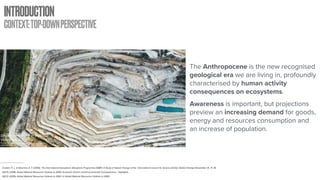
Drone over quarry in Barossa
Valley, SA, Australia
Picture Retrieved from: https://unsplash.com/photos/
oF7hh97lVqA
The Anthropocene is the new recognised
geological era we are living in, profoundly
characterised by human activity
consequences on ecosystems.
Awareness is important, but projections
preview an increasing demand for goods,
energy and resources consumption and
an increase of population.
Crutzen, P. J., & Stoermer, E. F. (2000). The International Geosphere–Biosphere Programme (IGBP): A Study of Global Change of the International Council for Science (ICSU). Global Change Newsletter, 41, 17–18.
OECD. (2018). Global Material Resources Outlook to 2060: Economic Drivers and Environmental Consequences - Highlights.
OECD. (2019). Global Material Resources Outlook to 2060. In Global Material Resources Outlook to 2060.
INTRODUCTION
CONTEXT:TOP-DOWNPERSPECTIVE
Drone over quarry in Barossa
Valley, SA, Australia
Picture Retrieved from: https://unsplash.com/photos/
oF7hh97lVqA
Gaiardo & Tamborrini (2015). SYSTEMIC INNOVATION DESIGN METHODOLOGY: THE COMPARISON OF TWO CASES STUDIES.
“The global growth markets, new
technologies opportunities and
emerging cultures are rewriting a
system where the old paradigms seem
didn't work anymore in the
contemporary context.[...]The result is
a world where local’s actions
influence the global scale and vice
versa.”
-Gaiardo & Tamborrini (2015)
INTRODUCTION
CONTEXT:TOP-DOWNPERSPECTIVE
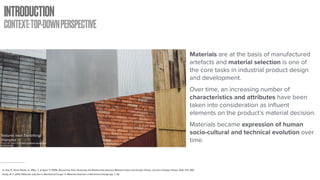
Textures near Tianzifang,
Shanghai.
Picture Retrieved from: https://unsplash.com/photos/
SsV4Ck4GISU
Materials are at the basis of manufactured
artefacts and material selection is one of
the core tasks in industrial product design
and development.
Over time, an increasing number of
characteristics and attributes have been
taken into consideration as influent
elements on the product’s material decision.
Materials became expression of human
socio-cultural and technical evolution over
time.
du Gay, P., Smart Martin, A., Miller, T., & Spyer, P. (1999). Beyond the Pale: Reviewing the Relationship between Material Culture and Design History. Journal of Design History, 12(4), 373–380.
Ashby, M. F. (2011). Materials selection in Mechanical Design. In Materials Selection in Mechanical Design (pp. 1–13).
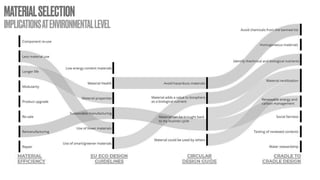
MATERIALSELECTION
IMPLICATIONSATENVIRONMENTALLEVEL
MATERIALSELECTION
EUROPEANSCENARIO
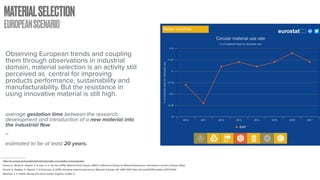
Observing European trends and coupling
them through observations in industrial
domain, material selection is an activity still
perceived as central for improving
products performance, sustainability and
manufacturability. But the resistance in
using innovative material is still high.
average gestation time between the research,
development and introduction of a new material into
the industrial flow
=
estimated to be at least 20 years.
https://ec.europa.eu/eurostat/web/sdi/responsible-consumption-and-production
Karana, E., Barati, B., Rognoli, V., & Laan, A. Z. Van Der. (2015). Material Driven Design ( MDD ): A Method to Design for Material Experiences. International Journal of Design, (May).
Karana, E., Pedgley, O., Rognoli, V., & Korsunsky, A. (2016). Emerging material experiences. Materials & Design, 90, 1248–1250. https://doi.org/10.1016/j.matdes.2015.07.042
Markham, S. K. (2002). Moving from lab to market. Engineer, (JUNE), 12
MATERIALSELECTION
INFORMATIONMANAGEMENT
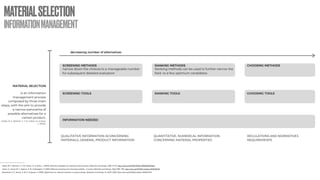
Ashby, M. F., Bréchet, Y. J. M., Cebon, D., & Salvo, L. (2004). Selection strategies for materials and processes. Materials and Design, 25(1), 51–67. https://doi.org/10.1016/S0261-3069(03)00159-6
Jahan, A., Ismail, M. Y., Sapuan, S. M., & Mustapha, F. (2010). Material screening and choosing methods - A review. Materials and Design, 31(2), 696–705. https://doi.org/10.1016/j.matdes.2009.08.013
Ramalhete, P. S., Senos, A. M. R., & Aguiar, C. (2010). Digital tools for material selection in product design. Materials and Design, 31, 2275–2287. https://doi.org/10.1016/j.matdes.2009.12.013
MATERIALSELECTION
INFORMATIONMANAGEMENT
Allione, C., De Giorgi, C., Lerma, B., & Petruccelli, L. (2012). From ecodesign products guidelines to materials guidelines for a sustainable product. Qualitative and quantitative multicriteria environmental profile of a material. Energy, 39(1), 90–99.
Ashby, M. F., & Johnson, K. (2014). Materials and design : the art and science of material selection in product design. ButterworthHeinemann.
Karana, E., Hekkert, P., & Kandachar, P. (2008). Material considerations in product design: A survey on crucial material aspects used by product designers. Materials and Design, 29(6), 1081–1089.
van Kesteren, I. E. H. (2008). Product designers’ information needs in materials selection. Materials and Design, 29(1), 133–145.
Tian, H., Zhang, H., & Liu, T. (2019). Research on Material Selection of Product Design under Environmental Awareness.
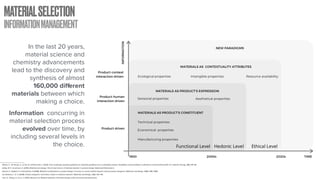
In the last 20 years,
material science and
chemistry advancements
lead to the discovery and
synthesis of almost
160,000 different
materials between which
making a choice.
Information concurring in
material selection process
evolved over time, by
including several levels in
the choice.
MATERIALSELECTION
INFORMATIONMANAGEMENT
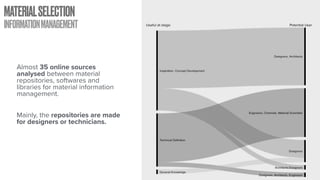
Almost 35 online sources
analysed between material
repositories, softwares and
libraries for material information
management.
Mainly, the repositories are made
for designers or technicians.
Useful at stage: Potential User
PROBLEMSETTING
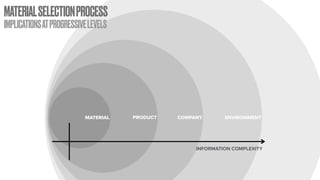
ENVIRONMENT
COMPANY
PRODUCT
MATERIAL
MATERIALSELECTIONPROCESS
IMPLICATIONSATPROGRESSIVELEVELS
INFORMATION COMPLEXITY
PROBLEMSETTING
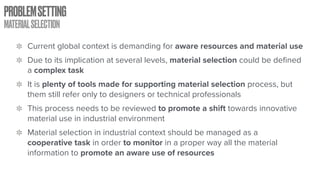
MATERIALSELECTION
Current global context is demanding for aware resources and material use
Due to its implication at several levels, material selection could be defined
a complex task
It is plenty of tools made for supporting material selection process, but
them still refer only to designers or technical professionals
This process needs to be reviewed to promote a shift towards innovative
material use in industrial environment
Material selection in industrial context should be managed as a
cooperative task in order to monitor in a proper way all the material
information to promote an aware use of resources
SYNTHESISMAPPING
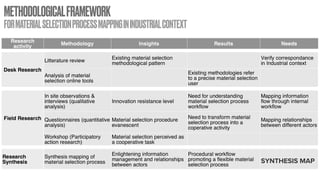
METHODOLOGICALFRAMEWORK
FORMATERIALSELECTIONPROCESSMAPPINGININDUSTRIALCONTEXT
SYNTHESIS MAP
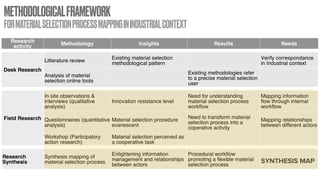
METHODOLOGICALFRAMEWORK
FORMATERIALSELECTIONPROCESSMAPPINGININDUSTRIALCONTEXT
SYNTHESIS MAP
METHODOLOGICALFRAMEWORK
FORMATERIALSELECTIONPROCESSMAPPINGININDUSTRIALCONTEXT
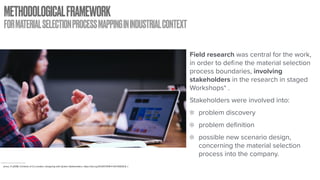
Field research was central for the work,
in order to define the material selection
process boundaries, involving
stakeholders in the research in staged
Workshops* .
Stakeholders were involved into:
problem discovery
problem definition
possible new scenario design,
concerning the material selection
process into the company.
Jones, P. (2018). Contexts of Co-creation: Designing with System Stakeholders. https://doi.org/10.1007/978-4-431-55639-8_1
“Synthesis maps are a type of system map that a team of designers and
researchers team develops in a course studio or professional project.
Synthesis maps differ significantly in size, visual appearance, and
application from the formal models used in systems engineering and
analytical traditions. The purpose of a synthesis map is to articulate the
processes and relationships that are vital to stakeholders of the system”
- Jones & Bowes (2017)
SYNTHESISMAPPING
MATERIALSELECTION
Jones & Bowes (2017). Rendering Systems Visible for Design: Synthesis Maps as Constructivist Design Narratives. She Ji Volume 3, Number 3, Autumn 2017 pp.229-248
SYNTHESISMAPPING
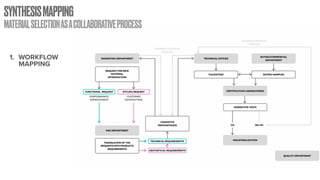
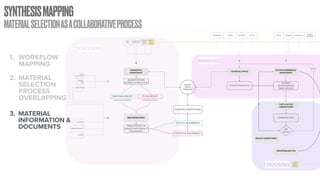
MATERIALSELECTIONASACOLLABORATIVEPROCESS
1. WORKFLOW
MAPPING
SYNTHESISMAPPING
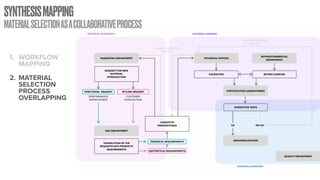
MATERIALSELECTIONASACOLLABORATIVEPROCESS
1. WORKFLOW
MAPPING
2. MATERIAL
SELECTION
PROCESS
OVERLAPPING
SYNTHESISMAPPING
MATERIALSELECTIONASACOLLABORATIVEPROCESS
1. WORKFLOW
MAPPING
2. MATERIAL
SELECTION
PROCESS
OVERLAPPING
3. MATERIAL
INFORMATION &
DOCUMENTS
SYNTHESISMAPPING
MATERIALSELECTIONASACOLLABORATIVEPROCESS
FURTHERDEVELOPMENTS
FUTUREUSEOFTHESYNTHESISMAP
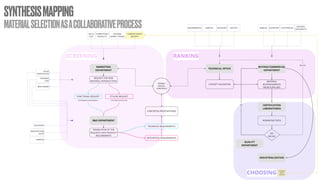
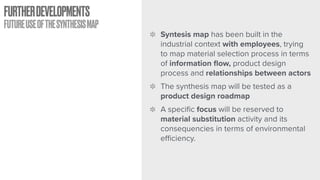
Syntesis map has been built in the
industrial context with employees, trying
to map material selection process in terms
of information flow, product design
process and relationships between actors
The synthesis map will be tested as a
product design roadmap
A specific focus will be reserved to
material substitution activity and its
consequencies in terms of environmental
efficiency.
FURTHERDEVELOPMENTS
CONCLUSION
A systematic material selection activity
could fasten the introduction of new
materials into the industrial environment
New materials introduction in the
production systems could facilitate the
transition towards new economic systems
(e.g. Circular economy) without
compromising the production efficiency
Further enrichments of the synthesis map
will provide an information flow even at an
environmental level (evolving into
GIGA.Maps)
THANKYOUFORYOURATTENTION.
E-MAIL: FLAVIA.PAPILE@POLIMI.IT
RSD9 - TALKS | ECOLOGICAL AND CIRCULAR ECONOMIES, FLOURISHING SOCIETY
F. PAPILE 1, B. DEL CURTO 2, A. COCCIA 3
1Design Department of Politecnico di Milano (ITALY)
2Department of Chemistry, Materials and Chemical Engineering “Giulio Natta” of Politecnico di Milano (ITALY)
3Innovation Manager at Faber S.p.A.
SYSTEMTHINKING&SYNTHESISMAPPINGTOMANAGEPRODUCTMATERIALSELECTIONPROCESS
ANEXPERIMENTALFRAMEWORK TOPROMOTETHEINTRODUCTIONOFINNOVATIVEMATERIALSINTOINDUSTRIALCOMPANIES

System thinking and synthesis mapping to manage product material selection process

  • 1.
    RSD9 - TALKS| ECOLOGICAL AND CIRCULAR ECONOMIES, FLOURISHING SOCIETY F. PAPILE 1, B. DEL CURTO 2, A. COCCIA 3 1Design Department of Politecnico di Milano (ITALY) 2Department of Chemistry, Materials and Chemical Engineering “Giulio Natta” of Politecnico di Milano (ITALY) 3Innovation Manager at Faber S.p.A. SYSTEMTHINKING&SYNTHESISMAPPINGTO MANAGEPRODUCTMATERIALSELECTIONPROCESS ANEXPERIMENTALFRAMEWORK TOPROMOTETHEINTRODUCTIONOF INNOVATIVEMATERIALSINTOINDUSTRIALCOMPANIES
  • 2.
  • 3.
    INTRODUCTION CONTEXT:TOP-DOWNPERSPECTIVE Drone over quarryin Barossa Valley, SA, Australia Picture Retrieved from: https://unsplash.com/photos/ oF7hh97lVqA The Anthropocene is the new recognised geological era we are living in, profoundly characterised by human activity consequences on ecosystems. Awareness is important, but projections preview an increasing demand for goods, energy and resources consumption and an increase of population. Crutzen, P. J., & Stoermer, E. F. (2000). The International Geosphere–Biosphere Programme (IGBP): A Study of Global Change of the International Council for Science (ICSU). Global Change Newsletter, 41, 17–18. OECD. (2018). Global Material Resources Outlook to 2060: Economic Drivers and Environmental Consequences - Highlights. OECD. (2019). Global Material Resources Outlook to 2060. In Global Material Resources Outlook to 2060.
  • 4.
    INTRODUCTION CONTEXT:TOP-DOWNPERSPECTIVE Drone over quarryin Barossa Valley, SA, Australia Picture Retrieved from: https://unsplash.com/photos/ oF7hh97lVqA Gaiardo & Tamborrini (2015). SYSTEMIC INNOVATION DESIGN METHODOLOGY: THE COMPARISON OF TWO CASES STUDIES. “The global growth markets, new technologies opportunities and emerging cultures are rewriting a system where the old paradigms seem didn't work anymore in the contemporary context.[...]The result is a world where local’s actions influence the global scale and vice versa.” -Gaiardo & Tamborrini (2015)
  • 5.
    INTRODUCTION CONTEXT:TOP-DOWNPERSPECTIVE Textures near Tianzifang, Shanghai. PictureRetrieved from: https://unsplash.com/photos/ SsV4Ck4GISU Materials are at the basis of manufactured artefacts and material selection is one of the core tasks in industrial product design and development. Over time, an increasing number of characteristics and attributes have been taken into consideration as influent elements on the product’s material decision. Materials became expression of human socio-cultural and technical evolution over time. du Gay, P., Smart Martin, A., Miller, T., & Spyer, P. (1999). Beyond the Pale: Reviewing the Relationship between Material Culture and Design History. Journal of Design History, 12(4), 373–380. Ashby, M. F. (2011). Materials selection in Mechanical Design. In Materials Selection in Mechanical Design (pp. 1–13).
  • 6.
  • 7.
    MATERIALSELECTION EUROPEANSCENARIO Observing European trendsand coupling them through observations in industrial domain, material selection is an activity still perceived as central for improving products performance, sustainability and manufacturability. But the resistance in using innovative material is still high. average gestation time between the research, development and introduction of a new material into the industrial flow = estimated to be at least 20 years. https://ec.europa.eu/eurostat/web/sdi/responsible-consumption-and-production Karana, E., Barati, B., Rognoli, V., & Laan, A. Z. Van Der. (2015). Material Driven Design ( MDD ): A Method to Design for Material Experiences. International Journal of Design, (May). Karana, E., Pedgley, O., Rognoli, V., & Korsunsky, A. (2016). Emerging material experiences. Materials & Design, 90, 1248–1250. https://doi.org/10.1016/j.matdes.2015.07.042 Markham, S. K. (2002). Moving from lab to market. Engineer, (JUNE), 12
  • 8.
    MATERIALSELECTION INFORMATIONMANAGEMENT Ashby, M. F.,Bréchet, Y. J. M., Cebon, D., & Salvo, L. (2004). Selection strategies for materials and processes. Materials and Design, 25(1), 51–67. https://doi.org/10.1016/S0261-3069(03)00159-6 Jahan, A., Ismail, M. Y., Sapuan, S. M., & Mustapha, F. (2010). Material screening and choosing methods - A review. Materials and Design, 31(2), 696–705. https://doi.org/10.1016/j.matdes.2009.08.013 Ramalhete, P. S., Senos, A. M. R., & Aguiar, C. (2010). Digital tools for material selection in product design. Materials and Design, 31, 2275–2287. https://doi.org/10.1016/j.matdes.2009.12.013
  • 9.
    MATERIALSELECTION INFORMATIONMANAGEMENT Allione, C., DeGiorgi, C., Lerma, B., & Petruccelli, L. (2012). From ecodesign products guidelines to materials guidelines for a sustainable product. Qualitative and quantitative multicriteria environmental profile of a material. Energy, 39(1), 90–99. Ashby, M. F., & Johnson, K. (2014). Materials and design : the art and science of material selection in product design. ButterworthHeinemann. Karana, E., Hekkert, P., & Kandachar, P. (2008). Material considerations in product design: A survey on crucial material aspects used by product designers. Materials and Design, 29(6), 1081–1089. van Kesteren, I. E. H. (2008). Product designers’ information needs in materials selection. Materials and Design, 29(1), 133–145. Tian, H., Zhang, H., & Liu, T. (2019). Research on Material Selection of Product Design under Environmental Awareness. In the last 20 years, material science and chemistry advancements lead to the discovery and synthesis of almost 160,000 different materials between which making a choice. Information concurring in material selection process evolved over time, by including several levels in the choice.
  • 10.
    MATERIALSELECTION INFORMATIONMANAGEMENT Almost 35 onlinesources analysed between material repositories, softwares and libraries for material information management. Mainly, the repositories are made for designers or technicians. Useful at stage: Potential User
  • 11.
  • 12.
  • 13.
    PROBLEMSETTING MATERIALSELECTION Current global contextis demanding for aware resources and material use Due to its implication at several levels, material selection could be defined a complex task It is plenty of tools made for supporting material selection process, but them still refer only to designers or technical professionals This process needs to be reviewed to promote a shift towards innovative material use in industrial environment Material selection in industrial context should be managed as a cooperative task in order to monitor in a proper way all the material information to promote an aware use of resources
  • 14.
  • 15.
  • 16.
  • 17.
    METHODOLOGICALFRAMEWORK FORMATERIALSELECTIONPROCESSMAPPINGININDUSTRIALCONTEXT Field research wascentral for the work, in order to define the material selection process boundaries, involving stakeholders in the research in staged Workshops* . Stakeholders were involved into: problem discovery problem definition possible new scenario design, concerning the material selection process into the company. Jones, P. (2018). Contexts of Co-creation: Designing with System Stakeholders. https://doi.org/10.1007/978-4-431-55639-8_1
  • 18.
    “Synthesis maps area type of system map that a team of designers and researchers team develops in a course studio or professional project. Synthesis maps differ significantly in size, visual appearance, and application from the formal models used in systems engineering and analytical traditions. The purpose of a synthesis map is to articulate the processes and relationships that are vital to stakeholders of the system” - Jones & Bowes (2017) SYNTHESISMAPPING MATERIALSELECTION Jones & Bowes (2017). Rendering Systems Visible for Design: Synthesis Maps as Constructivist Design Narratives. She Ji Volume 3, Number 3, Autumn 2017 pp.229-248
  • 19.
  • 20.
  • 21.
  • 22.
  • 23.
    FURTHERDEVELOPMENTS FUTUREUSEOFTHESYNTHESISMAP Syntesis map hasbeen built in the industrial context with employees, trying to map material selection process in terms of information flow, product design process and relationships between actors The synthesis map will be tested as a product design roadmap A specific focus will be reserved to material substitution activity and its consequencies in terms of environmental efficiency.
  • 24.
    FURTHERDEVELOPMENTS CONCLUSION A systematic materialselection activity could fasten the introduction of new materials into the industrial environment New materials introduction in the production systems could facilitate the transition towards new economic systems (e.g. Circular economy) without compromising the production efficiency Further enrichments of the synthesis map will provide an information flow even at an environmental level (evolving into GIGA.Maps)
  • 25.
    THANKYOUFORYOURATTENTION. E-MAIL: FLAVIA.PAPILE@POLIMI.IT RSD9 -TALKS | ECOLOGICAL AND CIRCULAR ECONOMIES, FLOURISHING SOCIETY F. PAPILE 1, B. DEL CURTO 2, A. COCCIA 3 1Design Department of Politecnico di Milano (ITALY) 2Department of Chemistry, Materials and Chemical Engineering “Giulio Natta” of Politecnico di Milano (ITALY) 3Innovation Manager at Faber S.p.A. SYSTEMTHINKING&SYNTHESISMAPPINGTOMANAGEPRODUCTMATERIALSELECTIONPROCESS ANEXPERIMENTALFRAMEWORK TOPROMOTETHEINTRODUCTIONOFINNOVATIVEMATERIALSINTOINDUSTRIALCOMPANIES