Cardiovascul
ar System
R. PH. AMMAR ABID KHAN
Content
▪ Body System
▪ Cardiovascular System
▪ Vascular System
▪ Blood
▪ Hemodynamic
Body Systems
▪The human body can be
categorized into different
systems based on their
functions and structures.
The major systems of the
human body include:
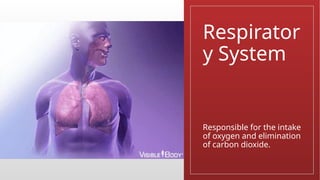
Respirator
y System
Responsible for the intake
of oxygen and elimination
of carbon dioxide.
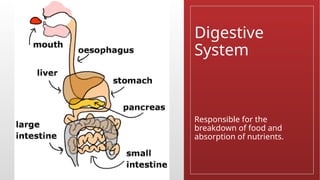
Digestive
System
Responsible for the
breakdown of food and
absorption of nutrients.
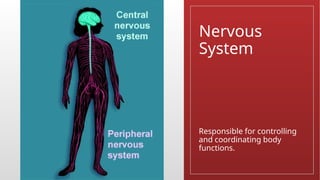
Nervous
System
Responsible for controlling
and coordinating body
functions.
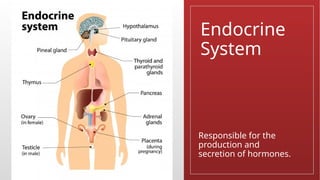
Endocrine
System
Responsible for the
production and
secretion of hormones.
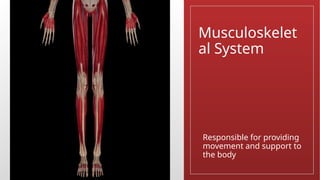
Musculoskelet
al System
Responsible for providing
movement and support to
the body
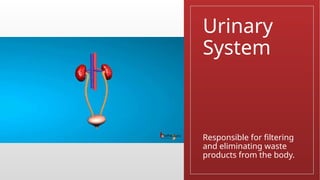
Urinary
System
Responsible for filtering
and eliminating waste
products from the body.
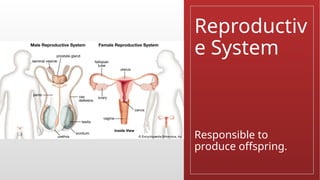
Reproductiv
e System
Responsible to
produce offspring.
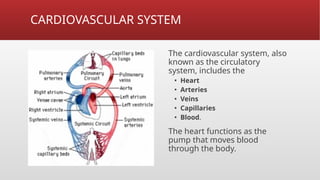
CARDIOVASCULAR SYSTEM
The cardiovascular system, also
known as the circulatory
system, includes the
▪ Heart
▪ Arteries
▪ Veins
▪ Capillaries
▪ Blood.
The heart functions as the
pump that moves blood
through the body.
CARDIOVASCULAR SYSTEM
The main Components of heart are:
▪ Heart
▪ Blood
▪ Vessels
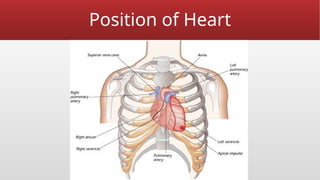
Position of Heart
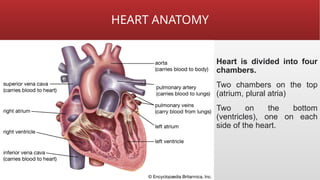
HEART ANATOMY
Heart is divided into four
chambers.
Two chambers on the top
(atrium, plural atria)
Two on the bottom
(ventricles), one on each
side of the heart.
HEART CHAMBERs
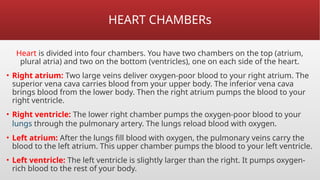
Heart is divided into four chambers. You have two chambers on the top (atrium,
plural atria) and two on the bottom (ventricles), one on each side of the heart.
• Right atrium: Two large veins deliver oxygen-poor blood to your right atrium. The
superior vena cava carries blood from your upper body. The inferior vena cava
brings blood from the lower body. Then the right atrium pumps the blood to your
right ventricle.
• Right ventricle: The lower right chamber pumps the oxygen-poor blood to your
lungs through the pulmonary artery. The lungs reload blood with oxygen.
• Left atrium: After the lungs fill blood with oxygen, the pulmonary veins carry the
blood to the left atrium. This upper chamber pumps the blood to your left ventricle.
• Left ventricle: The left ventricle is slightly larger than the right. It pumps oxygen-
rich blood to the rest of your body.
HEART Valves
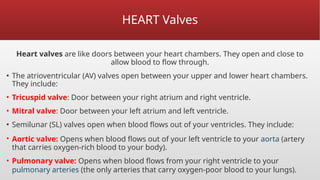
Heart valves are like doors between your heart chambers. They open and close to
allow blood to flow through.
▪ The atrioventricular (AV) valves open between your upper and lower heart chambers.
They include:
• Tricuspid valve: Door between your right atrium and right ventricle.
• Mitral valve: Door between your left atrium and left ventricle.
▪ Semilunar (SL) valves open when blood flows out of your ventricles. They include:
• Aortic valve: Opens when blood flows out of your left ventricle to your aorta (artery
that carries oxygen-rich blood to your body).
• Pulmonary valve: Opens when blood flows from your right ventricle to your
pulmonary arteries (the only arteries that carry oxygen-poor blood to your lungs).
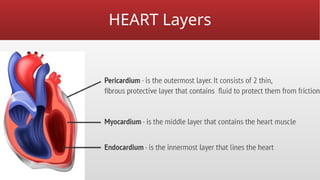
HEART Layers
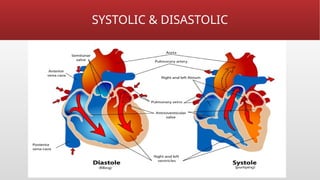
SYSTOLIC & DISASTOLIC
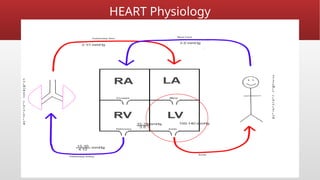
HEART Physiology
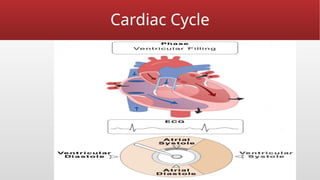
Cardiac Cycle
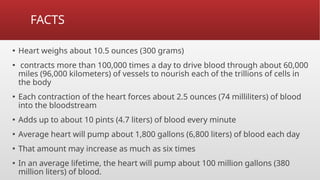
FACTS
▪ Heart weighs about 10.5 ounces (300 grams)
▪ contracts more than 100,000 times a day to drive blood through about 60,000
miles (96,000 kilometers) of vessels to nourish each of the trillions of cells in
the body
▪ Each contraction of the heart forces about 2.5 ounces (74 milliliters) of blood
into the bloodstream
▪ Adds up to about 10 pints (4.7 liters) of blood every minute
▪ Average heart will pump about 1,800 gallons (6,800 liters) of blood each day
▪ That amount may increase as much as six times
▪ In an average lifetime, the heart will pump about 100 million gallons (380
million liters) of blood.
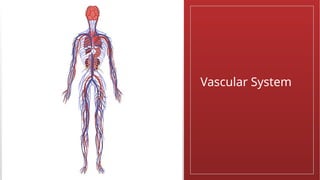
Vascular System
Vascular System
The vascular system, also called the circulatory
system, is made up of the vessels that carry
blood and lymph through the body. The arteries
and veins carry blood throughout the body,
delivering oxygen and nutrients to the body tissues
and taking away tissue waste matter.
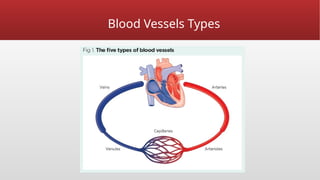
Blood Vessels Types
Blood Vessels Types
Five types of blood vessels as following
1.Arteries: Transport High-Blood pressure blood from the
heart to smaller arteries and arterioles
2.Arterioles: Connect Arteries and capillaries
3.Veins: Act as reservoir of blood and transport low-pressure blood from
venules to heart
4.Venules: Connects capillaries and veins
5.Capillaries: Allows gas exchange, nutrients transfer and waster removal
between blood and tissue fluids
Layers of Vessels
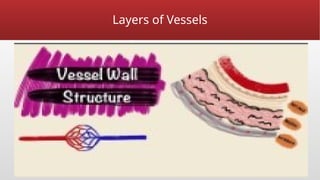
▪ Blood vessels, except the smallest ones, are made of three
layers i.e.
▪ Tunica interna
The tunica interna (innermost layer) is a single layer of squamous (flat) epithelial
cells called the endothelium
▪ Tunica media
▪ The tunica media (middle layer) takes up most of the arterial vessel wall and is
composed of smooth muscle fibers and elastin
▪ Tunica externa
▪ The tunica externa (outer layer) consists mainly of connective tissue fibres that
protect the blood vessels and attach them to any surrounding tissues
Layers of Vessels
Blood
Blood
▪Blood is a fluid that flows through our body,
delivering oxygen and nutrients to our
organs and tissues, while removing waste
products. It is made up of cells and a liquid
called plasma, which contains important
substances needed for our body's
functioning.
Blood Function
▪ Transportation
▪ Regulation
▪ Defense
▪ 4-6 liters depending on size 8% of body mass
Blood Composition
Blood Composition
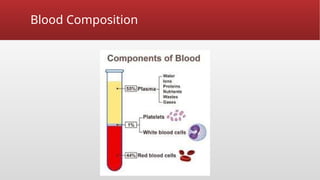
Blood is a specialized body fluid. It has four main components: plasma, red blood
cells, white blood cells, and platelets. Blood has many different functions, including:
▪ Transporting oxygen and nutrients to the lungs and tissues
▪ Forming blood clots to prevent excess blood loss
▪ Carrying cells and antibodies that fight infection
▪ Bringing waste products to the kidneys and liver, which filter and clean the blood
▪ Regulating body temperature
The blood that runs through the veins, arteries, and capillaries is known as whole
blood, a mixture of about 55 percent plasma and 45 percent blood cells. About 7 to
8 percent of your total body weight is blood. An average-sized man has about 12
pints of blood in his body, and an average-sized woman has about nine pints.
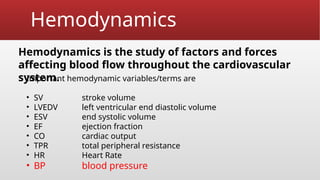
Hemodynamics
Hemodynamics is the study of factors and forces
affecting blood flow throughout the cardiovascular
system.
Important hemodynamic variables/terms are
• SV stroke volume
• LVEDV left ventricular end diastolic volume
• ESV end systolic volume
• EF ejection fraction
• CO cardiac output
• TPR total peripheral resistance
• HR Heart Rate
• BP blood pressure
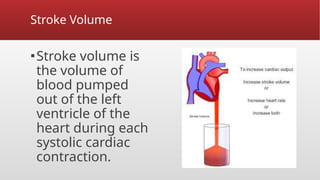
Stroke Volume
▪Stroke volume is
the volume of
blood pumped
out of the left
ventricle of the
heart during each
systolic cardiac
contraction.
Preload and Afterload
Preload
is the filling pressure in the heart ventricles at the end of the
relaxation phase of the diastole. Clinically, preload is synonymous
with ‘end diastolic pressure (EDP)’. leads to ventricular wall tension
at the end of the diastole is caused by
• venous return (rate, pressure and volume)
• distensibility of the ventricular wall
Afterload
is the force the ventricle must overcome to eject its contents. is
caused by
• peripheral resistance in the arteries
Ejection Fraction
• When the left ventricle contracts, forcing blood out into the body,
it's called "ejection“
• The "fraction" part is because that pumping chamber (the left
ventricle) never quite manages to pump out all the blood inside
it - there's always a little bit left behind that lies around waiting
for the next contraction
• The amount your left ventricle does pump out per beat is called
the "ejection fraction".
Heart Rate
• Heart Rate is the number of cardiac cycles per minute.
• Number of beats per minute
• Number of contraction per minute
• It is influenced by factors like sympathetic activity, physical
exercise, emotional stress, hormones, pathological conditions
(e.g., fever, hypoxia), drug effects (e.g., atropine).
• Oxygen Demand: Adjusting Factors
• Units = bpm
Cardiac Output
• Cardiac output (CO) is the amount of blood pumped by the heart
minute and is the mechanism whereby blood flows around the
body, especially providing blood flow to the brain and other vital
organs.
Cardiac Output
CO = Stroke Volume x Heart
Rate
Total Peripheral Resistance
• Total peripheral resistance is defined and measured in terms of the
force required to maintain blood flow from the root of the aorta
to the venous exit into the auricles.
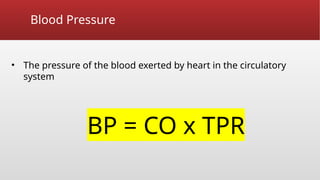
Blood Pressure
• The pressure of the blood exerted by heart in the circulatory
system
BP = CO x TPR
Conclusion
Break

System Anatomy Physiology - Beginners education

  • 1.
  • 2.
    Content ▪ Body System ▪Cardiovascular System ▪ Vascular System ▪ Blood ▪ Hemodynamic
  • 3.
    Body Systems ▪The humanbody can be categorized into different systems based on their functions and structures. The major systems of the human body include:
  • 4.
    Respirator y System Responsible forthe intake of oxygen and elimination of carbon dioxide.
  • 5.
    Digestive System Responsible for the breakdownof food and absorption of nutrients.
  • 6.
  • 7.
  • 8.
    Musculoskelet al System Responsible forproviding movement and support to the body
  • 9.
    Urinary System Responsible for filtering andeliminating waste products from the body.
  • 10.
  • 11.
    CARDIOVASCULAR SYSTEM The cardiovascularsystem, also known as the circulatory system, includes the ▪ Heart ▪ Arteries ▪ Veins ▪ Capillaries ▪ Blood. The heart functions as the pump that moves blood through the body.
  • 12.
    CARDIOVASCULAR SYSTEM The mainComponents of heart are: ▪ Heart ▪ Blood ▪ Vessels
  • 13.
  • 14.
    HEART ANATOMY Heart isdivided into four chambers. Two chambers on the top (atrium, plural atria) Two on the bottom (ventricles), one on each side of the heart.
  • 15.
    HEART CHAMBERs Heart isdivided into four chambers. You have two chambers on the top (atrium, plural atria) and two on the bottom (ventricles), one on each side of the heart. • Right atrium: Two large veins deliver oxygen-poor blood to your right atrium. The superior vena cava carries blood from your upper body. The inferior vena cava brings blood from the lower body. Then the right atrium pumps the blood to your right ventricle. • Right ventricle: The lower right chamber pumps the oxygen-poor blood to your lungs through the pulmonary artery. The lungs reload blood with oxygen. • Left atrium: After the lungs fill blood with oxygen, the pulmonary veins carry the blood to the left atrium. This upper chamber pumps the blood to your left ventricle. • Left ventricle: The left ventricle is slightly larger than the right. It pumps oxygen- rich blood to the rest of your body.
  • 16.
    HEART Valves Heart valvesare like doors between your heart chambers. They open and close to allow blood to flow through. ▪ The atrioventricular (AV) valves open between your upper and lower heart chambers. They include: • Tricuspid valve: Door between your right atrium and right ventricle. • Mitral valve: Door between your left atrium and left ventricle. ▪ Semilunar (SL) valves open when blood flows out of your ventricles. They include: • Aortic valve: Opens when blood flows out of your left ventricle to your aorta (artery that carries oxygen-rich blood to your body). • Pulmonary valve: Opens when blood flows from your right ventricle to your pulmonary arteries (the only arteries that carry oxygen-poor blood to your lungs).
  • 17.
  • 18.
  • 19.
  • 20.
  • 21.
    FACTS ▪ Heart weighsabout 10.5 ounces (300 grams) ▪ contracts more than 100,000 times a day to drive blood through about 60,000 miles (96,000 kilometers) of vessels to nourish each of the trillions of cells in the body ▪ Each contraction of the heart forces about 2.5 ounces (74 milliliters) of blood into the bloodstream ▪ Adds up to about 10 pints (4.7 liters) of blood every minute ▪ Average heart will pump about 1,800 gallons (6,800 liters) of blood each day ▪ That amount may increase as much as six times ▪ In an average lifetime, the heart will pump about 100 million gallons (380 million liters) of blood.
  • 22.
  • 23.
    Vascular System The vascularsystem, also called the circulatory system, is made up of the vessels that carry blood and lymph through the body. The arteries and veins carry blood throughout the body, delivering oxygen and nutrients to the body tissues and taking away tissue waste matter.
  • 24.
  • 25.
    Blood Vessels Types Fivetypes of blood vessels as following 1.Arteries: Transport High-Blood pressure blood from the heart to smaller arteries and arterioles 2.Arterioles: Connect Arteries and capillaries 3.Veins: Act as reservoir of blood and transport low-pressure blood from venules to heart 4.Venules: Connects capillaries and veins 5.Capillaries: Allows gas exchange, nutrients transfer and waster removal between blood and tissue fluids
  • 26.
    Layers of Vessels ▪Blood vessels, except the smallest ones, are made of three layers i.e. ▪ Tunica interna The tunica interna (innermost layer) is a single layer of squamous (flat) epithelial cells called the endothelium ▪ Tunica media ▪ The tunica media (middle layer) takes up most of the arterial vessel wall and is composed of smooth muscle fibers and elastin ▪ Tunica externa ▪ The tunica externa (outer layer) consists mainly of connective tissue fibres that protect the blood vessels and attach them to any surrounding tissues
  • 27.
  • 28.
  • 29.
    Blood ▪Blood is afluid that flows through our body, delivering oxygen and nutrients to our organs and tissues, while removing waste products. It is made up of cells and a liquid called plasma, which contains important substances needed for our body's functioning.
  • 30.
    Blood Function ▪ Transportation ▪Regulation ▪ Defense ▪ 4-6 liters depending on size 8% of body mass
  • 31.
  • 32.
    Blood Composition Blood isa specialized body fluid. It has four main components: plasma, red blood cells, white blood cells, and platelets. Blood has many different functions, including: ▪ Transporting oxygen and nutrients to the lungs and tissues ▪ Forming blood clots to prevent excess blood loss ▪ Carrying cells and antibodies that fight infection ▪ Bringing waste products to the kidneys and liver, which filter and clean the blood ▪ Regulating body temperature The blood that runs through the veins, arteries, and capillaries is known as whole blood, a mixture of about 55 percent plasma and 45 percent blood cells. About 7 to 8 percent of your total body weight is blood. An average-sized man has about 12 pints of blood in his body, and an average-sized woman has about nine pints.
  • 33.
    Hemodynamics Hemodynamics is thestudy of factors and forces affecting blood flow throughout the cardiovascular system. Important hemodynamic variables/terms are • SV stroke volume • LVEDV left ventricular end diastolic volume • ESV end systolic volume • EF ejection fraction • CO cardiac output • TPR total peripheral resistance • HR Heart Rate • BP blood pressure
  • 34.
    Stroke Volume ▪Stroke volumeis the volume of blood pumped out of the left ventricle of the heart during each systolic cardiac contraction.
  • 35.
    Preload and Afterload Preload isthe filling pressure in the heart ventricles at the end of the relaxation phase of the diastole. Clinically, preload is synonymous with ‘end diastolic pressure (EDP)’. leads to ventricular wall tension at the end of the diastole is caused by • venous return (rate, pressure and volume) • distensibility of the ventricular wall Afterload is the force the ventricle must overcome to eject its contents. is caused by • peripheral resistance in the arteries
  • 36.
    Ejection Fraction • Whenthe left ventricle contracts, forcing blood out into the body, it's called "ejection“ • The "fraction" part is because that pumping chamber (the left ventricle) never quite manages to pump out all the blood inside it - there's always a little bit left behind that lies around waiting for the next contraction • The amount your left ventricle does pump out per beat is called the "ejection fraction".
  • 37.
    Heart Rate • HeartRate is the number of cardiac cycles per minute. • Number of beats per minute • Number of contraction per minute • It is influenced by factors like sympathetic activity, physical exercise, emotional stress, hormones, pathological conditions (e.g., fever, hypoxia), drug effects (e.g., atropine). • Oxygen Demand: Adjusting Factors • Units = bpm
  • 38.
    Cardiac Output • Cardiacoutput (CO) is the amount of blood pumped by the heart minute and is the mechanism whereby blood flows around the body, especially providing blood flow to the brain and other vital organs. Cardiac Output CO = Stroke Volume x Heart Rate
  • 39.
    Total Peripheral Resistance •Total peripheral resistance is defined and measured in terms of the force required to maintain blood flow from the root of the aorta to the venous exit into the auricles.
  • 40.
    Blood Pressure • Thepressure of the blood exerted by heart in the circulatory system BP = CO x TPR
  • 41.
  • 42.