Syringe Driver
Aims of Session
To provide an understanding of the Syringe
Driver
Advantages and Disadvantages
When it should be used
Medication Regimes
What is a Syringe Driver/Pump
 A portable Battery-operated infusion pump for
administering medication.
 Used to deliver medicines at a predetermined
rate via the appropriate parenteral route (e.g.
subcutaneous)
 Suitable for both symptom management and
palliative care – not just used at end of life!
T34 McKinley Syringe Pump
• What is a syringe driver?
McKinley T34 Syringe Pump
in the community will be in
a locked box
When to use a Syringe Pump
Where oral route is not possible or is inappropriate:
• Dysphagia.
• Unable to take medicines orally e.g. due to oral
cancers.
• Loss of or altered level of consciousness.
means oral route not possible.
• Intractable nausea and vomiting which has not
responded to oral/rectal anti emetics.
• Intestinal obstruction.
• Malabsorption.
• Terminal agitation.
Benefits of using a Syringe Pump
 Oral route is preferred route.
 Where parenteral administration is necessary, the
subcutaneous route should be used where possible
in advanced disease because:
• Intravenous (IV) route is invasive and not
necessarily any more effective than
Subcutaneous (SC) route.
• Intramuscular (IM) injections can be painful,
particularly in the cachectic patient.
Benefits of using a Syringe Pump
 Drug administered continuously over 24 hours
which avoids the “peaks and troughs” of drug
delivery and thus maintains consistent control of
symptoms.
 More than one drug can be given at the same
time.
 Medication can be administered if impaired
Gastric Intestinal absorption is suspected
Benefits of using a Syringe Pump
 Patient’s well-being - reduced requirement for
repeated injections
 Allows mobility and independence for those
not at the end of life
 Assists with compliance
Disadvantages of using a Syringe Pumps
 Medicine requirements must be anticipated for a
24hour period and may result in loss of flexibility
of dosing
 May require PRN medications at initial set up
whilst waiting for medications to reach peak
plasma concentration
 Local reactions such as pain, inflammation or
infection can cause discomfort +/- interfere with
delivery of medication
Disadvantages of using a Syringe Pump
 Risks associated with additional steps in
administration process
 Patients may view syringe driver as the final step
before death
 Patients may find it obtrusive/disconcerting
 Initial cost of infusion devices
 Training of staff, together with need to maintain
competency
When to start a Syringe Pump in Relation
to Symptoms
 If symptoms are controlled, start the continuous
subcutaneous infusion (CSCI) 1–2h before the
effect of the medication is due to wear off.
 This means if a patch is in-situ you should titrate
the dose up by leaving the patch on.
 If symptoms are uncontrolled, set up the CSCI
immediately with stat doses of the same drugs.
Medicines commonly used in Syringe Pumps
 Pain – Opioids e.g. Morphine; Diamorphine;
Oxycodone (Second line if unable to tolerate side
effects of diamorphine or morphine); Alfentanil
(Alternative CSCI delivered opioid for patients
unable to tolerate morphine/diamorphine e.g. In
renal failure.)
 Anxiety & Agitation - Levomepromazine,
Midazolam, Haloperidol
 Respiratory Secretions - Glycopyrronium,
Hyoscine Hydrobromide, Hyoscine Butyl Bromide
Medicines commonly used in Syringe Pumps
 Nausea & Vomiting – Haloperidol,
Levomepromazine, Metoclopramide,
Cyclizine
 Anti-spasmodic/intestinal colic – Hyoscine
Butyl bromide
 Breathlessness – Opioids e.g. Morphine,
Diamorphine, Midazolam
Diluents used in Syringe Pumps
 Water for Injection is widely used as the first-line
diluent – less chance of incompatibility.
 0.9% saline should be considered if there is a
potential or actual problem with inflammatory
reactions at the skin injection site e.g with
levomepromazine (but watch out for
incompatibilities).
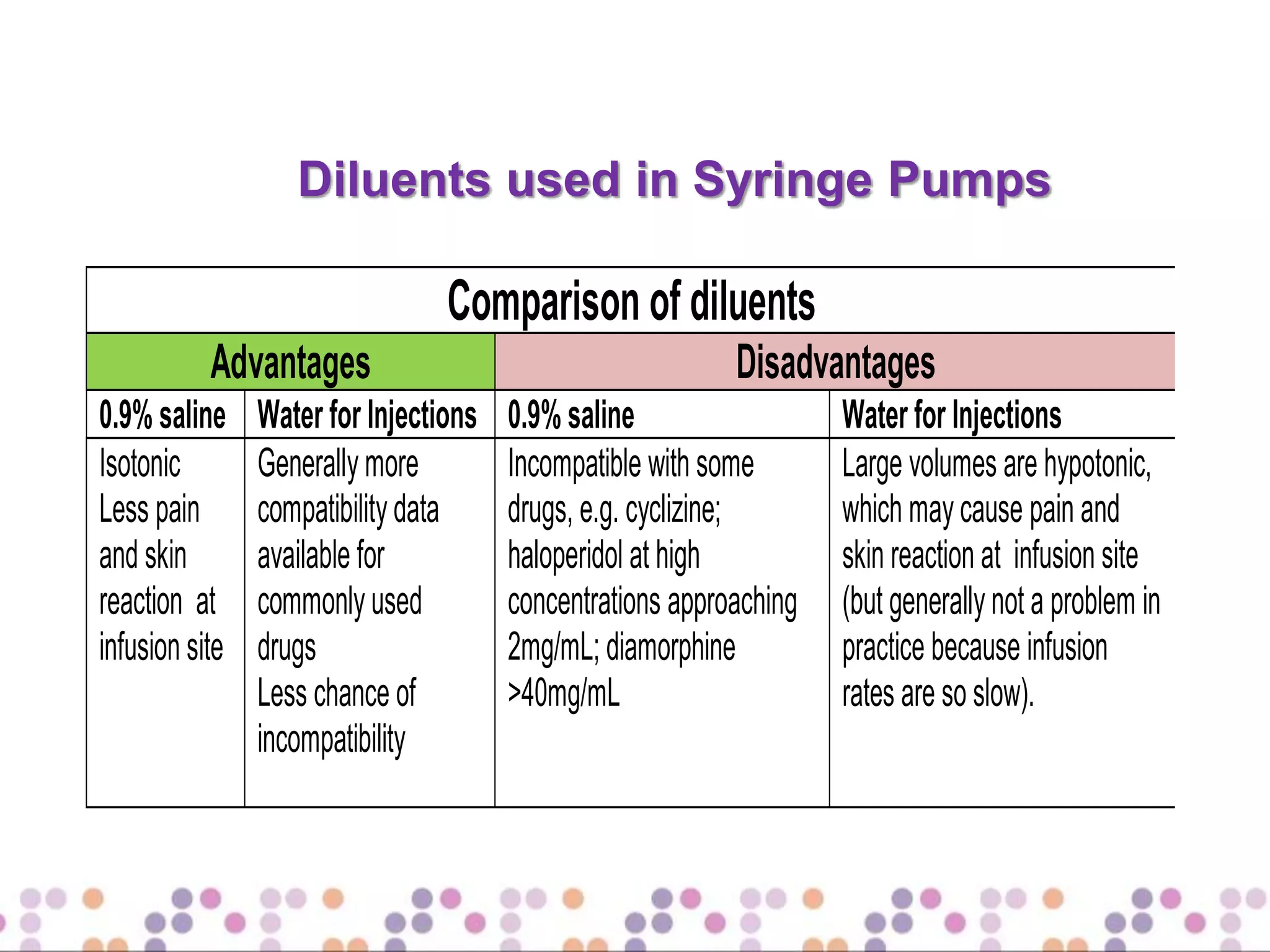
Diluents used in Syringe Pumps
Comparison of diluents
Advantages Disadvantages
0.9% saline Water for Injections 0.9% saline Water for Injections
Isotonic
Less pain
and skin
reaction at
infusion site
Generally more
compatibility data
available for
commonly used
drugs
Less chance of
incompatibility
Incompatible with some
drugs, e.g. cyclizine;
haloperidol at high
concentrations approaching
2mg/mL; diamorphine
>40mg/mL
Large volumes are hypotonic,
which may cause pain and
skin reaction at infusion site
(but generally not a problem in
practice because infusion
rates are so slow).
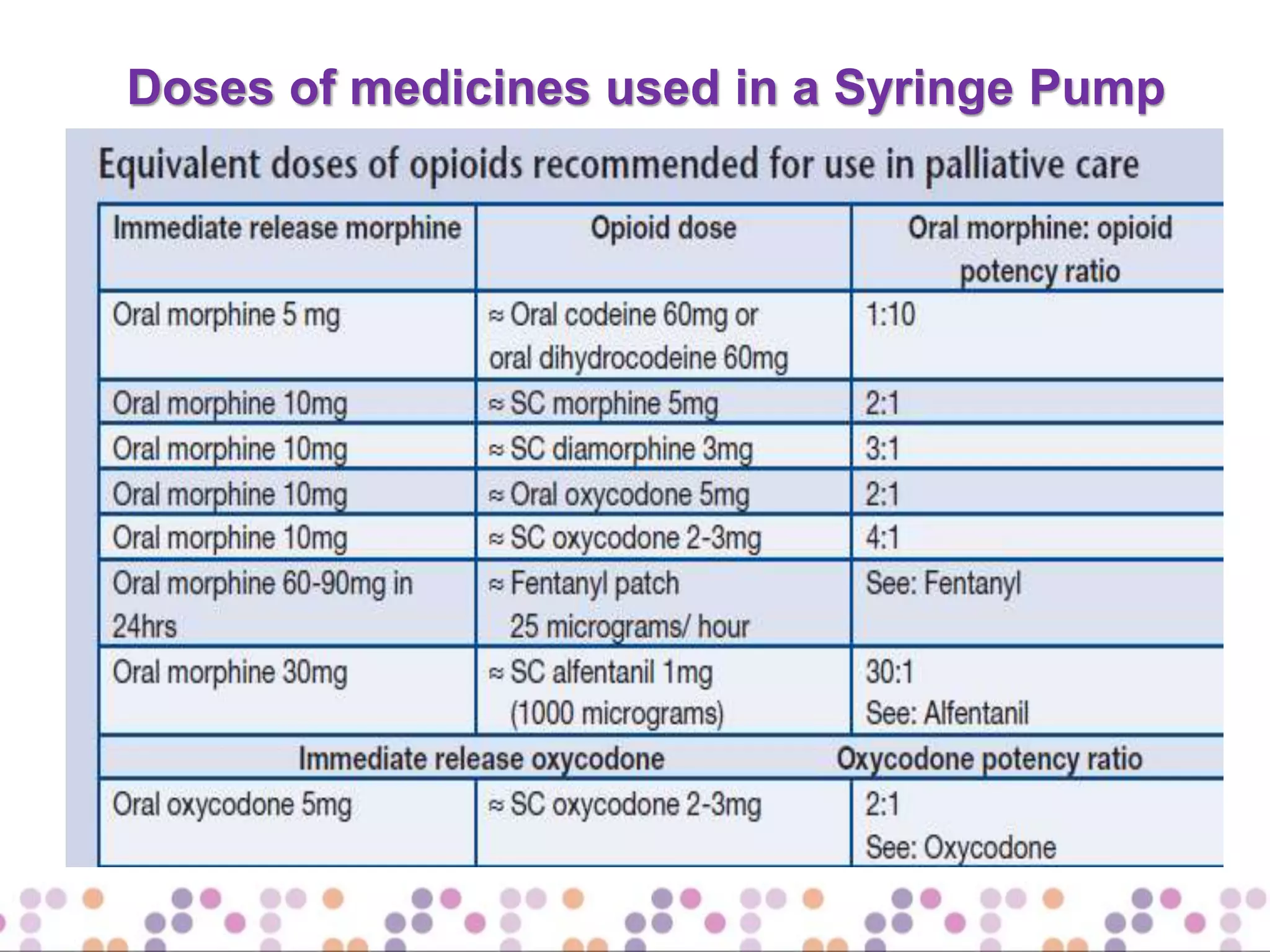
Doses of medicines used in a Syringe Pump
There are no set doses for palliative care – many medicines
are used outside of their Marketing Authorisation, and doses
may be higher than encountered in non-palliative medicine.
Doses should be titrated according to individual need.
For pain, breakthrough doses are calculated as 1/6th of the
total 24 hour opioid dose.
Dose conversions – will vary depending on source – if unsure
refer to local/national guidelines or take advice.
Doses of medicines used in a Syringe Pump
(Refer to local guidelines)
All doses are over 24 hours via CSCI
PAIN
Morphine – if opioid naïve – 5-10mg to start
Diamorphine - if opioid naïve – 2.5-5mg to start
Oxycodone – if opioid naïve 7.5mg over 24
Alfentanil – used only under specialist advice – 1st line for
renal failure
Dose increases normally not more than 30 to 50% of
previous dose
Use dose conversion tables if changing opioid or same
opioid, different route
Mixing Medicines and Incompatibilities
 Common for 2 or 3 medicines to be mixed in a
syringe driver.
 Need to check for ‘compatibility’ – chemical
reactions between drugs resulting in altered
composition, which may be therapeutically inactive
or toxic.
 Drugs said to be physically compatible if mixing
does not result in a physical change, e.g.
discoloration, clouding or crystallization. Can be
chemically incompatible (i.e. mixing results in loss or
degradation of one of the drugs).
Mixing Medicines and Incompatibilities
 Charts available for drug compatibility – “Palliative Care
Formulary” https://about.medicinescomplete.com/
 Palliative Care Adult Network Guidelines:
http://book.pallcare.info/index.php
Common incompatible drugs:
• Diamorphine & Cyclizine or haloperidol at higher
concentrations
• Levomepromazine and dexamethasone
• Oxycodone & Cyclizine
• Diamorphine, Dexamethasone and Levomepromazine
Mixing Medicines and Incompatibilities
Diluents and incompatibility with drugs:
Mixing of medicines leads not only to possible
incompatibilities, but also renders the drug mixture
unlicensed.
Doctors and other independent prescribers (nurse,
paramedic and pharmacist) can mix, and direct others to
mix, drugs for administration to a particular patient.
Supplementary prescribers can mix and direct others to
mix when part of a Clinical Management Plan.
Where to find information
• BNF – a bit on dose equivalents and compatibilities.
• Internet – be careful to use recognised sites – some
good ones:
• NHS Scotland Palliative Care Guidelines
www.palliativecareguidelines.scot.nhs.uk
• Palliative Care Formulary www.palliativedrugs.com
• https://about.medicinescomplete.com/
• Palliative Care Adult Network Guidelines:
http://book.pallcare.info/index.php
Volumes
Factors influencing the volume of the CSCI include the infusion device
being used, the total volume of the drugs, the maximum rate of delivery,
the intended infusion time.
Greater dilution reduces:
• risk of incompatibility
• impact of priming an extension set (less drug in the ‘dead space’)
• injection site skin reactions from the drug.
Make up to a standard volume
• 20ml syringe – 17ml
• 30ml syringe – 22ml
• 50ml syringe – 34ml (the maximum volume/24h that infusion device can
deliver.
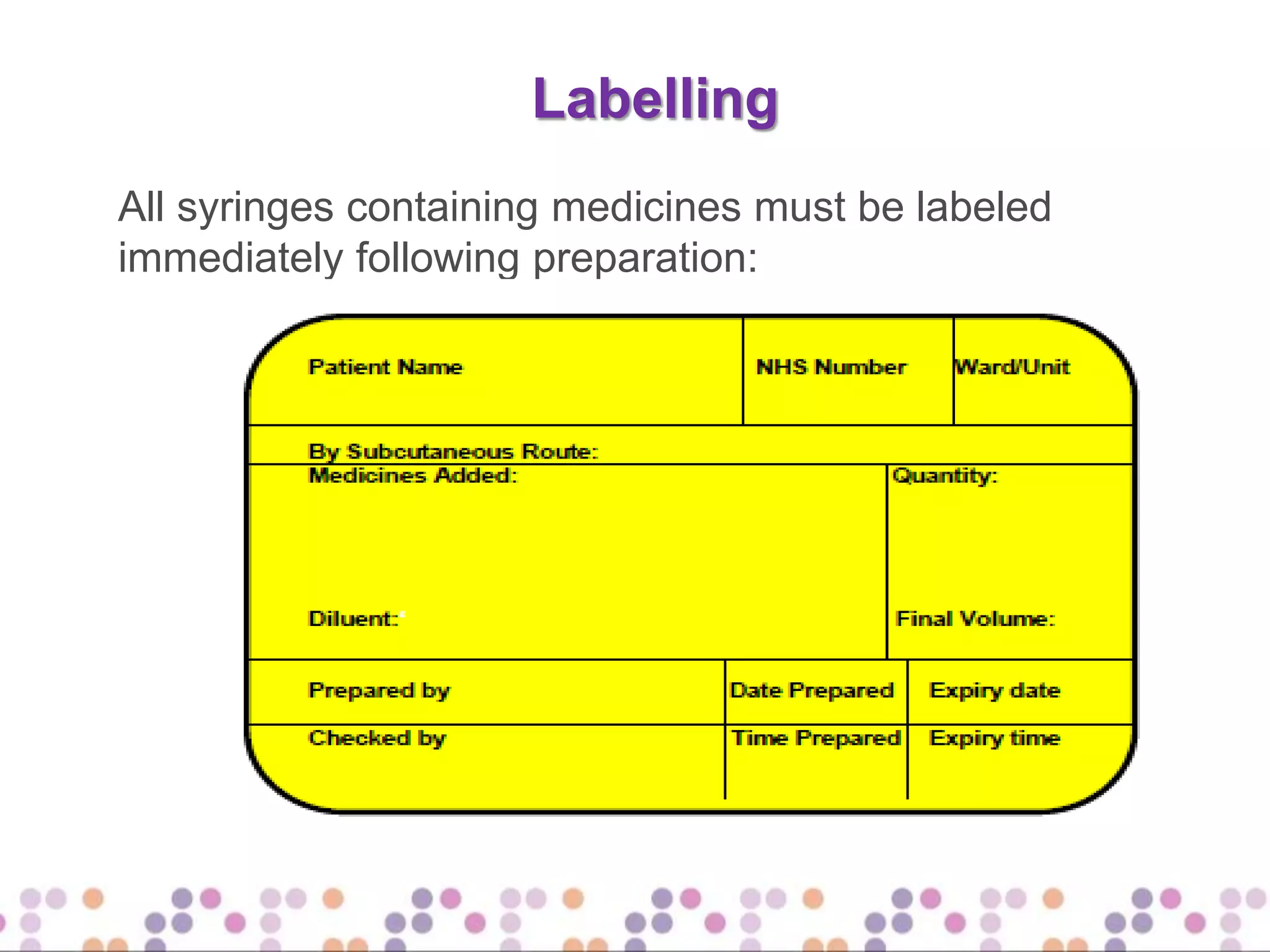
Labelling
All syringes containing medicines must be labeled
immediately following preparation:
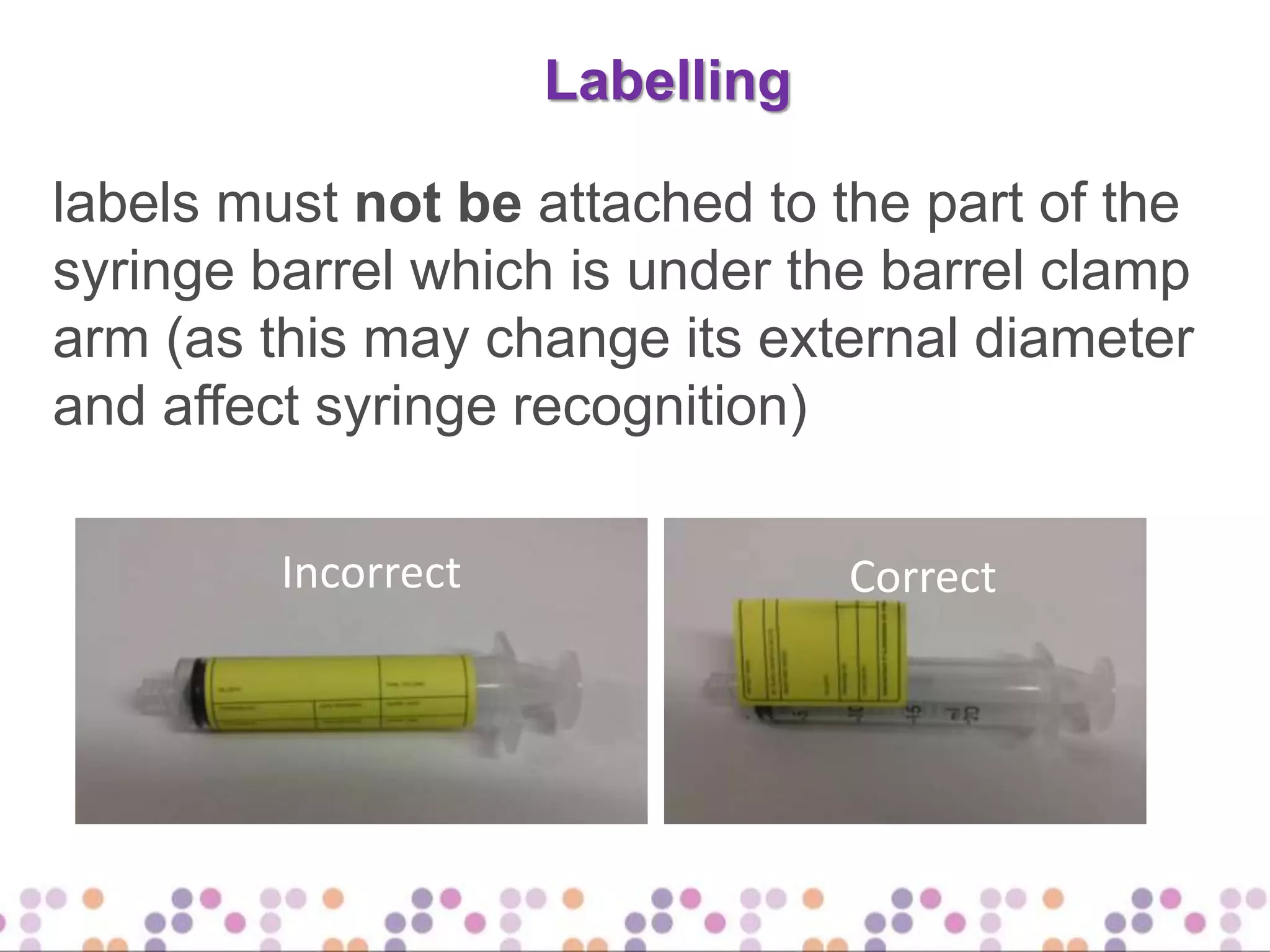
Labelling
labels must not be attached to the part of the
syringe barrel which is under the barrel clamp
arm (as this may change its external diameter
and affect syringe recognition)
Incorrect Correct
Questions

Syringe Driver PW.pptx

  • 1.
    Syringe Driver Aims ofSession To provide an understanding of the Syringe Driver Advantages and Disadvantages When it should be used Medication Regimes
  • 2.
    What is aSyringe Driver/Pump  A portable Battery-operated infusion pump for administering medication.  Used to deliver medicines at a predetermined rate via the appropriate parenteral route (e.g. subcutaneous)  Suitable for both symptom management and palliative care – not just used at end of life!
  • 3.
    T34 McKinley SyringePump • What is a syringe driver?
  • 4.
    McKinley T34 SyringePump in the community will be in a locked box
  • 5.
    When to usea Syringe Pump Where oral route is not possible or is inappropriate: • Dysphagia. • Unable to take medicines orally e.g. due to oral cancers. • Loss of or altered level of consciousness. means oral route not possible. • Intractable nausea and vomiting which has not responded to oral/rectal anti emetics. • Intestinal obstruction. • Malabsorption. • Terminal agitation.
  • 6.
    Benefits of usinga Syringe Pump  Oral route is preferred route.  Where parenteral administration is necessary, the subcutaneous route should be used where possible in advanced disease because: • Intravenous (IV) route is invasive and not necessarily any more effective than Subcutaneous (SC) route. • Intramuscular (IM) injections can be painful, particularly in the cachectic patient.
  • 7.
    Benefits of usinga Syringe Pump  Drug administered continuously over 24 hours which avoids the “peaks and troughs” of drug delivery and thus maintains consistent control of symptoms.  More than one drug can be given at the same time.  Medication can be administered if impaired Gastric Intestinal absorption is suspected
  • 8.
    Benefits of usinga Syringe Pump  Patient’s well-being - reduced requirement for repeated injections  Allows mobility and independence for those not at the end of life  Assists with compliance
  • 9.
    Disadvantages of usinga Syringe Pumps  Medicine requirements must be anticipated for a 24hour period and may result in loss of flexibility of dosing  May require PRN medications at initial set up whilst waiting for medications to reach peak plasma concentration  Local reactions such as pain, inflammation or infection can cause discomfort +/- interfere with delivery of medication
  • 10.
    Disadvantages of usinga Syringe Pump  Risks associated with additional steps in administration process  Patients may view syringe driver as the final step before death  Patients may find it obtrusive/disconcerting  Initial cost of infusion devices  Training of staff, together with need to maintain competency
  • 11.
    When to starta Syringe Pump in Relation to Symptoms  If symptoms are controlled, start the continuous subcutaneous infusion (CSCI) 1–2h before the effect of the medication is due to wear off.  This means if a patch is in-situ you should titrate the dose up by leaving the patch on.  If symptoms are uncontrolled, set up the CSCI immediately with stat doses of the same drugs.
  • 12.
    Medicines commonly usedin Syringe Pumps  Pain – Opioids e.g. Morphine; Diamorphine; Oxycodone (Second line if unable to tolerate side effects of diamorphine or morphine); Alfentanil (Alternative CSCI delivered opioid for patients unable to tolerate morphine/diamorphine e.g. In renal failure.)  Anxiety & Agitation - Levomepromazine, Midazolam, Haloperidol  Respiratory Secretions - Glycopyrronium, Hyoscine Hydrobromide, Hyoscine Butyl Bromide
  • 13.
    Medicines commonly usedin Syringe Pumps  Nausea & Vomiting – Haloperidol, Levomepromazine, Metoclopramide, Cyclizine  Anti-spasmodic/intestinal colic – Hyoscine Butyl bromide  Breathlessness – Opioids e.g. Morphine, Diamorphine, Midazolam
  • 14.
    Diluents used inSyringe Pumps  Water for Injection is widely used as the first-line diluent – less chance of incompatibility.  0.9% saline should be considered if there is a potential or actual problem with inflammatory reactions at the skin injection site e.g with levomepromazine (but watch out for incompatibilities).
  • 15.
    Diluents used inSyringe Pumps Comparison of diluents Advantages Disadvantages 0.9% saline Water for Injections 0.9% saline Water for Injections Isotonic Less pain and skin reaction at infusion site Generally more compatibility data available for commonly used drugs Less chance of incompatibility Incompatible with some drugs, e.g. cyclizine; haloperidol at high concentrations approaching 2mg/mL; diamorphine >40mg/mL Large volumes are hypotonic, which may cause pain and skin reaction at infusion site (but generally not a problem in practice because infusion rates are so slow).
  • 16.
    Doses of medicinesused in a Syringe Pump There are no set doses for palliative care – many medicines are used outside of their Marketing Authorisation, and doses may be higher than encountered in non-palliative medicine. Doses should be titrated according to individual need. For pain, breakthrough doses are calculated as 1/6th of the total 24 hour opioid dose. Dose conversions – will vary depending on source – if unsure refer to local/national guidelines or take advice.
  • 18.
    Doses of medicinesused in a Syringe Pump
  • 19.
    Doses of medicinesused in a Syringe Pump (Refer to local guidelines) All doses are over 24 hours via CSCI PAIN Morphine – if opioid naïve – 5-10mg to start Diamorphine - if opioid naïve – 2.5-5mg to start Oxycodone – if opioid naïve 7.5mg over 24 Alfentanil – used only under specialist advice – 1st line for renal failure Dose increases normally not more than 30 to 50% of previous dose Use dose conversion tables if changing opioid or same opioid, different route
  • 20.
    Mixing Medicines andIncompatibilities  Common for 2 or 3 medicines to be mixed in a syringe driver.  Need to check for ‘compatibility’ – chemical reactions between drugs resulting in altered composition, which may be therapeutically inactive or toxic.  Drugs said to be physically compatible if mixing does not result in a physical change, e.g. discoloration, clouding or crystallization. Can be chemically incompatible (i.e. mixing results in loss or degradation of one of the drugs).
  • 21.
    Mixing Medicines andIncompatibilities  Charts available for drug compatibility – “Palliative Care Formulary” https://about.medicinescomplete.com/  Palliative Care Adult Network Guidelines: http://book.pallcare.info/index.php Common incompatible drugs: • Diamorphine & Cyclizine or haloperidol at higher concentrations • Levomepromazine and dexamethasone • Oxycodone & Cyclizine • Diamorphine, Dexamethasone and Levomepromazine
  • 22.
    Mixing Medicines andIncompatibilities Diluents and incompatibility with drugs: Mixing of medicines leads not only to possible incompatibilities, but also renders the drug mixture unlicensed. Doctors and other independent prescribers (nurse, paramedic and pharmacist) can mix, and direct others to mix, drugs for administration to a particular patient. Supplementary prescribers can mix and direct others to mix when part of a Clinical Management Plan.
  • 23.
    Where to findinformation • BNF – a bit on dose equivalents and compatibilities. • Internet – be careful to use recognised sites – some good ones: • NHS Scotland Palliative Care Guidelines www.palliativecareguidelines.scot.nhs.uk • Palliative Care Formulary www.palliativedrugs.com • https://about.medicinescomplete.com/ • Palliative Care Adult Network Guidelines: http://book.pallcare.info/index.php
  • 24.
    Volumes Factors influencing thevolume of the CSCI include the infusion device being used, the total volume of the drugs, the maximum rate of delivery, the intended infusion time. Greater dilution reduces: • risk of incompatibility • impact of priming an extension set (less drug in the ‘dead space’) • injection site skin reactions from the drug. Make up to a standard volume • 20ml syringe – 17ml • 30ml syringe – 22ml • 50ml syringe – 34ml (the maximum volume/24h that infusion device can deliver.
  • 25.
    Labelling All syringes containingmedicines must be labeled immediately following preparation:
  • 26.
    Labelling labels must notbe attached to the part of the syringe barrel which is under the barrel clamp arm (as this may change its external diameter and affect syringe recognition) Incorrect Correct
  • 27.