


Synthesizing API Usage Examples


Ray Buse   Wes Weimer               ICSE 2012
                           Zurich, Switzerland

                                                 2
Java
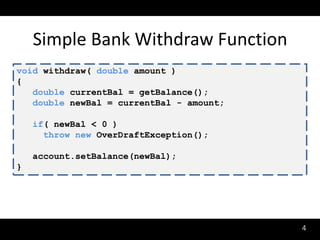
Simple Bank Withdraw Function
void withdraw( double amount )
{
   double currentBal = getBalance();
   double newBal = currentBal - amount;

    if( newBal < 0 )
      throw new OverDraftException();

    account.setBalance(newBal);
}


                                          4
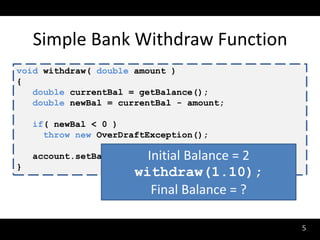
Simple Bank Withdraw Function
void withdraw( double amount )
{
   double currentBal = getBalance();
   double newBal = currentBal - amount;

    if( newBal < 0 )
      throw new OverDraftException();

                          Initial
    account.setBalance(newBal); Balance = 2
}
                        withdraw(1.10);
                          Final Balance = ?

                                              5
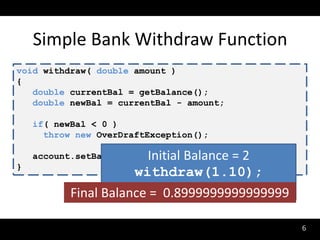
Simple Bank Withdraw Function
void withdraw( double amount )
{
   double currentBal = getBalance();
   double newBal = currentBal - amount;

    if( newBal < 0 )
      throw new OverDraftException();

                          Initial
    account.setBalance(newBal);Balance = 2
}
                      withdraw(1.10);
                         Final Balance = ?
           Final Balance = 0.8999999999999999

                                                6
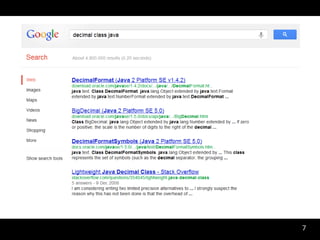
7
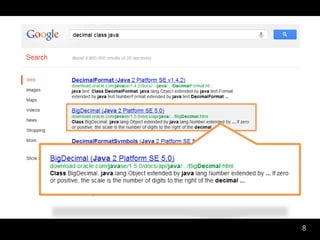
8
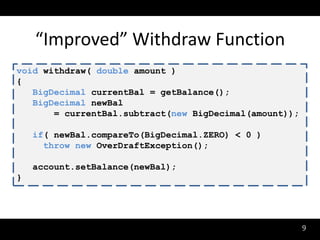
“Improved” Withdraw Function
void withdraw( double amount )
{
   BigDecimal currentBal = getBalance();
   BigDecimal newBal
       = currentBal.subtract(new BigDecimal(amount));

    if( newBal.compareTo(BigDecimal.ZERO) < 0 )
      throw new OverDraftException();

    account.setBalance(newBal);
}


                                                        9
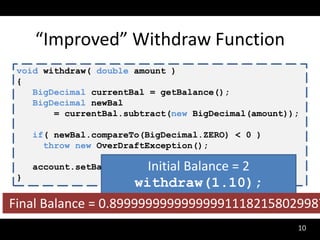
“Improved” Withdraw Function
 void withdraw( double amount )
 {
    BigDecimal currentBal = getBalance();
    BigDecimal newBal
        = currentBal.subtract(new BigDecimal(amount));

    if( newBal.compareTo(BigDecimal.ZERO) < 0 )
      throw new OverDraftException();

                          Initial
                              Balance = 2
    account.setBalance(newBal);
 }
                      withdraw(1.10);
                        Final Balance = ?
Final Balance = 0.899999999999999911182158029987
                                                     10
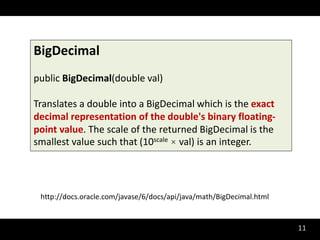
BigDecimal
public BigDecimal(double val)

Translates a double into a BigDecimal which is the exact
decimal representation of the double's binary floating-
point value. The scale of the returned BigDecimal is the
smallest value such that (10scale × val) is an integer.


 http://docs.oracle.com/javase/6/docs/api/java/math/BigDecimal.html


                                                                      11
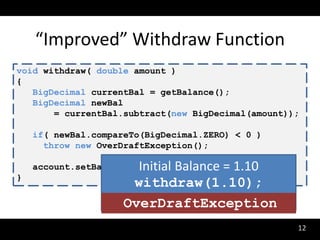
“Improved” Withdraw Function
void withdraw( double amount )
{
   BigDecimal currentBal = getBalance();
   BigDecimal newBal
       = currentBal.subtract(new BigDecimal(amount));

    if( newBal.compareTo(BigDecimal.ZERO) < 0 )
      throw new OverDraftException();

                        Initial Balance
    account.setBalance(newBal);      = 1.10
}
                      withdraw(1.10);
                        Final Balance = ?
                     OverDraftException
                                                    12
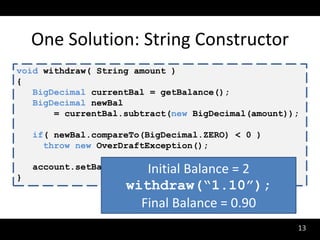
One Solution: String Constructor
void withdraw( String amount )
{
   BigDecimal currentBal = getBalance();
   BigDecimal newBal
       = currentBal.subtract(new BigDecimal(amount));

    if( newBal.compareTo(BigDecimal.ZERO) < 0 )
      throw new OverDraftException();

    account.setBalance(newBal);
                          Initial
                                Balance = 2
}
                      withdraw(“1.10”);
                        Final Balance = 0.90
                                                    13
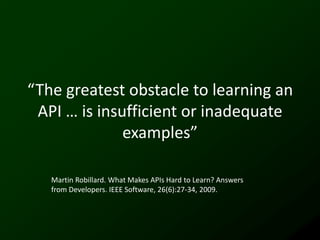
“The greatest obstacle to learning an
 API … is insufficient or inadequate
              examples”

   Martin Robillard. What Makes APIs Hard to Learn? Answers
   from Developers. IEEE Software, 26(6):27-34, 2009.
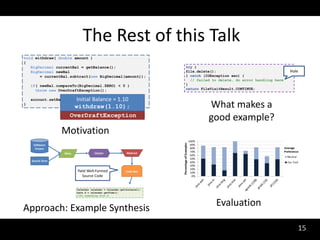
The Rest of this Talk


                              What makes a
                              good example?
        Motivation


Approach: Example Synthesis    Evaluation

                                              15
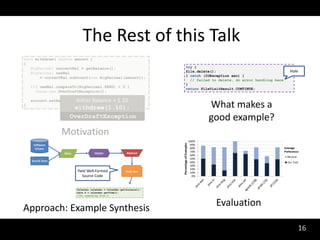
The Rest of this Talk


                              What makes a
                              good example?


Approach: Example Synthesis    Evaluation

                                              16
What makes a good example?
Some Common Sources of Examples


                                  18
Research Tools
• MAPO
  – H. Zhong, T. Xie, L. Zhang, J. Pei, and H. Mei,
    “MAPO: Mining and recommending API usage
    patterns,” in European Conference on Object-
    Oriented Programming, 2009.
• eXoaDocs
  – J. Kim, S. Lee, S. Hwang, and S. Kim, “Towards an
    intelligent code search engine,” in AAAI
    Conference on Artificial Intelligence, 2010.

                                                        19
Research Tools
• MAPO
  – H. Zhong, T. Xie, L. Zhang, J. Pei, and H. Mei,
    “MAPO: Mining and recommending API usage
    patterns,” in European Conference on Object-
    Oriented Programming, 2009.
• eXoaDocs
  – J. Kim, S. Lee, S. Hwang, and S. Kim, “Towards an
    intelligent code search engine,” in AAAI
    Conference on Artificial Intelligence, 2010.

                                                        20
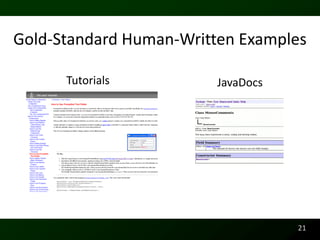
Gold-Standard Human-Written Examples

      Tutorials          JavaDocs


                                    21
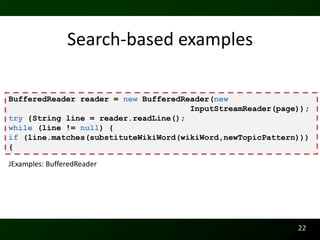
Search-based examples

BufferedReader reader = new BufferedReader(new
                                      InputStreamReader(page));
try {String line = reader.readLine();
while (line != null) {
if (line.matches(substituteWikiWord(wikiWord,newTopicPattern)))
{

JExamples: BufferedReader


                                                            22
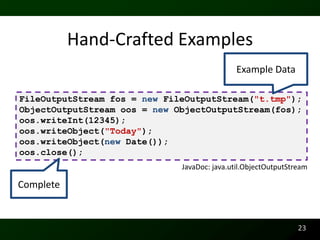
Hand-Crafted Examples
                                              Example Data

FileOutputStream fos = new FileOutputStream("t.tmp");
ObjectOutputStream oos = new ObjectOutputStream(fos);
oos.writeInt(12345);
oos.writeObject("Today");
oos.writeObject(new Date());
oos.close();
                              JavaDoc: java.util.ObjectOutputStream

Complete


                                                                23
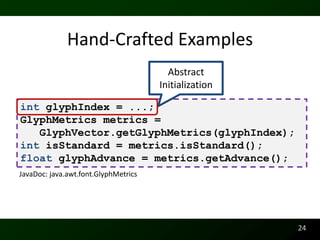
Hand-Crafted Examples
                                        Abstract
                                      Initialization

int glyphIndex = ...;
GlyphMetrics metrics =
   GlyphVector.getGlyphMetrics(glyphIndex);
int isStandard = metrics.isStandard();
float glyphAdvance = metrics.getAdvance();
JavaDoc: java.awt.font.GlyphMetrics


                                                       24
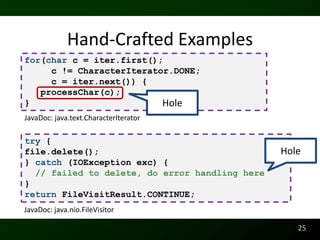
Hand-Crafted Examples
for(char c = iter.first();
     c != CharacterIterator.DONE;
     c = iter.next()) {
   processChar(c);
}                         Hole
JavaDoc: java.text.CharacterIterator

try {
file.delete();                                  Hole
} catch (IOException exc) {
  // failed to delete, do error handling here
}
return FileVisitResult.CONTINUE;
JavaDoc: java.nio.FileVisitor

                                                   25
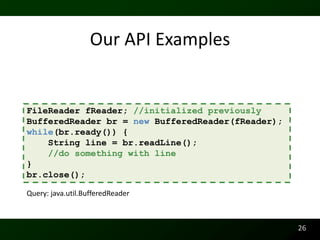
Our API Examples


FileReader fReader; //initialized previously
BufferedReader br = new BufferedReader(fReader);
while(br.ready()) {
    String line = br.readLine();
    //do something with line
}
br.close();

Query: java.util.BufferedReader


                                                   26
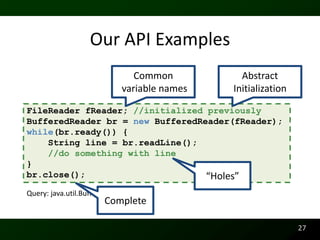
Our API Examples
                               Common          Abstract
                            variable names   Initialization

FileReader fReader; //initialized previously
BufferedReader br = new BufferedReader(fReader);
while(br.ready()) {
    String line = br.readLine();
    //do something with line
}
br.close();                       “Holes”
Query: java.util.BufferedReader
                       Complete

                                                              27
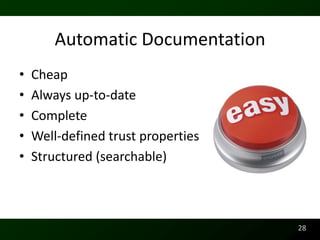
Automatic Documentation
•   Cheap
•   Always up-to-date
•   Complete
•   Well-defined trust properties
•   Structured (searchable)


                                    28
Our Approach
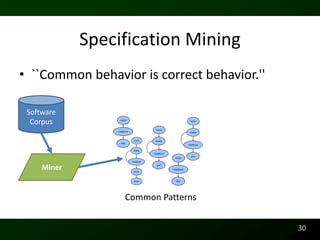
Specification Mining
• ``Common behavior is correct behavior.''

 Software
  Corpus


     Miner


                  Common Patterns


                                             30
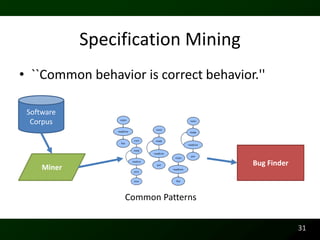
Specification Mining
• ``Common behavior is correct behavior.''

 Software
  Corpus


                                       Bug Finder
     Miner


                  Common Patterns


                                                    31
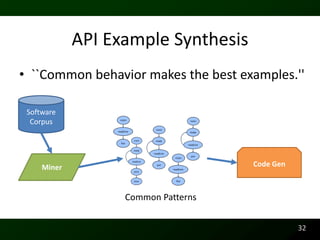
API Example Synthesis
• ``Common behavior makes the best examples.''

 Software
  Corpus


     Miner                           Code Gen


                   Common Patterns


                                                32
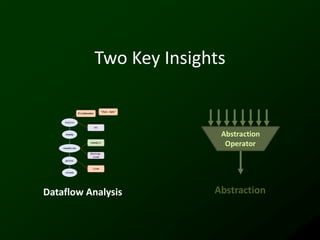
Two Key Insights


Dataflow Analysis        Abstraction
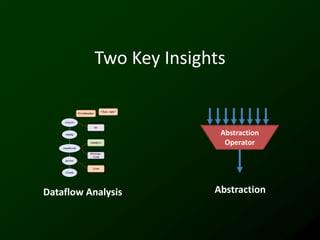
Two Key Insights


                          Abstraction
                           Operator


Dataflow Analysis        Abstraction
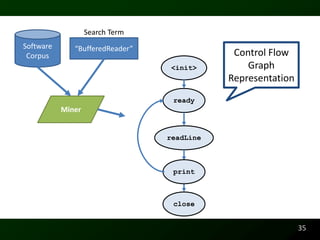
Search Term
Software      “BufferedReader”
 Corpus                                      Control Flow
                                 <init>         Graph
                                            Representation
                                  ready
           Miner


                                 readLine


                                  print


                                  close


                                                             35
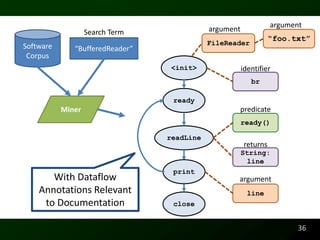
argument
                   Search Term              argument
                                                                  “foo.txt”
Software                                    FileReader
              “BufferedReader”
 Corpus
                                 <init>                identifier
                                                          br

                                  ready
           Miner                                   predicate
                                                       ready()

                                 readLine
                                                        returns
                                                       String:
                                                         line
                                  print
       With Dataflow                               argument
    Annotations Relevant                                 line
     to Documentation             close


                                                                         36
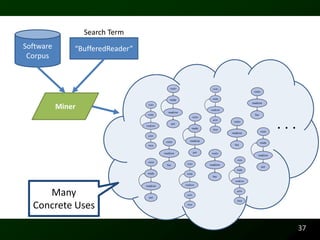
Search Term
Software       “BufferedReader”
 Corpus


           Miner

                                  ...


     Many
  Concrete Uses

                                        37
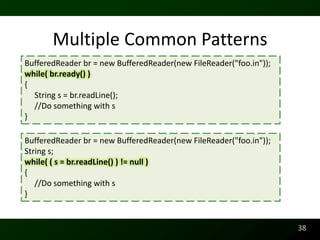
Multiple Common Patterns
BufferedReader br = new BufferedReader(new FileReader("foo.in"));
while( br.ready() )
{
  String s = br.readLine();
  //Do something with s
}

BufferedReader br = new BufferedReader(new FileReader("foo.in"));
String s;
while( ( s = br.readLine() ) != null )
{
   //Do something with s
}


                                                                    38
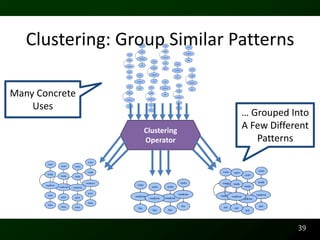
Clustering: Group Similar Patterns

Many Concrete
    Uses
                              … Grouped Into
                 Clustering
                              A Few Different
                 Operator        Patterns


                                          39
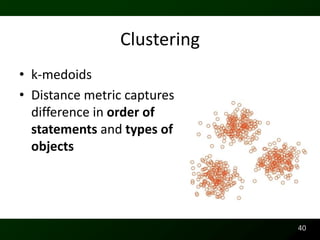
Clustering
• k-medoids
• Distance metric captures
  difference in order of
  statements and types of
  objects


                             40
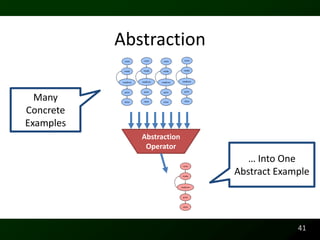
Abstraction

  Many
Concrete
Examples
              Abstraction
               Operator
                               … Into One
                            Abstract Example


                                         41
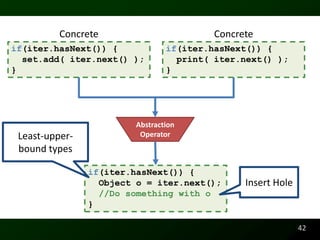
Concrete                        Concrete
if(iter.hasNext()) {             if(iter.hasNext()) {
  set.add( iter.next() );          print( iter.next() );
}                                }


                         Abstraction
 Least-upper-             Operator
 bound types

                if(iter.hasNext()) {
                  Object o = iter.next();       Insert Hole
                  //Do something with o
                }

                                                              42
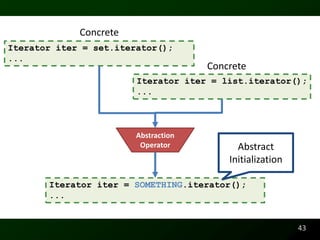
Concrete
Iterator iter = set.iterator();
...
                                      Concrete
                        Iterator iter = list.iterator();
                        ...


                        Abstraction
                         Operator           Abstract
                                          Initialization

       Iterator iter = SOMETHING.iterator();
       ...


                                                           43
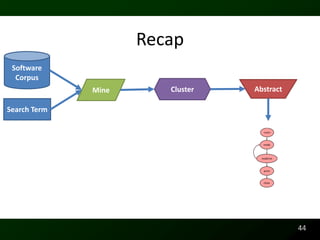
Recap
 Software
  Corpus
              Mine      Cluster   Abstract

Search Term


                                             44
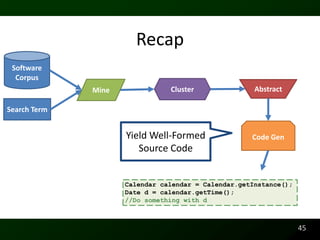
Recap
 Software
  Corpus
              Mine            Cluster    Abstract

Search Term


                     Yield Well-Formed   Code Gen
                        Source Code


                                                    45
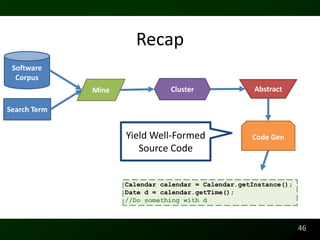
Recap
 Software
  Corpus
              Mine            Cluster    Abstract

Search Term


                     Yield Well-Formed   Code Gen
                        Source Code


                                                    46
47
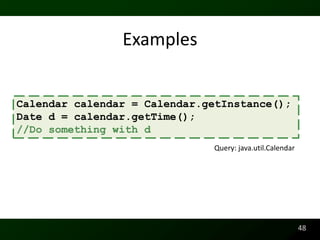
Examples


Calendar calendar = Calendar.getInstance();
Date d = calendar.getTime();
//Do something with d
                              Query: java.util.Calendar


                                                          48
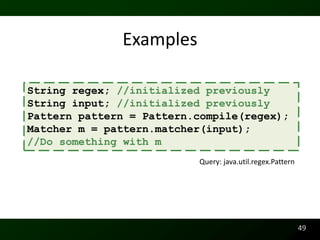
Examples

String regex; //initialized previously
String input; //initialized previously
Pattern pattern = Pattern.compile(regex);
Matcher m = pattern.matcher(input);
//Do something with m
                          Query: java.util.regex.Pattern


                                                           49
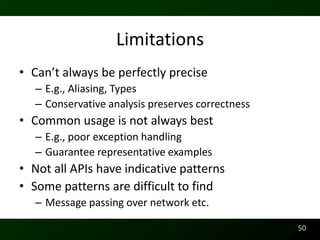
Limitations
• Can’t always be perfectly precise
   – E.g., Aliasing, Types
   – Conservative analysis preserves correctness
• Common usage is not always best
   – E.g., poor exception handling
   – Guarantee representative examples
• Not all APIs have indicative patterns
• Some patterns are difficult to find
   – Message passing over network etc.

                                                   50
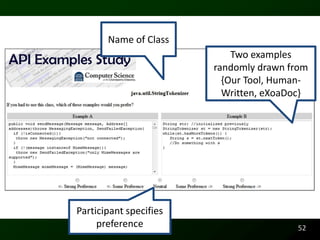
Evaluation
Name of Class
                            Two examples
                        randomly drawn from
                          {Our Tool, Human-
                          Written, eXoaDoc}


Participant specifies
     preference                         52
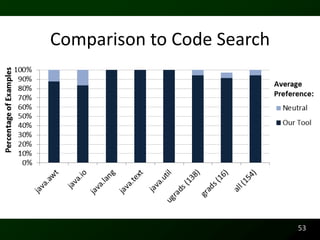
Comparison to Code Search


                            53
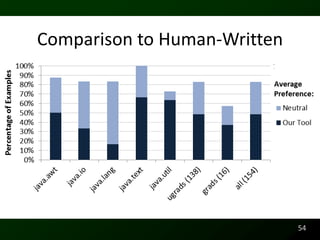
Comparison to Human-Written


                              54
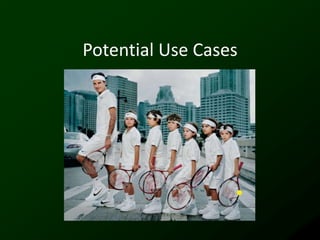
Potential Use Cases
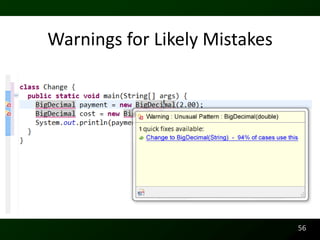
Warnings for Likely Mistakes


                               56
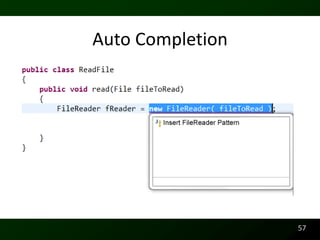
Auto Completion


                  57
Conclusion
Future Work
• More Complex Queries
  – How do I use X with Y ?
  – Kuat Yessenov, Zhilei Xu, and Armando Solar-
    Lezama, Data-driven synthesis for object-oriented
    frameworks, OOPSLA, 2011.
• What does this example do?
  – Symbolic execution of the example itself
• Additional Guarantees
  – Proof Carrying Examples

                                                        59
Our Implementation


                     60
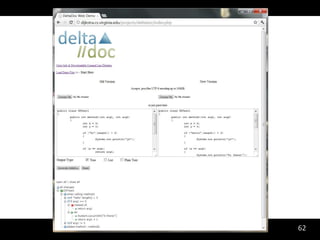
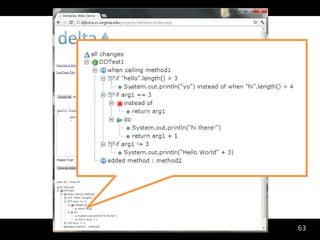
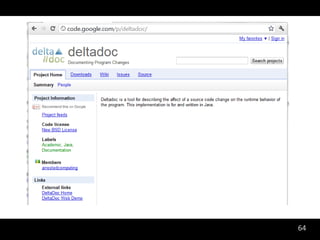
Documents how a source code change affects
program behavior.

arrestedcomputing.com/deltadoc


                                             61
62
63
64
Thank You!
Questions?


             66

Synthesizing API Usage Examples

  • 1.
    Synthesizing API UsageExamples Ray Buse Wes Weimer ICSE 2012 Zurich, Switzerland 2
  • 2.
  • 3.
    Simple Bank WithdrawFunction void withdraw( double amount ) { double currentBal = getBalance(); double newBal = currentBal - amount; if( newBal < 0 ) throw new OverDraftException(); account.setBalance(newBal); } 4
  • 4.
    Simple Bank WithdrawFunction void withdraw( double amount ) { double currentBal = getBalance(); double newBal = currentBal - amount; if( newBal < 0 ) throw new OverDraftException(); Initial account.setBalance(newBal); Balance = 2 } withdraw(1.10); Final Balance = ? 5
  • 5.
    Simple Bank WithdrawFunction void withdraw( double amount ) { double currentBal = getBalance(); double newBal = currentBal - amount; if( newBal < 0 ) throw new OverDraftException(); Initial account.setBalance(newBal);Balance = 2 } withdraw(1.10); Final Balance = ? Final Balance = 0.8999999999999999 6
  • 6.
  • 7.
  • 8.
    “Improved” Withdraw Function voidwithdraw( double amount ) { BigDecimal currentBal = getBalance(); BigDecimal newBal = currentBal.subtract(new BigDecimal(amount)); if( newBal.compareTo(BigDecimal.ZERO) < 0 ) throw new OverDraftException(); account.setBalance(newBal); } 9
  • 9.
    “Improved” Withdraw Function void withdraw( double amount ) { BigDecimal currentBal = getBalance(); BigDecimal newBal = currentBal.subtract(new BigDecimal(amount)); if( newBal.compareTo(BigDecimal.ZERO) < 0 ) throw new OverDraftException(); Initial Balance = 2 account.setBalance(newBal); } withdraw(1.10); Final Balance = ? Final Balance = 0.899999999999999911182158029987 10
  • 10.
    BigDecimal public BigDecimal(double val) Translatesa double into a BigDecimal which is the exact decimal representation of the double's binary floating- point value. The scale of the returned BigDecimal is the smallest value such that (10scale × val) is an integer. http://docs.oracle.com/javase/6/docs/api/java/math/BigDecimal.html 11
  • 11.
    “Improved” Withdraw Function voidwithdraw( double amount ) { BigDecimal currentBal = getBalance(); BigDecimal newBal = currentBal.subtract(new BigDecimal(amount)); if( newBal.compareTo(BigDecimal.ZERO) < 0 ) throw new OverDraftException(); Initial Balance account.setBalance(newBal); = 1.10 } withdraw(1.10); Final Balance = ? OverDraftException 12
  • 12.
    One Solution: StringConstructor void withdraw( String amount ) { BigDecimal currentBal = getBalance(); BigDecimal newBal = currentBal.subtract(new BigDecimal(amount)); if( newBal.compareTo(BigDecimal.ZERO) < 0 ) throw new OverDraftException(); account.setBalance(newBal); Initial Balance = 2 } withdraw(“1.10”); Final Balance = 0.90 13
  • 13.
    “The greatest obstacleto learning an API … is insufficient or inadequate examples” Martin Robillard. What Makes APIs Hard to Learn? Answers from Developers. IEEE Software, 26(6):27-34, 2009.
  • 14.
    The Rest ofthis Talk What makes a good example? Motivation Approach: Example Synthesis Evaluation 15
  • 15.
    The Rest ofthis Talk What makes a good example? Approach: Example Synthesis Evaluation 16
  • 16.
    What makes agood example?
  • 17.
    Some Common Sourcesof Examples 18
  • 18.
    Research Tools • MAPO – H. Zhong, T. Xie, L. Zhang, J. Pei, and H. Mei, “MAPO: Mining and recommending API usage patterns,” in European Conference on Object- Oriented Programming, 2009. • eXoaDocs – J. Kim, S. Lee, S. Hwang, and S. Kim, “Towards an intelligent code search engine,” in AAAI Conference on Artificial Intelligence, 2010. 19
  • 19.
    Research Tools • MAPO – H. Zhong, T. Xie, L. Zhang, J. Pei, and H. Mei, “MAPO: Mining and recommending API usage patterns,” in European Conference on Object- Oriented Programming, 2009. • eXoaDocs – J. Kim, S. Lee, S. Hwang, and S. Kim, “Towards an intelligent code search engine,” in AAAI Conference on Artificial Intelligence, 2010. 20
  • 20.
  • 21.
    Search-based examples BufferedReader reader= new BufferedReader(new InputStreamReader(page)); try {String line = reader.readLine(); while (line != null) { if (line.matches(substituteWikiWord(wikiWord,newTopicPattern))) { JExamples: BufferedReader 22
  • 22.
    Hand-Crafted Examples Example Data FileOutputStream fos = new FileOutputStream("t.tmp"); ObjectOutputStream oos = new ObjectOutputStream(fos); oos.writeInt(12345); oos.writeObject("Today"); oos.writeObject(new Date()); oos.close(); JavaDoc: java.util.ObjectOutputStream Complete 23
  • 23.
    Hand-Crafted Examples Abstract Initialization int glyphIndex = ...; GlyphMetrics metrics = GlyphVector.getGlyphMetrics(glyphIndex); int isStandard = metrics.isStandard(); float glyphAdvance = metrics.getAdvance(); JavaDoc: java.awt.font.GlyphMetrics 24
  • 24.
    Hand-Crafted Examples for(char c= iter.first(); c != CharacterIterator.DONE; c = iter.next()) { processChar(c); } Hole JavaDoc: java.text.CharacterIterator try { file.delete(); Hole } catch (IOException exc) { // failed to delete, do error handling here } return FileVisitResult.CONTINUE; JavaDoc: java.nio.FileVisitor 25
  • 25.
    Our API Examples FileReaderfReader; //initialized previously BufferedReader br = new BufferedReader(fReader); while(br.ready()) { String line = br.readLine(); //do something with line } br.close(); Query: java.util.BufferedReader 26
  • 26.
    Our API Examples Common Abstract variable names Initialization FileReader fReader; //initialized previously BufferedReader br = new BufferedReader(fReader); while(br.ready()) { String line = br.readLine(); //do something with line } br.close(); “Holes” Query: java.util.BufferedReader Complete 27
  • 27.
    Automatic Documentation • Cheap • Always up-to-date • Complete • Well-defined trust properties • Structured (searchable) 28
  • 28.
  • 29.
    Specification Mining • ``Commonbehavior is correct behavior.'' Software Corpus Miner Common Patterns 30
  • 30.
    Specification Mining • ``Commonbehavior is correct behavior.'' Software Corpus Bug Finder Miner Common Patterns 31
  • 31.
    API Example Synthesis •``Common behavior makes the best examples.'' Software Corpus Miner Code Gen Common Patterns 32
  • 32.
    Two Key Insights DataflowAnalysis Abstraction
  • 33.
    Two Key Insights Abstraction Operator Dataflow Analysis Abstraction
  • 34.
    Search Term Software “BufferedReader” Corpus Control Flow <init> Graph Representation ready Miner readLine print close 35
  • 35.
    argument Search Term argument “foo.txt” Software FileReader “BufferedReader” Corpus <init> identifier br ready Miner predicate ready() readLine returns String: line print With Dataflow argument Annotations Relevant line to Documentation close 36
  • 36.
    Search Term Software “BufferedReader” Corpus Miner ... Many Concrete Uses 37
  • 37.
    Multiple Common Patterns BufferedReaderbr = new BufferedReader(new FileReader("foo.in")); while( br.ready() ) { String s = br.readLine(); //Do something with s } BufferedReader br = new BufferedReader(new FileReader("foo.in")); String s; while( ( s = br.readLine() ) != null ) { //Do something with s } 38
  • 38.
    Clustering: Group SimilarPatterns Many Concrete Uses … Grouped Into Clustering A Few Different Operator Patterns 39
  • 39.
    Clustering • k-medoids • Distancemetric captures difference in order of statements and types of objects 40
  • 40.
    Abstraction Many Concrete Examples Abstraction Operator … Into One Abstract Example 41
  • 41.
    Concrete Concrete if(iter.hasNext()) { if(iter.hasNext()) { set.add( iter.next() ); print( iter.next() ); } } Abstraction Least-upper- Operator bound types if(iter.hasNext()) { Object o = iter.next(); Insert Hole //Do something with o } 42
  • 42.
    Concrete Iterator iter =set.iterator(); ... Concrete Iterator iter = list.iterator(); ... Abstraction Operator Abstract Initialization Iterator iter = SOMETHING.iterator(); ... 43
  • 43.
    Recap Software Corpus Mine Cluster Abstract Search Term 44
  • 44.
    Recap Software Corpus Mine Cluster Abstract Search Term Yield Well-Formed Code Gen Source Code 45
  • 45.
    Recap Software Corpus Mine Cluster Abstract Search Term Yield Well-Formed Code Gen Source Code 46
  • 46.
  • 47.
    Examples Calendar calendar =Calendar.getInstance(); Date d = calendar.getTime(); //Do something with d Query: java.util.Calendar 48
  • 48.
    Examples String regex; //initializedpreviously String input; //initialized previously Pattern pattern = Pattern.compile(regex); Matcher m = pattern.matcher(input); //Do something with m Query: java.util.regex.Pattern 49
  • 49.
    Limitations • Can’t alwaysbe perfectly precise – E.g., Aliasing, Types – Conservative analysis preserves correctness • Common usage is not always best – E.g., poor exception handling – Guarantee representative examples • Not all APIs have indicative patterns • Some patterns are difficult to find – Message passing over network etc. 50
  • 50.
  • 51.
    Name of Class Two examples randomly drawn from {Our Tool, Human- Written, eXoaDoc} Participant specifies preference 52
  • 52.
  • 53.
  • 54.
  • 55.
  • 56.
  • 57.
  • 58.
    Future Work • MoreComplex Queries – How do I use X with Y ? – Kuat Yessenov, Zhilei Xu, and Armando Solar- Lezama, Data-driven synthesis for object-oriented frameworks, OOPSLA, 2011. • What does this example do? – Symbolic execution of the example itself • Additional Guarantees – Proof Carrying Examples 59
  • 59.
  • 60.
    Documents how asource code change affects program behavior. arrestedcomputing.com/deltadoc 61
  • 61.
  • 62.
  • 63.
  • 64.
  • 65.