Drugs that bindto the adrenergic receptors
and results in activation of adrenergic
receptors are known as
‘’SYMPATHOMIMETICS or ADRENERGIC
AGONISTS’’
3.
SYMPATHOMIMETICS
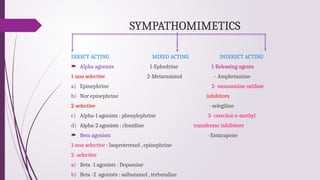
DIRECT ACTING MIXEDACTING INDIRECT ACTING
Alpha agonists 1-Ephedrine 1-Releasing agents
1-non selective 2-Metaraminol - Amphetamine
a) Epinephrine 2- monoamine oxidase
b) Nor epinephrine inhibitors
2-selective - selegiline
c) Alpha-1 agonists : phenylephrine 3- catechol-o-methyl
d) Alpha-2 agonists : clonidine transferase inhibitors
Beta agonists -Entacapone
1-non selective : Isoproterenol , epinephrine
2- selective
a) Beta -1 agonists : Dopamine
b) Beta -2 agonists : salbutamol , terbutaline
4.
DIRECT ACTING
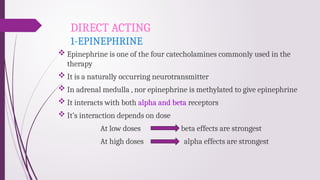
1-EPINEPHRINE
Epinephrineis one of the four catecholamines commonly used in the
therapy
It is a naturally occurring neurotransmitter
In adrenal medulla , nor epinephrine is methylated to give epinephrine
It interacts with both alpha and beta receptors
It’s interaction depends on dose
At low doses beta effects are strongest
At high doses alpha effects are strongest
5.
PHARMACOLOGICAL ACTIONS
1-Cardiovascular :
It has both positive inotrope and chronotrope activity on heart as a
result cardiac output increases and it also acts on kidneys to release
renin which is a potent vasoconstrictor [beta-1 action]
It also have alpha effects like constriction of arterioles in the
viscera and mucuous membranes and have beta-2 effects like
dilation of vessels in liver and skeletal muscles
2-Respiratory : Epinephrine is a potent bronchodilatior [beta-2
action]
3-Hyperglycemia : This effect is due to increased glycogenolysis in liver
and increase release of glucagon
6.
USES
It isthe primary drug used in treatment of anaphylactic shock
and type-1 hypersensitivity reactions
Used to induce and maintain mydriasis during intraocular surgery
It also increases the duration of the local anesthesia
PHARMACOKINETICS
ABSORPTION – Has rapid onset but brief duration of action and
epinephrine is given as IM , IV or SC
METABOLISM – By monoamine oxidase [MAO] and catechol-o-methyl
transferase [COMT]
EXCRETION – metabolites like metanephrine and vanillyl mandelic
acid are excreted by urine
7.
ADVERSE EFFECTS
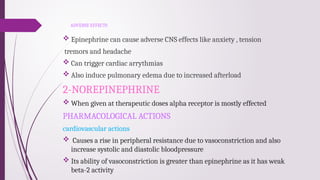
Epinephrinecan cause adverse CNS effects like anxiety , tension
tremors and headache
Can trigger cardiac arrythmias
Also induce pulmonary edema due to increased afterload
2-NOREPINEPHRINE
When given at therapeutic doses alpha receptor is mostly effected
PHARMACOLOGICAL ACTIONS
cardiovascular actions
Causes a rise in peripheral resistance due to vasoconstriction and also
increase systolic and diastolic bloodpressure
Its ability of vasoconstriction is greater than epinephrine as it has weak
beta-2 activity
8.
Baroreceptor reflex
Itrises blood pressure stimulates baroreceptors which increase vagal activity
and produces reflex bradycardia
USES
Used to treat shock like septic shock
It has no other significant uses
PHARMACOKINETICS
A – given as IV
M – by MAO and COMT
E – inactive metabolites excreted by urine
ADVERSE EFFECTS
Similar to epinephrine
Blanching and sloughing of skin and cause tissue necrosis if extravastation
occurs
9.
3-DOPAMINE
It isthe metabolic precursor of nor epinephrine that mainly occurs
naturally in the basal ganglia of CNS
It acts on both alpha and beta receptors and also on D1 and D2 receptors
present in peripheral mesenteric and renal vascular beds
PHARMACOLOGICAL ACTIONS
1- cardiovascular actions
It has stimulatory effects on β1 receptors on heart that increases both heart
rate and contraction of heart and at high doses it cause vasoconstriction
2-Renal and visceral
Causes dilation of renal and splanchnic arterioles and increase blood flow
to kidneys
10.
USES
Used totreat both cardiogenic and septic shock
Enhances perfusion to both kidney and splanchnic areas
Used to treat hypotension , heart failure , bradycardia
Used to treat acute renal failure [effects are limited]
ADRs
Rapidly metabolized by MAO and COMT so its adverse effects like
nausea , hypertension and arrhythmias are short lived
11.
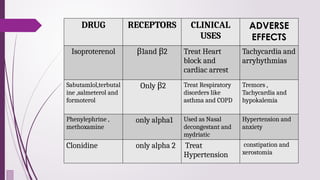
. DRUG RECEPTORSCLINICAL
USES
ADVERSE
EFFECTS
Isoproterenol β1and β2 Treat Heart
block and
cardiac arrest
Tachycardia and
arryhythmias
Sabutamlol,terbutal
ine ,salmeterol and
formoterol
Only β2 Treat Respiratory
disorders like
asthma and COPD
Tremors ,
Tachycardia and
hypokalemia
Phenylephrine ,
methoxamine
only alpha1 Used as Nasal
decongestant and
mydriatic
Hypertension and
anxiety
Clonidine only alpha 2 Treat
Hypertension
constipation and
xerostomia
12.
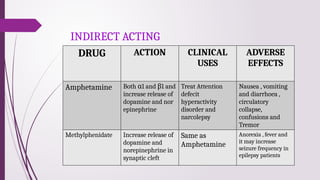
INDIRECT ACTING
DRUG ACTIONCLINICAL
USES
ADVERSE
EFFECTS
Amphetamine Both α1 and β1 and
increase release of
dopamine and nor
epinephrine
Treat Attention
defecit
hyperactivity
disorder and
narcolepsy
Nausea , vomiting
and diarrhoea ,
circulatory
collapse,
confusions and
Tremor
Methylphenidate Increase release of
dopamine and
norepinephrine in
synaptic cleft
Same as
Amphetamine
Anorexia , fever and
it may increase
seizure frequency in
epilepsy patients
13.
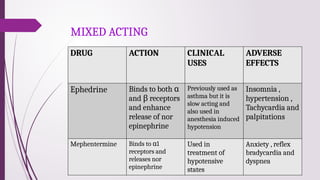
MIXED ACTING
DRUG ACTIONCLINICAL
USES
ADVERSE
EFFECTS
Ephedrine Binds to both α
and β receptors
and enhance
release of nor
epinephrine
Previously used as
asthma but it is
slow acting and
also used in
anesthesia induced
hypotension
Insomnia ,
hypertension ,
Tachycardia and
palpitations
Mephentermine Binds to α1
receptors and
releases nor
epinephrine
Used in
treatment of
hypotensive
states
Anxiety , reflex
bradycardia and
dyspnea

![PHARMACOLOGICAL ACTIONS
1-Cardiovascular :
It has both positive inotrope and chronotrope activity on heart as a
result cardiac output increases and it also acts on kidneys to release
renin which is a potent vasoconstrictor [beta-1 action]
It also have alpha effects like constriction of arterioles in the
viscera and mucuous membranes and have beta-2 effects like
dilation of vessels in liver and skeletal muscles
2-Respiratory : Epinephrine is a potent bronchodilatior [beta-2
action]
3-Hyperglycemia : This effect is due to increased glycogenolysis in liver
and increase release of glucagon](https://image.slidesharecdn.com/sympathomimetics4-250622122216-36015c02/85/SYMPATHOMIMETICS-ADRENERGIC-AGONISTS-pptx-5-320.jpg)
![USES
It is the primary drug used in treatment of anaphylactic shock
and type-1 hypersensitivity reactions
Used to induce and maintain mydriasis during intraocular surgery
It also increases the duration of the local anesthesia
PHARMACOKINETICS
ABSORPTION – Has rapid onset but brief duration of action and
epinephrine is given as IM , IV or SC
METABOLISM – By monoamine oxidase [MAO] and catechol-o-methyl
transferase [COMT]
EXCRETION – metabolites like metanephrine and vanillyl mandelic
acid are excreted by urine](https://image.slidesharecdn.com/sympathomimetics4-250622122216-36015c02/85/SYMPATHOMIMETICS-ADRENERGIC-AGONISTS-pptx-6-320.jpg)
![USES
Used to treat both cardiogenic and septic shock
Enhances perfusion to both kidney and splanchnic areas
Used to treat hypotension , heart failure , bradycardia
Used to treat acute renal failure [effects are limited]
ADRs
Rapidly metabolized by MAO and COMT so its adverse effects like
nausea , hypertension and arrhythmias are short lived](https://image.slidesharecdn.com/sympathomimetics4-250622122216-36015c02/85/SYMPATHOMIMETICS-ADRENERGIC-AGONISTS-pptx-10-320.jpg)