SYMBOLIC
INTERACTIONISM
Prepared by: Resty Hezron C. Damaso
Definitions
• The symbolic
interaction perspective,
also called symbolic
interactionism, is a
major framework of
sociological theory. This
perspective relies on
the symbolic meaning
that people develop
and rely upon in the
process of social
interaction.
Definitions
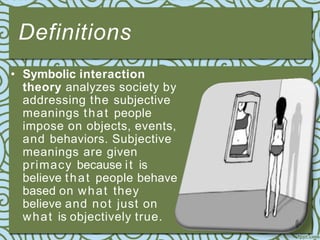
• Symbolic interaction
theory analyzes society by
addressing the subjective
meanings that people
impose on objects, events,
and behaviors. Subjective
meanings are given
primacy because it is
believe that people behave
based on what they
believe and not just on
what is objectively true.
Definitions
• Symbolic
interactionism looks
at individual and
group meaning-
making, focusing on
human action instead
of large-scale social
structures.
George tferbert Mead
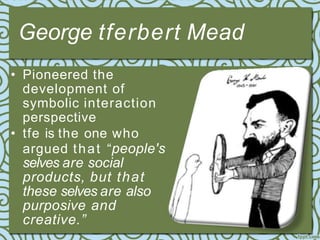
• Pioneered the
development of
symbolic interaction
perspective
• tfe is the one who
argued that “people's
selves are social
products, but that
these selves are also
purposive and
creative.”
The Three Basic Premises
tferbert Blumer (1969) set out three basic
premises of the perspective:
• "tfumans act toward things on the basis of the
meanings they ascribe to those things."
• "The meaning of such things is derived from,
or arises out of, the social interaction that one
has with others and the society."
• "These meanings are handled in, and modified
through, an interpretative process used by the
person in dealing with the things he/she
encounters."
The first premise:
"tfumans act toward things on the basis of the meanings they
ascribe to those things."
• includes everything that a
human being may note in
their world, including
physical objects, actions
and concepts. Essentially,
individuals behave
towards objects and
others based on the
personal meanings that
the individuals has
already given these items.
The second premise:
"The meaning of such things is derived from, or arises out of, the
social interaction that one has with others and the society."
• arises out of, the
social interaction that
one has with other
humans. People
interact with each
other by interpreting
or defining each
other's actions instead
of merely reacting to
each other's actions.
The third premise:
"These meanings are handled in, and modified through, an interpretative
process used by the person in dealing with the things he/she encounters."
• We naturally talk to
ourselves in order to sort
out the meaning of a
difficult situation. But
first, we need language.
Before we can think, we
must be able to interact
symbolically. emphasis on
symbols, negotiated
meaning, and social
construction of society
brought on attention to
the roles people play.
Key points:
• Symbolic interaction
has roots in
phenomenology, which
emphasizes the
subjective meaning of
reality.
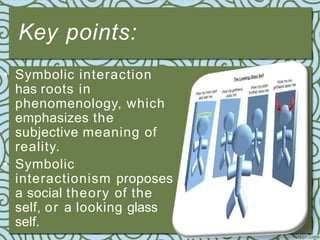
• Symbolic
interactionism proposes
a social theory of the
self, or a looking glass
self.
Key points:
• Symbolic interactionists
study meaning and
communication; they
tend to use
qualitative methods.
• Symbolic
interactionism has been
criticized for failing to
take into account
large-scale macro social
structures and forces.
Example:
• Studies find that teenagers
are well informed about the
risks of tobacco, but they
also think that smoking is
cool, that they themselves
will be safe from harm, and
that smoking projects a
positive image to their
peers. So, the symbolic
meaning of smoking
overrides that actual facts
regarding smoking and risk.

Symbolic Interactionism

  • 1.
  • 2.
    Definitions • The symbolic interactionperspective, also called symbolic interactionism, is a major framework of sociological theory. This perspective relies on the symbolic meaning that people develop and rely upon in the process of social interaction.
  • 3.
    Definitions • Symbolic interaction theoryanalyzes society by addressing the subjective meanings that people impose on objects, events, and behaviors. Subjective meanings are given primacy because it is believe that people behave based on what they believe and not just on what is objectively true.
  • 4.
    Definitions • Symbolic interactionism looks atindividual and group meaning- making, focusing on human action instead of large-scale social structures.
  • 5.
    George tferbert Mead •Pioneered the development of symbolic interaction perspective • tfe is the one who argued that “people's selves are social products, but that these selves are also purposive and creative.”
  • 6.
    The Three BasicPremises tferbert Blumer (1969) set out three basic premises of the perspective: • "tfumans act toward things on the basis of the meanings they ascribe to those things." • "The meaning of such things is derived from, or arises out of, the social interaction that one has with others and the society." • "These meanings are handled in, and modified through, an interpretative process used by the person in dealing with the things he/she encounters."
  • 7.
    The first premise: "tfumansact toward things on the basis of the meanings they ascribe to those things." • includes everything that a human being may note in their world, including physical objects, actions and concepts. Essentially, individuals behave towards objects and others based on the personal meanings that the individuals has already given these items.
  • 8.
    The second premise: "Themeaning of such things is derived from, or arises out of, the social interaction that one has with others and the society." • arises out of, the social interaction that one has with other humans. People interact with each other by interpreting or defining each other's actions instead of merely reacting to each other's actions.
  • 9.
    The third premise: "Thesemeanings are handled in, and modified through, an interpretative process used by the person in dealing with the things he/she encounters." • We naturally talk to ourselves in order to sort out the meaning of a difficult situation. But first, we need language. Before we can think, we must be able to interact symbolically. emphasis on symbols, negotiated meaning, and social construction of society brought on attention to the roles people play.
  • 10.
    Key points: • Symbolicinteraction has roots in phenomenology, which emphasizes the subjective meaning of reality. • Symbolic interactionism proposes a social theory of the self, or a looking glass self.
  • 11.
    Key points: • Symbolicinteractionists study meaning and communication; they tend to use qualitative methods. • Symbolic interactionism has been criticized for failing to take into account large-scale macro social structures and forces.
  • 12.
    Example: • Studies findthat teenagers are well informed about the risks of tobacco, but they also think that smoking is cool, that they themselves will be safe from harm, and that smoking projects a positive image to their peers. So, the symbolic meaning of smoking overrides that actual facts regarding smoking and risk.