Basic concepts and principles
of the major social science
theories:
a) Structural-functionalism b) Marxism c) Symbolic
Interaction
c) Symbolic Interaction
1. What is Marxism?
is a sociological, political, and
economic philosophy that is
based on the ideas and
theories
2. It is characterized by a classless society
having common ownership of property and
resources (means of production).
Communist society
3.Who are the fathers of Marxism
theory?
Karl Marx and Friedrich
Engels (1820–1895)
4.What are the two classes in society
created in Industrial capitalism?
Bourgeoisie
Proletariat
to treat the economic status equally
for every individual in the society.
5.What is the purpose of
Marxism
Social equality
SOCIAL INEQUALITY
• In a capitalist society, oppression and exploitation are among the socia
inequalities that exist between the bourgeoisie and the proletariat.
• Marx argued that the profit from goods should be equally divided among
the laborers since they are the ones who work to produce such goods. But
in reality, they are given low wages and are often asked to work in terrible
working conditions.
• For Marx, capitalists steal by taking the profit for themselves, while leaving
the workers with salaries disproportionate to the work that they provide.
OBJECTIVES
•Explain in the theories on Symbolic
Interactions.
• Enumerates the examples of symbolic
interactionism in everyday life.
What is Symbolic
interactionism?
SYMBOLIC INTERACTIONISM
-is a theory on society that focuses on the
individuals interactions with other objects or
people.
- It perceives reality through the compositions of
social interactions and the understanding of the
meanings of these social interactions that provide
a perspective on social order and social society.
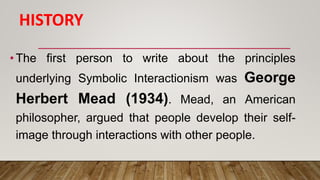
HISTORY
•The first person to write about the principles
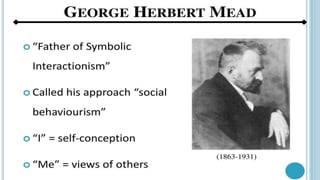
underlying Symbolic Interactionism was George
Herbert Mead (1934). Mead, an American
philosopher, argued that people develop their self-
image through interactions with other people.
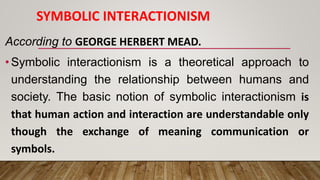
SYMBOLIC INTERACTIONISM
According to GEORGE HERBERT MEAD.
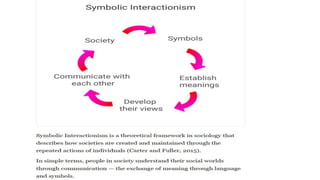
•Symbolic interactionism is a theoretical approach to
understanding the relationship between humans and
society. The basic notion of symbolic interactionism is
that human action and interaction are understandable only
though the exchange of meaning communication or
symbols.
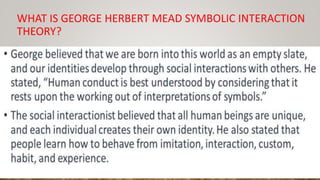
WHAT IS GEORGE HERBERT MEAD SYMBOLIC INTERACTION
THEORY?
SOCIETY
IS THE PRODUCT OF THE
EVERYDAY INTERACTIONS.
DON’T LOOK AT THE BIG
PICTURE; LOOK AT THE
INTERACTIONS BETWEEN
PEOPLE
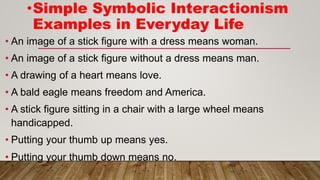
• An image of a stick figure with a dress means woman.
• An image of a stick figure without a dress means man.
• A drawing of a heart means love.
• A bald eagle means freedom and America.
• A stick figure sitting in a chair with a large wheel means
handicapped.
• Putting your thumb up means yes.
• Putting your thumb down means no.
•Simple Symbolic Interactionism
Examples in Everyday Life
EXAMPLES OF SYMBOLIC
INTERACTIONISM IN SOCIETY
American Flag
•The American flag to some is a symbol of freedom,
hope, and pride. However, for others, the American
flag can be seen as a symbol of oppression.
Depending on your interaction with the American
flag, the meaning behind it will be different.
EXAMPLES OF SYMBOLIC
INTERACTIONISM IN SOCIETY
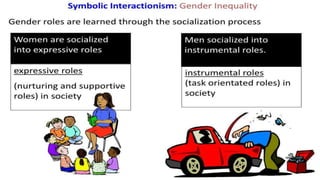
•Gender
It can be understood through symbolic interactionism
because gender is a sociological construct. For example,
for the symbols attached to “males” and “females”, actions
and looks are based on what is believed is true from your
interactions rather than what is objectively true. For
example, women might be seen as weaker than men.
EXAMPLES OF SYMBOLIC
INTERACTIONISM IN SOCIETY
•Relationship Roles
Symbolic interactionism plays a big role in family
and relationships. Your understanding of a word or
event changes based on interactions with it. For
example, if you have a great relationship with your
wife, the word wife will be positive.
What Are the Three Premises of
Symbolic Interactionism?
According to sociologists Howard S. Becker and Blanche Geer,
symbolic interactionism has three main premises:
1. Reality is created through social interactions.
2. As people interact with others, they create shared meaning
from the symbols involved in these conversations (and symbols
are actions or things that have meanings attached to them).
3. These shared meanings are what define social behavior and
the actions of individuals.
-Symbolic interaction can be summed up as the study of human
behavior in terms of meanings. The idea is that humans do not just
act upon their environment, but they also interpret their environment
and then respond to it.
-This theory is helpful because it can be used to explain why people
behave in specific ways. It also shows how environmental factors
influence human behavior and how human behavior can affect the
environment (Wikipedia).
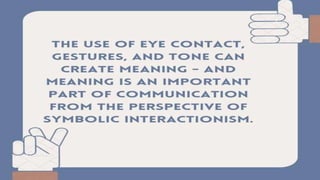
-Symbolic interaction theory studies verbal communication and
body language and even actions with no words attached to them
(non-verbal) (e.g., a person nodding their head, crossing their
arms).
Symbolic interaction Theory in Sociology
• The symbolic interactionist perspective helps us better understand the
process by which people create their understanding of reality.
• Symbolic interactionist theory is important because if we can
understand how people come to understand the world around them, we
can better explain why individuals hold particular beliefs and act in
certain ways.
• With this perspective on life, it is believed that people affect one another
through their interactions. Their actions can sometimes be unintentional,
but they have consequences for their individual lives and other social
units.
What is the Importance of Symbolic Interactionism?
What are your experiences that
could relate the theory of symbolic
interactionism
THANK YOU

lessonsymbolicinteraction-221129002726-d80206ad.pptx

  • 1.
    Basic concepts andprinciples of the major social science theories: a) Structural-functionalism b) Marxism c) Symbolic Interaction c) Symbolic Interaction
  • 2.
    1. What isMarxism? is a sociological, political, and economic philosophy that is based on the ideas and theories
  • 3.
    2. It ischaracterized by a classless society having common ownership of property and resources (means of production). Communist society
  • 4.
    3.Who are thefathers of Marxism theory? Karl Marx and Friedrich Engels (1820–1895)
  • 5.
    4.What are thetwo classes in society created in Industrial capitalism? Bourgeoisie Proletariat
  • 6.
    to treat theeconomic status equally for every individual in the society. 5.What is the purpose of Marxism Social equality
  • 7.
    SOCIAL INEQUALITY • Ina capitalist society, oppression and exploitation are among the socia inequalities that exist between the bourgeoisie and the proletariat. • Marx argued that the profit from goods should be equally divided among the laborers since they are the ones who work to produce such goods. But in reality, they are given low wages and are often asked to work in terrible working conditions. • For Marx, capitalists steal by taking the profit for themselves, while leaving the workers with salaries disproportionate to the work that they provide.
  • 9.
    OBJECTIVES •Explain in thetheories on Symbolic Interactions. • Enumerates the examples of symbolic interactionism in everyday life.
  • 10.
  • 11.
    SYMBOLIC INTERACTIONISM -is atheory on society that focuses on the individuals interactions with other objects or people. - It perceives reality through the compositions of social interactions and the understanding of the meanings of these social interactions that provide a perspective on social order and social society.
  • 13.
    HISTORY •The first personto write about the principles underlying Symbolic Interactionism was George Herbert Mead (1934). Mead, an American philosopher, argued that people develop their self- image through interactions with other people.
  • 15.
    SYMBOLIC INTERACTIONISM According toGEORGE HERBERT MEAD. •Symbolic interactionism is a theoretical approach to understanding the relationship between humans and society. The basic notion of symbolic interactionism is that human action and interaction are understandable only though the exchange of meaning communication or symbols.
  • 16.
    WHAT IS GEORGEHERBERT MEAD SYMBOLIC INTERACTION THEORY?
  • 17.
    SOCIETY IS THE PRODUCTOF THE EVERYDAY INTERACTIONS. DON’T LOOK AT THE BIG PICTURE; LOOK AT THE INTERACTIONS BETWEEN PEOPLE
  • 18.
    • An imageof a stick figure with a dress means woman. • An image of a stick figure without a dress means man. • A drawing of a heart means love. • A bald eagle means freedom and America. • A stick figure sitting in a chair with a large wheel means handicapped. • Putting your thumb up means yes. • Putting your thumb down means no. •Simple Symbolic Interactionism Examples in Everyday Life
  • 19.
    EXAMPLES OF SYMBOLIC INTERACTIONISMIN SOCIETY American Flag •The American flag to some is a symbol of freedom, hope, and pride. However, for others, the American flag can be seen as a symbol of oppression. Depending on your interaction with the American flag, the meaning behind it will be different.
  • 20.
    EXAMPLES OF SYMBOLIC INTERACTIONISMIN SOCIETY •Gender It can be understood through symbolic interactionism because gender is a sociological construct. For example, for the symbols attached to “males” and “females”, actions and looks are based on what is believed is true from your interactions rather than what is objectively true. For example, women might be seen as weaker than men.
  • 22.
    EXAMPLES OF SYMBOLIC INTERACTIONISMIN SOCIETY •Relationship Roles Symbolic interactionism plays a big role in family and relationships. Your understanding of a word or event changes based on interactions with it. For example, if you have a great relationship with your wife, the word wife will be positive.
  • 24.
    What Are theThree Premises of Symbolic Interactionism? According to sociologists Howard S. Becker and Blanche Geer, symbolic interactionism has three main premises: 1. Reality is created through social interactions. 2. As people interact with others, they create shared meaning from the symbols involved in these conversations (and symbols are actions or things that have meanings attached to them). 3. These shared meanings are what define social behavior and the actions of individuals.
  • 25.
    -Symbolic interaction canbe summed up as the study of human behavior in terms of meanings. The idea is that humans do not just act upon their environment, but they also interpret their environment and then respond to it. -This theory is helpful because it can be used to explain why people behave in specific ways. It also shows how environmental factors influence human behavior and how human behavior can affect the environment (Wikipedia). -Symbolic interaction theory studies verbal communication and body language and even actions with no words attached to them (non-verbal) (e.g., a person nodding their head, crossing their arms). Symbolic interaction Theory in Sociology
  • 27.
    • The symbolicinteractionist perspective helps us better understand the process by which people create their understanding of reality. • Symbolic interactionist theory is important because if we can understand how people come to understand the world around them, we can better explain why individuals hold particular beliefs and act in certain ways. • With this perspective on life, it is believed that people affect one another through their interactions. Their actions can sometimes be unintentional, but they have consequences for their individual lives and other social units. What is the Importance of Symbolic Interactionism?
  • 28.
    What are yourexperiences that could relate the theory of symbolic interactionism
  • 29.