SYMANTEC INTELLIGENCE REPORT 
SEPTEMBER 2014
p. 2 
Symantec Corporation 
Symantec Intelligence Report :: SEPTEMBER 2014 
CONTENTS 
3 Summary 
4 TARGETED ATTACKS + DATA BREACHES 
5 Targeted Attacks 
5 Attachments Used in Spear-Phishing 
Emails 
5 Spear-Phishing Attacks by Size of 
Targeted Organization 
5 Average Number of Spear-Phishing 
Attacks Per Day 
6 Top-Ten Industries Targeted 
in Spear-Phishing Attacks 
7 Data Breaches 
7 Timeline of Data Breaches 
8 Total Identities Exposed 
8 Top Causes of Data Breaches 
8 Total Data Breaches 
9 Top-Ten Types of Information Breached 
10 MALWARE TACTICS 
11 Malware Tactics 
11 Top-Ten Malware 
11 Top-Ten Mac OSX Malware Blocked on OSX Endpoints 
12 Ransomware Over Time 
12 Malicious Activity by Source: Bots 
13 Vulnerabilities 
13 Number of Vulnerabilities 
13 Zero-Day Vulnerabilities 
14 Browser Vulnerabilities 
14 Plug-in Vulnerabilities 
15 SOCIAL MEDIA 
+ MOBILE THREATS 
16 Mobile 
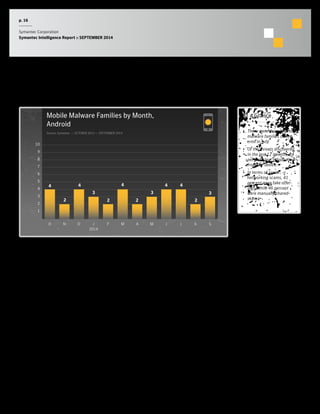
16 Mobile Malware Families by Month, 
Android 
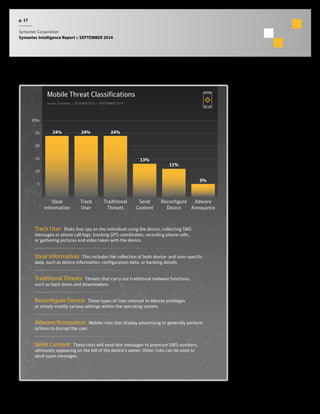
17 Mobile Threat Classifications 
18 Social Media 
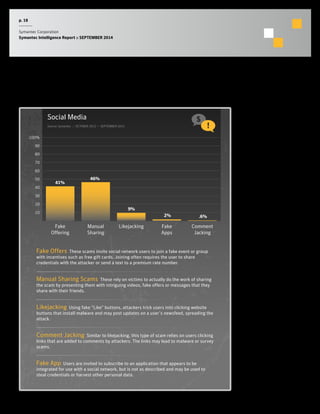
18 Social Media 
19 PHISHING, SPAM + EMAIL THREATS 
20 Phishing and Spam 
20 Phishing Rate 
20 Global Spam Rate 
21 Email Threats 
21 Proportion of Email Traffic 
Containing URL Malware 
21 Proportion of Email Traffic 
in Which Virus Was Detected 
22 About Symantec 
22 More Information
p. 3 
Symantec Corporation 
Symantec Intelligence Report :: SEPTEMBER 2014 
Summary 
Welcome to the September edition of the 
Symantec Intelligence report. Symantec 
Intelligence aims to provide the latest 
analysis of cyber security threats, trends, 
and insights concerning malware, spam, and 
other potentially harmful business risks. 
Symantec has established the most 
comprehensive source of Internet threat 
data in the world through the Symantec™ 
Global Intelligence Network, which is made 
up of more than 41.5 million attack sensors 
and records thousands of events per second. 
This network monitors threat activity in 
over 157 countries and territories through 
a combination of Symantec products and 
services such as Symantec DeepSight™ 
Threat Management System, Symantec™ 
Managed Security Services, Norton™ 
consumer products, and other third-party 
data sources. 
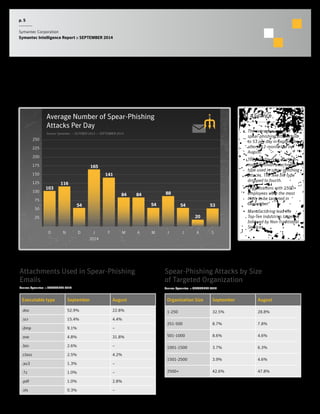
The average number of spear-phishing attacks rose to 53 per day 
in September, after a 12-month low in August. Spear phishing 
activity has returned to levels seen earlier in the summer, but is 
still down from the 12-month average of 85 attacks per day. 
The .doc file type was the most common attachment type used 
in spear-phishing attacks, making up more than 52.9 percent of 
all attachments in September. At 4.8 percent, last month’s top 
attachment, .exe file types, dropped to fourth. 
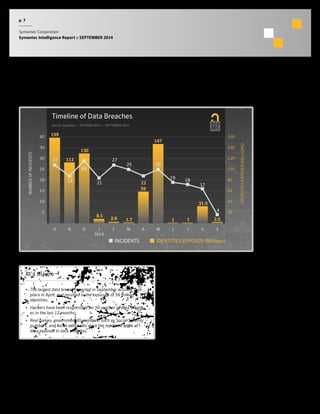
There were only four publically disclosed data breaches that 
took place within the month September, resulting in the 
exposure of 2.5 million identities. However, there were 14 
additional data breaches reported in September that took 
place earlier in the year. The largest data breach reported in 
September actually took place in April, and resulted in the 
exposure of 56 million identities. 
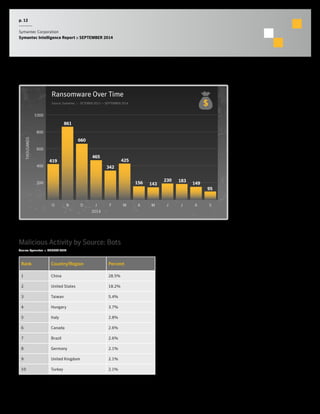
Ransomware continues to decline as 2014 progresses. However, 
crypto-style ransomware remains high, making up 38 percent of 
all ransomware detected in September. 
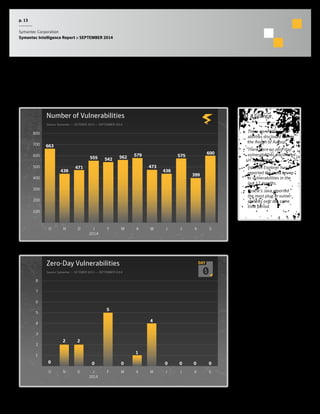
There were 600 vulnerabilities disclosed in the month of 
September, the highest number so far in 2014 and second-high-est 
in the last 12 months. 
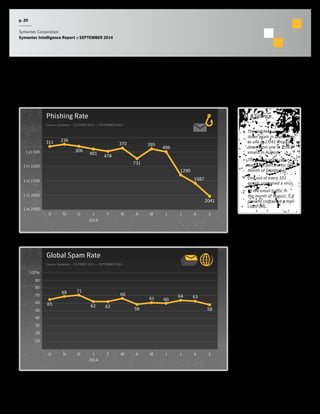
One in 2,041 emails was identified as a phishing attempt, 
compared with one in 1,587 for August. While at first glance this 
looks like a big drop, it results in only a 0.01 percentage point 
decrease in the overall phishing rate. 
We hope that you enjoy this month’s report and feel free to 
contact us with any comments or feedback. 
Ben Nahorney, Cyber Security Threat Analyst 
symantec_intelligence@symantec.com
p. 4 
Symantec Corporation 
Symantec Intelligence Report :: SEPTEMBER 2014 
TARGETED ATTACKS 
+ DATA BREACHES
p. 5 
Symantec Corporation 
Symantec Intelligence Report :: SEPTEMBER 2014 
At a Glance 
• The average number of 
spear-phishing attacks rose 
to 53 per day in September, 
after a 12-month low in 
August. 
• The .doc file type was the 
most common attachment 
type used in spear-phishing 
attacks. The .exe file type 
dropped to fourth. 
• Organizations with 2500+ 
employees were the most 
likely to be targeted in 
September. 
• Manufacturing lead the 
Top-Ten Industries targeted, 
followed by Non-Traditional 
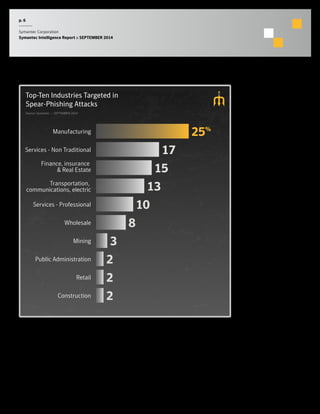
Services. 
Targeted Attacks 
Average Number of Spear-Phishing 
Attacks Per Day 
Source: Symantec :: OCTOBER 2013 — SEPTEMBER 2014 
25 
50 
75 
100 
125 
150 
175 
200 
225 
250 
J F M A M J J A S 
2014 
O N D 
54 53 
20 
116 
54 
141 
84 84 
54 
88 
103 
165 
Attachments Used in Spear-Phishing 
Emails 
Source: Symantec :: SEPTEMBER 2014 
Executable type September August 
.doc 52.9% 22.8% 
.scr 15.4% 4.4% 
.dmp 9.1% – 
.exe 4.8% 31.8% 
.bin 2.6% – 
.class 2.5% 4.2% 
.au3 1.3% – 
.7z 1.0% – 
.pdf 1.0% 2.8% 
.xls 0.3% – 
Spear-Phishing Attacks by Size 
of Targeted Organization 
Source: Symantec :: SEPTEMBER 2014 
Organization Size September August 
1-250 32.5% 28.8% 
251-500 8.7% 7.8% 
501-1000 8.6% 4.6% 
1001-1500 3.7% 6.3% 
1501-2500 3.9% 4.6% 
2500+ 42.6% 47.8%
p. 6 
Symantec Corporation 
Symantec Intelligence Report :: SEPTEMBER 2014 
Top-Ten Industries Targeted in 
Spear-Phishing Attacks 
Source: Symantec :: SEPTEMBER 2014 
Construction 
Retail 
Public Administration 
Mining 
Wholesale 
Services - Professional 
Transportation, 
communications, electric 
Finance, insurance 
& Real Estate 
Services - Non Traditional 
Manufacturing 25% 
17 
15 
13 
10 
8 
3 
2 
2 
2
p. 7 
Symantec Corporation 
Symantec Intelligence Report :: SEPTEMBER 2014 
Data Breaches 
At a Glance 
• The largest data breach reported in September actually took 
place in April, and resulted in the exposure of 56 million 
identities. 
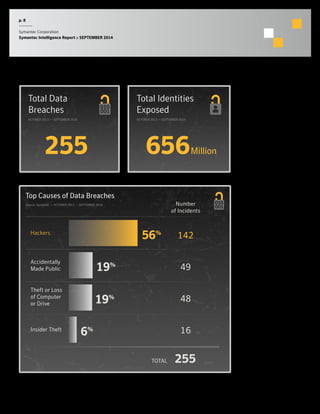
• Hackers have been responsible for 56 percent of data breach-es 
in the last 12 months. 
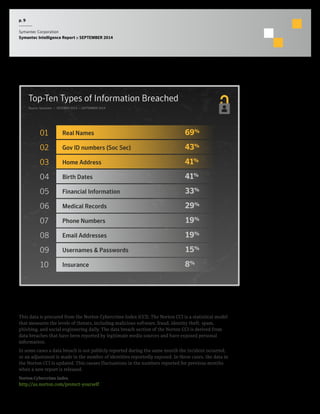
• Real names, government ID numbers, such as Social Security 
numbers, and home addresses were the top three types of 
data exposed in data breaches. 
20 
40 
60 
80 
100 
120 
140 
160 
J F M A M J J A S 
2014 
O N D 
NUMBER OF INCIDENTS 
IDENTITIES EXPOSED (MILLIONS) 
INCIDENTS IDENTITIES EXPOSED (Millions) 
Timeline of Data Breaches 
Source: Symantec :: OCTOBER 2013 — SEPTEMBER 2014 
147 
59 
1 1 
31.5 
2.6 1.7 2.5 8.1 
130 
113 
159 
27 
22 
29 
27 
25 
22 
25 
19 18 
17 
4 
21 
5 
10 
15 
20 
25 
30 
35 
40
p. 8 
Symantec Corporation 
Symantec Intelligence Report :: SEPTEMBER 2014 
Top Causes of Data Breaches 
Source: Symantec :: OCTOBER 2013 — SEPTEMBER 2014 
Insider Theft 
Theft or Loss 
of Computer 
or Drive 
Accidentally 
Made Public 
Hackers 56% 
19% 
19% 
6% 
Number 
of Incidents 
142 
49 
48 
16 
TOTAL 255 
Total Data 
Breaches 
OCTOBER 2013 — SEPTEMBER 2014 
255 
Total Identities 
Exposed 
OCTOBER 2013 — SEPTEMBER 2014 
656Million
p. 9 
Symantec Corporation 
Symantec Intelligence Report :: SEPTEMBER 2014 
Top-Ten Types of Information Breached 
Source: Symantec :: OCTOBER 2013 — SEPTEMBER 2014 
Real Names 
Gov ID numbers (Soc Sec) 
Home Address 
Birth Dates 
Financial Information 
Medical Records 
Phone Numbers 
Email Addresses 
Usernames & Passwords 
Insurance 
01 
02 
03 
04 
05 
06 
07 
08 
09 
10 
69% 
43% 
41% 
41% 
33% 
29% 
19% 
19% 
15% 
8% 
Methodology 
This data is procured from the Norton Cybercrime Index (CCI). The Norton CCI is a statistical model 
that measures the levels of threats, including malicious software, fraud, identity theft, spam, 
phishing, and social engineering daily. The data breach section of the Norton CCI is derived from 
data breaches that have been reported by legitimate media sources and have exposed personal 
information. 
In some cases a data breach is not publicly reported during the same month the incident occurred, 
or an adjustment is made in the number of identities reportedly exposed. In these cases, the data in 
the Norton CCI is updated. This causes fluctuations in the numbers reported for previous months 
when a new report is released. 
Norton Cybercrime Index 
http://us.norton.com/protect-yourself
p. 10 
Symantec Corporation 
Symantec Intelligence Report :: SEPTEMBER 2014 
MALWARE TACTICS
p. 11 
Symantec Corporation 
Symantec Intelligence Report :: SEPTEMBER 2014 
Malware Tactics 
At a Glance 
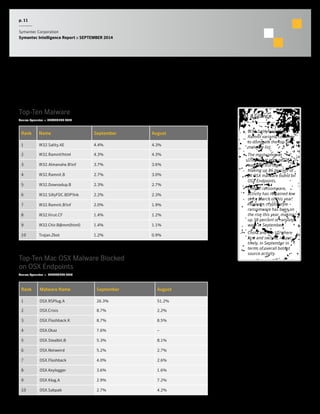
• W32.Sality and W32. 
Ramnit variants continue 
to dominate the top-ten 
malware list. 
• The most common 
OSX threat seen on OSX 
was OSX.RSPlug.A, 
making up 26 percent of 
all OSX malware found on 
OSX Endpoints. 
• Overall ransomware 
activity has remained low 
since March of this year. 
However, crypto-style 
ransomware has been on 
the rise this year, making 
up 38 percent of ransom-ware 
in September. 
• China and the US where 
first and second, respec-tively, 
in September in 
terms of overall botnet 
source activity. 
Top-Ten Malware 
Source: Symantec :: SEPTEMBER 2014 
Rank Name September August 
1 W32.Sality.AE 4.4% 4.3% 
2 W32.Ramnit!html 4.3% 4.3% 
3 W32.Almanahe.B!inf 3.7% 3.6% 
4 W32.Ramnit.B 2.7% 3.0% 
5 W32.Downadup.B 2.3% 2.7% 
6 W32.SillyFDC.BDP!lnk 2.2% 2.3% 
7 W32.Ramnit.B!inf 2.0% 1.9% 
8 W32.Virut.CF 1.4% 1.2% 
9 W32.Chir.B@mm(html) 1.4% 1.1% 
10 Trojan.Zbot 1.2% 0.9% 
Top-Ten Mac OSX Malware Blocked 
on OSX Endpoints 
Source: Symantec :: SEPTEMBER 2014 
Rank Malware Name September August 
1 OSX.RSPlug.A 26.3% 51.2% 
2 OSX.Crisis 8.7% 2.2% 
3 OSX.Flashback.K 8.7% 8.5% 
4 OSX.Okaz 7.6% – 
5 OSX.Stealbit.B 5.3% 8.1% 
6 OSX.Netweird 5.2% 2.7% 
7 OSX.Flashback 4.0% 2.6% 
8 OSX.Keylogger 3.6% 1.6% 
9 OSX.Klog.A 2.9% 7.2% 
10 OSX.Sabpab 2.7% 4.2%
p. 12 
Symantec Corporation 
Symantec Intelligence Report :: SEPTEMBER 2014 
Malicious Activity by Source: Bots 
Source: Symantec :: AUGUST 2014 
Rank Country/Region Percent 
1 China 28.5% 
2 United States 18.2% 
3 Taiwan 5.4% 
4 Hungary 3.7% 
5 Italy 2.8% 
6 Canada 2.6% 
7 Brazil 2.6% 
8 Germany 2.1% 
9 United Kingdom 2.1% 
10 Turkey 2.1% 
Ransomware Over Time 
Source: Symantec :: OCTOBER 2013 — SEPTEMBER 2014 
THOUSANDS 
200 
400 
600 
800 
1000 
J F M A M J J A S 
2014 
O N D 
419 
861 
660 
465 
342 
425 
156 143 
230 183 149 
95
p. 13 
Symantec Corporation 
Symantec Intelligence Report :: SEPTEMBER 2014 
Number of Vulnerabilities 
Source: Symantec :: OCTOBER 2013 — SEPTEMBER 2014 
100 
200 
300 
400 
500 
600 
700 
800 
J F M A M J J A S 
2014 
O N D 
438 
575 600 
399 
438 
471 
542 562 579 
473 
663 
555 
Zero-Day Vulnerabilities 
Source: Symantec :: OCTOBER 2013 — SEPTEMBER 2014 
1 
2 
3 
4 
5 
6 
7 
8 
J F M A M J J A S 
2014 
O N D 
0 0 0 0 0 
2 2 
0 
5 
0 
1 
4 
Vulnerabilities 
At a Glance 
• There were 600 vulner-abilities 
disclosed during 
the month of August. 
• There were no zero-day 
vulnerabilities discovered 
in September. 
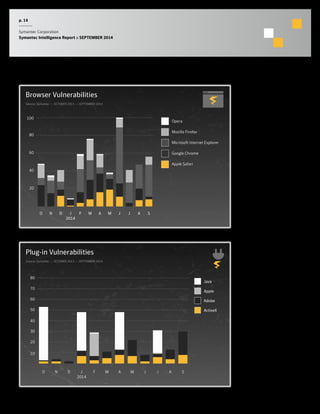
• Internet Explorer has 
reported the most brows-er 
vulnerabilities in the 
last 12 months. 
• Oracle’s Java reported 
the most plug-in vulner-abilities 
over the same 
time period.
p. 14 
Symantec Corporation 
Symantec Intelligence Report :: SEPTEMBER 2014 
Browser Vulnerabilities 
Source: Symantec :: OCTOBER 2013 — SEPTEMBER 2014 
20 
40 
60 
80 
100 
J F M A M J J A S 
2014 
O N D 
Opera 
Mozilla Firefox 
Microsoft Internet Explorer 
Google Chrome 
Apple Safari 
Plug-in Vulnerabilities 
Source: Symantec :: OCTOBER 2013 — SEPTEMBER 2014 
10 
20 
30 
40 
50 
60 
70 
80 
Java 
Apple 
Adobe 
ActiveX 
J F M A M J J A S 
2014 
O N D
p. 15 
Symantec Corporation 
Symantec Intelligence Report :: SEPTEMBER 2014 
SOCIAL MEDIA 
+ MOBILE THREATS
p. 16 
Symantec Corporation 
Symantec Intelligence Report :: SEPTEMBER 2014 
Mobile 
Mobile Malware Families by Month, 
Android 
Source: Symantec :: OCTOBER 2013 — SEPTEMBER 2014 
2 
4 
2 
4 
2 2 
3 3 
4 4 4 
3 
1 
2 
3 
4 
5 
6 
7 
8 
9 
10 
J F M A M J J A S 
2014 
O N D 
At a Glance 
• There were three Android 
malware families discov-ered 
in July. 
• Of the threats discovered 
in the last 12 months, 24 
percent steal information 
from the device. 
• In terms of social 
networking scams, 41 
percent were fake offer-ings, 
while 46 percent 
were manually shared 
scams.
p. 17 
Symantec Corporation 
Symantec Intelligence Report :: SEPTEMBER 2014 
Mobile Threat Classifications 
Source: Symantec :: OCTOBER 2013 — SEPTEMBER 2014 
Track User Risks that spy on the individual using the device, collecting SMS 
messages or phone call logs, tracking GPS coordinates, recording phone calls, 
or gathering pictures and video taken with the device. 
Steal Information This includes the collection of both device- and user-specific 
data, such as device information, configuration data, or banking details. 
Traditional Threats Threats that carry out traditional malware functions, 
such as back doors and downloaders. 
Recongure Device These types of risks attempt to elevate privileges 
or simply modify various settings within the operating system. 
Adware/Annoyance Mobile risks that display advertising or generally perform 
actions to disrupt the user. 
Send Content These risks will send text messages to premium SMS numbers, 
ultimately appearing on the bill of the device’s owner. Other risks can be used to 
send spam messages. 
5 
10 
15 
20 
25 
30% 
Adware 
Annoyance 
Reconfigure 
Device 
Send 
Content 
Traditional 
Threats 
Track 
User 
Steal 
Information 
5% 
11% 
24% 24% 
13% 
24%
p. 18 
Symantec Corporation 
Symantec Intelligence Report :: SEPTEMBER 2014 
Social Media 
Social Media 
Source: Symantec :: OCTOBER 2013 — SEPTEMBER 2014 
Fake Offers These scams invite social network users to join a fake event or group 
with incentives such as free gift cards. Joining often requires the user to share 
credentials with the attacker or send a text to a premium rate number. 
Manual Sharing Scams These rely on victims to actually do the work of sharing 
the scam by presenting them with intriguing videos, fake offers or messages that they 
share with their friends. 
Likejacking Using fake “Like” buttons, attackers trick users into clicking website 
buttons that install malware and may post updates on a user’s newsfeed, spreading the 
attack. 
Comment Jacking Similar to likejacking, this type of scam relies on users clicking 
links that are added to comments by attackers. The links may lead to malware or survey 
scams. 
Fake App Users are invited to subscribe to an application that appears to be 
integrated for use with a social network, but is not as described and may be used to 
steal credentials or harvest other personal data. 
10 
20 
30 
40 
50 
60 
70 
80 
90 
100% 
Comment 
Jacking 
Fake 
Apps 
Manual Likejacking 
Sharing 
Fake 
Offering 
2% .6% 
41% 
46% 
9%
p. 19 
Symantec Corporation 
Symantec Intelligence Report :: SEPTEMBER 2014 
PHISHING, SPAM + EMAIL THREATS
p. 20 
Symantec Corporation 
Symantec Intelligence Report :: SEPTEMBER 2014 
Phishing and Spam 
Phishing Rate 
Source: Symantec :: OCTOBER 2013 — SEPTEMBER 2014 
1 in 500 
1 in 1000 
1 in 1500 
1 in 2000 
1 in 2500 
J F M A M J J A S 
2014 
O N D 
2041 
311 236 
306 
401 478 
370 
731 
395 
496 
1290 
1587 
At a Glance 
• The phishing rate was 
down again in September, 
at one in 2,041 emails, 
down from one in 1,587 
emails in August. 
• The global spam rate 
was 57.9 percent for the 
month of September. 
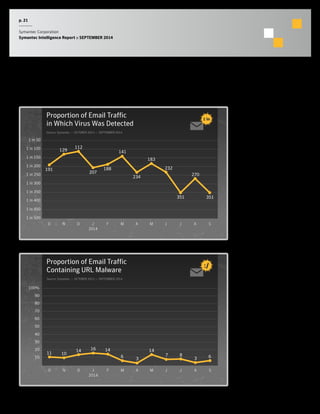
• One out of every 351 
emails contained a virus. 
• Of the email traffic in 
the month of August, 5.8 
percent contained a mali-cious 
URL. 
Global Spam Rate 
Source: Symantec :: OCTOBER 2013 — SEPTEMBER 2014 
10 
20 
30 
40 
50 
60 
70 
80 
90 
100% 
J F M A M J J A S 
2014 
O N D 
65 
69 71 
62 62 
66 
59 
61 60 
64 63 
58
p. 21 
Symantec Corporation 
Symantec Intelligence Report :: SEPTEMBER 2014 
Email Threats 
Proportion of Email Traffic 
Containing URL Malware 
Source: Symantec :: OCTOBER 2013 — SEPTEMBER 2014 
10 
20 
30 
40 
50 
60 
70 
80 
90 
100% 
J F M A M J J A S 
2014 
O N D 
6 
11 10 
14 16 14 
6 3 
14 
7 8 
3 
1 in 50 
1 in 100 
1 in 150 
1 in 200 
1 in 250 
1 in 300 
1 in 350 
1 in 400 
1 in 450 
1 in 500 
J F M A M J J A S 
2014 
O N D 
Proportion of Email Traffic 
in Which Virus Was Detected 
Source: Symantec :: OCTOBER 2013 — SEPTEMBER 2014 
351 
191 
129 
112 
207 
188 
141 
234 
183 
232 
351 
270
p. 22 
Symantec Corporation 
Symantec Intelligence Report :: SEPTEMBER 2014 
About Symantec 
More Information 
• Symantec Worldwide: http://www.symantec.com/ 
• ISTR and Symantec Intelligence Resources: http://www.symantec.com/threatreport/ 
• Symantec Security Response: http://www.symantec.com/security_response/ 
• Norton Threat Explorer: http://us.norton.com/security_response/threatexplorer/ 
• Norton Cybercrime Index: http://us.norton.com/cybercrimeindex/ 
Symantec Corporation (NASDAQ: SYMC) is an information protection expert that helps 
people, businesses and governments seeking the freedom to unlock the opportunities 
technology brings – anytime, anywhere. Founded in April 1982, Symantec, a Fortune 
500 company, operating one of the largest global data-intelligence networks, has 
provided leading security, backup and availability solutions for where vital information 
is stored, accessed and shared. The company’s more than 20,000 employees reside in 
more than 50 countries. Ninety-nine percent of Fortune 500 companies are Symantec 
customers. In fiscal 2013, it recorded revenues of $6.9 billion. To learn more go to 
www.symantec.com or connect with Symantec at: go.symantec.com/socialmedia.
For specific country offices and contact numbers, 
please visit our website. 
For product information in the U.S., 
call toll-free 1 (800) 745 6054. 
Symantec Corporation World Headquarters 
350 Ellis Street 
Mountain View, CA 94043 USA 
+1 (650) 527 8000 
1 (800) 721 3934 
www.symantec.com 
Copyright © 2014 Symantec Corporation. 
All rights reserved. Symantec, the Symantec Logo, 
and the Checkmark Logo are trademarks or registered 
trademarks of Symantec Corporation or its affiliates in 
the U.S. and other countries. Other names may 
be trademarks of their respective owners

Symantec Intelligence Report September 2014

  • 1.
  • 2.
    p. 2 SymantecCorporation Symantec Intelligence Report :: SEPTEMBER 2014 CONTENTS 3 Summary 4 TARGETED ATTACKS + DATA BREACHES 5 Targeted Attacks 5 Attachments Used in Spear-Phishing Emails 5 Spear-Phishing Attacks by Size of Targeted Organization 5 Average Number of Spear-Phishing Attacks Per Day 6 Top-Ten Industries Targeted in Spear-Phishing Attacks 7 Data Breaches 7 Timeline of Data Breaches 8 Total Identities Exposed 8 Top Causes of Data Breaches 8 Total Data Breaches 9 Top-Ten Types of Information Breached 10 MALWARE TACTICS 11 Malware Tactics 11 Top-Ten Malware 11 Top-Ten Mac OSX Malware Blocked on OSX Endpoints 12 Ransomware Over Time 12 Malicious Activity by Source: Bots 13 Vulnerabilities 13 Number of Vulnerabilities 13 Zero-Day Vulnerabilities 14 Browser Vulnerabilities 14 Plug-in Vulnerabilities 15 SOCIAL MEDIA + MOBILE THREATS 16 Mobile 16 Mobile Malware Families by Month, Android 17 Mobile Threat Classifications 18 Social Media 18 Social Media 19 PHISHING, SPAM + EMAIL THREATS 20 Phishing and Spam 20 Phishing Rate 20 Global Spam Rate 21 Email Threats 21 Proportion of Email Traffic Containing URL Malware 21 Proportion of Email Traffic in Which Virus Was Detected 22 About Symantec 22 More Information
  • 3.
    p. 3 SymantecCorporation Symantec Intelligence Report :: SEPTEMBER 2014 Summary Welcome to the September edition of the Symantec Intelligence report. Symantec Intelligence aims to provide the latest analysis of cyber security threats, trends, and insights concerning malware, spam, and other potentially harmful business risks. Symantec has established the most comprehensive source of Internet threat data in the world through the Symantec™ Global Intelligence Network, which is made up of more than 41.5 million attack sensors and records thousands of events per second. This network monitors threat activity in over 157 countries and territories through a combination of Symantec products and services such as Symantec DeepSight™ Threat Management System, Symantec™ Managed Security Services, Norton™ consumer products, and other third-party data sources. The average number of spear-phishing attacks rose to 53 per day in September, after a 12-month low in August. Spear phishing activity has returned to levels seen earlier in the summer, but is still down from the 12-month average of 85 attacks per day. The .doc file type was the most common attachment type used in spear-phishing attacks, making up more than 52.9 percent of all attachments in September. At 4.8 percent, last month’s top attachment, .exe file types, dropped to fourth. There were only four publically disclosed data breaches that took place within the month September, resulting in the exposure of 2.5 million identities. However, there were 14 additional data breaches reported in September that took place earlier in the year. The largest data breach reported in September actually took place in April, and resulted in the exposure of 56 million identities. Ransomware continues to decline as 2014 progresses. However, crypto-style ransomware remains high, making up 38 percent of all ransomware detected in September. There were 600 vulnerabilities disclosed in the month of September, the highest number so far in 2014 and second-high-est in the last 12 months. One in 2,041 emails was identified as a phishing attempt, compared with one in 1,587 for August. While at first glance this looks like a big drop, it results in only a 0.01 percentage point decrease in the overall phishing rate. We hope that you enjoy this month’s report and feel free to contact us with any comments or feedback. Ben Nahorney, Cyber Security Threat Analyst symantec_intelligence@symantec.com
  • 4.
    p. 4 SymantecCorporation Symantec Intelligence Report :: SEPTEMBER 2014 TARGETED ATTACKS + DATA BREACHES
  • 5.
    p. 5 SymantecCorporation Symantec Intelligence Report :: SEPTEMBER 2014 At a Glance • The average number of spear-phishing attacks rose to 53 per day in September, after a 12-month low in August. • The .doc file type was the most common attachment type used in spear-phishing attacks. The .exe file type dropped to fourth. • Organizations with 2500+ employees were the most likely to be targeted in September. • Manufacturing lead the Top-Ten Industries targeted, followed by Non-Traditional Services. Targeted Attacks Average Number of Spear-Phishing Attacks Per Day Source: Symantec :: OCTOBER 2013 — SEPTEMBER 2014 25 50 75 100 125 150 175 200 225 250 J F M A M J J A S 2014 O N D 54 53 20 116 54 141 84 84 54 88 103 165 Attachments Used in Spear-Phishing Emails Source: Symantec :: SEPTEMBER 2014 Executable type September August .doc 52.9% 22.8% .scr 15.4% 4.4% .dmp 9.1% – .exe 4.8% 31.8% .bin 2.6% – .class 2.5% 4.2% .au3 1.3% – .7z 1.0% – .pdf 1.0% 2.8% .xls 0.3% – Spear-Phishing Attacks by Size of Targeted Organization Source: Symantec :: SEPTEMBER 2014 Organization Size September August 1-250 32.5% 28.8% 251-500 8.7% 7.8% 501-1000 8.6% 4.6% 1001-1500 3.7% 6.3% 1501-2500 3.9% 4.6% 2500+ 42.6% 47.8%
  • 6.
    p. 6 SymantecCorporation Symantec Intelligence Report :: SEPTEMBER 2014 Top-Ten Industries Targeted in Spear-Phishing Attacks Source: Symantec :: SEPTEMBER 2014 Construction Retail Public Administration Mining Wholesale Services - Professional Transportation, communications, electric Finance, insurance & Real Estate Services - Non Traditional Manufacturing 25% 17 15 13 10 8 3 2 2 2
  • 7.
    p. 7 SymantecCorporation Symantec Intelligence Report :: SEPTEMBER 2014 Data Breaches At a Glance • The largest data breach reported in September actually took place in April, and resulted in the exposure of 56 million identities. • Hackers have been responsible for 56 percent of data breach-es in the last 12 months. • Real names, government ID numbers, such as Social Security numbers, and home addresses were the top three types of data exposed in data breaches. 20 40 60 80 100 120 140 160 J F M A M J J A S 2014 O N D NUMBER OF INCIDENTS IDENTITIES EXPOSED (MILLIONS) INCIDENTS IDENTITIES EXPOSED (Millions) Timeline of Data Breaches Source: Symantec :: OCTOBER 2013 — SEPTEMBER 2014 147 59 1 1 31.5 2.6 1.7 2.5 8.1 130 113 159 27 22 29 27 25 22 25 19 18 17 4 21 5 10 15 20 25 30 35 40
  • 8.
    p. 8 SymantecCorporation Symantec Intelligence Report :: SEPTEMBER 2014 Top Causes of Data Breaches Source: Symantec :: OCTOBER 2013 — SEPTEMBER 2014 Insider Theft Theft or Loss of Computer or Drive Accidentally Made Public Hackers 56% 19% 19% 6% Number of Incidents 142 49 48 16 TOTAL 255 Total Data Breaches OCTOBER 2013 — SEPTEMBER 2014 255 Total Identities Exposed OCTOBER 2013 — SEPTEMBER 2014 656Million
  • 9.
    p. 9 SymantecCorporation Symantec Intelligence Report :: SEPTEMBER 2014 Top-Ten Types of Information Breached Source: Symantec :: OCTOBER 2013 — SEPTEMBER 2014 Real Names Gov ID numbers (Soc Sec) Home Address Birth Dates Financial Information Medical Records Phone Numbers Email Addresses Usernames & Passwords Insurance 01 02 03 04 05 06 07 08 09 10 69% 43% 41% 41% 33% 29% 19% 19% 15% 8% Methodology This data is procured from the Norton Cybercrime Index (CCI). The Norton CCI is a statistical model that measures the levels of threats, including malicious software, fraud, identity theft, spam, phishing, and social engineering daily. The data breach section of the Norton CCI is derived from data breaches that have been reported by legitimate media sources and have exposed personal information. In some cases a data breach is not publicly reported during the same month the incident occurred, or an adjustment is made in the number of identities reportedly exposed. In these cases, the data in the Norton CCI is updated. This causes fluctuations in the numbers reported for previous months when a new report is released. Norton Cybercrime Index http://us.norton.com/protect-yourself
  • 10.
    p. 10 SymantecCorporation Symantec Intelligence Report :: SEPTEMBER 2014 MALWARE TACTICS
  • 11.
    p. 11 SymantecCorporation Symantec Intelligence Report :: SEPTEMBER 2014 Malware Tactics At a Glance • W32.Sality and W32. Ramnit variants continue to dominate the top-ten malware list. • The most common OSX threat seen on OSX was OSX.RSPlug.A, making up 26 percent of all OSX malware found on OSX Endpoints. • Overall ransomware activity has remained low since March of this year. However, crypto-style ransomware has been on the rise this year, making up 38 percent of ransom-ware in September. • China and the US where first and second, respec-tively, in September in terms of overall botnet source activity. Top-Ten Malware Source: Symantec :: SEPTEMBER 2014 Rank Name September August 1 W32.Sality.AE 4.4% 4.3% 2 W32.Ramnit!html 4.3% 4.3% 3 W32.Almanahe.B!inf 3.7% 3.6% 4 W32.Ramnit.B 2.7% 3.0% 5 W32.Downadup.B 2.3% 2.7% 6 W32.SillyFDC.BDP!lnk 2.2% 2.3% 7 W32.Ramnit.B!inf 2.0% 1.9% 8 W32.Virut.CF 1.4% 1.2% 9 W32.Chir.B@mm(html) 1.4% 1.1% 10 Trojan.Zbot 1.2% 0.9% Top-Ten Mac OSX Malware Blocked on OSX Endpoints Source: Symantec :: SEPTEMBER 2014 Rank Malware Name September August 1 OSX.RSPlug.A 26.3% 51.2% 2 OSX.Crisis 8.7% 2.2% 3 OSX.Flashback.K 8.7% 8.5% 4 OSX.Okaz 7.6% – 5 OSX.Stealbit.B 5.3% 8.1% 6 OSX.Netweird 5.2% 2.7% 7 OSX.Flashback 4.0% 2.6% 8 OSX.Keylogger 3.6% 1.6% 9 OSX.Klog.A 2.9% 7.2% 10 OSX.Sabpab 2.7% 4.2%
  • 12.
    p. 12 SymantecCorporation Symantec Intelligence Report :: SEPTEMBER 2014 Malicious Activity by Source: Bots Source: Symantec :: AUGUST 2014 Rank Country/Region Percent 1 China 28.5% 2 United States 18.2% 3 Taiwan 5.4% 4 Hungary 3.7% 5 Italy 2.8% 6 Canada 2.6% 7 Brazil 2.6% 8 Germany 2.1% 9 United Kingdom 2.1% 10 Turkey 2.1% Ransomware Over Time Source: Symantec :: OCTOBER 2013 — SEPTEMBER 2014 THOUSANDS 200 400 600 800 1000 J F M A M J J A S 2014 O N D 419 861 660 465 342 425 156 143 230 183 149 95
  • 13.
    p. 13 SymantecCorporation Symantec Intelligence Report :: SEPTEMBER 2014 Number of Vulnerabilities Source: Symantec :: OCTOBER 2013 — SEPTEMBER 2014 100 200 300 400 500 600 700 800 J F M A M J J A S 2014 O N D 438 575 600 399 438 471 542 562 579 473 663 555 Zero-Day Vulnerabilities Source: Symantec :: OCTOBER 2013 — SEPTEMBER 2014 1 2 3 4 5 6 7 8 J F M A M J J A S 2014 O N D 0 0 0 0 0 2 2 0 5 0 1 4 Vulnerabilities At a Glance • There were 600 vulner-abilities disclosed during the month of August. • There were no zero-day vulnerabilities discovered in September. • Internet Explorer has reported the most brows-er vulnerabilities in the last 12 months. • Oracle’s Java reported the most plug-in vulner-abilities over the same time period.
  • 14.
    p. 14 SymantecCorporation Symantec Intelligence Report :: SEPTEMBER 2014 Browser Vulnerabilities Source: Symantec :: OCTOBER 2013 — SEPTEMBER 2014 20 40 60 80 100 J F M A M J J A S 2014 O N D Opera Mozilla Firefox Microsoft Internet Explorer Google Chrome Apple Safari Plug-in Vulnerabilities Source: Symantec :: OCTOBER 2013 — SEPTEMBER 2014 10 20 30 40 50 60 70 80 Java Apple Adobe ActiveX J F M A M J J A S 2014 O N D
  • 15.
    p. 15 SymantecCorporation Symantec Intelligence Report :: SEPTEMBER 2014 SOCIAL MEDIA + MOBILE THREATS
  • 16.
    p. 16 SymantecCorporation Symantec Intelligence Report :: SEPTEMBER 2014 Mobile Mobile Malware Families by Month, Android Source: Symantec :: OCTOBER 2013 — SEPTEMBER 2014 2 4 2 4 2 2 3 3 4 4 4 3 1 2 3 4 5 6 7 8 9 10 J F M A M J J A S 2014 O N D At a Glance • There were three Android malware families discov-ered in July. • Of the threats discovered in the last 12 months, 24 percent steal information from the device. • In terms of social networking scams, 41 percent were fake offer-ings, while 46 percent were manually shared scams.
  • 17.
    p. 17 SymantecCorporation Symantec Intelligence Report :: SEPTEMBER 2014 Mobile Threat Classifications Source: Symantec :: OCTOBER 2013 — SEPTEMBER 2014 Track User Risks that spy on the individual using the device, collecting SMS messages or phone call logs, tracking GPS coordinates, recording phone calls, or gathering pictures and video taken with the device. Steal Information This includes the collection of both device- and user-specific data, such as device information, configuration data, or banking details. Traditional Threats Threats that carry out traditional malware functions, such as back doors and downloaders. Recongure Device These types of risks attempt to elevate privileges or simply modify various settings within the operating system. Adware/Annoyance Mobile risks that display advertising or generally perform actions to disrupt the user. Send Content These risks will send text messages to premium SMS numbers, ultimately appearing on the bill of the device’s owner. Other risks can be used to send spam messages. 5 10 15 20 25 30% Adware Annoyance Reconfigure Device Send Content Traditional Threats Track User Steal Information 5% 11% 24% 24% 13% 24%
  • 18.
    p. 18 SymantecCorporation Symantec Intelligence Report :: SEPTEMBER 2014 Social Media Social Media Source: Symantec :: OCTOBER 2013 — SEPTEMBER 2014 Fake Offers These scams invite social network users to join a fake event or group with incentives such as free gift cards. Joining often requires the user to share credentials with the attacker or send a text to a premium rate number. Manual Sharing Scams These rely on victims to actually do the work of sharing the scam by presenting them with intriguing videos, fake offers or messages that they share with their friends. Likejacking Using fake “Like” buttons, attackers trick users into clicking website buttons that install malware and may post updates on a user’s newsfeed, spreading the attack. Comment Jacking Similar to likejacking, this type of scam relies on users clicking links that are added to comments by attackers. The links may lead to malware or survey scams. Fake App Users are invited to subscribe to an application that appears to be integrated for use with a social network, but is not as described and may be used to steal credentials or harvest other personal data. 10 20 30 40 50 60 70 80 90 100% Comment Jacking Fake Apps Manual Likejacking Sharing Fake Offering 2% .6% 41% 46% 9%
  • 19.
    p. 19 SymantecCorporation Symantec Intelligence Report :: SEPTEMBER 2014 PHISHING, SPAM + EMAIL THREATS
  • 20.
    p. 20 SymantecCorporation Symantec Intelligence Report :: SEPTEMBER 2014 Phishing and Spam Phishing Rate Source: Symantec :: OCTOBER 2013 — SEPTEMBER 2014 1 in 500 1 in 1000 1 in 1500 1 in 2000 1 in 2500 J F M A M J J A S 2014 O N D 2041 311 236 306 401 478 370 731 395 496 1290 1587 At a Glance • The phishing rate was down again in September, at one in 2,041 emails, down from one in 1,587 emails in August. • The global spam rate was 57.9 percent for the month of September. • One out of every 351 emails contained a virus. • Of the email traffic in the month of August, 5.8 percent contained a mali-cious URL. Global Spam Rate Source: Symantec :: OCTOBER 2013 — SEPTEMBER 2014 10 20 30 40 50 60 70 80 90 100% J F M A M J J A S 2014 O N D 65 69 71 62 62 66 59 61 60 64 63 58
  • 21.
    p. 21 SymantecCorporation Symantec Intelligence Report :: SEPTEMBER 2014 Email Threats Proportion of Email Traffic Containing URL Malware Source: Symantec :: OCTOBER 2013 — SEPTEMBER 2014 10 20 30 40 50 60 70 80 90 100% J F M A M J J A S 2014 O N D 6 11 10 14 16 14 6 3 14 7 8 3 1 in 50 1 in 100 1 in 150 1 in 200 1 in 250 1 in 300 1 in 350 1 in 400 1 in 450 1 in 500 J F M A M J J A S 2014 O N D Proportion of Email Traffic in Which Virus Was Detected Source: Symantec :: OCTOBER 2013 — SEPTEMBER 2014 351 191 129 112 207 188 141 234 183 232 351 270
  • 22.
    p. 22 SymantecCorporation Symantec Intelligence Report :: SEPTEMBER 2014 About Symantec More Information • Symantec Worldwide: http://www.symantec.com/ • ISTR and Symantec Intelligence Resources: http://www.symantec.com/threatreport/ • Symantec Security Response: http://www.symantec.com/security_response/ • Norton Threat Explorer: http://us.norton.com/security_response/threatexplorer/ • Norton Cybercrime Index: http://us.norton.com/cybercrimeindex/ Symantec Corporation (NASDAQ: SYMC) is an information protection expert that helps people, businesses and governments seeking the freedom to unlock the opportunities technology brings – anytime, anywhere. Founded in April 1982, Symantec, a Fortune 500 company, operating one of the largest global data-intelligence networks, has provided leading security, backup and availability solutions for where vital information is stored, accessed and shared. The company’s more than 20,000 employees reside in more than 50 countries. Ninety-nine percent of Fortune 500 companies are Symantec customers. In fiscal 2013, it recorded revenues of $6.9 billion. To learn more go to www.symantec.com or connect with Symantec at: go.symantec.com/socialmedia.
  • 23.
    For specific countryoffices and contact numbers, please visit our website. For product information in the U.S., call toll-free 1 (800) 745 6054. Symantec Corporation World Headquarters 350 Ellis Street Mountain View, CA 94043 USA +1 (650) 527 8000 1 (800) 721 3934 www.symantec.com Copyright © 2014 Symantec Corporation. All rights reserved. Symantec, the Symantec Logo, and the Checkmark Logo are trademarks or registered trademarks of Symantec Corporation or its affiliates in the U.S. and other countries. Other names may be trademarks of their respective owners