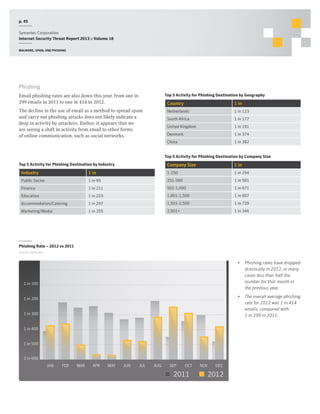
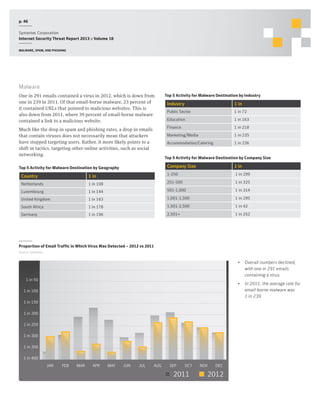
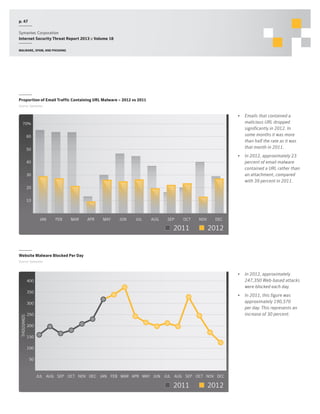
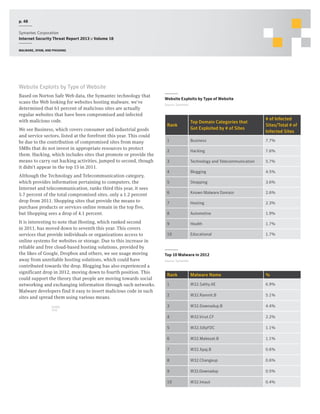
2012 Trends, Volume 18, Published April 2013

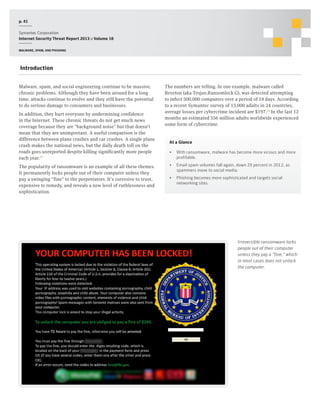
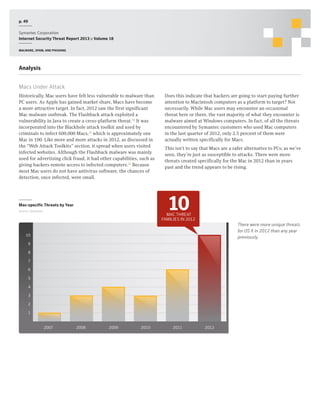
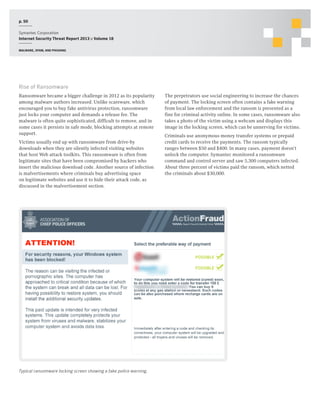
internet security THREAT REPORT

2013
p. 2
Symantec Corporation
Internet Security Threat Report 2013 :: Volume 18

CONTENTS
03	Introduction

31	 Social Networking, Mobile, and the Cloud

04	 Executive Summary

32	Introduction
32	Data

06	 2012 Security Timeline
35	Analysis

09	 2012 in Numbers

35		 Spam and Phishing Move to Social Media
37		 Mobile Threats

13	 Targeted Attacks, Hacktivism, and Data Breaches

38		 Cloud Computing Risks

14	Introduction
14	Data

40	 Malware, Spam, and Phishing

17		 DDoS Used as a Diversion

41	Introduction

17		 Data Breaches

42	Data

19	Analysis

42		Spam

19		 Cyberwarfare, Cybersabotage, and Industrial Espionage

45		Phishing

20		 Advanced Persistent Threats and Targeted Attacks

46		Malware

20		 Social Engineering and Indirect Attacks

48		 Website Exploits by Type of Website

21		 Watering Hole Attacks

49	Analysis
49		 Macs Under Attack

23	 Vulnerabilities, Exploits, and Toolkits

50		 Rise of Ransomware

24	Introduction

51		 Long-term Stealthy Malware

24	Data

51		 Email Spam Volume Down

26	Analysis

51		 Advanced Phishing

26		 Web-based Attacks on the Rise
27		 The Arms Race to Exploit New Vulnerabilities

53	 Looking ahead

27		 Malvertising and Website Hacking

56	Endnotes

28		Web Attack Toolkits

57	 About Symantec

29		 Website Malware Scanning and Website

57	 More Information

		 Vulnerability Assessment

29		 The Growth of Secured Connections
29		 Norton Secured Seal and Trust Marks
29		 Stolen Key-signing Certificates
p. 3
Symantec Corporation
Internet Security Threat Report 2013 :: Volume 18

Introduction

Symantec has established some of the most
comprehensive sources of Internet threat
data in the world through the Symantec™
Global Intelligence Network, which is made
up of approximately 69 million attack
sensors and records thousands of events
per second. This network monitors threat
activity in over 157 countries and territories
through a combination of Symantec
products and services such as Symantec
DeepSight™ Threat Management System,
Symantec™ Managed Security Services and
Norton™ consumer products, and other
third-party data sources.

In addition, Symantec maintains one of the world’s most
comprehensive vulnerability databases, currently consisting of
more than 51,644 recorded vulnerabilities (spanning more than
two decades) from over 16,687 vendors representing over 43,391
products.
Spam, phishing, and malware data is captured through a variety
of sources, including the Symantec Probe Network, a system
of more than 5 million decoy accounts; Symantec.cloud and
a number of other Symantec security technologies. Skeptic™,
the Symantec.cloud proprietary heuristic technology, is able to
detect new and sophisticated targeted threats before reaching
customers’ networks. Over 3 billion email messages and more
than 1.4 billion Web requests are processed each day across
14 data centers. Symantec also gathers phishing information
through an extensive antifraud community of enterprises,
security vendors, and more than 50 million consumers.
Symantec Trust Services provides 100 percent availability and
processes over 4.5 billion Online Certificate Status Protocol
(OCSP) look-ups per day, which are used for obtaining the
revocation status of X.509 digital certificates around the world.
These resources give Symantec’s analysts unparalleled sources
of data with which to identify, analyze, and provide informed
commentary on emerging trends in attacks, malicious code
activity, phishing, and spam. The result is the annual Symantec
Internet Security Threat Report, which gives enterprises, small
businesses, and consumers the essential information to secure
their systems effectively now and into the future.
SHARE
THIS
p. 4
Symantec Corporation
Internet Security Threat Report 2013 :: Volume 18

Executive Summary

Threats to online security have grown and evolved considerably in 2012. From the threats of
cyberespionage and industrial espionage to the widespread, chronic problems of malware
and phishing, we have seen constant innovation from malware authors.
We have also seen an expansion of traditional threats into new forums. In particular, social
media and mobile devices have come under increasing attack in 2012, even as spam and
phishing attacks via traditional routes have fallen. Online criminals are following users onto
these new platforms.
The most important trends in 2012 were:
Small Businesses Are the Path of Least Resistance
for Attackers
Last year’s data made it clear that any business, no matter its
size, was a potential target for attackers. This was not a fluke. In
2012, 50 percent of all targeted attacks were aimed at businesses
with fewer than 2,500 employees. In fact, the largest growth area
for targeted attacks in 2012 was businesses with fewer than 250
employees; 31 percent of all attacks targeted them.
This is especially bad news because based on surveys conducted
by Symantec, small businesses believe they are immune to
attacks targeted at them. However, money stolen from a small
business is as easy to spend as money stolen from a large
business. And while small businesses may assume that they
have nothing a targeted attacker would want to steal, they
forget that they retain customer information, create intellectual
property, and keep money in the bank. While it can be argued
that the rewards of attacking a small business are less than
what can be gained from a large enterprise, this is more than
compensated by the fact that many small companies are
typically less careful in their cyberdefenses. Criminal activity is
often driven by crimes of opportunity. With cybercrimes, that
opportunity appears to be with small businesses.
Even worse, the lack of adequate security practices by small
businesses threatens all of us. Attackers deterred by a large
company’s defenses often choose to breach the lesser defenses
of a small business that has a business relationship with the
attacker’s ultimate target, using the smaller company to leap
frog into the larger one.
Additionally, small businesses and organizations can become
pawns in more sophisticated attacks. Driven by attack toolkits,
in 2012 the number of Web-based attacks increased by one third
and many of these attacks originated from the compromised
websites of small businesses. These massive attacks increase

the risk of infection for all of us. But even more nefariously, as
reported in our Elderwood white paper last year, the websites
of small businesses and organizations are even being used
in targeted attacks. Supplementing their phishing attacks,
cyberespionage gangs now hijack these websites, lying in wait
for their targets to visit so that they can infect them. This
type of attack, called a watering hole, is another way attackers
leverage weak security of one entity to defeat the strong security
of another.

Malware Authors Act as Big Brother
If you think someone is violating your privacy online, you are
probably right. Fifty percent of mobile malware created in 2012
attempted to steal our information or track our movements.
Whether they are attacking our computers, mobile phones or
social networks, Cyber-criminals are looking to profit by spying
on us. Their ultimate goal is to make money. Their method is to
learn our banking information, the phone numbers and email
addresses of our friends and business associates, our personal
information, and even how to become us by stealing our identity.
But the most ominous example of malware authors knowing
all about us is in targeted attacks. Creating successful targeted
attacks requires attackers to learn about us. They will research
our email addresses, our job, our professional interests, and even
the conferences we attend and the websites we frequent. All
of this information is compiled to launch a successful targeted
attack. Once on our devices, the attacker’s tools are designed
to pull as much data as possible. Undiscovered targeted attacks
can collect years of our email, files, and contact information.
These tools also contain the ability to log our keystrokes, view
our computer screens, and turn on our computers’ microphones
and cameras. Targeted attackers truly act as an Orwellian
incarnation of Big Brother.
SHARE
THIS
p. 5
Symantec Corporation
Internet Security Threat Report 2013 :: Volume 18

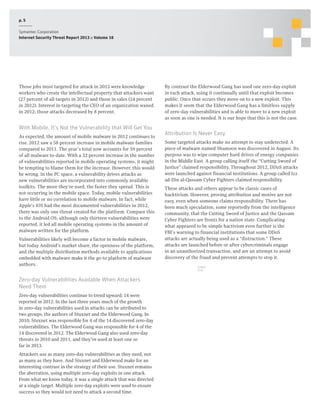
Those jobs most targeted for attack in 2012 were knowledge
workers who create the intellectual property that attackers want
(27 percent of all targets in 2012) and those in sales (24 percent
in 2012). Interest in targeting the CEO of an organization waned
in 2012; those attacks decreased by 8 percent.

With Mobile, It’s Not the Vulnerability that Will Get You
As expected, the amount of mobile malware in 2012 continues to
rise. 2012 saw a 58 percent increase in mobile malware families
compared to 2011. The year’s total now accounts for 59 percent
of all malware to-date. With a 32 percent increase in the number
of vulnerabilities reported in mobile operating systems, it might
be tempting to blame them for the increase. However, this would
be wrong. In the PC space, a vulnerability drives attacks as
new vulnerabilities are incorporated into commonly available
toolkits. The more they’re used, the faster they spread. This is
not occurring in the mobile space. Today, mobile vulnerabilities
have little or no correlation to mobile malware. In fact, while
Apple’s iOS had the most documented vulnerabilities in 2012,
there was only one threat created for the platform. Compare this
to the Android OS; although only thirteen vulnerabilities were
reported, it led all mobile operating systems in the amount of
malware written for the platform.
Vulnerabilities likely will become a factor in mobile malware,
but today Android’s market share, the openness of the platform,
and the multiple distribution methods available to applications
embedded with malware make it the go-to platform of malware
authors.

Zero-day Vulnerabilities Available When Attackers
Need Them
Zero-day vulnerabilities continue to trend upward; 14 were
reported in 2012. In the last three years much of the growth
in zero-day vulnerabilities used in attacks can be attributed to
two groups; the authors of Stuxnet and the Elderwood Gang. In
2010, Stuxnet was responsible for 4 of the 14 discovered zero-day
vulnerabilities. The Elderwood Gang was responsible for 4 of the
14 discovered in 2012. The Elderwood Gang also used zero-day
threats in 2010 and 2011, and they’ve used at least one so
far in 2013.
Attackers use as many zero-day vulnerabilities as they need, not
as many as they have. And Stuxnet and Elderwood make for an
interesting contrast in the strategy of their use. Stuxnet remains
the aberration, using multiple zero-day exploits in one attack.
From what we know today, it was a single attack that was directed
at a single target. Multiple zero-day exploits were used to ensure
success so they would not need to attack a second time.

By contrast the Elderwood Gang has used one zero-day exploit
in each attack, using it continually until that exploit becomes
public. Once that occurs they move on to a new exploit. This
makes it seem that the Elderwood Gang has a limitless supply
of zero-day vulnerabilities and is able to move to a new exploit
as soon as one is needed. It is our hope that this is not the case.

Attribution Is Never Easy
Some targeted attacks make no attempt to stay undetected. A
piece of malware named Shamoon was discovered in August. Its
purpose was to wipe computer hard drives of energy companies
in the Middle East. A group calling itself the “Cutting Sword of
Justice” claimed responsibility. Throughout 2012, DDoS attacks
were launched against financial institutions. A group called Izz
ad-Din al-Qassam Cyber Fighters claimed responsibility.
These attacks and others appear to be classic cases of
hacktivism. However, proving attribution and motive are not
easy, even when someone claims responsibility. There has
been much speculation, some reportedly from the intelligence
community, that the Cutting Sword of Justice and the Qassam
Cyber Fighters are fronts for a nation state. Complicating
what appeared to be simple hactivism even further is the
FBI’s warning to financial institutions that some DDoS
attacks are actually being used as a “distraction.” These
attacks are launched before or after cybercriminals engage
in an unauthorized transaction, and are an attempt to avoid
discovery of the fraud and prevent attempts to stop it.
SHARE
THIS
p. 6
Symantec Corporation
Internet Security Threat Report 2013 :: Volume 18

2012 SECURITY TIMELINE
p. 7
Symantec Corporation
Internet Security Threat Report 2013 :: Volume 18

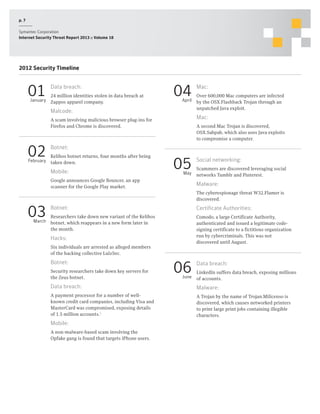
2012 Security Timeline

01

Data breach:

24 million identities stolen in data breach at
January Zappos apparel company.

04

April

Malcode:

Over 600,000 Mac computers are infected
by the OSX.Flashback Trojan through an
unpatched Java exploit.

Mac:

A scam involving malicious browser plug-ins for
Firefox and Chrome is discovered.

02

Mac:

A second Mac Trojan is discovered,
OSX.Sabpab, which also uses Java exploits
to compromise a computer.

Botnet:

Kelihos botnet returns, four months after being
February taken down.

Mobile:

05
May

Google announces Google Bouncer, an app
scanner for the Google Play market.

Social networking:
Scammers are discovered leveraging social
networks Tumblr and Pinterest.

Malware:
The cyberespionage threat W32.Flamer is
discovered.

03

Botnet:

Certificate Authorities:

Researchers take down new variant of the Kelihos
March botnet, which reappears in a new form later in
the month.

Comodo, a large Certificate Authority,
authenticated and issued a legitimate codesigning certificate to a fictitious organization
run by cybercriminals. This was not
discovered until August.

Hacks:
Six individuals are arrested as alleged members
of the hacking collective LulzSec.

Botnet:
Security researchers take down key servers for
the Zeus botnet.

06
June

Data breach:
LinkedIn suffers data breach, exposing millions
of accounts.

Data breach:

Malware:

A payment processor for a number of wellknown credit card companies, including Visa and
MasterCard was compromised, exposing details
of 1.5 million accounts.1

A Trojan by the name of Trojan.Milicenso is
discovered, which causes networked printers
to print large print jobs containing illegible
characters.

Mobile:
A non-malware-based scam involving the
Opfake gang is found that targets iPhone users.
p. 8
Symantec Corporation
Internet Security Threat Report 2013 :: Volume 18

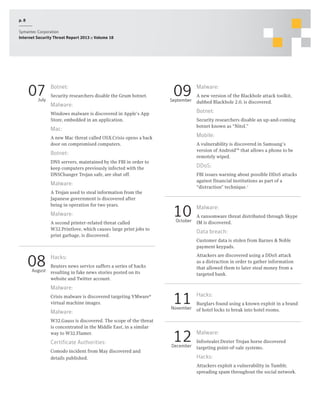
07
July

Botnet:
Security researchers disable the Grum botnet.

Malware:

09

September

Security researchers disable an up-and-coming
botnet known as “Nitol.”

Mac:

Mobile:

A new Mac threat called OSX.Crisis opens a back
door on compromised computers.

A vulnerability is discovered in Samsung’s
version of Android™ that allows a phone to be
remotely wiped.

Botnet:
DNS servers, maintained by the FBI in order to
keep computers previously infected with the
DNSChanger Trojan safe, are shut off.

DDoS:
FBI issues warning about possible DDoS attacks
against financial institutions as part of a
“distraction” technique.2

Malware:

Malware:
A second printer-related threat called
W32.Printlove, which causes large print jobs to
print garbage, is discovered.

08
August

10

October

Malware:
W32.Gauss is discovered. The scope of the threat
is concentrated in the Middle East, in a similar
way to W32.Flamer.

Certificate Authorities:
Comodo incident from May discovered and
details published.

A ransomware threat distributed through Skype
IM is discovered.

Customer data is stolen from Barnes & Noble
payment keypads.
Attackers are discovered using a DDoS attack
as a distraction in order to gather information
that allowed them to later steal money from a
targeted bank.

Reuters news service suffers a series of hacks
resulting in fake news stories posted on its
website and Twitter account.

Crisis malware is discovered targeting VMware®
virtual machine images.

Malware:

Data breach:

Hacks:

Malware:

A new version of the Blackhole attack toolkit,
dubbed Blackhole 2.0, is discovered.

Botnet:

Windows malware is discovered in Apple’s App
Store, embedded in an application.

A Trojan used to steal information from the
Japanese government is discovered after
being in operation for two years.

Malware:

11

Hacks:

12

Malware:

November

December

Burglars found using a known exploit in a brand
of hotel locks to break into hotel rooms.

Infostealer.Dexter Trojan horse discovered
targeting point-of-sale systems.

Hacks:
Attackers exploit a vulnerability in Tumblr,
spreading spam throughout the social network.
p. 9
Symantec Corporation
Internet Security Threat Report 2013 :: Volume 18

2012 in
num b
ers
p. 10
Symantec Corporation
Internet Security Threat Report 2013 :: Volume 18
2012 in numbers

SHARE
THIS

2012 in Numbers

Targeted
Attacks
in 2012

42% INCREASE

New Vulnerabilities
2010

2011

2012

6,253

4,989

5,291

Average Number of
Identities Exposed
Per Breach in 2012

604,826

Mobile
Vulnerabilities

415
315
2012

2011
2010

163
p. 11
Symantec Corporation
Internet Security Threat Report 2013 :: Volume 18
2012 in numbers

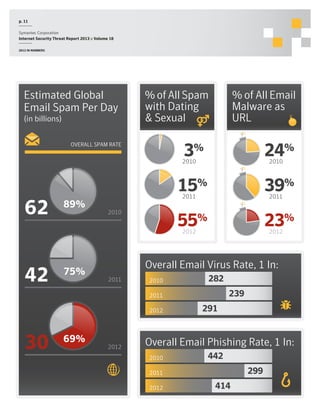
Estimated Global
Email Spam Per Day
(in billions)

% of All Spam
with Dating
& Sexual

% of All Email
Malware as
URL

3%

24%

15%

39%

55%

OVERALL SPAM RATE

23%

2010

62

89%

2010

2011

2010

2011

2012

42

75%

2012

Overall Email Virus Rate, 1 In:
2011

2010

282
239

2011
2012

30

69%

2012

291

Overall Email Phishing Rate, 1 In:
2010

442
299

2011
2012

414
p. 12
Symantec Corporation
Internet Security Threat Report 2013 :: Volume 18
2012 in numbers

Bot Zombies

New Zero-Day
Vulnerabilities

(in millions)

14

3.1
2012 3.4

2011

Mobile Malware
Families Increase

2011

2012

Web Attacks
Blocked Per Day
2012 2011

4.5

14

2010

2010

8

190,370
247,350

2011–2012

58%

New Unique
Malicious Web Domains
2010

43,000

2011

55,000
2012

74,000
p. 13
Symantec Corporation
Internet Security Threat Report 2013 :: Volume 18

Targ eted a ttacks
hack
tivism
AND data b reach es
p. 14
Symantec Corporation
Internet Security Threat Report 2013 :: Volume 18
Targeted attacks, hacktivism, and data breaches

Introduction
“Just as nuclear was the strategic warfare of the industrial
era, cyberwarfare has become the strategic war of the
information era,” says U.S. Secretary of Defense Leon Panetta.3
Cyberespionage and cybersabotage are already a reality.

At a Glance
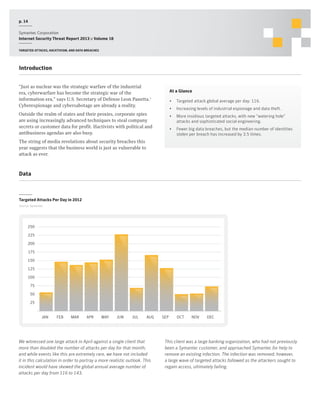
•	 Targeted attack global average per day: 116.
•	 Increasing levels of industrial espionage and data theft.

Outside the realm of states and their proxies, corporate spies
are using increasingly advanced techniques to steal company
secrets or customer data for profit. Hactivists with political and
antibusiness agendas are also busy.

•	 More insidious targeted attacks, with new “watering hole”
attacks and sophisticated social engineering.
•	 Fewer big data breaches, but the median number of identities
stolen per breach has increased by 3.5 times.

The string of media revelations about security breaches this
year suggests that the business world is just as vulnerable to
attack as ever.

Data

Targeted Attacks Per Day in 2012
Source: Symantec

250
225
200
175
150
125
100
75
50
25
JAN

FEB

MAR

APR

MAY

JUN

JUL

AUG

We witnessed one large attack in April against a single client that
more than doubled the number of attacks per day for that month;
and while events like this are extremely rare, we have not included
it in this calculation in order to portray a more realistic outlook. This
incident would have skewed the global annual average number of
attacks per day from 116 to 143.

SEP

OCT

NOV

DEC

This client was a large banking organization, who had not previously
been a Symantec customer, and approached Symantec for help to
remove an existing infection. The infection was removed; however,
a large wave of targeted attacks followed as the attackers sought to
regain access, ultimately failing.
p. 15
Symantec Corporation
Internet Security Threat Report 2013 :: Volume 18
Targeted attacks, hacktivism, and data breaches

Top 10 Industries Attacked in 2012
Source: Symantec

24%

Manufacturing

19
17
12
10
8

Finance, Insurance & Real Estate
Services – Non-Traditional
Government
Energy/Utilities
Services – Professional

2
2
2
1

Aerospace
Retail
Wholesale
Transportation,
Communications, Electric, Gas
0

5

10

15

20

25%

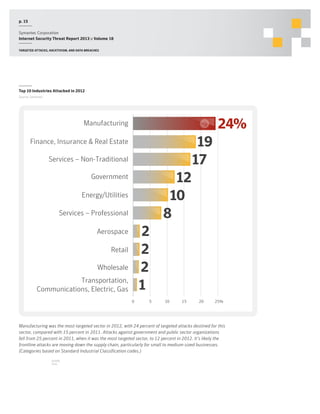
Manufacturing was the most-targeted sector in 2012, with 24 percent of targeted attacks destined for this
sector, compared with 15 percent in 2011. Attacks against government and public sector organizations
fell from 25 percent in 2011, when it was the most targeted sector, to 12 percent in 2012. It’s likely the
frontline attacks are moving down the supply chain, particularly for small to medium-sized businesses.
(Categories based on Standard Industrial Classification codes.)
SHARE
THIS
p. 16
Symantec Corporation
Internet Security Threat Report 2013 :: Volume 18
Targeted attacks, hacktivism, and data breaches

SHARE
THIS

Attacks by Size of Targeted Organization
Source: Symantec

50% 2,501+

50% 1 to 2,500

9%

1,501 to 2,500

2%
3%

1,001 to 1,500
501 to 1,000

5%

Employees
2,501+

251 to 500

50%
50%

in 2011

31%

1 to 250

18%

in 2011

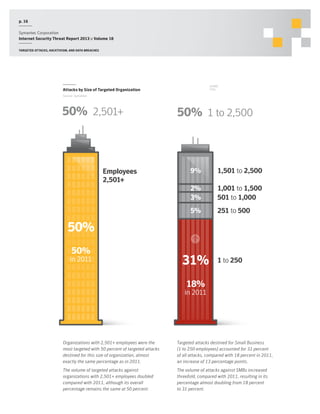
Organizations with 2,501+ employees were the
most targeted with 50 percent of targeted attacks
destined for this size of organization, almost
exactly the same percentage as in 2011.

Targeted attacks destined for Small Business
(1 to 250 employees) accounted for 31 percent
of all attacks, compared with 18 percent in 2011,
an increase of 13 percentage points.

The volume of targeted attacks against
organizations with 2,501+ employees doubled
compared with 2011, although its overall
percentage remains the same at 50 percent.

The volume of attacks against SMBs increased
threefold, compared with 2011, resulting in its
percentage almost doubling from 18 percent
to 31 percent.
p. 17
Symantec Corporation
Internet Security Threat Report 2013 :: Volume 18
Targeted attacks, hacktivism, and data breaches

Targeted Attack Recipients by Role in 2012
Source: Symantec

2011

2012

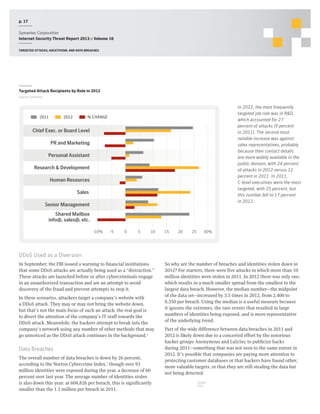
In 2012, the most frequently
targeted job role was in R&D,
which accounted for 27
percent of attacks (9 percent
in 2011). The second most
notable increase was against
sales representatives, probably
because their contact details
are more widely available in the
public domain, with 24 percent
of attacks in 2012 versus 12
percent in 2011. In 2011,
C-level executives were the most
targeted, with 25 percent, but
this number fell to 17 percent
in 2012.

% CHANGE

Chief Exec. or Board Level
PR and Marketing
Personal Assistant
Research & Development
Human Resources
Sales
Senior Management
Shared Mailbox
info@, sales@, etc.
-15% -10%

-5

0

5

10

15

20

25

30%

DDoS Used as a Diversion
In September, the FBI issued a warning to financial institutions
that some DDoS attacks are actually being used as a “distraction.”
These attacks are launched before or after cybercriminals engage
in an unauthorized transaction and are an attempt to avoid
discovery of the fraud and prevent attempts to stop it.
In these scenarios, attackers target a company’s website with
a DDoS attack. They may or may not bring the website down,
but that’s not the main focus of such an attack; the real goal is
to divert the attention of the company’s IT staff towards the
DDoS attack. Meanwhile, the hackers attempt to break into the
company’s network using any number of other methods that may
go unnoticed as the DDoS attack continues in the background.4

Data Breaches
The overall number of data breaches is down by 26 percent,
according to the Norton Cybercrime Index,5 though over 93
million identities were exposed during the year, a decrease of 60
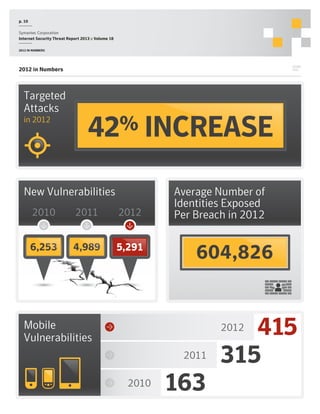
percent over last year. The average number of identities stolen
is also down this year: at 604,826 per breach, this is significantly
smaller than the 1.1 million per breach in 2011.

So why are the number of breaches and identities stolen down in
2012? For starters, there were five attacks in which more than 10
million identities were stolen in 2011. In 2012 there was only one,
which results in a much smaller spread from the smallest to the
largest data breach. However, the median number—the midpoint
of the data set—increased by 3.5 times in 2012, from 2,400 to
8,350 per breach. Using the median is a useful measure because
it ignores the extremes, the rare events that resulted in large
numbers of identities being exposed, and is more representative
of the underlying trend.
Part of the wide difference between data breaches in 2011 and
2012 is likely down due to a concerted effort by the notorious
hacker groups Anonymous and LulzSec to publicize hacks
during 2011—something that was not seen to the same extent in
2012. It’s possible that companies are paying more attention to
protecting customer databases or that hackers have found other,
more valuable targets, or that they are still stealing the data but
not being detected.
SHARE
THIS
p. 18
Symantec Corporation
Internet Security Threat Report 2013 :: Volume 18
Targeted attacks, hacktivism, and data breaches

Healthcare, education, and government accounted for nearly
two-thirds of all identities breached in 2012. This suggests
that the public sector should further increase efforts to
protect personal information, particularly considering
how these organizations are often looked upon as the
custodians of information for the most vulnerable in society.
Alternatively, this could indicate that the private sector may
not be reporting all data breaches, given how many public
sector organizations are required by law to report breaches.

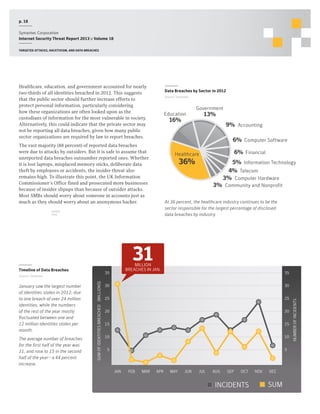
Data Breaches by Sector in 2012
Source: Symantec

Education

Government

13%

16%

9% Accounting
6% Computer Software

The vast majority (88 percent) of reported data breaches
were due to attacks by outsiders. But it is safe to assume that
unreported data breaches outnumber reported ones. Whether
it is lost laptops, misplaced memory sticks, deliberate data
theft by employees or accidents, the insider threat also
remains high. To illustrate this point, the UK Information
Commissioner’s Office fined and prosecuted more businesses
because of insider slipups than because of outsider attacks.
Most SMBs should worry about someone in accounts just as
much as they should worry about an anonymous hacker.

6% Financial

Healthcare

36%

5% Information Technology
4% Telecom
3% Computer Hardware

3% Community and Nonprofit
At 36 percent, the healthcare industry continues to be the
sector responsible for the largest percentage of disclosed
data breaches by industry.

SHARE
THIS

31

35

The average number of breaches
for the first half of the year was
11, and rose to 15 in the second
half of the year– a 44 percent
increase.

SUM OF IDENTITIES BREACHED (MILLIONS)

Source: Symantec

January saw the largest number
of identities stolen in 2012, due
to one breach of over 24 million
identities, while the numbers
of the rest of the year mostly
fluctuated between one and
12 million identities stolen per
month.

MILLION
BREACHES IN JAN.

35

30

30

25

25

20

20

15

15

10

10

5

5

0
JAN
JAN

FEB
FEB

MAR
MAR

APR
APR

MAY
MAY

JUN
JUN

JUL
JUL

AUG
AUG

SEP
SEP

OCT
OCT

INCIDENTS

NOV
NOV

DEC
DEC

SUM

0

NUMBER OF INCIDENTS

Timeline of Data Breaches
p. 19
Symantec Corporation
Internet Security Threat Report 2013 :: Volume 18
Targeted attacks, hacktivism, and data breaches

Average Cost Per Capita of a Data Breach 6

Top Causes of Data Breaches in 2012

Source: Symantec

Source: Symantec

Country

Average Cost Per Capita

U.S.

$159

Australia

$145

Japan

$132

UK

$124

Italy

$102

Indonesia

$42

20

$191

France

10

30

$194

Denmark

0

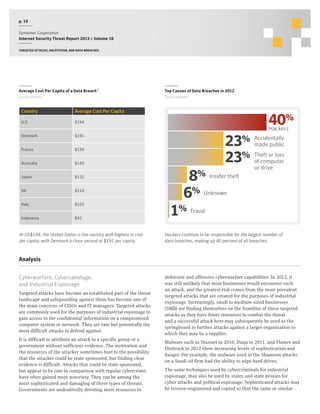
At US$194, the United States is the country with highest in cost
per capita, with Denmark a close second at $191 per capita.

8%
6%

23%
23%

40

50

40%
Hackers

Accidentally
made public
Theft or loss
of computer
or drive

Insider theft

Unknown

1%

Fraud

Hackers continue to be responsible for the largest number of
data breaches, making up 40 percent of all breaches.

Analysis
Cyberwarfare, Cybersabotage,
and Industrial Espionage
Targeted attacks have become an established part of the threat
landscape and safeguarding against them has become one of
the main concerns of CISOs and IT managers. Targeted attacks
are commonly used for the purposes of industrial espionage to
gain access to the confidential information on a compromised
computer system or network. They are rare but potentially the
most difficult attacks to defend against.
It is difficult to attribute an attack to a specific group or a
government without sufficient evidence. The motivation and
the resources of the attacker sometimes hint to the possibility
that the attacker could be state sponsored, but finding clear
evidence is difficult. Attacks that could be state sponsored,
but appear to be rare in comparison with regular cybercrime,
have often gained more notoriety. They can be among the
most sophisticated and damaging of these types of threats.
Governments are undoubtedly devoting more resources to

defensive and offensive cyberwarfare capabilities. In 2012, it
was still unlikely that most businesses would encounter such
an attack, and the greatest risk comes from the more prevalent
targeted attacks that are created for the purposes of industrial
espionage. Increasingly, small to medium-sized businesses
(SMB) are finding themselves on the frontline of these targeted
attacks as they have fewer resources to combat the threat
and a successful attack here may subsequently be used as the
springboard to further attacks against a larger organization to
which they may be a supplier.
Malware such as Stuxnet in 2010, Duqu in 2011, and Flamer and
Disttrack in 2012 show increasing levels of sophistication and
danger. For example, the malware used in the Shamoon attacks
on a Saudi oil firm had the ability to wipe hard drives.7
The same techniques used by cybercriminals for industrial
espionage, may also be used by states and state proxies for
cyber attacks and political espionage. Sophisticated attacks may
be reverse-engineered and copied so that the same or similar
p. 20
Symantec Corporation
Internet Security Threat Report 2013 :: Volume 18
Targeted attacks, hacktivism, and data breaches

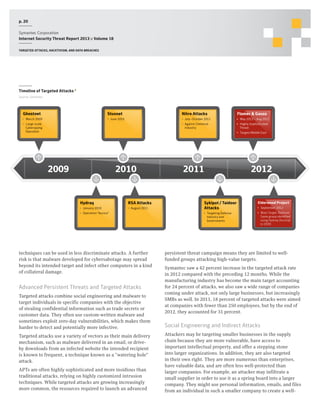
Timeline of Targeted Attacks 8
Source: Symantec

Ghostnet

Stuxnet

Nitro Attacks

Flamer & Gauss

• March 2009

• June 2010

• July–October 2011

• May 2012 – Aug 2012

• Against Chemical
Industry

• Highly Sophisticated
Threat

• Large-scale
Cyberspying
Operation

• Targets Middle East

2010

2009

Hydraq

RSA Attacks

• January 2010

• August 2011

• Operation “Aurora”

techniques can be used in less discriminate attacks. A further
risk is that malware developed for cybersabotage may spread
beyond its intended target and infect other computers in a kind
of collateral damage.

Advanced Persistent Threats and Targeted Attacks
Targeted attacks combine social engineering and malware to
target individuals in specific companies with the objective
of stealing confidential information such as trade secrets or
customer data. They often use custom-written malware and
sometimes exploit zero-day vulnerabilities, which makes them
harder to detect and potentially more infective.
Targeted attacks use a variety of vectors as their main delivery
mechanism, such as malware delivered in an email, or driveby downloads from an infected website the intended recipient
is known to frequent, a technique known as a ”watering hole”
attack.
APTs are often highly sophisticated and more insidious than
traditional attacks, relying on highly customized intrusion
techniques. While targeted attacks are growing increasingly
more common, the resources required to launch an advanced

2011

Sykipot / Taidoor
Attacks
• Targeting Defense
Industry and
Governments

2012

Elderwood Project
• September 2012
• Main Target: Defense.
Same group identified
using Hydraq (Aurora)
in 2009

persistent threat campaign means they are limited to wellfunded groups attacking high-value targets.
Symantec saw a 42 percent increase in the targeted attack rate
in 2012 compared with the preceding 12 months. While the
manufacturing industry has become the main target accounting
for 24 percent of attacks, we also saw a wide range of companies
coming under attack, not only large businesses, but increasingly
SMBs as well. In 2011, 18 percent of targeted attacks were aimed
at companies with fewer than 250 employees, but by the end of
2012, they accounted for 31 percent.

Social Engineering and Indirect Attacks
Attackers may be targeting smaller businesses in the supply
chain because they are more vulnerable, have access to
important intellectual property, and offer a stepping stone
into larger organizations. In addition, they are also targeted
in their own right. They are more numerous than enterprises,
have valuable data, and are often less well-protected than
larger companies. For example, an attacker may infiltrate a
small supplier in order to use it as a spring board into a larger
company. They might use personal information, emails, and files
from an individual in such a smaller company to create a well-
p. 21
Symantec Corporation
Internet Security Threat Report 2013 :: Volume 18
Targeted attacks, hacktivism, and data breaches

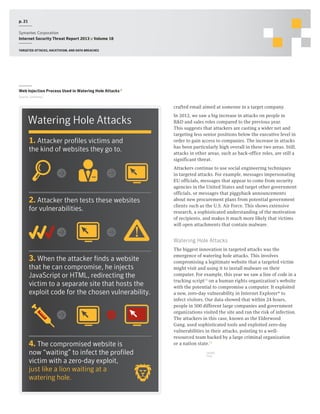
Web Injection Process Used in Watering Hole Attacks 9
Source: Symantec

crafted email aimed at someone in a target company.

Watering Hole Attacks
1. Attacker profiles victims and

the kind of websites they go to.

2. Attacker then tests these websites

for vulnerabilities.

In 2012, we saw a big increase in attacks on people in
R&D and sales roles compared to the previous year.
This suggests that attackers are casting a wider net and
targeting less senior positions below the executive level in
order to gain access to companies. The increase in attacks
has been particularly high overall in these two areas. Still,
attacks in other areas, such as back-office roles, are still a
significant threat.
Attackers continue to use social engineering techniques
in targeted attacks. For example, messages impersonating
EU officials, messages that appear to come from security
agencies in the United States and target other government
officials, or messages that piggyback announcements
about new procurement plans from potential government
clients such as the U.S. Air Force. This shows extensive
research, a sophisticated understanding of the motivation
of recipients, and makes it much more likely that victims
will open attachments that contain malware.

Watering Hole Attacks	

3. When the attacker finds a website

that he can compromise, he injects
JavaScript or HTML, redirecting the
victim to a separate site that hosts the
exploit code for the chosen vulnerability.

4. The compromised website is

now “waiting” to infect the profiled
victim with a zero-day exploit,
just like a lion waiting at a
watering hole.

The biggest innovation in targeted attacks was the
emergence of watering hole attacks. This involves
compromising a legitimate website that a targeted victim
might visit and using it to install malware on their
computer. For example, this year we saw a line of code in a
tracking script10 on a human rights organization’s website
with the potential to compromise a computer. It exploited
a new, zero-day vulnerability in Internet Explorer® to
infect visitors. Our data showed that within 24 hours,
people in 500 different large companies and government
organizations visited the site and ran the risk of infection.
The attackers in this case, known as the Elderwood
Gang, used sophisticated tools and exploited zero-day
vulnerabilities in their attacks, pointing to a wellresourced team backed by a large criminal organization
or a nation state.11
SHARE
THIS
p. 22
Symantec Corporation
Internet Security Threat Report 2013 :: Volume 18
Targeted attacks, hacktivism, and data breaches

Recommendations
Assume You’re a Target.

Educate Employees.

Small size and relative anonymity are not defenses against the
most sophisticated attacks. Targeted attacks threaten small
companies as well as large ones. Attackers could also use your
website as a way to attack other people. If you assume you
are a potential target and improve your defenses against the
most serious threats, you will automatically improve your
protection against other threats.

Raise employees’ awareness about the risks of social
engineering and counter it with staff training. Similarly, good
training and procedures can reduce the risk of accidental data
loss and other insider risks. Train staff about the value of
data and how to protect it.

Defense in Depth.
Emphasize multiple, overlapping, and mutually supportive
defensive systems to guard against single-point failures in
any specific technology or protection method. This should
include the deployment of regularly updated firewalls, as well
as gateway antivirus, intrusion detection, intrusion protection
systems, and Web security gateway solutions throughout the
network. Endpoints must be secured by more than signaturebased antivirus technology.

Data Loss Prevention.
Prevent data loss and exfiltration with data loss protection
software on your network. Use encryption to protect data in
transit, whether online or via removable storage.
p. 23
Symantec Corporation
Internet Security Threat Report 2013 :: Volume 18

V
ex
and
ulner ab
ploits
toolk its
ilities
p. 24
Symantec Corporation
Internet Security Threat Report 2013 :: Volume 18
Vulnerabilities, exploits, and toolkits

Introduction
Recent research by the Ponemon Institute suggests that the
cost of cybercrime rose by six percent in 2012 with a 42 percent
increase in the number of cyberattacks. The cost is significant
with businesses incurring an average cost of $591,780.12 Given
the increase availability of vulnerabilities and exploits it comes
as no surprise that the cybercriminals have increased their
ability to make a profit.
Quite a few diverse skills are needed to find vulnerabilities,
create ways to exploit them, and then run attacks using them.
Fortunately for the cybercriminal, a black market exists where
these skills can be purchased in the form of toolkits. Hackers
find and exploit and or sell vulnerabilities. Toolkit authors find
or buy exploit code and incorporate it into their “products.”
Cybercriminals in turn buy or steal the latest versions of toolkits
which allow them to run massive attacks without the trouble of
learning the skills needed to run the whole operation.

At a Glance
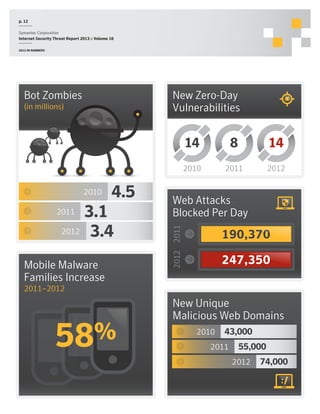
•	 Usage of zero-day vulnerabilities is up, from 8 to 14 in 2012.
•	 There is an increasingly sophisticated black market serving a
multi-billion dollar online crime industry.
•	 These vulnerabilities are later commercialized and added
to Web-attack toolkits, usually after they become published
publicly.
•	 In 2012, drive-by Web attacks increased by one third, possibly
driven by malvertising.
•	 Around 600,000 Macs were infected with Flashback malware
this year.
•	 The Sakura toolkit, which had little impact in 2011, now
accounts for approximately 22 percent of Web-based toolkit
attacks, overtaking Blackhole during some points of the year.

SHARE
THIS

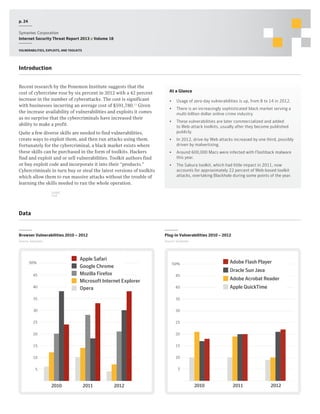
Data

Browser Vulnerabilities 2010 – 2012

Plug-in Vulnerabilities 2010 – 2012

Source: Symantec

Source: Symantec

Apple Safari
Google Chrome
Mozilla Firefox
Microsoft Internet Explorer
Opera

50%
45
40

Adobe Flash Player

50%

Oracle Sun Java

45

Adobe Acrobat Reader
Apple QuickTime

40

35

35

30

30

25

25

20

20

15

15

10

10

5

5

2010

2011

2012

2010

2011

2012
p. 25
Symantec Corporation
Internet Security Threat Report 2013 :: Volume 18
Vulnerabilities, exploits, and toolkits

Total Vulnerabilities
Source: Symantec

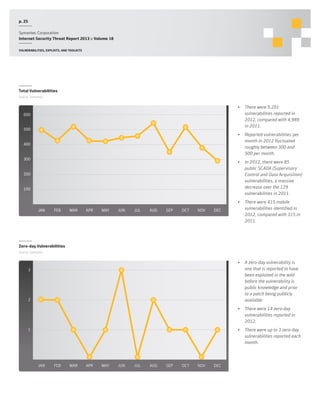
•	 There were 5,291
vulnerabilities reported in
2012, compared with 4,989
in 2011.

600
500

•	 Reported vulnerabilities per
month in 2012 fluctuated
roughly between 300 and
500 per month.

400
300

•	 In 2012, there were 85
public SCADA (Supervisory
Control and Data Acquisition)
vulnerabilities, a massive
decrease over the 129
vulnerabilities in 2011.

200
100
0
JAN

FEB

MAR

APR

MAY

JUN

JUL

AUG

SEP

OCT

NOV

DEC

•	 There were 415 mobile
vulnerabilities identified in
2012, compared with 315 in
2011.

Zero-day Vulnerabilities
Source: Symantec

•	 A zero-day vulnerability is
one that is reported to have
been exploited in the wild
before the vulnerability is
public knowledge and prior
to a patch being publicly
available.

3

2

•	 There were 14 zero-day
vulnerabilities reported in
2012.
•	 There were up to 3 zero-day
vulnerabilities reported each
month.

1

JAN

FEB

MAR

APR

MAY

JUN

JUL

AUG

SEP

OCT

NOV

DEC
p. 26
Symantec Corporation
Internet Security Threat Report 2013 :: Volume 18
Vulnerabilities, exploits, and toolkits

Analysis
Web-based Attacks on the Rise

The Arms Race to Exploit New Vulnerabilities

We have seen the number of Web-based attacks increase by
almost a third. These attacks silently infect enterprise and
consumer users when they visit a compromised website. In
other words, you can be infected simply by visiting a legitimate
website. Typically, attackers infiltrate the website to install their
attack toolkits and malware payloads, unbeknown to the site
owner or the potential victims.

We have witnessed an increase in zero-day vulnerabilities this
year. There were 14 unreported vulnerabilities first seen being
used in the wild in 2012. This is up from 8 in 2011. Overall,
reported vulnerabilities are up slightly in 2012, from 4,989 in
2011 to 5,291 in 2012. Mobile vulnerabilities are also up, from
315 in 2011 to 415 reported in 2012.

The malware payload that is dropped by Web-attack toolkits
is often server-side polymorphic or dynamically generated,
rendering enterprises that rely on signature-based antivirus
protection unable to protect themselves against these silent
attacks. A hidden piece of JavaScript™ or a few lines of code
linking to another website can install malware that is very
difficult to detect. It then checks the system of each visitor for
browser or operating system vulnerabilities until it finds one
that is likely to succeed and it uses that to install malware on
the visitor’s computer.
These attacks are successful because enterprise and consumer
systems are not up to date with the latest patches for browser
plug-ins, such as Adobe’s Flash Player® and Acrobat Reader®,
as well as Oracle’s Java™ platform. While a lack of attentiveness
can be blamed for consumers remaining out of date, often in
larger companies, older versions of these plug-ins are required
to run critical business systems, making it harder to upgrade
to the latest versions. Such patch management predicaments,
with slow patch deployment rates, make companies especially
vulnerable to Web-based attacks.
It’s important to note that the volume of vulnerabilities doesn’t
correlate to increased levels of risk. One single vulnerability in
an application may present a critical risk to an organization,
if exploited successfully. Analysis of risk from vulnerabilities
exploited in Web-based attack toolkits is an area that Symantec
will explore further in 2013.
The key is that it’s not the latest zero-day vulnerability that is
responsible for the widespread success of Web-based attacks.
The rate of attacks from compromised websites has increased
by 30 percent, while the rate of discovery of vulnerabilities has
only increased by 6 percent. In a nutshell, it’s older, non-patched
vulnerabilities that cause most systems to get compromised.
SHARE
THIS

Organized groups, such as the team behind the Elderwood
attacks, have worked to discover new weaknesses in everyday
software such as Web browsers and browser plug-ins. When one
vulnerability becomes public, they are able to quickly deploy
a new one, which speaks to the sophistication of the groups
creating vulnerabilities.
There is an arms race between Internet criminals and legitimate
software developers. Criminals’ ability to quickly find and
exploit new vulnerabilities is not matched by software vendors’
ability to fix and release patches. Some software companies
only patch once a quarter; others are slow to acknowledge
vulnerabilities. Even if they do a good job with updates,
companies are often slow to deploy them.
While zero-day vulnerabilities present a serious security threat,
known (and even patched) vulnerabilities are dangerous if ignored.
Many companies and consumers fail to apply published updates
in a timely way. Toolkits that target well-known vulnerabilities
make it easy for criminals to target millions of PCs and find the
ones that remain open to infection. In fact, the vulnerabilities that
are exploited the most often are not the newest.
SHARE
THIS
p. 27
Symantec Corporation
Internet Security Threat Report 2013 :: Volume 18
Vulnerabilities, exploits, and toolkits

Malvertising and Website Hacking
How does a hacker add his code to a legitimate website? Toolkits
are available that make it easy. For example, in May 2012, the
LizaMoon toolkit used a SQL injection technique to affect at
least a million websites.13 Other approaches include:
•  Exploiting a known vulnerability in the website hosting or
content management software
•  Using phishing, spyware, or social engineering to get the
webmaster’s password
•  Hacking through the Web server backend infrastructure,
such as control panels or databases
•  Paying to host an advertisement that contains the infection
This last technique, known as malvertising, means that legitimate
websites can be impacted without even being compromised. This
form of attack appears to be very common. Using experimental
scanning software (see “Website Malware Scanning and Website
Vulnerability Assessment” later in this section), Symantec found
that half of the tested sites were infected by malvertising.
Malvertising opens an avenue of attack that hackers can use
to compromise a website without having to directly hack
the website itself. Using these malicious ads allows them to
silently infect users, often installing dynamically created
malware that antivirus alone is unable to detect.
A sign of the seriousness of the problem is that Google
and other search engines scan for malware and blacklist
sites that contain malware. There have been occasions
when prominent advertising networks have fallen prey to
malvertising, impacting some of the biggest names in online
media.14 Situations like this can have a serious impact on
websites whose bottom line often depends on revenue, even
diminishing their credibility in the eyes of their readers.
With dozens of advertising networks and constantly rotating
adverts, tracking malvertising and preventing it is a huge
challenge.

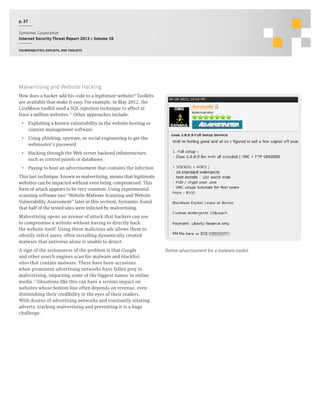
Online advertisement for a malware toolkit.
p. 28
Symantec Corporation
Internet Security Threat Report 2013 :: Volume 18
Vulnerabilities, exploits, and toolkits

Web Attack Toolkits
It’s one thing to discover new vulnerabilities, but another
matter to implement a way to exploit them. Criminal
entrepreneurs turn them into toolkits that less sophisticated
users can buy and use. Like commercial software, they even
include support and warranties. Authors accept payments
using online payment services with anonymous numbered
accounts.

Top Web Attack Toolkits by Percent
Source: Symantec

10% Phoenix
Sakura

22%

Attack toolkits exist for creating a variety of malware and
for attacking websites. The popular Blackhole toolkit is a
notorious example. This updating strategy suggests that it has
a kind of brand loyalty and that the authors are building on
that in the same way that legitimate software vendors do with
their updates and new editions.

7% Redkit

Others

Blackhole

20%

41%

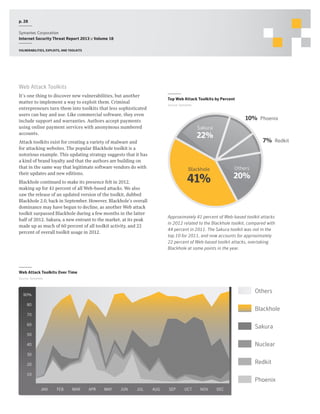
Blackhole continued to make its presence felt in 2012,
making up for 41 percent of all Web-based attacks. We also
saw the release of an updated version of the toolkit, dubbed
Blackhole 2.0, back in September. However, Blackhole’s overall
dominance may have begun to decline, as another Web attack
toolkit surpassed Blackhole during a few months in the latter
half of 2012. Sakura, a new entrant to the market, at its peak
made up as much of 60 percent of all toolkit activity, and 22
percent of overall toolkit usage in 2012.

Approximately 41 percent of Web-based toolkit attacks
in 2012 related to the Blackhole toolkit, compared with
44 percent in 2011. The Sakura toolkit was not in the
top 10 for 2011, and now accounts for approximately
22 percent of Web-based toolkit attacks, overtaking
Blackhole at some points in the year.

Web Attack Toolkits Over Time
Source: Symantec

Others

90%
80

Blackhole

70
60

Sakura

50

Nuclear

40
30

Redkit

20
10

Phoenix
JAN

FEB

MAR

APR

MAY

JUN

JUL

AUG

SEP

OCT

NOV

DEC
p. 29
Symantec Corporation
Internet Security Threat Report 2013 :: Volume 18
Vulnerabilities, exploits, and toolkits

Website Malware Scanning and Website
Vulnerability Assessment
In 2012, Symantec’s Trust Services (formerly VeriSign)
technology scanned over 1.5 million websites as part of its
Website Malware Scanning and Vulnerability Assessment
services. Over 130,000 URLs were scanned for malware each
day, with 1 in 532 of websites found to be infected with
malware. The most common form of compromise was for
the use of drive-by downloads.
Furthermore, in assessing potentially exploitable vulnerabilities
on websites, over 1,400 vulnerability scans were performed each
day. Approximately 53 percent of websites scanned were found
to have unpatched, potentially exploitable vulnerabilities (36
percent in 2011), of which 24 percent were deemed to be critical
(25 percent in 2011). The most common vulnerability found was
for cross-site scripting vulnerabilities.

The Growth of Secured Connections
One of the ways to judge the growth of usage for SSL is to
monitor the change in statistics for OCSP (Online Certificate
Status Protocol, which is used for obtaining the revocation
status of a digital certificate) and CRL (Certificate Revocation
List) lookups. When an SSL secured connection is initiated, a
revocation check is performed using OCSP or CRL and we track
the number of lookups that go through our systems. This is a
growth indicator for the number of SSL secured sessions that
are performed online. This implies that more people are going
online and using secured connections (for example, representing
a growth of eCommerce transactions on the Web). It also may
show the impact of the adoption of SSL more widely, in more
places and for more uses, such as the growing use of Extended
Validation SSL Certificates, which trigger browsers to indicate
whether a user is on a secured site by turning the address bar
green, and for “Always On SSL” (adopted heavily through 2012
by social networks, search services, and online email providers).
Further, it may be a result of devices other than traditional
desktops and laptops that enable online access; for example,
smartphones and tablets.
In 2012, Symantec identified the average number of OCSP
lookups grew by 31 percent year on year between 2011 and
2012, with more than 4.8 billion lookups performed each day in
2012. The high-water-mark of OCSP lookups was 5.8 billion in
a single day in 2012. It is worth noting that OCSP is the modern
revocation checking methodology.

Additionally, Symantec’s CRL lookups increased by 45 percent
year on year between 2011 and 2012, with approximately
1.4 billion per day, and a high-water-mark of 2.1 billion.
CRL is the older lookup technology that OCSP supersedes.

Norton Secured Seal and Trust Marks
In 2012, more consumers were visiting websites with trust
marks (such as the Norton Secured Seal) in 2012. Based on
analysis of the statistics from Symantec’s own trust marks, we
saw an 8 percent increase in 2012. The Symantec trust mark
was viewed up to 750 million times a day in 2012 as more online
users are necessitating stronger security to safeguard their
online activities.

Stolen Key-signing Certificates
2012 continued to show that organizations large and small were
susceptible to becoming unwitting players in the global malware
distribution network. We’ve seen increased activity of malware
being signed with legitimate code-signing certificates. Since the
malware code is signed, it appears to be legitimate, which make
it easier to spread.
Malware developers often use stolen code-signing private
keys. They attack Certificate Authorities and once inside
their networks, they seek out and steal private keys. In other
cases, poor security practices allow them to buy legitimate
certificates with fake identities. For example, in May 2012,
Comodo, a large Certificate Authority, authenticated and
issued a legitimate code-signing certificate to a fictitious
organization run by cybercriminals.15
p. 30
Symantec Corporation
Internet Security Threat Report 2013 :: Volume 18
Vulnerabilities, exploits, and toolkits

Recommendations
Use a Full Range of Protection Technology.
If the threat landscape was less advanced, then file scanning
technology (commonly called antivirus) would be sufficient
to prevent malware infections. However, with toolkits for
building malware-on-demand, polymorphic malware and
zero-day exploits, antivirus is not enough. Network-based
protection and reputation technology must be deployed on
endpoints to help prevent attacks. And behavior blocking and
scheduled file scanning must be used to help find malware
that avoid preventative defense.

Protect Your Public-facing Websites.
Consider Always On SSL to encrypt visitors’ interactions
with your site across the whole site, not just on the checkout
or sign-up pages. Make sure you update your content
management system and Web server software just as you
would a client PC. Run vulnerability and malware scanning
tools on your websites to detect problems promptly. To protect
these credentials against social engineering and phishing, use
strong passwords for admin accounts and other services. Limit
login access to important Web servers to users that need it.

Protect Code-signing Certificates.
Certificate owners should apply rigorous protection and
security policies to safeguard keys. This means effective
physical security, the use of cryptographic hardware security
modules, and effective network and endpoint security,
including data loss prevention on servers involved in signing
code, and thorough security for applications used to sign code.
In addition, Certificate Authorities need to ensure that they
are using best practices in every step of the authentication
process.

Adopting an Always On SSL approach helps to safeguard
account information from unencrypted connections and thus
render end users less vulnerable to a man-in-the-middle attack.

Be Aggressive on Your Software Updating and Review
Your Patching Processes.
The majority of Web-based attacks exploit the top 20 most
common vulnerabilities. Consequently, installing patches for
known vulnerabilities will prevent the most common attacks.
It’s essential to update and patch all your software promptly.
In particular, with risks like the Flashback attacks that used
Java, it’s important to run the latest version of that software
or do without it altogether. This is equally true for CIOs
managing thousands of users, small business owners with
dozens of users, or individual users at home.
Update, patch, and migrate from outdated and insecure
browsers, applications, and browser plug-ins to the latest
available versions using the vendors’ automatic update
mechanisms, especially for the top software vulnerabilities
being exploited. Most software vendors work diligently
to patch exploited software vulnerabilities; however, such
patches can only be effective if adopted in the field. Be wary of
deploying standard corporate images containing older versions
of browsers, applications, and browser plug-ins that are
outdated and insecure. Consider removing vulnerable plug-ins
from images for employees that have no need for that software.
Wherever possible, automate patch deployments to maintain
protection against vulnerabilities across the organization.
p. 31
Symantec Corporation
Internet Security Threat Report 2013 :: Volume 18

S ocial
mob ile
and the
network in g

clou d
p. 32
Symantec Corporation
Internet Security Threat Report 2013 :: Volume 18
Social networking, mobile, and the cloud

Introduction
Online criminals and spammers are less interested in email as
an infection vector than they were. Why? Because social media
is becoming so popular and it gives them many new ways to
steal people’s identities or personal information and infect their
computers with malware.

Moreover, many mobile applications frequently rely on cloudbased storage, and without an Internet connection are often
limited in their functionality. Many more people and businesses
are routinely using cloud-based systems, sometimes without
even realising it.

Social media combines two behaviors that are useful for
criminals: social proof and sharing. Social proofing is the
psychological mechanism that convinces people to do things
because their friends are doing it. For example, if you get a
message on your Facebook wall from a trusted friend, you’re
more likely to click on it.

The bank robber Willie Sutton famously explained why he robbed
banks: “Because that’s where the money is.” Online criminals
target social media because that’s where the victims are.

Sharing is what people do with social networks: they share
personal information such as their birthday, home address, and
other contact details. This type of information is very useful for
identity thieves. For example, your social media profile might
contain clues to security questions a hacker would need to reset
your password and take control of your account.
People are spending more time online, and the most popular
activity is for social networking. Furthermore, younger users are
more commonly using mobile devices to access the Internet and
social media applications.16

Facebook users can report potential Facebook phishing
scams to the company through the following email address:
phish@fb.com.

At a Glance
•	 Scammers continue to use social media as spam and phishing
tools, including newer sites such as Pinterest and Instagram.
•	 Mobile malware has increased significantly in 2012 with new
threats such as mobile botnets.
•	 Thirty-two percent of all mobile malware steals information
from the compromised device.
•	 Fast-growing trends towards cloud computing, bring your
own device, and consumerization create additional risks for
businesses.

Data

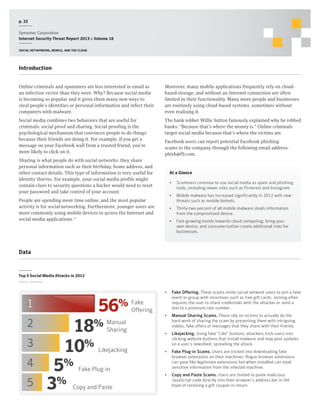
Top 5 Social Media Attacks in 2012
Source: Symantec

56%

1
2
3
4
5

18%
10%

Manual
Sharing

Likejacking

5%
3%

Fake Plug-in

Copy and Paste

Fake
Offering

•	 Fake Offering. These scams invite social network users to join a fake
event or group with incentives such as free gift cards. Joining often
requires the user to share credentials with the attacker or send a
text to a premium rate number.
•	 Manual Sharing Scams. These rely on victims to actually do the
hard work of sharing the scam by presenting them with intriguing
videos, fake offers or messages that they share with their friends.
•	 Likejacking. Using fake “Like” buttons, attackers trick users into
clicking website buttons that install malware and may post updates
on a user’s newsfeed, spreading the attack.
•	 Fake Plug-in Scams. Users are tricked into downloading fake
browser extensions on their machines. Rogue browser extensions
can pose like legitimate extensions but when installed can steal
sensitive information from the infected machine.
•	 Copy and Paste Scams. Users are invited to paste malicious
JavaScript code directly into their browser’s address bar in the
hope of receiving a gift coupon in return.
p. 33
Symantec Corporation
Internet Security Threat Report 2013 :: Volume 18
Social networking, mobile, and the cloud

121

Mobile Vulnerabilities
Source: Symantec

MOBILE
VULNERABILITIES
IN MARCH

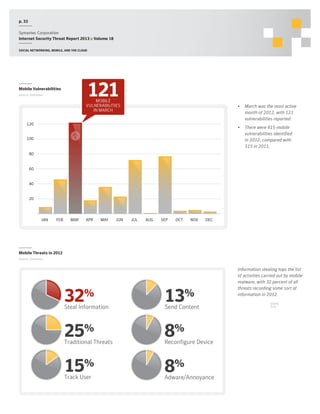
•	 March was the most active
month of 2012, with 121
vulnerabilities reported.

120

•	 There were 415 mobile
vulnerabilities identified
in 2012, compared with
315 in 2011.

100
80
60
40
20

JAN

FEB

MAR

APR

MAY

JUN

JUL

AUG

SEP

OCT

NOV

DEC

Mobile Threats in 2012
Source: Symantec

32%

13%

25%

8%

15%

8%

Steal Information

Traditional Threats

Track User

Send Content

Reconfigure Device

Adware/Annoyance

Information stealing tops the list
of activities carried out by mobile
malware, with 32 percent of all
threats recording some sort of
information in 2012.
SHARE
THIS
p. 34
Symantec Corporation
Internet Security Threat Report 2013 :: Volume 18
Social networking, mobile, and the cloud

Cumulative Mobile Android Malware, Families and Variants 2010 to 2012
Source: Symantec

4,500

160

4,000

140

3,500

120

3,000

100

2,500

80

2,000

60

1,500

40

1,000

20

500

0
JAN 2011
JAN, 2011

JAN, 2010

VARIANTS
•	

0

JAN 2012
JAN, 2012

FAMILIES

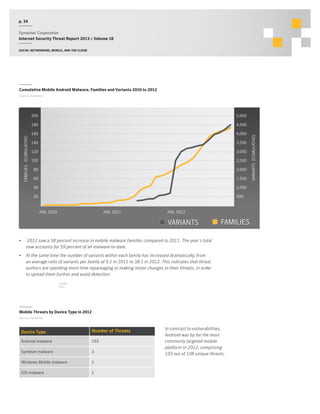
2012 saw a 58 percent increase in mobile malware families compared to 2011. The year’s total
now accounts for 59 percent of all malware to-date.

•	 At the same time the number of variants within each family has increased dramatically, from
an average ratio of variants per family of 5:1 in 2011 to 38:1 in 2012. This indicates that threat
authors are spending more time repackaging or making minor changes to their threats, in order
to spread them further and avoid detection.
SHARE
THIS

Mobile Threats by Device Type in 2012
Source: Symantec

Device Type

Number of Threats

Android malware

103

Symbian malware

3

Windows Mobile malware

1

iOS malware

1

In contrast to vulnerabilities,
Android was by far the most
commonly targeted mobile
platform in 2012, comprising
103 out of 108 unique threats.

VARIANTS (CUMULATIVE)

5,000

180

FAMILIES (CUMULATIVE)

200
p. 35
Symantec Corporation
Internet Security Threat Report 2013 :: Volume 18
Social networking, mobile, and the cloud

Mobile Vulnerabilities by OS
Source: Symantec

Platform

Documented Vulnerabilities

Apple iOS

387

Android

13

BlackBerry

13

Nokia

0

LG Electronics

0

Windows Mobile

The vast majority of vulnerabilities
on mobile systems were on the iOS
platform. However, the higher number
of vulnerabilities is not indicative of a
higher level of threat, because most
mobile threats have not used software
vulnerabilities.

2

Analysis
Spam and Phishing Move to Social Media
In the last few years, we’ve seen a significant increase in spam
and phishing on social media sites. Criminals follow users to
popular sites. As Facebook and Twitter have grown in popularity
for users, they have also attracted more criminal activity.
However, in the last year, online criminals have also started
targeting newer, fast-growing sites such as Instagram,
Pinterest, and Tumblr.
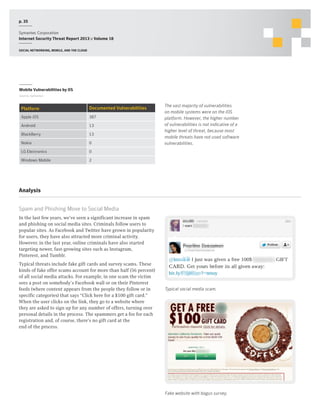
Typical threats include fake gift cards and survey scams. These
kinds of fake offer scams account for more than half (56 percent)
of all social media attacks. For example, in one scam the victim
sees a post on somebody’s Facebook wall or on their Pinterest
feeds (where content appears from the people they follow or in
specific categories) that says “Click here for a $100 gift card.”
When the user clicks on the link, they go to a website where
they are asked to sign up for any number of offers, turning over
personal details in the process. The spammers get a fee for each
registration and, of course, there’s no gift card at the
end of the process.

Typical social media scam.

Fake website with bogus survey.
p. 36
Symantec Corporation
Internet Security Threat Report 2013 :: Volume 18
Social networking, mobile, and the cloud

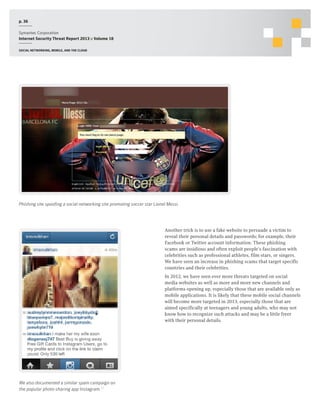
Phishing site spoofing a social networking site promoting soccer star Lionel Messi.

Another trick is to use a fake website to persuade a victim to
reveal their personal details and passwords; for example, their
Facebook or Twitter account information. These phishing
scams are insidious and often exploit people’s fascination with
celebrities such as professional athletes, film stars, or singers.
We have seen an increase in phishing scams that target specific
countries and their celebrities.
In 2012, we have seen ever more threats targeted on social
media websites as well as more and more new channels and
platforms opening up, especially those that are available only as
mobile applications. It is likely that these mobile social channels
will become more targeted in 2013, especially those that are
aimed specifically at teenagers and young adults, who may not
know how to recognize such attacks and may be a little freer
with their personal details.

We also documented a similar spam campaign on
the popular photo-sharing app Instagram.17
p. 37
Symantec Corporation
Internet Security Threat Report 2013 :: Volume 18
Social networking, mobile, and the cloud

Mobile Threats
In the last year, we have seen a further increase in mobile
malware. This correlates with increasing numbers of Internetconnected mobile devices. Android has a 72 percent market
share with Apple® iOS a distant second with 14 percent,
according to Gartner.18 As a result of its market share and more
open development environment, Android is the main target for
mobile threats.
Typically, people use phones to store personal information and
contact information and increasingly they have high-speed
Internet connections. The smartphone has become a powerful
computer in its own right, and this makes these attractive
devices to criminals. They also have the added advantage of
being tied to a payment system—the owner’s phone contract—
which means that they offer additional ways for criminals to
siphon off money from the victim.
We’ve seen a big rise in all kinds of mobile phone attacks:
•  Android threats were more commonly found in Eastern
Europe and Asia; however, during the last year, the number
of Android threats in the rest of Europe and the United
States has increased.
•  Privacy leaks that disclose personal information, including
the release of surveillance software designed to covertly
transmit the owner’s location.19
•  Premium number fraud where malicious apps send expensive
text messages. This is the quickest way to make money from
mobile malware. One mobile botnet Symantec observed
used fake mobile apps to infect users and by our calculation
the botmaster is generating anywhere between $1,600 to
$9,000 per day and $547,500 to $3,285,000 per year.20
•  Mobile botnets. Just as spammers have linked networks of
PCs into botnets to send out unwanted email, now criminals
have begun using Android botnets the same way.21 This
suggests that attackers are adapting techniques used on
PCs to work on smartphones.
Historically, malware infected smartphones through rogue app
markets and users sideloading apps directly onto their devices.
However, legitimate app stores are not immune. In 2012, we saw
rogue software masquerading as popular games on the Google®
Play market, having bypassed Google’s automated screening
process.22
Businesses are increasingly allowing staff to “bring your
own device” (BYOD) to work, either by allowing them to use
personal computers, tablets, or smartphones for work, even
subsidizing their purchase. Even when companies provide their
own equipment, the trend towards consumerization means

that companies often turn to consumer technology, such as
file-sharing websites, and devices, such as consumer laptops
or tablets, to reduce costs. These two trends open the door to
a greater risk to businesses from mobile devices because they
often lack security features such as encryption, access control,
and manageability.
We have seen far more vulnerabilities for the iOS platform,
which makes up 93 percent of those published, than for Android
in 2012, but yet Android dominates the malware landscape, with
97 percent of new threats.
While seemingly contradictory at first, there is a good reason
for this: jailbreaking iOS devices. In order to install applications
that are not available on the Apple App Store, a user must run
an exploit against a vulnerability in the software. While not the
safest approach from a security standpoint, this is the only way
to install applications that are not available through the Apple
App Store.
In contrast, the Android platform provides the option to
install apps from unofficial markets by simply changing settings
in the operating system. Since no exploit is needed, the same
incentives aren’t present as there are on iOS. Android users are
vulnerable to a whole host of threats; however, very few have
utilized vulnerabilities to spread threats.
While Android clocks in with 103 threats in 2012, this number
may appear small compared to other estimates on the scope of
the mobile threat landscape. Many estimates are larger because
they provide a count of overall variants, as opposed to new,
unique threats. While many of these variants simply undergone
minor changes in an attempt to avoid antivirus scanners
detecting them, Symantec counted at least 3,906 different
mobile variants for the year.
There’s an important distinction between old and new Android
versions regarding security features. Google added a feature in
Android version 4.x to allow users to block any particular app
from pushing notifications into the status bar. This came in
response to feedback from users of older versions, annoyed by
ad platforms that push notifications to the status bar.
Also, due to the rise of threats that silently send premium text
messages—Android.Opfake, Android.Premiumtext, Android.
Positmob, and Android.Rufraud, for instance—Google added a
feature in Android 4.2 to prompt the user to confirm sending
such premium text messages. This can be very helpful in
protecting most users.
However, at around 10 percent market penetration at the end of
2012,23 Android 4.2 devices account only for a small percentage
p. 38
Symantec Corporation
Internet Security Threat Report 2013 :: Volume 18
Social networking, mobile, and the cloud

of the total devices out there. The Android ecosystem makes it
harder to keep everyone up to date. Google released the official
platform that works out of the box only on Nexus devices—
Google’s own branded device. From there each manufacturer
modifies and releases its own platform, which is in turn picked
up by mobile network operators who also customize those
platforms.
This makes it impossible for any change coming from Google
to be quickly available to all in-field devices. Any change to the
platform requires thorough testing by each manufacturer and
then each operator, all adding to the time needed to reach users.
Having so many device models also multiplies the amount of
resources all these companies have to allocate for each update,
leading to infrequently released updates or in some cases no
updates for older devices.
For most exploits in the OS, Google released quick fixes;
however, users still had long waits before they received the
fix from their network operators. Some exploits are not in the
original OS itself but in the custom modifications made by
manufacturers, such as the exploit for Samsung models that
appeared in 2012. Samsung was quick to fix it, but the fix still
had to propagate through network operators to reach users.
Tighter control from Google over the platform can solve some of
the “fragmentation” issues, but this could affect the relationship
it has with manufacturers. A cut-off point for older Android
users could help to mitigate the risk, but it is usually the
manufacturers that do this.

Cloud Computing Risks
The cloud services market was expected to grow by 20 percent
in 2012, according to Gartner.24 Cloud computing promises
businesses a way to enhance their IT without heavy upfront
capital costs and, for smaller businesses, it offers access to
enterprise-class business software at an affordable price. On
a fundamental level, it offers huge and growing economies of
scale as Internet bandwidth and processing power continue to
increase rapidly.
Cloud computing offers some potential security benefits,
especially for smaller companies without dedicated IT security
staff. Well-run cloud applications are more likely to be patched
and updated efficiently. They are also more likely to be resilient,
secure, and backed up than on-premises systems.
However, cloud computing presents some security concerns, too:
•  Privacy. Well-run cloud companies will have strong
policies about who can access customer data (for example,
for troubleshooting) and under what circumstances.

Information should only be entrusted to a third party over
the Internet where there is sufficient assurance as to how
that data will be managed and accessed.
•  Data Liberation. Cloud computing businesses make it easy
to get started, and reputable companies make it easy to
extract your data (for example, archived emails or customer
records) if you want to change providers. Before entrusting
their data to a cloud provider, potential users should
fully evaluate the terms and conditions of extracting and
recovering that data at a later date.
•  Eggs in One Basket. As we have seen from large-scale data
breaches in the last few years, attackers tend to go where
they can score the most data for the least effort. If a cloud
services provider stores confidential information for a
large number of customers, it becomes a bigger target for
attackers. A single breach at a cloud provider could be a
gold mine of personal data for an attacker.
•  Consumerization. Companies face a significant risk of
accidental or deliberate data loss when their employees
use unapproved cloud systems on an ad-hoc basis. For
example, if company policies make it difficult to email
large files to third parties, employees may decide to use
free online file sharing applications instead. The risk is
that these systems may fall short of company standards
for security. For example, one popular file-sharing site left
all its user accounts unlocked for four hours.25 In addition,
where employees use unauthorized cloud applications for
their work, such as social networking sites for marketing
purposes, they open up the company to attack from Webbased malware.
•  Infrastructure. Although not in the wild, there is a
theoretical risk that in a virtualized, multi-tenant
architecture, a malicious user could rent a virtual machine
and use it to launch an attack against the system by
exploiting a vulnerability in the underlying hypervisor and
use this to gain access to other virtual machines running in
the same environment. Consideration should also be given to
data encryption within the virtual machine to minimize the
risk from unauthorized access to the physical hard disks.
p. 39
Symantec Corporation
Internet Security Threat Report 2013 :: Volume 18
Social networking, mobile, and the cloud

Recommendations
Social Media Threats Are a Business Issue.

Protect Your Mobile Devices.

Companies are often unwilling to block access to social
media sites altogether, but they need to find ways to protect
themselves against Web-based malware on these and other
sites. This means multi-layer security software at the gateway
and on client PCs. It also requires aggressive patching and
updating to reduce the risk of drive-by infections. Lastly, user
education and clear policies are essential, especially regarding
the amount of personal information users disclose online.

Consider installing security software on mobile devices.
Also, users need to be educated about the risks of
downloading rogue applications and how to use their privacy
and permission settings. For company-provided devices,
consider locking them down and preventing the installation
of unapproved applications altogether.

Cloud Security Advice.26
Carry out a full risk assessment before signing up. Secure
your own information and identities. Implement a strong
governance framework.
p. 40
Symantec Corporation
Internet Security Threat Report 2013 :: Volume 18

Ma lw a re
spam
and ph is h in g
p. 41
Symantec Corporation
Internet Security Threat Report 2013 :: Volume 18
Malware, spam, and phishing

Introduction
Malware, spam, and social engineering continue to be massive,
chronic problems. Although they have been around for a long
time, attacks continue to evolve and they still have the potential
to do serious damage to consumers and businesses.
In addition, they hurt everyone by undermining confidence
in the Internet. These chronic threats do not get much news
coverage because they are “background noise” but that doesn’t
mean that they are unimportant. A useful comparison is the
difference between plane crashes and car crashes. A single plane
crash makes the national news, but the daily death toll on the
roads goes unreported despite killing significantly more people
each year.27
The popularity of ransomware is an example of all these themes.
It permanently locks people out of their computer unless they
pay a swinging “fine” to the perpetrators. It’s corrosive to trust,
expensive to remedy, and reveals a new level of ruthlessness and
sophistication.

The numbers are telling. In one example, malware called
Reveton (aka Trojan.Ransomlock.G), was detected attempting
to infect 500,000 computers over a period of 18 days. According
to a recent Symantec survey of 13,000 adults in 24 countries,
average losses per cybercrime incident are $197.28 In the last 12
months an estimated 556 million adults worldwide experienced
some form of cybercrime.

At a Glance
•	 With ransomware, malware has become more vicious and more
profitable.
•	 Email spam volumes fall again, down 29 percent in 2012, as
spammers move to social media.
•	 Phishing becomes more sophisticated and targets social
networking sites.

Irreversible ransomware locks
people out of their computer
unless they pay a “fine,” which
in most cases does not unlock
the computer.
p. 42
Symantec Corporation
Internet Security Threat Report 2013 :: Volume 18
Malware, spam, and phishing

Data
Spam
Spam rates declined for a second year in a row, dropping from
75 percent in 2011 to 69 percent of all email in 2012. In 2011
we were reluctant to call this decrease in spam a permanent
trend. Botnets can be rebuilt, new ones created. But several
factors appear to be keeping spam rates lower than in previous
years.
The takedowns of spam botnets continued in 2012. In March
2012 a resurrected Kelihos botnet was taken down for a second
time. In July the Grum botnet was taken down. While both were
significant spam botnets and contributed to the reduction in
spam, undoubtedly email spammers are still feeling the pain
of botnet takedowns from 2011.
Additionally, pharmaceutical spam continues to decline,
apparently unable to recover from the loss of the major players
in the online pharmaceutical business.29 Given advancements
in anti-spam technology, plus the migration of many users to
social networks as a means of communication, spammers may
be diversifying in order to stay in business.
This is not to say that the problem of spam has been solved.
At 69 percent of all email, it still represents a significant
amount of unwanted messages.
As email spam rates continue to decline, we see the same social
engineering techniques that have been used in email spam
campaigns increasingly being adopted in spam campaigns and
being promoted through social networking channels.
SHARE
THIS

Top 5 Activity for Spam Destination by Geography

Country

%

Saudi Arabia

79%

Bulgaria

76%

Chile

74%

Hungary

74%

China

73%

Top 5 Activity for Spam Destination by Industry

Industry

%

Marketing/Media

69%

Manufacturing

69%

Recreation

69%

Agriculture

69%

Chemical/Pharmaceutical

69%

Top 5 Activity for Spam Destination by Company Size

Organization Size

%

1-250

68%

251-500

68%

501-1,000

68%

1,001-1,500

69%

1,501-2,500

69%

2,501+

68%
p. 43
Symantec Corporation
Internet Security Threat Report 2013 :: Volume 18
Malware, spam, and phishing

Global Spam Volume Per Day in 2012
Source: Symantec

•	 Spam volumes were
highest in August.

60

•	 The estimated projection
of global spam volumes
decreased by 29 percent,
from 42 billion spam emails
per day in 2011, to 30
billion in 2012.

50
40
30
20
BILLIONS
10
0
JAN

FEB

MAR

APR

MAY

JUN

JUL

AUG

SEP

OCT

NOV

DEC

Global Spam Rate – 2012 vs 2011
Source: Symantec

The overall average global spam
rate for 2012 was 69 percent,
compared with 75 percent in
2011.

90%
80
70
60
50
40
30
20
10

JAN

FEB

MAR

APR

MAY

JUN

JUL

AUG

SEP

OCT

2011

NOV

DEC

2012
p. 44
Symantec Corporation
Internet Security Threat Report 2013 :: Volume 18
Malware, spam, and phishing

Pharmaceutical Spam – 2012 vs 2011
Source: Symantec

•	 Pharmaceutical spam makes
up 21 percent of all spam, but
was overtaken by the Adult/
Sex/Dating category, which
now makes up 55 percent of
spam.

70%
60
50

•	 Pharmaceutical spam in 2012
declined by approximately 19
percentage points compared
with 2011.

40
30
20
10

JAN

FEB

MAR

APR

MAY

JUN

JUL

AUG

SEP

OCT

NOV

2011

DEC

2012

Adult/Sex/Dating Spam – 2012 vs 2011
Source: Symantec

•	 Adult/Dating spam in 2012
increased by approximately
40 percentage points
compared with 2011.

90%
80

•	 This suggests an almost
direct correlation
between the decline in
pharmaceutical spam and
the increase in dating spam.

70
60
50
40
30
20
10

JAN

FEB

MAR

APR

MAY

JUN

JUL

AUG

SEP

OCT

2011

NOV

DEC

2012

•	 The proportion of adult/
sex/dating spam was
greater in 2012 than for
pharmaceutical spam in
2011, but the actual volume
of adult/sex/dating spam
in 2012 was lower than for
pharmaceutical spam in
2011, since overall spam
volumes were lower in 2012
than in the previous year.
p. 45
Symantec Corporation
Internet Security Threat Report 2013 :: Volume 18
Malware, spam, and phishing

Phishing
Top 5 Activity for Phishing Destination by Geography

Email phishing rates are also down this year, from one in
299 emails in 2011 to one in 414 in 2012.

Country

1 in

Netherlands

1 in 123

South Africa

1 in 177

United Kingdom

1 in 191

Denmark

1 in 374

China

The decline in the use of email as a method to spread spam
and carry out phishing attacks does not likely indicate a
drop in activity by attackers. Rather, it appears that we
are seeing a shift in activity from email to other forms
of online communication, such as social networks.

1 in 382

Top 5 Activity for Phishing Destination by Company Size
Top 5 Activity for Phishing Destination by Industry

Company Size

1 in

1 in

1-250

1 in 294

Public Sector

1 in 95

251-500

1 in 501

Finance

1 in 211

501-1,000

1 in 671

Education

1 in 223

1,001-1,500

1 in 607

Accommodation/Catering

1 in 297

1,501-2,500

1 in 739

Marketing/Media

1 in 355

2,501+

1 in 346

Industry

Phishing Rate – 2012 vs 2011
Source: Symantec

•	 Phishing rates have dropped
drastically in 2012, in many
cases less than half the
number for that month in
the previous year.

1 in 100

•	 The overall average phishing
rate for 2012 was 1 in 414
emails, compared with
1 in 299 in 2011.

1 in 200
1 in 300
1 in 400
1 in 500
1 in 600
JAN

FEB

MAR

APR

MAY

JUN

JUL

AUG

SEP

OCT

2011

NOV

DEC

2012
p. 46
Symantec Corporation
Internet Security Threat Report 2013 :: Volume 18
Malware, spam, and phishing

Malware
One in 291 emails contained a virus in 2012, which is down from
one in 239 in 2011. Of that email-borne malware, 23 percent of
it contained URLs that pointed to malicious websites. This is
also down from 2011, where 39 percent of email-borne malware
contained a link to a malicious website.

Top 5 Activity for Malware Destination by Industry

1 in

Public Sector

1 in 72

Education

1 in 163

Finance

1 in 218

Marketing/Media

1 in 235

Accommodation/Catering

Much like the drop in spam and phishing rates, a drop in emails
that contain viruses does not necessarily mean that attackers
have stopped targeting users. Rather, it more likely points to a
shift in tactics, targeting other online activities, such as social
networking.

Industry

1 in 236

Top 5 Activity for Malware Destination by Company Size

Company Size

Top 5 Activity for Malware Destination by Geography

1 in
1 in 299

Country

1 in

1-250

Netherlands

1 in 108

251-500

1 in 325

Luxembourg

1 in 144

501-1,000

1 in 314

United Kingdom

1 in 163

1,001-1,500

1 in 295

South Africa

1 in 178

1,501-2,500

1 in 42

Germany

1 in 196

2,501+

1 in 252

Proportion of Email Traffic in Which Virus Was Detected – 2012 vs 2011
Source: Symantec

•	 Overall numbers declined,
with one in 291 emails
containing a virus.

1 in 50

•	 In 2011, the average rate for
email-borne malware was
1 in 239

1 in 100
1 in 150
1 in 200
1 in 250
1 in 300
1 in 350
1 in 400
JAN

FEB

MAR

APR

MAY

JUN

JUL

AUG

SEP

OCT

2011

NOV

DEC

2012
p. 47
Symantec Corporation
Internet Security Threat Report 2013 :: Volume 18
Malware, spam, and phishing

Proportion of Email Traffic Containing URL Malware – 2012 vs 2011
Source: Symantec

•	 Emails that contained a
malicious URL dropped
significantly in 2012. In
some months it was more
than half the rate as it was
that month in 2011.

70%
60
50

•	 In 2012, approximately 23
percent of email malware
contained a URL rather than
an attachment, compared
with 39 percent in 2011.

40
30
20
10

JAN

FEB

MAR

APR

MAY

JUN

JUL

AUG

SEP

OCT

2011

NOV

DEC

2012

Website Malware Blocked Per Day
Source: Symantec

•	 In 2012, approximately
247,350 Web-based attacks
were blocked each day.

400
350

•	 In 2011, this figure was
approximately 190,370
per day. This represents an
increase of 30 percent.

THOUSANDS

300
250
200
150
100
50
0
JUL AUG SEP OCT NOV DEC JAN FEB MAR APR MAY JUN JUL AUG SEP OCT NOV DEC

2011

2012
p. 48
Symantec Corporation
Internet Security Threat Report 2013 :: Volume 18
Malware, spam, and phishing

Website Exploits by Type of Website
Based on Norton Safe Web data, the Symantec technology that
scans the Web looking for websites hosting malware, we’ve
determined that 61 percent of malicious sites are actually
regular websites that have been compromised and infected
with malicious code.
We see Business, which covers consumer and industrial goods
and service sectors, listed at the forefront this year. This could
be due to the contribution of compromised sites from many
SMBs that do not invest in appropriate resources to protect
them. Hacking, which includes sites that promote or provide the
means to carry out hacking activities, jumped to second, though
it didn’t appear in the top 15 in 2011.
Although the Technology and Telecommunication category,
which provides information pertaining to computers, the
Internet and telecommunication, ranks third this year, it sees
5.7 percent of the total compromised sites, only a 1.2 percent
drop from 2011. Shopping sites that provide the means to
purchase products or services online remain in the top five,
but Shopping sees a drop of 4.1 percent.
It is interesting to note that Hosting, which ranked second
in 2011, has moved down to seventh this year. This covers
services that provide individuals or organizations access to
online systems for websites or storage. Due to this increase in
reliable and free cloud-based hosting solutions, provided by
the likes of Google, Dropbox and others, we see usage moving
away from unreliable hosting solutions, which could have
contributed towards the drop. Blogging has also experienced a
significant drop in 2012, moving down to fourth position. This
could support the theory that people are moving towards social
networking and exchanging information through such networks.
Malware developers find it easy to insert malicious code in such
sites and spread them using various means.
SHARE
THIS

Website Exploits by Type of Website
Source: Symantec

Rank

Top Domain Categories that
Got Exploited by # of Sites

# of Infected
Sites/Total # of
Infected Sites

1

Business

7.7%

2

Hacking

7.6%

3

Technology and Telecommunication

5.7%

4

Blogging

4.5%

5

Shopping

3.6%

6

Known Malware Domain

2.6%

7

Hosting

2.3%

8

Automotive

1.9%

9

Health

1.7%

10

Educational

1.7%

Top 10 Malware in 2012
Source: Symantec

Rank

Malware Name

%

1

W32.Sality.AE

6.9%

2

W32.Ramnit.B

5.1%

3

W32.Downadup.B

4.4%

4

W32.Virut.CF

2.2%

5

W32.SillyFDC

1.1%

6

W32.Mabezat.B

1.1%

7

W32.Xpaj.B

0.6%

8

W32.Changeup

0.6%

9

W32.Downadup

0.5%

10

W32.Imaut

0.4%
p. 49
Symantec Corporation
Internet Security Threat Report 2013 :: Volume 18
Malware, spam, and phishing

Analysis
Macs Under Attack
Historically, Mac users have felt less vulnerable to malware than
PC users. As Apple has gained market share, Macs have become
a more attractive target. In fact, 2012 saw the first significant
Mac malware outbreak. The Flashback attack exploited a
vulnerability in Java to create a cross-platform threat.30 It was
incorporated into the Blackhole attack toolkit and used by
criminals to infect 600,000 Macs,31 which is approximately one
Mac in 100. Like more and more attacks in 2012, as discussed in
the “Web Attack Toolkits” section, it spread when users visited
infected websites. Although the Flashback malware was mainly
used for advertising click fraud, it had other capabilities, such as
giving hackers remote access to infected computers.32 Because
most Mac users do not have antivirus software, the chances of
detection, once infected, were small.

Does this indicate that hackers are going to start paying further
attention to Macintosh computers as a platform to target? Not
necessarily. While Mac users may encounter an occasional
threat here or there, the vast majority of what they encounter is
malware aimed at Windows computers. In fact, of all the threats
encountered by Symantec customers who used Mac computers
in the last quarter of 2012, only 2.5 percent of them were
actually written specifically for Macs.
This isn’t to say that Macs are a safer alternative to PCs; as we’ve
seen, they’re just as susceptible to attacks. There were more
threats created specifically for the Mac in 2012 than in years
past and the trend appears to be rising.

10

Mac-specific Threats by Year
Source: Symantec

MAC THREAT
FAMILIES IN 2012

There were more unique threats
for OS X in 2012 than any year
previously.

10
9
8
7
6
5
4
3
2
1
2007

2008

2009

2010

2011

2012
p. 50
Symantec Corporation
Internet Security Threat Report 2013 :: Volume 18
Malware, spam, and phishing

Rise of Ransomware
Ransomware became a bigger challenge in 2012 as its popularity
among malware authors increased. Unlike scareware, which
encouraged you to buy fake antivirus protection, ransomware
just locks your computer and demands a release fee. The
malware is often quite sophisticated, difficult to remove, and in
some cases it persists in safe mode, blocking attempts at remote
support.
Victims usually end up with ransomware from drive-by
downloads when they are silently infected visiting websites
that host Web attack toolkits. This ransomware is often from
legitimate sites that have been compromised by hackers who
insert the malicious download code. Another source of infection
is malvertisements where criminals buy advertising space
on legitimate websites and use it to hide their attack code, as
discussed in the malvertisement section.

Typical ransomware locking screen showing a fake police warning.

The perpetrators use social engineering to increase the chances
of payment. The locking screen often contains a fake warning
from local law enforcement and the ransom is presented as a
fine for criminal activity online. In some cases, ransomware also
takes a photo of the victim using a webcam and displays this
image in the locking screen, which can be unnerving for victims.
Criminals use anonymous money transfer systems or prepaid
credit cards to receive the payments. The ransom typically
ranges between $50 and $400. In many cases, payment doesn’t
unlock the computer. Symantec monitored a ransomware
command and control server and saw 5,300 computers infected.
About three percent of victims paid the ransom, which netted
the criminals about $30,000.
p. 51
Symantec Corporation
Internet Security Threat Report 2013 :: Volume 18
Malware, spam, and phishing

Long-term Stealthy Malware
Internet criminals are also making money from malware that
stays hidden on the victims’ computers. Operating in botnets
with many thousands of computers acting collectively, these
stealthy programs send out spam or generate bogus clicks on
website advertisements (which generate referral income for the
site owners). These techniques don’t generate rapid returns like
ransomware; however, they are much less likely to be discovered
and, thanks to clever coding, are more difficult to remove.
Consequently, they can generate a constant stream of revenue
over time.

Email Spam Volume Down
After decreases in 2011, this year saw a further reduction in the
volume of email spam from 76 percent of all email messages
to 69 percent. There are several reasons for this. First, law
enforcement action has closed down several botnets, reducing
the number of messages being sent.33 Second, spammers are
increasingly redirecting their efforts to social media sites
instead of email. Lastly, spammers are improving the quality and
targeting of their spam messages in an effort to bypass filters
and this has led to a reduction in the overall numbers being sent.

Advanced Phishing
While spam has declined slightly in 2012, phishing attacks have
increased. Phishers are using very sophisticated fake websites—
in some cases, perfect replicas of real sites—to trick victims into
revealing personal information, passwords, credit card details,
and bank credentials. In the past they relied more on fake
emails, but now those emails coupled with similar links posted
on social media sites are used to lure the victim to these more
advanced phishing websites.
Typical fake sites include banks and credit card companies, as
you’d expect, but also popular social media sites. The number
of phishing sites that spoofed social network sites increased
123 percent in 2012.

If criminals can capture your social media login details, they can
use your account to send phishing emails to all your friends. A
message that seems to come from a friend appears much more
trustworthy. Another way to use a cracked social media account
is to send out a fake message to someone’s friends about some
kind of emergency. For example, “Help! I’m stuck overseas
and my wallet has been stolen. Please send $200 as soon as
possible.”
In an attempt to bypass security and filtering software,
criminals use complex website addresses and nested URL
shortening services. They also use social engineering to
motivate victims to click on links. In the last year, they have
focused their messages around celebrities, movies, sports
personalities, and attractive gadgets such as smartphones
and tablets. The number of phishing websites that used SSL
certificates in an attempt to lull victims into a false sense of
security increased by 46 percent in 2012 compared with the
previous year.
We saw a significant (threefold) rise in non-English phishing in
2012. In particular, we saw a significant increase in South Korea.
The non-English languages that had the highest number of
phishing sites were French, Italian, Portuguese, Chinese,
and Spanish.
SHARE
THIS
p. 52
Symantec Corporation
Internet Security Threat Report 2013 :: Volume 18
Malware, spam, and phishing

Recommendations
Protect Yourself Against Social Engineering.

Antivirus on Endpoints Is Not Enough.

For individuals as well as for businesses, it’s essential that
people learn to spot the telltale signs of social engineering,
which can include undue pressure, titillation or a false sense
of urgency, an offer that is literally too good to be true, bogus
“officialese” in an attempt to make something look authentic
(for example, lengthy reference numbers), implausible
pretexts (for example, a Microsoft “representative” calls to
tell you that your computer has a virus), and false quid-proquo offers (for example, receive a free gift when you provide
personal or confidential information).

On endpoints (desktops/laptops), signature-based antivirus
alone is not enough to protect against today’s threats and
Web-based attack toolkits. Deploy and use a comprehensive
endpoint security product that includes additional layers of
protection, including:

Avoid Ransomware.
Avoid marginal websites and, in particular, pirate software
and adult sites. Do not install unsolicited plug-ins or
executables if prompted to do so, even on legitimate websites.
Consider using advertising blocker software in your browser.
Ensure that your computer is up to date with the latest
patches and updates to increase your resistance to drive-by
Web infections. Keep backups and recovery disks so you can
unlock your computer in an emergency. And, of course, have
effective, up-to-date security software.

Think Before You Click.
That unsolicited email from a known acquaintance, such as
your mother or coworker, may not be legit. Their account
may have been compromised, if they’ve fallen for a social
engineering trick.

•  Endpoint intrusion prevention that protects against
unpatched vulnerabilities from being exploited, protects
against social engineering attacks, and stops malware
from ever making it onto endpoints;
•  Browser protection for protection against obfuscated Webbased attacks;
•  Heuristic file-based malware prevention to provide more
intelligent protection against unknown threats;
•  File and Web-based reputation solutions that provide a
risk-and-reputation rating of any application and website
to prevent rapidly mutating and polymorphic malware;
•  Behavioral prevention capabilities that look at the
behavior of applications and malware and prevent
malware;
•  Application control settings that can prevent applications
and browser plug-ins from downloading unauthorized
malicious content;
•  Device control settings that prevent and limit the types of
USB devices to be used.
p. 53
Symantec Corporation
Internet Security Threat Report 2013 :: Volume 18

L ook in g ahead
p. 54
Symantec Corporation
Internet Security Threat Report 2013 :: Volume 18

Looking Ahead

“Never make predictions,” said a wise man, “especially about the future.” But we can
extrapolate from this year’s data to speculate on future trends in the hope that this will help
organizations and individuals protect themselves more effectively. Looking ahead, here are
our priorities and concerns for the coming year:
More State-sponsored Cyber Attacks

Social Media Will Be a Major Security Battleground

The last few years have seen increasingly sophisticated and
widespread use of cyber attacks. In peacetime, they provide
plausible deniability; in wartime, they could be an essential
tool. Cyber attacks will continue to be an outlet where tensions
between countries are played out. Moreover, in addition to
state-sponsored attacks, non-state sponsored attacks, including
attacks by nationalist activists against those whom they perceive
to be acting against their country’s interest, will continue.
Security companies and businesses need to be prepared for
blowback and collateral damage from these attacks and, as
ever, they need to make strenuous efforts to protect themselves
against targeted attacks of all kinds.

Social media websites already combine elements of an
operating system, a communications platform, and an
advertising network. As they go mobile and add payment
mechanisms, they will attract even more attention from online
criminals with malware, phishing, spam, and scams. Traditional
spam, phishing, and malware will hold steady or decline
somewhat; however, social media attacks will grow enormously.
As new social media tools emerge and become popular, criminals
will target them. Further, we think that the intersection of
smartphones and social media will become an important
security battleground as criminals target teenagers, young
adults, and other people who may be less guarded about their
personal data and insufficiently security-minded to protect their
devices and avoid scams.

Sophisticated Attack Techniques Trickle Down
Know-how used for industrial espionage or cyberwarfare will be
reverse-engineered by criminal hackers for commercial gain. For
example, the zero-day exploits used by the Elderwood Gang will
be exploited by other malware authors. Similarly the “opensourcing” of malware toolkits such as Zeus (also known as Zbot),
perhaps in an effort to throw law enforcement off the trail of the
original authors, will make it easier for authors to create new
malware.

Websites Will Become More Dangerous
Drive-by infections from websites will become even more
common and even harder to block without advanced security
software. Criminals will increasingly attack websites, using
malvertising and website attack kits, as a means of infecting
users. Software vendors will come under pressure to increase
their efforts in fixing vulnerabilities promptly. Users and
companies that employ them will need to be more proactive
about maintaining their privacy and security in this new social
media world.

Attacks Against Cloud Providers Will Increase
So far, the very big data breaches have occurred in businesses
that collect a lot of personal data, such as healthcare providers,
online retailers or games companies. In 2013 we expect to see a
variety of attacks against cloud software providers.

Increasingly Vicious Malware
Malware has advanced from being predominantly about data
theft and botnets (although both are still very common) through
fake antivirus scams to increased ransomware attacks in 2012.
We expect to see these attacks become harder to undo, more
aggressive, and more professional over time. Once criminals
see that they can get a high conversion rate from this kind of
extortion, we may see other manifestations, such as malware
that threatens to and then actually deletes the contents of
your hard disk. This was the case of the Shamoon attacks that
occurred in August and erased data from the infected computer.
Essentially, if it is possible, someone will try it; if it is profitable,
many people will do it.
p. 55
Symantec Corporation
Internet Security Threat Report 2013 :: Volume 18

Mobile Malware Comes of Age

Persistent Phishing

Just as social media is becoming the new “operating system” for
computers, mobile phones and tablets are becoming the new
hardware platform. Tablet adoption and smartphone market
penetration will continue and this will attract criminals. What
has evolved over a decade on PCs is emerging more rapidly on
smartphones and tablets. We’ll see ransomware and drive-by
website infections on these new platforms in the coming year.
For businesses that use these new devices or allow employees
to bring their own to work, this will present a serious security
problem in 2013.

Identities are valuable, so criminals will continue to try to steal
them. Phishing attacks will continue to get smarter and more
sophisticated. For example, we’ll see more perfect site replicas
and SSL-encryption phishing sites. Phishing will become more
regional and it will appear in a wider variety of languages,
making it harder to block and more effective. It will continue
its spread on social media websites where it will exploit the
medium’s virality and trusted messaging.
p. 56
Symantec Corporation
Internet Security Threat Report 2013 :: Volume 18

Endnotes
01	See http://krebsonsecurity.com/2012/03/mastercard-visa-warn-of-processor-breach/.
02	See http://www.ic3.gov/media/2012/FraudAlertFinancialInstitutionEmployeeCredentialsTargeted.pdf.
03	 Aviation Week & Space Technology, October 22, 2012, 82.
04	See http://www.ic3.gov/media/2012/FraudAlertFinancialInstitutionEmployeeCredentialsTargeted.pdf.
05	 The data for the data breaches that could lead to identity theft is procured from the Norton Cybercrime Index (CCI). The Norton CCI
is a statistical model that measures the levels of threats including malicious software, fraud, identity theft, spam, phishing, and
social engineering daily. Data for the CCI is primarily derived from Symantec Global Intelligence Network and for certain data from
ID Analytics. The majority of the Norton CCI’s data comes from Symantec’s Global Intelligence Network, one of the industry’s most
comprehensive sources of intelligence about online threats. The data breach section of the Norton CCI is derived from data breaches
that have been reported by legitimate media sources and have exposed personal information, including name, address, Social
Security numbers, credit card numbers, or medical history. Using publicly available data the Norton CCI determines the sectors that
were most often affected by data breaches, as well as the most common causes of data loss.
06	See http://www.symantec.com/content/en/us/about/media/pdfs/b-ponemon-2011-cost-of-data-breach-global.en-us.pdf.
07	See http://www.symantec.com/connect/blogs/shamoon-attacks.
08	 Internet Security Threat Report, April 2012, “Targeted Attacks,” 16.
09	See http://www.symantec.com/content/en/us/enterprise/media/security_response/whitepapers/the-elderwood-project.pdf.
10	See http://www.symantec.com/connect/blogs/cve-2012-1875-exploited-wild-part-1-trojannaid.
11	See http://www.symantec.com/content/en/us/enterprise/media/security_response/whitepapers/the-elderwood-project.pdf.
12	See http://www.symantec.com/connect/blogs/cost-cybercrime-2012.
13	See http://www.symantec.com/connect/blogs/lizamoon-mass-sql-injection-tried-and-tested-formula.
14	See http://www.symantec.com/connect/blogs/danger-malware-ahead-please-not-my-site.
15	See http://www.securityweek.com/comodo-certificates-used-sign-banking-trojans-brazil.
16	See http://blog.nielsen.com/nielsenwire/social/2012/.
17	See http://www.symantec.com/connect/blogs/instaspam-instagram-users-receive-gift-card-spam.
18	See http://www.gartner.com/it/page.jsp?id=2237315.
19	See http://en.wikipedia.org/wiki/FinFisher and http://www.nytimes.com/2012/08/31/technology/finspy-software-is-trackingpolitical-dissidents.html?_r=1.
20	See http://www.symantec.com/connect/blogs/androidbmaster-million-dollar-mobile-botnet.
21	See http://www.symantec.com/connect/blogs/androidbmaster-million-dollar-mobile-botnet.
22	See http://news.cnet.com/8301-1009_3-57470729-83/malware-went-undiscovered-for-weeks-on-google-play.
23	See http://developer.android.com/about/dashboards/index.html.
24	See http://www.gartner.com/it/page.jsp?id=2163616.
25	See http://www.wired.com/threatlevel/2011/06/dropbox/.
26	 For more advice about cloud adoption, see https://www4.symantec.com/mktginfo/.
27	 In the United States, for example, the NTSB reports that 472 people died in aircraft accidents in 2010 compared with 32,885 in
highway accidents. See http://www.ntsb.gov/data/index.html.
28	See http://www.symantec.com/about/news/release/article.jsp?prid=20120905_02.
29	See http://www.npr.org/blogs/money/2013/01/15/169424047/episode-430-black-market-pharmacies-and-the-spam-empire-behindthem.
30	See http://www.symantec.com/security_response/writeup.jsp?docid=2012-041001-0020-99.
31	See http://www.symantec.com/connect/blogs/flashback-cleanup-still-underway-approximately-140000-infections.
32	See http://www.symantec.com/connect/blogs/both-mac-and-windows-are-targeted-once.
33	See http://krebsonsecurity.com/tag/planet-money/.
p. 57
Symantec Corporation
Internet Security Threat Report 2013 :: Volume 18

About Symantec

Symantec protects the world’s information and is a global leader in security, backup, and
availability solutions. Our innovative products and services protect people and information
in any environment—from the smallest mobile device to the enterprise data center to cloudbased systems. Our world-renowned expertise in protecting data, identities, and interactions
gives our customers confidence in a connected world. More information is available at
www.symantec.com or by connecting with Symantec at go.symantec.com/socialmedia.

More Information
•  Symantec.cloud Global Threats: http://www.symanteccloud.com/en/gb/globalthreats/.
•  Symantec Security Response: http://www.symantec.com/security_response/.
•  Internet Security Threat Report Resource Page: http://www.symantec.com/threatreport/.
•  Norton Threat Explorer: http://us.norton.com/security_response/threatexplorer/.
•  Norton Cybercrime Index: http://us.norton.com/cybercrimeindex/.
Confidence in a connected world.

For specific country offices and contact numbers,
please visit our website.
For product information in the U.S.,
call toll-free 1 (800) 745 6054.
Symantec Corporation World Headquarters
350 Ellis Street
Mountain View, CA 94043 USA
+1 (650) 527 8000
1 (800) 721 3934
www.symantec.com

Copyright © 2013 Symantec Corporation.
All rights reserved. Symantec, the Symantec Logo,
and the Checkmark Logo are trademarks or registered
trademarks of Symantec Corporation or its affiliates in
the U.S. and other countries. Other names may
be trademarks of their respective owners.
04/13 21291018

B istr main-report_v18_2012_21291018.en-us

  • 1.
    2012 Trends, Volume18, Published April 2013 internet security THREAT REPORT 2013
  • 2.
    p. 2 Symantec Corporation InternetSecurity Threat Report 2013 :: Volume 18 CONTENTS 03 Introduction 31 Social Networking, Mobile, and the Cloud 04 Executive Summary 32 Introduction 32 Data 06 2012 Security Timeline 35 Analysis 09 2012 in Numbers 35 Spam and Phishing Move to Social Media 37 Mobile Threats 13 Targeted Attacks, Hacktivism, and Data Breaches 38 Cloud Computing Risks 14 Introduction 14 Data 40 Malware, Spam, and Phishing 17 DDoS Used as a Diversion 41 Introduction 17 Data Breaches 42 Data 19 Analysis 42 Spam 19 Cyberwarfare, Cybersabotage, and Industrial Espionage 45 Phishing 20 Advanced Persistent Threats and Targeted Attacks 46 Malware 20 Social Engineering and Indirect Attacks 48 Website Exploits by Type of Website 21 Watering Hole Attacks 49 Analysis 49 Macs Under Attack 23 Vulnerabilities, Exploits, and Toolkits 50 Rise of Ransomware 24 Introduction 51 Long-term Stealthy Malware 24 Data 51 Email Spam Volume Down 26 Analysis 51 Advanced Phishing 26 Web-based Attacks on the Rise 27 The Arms Race to Exploit New Vulnerabilities 53 Looking ahead 27 Malvertising and Website Hacking 56 Endnotes 28 Web Attack Toolkits 57 About Symantec 29 Website Malware Scanning and Website 57 More Information Vulnerability Assessment 29 The Growth of Secured Connections 29 Norton Secured Seal and Trust Marks 29 Stolen Key-signing Certificates
  • 3.
    p. 3 Symantec Corporation InternetSecurity Threat Report 2013 :: Volume 18 Introduction Symantec has established some of the most comprehensive sources of Internet threat data in the world through the Symantec™ Global Intelligence Network, which is made up of approximately 69 million attack sensors and records thousands of events per second. This network monitors threat activity in over 157 countries and territories through a combination of Symantec products and services such as Symantec DeepSight™ Threat Management System, Symantec™ Managed Security Services and Norton™ consumer products, and other third-party data sources. In addition, Symantec maintains one of the world’s most comprehensive vulnerability databases, currently consisting of more than 51,644 recorded vulnerabilities (spanning more than two decades) from over 16,687 vendors representing over 43,391 products. Spam, phishing, and malware data is captured through a variety of sources, including the Symantec Probe Network, a system of more than 5 million decoy accounts; Symantec.cloud and a number of other Symantec security technologies. Skeptic™, the Symantec.cloud proprietary heuristic technology, is able to detect new and sophisticated targeted threats before reaching customers’ networks. Over 3 billion email messages and more than 1.4 billion Web requests are processed each day across 14 data centers. Symantec also gathers phishing information through an extensive antifraud community of enterprises, security vendors, and more than 50 million consumers. Symantec Trust Services provides 100 percent availability and processes over 4.5 billion Online Certificate Status Protocol (OCSP) look-ups per day, which are used for obtaining the revocation status of X.509 digital certificates around the world. These resources give Symantec’s analysts unparalleled sources of data with which to identify, analyze, and provide informed commentary on emerging trends in attacks, malicious code activity, phishing, and spam. The result is the annual Symantec Internet Security Threat Report, which gives enterprises, small businesses, and consumers the essential information to secure their systems effectively now and into the future. SHARE THIS
  • 4.
    p. 4 Symantec Corporation InternetSecurity Threat Report 2013 :: Volume 18 Executive Summary Threats to online security have grown and evolved considerably in 2012. From the threats of cyberespionage and industrial espionage to the widespread, chronic problems of malware and phishing, we have seen constant innovation from malware authors. We have also seen an expansion of traditional threats into new forums. In particular, social media and mobile devices have come under increasing attack in 2012, even as spam and phishing attacks via traditional routes have fallen. Online criminals are following users onto these new platforms. The most important trends in 2012 were: Small Businesses Are the Path of Least Resistance for Attackers Last year’s data made it clear that any business, no matter its size, was a potential target for attackers. This was not a fluke. In 2012, 50 percent of all targeted attacks were aimed at businesses with fewer than 2,500 employees. In fact, the largest growth area for targeted attacks in 2012 was businesses with fewer than 250 employees; 31 percent of all attacks targeted them. This is especially bad news because based on surveys conducted by Symantec, small businesses believe they are immune to attacks targeted at them. However, money stolen from a small business is as easy to spend as money stolen from a large business. And while small businesses may assume that they have nothing a targeted attacker would want to steal, they forget that they retain customer information, create intellectual property, and keep money in the bank. While it can be argued that the rewards of attacking a small business are less than what can be gained from a large enterprise, this is more than compensated by the fact that many small companies are typically less careful in their cyberdefenses. Criminal activity is often driven by crimes of opportunity. With cybercrimes, that opportunity appears to be with small businesses. Even worse, the lack of adequate security practices by small businesses threatens all of us. Attackers deterred by a large company’s defenses often choose to breach the lesser defenses of a small business that has a business relationship with the attacker’s ultimate target, using the smaller company to leap frog into the larger one. Additionally, small businesses and organizations can become pawns in more sophisticated attacks. Driven by attack toolkits, in 2012 the number of Web-based attacks increased by one third and many of these attacks originated from the compromised websites of small businesses. These massive attacks increase the risk of infection for all of us. But even more nefariously, as reported in our Elderwood white paper last year, the websites of small businesses and organizations are even being used in targeted attacks. Supplementing their phishing attacks, cyberespionage gangs now hijack these websites, lying in wait for their targets to visit so that they can infect them. This type of attack, called a watering hole, is another way attackers leverage weak security of one entity to defeat the strong security of another. Malware Authors Act as Big Brother If you think someone is violating your privacy online, you are probably right. Fifty percent of mobile malware created in 2012 attempted to steal our information or track our movements. Whether they are attacking our computers, mobile phones or social networks, Cyber-criminals are looking to profit by spying on us. Their ultimate goal is to make money. Their method is to learn our banking information, the phone numbers and email addresses of our friends and business associates, our personal information, and even how to become us by stealing our identity. But the most ominous example of malware authors knowing all about us is in targeted attacks. Creating successful targeted attacks requires attackers to learn about us. They will research our email addresses, our job, our professional interests, and even the conferences we attend and the websites we frequent. All of this information is compiled to launch a successful targeted attack. Once on our devices, the attacker’s tools are designed to pull as much data as possible. Undiscovered targeted attacks can collect years of our email, files, and contact information. These tools also contain the ability to log our keystrokes, view our computer screens, and turn on our computers’ microphones and cameras. Targeted attackers truly act as an Orwellian incarnation of Big Brother. SHARE THIS
  • 5.
    p. 5 Symantec Corporation InternetSecurity Threat Report 2013 :: Volume 18 Those jobs most targeted for attack in 2012 were knowledge workers who create the intellectual property that attackers want (27 percent of all targets in 2012) and those in sales (24 percent in 2012). Interest in targeting the CEO of an organization waned in 2012; those attacks decreased by 8 percent. With Mobile, It’s Not the Vulnerability that Will Get You As expected, the amount of mobile malware in 2012 continues to rise. 2012 saw a 58 percent increase in mobile malware families compared to 2011. The year’s total now accounts for 59 percent of all malware to-date. With a 32 percent increase in the number of vulnerabilities reported in mobile operating systems, it might be tempting to blame them for the increase. However, this would be wrong. In the PC space, a vulnerability drives attacks as new vulnerabilities are incorporated into commonly available toolkits. The more they’re used, the faster they spread. This is not occurring in the mobile space. Today, mobile vulnerabilities have little or no correlation to mobile malware. In fact, while Apple’s iOS had the most documented vulnerabilities in 2012, there was only one threat created for the platform. Compare this to the Android OS; although only thirteen vulnerabilities were reported, it led all mobile operating systems in the amount of malware written for the platform. Vulnerabilities likely will become a factor in mobile malware, but today Android’s market share, the openness of the platform, and the multiple distribution methods available to applications embedded with malware make it the go-to platform of malware authors. Zero-day Vulnerabilities Available When Attackers Need Them Zero-day vulnerabilities continue to trend upward; 14 were reported in 2012. In the last three years much of the growth in zero-day vulnerabilities used in attacks can be attributed to two groups; the authors of Stuxnet and the Elderwood Gang. In 2010, Stuxnet was responsible for 4 of the 14 discovered zero-day vulnerabilities. The Elderwood Gang was responsible for 4 of the 14 discovered in 2012. The Elderwood Gang also used zero-day threats in 2010 and 2011, and they’ve used at least one so far in 2013. Attackers use as many zero-day vulnerabilities as they need, not as many as they have. And Stuxnet and Elderwood make for an interesting contrast in the strategy of their use. Stuxnet remains the aberration, using multiple zero-day exploits in one attack. From what we know today, it was a single attack that was directed at a single target. Multiple zero-day exploits were used to ensure success so they would not need to attack a second time. By contrast the Elderwood Gang has used one zero-day exploit in each attack, using it continually until that exploit becomes public. Once that occurs they move on to a new exploit. This makes it seem that the Elderwood Gang has a limitless supply of zero-day vulnerabilities and is able to move to a new exploit as soon as one is needed. It is our hope that this is not the case. Attribution Is Never Easy Some targeted attacks make no attempt to stay undetected. A piece of malware named Shamoon was discovered in August. Its purpose was to wipe computer hard drives of energy companies in the Middle East. A group calling itself the “Cutting Sword of Justice” claimed responsibility. Throughout 2012, DDoS attacks were launched against financial institutions. A group called Izz ad-Din al-Qassam Cyber Fighters claimed responsibility. These attacks and others appear to be classic cases of hacktivism. However, proving attribution and motive are not easy, even when someone claims responsibility. There has been much speculation, some reportedly from the intelligence community, that the Cutting Sword of Justice and the Qassam Cyber Fighters are fronts for a nation state. Complicating what appeared to be simple hactivism even further is the FBI’s warning to financial institutions that some DDoS attacks are actually being used as a “distraction.” These attacks are launched before or after cybercriminals engage in an unauthorized transaction, and are an attempt to avoid discovery of the fraud and prevent attempts to stop it. SHARE THIS
  • 6.
    p. 6 Symantec Corporation InternetSecurity Threat Report 2013 :: Volume 18 2012 SECURITY TIMELINE
  • 7.
    p. 7 Symantec Corporation InternetSecurity Threat Report 2013 :: Volume 18 2012 Security Timeline 01 Data breach: 24 million identities stolen in data breach at January Zappos apparel company. 04 April Malcode: Over 600,000 Mac computers are infected by the OSX.Flashback Trojan through an unpatched Java exploit. Mac: A scam involving malicious browser plug-ins for Firefox and Chrome is discovered. 02 Mac: A second Mac Trojan is discovered, OSX.Sabpab, which also uses Java exploits to compromise a computer. Botnet: Kelihos botnet returns, four months after being February taken down. Mobile: 05 May Google announces Google Bouncer, an app scanner for the Google Play market. Social networking: Scammers are discovered leveraging social networks Tumblr and Pinterest. Malware: The cyberespionage threat W32.Flamer is discovered. 03 Botnet: Certificate Authorities: Researchers take down new variant of the Kelihos March botnet, which reappears in a new form later in the month. Comodo, a large Certificate Authority, authenticated and issued a legitimate codesigning certificate to a fictitious organization run by cybercriminals. This was not discovered until August. Hacks: Six individuals are arrested as alleged members of the hacking collective LulzSec. Botnet: Security researchers take down key servers for the Zeus botnet. 06 June Data breach: LinkedIn suffers data breach, exposing millions of accounts. Data breach: Malware: A payment processor for a number of wellknown credit card companies, including Visa and MasterCard was compromised, exposing details of 1.5 million accounts.1 A Trojan by the name of Trojan.Milicenso is discovered, which causes networked printers to print large print jobs containing illegible characters. Mobile: A non-malware-based scam involving the Opfake gang is found that targets iPhone users.
  • 8.
    p. 8 Symantec Corporation InternetSecurity Threat Report 2013 :: Volume 18 07 July Botnet: Security researchers disable the Grum botnet. Malware: 09 September Security researchers disable an up-and-coming botnet known as “Nitol.” Mac: Mobile: A new Mac threat called OSX.Crisis opens a back door on compromised computers. A vulnerability is discovered in Samsung’s version of Android™ that allows a phone to be remotely wiped. Botnet: DNS servers, maintained by the FBI in order to keep computers previously infected with the DNSChanger Trojan safe, are shut off. DDoS: FBI issues warning about possible DDoS attacks against financial institutions as part of a “distraction” technique.2 Malware: Malware: A second printer-related threat called W32.Printlove, which causes large print jobs to print garbage, is discovered. 08 August 10 October Malware: W32.Gauss is discovered. The scope of the threat is concentrated in the Middle East, in a similar way to W32.Flamer. Certificate Authorities: Comodo incident from May discovered and details published. A ransomware threat distributed through Skype IM is discovered. Customer data is stolen from Barnes & Noble payment keypads. Attackers are discovered using a DDoS attack as a distraction in order to gather information that allowed them to later steal money from a targeted bank. Reuters news service suffers a series of hacks resulting in fake news stories posted on its website and Twitter account. Crisis malware is discovered targeting VMware® virtual machine images. Malware: Data breach: Hacks: Malware: A new version of the Blackhole attack toolkit, dubbed Blackhole 2.0, is discovered. Botnet: Windows malware is discovered in Apple’s App Store, embedded in an application. A Trojan used to steal information from the Japanese government is discovered after being in operation for two years. Malware: 11 Hacks: 12 Malware: November December Burglars found using a known exploit in a brand of hotel locks to break into hotel rooms. Infostealer.Dexter Trojan horse discovered targeting point-of-sale systems. Hacks: Attackers exploit a vulnerability in Tumblr, spreading spam throughout the social network.
  • 9.
    p. 9 Symantec Corporation InternetSecurity Threat Report 2013 :: Volume 18 2012 in num b ers
  • 10.
    p. 10 Symantec Corporation InternetSecurity Threat Report 2013 :: Volume 18 2012 in numbers SHARE THIS 2012 in Numbers Targeted Attacks in 2012 42% INCREASE New Vulnerabilities 2010 2011 2012 6,253 4,989 5,291 Average Number of Identities Exposed Per Breach in 2012 604,826 Mobile Vulnerabilities 415 315 2012 2011 2010 163
  • 11.
    p. 11 Symantec Corporation InternetSecurity Threat Report 2013 :: Volume 18 2012 in numbers Estimated Global Email Spam Per Day (in billions) % of All Spam with Dating & Sexual % of All Email Malware as URL 3% 24% 15% 39% 55% OVERALL SPAM RATE 23% 2010 62 89% 2010 2011 2010 2011 2012 42 75% 2012 Overall Email Virus Rate, 1 In: 2011 2010 282 239 2011 2012 30 69% 2012 291 Overall Email Phishing Rate, 1 In: 2010 442 299 2011 2012 414
  • 12.
    p. 12 Symantec Corporation InternetSecurity Threat Report 2013 :: Volume 18 2012 in numbers Bot Zombies New Zero-Day Vulnerabilities (in millions) 14 3.1 2012 3.4 2011 Mobile Malware Families Increase 2011 2012 Web Attacks Blocked Per Day 2012 2011 4.5 14 2010 2010 8 190,370 247,350 2011–2012 58% New Unique Malicious Web Domains 2010 43,000 2011 55,000 2012 74,000
  • 13.
    p. 13 Symantec Corporation InternetSecurity Threat Report 2013 :: Volume 18 Targ eted a ttacks hack tivism AND data b reach es
  • 14.
    p. 14 Symantec Corporation InternetSecurity Threat Report 2013 :: Volume 18 Targeted attacks, hacktivism, and data breaches Introduction “Just as nuclear was the strategic warfare of the industrial era, cyberwarfare has become the strategic war of the information era,” says U.S. Secretary of Defense Leon Panetta.3 Cyberespionage and cybersabotage are already a reality. At a Glance • Targeted attack global average per day: 116. • Increasing levels of industrial espionage and data theft. Outside the realm of states and their proxies, corporate spies are using increasingly advanced techniques to steal company secrets or customer data for profit. Hactivists with political and antibusiness agendas are also busy. • More insidious targeted attacks, with new “watering hole” attacks and sophisticated social engineering. • Fewer big data breaches, but the median number of identities stolen per breach has increased by 3.5 times. The string of media revelations about security breaches this year suggests that the business world is just as vulnerable to attack as ever. Data Targeted Attacks Per Day in 2012 Source: Symantec 250 225 200 175 150 125 100 75 50 25 JAN FEB MAR APR MAY JUN JUL AUG We witnessed one large attack in April against a single client that more than doubled the number of attacks per day for that month; and while events like this are extremely rare, we have not included it in this calculation in order to portray a more realistic outlook. This incident would have skewed the global annual average number of attacks per day from 116 to 143. SEP OCT NOV DEC This client was a large banking organization, who had not previously been a Symantec customer, and approached Symantec for help to remove an existing infection. The infection was removed; however, a large wave of targeted attacks followed as the attackers sought to regain access, ultimately failing.
  • 15.
    p. 15 Symantec Corporation InternetSecurity Threat Report 2013 :: Volume 18 Targeted attacks, hacktivism, and data breaches Top 10 Industries Attacked in 2012 Source: Symantec 24% Manufacturing 19 17 12 10 8 Finance, Insurance & Real Estate Services – Non-Traditional Government Energy/Utilities Services – Professional 2 2 2 1 Aerospace Retail Wholesale Transportation, Communications, Electric, Gas 0 5 10 15 20 25% Manufacturing was the most-targeted sector in 2012, with 24 percent of targeted attacks destined for this sector, compared with 15 percent in 2011. Attacks against government and public sector organizations fell from 25 percent in 2011, when it was the most targeted sector, to 12 percent in 2012. It’s likely the frontline attacks are moving down the supply chain, particularly for small to medium-sized businesses. (Categories based on Standard Industrial Classification codes.) SHARE THIS
  • 16.
    p. 16 Symantec Corporation InternetSecurity Threat Report 2013 :: Volume 18 Targeted attacks, hacktivism, and data breaches SHARE THIS Attacks by Size of Targeted Organization Source: Symantec 50% 2,501+ 50% 1 to 2,500 9% 1,501 to 2,500 2% 3% 1,001 to 1,500 501 to 1,000 5% Employees 2,501+ 251 to 500 50% 50% in 2011 31% 1 to 250 18% in 2011 Organizations with 2,501+ employees were the most targeted with 50 percent of targeted attacks destined for this size of organization, almost exactly the same percentage as in 2011. Targeted attacks destined for Small Business (1 to 250 employees) accounted for 31 percent of all attacks, compared with 18 percent in 2011, an increase of 13 percentage points. The volume of targeted attacks against organizations with 2,501+ employees doubled compared with 2011, although its overall percentage remains the same at 50 percent. The volume of attacks against SMBs increased threefold, compared with 2011, resulting in its percentage almost doubling from 18 percent to 31 percent.
  • 17.
    p. 17 Symantec Corporation InternetSecurity Threat Report 2013 :: Volume 18 Targeted attacks, hacktivism, and data breaches Targeted Attack Recipients by Role in 2012 Source: Symantec 2011 2012 In 2012, the most frequently targeted job role was in R&D, which accounted for 27 percent of attacks (9 percent in 2011). The second most notable increase was against sales representatives, probably because their contact details are more widely available in the public domain, with 24 percent of attacks in 2012 versus 12 percent in 2011. In 2011, C-level executives were the most targeted, with 25 percent, but this number fell to 17 percent in 2012. % CHANGE Chief Exec. or Board Level PR and Marketing Personal Assistant Research & Development Human Resources Sales Senior Management Shared Mailbox info@, sales@, etc. -15% -10% -5 0 5 10 15 20 25 30% DDoS Used as a Diversion In September, the FBI issued a warning to financial institutions that some DDoS attacks are actually being used as a “distraction.” These attacks are launched before or after cybercriminals engage in an unauthorized transaction and are an attempt to avoid discovery of the fraud and prevent attempts to stop it. In these scenarios, attackers target a company’s website with a DDoS attack. They may or may not bring the website down, but that’s not the main focus of such an attack; the real goal is to divert the attention of the company’s IT staff towards the DDoS attack. Meanwhile, the hackers attempt to break into the company’s network using any number of other methods that may go unnoticed as the DDoS attack continues in the background.4 Data Breaches The overall number of data breaches is down by 26 percent, according to the Norton Cybercrime Index,5 though over 93 million identities were exposed during the year, a decrease of 60 percent over last year. The average number of identities stolen is also down this year: at 604,826 per breach, this is significantly smaller than the 1.1 million per breach in 2011. So why are the number of breaches and identities stolen down in 2012? For starters, there were five attacks in which more than 10 million identities were stolen in 2011. In 2012 there was only one, which results in a much smaller spread from the smallest to the largest data breach. However, the median number—the midpoint of the data set—increased by 3.5 times in 2012, from 2,400 to 8,350 per breach. Using the median is a useful measure because it ignores the extremes, the rare events that resulted in large numbers of identities being exposed, and is more representative of the underlying trend. Part of the wide difference between data breaches in 2011 and 2012 is likely down due to a concerted effort by the notorious hacker groups Anonymous and LulzSec to publicize hacks during 2011—something that was not seen to the same extent in 2012. It’s possible that companies are paying more attention to protecting customer databases or that hackers have found other, more valuable targets, or that they are still stealing the data but not being detected. SHARE THIS
  • 18.
    p. 18 Symantec Corporation InternetSecurity Threat Report 2013 :: Volume 18 Targeted attacks, hacktivism, and data breaches Healthcare, education, and government accounted for nearly two-thirds of all identities breached in 2012. This suggests that the public sector should further increase efforts to protect personal information, particularly considering how these organizations are often looked upon as the custodians of information for the most vulnerable in society. Alternatively, this could indicate that the private sector may not be reporting all data breaches, given how many public sector organizations are required by law to report breaches. Data Breaches by Sector in 2012 Source: Symantec Education Government 13% 16% 9% Accounting 6% Computer Software The vast majority (88 percent) of reported data breaches were due to attacks by outsiders. But it is safe to assume that unreported data breaches outnumber reported ones. Whether it is lost laptops, misplaced memory sticks, deliberate data theft by employees or accidents, the insider threat also remains high. To illustrate this point, the UK Information Commissioner’s Office fined and prosecuted more businesses because of insider slipups than because of outsider attacks. Most SMBs should worry about someone in accounts just as much as they should worry about an anonymous hacker. 6% Financial Healthcare 36% 5% Information Technology 4% Telecom 3% Computer Hardware 3% Community and Nonprofit At 36 percent, the healthcare industry continues to be the sector responsible for the largest percentage of disclosed data breaches by industry. SHARE THIS 31 35 The average number of breaches for the first half of the year was 11, and rose to 15 in the second half of the year– a 44 percent increase. SUM OF IDENTITIES BREACHED (MILLIONS) Source: Symantec January saw the largest number of identities stolen in 2012, due to one breach of over 24 million identities, while the numbers of the rest of the year mostly fluctuated between one and 12 million identities stolen per month. MILLION BREACHES IN JAN. 35 30 30 25 25 20 20 15 15 10 10 5 5 0 JAN JAN FEB FEB MAR MAR APR APR MAY MAY JUN JUN JUL JUL AUG AUG SEP SEP OCT OCT INCIDENTS NOV NOV DEC DEC SUM 0 NUMBER OF INCIDENTS Timeline of Data Breaches
  • 19.
    p. 19 Symantec Corporation InternetSecurity Threat Report 2013 :: Volume 18 Targeted attacks, hacktivism, and data breaches Average Cost Per Capita of a Data Breach 6 Top Causes of Data Breaches in 2012 Source: Symantec Source: Symantec Country Average Cost Per Capita U.S. $159 Australia $145 Japan $132 UK $124 Italy $102 Indonesia $42 20 $191 France 10 30 $194 Denmark 0 At US$194, the United States is the country with highest in cost per capita, with Denmark a close second at $191 per capita. 8% 6% 23% 23% 40 50 40% Hackers Accidentally made public Theft or loss of computer or drive Insider theft Unknown 1% Fraud Hackers continue to be responsible for the largest number of data breaches, making up 40 percent of all breaches. Analysis Cyberwarfare, Cybersabotage, and Industrial Espionage Targeted attacks have become an established part of the threat landscape and safeguarding against them has become one of the main concerns of CISOs and IT managers. Targeted attacks are commonly used for the purposes of industrial espionage to gain access to the confidential information on a compromised computer system or network. They are rare but potentially the most difficult attacks to defend against. It is difficult to attribute an attack to a specific group or a government without sufficient evidence. The motivation and the resources of the attacker sometimes hint to the possibility that the attacker could be state sponsored, but finding clear evidence is difficult. Attacks that could be state sponsored, but appear to be rare in comparison with regular cybercrime, have often gained more notoriety. They can be among the most sophisticated and damaging of these types of threats. Governments are undoubtedly devoting more resources to defensive and offensive cyberwarfare capabilities. In 2012, it was still unlikely that most businesses would encounter such an attack, and the greatest risk comes from the more prevalent targeted attacks that are created for the purposes of industrial espionage. Increasingly, small to medium-sized businesses (SMB) are finding themselves on the frontline of these targeted attacks as they have fewer resources to combat the threat and a successful attack here may subsequently be used as the springboard to further attacks against a larger organization to which they may be a supplier. Malware such as Stuxnet in 2010, Duqu in 2011, and Flamer and Disttrack in 2012 show increasing levels of sophistication and danger. For example, the malware used in the Shamoon attacks on a Saudi oil firm had the ability to wipe hard drives.7 The same techniques used by cybercriminals for industrial espionage, may also be used by states and state proxies for cyber attacks and political espionage. Sophisticated attacks may be reverse-engineered and copied so that the same or similar
  • 20.
    p. 20 Symantec Corporation InternetSecurity Threat Report 2013 :: Volume 18 Targeted attacks, hacktivism, and data breaches Timeline of Targeted Attacks 8 Source: Symantec Ghostnet Stuxnet Nitro Attacks Flamer & Gauss • March 2009 • June 2010 • July–October 2011 • May 2012 – Aug 2012 • Against Chemical Industry • Highly Sophisticated Threat • Large-scale Cyberspying Operation • Targets Middle East 2010 2009 Hydraq RSA Attacks • January 2010 • August 2011 • Operation “Aurora” techniques can be used in less discriminate attacks. A further risk is that malware developed for cybersabotage may spread beyond its intended target and infect other computers in a kind of collateral damage. Advanced Persistent Threats and Targeted Attacks Targeted attacks combine social engineering and malware to target individuals in specific companies with the objective of stealing confidential information such as trade secrets or customer data. They often use custom-written malware and sometimes exploit zero-day vulnerabilities, which makes them harder to detect and potentially more infective. Targeted attacks use a variety of vectors as their main delivery mechanism, such as malware delivered in an email, or driveby downloads from an infected website the intended recipient is known to frequent, a technique known as a ”watering hole” attack. APTs are often highly sophisticated and more insidious than traditional attacks, relying on highly customized intrusion techniques. While targeted attacks are growing increasingly more common, the resources required to launch an advanced 2011 Sykipot / Taidoor Attacks • Targeting Defense Industry and Governments 2012 Elderwood Project • September 2012 • Main Target: Defense. Same group identified using Hydraq (Aurora) in 2009 persistent threat campaign means they are limited to wellfunded groups attacking high-value targets. Symantec saw a 42 percent increase in the targeted attack rate in 2012 compared with the preceding 12 months. While the manufacturing industry has become the main target accounting for 24 percent of attacks, we also saw a wide range of companies coming under attack, not only large businesses, but increasingly SMBs as well. In 2011, 18 percent of targeted attacks were aimed at companies with fewer than 250 employees, but by the end of 2012, they accounted for 31 percent. Social Engineering and Indirect Attacks Attackers may be targeting smaller businesses in the supply chain because they are more vulnerable, have access to important intellectual property, and offer a stepping stone into larger organizations. In addition, they are also targeted in their own right. They are more numerous than enterprises, have valuable data, and are often less well-protected than larger companies. For example, an attacker may infiltrate a small supplier in order to use it as a spring board into a larger company. They might use personal information, emails, and files from an individual in such a smaller company to create a well-
  • 21.
    p. 21 Symantec Corporation InternetSecurity Threat Report 2013 :: Volume 18 Targeted attacks, hacktivism, and data breaches Web Injection Process Used in Watering Hole Attacks 9 Source: Symantec crafted email aimed at someone in a target company. Watering Hole Attacks 1. Attacker profiles victims and the kind of websites they go to. 2. Attacker then tests these websites for vulnerabilities. In 2012, we saw a big increase in attacks on people in R&D and sales roles compared to the previous year. This suggests that attackers are casting a wider net and targeting less senior positions below the executive level in order to gain access to companies. The increase in attacks has been particularly high overall in these two areas. Still, attacks in other areas, such as back-office roles, are still a significant threat. Attackers continue to use social engineering techniques in targeted attacks. For example, messages impersonating EU officials, messages that appear to come from security agencies in the United States and target other government officials, or messages that piggyback announcements about new procurement plans from potential government clients such as the U.S. Air Force. This shows extensive research, a sophisticated understanding of the motivation of recipients, and makes it much more likely that victims will open attachments that contain malware. Watering Hole Attacks 3. When the attacker finds a website that he can compromise, he injects JavaScript or HTML, redirecting the victim to a separate site that hosts the exploit code for the chosen vulnerability. 4. The compromised website is now “waiting” to infect the profiled victim with a zero-day exploit, just like a lion waiting at a watering hole. The biggest innovation in targeted attacks was the emergence of watering hole attacks. This involves compromising a legitimate website that a targeted victim might visit and using it to install malware on their computer. For example, this year we saw a line of code in a tracking script10 on a human rights organization’s website with the potential to compromise a computer. It exploited a new, zero-day vulnerability in Internet Explorer® to infect visitors. Our data showed that within 24 hours, people in 500 different large companies and government organizations visited the site and ran the risk of infection. The attackers in this case, known as the Elderwood Gang, used sophisticated tools and exploited zero-day vulnerabilities in their attacks, pointing to a wellresourced team backed by a large criminal organization or a nation state.11 SHARE THIS
  • 22.
    p. 22 Symantec Corporation InternetSecurity Threat Report 2013 :: Volume 18 Targeted attacks, hacktivism, and data breaches Recommendations Assume You’re a Target. Educate Employees. Small size and relative anonymity are not defenses against the most sophisticated attacks. Targeted attacks threaten small companies as well as large ones. Attackers could also use your website as a way to attack other people. If you assume you are a potential target and improve your defenses against the most serious threats, you will automatically improve your protection against other threats. Raise employees’ awareness about the risks of social engineering and counter it with staff training. Similarly, good training and procedures can reduce the risk of accidental data loss and other insider risks. Train staff about the value of data and how to protect it. Defense in Depth. Emphasize multiple, overlapping, and mutually supportive defensive systems to guard against single-point failures in any specific technology or protection method. This should include the deployment of regularly updated firewalls, as well as gateway antivirus, intrusion detection, intrusion protection systems, and Web security gateway solutions throughout the network. Endpoints must be secured by more than signaturebased antivirus technology. Data Loss Prevention. Prevent data loss and exfiltration with data loss protection software on your network. Use encryption to protect data in transit, whether online or via removable storage.
  • 23.
    p. 23 Symantec Corporation InternetSecurity Threat Report 2013 :: Volume 18 V ex and ulner ab ploits toolk its ilities
  • 24.
    p. 24 Symantec Corporation InternetSecurity Threat Report 2013 :: Volume 18 Vulnerabilities, exploits, and toolkits Introduction Recent research by the Ponemon Institute suggests that the cost of cybercrime rose by six percent in 2012 with a 42 percent increase in the number of cyberattacks. The cost is significant with businesses incurring an average cost of $591,780.12 Given the increase availability of vulnerabilities and exploits it comes as no surprise that the cybercriminals have increased their ability to make a profit. Quite a few diverse skills are needed to find vulnerabilities, create ways to exploit them, and then run attacks using them. Fortunately for the cybercriminal, a black market exists where these skills can be purchased in the form of toolkits. Hackers find and exploit and or sell vulnerabilities. Toolkit authors find or buy exploit code and incorporate it into their “products.” Cybercriminals in turn buy or steal the latest versions of toolkits which allow them to run massive attacks without the trouble of learning the skills needed to run the whole operation. At a Glance • Usage of zero-day vulnerabilities is up, from 8 to 14 in 2012. • There is an increasingly sophisticated black market serving a multi-billion dollar online crime industry. • These vulnerabilities are later commercialized and added to Web-attack toolkits, usually after they become published publicly. • In 2012, drive-by Web attacks increased by one third, possibly driven by malvertising. • Around 600,000 Macs were infected with Flashback malware this year. • The Sakura toolkit, which had little impact in 2011, now accounts for approximately 22 percent of Web-based toolkit attacks, overtaking Blackhole during some points of the year. SHARE THIS Data Browser Vulnerabilities 2010 – 2012 Plug-in Vulnerabilities 2010 – 2012 Source: Symantec Source: Symantec Apple Safari Google Chrome Mozilla Firefox Microsoft Internet Explorer Opera 50% 45 40 Adobe Flash Player 50% Oracle Sun Java 45 Adobe Acrobat Reader Apple QuickTime 40 35 35 30 30 25 25 20 20 15 15 10 10 5 5 2010 2011 2012 2010 2011 2012
  • 25.
    p. 25 Symantec Corporation InternetSecurity Threat Report 2013 :: Volume 18 Vulnerabilities, exploits, and toolkits Total Vulnerabilities Source: Symantec • There were 5,291 vulnerabilities reported in 2012, compared with 4,989 in 2011. 600 500 • Reported vulnerabilities per month in 2012 fluctuated roughly between 300 and 500 per month. 400 300 • In 2012, there were 85 public SCADA (Supervisory Control and Data Acquisition) vulnerabilities, a massive decrease over the 129 vulnerabilities in 2011. 200 100 0 JAN FEB MAR APR MAY JUN JUL AUG SEP OCT NOV DEC • There were 415 mobile vulnerabilities identified in 2012, compared with 315 in 2011. Zero-day Vulnerabilities Source: Symantec • A zero-day vulnerability is one that is reported to have been exploited in the wild before the vulnerability is public knowledge and prior to a patch being publicly available. 3 2 • There were 14 zero-day vulnerabilities reported in 2012. • There were up to 3 zero-day vulnerabilities reported each month. 1 JAN FEB MAR APR MAY JUN JUL AUG SEP OCT NOV DEC
  • 26.
    p. 26 Symantec Corporation InternetSecurity Threat Report 2013 :: Volume 18 Vulnerabilities, exploits, and toolkits Analysis Web-based Attacks on the Rise The Arms Race to Exploit New Vulnerabilities We have seen the number of Web-based attacks increase by almost a third. These attacks silently infect enterprise and consumer users when they visit a compromised website. In other words, you can be infected simply by visiting a legitimate website. Typically, attackers infiltrate the website to install their attack toolkits and malware payloads, unbeknown to the site owner or the potential victims. We have witnessed an increase in zero-day vulnerabilities this year. There were 14 unreported vulnerabilities first seen being used in the wild in 2012. This is up from 8 in 2011. Overall, reported vulnerabilities are up slightly in 2012, from 4,989 in 2011 to 5,291 in 2012. Mobile vulnerabilities are also up, from 315 in 2011 to 415 reported in 2012. The malware payload that is dropped by Web-attack toolkits is often server-side polymorphic or dynamically generated, rendering enterprises that rely on signature-based antivirus protection unable to protect themselves against these silent attacks. A hidden piece of JavaScript™ or a few lines of code linking to another website can install malware that is very difficult to detect. It then checks the system of each visitor for browser or operating system vulnerabilities until it finds one that is likely to succeed and it uses that to install malware on the visitor’s computer. These attacks are successful because enterprise and consumer systems are not up to date with the latest patches for browser plug-ins, such as Adobe’s Flash Player® and Acrobat Reader®, as well as Oracle’s Java™ platform. While a lack of attentiveness can be blamed for consumers remaining out of date, often in larger companies, older versions of these plug-ins are required to run critical business systems, making it harder to upgrade to the latest versions. Such patch management predicaments, with slow patch deployment rates, make companies especially vulnerable to Web-based attacks. It’s important to note that the volume of vulnerabilities doesn’t correlate to increased levels of risk. One single vulnerability in an application may present a critical risk to an organization, if exploited successfully. Analysis of risk from vulnerabilities exploited in Web-based attack toolkits is an area that Symantec will explore further in 2013. The key is that it’s not the latest zero-day vulnerability that is responsible for the widespread success of Web-based attacks. The rate of attacks from compromised websites has increased by 30 percent, while the rate of discovery of vulnerabilities has only increased by 6 percent. In a nutshell, it’s older, non-patched vulnerabilities that cause most systems to get compromised. SHARE THIS Organized groups, such as the team behind the Elderwood attacks, have worked to discover new weaknesses in everyday software such as Web browsers and browser plug-ins. When one vulnerability becomes public, they are able to quickly deploy a new one, which speaks to the sophistication of the groups creating vulnerabilities. There is an arms race between Internet criminals and legitimate software developers. Criminals’ ability to quickly find and exploit new vulnerabilities is not matched by software vendors’ ability to fix and release patches. Some software companies only patch once a quarter; others are slow to acknowledge vulnerabilities. Even if they do a good job with updates, companies are often slow to deploy them. While zero-day vulnerabilities present a serious security threat, known (and even patched) vulnerabilities are dangerous if ignored. Many companies and consumers fail to apply published updates in a timely way. Toolkits that target well-known vulnerabilities make it easy for criminals to target millions of PCs and find the ones that remain open to infection. In fact, the vulnerabilities that are exploited the most often are not the newest. SHARE THIS
  • 27.
    p. 27 Symantec Corporation InternetSecurity Threat Report 2013 :: Volume 18 Vulnerabilities, exploits, and toolkits Malvertising and Website Hacking How does a hacker add his code to a legitimate website? Toolkits are available that make it easy. For example, in May 2012, the LizaMoon toolkit used a SQL injection technique to affect at least a million websites.13 Other approaches include: •  Exploiting a known vulnerability in the website hosting or content management software •  Using phishing, spyware, or social engineering to get the webmaster’s password •  Hacking through the Web server backend infrastructure, such as control panels or databases •  Paying to host an advertisement that contains the infection This last technique, known as malvertising, means that legitimate websites can be impacted without even being compromised. This form of attack appears to be very common. Using experimental scanning software (see “Website Malware Scanning and Website Vulnerability Assessment” later in this section), Symantec found that half of the tested sites were infected by malvertising. Malvertising opens an avenue of attack that hackers can use to compromise a website without having to directly hack the website itself. Using these malicious ads allows them to silently infect users, often installing dynamically created malware that antivirus alone is unable to detect. A sign of the seriousness of the problem is that Google and other search engines scan for malware and blacklist sites that contain malware. There have been occasions when prominent advertising networks have fallen prey to malvertising, impacting some of the biggest names in online media.14 Situations like this can have a serious impact on websites whose bottom line often depends on revenue, even diminishing their credibility in the eyes of their readers. With dozens of advertising networks and constantly rotating adverts, tracking malvertising and preventing it is a huge challenge. Online advertisement for a malware toolkit.
  • 28.
    p. 28 Symantec Corporation InternetSecurity Threat Report 2013 :: Volume 18 Vulnerabilities, exploits, and toolkits Web Attack Toolkits It’s one thing to discover new vulnerabilities, but another matter to implement a way to exploit them. Criminal entrepreneurs turn them into toolkits that less sophisticated users can buy and use. Like commercial software, they even include support and warranties. Authors accept payments using online payment services with anonymous numbered accounts. Top Web Attack Toolkits by Percent Source: Symantec 10% Phoenix Sakura 22% Attack toolkits exist for creating a variety of malware and for attacking websites. The popular Blackhole toolkit is a notorious example. This updating strategy suggests that it has a kind of brand loyalty and that the authors are building on that in the same way that legitimate software vendors do with their updates and new editions. 7% Redkit Others Blackhole 20% 41% Blackhole continued to make its presence felt in 2012, making up for 41 percent of all Web-based attacks. We also saw the release of an updated version of the toolkit, dubbed Blackhole 2.0, back in September. However, Blackhole’s overall dominance may have begun to decline, as another Web attack toolkit surpassed Blackhole during a few months in the latter half of 2012. Sakura, a new entrant to the market, at its peak made up as much of 60 percent of all toolkit activity, and 22 percent of overall toolkit usage in 2012. Approximately 41 percent of Web-based toolkit attacks in 2012 related to the Blackhole toolkit, compared with 44 percent in 2011. The Sakura toolkit was not in the top 10 for 2011, and now accounts for approximately 22 percent of Web-based toolkit attacks, overtaking Blackhole at some points in the year. Web Attack Toolkits Over Time Source: Symantec Others 90% 80 Blackhole 70 60 Sakura 50 Nuclear 40 30 Redkit 20 10 Phoenix JAN FEB MAR APR MAY JUN JUL AUG SEP OCT NOV DEC
  • 29.
    p. 29 Symantec Corporation InternetSecurity Threat Report 2013 :: Volume 18 Vulnerabilities, exploits, and toolkits Website Malware Scanning and Website Vulnerability Assessment In 2012, Symantec’s Trust Services (formerly VeriSign) technology scanned over 1.5 million websites as part of its Website Malware Scanning and Vulnerability Assessment services. Over 130,000 URLs were scanned for malware each day, with 1 in 532 of websites found to be infected with malware. The most common form of compromise was for the use of drive-by downloads. Furthermore, in assessing potentially exploitable vulnerabilities on websites, over 1,400 vulnerability scans were performed each day. Approximately 53 percent of websites scanned were found to have unpatched, potentially exploitable vulnerabilities (36 percent in 2011), of which 24 percent were deemed to be critical (25 percent in 2011). The most common vulnerability found was for cross-site scripting vulnerabilities. The Growth of Secured Connections One of the ways to judge the growth of usage for SSL is to monitor the change in statistics for OCSP (Online Certificate Status Protocol, which is used for obtaining the revocation status of a digital certificate) and CRL (Certificate Revocation List) lookups. When an SSL secured connection is initiated, a revocation check is performed using OCSP or CRL and we track the number of lookups that go through our systems. This is a growth indicator for the number of SSL secured sessions that are performed online. This implies that more people are going online and using secured connections (for example, representing a growth of eCommerce transactions on the Web). It also may show the impact of the adoption of SSL more widely, in more places and for more uses, such as the growing use of Extended Validation SSL Certificates, which trigger browsers to indicate whether a user is on a secured site by turning the address bar green, and for “Always On SSL” (adopted heavily through 2012 by social networks, search services, and online email providers). Further, it may be a result of devices other than traditional desktops and laptops that enable online access; for example, smartphones and tablets. In 2012, Symantec identified the average number of OCSP lookups grew by 31 percent year on year between 2011 and 2012, with more than 4.8 billion lookups performed each day in 2012. The high-water-mark of OCSP lookups was 5.8 billion in a single day in 2012. It is worth noting that OCSP is the modern revocation checking methodology. Additionally, Symantec’s CRL lookups increased by 45 percent year on year between 2011 and 2012, with approximately 1.4 billion per day, and a high-water-mark of 2.1 billion. CRL is the older lookup technology that OCSP supersedes. Norton Secured Seal and Trust Marks In 2012, more consumers were visiting websites with trust marks (such as the Norton Secured Seal) in 2012. Based on analysis of the statistics from Symantec’s own trust marks, we saw an 8 percent increase in 2012. The Symantec trust mark was viewed up to 750 million times a day in 2012 as more online users are necessitating stronger security to safeguard their online activities. Stolen Key-signing Certificates 2012 continued to show that organizations large and small were susceptible to becoming unwitting players in the global malware distribution network. We’ve seen increased activity of malware being signed with legitimate code-signing certificates. Since the malware code is signed, it appears to be legitimate, which make it easier to spread. Malware developers often use stolen code-signing private keys. They attack Certificate Authorities and once inside their networks, they seek out and steal private keys. In other cases, poor security practices allow them to buy legitimate certificates with fake identities. For example, in May 2012, Comodo, a large Certificate Authority, authenticated and issued a legitimate code-signing certificate to a fictitious organization run by cybercriminals.15
  • 30.
    p. 30 Symantec Corporation InternetSecurity Threat Report 2013 :: Volume 18 Vulnerabilities, exploits, and toolkits Recommendations Use a Full Range of Protection Technology. If the threat landscape was less advanced, then file scanning technology (commonly called antivirus) would be sufficient to prevent malware infections. However, with toolkits for building malware-on-demand, polymorphic malware and zero-day exploits, antivirus is not enough. Network-based protection and reputation technology must be deployed on endpoints to help prevent attacks. And behavior blocking and scheduled file scanning must be used to help find malware that avoid preventative defense. Protect Your Public-facing Websites. Consider Always On SSL to encrypt visitors’ interactions with your site across the whole site, not just on the checkout or sign-up pages. Make sure you update your content management system and Web server software just as you would a client PC. Run vulnerability and malware scanning tools on your websites to detect problems promptly. To protect these credentials against social engineering and phishing, use strong passwords for admin accounts and other services. Limit login access to important Web servers to users that need it. Protect Code-signing Certificates. Certificate owners should apply rigorous protection and security policies to safeguard keys. This means effective physical security, the use of cryptographic hardware security modules, and effective network and endpoint security, including data loss prevention on servers involved in signing code, and thorough security for applications used to sign code. In addition, Certificate Authorities need to ensure that they are using best practices in every step of the authentication process. Adopting an Always On SSL approach helps to safeguard account information from unencrypted connections and thus render end users less vulnerable to a man-in-the-middle attack. Be Aggressive on Your Software Updating and Review Your Patching Processes. The majority of Web-based attacks exploit the top 20 most common vulnerabilities. Consequently, installing patches for known vulnerabilities will prevent the most common attacks. It’s essential to update and patch all your software promptly. In particular, with risks like the Flashback attacks that used Java, it’s important to run the latest version of that software or do without it altogether. This is equally true for CIOs managing thousands of users, small business owners with dozens of users, or individual users at home. Update, patch, and migrate from outdated and insecure browsers, applications, and browser plug-ins to the latest available versions using the vendors’ automatic update mechanisms, especially for the top software vulnerabilities being exploited. Most software vendors work diligently to patch exploited software vulnerabilities; however, such patches can only be effective if adopted in the field. Be wary of deploying standard corporate images containing older versions of browsers, applications, and browser plug-ins that are outdated and insecure. Consider removing vulnerable plug-ins from images for employees that have no need for that software. Wherever possible, automate patch deployments to maintain protection against vulnerabilities across the organization.
  • 31.
    p. 31 Symantec Corporation InternetSecurity Threat Report 2013 :: Volume 18 S ocial mob ile and the network in g clou d
  • 32.
    p. 32 Symantec Corporation InternetSecurity Threat Report 2013 :: Volume 18 Social networking, mobile, and the cloud Introduction Online criminals and spammers are less interested in email as an infection vector than they were. Why? Because social media is becoming so popular and it gives them many new ways to steal people’s identities or personal information and infect their computers with malware. Moreover, many mobile applications frequently rely on cloudbased storage, and without an Internet connection are often limited in their functionality. Many more people and businesses are routinely using cloud-based systems, sometimes without even realising it. Social media combines two behaviors that are useful for criminals: social proof and sharing. Social proofing is the psychological mechanism that convinces people to do things because their friends are doing it. For example, if you get a message on your Facebook wall from a trusted friend, you’re more likely to click on it. The bank robber Willie Sutton famously explained why he robbed banks: “Because that’s where the money is.” Online criminals target social media because that’s where the victims are. Sharing is what people do with social networks: they share personal information such as their birthday, home address, and other contact details. This type of information is very useful for identity thieves. For example, your social media profile might contain clues to security questions a hacker would need to reset your password and take control of your account. People are spending more time online, and the most popular activity is for social networking. Furthermore, younger users are more commonly using mobile devices to access the Internet and social media applications.16 Facebook users can report potential Facebook phishing scams to the company through the following email address: phish@fb.com. At a Glance • Scammers continue to use social media as spam and phishing tools, including newer sites such as Pinterest and Instagram. • Mobile malware has increased significantly in 2012 with new threats such as mobile botnets. • Thirty-two percent of all mobile malware steals information from the compromised device. • Fast-growing trends towards cloud computing, bring your own device, and consumerization create additional risks for businesses. Data Top 5 Social Media Attacks in 2012 Source: Symantec 56% 1 2 3 4 5 18% 10% Manual Sharing Likejacking 5% 3% Fake Plug-in Copy and Paste Fake Offering • Fake Offering. These scams invite social network users to join a fake event or group with incentives such as free gift cards. Joining often requires the user to share credentials with the attacker or send a text to a premium rate number. • Manual Sharing Scams. These rely on victims to actually do the hard work of sharing the scam by presenting them with intriguing videos, fake offers or messages that they share with their friends. • Likejacking. Using fake “Like” buttons, attackers trick users into clicking website buttons that install malware and may post updates on a user’s newsfeed, spreading the attack. • Fake Plug-in Scams. Users are tricked into downloading fake browser extensions on their machines. Rogue browser extensions can pose like legitimate extensions but when installed can steal sensitive information from the infected machine. • Copy and Paste Scams. Users are invited to paste malicious JavaScript code directly into their browser’s address bar in the hope of receiving a gift coupon in return.
  • 33.
    p. 33 Symantec Corporation InternetSecurity Threat Report 2013 :: Volume 18 Social networking, mobile, and the cloud 121 Mobile Vulnerabilities Source: Symantec MOBILE VULNERABILITIES IN MARCH • March was the most active month of 2012, with 121 vulnerabilities reported. 120 • There were 415 mobile vulnerabilities identified in 2012, compared with 315 in 2011. 100 80 60 40 20 JAN FEB MAR APR MAY JUN JUL AUG SEP OCT NOV DEC Mobile Threats in 2012 Source: Symantec 32% 13% 25% 8% 15% 8% Steal Information Traditional Threats Track User Send Content Reconfigure Device Adware/Annoyance Information stealing tops the list of activities carried out by mobile malware, with 32 percent of all threats recording some sort of information in 2012. SHARE THIS
  • 34.
    p. 34 Symantec Corporation InternetSecurity Threat Report 2013 :: Volume 18 Social networking, mobile, and the cloud Cumulative Mobile Android Malware, Families and Variants 2010 to 2012 Source: Symantec 4,500 160 4,000 140 3,500 120 3,000 100 2,500 80 2,000 60 1,500 40 1,000 20 500 0 JAN 2011 JAN, 2011 JAN, 2010 VARIANTS • 0 JAN 2012 JAN, 2012 FAMILIES 2012 saw a 58 percent increase in mobile malware families compared to 2011. The year’s total now accounts for 59 percent of all malware to-date. • At the same time the number of variants within each family has increased dramatically, from an average ratio of variants per family of 5:1 in 2011 to 38:1 in 2012. This indicates that threat authors are spending more time repackaging or making minor changes to their threats, in order to spread them further and avoid detection. SHARE THIS Mobile Threats by Device Type in 2012 Source: Symantec Device Type Number of Threats Android malware 103 Symbian malware 3 Windows Mobile malware 1 iOS malware 1 In contrast to vulnerabilities, Android was by far the most commonly targeted mobile platform in 2012, comprising 103 out of 108 unique threats. VARIANTS (CUMULATIVE) 5,000 180 FAMILIES (CUMULATIVE) 200
  • 35.
    p. 35 Symantec Corporation InternetSecurity Threat Report 2013 :: Volume 18 Social networking, mobile, and the cloud Mobile Vulnerabilities by OS Source: Symantec Platform Documented Vulnerabilities Apple iOS 387 Android 13 BlackBerry 13 Nokia 0 LG Electronics 0 Windows Mobile The vast majority of vulnerabilities on mobile systems were on the iOS platform. However, the higher number of vulnerabilities is not indicative of a higher level of threat, because most mobile threats have not used software vulnerabilities. 2 Analysis Spam and Phishing Move to Social Media In the last few years, we’ve seen a significant increase in spam and phishing on social media sites. Criminals follow users to popular sites. As Facebook and Twitter have grown in popularity for users, they have also attracted more criminal activity. However, in the last year, online criminals have also started targeting newer, fast-growing sites such as Instagram, Pinterest, and Tumblr. Typical threats include fake gift cards and survey scams. These kinds of fake offer scams account for more than half (56 percent) of all social media attacks. For example, in one scam the victim sees a post on somebody’s Facebook wall or on their Pinterest feeds (where content appears from the people they follow or in specific categories) that says “Click here for a $100 gift card.” When the user clicks on the link, they go to a website where they are asked to sign up for any number of offers, turning over personal details in the process. The spammers get a fee for each registration and, of course, there’s no gift card at the end of the process. Typical social media scam. Fake website with bogus survey.
  • 36.
    p. 36 Symantec Corporation InternetSecurity Threat Report 2013 :: Volume 18 Social networking, mobile, and the cloud Phishing site spoofing a social networking site promoting soccer star Lionel Messi. Another trick is to use a fake website to persuade a victim to reveal their personal details and passwords; for example, their Facebook or Twitter account information. These phishing scams are insidious and often exploit people’s fascination with celebrities such as professional athletes, film stars, or singers. We have seen an increase in phishing scams that target specific countries and their celebrities. In 2012, we have seen ever more threats targeted on social media websites as well as more and more new channels and platforms opening up, especially those that are available only as mobile applications. It is likely that these mobile social channels will become more targeted in 2013, especially those that are aimed specifically at teenagers and young adults, who may not know how to recognize such attacks and may be a little freer with their personal details. We also documented a similar spam campaign on the popular photo-sharing app Instagram.17
  • 37.
    p. 37 Symantec Corporation InternetSecurity Threat Report 2013 :: Volume 18 Social networking, mobile, and the cloud Mobile Threats In the last year, we have seen a further increase in mobile malware. This correlates with increasing numbers of Internetconnected mobile devices. Android has a 72 percent market share with Apple® iOS a distant second with 14 percent, according to Gartner.18 As a result of its market share and more open development environment, Android is the main target for mobile threats. Typically, people use phones to store personal information and contact information and increasingly they have high-speed Internet connections. The smartphone has become a powerful computer in its own right, and this makes these attractive devices to criminals. They also have the added advantage of being tied to a payment system—the owner’s phone contract— which means that they offer additional ways for criminals to siphon off money from the victim. We’ve seen a big rise in all kinds of mobile phone attacks: •  Android threats were more commonly found in Eastern Europe and Asia; however, during the last year, the number of Android threats in the rest of Europe and the United States has increased. •  Privacy leaks that disclose personal information, including the release of surveillance software designed to covertly transmit the owner’s location.19 •  Premium number fraud where malicious apps send expensive text messages. This is the quickest way to make money from mobile malware. One mobile botnet Symantec observed used fake mobile apps to infect users and by our calculation the botmaster is generating anywhere between $1,600 to $9,000 per day and $547,500 to $3,285,000 per year.20 •  Mobile botnets. Just as spammers have linked networks of PCs into botnets to send out unwanted email, now criminals have begun using Android botnets the same way.21 This suggests that attackers are adapting techniques used on PCs to work on smartphones. Historically, malware infected smartphones through rogue app markets and users sideloading apps directly onto their devices. However, legitimate app stores are not immune. In 2012, we saw rogue software masquerading as popular games on the Google® Play market, having bypassed Google’s automated screening process.22 Businesses are increasingly allowing staff to “bring your own device” (BYOD) to work, either by allowing them to use personal computers, tablets, or smartphones for work, even subsidizing their purchase. Even when companies provide their own equipment, the trend towards consumerization means that companies often turn to consumer technology, such as file-sharing websites, and devices, such as consumer laptops or tablets, to reduce costs. These two trends open the door to a greater risk to businesses from mobile devices because they often lack security features such as encryption, access control, and manageability. We have seen far more vulnerabilities for the iOS platform, which makes up 93 percent of those published, than for Android in 2012, but yet Android dominates the malware landscape, with 97 percent of new threats. While seemingly contradictory at first, there is a good reason for this: jailbreaking iOS devices. In order to install applications that are not available on the Apple App Store, a user must run an exploit against a vulnerability in the software. While not the safest approach from a security standpoint, this is the only way to install applications that are not available through the Apple App Store. In contrast, the Android platform provides the option to install apps from unofficial markets by simply changing settings in the operating system. Since no exploit is needed, the same incentives aren’t present as there are on iOS. Android users are vulnerable to a whole host of threats; however, very few have utilized vulnerabilities to spread threats. While Android clocks in with 103 threats in 2012, this number may appear small compared to other estimates on the scope of the mobile threat landscape. Many estimates are larger because they provide a count of overall variants, as opposed to new, unique threats. While many of these variants simply undergone minor changes in an attempt to avoid antivirus scanners detecting them, Symantec counted at least 3,906 different mobile variants for the year. There’s an important distinction between old and new Android versions regarding security features. Google added a feature in Android version 4.x to allow users to block any particular app from pushing notifications into the status bar. This came in response to feedback from users of older versions, annoyed by ad platforms that push notifications to the status bar. Also, due to the rise of threats that silently send premium text messages—Android.Opfake, Android.Premiumtext, Android. Positmob, and Android.Rufraud, for instance—Google added a feature in Android 4.2 to prompt the user to confirm sending such premium text messages. This can be very helpful in protecting most users. However, at around 10 percent market penetration at the end of 2012,23 Android 4.2 devices account only for a small percentage
  • 38.
    p. 38 Symantec Corporation InternetSecurity Threat Report 2013 :: Volume 18 Social networking, mobile, and the cloud of the total devices out there. The Android ecosystem makes it harder to keep everyone up to date. Google released the official platform that works out of the box only on Nexus devices— Google’s own branded device. From there each manufacturer modifies and releases its own platform, which is in turn picked up by mobile network operators who also customize those platforms. This makes it impossible for any change coming from Google to be quickly available to all in-field devices. Any change to the platform requires thorough testing by each manufacturer and then each operator, all adding to the time needed to reach users. Having so many device models also multiplies the amount of resources all these companies have to allocate for each update, leading to infrequently released updates or in some cases no updates for older devices. For most exploits in the OS, Google released quick fixes; however, users still had long waits before they received the fix from their network operators. Some exploits are not in the original OS itself but in the custom modifications made by manufacturers, such as the exploit for Samsung models that appeared in 2012. Samsung was quick to fix it, but the fix still had to propagate through network operators to reach users. Tighter control from Google over the platform can solve some of the “fragmentation” issues, but this could affect the relationship it has with manufacturers. A cut-off point for older Android users could help to mitigate the risk, but it is usually the manufacturers that do this. Cloud Computing Risks The cloud services market was expected to grow by 20 percent in 2012, according to Gartner.24 Cloud computing promises businesses a way to enhance their IT without heavy upfront capital costs and, for smaller businesses, it offers access to enterprise-class business software at an affordable price. On a fundamental level, it offers huge and growing economies of scale as Internet bandwidth and processing power continue to increase rapidly. Cloud computing offers some potential security benefits, especially for smaller companies without dedicated IT security staff. Well-run cloud applications are more likely to be patched and updated efficiently. They are also more likely to be resilient, secure, and backed up than on-premises systems. However, cloud computing presents some security concerns, too: •  Privacy. Well-run cloud companies will have strong policies about who can access customer data (for example, for troubleshooting) and under what circumstances. Information should only be entrusted to a third party over the Internet where there is sufficient assurance as to how that data will be managed and accessed. •  Data Liberation. Cloud computing businesses make it easy to get started, and reputable companies make it easy to extract your data (for example, archived emails or customer records) if you want to change providers. Before entrusting their data to a cloud provider, potential users should fully evaluate the terms and conditions of extracting and recovering that data at a later date. •  Eggs in One Basket. As we have seen from large-scale data breaches in the last few years, attackers tend to go where they can score the most data for the least effort. If a cloud services provider stores confidential information for a large number of customers, it becomes a bigger target for attackers. A single breach at a cloud provider could be a gold mine of personal data for an attacker. •  Consumerization. Companies face a significant risk of accidental or deliberate data loss when their employees use unapproved cloud systems on an ad-hoc basis. For example, if company policies make it difficult to email large files to third parties, employees may decide to use free online file sharing applications instead. The risk is that these systems may fall short of company standards for security. For example, one popular file-sharing site left all its user accounts unlocked for four hours.25 In addition, where employees use unauthorized cloud applications for their work, such as social networking sites for marketing purposes, they open up the company to attack from Webbased malware. •  Infrastructure. Although not in the wild, there is a theoretical risk that in a virtualized, multi-tenant architecture, a malicious user could rent a virtual machine and use it to launch an attack against the system by exploiting a vulnerability in the underlying hypervisor and use this to gain access to other virtual machines running in the same environment. Consideration should also be given to data encryption within the virtual machine to minimize the risk from unauthorized access to the physical hard disks.
  • 39.
    p. 39 Symantec Corporation InternetSecurity Threat Report 2013 :: Volume 18 Social networking, mobile, and the cloud Recommendations Social Media Threats Are a Business Issue. Protect Your Mobile Devices. Companies are often unwilling to block access to social media sites altogether, but they need to find ways to protect themselves against Web-based malware on these and other sites. This means multi-layer security software at the gateway and on client PCs. It also requires aggressive patching and updating to reduce the risk of drive-by infections. Lastly, user education and clear policies are essential, especially regarding the amount of personal information users disclose online. Consider installing security software on mobile devices. Also, users need to be educated about the risks of downloading rogue applications and how to use their privacy and permission settings. For company-provided devices, consider locking them down and preventing the installation of unapproved applications altogether. Cloud Security Advice.26 Carry out a full risk assessment before signing up. Secure your own information and identities. Implement a strong governance framework.
  • 40.
    p. 40 Symantec Corporation InternetSecurity Threat Report 2013 :: Volume 18 Ma lw a re spam and ph is h in g
  • 41.
    p. 41 Symantec Corporation InternetSecurity Threat Report 2013 :: Volume 18 Malware, spam, and phishing Introduction Malware, spam, and social engineering continue to be massive, chronic problems. Although they have been around for a long time, attacks continue to evolve and they still have the potential to do serious damage to consumers and businesses. In addition, they hurt everyone by undermining confidence in the Internet. These chronic threats do not get much news coverage because they are “background noise” but that doesn’t mean that they are unimportant. A useful comparison is the difference between plane crashes and car crashes. A single plane crash makes the national news, but the daily death toll on the roads goes unreported despite killing significantly more people each year.27 The popularity of ransomware is an example of all these themes. It permanently locks people out of their computer unless they pay a swinging “fine” to the perpetrators. It’s corrosive to trust, expensive to remedy, and reveals a new level of ruthlessness and sophistication. The numbers are telling. In one example, malware called Reveton (aka Trojan.Ransomlock.G), was detected attempting to infect 500,000 computers over a period of 18 days. According to a recent Symantec survey of 13,000 adults in 24 countries, average losses per cybercrime incident are $197.28 In the last 12 months an estimated 556 million adults worldwide experienced some form of cybercrime. At a Glance • With ransomware, malware has become more vicious and more profitable. • Email spam volumes fall again, down 29 percent in 2012, as spammers move to social media. • Phishing becomes more sophisticated and targets social networking sites. Irreversible ransomware locks people out of their computer unless they pay a “fine,” which in most cases does not unlock the computer.
  • 42.
    p. 42 Symantec Corporation InternetSecurity Threat Report 2013 :: Volume 18 Malware, spam, and phishing Data Spam Spam rates declined for a second year in a row, dropping from 75 percent in 2011 to 69 percent of all email in 2012. In 2011 we were reluctant to call this decrease in spam a permanent trend. Botnets can be rebuilt, new ones created. But several factors appear to be keeping spam rates lower than in previous years. The takedowns of spam botnets continued in 2012. In March 2012 a resurrected Kelihos botnet was taken down for a second time. In July the Grum botnet was taken down. While both were significant spam botnets and contributed to the reduction in spam, undoubtedly email spammers are still feeling the pain of botnet takedowns from 2011. Additionally, pharmaceutical spam continues to decline, apparently unable to recover from the loss of the major players in the online pharmaceutical business.29 Given advancements in anti-spam technology, plus the migration of many users to social networks as a means of communication, spammers may be diversifying in order to stay in business. This is not to say that the problem of spam has been solved. At 69 percent of all email, it still represents a significant amount of unwanted messages. As email spam rates continue to decline, we see the same social engineering techniques that have been used in email spam campaigns increasingly being adopted in spam campaigns and being promoted through social networking channels. SHARE THIS Top 5 Activity for Spam Destination by Geography Country % Saudi Arabia 79% Bulgaria 76% Chile 74% Hungary 74% China 73% Top 5 Activity for Spam Destination by Industry Industry % Marketing/Media 69% Manufacturing 69% Recreation 69% Agriculture 69% Chemical/Pharmaceutical 69% Top 5 Activity for Spam Destination by Company Size Organization Size % 1-250 68% 251-500 68% 501-1,000 68% 1,001-1,500 69% 1,501-2,500 69% 2,501+ 68%
  • 43.
    p. 43 Symantec Corporation InternetSecurity Threat Report 2013 :: Volume 18 Malware, spam, and phishing Global Spam Volume Per Day in 2012 Source: Symantec • Spam volumes were highest in August. 60 • The estimated projection of global spam volumes decreased by 29 percent, from 42 billion spam emails per day in 2011, to 30 billion in 2012. 50 40 30 20 BILLIONS 10 0 JAN FEB MAR APR MAY JUN JUL AUG SEP OCT NOV DEC Global Spam Rate – 2012 vs 2011 Source: Symantec The overall average global spam rate for 2012 was 69 percent, compared with 75 percent in 2011. 90% 80 70 60 50 40 30 20 10 JAN FEB MAR APR MAY JUN JUL AUG SEP OCT 2011 NOV DEC 2012
  • 44.
    p. 44 Symantec Corporation InternetSecurity Threat Report 2013 :: Volume 18 Malware, spam, and phishing Pharmaceutical Spam – 2012 vs 2011 Source: Symantec • Pharmaceutical spam makes up 21 percent of all spam, but was overtaken by the Adult/ Sex/Dating category, which now makes up 55 percent of spam. 70% 60 50 • Pharmaceutical spam in 2012 declined by approximately 19 percentage points compared with 2011. 40 30 20 10 JAN FEB MAR APR MAY JUN JUL AUG SEP OCT NOV 2011 DEC 2012 Adult/Sex/Dating Spam – 2012 vs 2011 Source: Symantec • Adult/Dating spam in 2012 increased by approximately 40 percentage points compared with 2011. 90% 80 • This suggests an almost direct correlation between the decline in pharmaceutical spam and the increase in dating spam. 70 60 50 40 30 20 10 JAN FEB MAR APR MAY JUN JUL AUG SEP OCT 2011 NOV DEC 2012 • The proportion of adult/ sex/dating spam was greater in 2012 than for pharmaceutical spam in 2011, but the actual volume of adult/sex/dating spam in 2012 was lower than for pharmaceutical spam in 2011, since overall spam volumes were lower in 2012 than in the previous year.
  • 45.
    p. 45 Symantec Corporation InternetSecurity Threat Report 2013 :: Volume 18 Malware, spam, and phishing Phishing Top 5 Activity for Phishing Destination by Geography Email phishing rates are also down this year, from one in 299 emails in 2011 to one in 414 in 2012. Country 1 in Netherlands 1 in 123 South Africa 1 in 177 United Kingdom 1 in 191 Denmark 1 in 374 China The decline in the use of email as a method to spread spam and carry out phishing attacks does not likely indicate a drop in activity by attackers. Rather, it appears that we are seeing a shift in activity from email to other forms of online communication, such as social networks. 1 in 382 Top 5 Activity for Phishing Destination by Company Size Top 5 Activity for Phishing Destination by Industry Company Size 1 in 1 in 1-250 1 in 294 Public Sector 1 in 95 251-500 1 in 501 Finance 1 in 211 501-1,000 1 in 671 Education 1 in 223 1,001-1,500 1 in 607 Accommodation/Catering 1 in 297 1,501-2,500 1 in 739 Marketing/Media 1 in 355 2,501+ 1 in 346 Industry Phishing Rate – 2012 vs 2011 Source: Symantec • Phishing rates have dropped drastically in 2012, in many cases less than half the number for that month in the previous year. 1 in 100 • The overall average phishing rate for 2012 was 1 in 414 emails, compared with 1 in 299 in 2011. 1 in 200 1 in 300 1 in 400 1 in 500 1 in 600 JAN FEB MAR APR MAY JUN JUL AUG SEP OCT 2011 NOV DEC 2012
  • 46.
    p. 46 Symantec Corporation InternetSecurity Threat Report 2013 :: Volume 18 Malware, spam, and phishing Malware One in 291 emails contained a virus in 2012, which is down from one in 239 in 2011. Of that email-borne malware, 23 percent of it contained URLs that pointed to malicious websites. This is also down from 2011, where 39 percent of email-borne malware contained a link to a malicious website. Top 5 Activity for Malware Destination by Industry 1 in Public Sector 1 in 72 Education 1 in 163 Finance 1 in 218 Marketing/Media 1 in 235 Accommodation/Catering Much like the drop in spam and phishing rates, a drop in emails that contain viruses does not necessarily mean that attackers have stopped targeting users. Rather, it more likely points to a shift in tactics, targeting other online activities, such as social networking. Industry 1 in 236 Top 5 Activity for Malware Destination by Company Size Company Size Top 5 Activity for Malware Destination by Geography 1 in 1 in 299 Country 1 in 1-250 Netherlands 1 in 108 251-500 1 in 325 Luxembourg 1 in 144 501-1,000 1 in 314 United Kingdom 1 in 163 1,001-1,500 1 in 295 South Africa 1 in 178 1,501-2,500 1 in 42 Germany 1 in 196 2,501+ 1 in 252 Proportion of Email Traffic in Which Virus Was Detected – 2012 vs 2011 Source: Symantec • Overall numbers declined, with one in 291 emails containing a virus. 1 in 50 • In 2011, the average rate for email-borne malware was 1 in 239 1 in 100 1 in 150 1 in 200 1 in 250 1 in 300 1 in 350 1 in 400 JAN FEB MAR APR MAY JUN JUL AUG SEP OCT 2011 NOV DEC 2012
  • 47.
    p. 47 Symantec Corporation InternetSecurity Threat Report 2013 :: Volume 18 Malware, spam, and phishing Proportion of Email Traffic Containing URL Malware – 2012 vs 2011 Source: Symantec • Emails that contained a malicious URL dropped significantly in 2012. In some months it was more than half the rate as it was that month in 2011. 70% 60 50 • In 2012, approximately 23 percent of email malware contained a URL rather than an attachment, compared with 39 percent in 2011. 40 30 20 10 JAN FEB MAR APR MAY JUN JUL AUG SEP OCT 2011 NOV DEC 2012 Website Malware Blocked Per Day Source: Symantec • In 2012, approximately 247,350 Web-based attacks were blocked each day. 400 350 • In 2011, this figure was approximately 190,370 per day. This represents an increase of 30 percent. THOUSANDS 300 250 200 150 100 50 0 JUL AUG SEP OCT NOV DEC JAN FEB MAR APR MAY JUN JUL AUG SEP OCT NOV DEC 2011 2012
  • 48.
    p. 48 Symantec Corporation InternetSecurity Threat Report 2013 :: Volume 18 Malware, spam, and phishing Website Exploits by Type of Website Based on Norton Safe Web data, the Symantec technology that scans the Web looking for websites hosting malware, we’ve determined that 61 percent of malicious sites are actually regular websites that have been compromised and infected with malicious code. We see Business, which covers consumer and industrial goods and service sectors, listed at the forefront this year. This could be due to the contribution of compromised sites from many SMBs that do not invest in appropriate resources to protect them. Hacking, which includes sites that promote or provide the means to carry out hacking activities, jumped to second, though it didn’t appear in the top 15 in 2011. Although the Technology and Telecommunication category, which provides information pertaining to computers, the Internet and telecommunication, ranks third this year, it sees 5.7 percent of the total compromised sites, only a 1.2 percent drop from 2011. Shopping sites that provide the means to purchase products or services online remain in the top five, but Shopping sees a drop of 4.1 percent. It is interesting to note that Hosting, which ranked second in 2011, has moved down to seventh this year. This covers services that provide individuals or organizations access to online systems for websites or storage. Due to this increase in reliable and free cloud-based hosting solutions, provided by the likes of Google, Dropbox and others, we see usage moving away from unreliable hosting solutions, which could have contributed towards the drop. Blogging has also experienced a significant drop in 2012, moving down to fourth position. This could support the theory that people are moving towards social networking and exchanging information through such networks. Malware developers find it easy to insert malicious code in such sites and spread them using various means. SHARE THIS Website Exploits by Type of Website Source: Symantec Rank Top Domain Categories that Got Exploited by # of Sites # of Infected Sites/Total # of Infected Sites 1 Business 7.7% 2 Hacking 7.6% 3 Technology and Telecommunication 5.7% 4 Blogging 4.5% 5 Shopping 3.6% 6 Known Malware Domain 2.6% 7 Hosting 2.3% 8 Automotive 1.9% 9 Health 1.7% 10 Educational 1.7% Top 10 Malware in 2012 Source: Symantec Rank Malware Name % 1 W32.Sality.AE 6.9% 2 W32.Ramnit.B 5.1% 3 W32.Downadup.B 4.4% 4 W32.Virut.CF 2.2% 5 W32.SillyFDC 1.1% 6 W32.Mabezat.B 1.1% 7 W32.Xpaj.B 0.6% 8 W32.Changeup 0.6% 9 W32.Downadup 0.5% 10 W32.Imaut 0.4%
  • 49.
    p. 49 Symantec Corporation InternetSecurity Threat Report 2013 :: Volume 18 Malware, spam, and phishing Analysis Macs Under Attack Historically, Mac users have felt less vulnerable to malware than PC users. As Apple has gained market share, Macs have become a more attractive target. In fact, 2012 saw the first significant Mac malware outbreak. The Flashback attack exploited a vulnerability in Java to create a cross-platform threat.30 It was incorporated into the Blackhole attack toolkit and used by criminals to infect 600,000 Macs,31 which is approximately one Mac in 100. Like more and more attacks in 2012, as discussed in the “Web Attack Toolkits” section, it spread when users visited infected websites. Although the Flashback malware was mainly used for advertising click fraud, it had other capabilities, such as giving hackers remote access to infected computers.32 Because most Mac users do not have antivirus software, the chances of detection, once infected, were small. Does this indicate that hackers are going to start paying further attention to Macintosh computers as a platform to target? Not necessarily. While Mac users may encounter an occasional threat here or there, the vast majority of what they encounter is malware aimed at Windows computers. In fact, of all the threats encountered by Symantec customers who used Mac computers in the last quarter of 2012, only 2.5 percent of them were actually written specifically for Macs. This isn’t to say that Macs are a safer alternative to PCs; as we’ve seen, they’re just as susceptible to attacks. There were more threats created specifically for the Mac in 2012 than in years past and the trend appears to be rising. 10 Mac-specific Threats by Year Source: Symantec MAC THREAT FAMILIES IN 2012 There were more unique threats for OS X in 2012 than any year previously. 10 9 8 7 6 5 4 3 2 1 2007 2008 2009 2010 2011 2012
  • 50.
    p. 50 Symantec Corporation InternetSecurity Threat Report 2013 :: Volume 18 Malware, spam, and phishing Rise of Ransomware Ransomware became a bigger challenge in 2012 as its popularity among malware authors increased. Unlike scareware, which encouraged you to buy fake antivirus protection, ransomware just locks your computer and demands a release fee. The malware is often quite sophisticated, difficult to remove, and in some cases it persists in safe mode, blocking attempts at remote support. Victims usually end up with ransomware from drive-by downloads when they are silently infected visiting websites that host Web attack toolkits. This ransomware is often from legitimate sites that have been compromised by hackers who insert the malicious download code. Another source of infection is malvertisements where criminals buy advertising space on legitimate websites and use it to hide their attack code, as discussed in the malvertisement section. Typical ransomware locking screen showing a fake police warning. The perpetrators use social engineering to increase the chances of payment. The locking screen often contains a fake warning from local law enforcement and the ransom is presented as a fine for criminal activity online. In some cases, ransomware also takes a photo of the victim using a webcam and displays this image in the locking screen, which can be unnerving for victims. Criminals use anonymous money transfer systems or prepaid credit cards to receive the payments. The ransom typically ranges between $50 and $400. In many cases, payment doesn’t unlock the computer. Symantec monitored a ransomware command and control server and saw 5,300 computers infected. About three percent of victims paid the ransom, which netted the criminals about $30,000.
  • 51.
    p. 51 Symantec Corporation InternetSecurity Threat Report 2013 :: Volume 18 Malware, spam, and phishing Long-term Stealthy Malware Internet criminals are also making money from malware that stays hidden on the victims’ computers. Operating in botnets with many thousands of computers acting collectively, these stealthy programs send out spam or generate bogus clicks on website advertisements (which generate referral income for the site owners). These techniques don’t generate rapid returns like ransomware; however, they are much less likely to be discovered and, thanks to clever coding, are more difficult to remove. Consequently, they can generate a constant stream of revenue over time. Email Spam Volume Down After decreases in 2011, this year saw a further reduction in the volume of email spam from 76 percent of all email messages to 69 percent. There are several reasons for this. First, law enforcement action has closed down several botnets, reducing the number of messages being sent.33 Second, spammers are increasingly redirecting their efforts to social media sites instead of email. Lastly, spammers are improving the quality and targeting of their spam messages in an effort to bypass filters and this has led to a reduction in the overall numbers being sent. Advanced Phishing While spam has declined slightly in 2012, phishing attacks have increased. Phishers are using very sophisticated fake websites— in some cases, perfect replicas of real sites—to trick victims into revealing personal information, passwords, credit card details, and bank credentials. In the past they relied more on fake emails, but now those emails coupled with similar links posted on social media sites are used to lure the victim to these more advanced phishing websites. Typical fake sites include banks and credit card companies, as you’d expect, but also popular social media sites. The number of phishing sites that spoofed social network sites increased 123 percent in 2012. If criminals can capture your social media login details, they can use your account to send phishing emails to all your friends. A message that seems to come from a friend appears much more trustworthy. Another way to use a cracked social media account is to send out a fake message to someone’s friends about some kind of emergency. For example, “Help! I’m stuck overseas and my wallet has been stolen. Please send $200 as soon as possible.” In an attempt to bypass security and filtering software, criminals use complex website addresses and nested URL shortening services. They also use social engineering to motivate victims to click on links. In the last year, they have focused their messages around celebrities, movies, sports personalities, and attractive gadgets such as smartphones and tablets. The number of phishing websites that used SSL certificates in an attempt to lull victims into a false sense of security increased by 46 percent in 2012 compared with the previous year. We saw a significant (threefold) rise in non-English phishing in 2012. In particular, we saw a significant increase in South Korea. The non-English languages that had the highest number of phishing sites were French, Italian, Portuguese, Chinese, and Spanish. SHARE THIS
  • 52.
    p. 52 Symantec Corporation InternetSecurity Threat Report 2013 :: Volume 18 Malware, spam, and phishing Recommendations Protect Yourself Against Social Engineering. Antivirus on Endpoints Is Not Enough. For individuals as well as for businesses, it’s essential that people learn to spot the telltale signs of social engineering, which can include undue pressure, titillation or a false sense of urgency, an offer that is literally too good to be true, bogus “officialese” in an attempt to make something look authentic (for example, lengthy reference numbers), implausible pretexts (for example, a Microsoft “representative” calls to tell you that your computer has a virus), and false quid-proquo offers (for example, receive a free gift when you provide personal or confidential information). On endpoints (desktops/laptops), signature-based antivirus alone is not enough to protect against today’s threats and Web-based attack toolkits. Deploy and use a comprehensive endpoint security product that includes additional layers of protection, including: Avoid Ransomware. Avoid marginal websites and, in particular, pirate software and adult sites. Do not install unsolicited plug-ins or executables if prompted to do so, even on legitimate websites. Consider using advertising blocker software in your browser. Ensure that your computer is up to date with the latest patches and updates to increase your resistance to drive-by Web infections. Keep backups and recovery disks so you can unlock your computer in an emergency. And, of course, have effective, up-to-date security software. Think Before You Click. That unsolicited email from a known acquaintance, such as your mother or coworker, may not be legit. Their account may have been compromised, if they’ve fallen for a social engineering trick. •  Endpoint intrusion prevention that protects against unpatched vulnerabilities from being exploited, protects against social engineering attacks, and stops malware from ever making it onto endpoints; •  Browser protection for protection against obfuscated Webbased attacks; •  Heuristic file-based malware prevention to provide more intelligent protection against unknown threats; •  File and Web-based reputation solutions that provide a risk-and-reputation rating of any application and website to prevent rapidly mutating and polymorphic malware; •  Behavioral prevention capabilities that look at the behavior of applications and malware and prevent malware; •  Application control settings that can prevent applications and browser plug-ins from downloading unauthorized malicious content; •  Device control settings that prevent and limit the types of USB devices to be used.
  • 53.
    p. 53 Symantec Corporation InternetSecurity Threat Report 2013 :: Volume 18 L ook in g ahead
  • 54.
    p. 54 Symantec Corporation InternetSecurity Threat Report 2013 :: Volume 18 Looking Ahead “Never make predictions,” said a wise man, “especially about the future.” But we can extrapolate from this year’s data to speculate on future trends in the hope that this will help organizations and individuals protect themselves more effectively. Looking ahead, here are our priorities and concerns for the coming year: More State-sponsored Cyber Attacks Social Media Will Be a Major Security Battleground The last few years have seen increasingly sophisticated and widespread use of cyber attacks. In peacetime, they provide plausible deniability; in wartime, they could be an essential tool. Cyber attacks will continue to be an outlet where tensions between countries are played out. Moreover, in addition to state-sponsored attacks, non-state sponsored attacks, including attacks by nationalist activists against those whom they perceive to be acting against their country’s interest, will continue. Security companies and businesses need to be prepared for blowback and collateral damage from these attacks and, as ever, they need to make strenuous efforts to protect themselves against targeted attacks of all kinds. Social media websites already combine elements of an operating system, a communications platform, and an advertising network. As they go mobile and add payment mechanisms, they will attract even more attention from online criminals with malware, phishing, spam, and scams. Traditional spam, phishing, and malware will hold steady or decline somewhat; however, social media attacks will grow enormously. As new social media tools emerge and become popular, criminals will target them. Further, we think that the intersection of smartphones and social media will become an important security battleground as criminals target teenagers, young adults, and other people who may be less guarded about their personal data and insufficiently security-minded to protect their devices and avoid scams. Sophisticated Attack Techniques Trickle Down Know-how used for industrial espionage or cyberwarfare will be reverse-engineered by criminal hackers for commercial gain. For example, the zero-day exploits used by the Elderwood Gang will be exploited by other malware authors. Similarly the “opensourcing” of malware toolkits such as Zeus (also known as Zbot), perhaps in an effort to throw law enforcement off the trail of the original authors, will make it easier for authors to create new malware. Websites Will Become More Dangerous Drive-by infections from websites will become even more common and even harder to block without advanced security software. Criminals will increasingly attack websites, using malvertising and website attack kits, as a means of infecting users. Software vendors will come under pressure to increase their efforts in fixing vulnerabilities promptly. Users and companies that employ them will need to be more proactive about maintaining their privacy and security in this new social media world. Attacks Against Cloud Providers Will Increase So far, the very big data breaches have occurred in businesses that collect a lot of personal data, such as healthcare providers, online retailers or games companies. In 2013 we expect to see a variety of attacks against cloud software providers. Increasingly Vicious Malware Malware has advanced from being predominantly about data theft and botnets (although both are still very common) through fake antivirus scams to increased ransomware attacks in 2012. We expect to see these attacks become harder to undo, more aggressive, and more professional over time. Once criminals see that they can get a high conversion rate from this kind of extortion, we may see other manifestations, such as malware that threatens to and then actually deletes the contents of your hard disk. This was the case of the Shamoon attacks that occurred in August and erased data from the infected computer. Essentially, if it is possible, someone will try it; if it is profitable, many people will do it.
  • 55.
    p. 55 Symantec Corporation InternetSecurity Threat Report 2013 :: Volume 18 Mobile Malware Comes of Age Persistent Phishing Just as social media is becoming the new “operating system” for computers, mobile phones and tablets are becoming the new hardware platform. Tablet adoption and smartphone market penetration will continue and this will attract criminals. What has evolved over a decade on PCs is emerging more rapidly on smartphones and tablets. We’ll see ransomware and drive-by website infections on these new platforms in the coming year. For businesses that use these new devices or allow employees to bring their own to work, this will present a serious security problem in 2013. Identities are valuable, so criminals will continue to try to steal them. Phishing attacks will continue to get smarter and more sophisticated. For example, we’ll see more perfect site replicas and SSL-encryption phishing sites. Phishing will become more regional and it will appear in a wider variety of languages, making it harder to block and more effective. It will continue its spread on social media websites where it will exploit the medium’s virality and trusted messaging.
  • 56.
    p. 56 Symantec Corporation InternetSecurity Threat Report 2013 :: Volume 18 Endnotes 01 See http://krebsonsecurity.com/2012/03/mastercard-visa-warn-of-processor-breach/. 02 See http://www.ic3.gov/media/2012/FraudAlertFinancialInstitutionEmployeeCredentialsTargeted.pdf. 03 Aviation Week & Space Technology, October 22, 2012, 82. 04 See http://www.ic3.gov/media/2012/FraudAlertFinancialInstitutionEmployeeCredentialsTargeted.pdf. 05 The data for the data breaches that could lead to identity theft is procured from the Norton Cybercrime Index (CCI). The Norton CCI is a statistical model that measures the levels of threats including malicious software, fraud, identity theft, spam, phishing, and social engineering daily. Data for the CCI is primarily derived from Symantec Global Intelligence Network and for certain data from ID Analytics. The majority of the Norton CCI’s data comes from Symantec’s Global Intelligence Network, one of the industry’s most comprehensive sources of intelligence about online threats. The data breach section of the Norton CCI is derived from data breaches that have been reported by legitimate media sources and have exposed personal information, including name, address, Social Security numbers, credit card numbers, or medical history. Using publicly available data the Norton CCI determines the sectors that were most often affected by data breaches, as well as the most common causes of data loss. 06 See http://www.symantec.com/content/en/us/about/media/pdfs/b-ponemon-2011-cost-of-data-breach-global.en-us.pdf. 07 See http://www.symantec.com/connect/blogs/shamoon-attacks. 08 Internet Security Threat Report, April 2012, “Targeted Attacks,” 16. 09 See http://www.symantec.com/content/en/us/enterprise/media/security_response/whitepapers/the-elderwood-project.pdf. 10 See http://www.symantec.com/connect/blogs/cve-2012-1875-exploited-wild-part-1-trojannaid. 11 See http://www.symantec.com/content/en/us/enterprise/media/security_response/whitepapers/the-elderwood-project.pdf. 12 See http://www.symantec.com/connect/blogs/cost-cybercrime-2012. 13 See http://www.symantec.com/connect/blogs/lizamoon-mass-sql-injection-tried-and-tested-formula. 14 See http://www.symantec.com/connect/blogs/danger-malware-ahead-please-not-my-site. 15 See http://www.securityweek.com/comodo-certificates-used-sign-banking-trojans-brazil. 16 See http://blog.nielsen.com/nielsenwire/social/2012/. 17 See http://www.symantec.com/connect/blogs/instaspam-instagram-users-receive-gift-card-spam. 18 See http://www.gartner.com/it/page.jsp?id=2237315. 19 See http://en.wikipedia.org/wiki/FinFisher and http://www.nytimes.com/2012/08/31/technology/finspy-software-is-trackingpolitical-dissidents.html?_r=1. 20 See http://www.symantec.com/connect/blogs/androidbmaster-million-dollar-mobile-botnet. 21 See http://www.symantec.com/connect/blogs/androidbmaster-million-dollar-mobile-botnet. 22 See http://news.cnet.com/8301-1009_3-57470729-83/malware-went-undiscovered-for-weeks-on-google-play. 23 See http://developer.android.com/about/dashboards/index.html. 24 See http://www.gartner.com/it/page.jsp?id=2163616. 25 See http://www.wired.com/threatlevel/2011/06/dropbox/. 26 For more advice about cloud adoption, see https://www4.symantec.com/mktginfo/. 27 In the United States, for example, the NTSB reports that 472 people died in aircraft accidents in 2010 compared with 32,885 in highway accidents. See http://www.ntsb.gov/data/index.html. 28 See http://www.symantec.com/about/news/release/article.jsp?prid=20120905_02. 29 See http://www.npr.org/blogs/money/2013/01/15/169424047/episode-430-black-market-pharmacies-and-the-spam-empire-behindthem. 30 See http://www.symantec.com/security_response/writeup.jsp?docid=2012-041001-0020-99. 31 See http://www.symantec.com/connect/blogs/flashback-cleanup-still-underway-approximately-140000-infections. 32 See http://www.symantec.com/connect/blogs/both-mac-and-windows-are-targeted-once. 33 See http://krebsonsecurity.com/tag/planet-money/.
  • 57.
    p. 57 Symantec Corporation InternetSecurity Threat Report 2013 :: Volume 18 About Symantec Symantec protects the world’s information and is a global leader in security, backup, and availability solutions. Our innovative products and services protect people and information in any environment—from the smallest mobile device to the enterprise data center to cloudbased systems. Our world-renowned expertise in protecting data, identities, and interactions gives our customers confidence in a connected world. More information is available at www.symantec.com or by connecting with Symantec at go.symantec.com/socialmedia. More Information •  Symantec.cloud Global Threats: http://www.symanteccloud.com/en/gb/globalthreats/. •  Symantec Security Response: http://www.symantec.com/security_response/. •  Internet Security Threat Report Resource Page: http://www.symantec.com/threatreport/. •  Norton Threat Explorer: http://us.norton.com/security_response/threatexplorer/. •  Norton Cybercrime Index: http://us.norton.com/cybercrimeindex/.
  • 58.
    Confidence in aconnected world. For specific country offices and contact numbers, please visit our website. For product information in the U.S., call toll-free 1 (800) 745 6054. Symantec Corporation World Headquarters 350 Ellis Street Mountain View, CA 94043 USA +1 (650) 527 8000 1 (800) 721 3934 www.symantec.com Copyright © 2013 Symantec Corporation. All rights reserved. Symantec, the Symantec Logo, and the Checkmark Logo are trademarks or registered trademarks of Symantec Corporation or its affiliates in the U.S. and other countries. Other names may be trademarks of their respective owners. 04/13 21291018