1
Dr.L.Kurinjimalar/Sri Sairam
Engineering College
SYNCHRONOUS MOTOR
CONTROL
INTRODUCTION
L KURINJIMALAR
2
Dr.L.Kurinjimalar/Sri Sairam
Engineering College
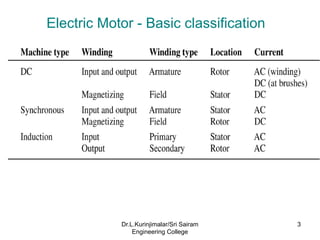
Electric Motor - Basic classification
3
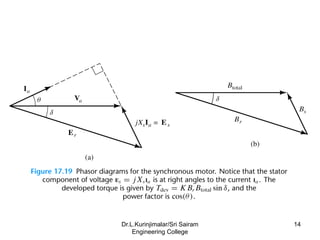
Dr.L.Kurinjimalar/Sri Sairam
Engineering College
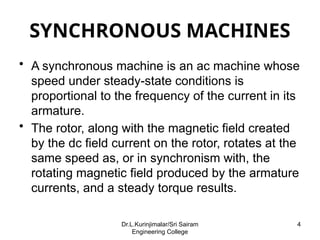
SYNCHRONOUS MACHINES
• A synchronous machine is an ac machine whose
speed under steady-state conditions is
proportional to the frequency of the current in its
armature.
• The rotor, along with the magnetic field created
by the dc field current on the rotor, rotates at the
same speed as, or in synchronism with, the
rotating magnetic field produced by the armature
currents, and a steady torque results.
4
Dr.L.Kurinjimalar/Sri Sairam
Engineering College
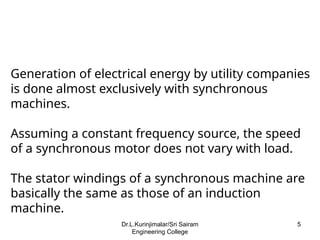
Generation of electrical energy by utility companies
is done almost exclusively with synchronous
machines.
Assuming a constant frequency source, the speed
of a synchronous motor does not vary with load.
The stator windings of a synchronous machine are
basically the same as those of an induction
machine.
5
Dr.L.Kurinjimalar/Sri Sairam
Engineering College
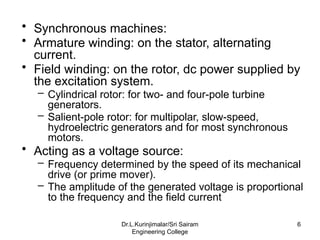
• Synchronous machines:
• Armature winding: on the stator, alternating
current.
• Field winding: on the rotor, dc power supplied by
the excitation system.
– Cylindrical rotor: for two- and four-pole turbine
generators.
– Salient-pole rotor: for multipolar, slow-speed,
hydroelectric generators and for most synchronous
motors.
• Acting as a voltage source:
– Frequency determined by the speed of its mechanical
drive (or prime mover).
– The amplitude of the generated voltage is proportional
to the frequency and the field current
6
Dr.L.Kurinjimalar/Sri Sairam
Engineering College
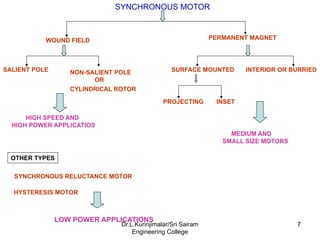
SYNCHRONOUS MOTOR
WOUND FIELD PERMANENT MAGNET
SYNCHRONOUS RELUCTANCE MOTOR
HYSTERESIS MOTOR
SALIENT POLE NON-SALIENT POLE
OR
CYLINDRICAL ROTOR
HIGH SPEED AND
HIGH POWER APPLICATIOS
SURFACE MOUNTED INTERIOR OR BURRIED
PROJECTING INSET
MEDIUM AND
SMALL SIZE MOTORS
OTHER TYPES
LOW POWER APPLICATIONS
7
Dr.L.Kurinjimalar/Sri Sairam
Engineering College
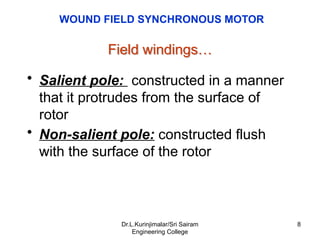
Field windings…
• Salient pole: constructed in a manner
that it protrudes from the surface of
rotor
• Non-salient pole: constructed flush
with the surface of the rotor
WOUND FIELD SYNCHRONOUS MOTOR
8
Dr.L.Kurinjimalar/Sri Sairam
Engineering College
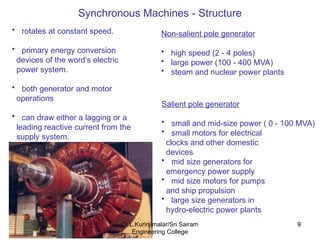
Synchronous Machines - Structure
Non-salient pole generator
• high speed (2 - 4 poles)
• large power (100 - 400 MVA)
• steam and nuclear power plants
Salient pole generator
• small and mid-size power ( 0 - 100 MVA)
• small motors for electrical
clocks and other domestic
devices
• mid size generators for
emergency power supply
• mid size motors for pumps
and ship propulsion
• large size generators in
hydro-electric power plants
• rotates at constant speed.
• primary energy conversion
devices of the word’s electric
power system.
• both generator and motor
operations
• can draw either a lagging or a
leading reactive current from the
supply system.
9
Dr.L.Kurinjimalar/Sri Sairam
Engineering College
Field Components
The total field rotating in the air gap is
partly due to the dc currents in the rotor
windings and partly due to the ac currents
in the stator (armature) windings.
Synchronous machines are designed so
the flux varies sinusoidally around the air
gap.
10
Dr.L.Kurinjimalar/Sri Sairam
Engineering College
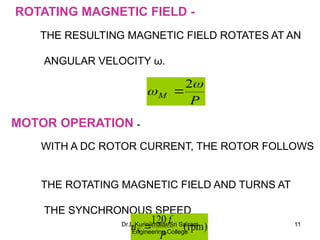
ROTATING MAGNETIC FIELD -
THE RESULTING MAGNETIC FIELD ROTATES AT AN
ANGULAR VELOCITY ω.
MOTOR OPERATION -
WITH A DC ROTOR CURRENT, THE ROTOR FOLLOWS
THE ROTATING MAGNETIC FIELD AND TURNS AT
THE SYNCHRONOUS SPEED
P
M


2

)
rpm
(
120
P
f
nS  11
Dr.L.Kurinjimalar/Sri Sairam
Engineering College
r
s B
B
B 

total
 

sin
total
dev B
KB
T r

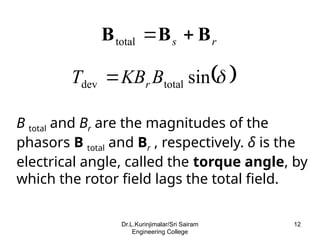
B total and Br are the magnitudes of the
phasors B total and Br , respectively. δ is the
electrical angle, called the torque angle, by
which the rotor field lags the total field.
12
Dr.L.Kurinjimalar/Sri Sairam
Engineering College
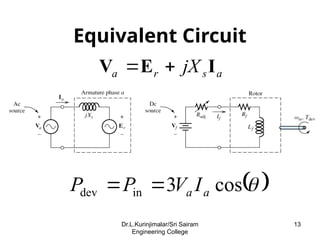
Equivalent Circuit
a
s
r
a jX I
E
V 

 

cos
3
in
dev a
a I
V
P
P 

13
Dr.L.Kurinjimalar/Sri Sairam
Engineering College
14
Dr.L.Kurinjimalar/Sri Sairam
Engineering College
15
Dr.L.Kurinjimalar/Sri Sairam
Engineering College
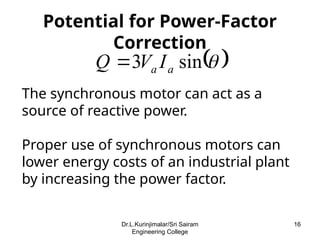
Potential for Power-Factor
Correction
 

sin
3 a
a I
V
Q 
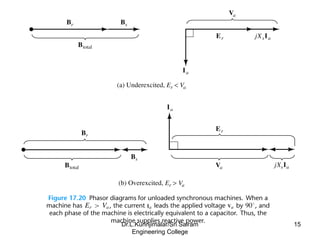
The synchronous motor can act as a
source of reactive power.
Proper use of synchronous motors can
lower energy costs of an industrial plant
by increasing the power factor.
16
Dr.L.Kurinjimalar/Sri Sairam
Engineering College
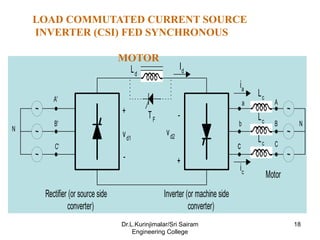
Load Commutated Inverters
As mentioned earlier, thyristor current-fed,
load commutated inverters (LCI’s) are very
popular for high power (multi-MW) wound-
field synchronous motor drives where it is
easy to maintain the required leading PF
angle by adjusting the field excitation.
17
Dr.L.Kurinjimalar/Sri Sairam
Engineering College
~ ~
~
~ ~
~
A
B
C
a
b
c
A'
B'
C'
N
N
Lc
Lc
Lc
Id
Rectifier (or source side
converter)
Inverter (or machine side
converter)
+
-
-
+
vd1
vd2
Ld
TF
ic
ia
Motor
LOAD COMMUTATED CURRENT SOURCE
INVERTER (CSI) FED SYNCHRONOUS
MOTOR
18
Dr.L.Kurinjimalar/Sri Sairam
Engineering College
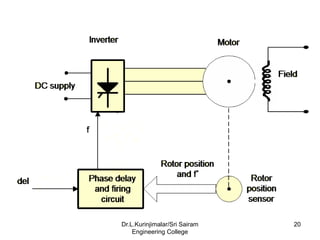
SELF CONTROL
A Machine gets variable frequency from
an inverter whose thyristors are fired
sequentially, according to the position of
rotor and stator voltage.
19
Dr.L.Kurinjimalar/Sri Sairam
Engineering College
20
Dr.L.Kurinjimalar/Sri Sairam
Engineering College
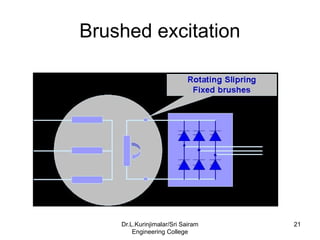
Brushed excitation
21
Dr.L.Kurinjimalar/Sri Sairam
Engineering College
DISADVANTAGES
• SPARKING
• MAINTENANCE AND RELIABILITY
PROBLEMS
• EMI PROBLEM
• LIMITATIONS IN SPEED AND POWER
RATING
• DIFFICULTY IN OPERATING IN
CORROSIVE AND EXPLOSIVE
ENVIRONMENT
22
Dr.L.Kurinjimalar/Sri Sairam
Engineering College
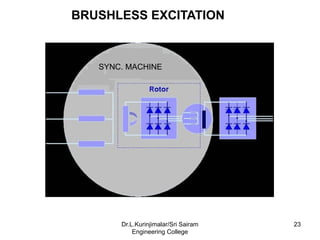
SYNC. MACHINE
BRUSHLESS EXCITATION
23
Dr.L.Kurinjimalar/Sri Sairam
Engineering College
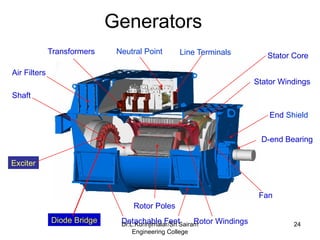
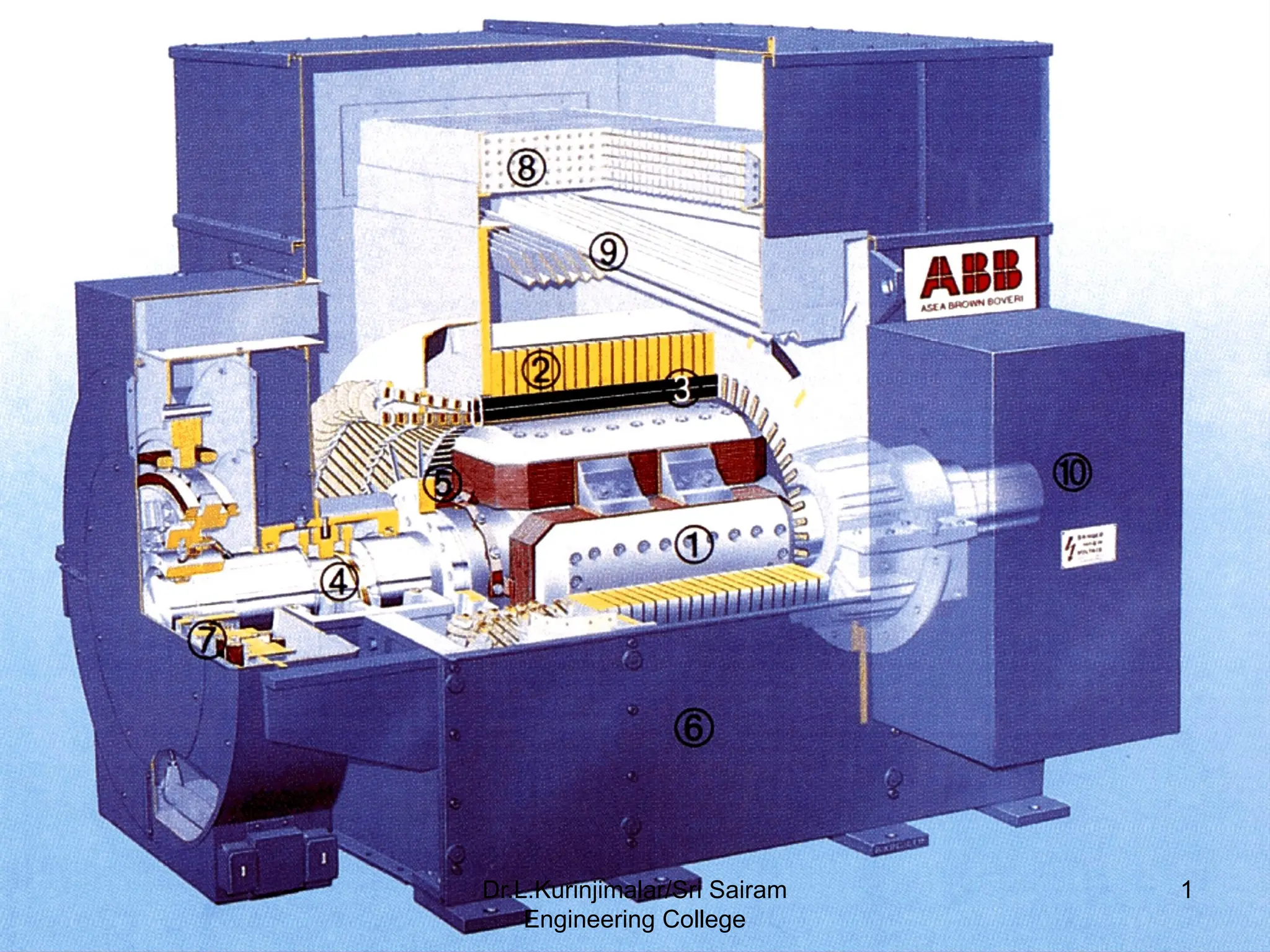
Generators
Exciter
D-end Bearing
Diode Bridge
End Shield
Rotor Poles
Transformers Line Terminals
Shaft
Stator Core
Fan
Stator Windings
Neutral Point
Detachable Feet
Air Filters
Rotor Windings 24
Dr.L.Kurinjimalar/Sri Sairam
Engineering College
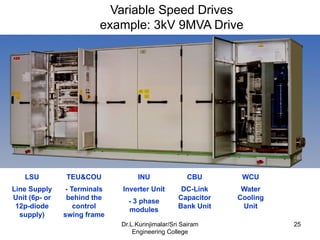
Variable Speed Drives
example: 3kV 9MVA Drive
LSU
Line Supply
Unit (6p- or
12p-diode
supply)
TEU&COU
- Terminals
behind the
control
swing frame
INU
Inverter Unit
- 3 phase
modules
CBU
DC-Link
Capacitor
Bank Unit
WCU
Water
Cooling
Unit
25
Dr.L.Kurinjimalar/Sri Sairam
Engineering College
APPLICATIONS
• FIBER SPINNING MILLS
• ROLLING MILLS CEMENT MILLS
• SHIP PROPULSION
• CEMENT MILLS
• ELECTRIC VEHICLES
• SERVO AND ROBOTIC DEVICES
• MAGLEV-LINEAR SYNCHRONOUS MOTOR
PROPULSION
• STARTERS/GENERATORS FOR AIRCRAFT ENGINES
26
Dr.L.Kurinjimalar/Sri Sairam
Engineering College
REFERENCES
• BIMAL.K.BOSE,”MODERN POWERELECTRONICS AND AC
DRVES”,PEARSON EDUCATION ASIA 2002.
• VEDAM SUBRAMANIAM,”ELECTRIC DRIVES- CONCEPTS AND
APPLICATIONS”,TATA MC GRAW HILL,1994
• HANDBOOK OF AUTOMATIVE POWER ELECTRONICS AND
DRIVES BY
ALI EMADI
• http//:uenics.evansville.edu
• www.toolingu.com
• www.ece.vill.edu
• www.uwindsor.ca
• www.basler.com
27
Dr.L.Kurinjimalar/Sri Sairam
Engineering College
THANK YOU
28
Dr.L.Kurinjimalar/Sri Sairam
Engineering College

Sychronous Motor Control and classification.pptx

  • 1.
  • 2.
  • 3.
    Electric Motor -Basic classification 3 Dr.L.Kurinjimalar/Sri Sairam Engineering College
  • 4.
    SYNCHRONOUS MACHINES • Asynchronous machine is an ac machine whose speed under steady-state conditions is proportional to the frequency of the current in its armature. • The rotor, along with the magnetic field created by the dc field current on the rotor, rotates at the same speed as, or in synchronism with, the rotating magnetic field produced by the armature currents, and a steady torque results. 4 Dr.L.Kurinjimalar/Sri Sairam Engineering College
  • 5.
    Generation of electricalenergy by utility companies is done almost exclusively with synchronous machines. Assuming a constant frequency source, the speed of a synchronous motor does not vary with load. The stator windings of a synchronous machine are basically the same as those of an induction machine. 5 Dr.L.Kurinjimalar/Sri Sairam Engineering College
  • 6.
    • Synchronous machines: •Armature winding: on the stator, alternating current. • Field winding: on the rotor, dc power supplied by the excitation system. – Cylindrical rotor: for two- and four-pole turbine generators. – Salient-pole rotor: for multipolar, slow-speed, hydroelectric generators and for most synchronous motors. • Acting as a voltage source: – Frequency determined by the speed of its mechanical drive (or prime mover). – The amplitude of the generated voltage is proportional to the frequency and the field current 6 Dr.L.Kurinjimalar/Sri Sairam Engineering College
  • 7.
    SYNCHRONOUS MOTOR WOUND FIELDPERMANENT MAGNET SYNCHRONOUS RELUCTANCE MOTOR HYSTERESIS MOTOR SALIENT POLE NON-SALIENT POLE OR CYLINDRICAL ROTOR HIGH SPEED AND HIGH POWER APPLICATIOS SURFACE MOUNTED INTERIOR OR BURRIED PROJECTING INSET MEDIUM AND SMALL SIZE MOTORS OTHER TYPES LOW POWER APPLICATIONS 7 Dr.L.Kurinjimalar/Sri Sairam Engineering College
  • 8.
    Field windings… • Salientpole: constructed in a manner that it protrudes from the surface of rotor • Non-salient pole: constructed flush with the surface of the rotor WOUND FIELD SYNCHRONOUS MOTOR 8 Dr.L.Kurinjimalar/Sri Sairam Engineering College
  • 9.
    Synchronous Machines -Structure Non-salient pole generator • high speed (2 - 4 poles) • large power (100 - 400 MVA) • steam and nuclear power plants Salient pole generator • small and mid-size power ( 0 - 100 MVA) • small motors for electrical clocks and other domestic devices • mid size generators for emergency power supply • mid size motors for pumps and ship propulsion • large size generators in hydro-electric power plants • rotates at constant speed. • primary energy conversion devices of the word’s electric power system. • both generator and motor operations • can draw either a lagging or a leading reactive current from the supply system. 9 Dr.L.Kurinjimalar/Sri Sairam Engineering College
  • 10.
    Field Components The totalfield rotating in the air gap is partly due to the dc currents in the rotor windings and partly due to the ac currents in the stator (armature) windings. Synchronous machines are designed so the flux varies sinusoidally around the air gap. 10 Dr.L.Kurinjimalar/Sri Sairam Engineering College
  • 11.
    ROTATING MAGNETIC FIELD- THE RESULTING MAGNETIC FIELD ROTATES AT AN ANGULAR VELOCITY ω. MOTOR OPERATION - WITH A DC ROTOR CURRENT, THE ROTOR FOLLOWS THE ROTATING MAGNETIC FIELD AND TURNS AT THE SYNCHRONOUS SPEED P M   2  ) rpm ( 120 P f nS  11 Dr.L.Kurinjimalar/Sri Sairam Engineering College
  • 12.
    r s B B B   total   sin total dev B KB T r  B total and Br are the magnitudes of the phasors B total and Br , respectively. δ is the electrical angle, called the torque angle, by which the rotor field lags the total field. 12 Dr.L.Kurinjimalar/Sri Sairam Engineering College
  • 13.
    Equivalent Circuit a s r a jXI E V      cos 3 in dev a a I V P P   13 Dr.L.Kurinjimalar/Sri Sairam Engineering College
  • 14.
  • 15.
  • 16.
    Potential for Power-Factor Correction   sin 3 a a I V Q  The synchronous motor can act as a source of reactive power. Proper use of synchronous motors can lower energy costs of an industrial plant by increasing the power factor. 16 Dr.L.Kurinjimalar/Sri Sairam Engineering College
  • 17.
    Load Commutated Inverters Asmentioned earlier, thyristor current-fed, load commutated inverters (LCI’s) are very popular for high power (multi-MW) wound- field synchronous motor drives where it is easy to maintain the required leading PF angle by adjusting the field excitation. 17 Dr.L.Kurinjimalar/Sri Sairam Engineering College
  • 18.
    ~ ~ ~ ~ ~ ~ A B C a b c A' B' C' N N Lc Lc Lc Id Rectifier(or source side converter) Inverter (or machine side converter) + - - + vd1 vd2 Ld TF ic ia Motor LOAD COMMUTATED CURRENT SOURCE INVERTER (CSI) FED SYNCHRONOUS MOTOR 18 Dr.L.Kurinjimalar/Sri Sairam Engineering College
  • 19.
    SELF CONTROL A Machinegets variable frequency from an inverter whose thyristors are fired sequentially, according to the position of rotor and stator voltage. 19 Dr.L.Kurinjimalar/Sri Sairam Engineering College
  • 20.
  • 21.
  • 22.
    DISADVANTAGES • SPARKING • MAINTENANCEAND RELIABILITY PROBLEMS • EMI PROBLEM • LIMITATIONS IN SPEED AND POWER RATING • DIFFICULTY IN OPERATING IN CORROSIVE AND EXPLOSIVE ENVIRONMENT 22 Dr.L.Kurinjimalar/Sri Sairam Engineering College
  • 23.
  • 24.
    Generators Exciter D-end Bearing Diode Bridge EndShield Rotor Poles Transformers Line Terminals Shaft Stator Core Fan Stator Windings Neutral Point Detachable Feet Air Filters Rotor Windings 24 Dr.L.Kurinjimalar/Sri Sairam Engineering College
  • 25.
    Variable Speed Drives example:3kV 9MVA Drive LSU Line Supply Unit (6p- or 12p-diode supply) TEU&COU - Terminals behind the control swing frame INU Inverter Unit - 3 phase modules CBU DC-Link Capacitor Bank Unit WCU Water Cooling Unit 25 Dr.L.Kurinjimalar/Sri Sairam Engineering College
  • 26.
    APPLICATIONS • FIBER SPINNINGMILLS • ROLLING MILLS CEMENT MILLS • SHIP PROPULSION • CEMENT MILLS • ELECTRIC VEHICLES • SERVO AND ROBOTIC DEVICES • MAGLEV-LINEAR SYNCHRONOUS MOTOR PROPULSION • STARTERS/GENERATORS FOR AIRCRAFT ENGINES 26 Dr.L.Kurinjimalar/Sri Sairam Engineering College
  • 27.
    REFERENCES • BIMAL.K.BOSE,”MODERN POWERELECTRONICSAND AC DRVES”,PEARSON EDUCATION ASIA 2002. • VEDAM SUBRAMANIAM,”ELECTRIC DRIVES- CONCEPTS AND APPLICATIONS”,TATA MC GRAW HILL,1994 • HANDBOOK OF AUTOMATIVE POWER ELECTRONICS AND DRIVES BY ALI EMADI • http//:uenics.evansville.edu • www.toolingu.com • www.ece.vill.edu • www.uwindsor.ca • www.basler.com 27 Dr.L.Kurinjimalar/Sri Sairam Engineering College
  • 28.